January 19, 2012
Mini-Review: How It All Began by Penelope Lively
 I read this book for pleasure purely and have no time to review it here, but couldn’t not post anything about it in case you never learned how wonderful this book is and how much you have to read it. How It All Began is the latest by Penelope Lively, who I’ve loved ever since Moon Tiger. This is a story about story, about the chaos theory as applied to history, to life itself, to narrative. When Charlotte Rainsford is mugged in the street, a whole chain of events is set forth that forever changes the lives of people who never suspect the ways in which their worlds are connected. And it’s interesting because these characters spend the entire book reading books, talking about stories, and making clear the ways in which the way stories go in real life and the way they do in books is markedly different– all the while unsuspecting that they’re fictional characters themselves. Oh, that cheeky Penelope Lively who constructs her universes to be so much like the one that we know, and manipulates her people with such deftness that we can nearly forget she’s there, but not completely. I do adore her authorial presence, which is always felt, its charm, and her preoccupations with history and happenstance. There’s a Carol Shields reference in this one, which is not far off the mark. How It All Began is the best book Lively has published in ages (which is saying something, because she’s always pretty good).
January 18, 2012
Winter: Five Windows on the Season by Adam Gopnik
 Winter has always been difficult. When I was 20 years old, and prone to fits of angst and melodrama, my roommate and I copied out an epigraph from Margaret Atwood’s Survival (we were English majors, in addition to being melodramatic) and mounted the paper on our wall: “To find words for what we suffer,/ To enjoy what we must suffer–/ Not to be dumb beasts…/ We shall survive/And we shall walk/ Somehow into summer…” (DG Jones, “Beating the Bushes: Christmas 1963”).
Last winter, I went about survival all wrong. As the winter solstice arrived in December, I kept telling myself that the darkness only meant that spring had never been so close. This thought was consoling, but it utterly ruined things once June came around, and I couldn’t shake my head of the fact it only meant now that winter had never been so close.
So I decided to do better this year, and Adam Gopnik’s Winter: Five Windows on the Season was part of that. My plan was so strategic that when the book came out in October, I couldn’t actually read it because it wasn’t winter yet. In fact, it wasn’t really winter until last Friday when the snow fell, and so that was the day I finally started reading. Winter is this year’s Massey Lectures in book form, written and delivered by Gopnik, of the revered New Yorker columns and wonderful books (I loved Through the Children’s Gate). Gopnik, who gets to start sentences with, “My brother-in-law, the Arctic explorer…”, which underlines something I’ve long suspected: that it’s people with the best stories who get to be the best story-tellers.
The book is divided into five essays, but structurally, these essays are curious. They’re not built from the bottom-up as much as vertically, as a flow, words and ideas flying by in a whirl of pages. They’re more consecutive impressions than a cumulation of ideas, which makes sense for lectures, and I also don’t mean to imply a lack of depth. Sure, breadth is what’s on display here, but there is an underlying structure, but it’s easy to get distracted from it by the essays’ sheer volume of stuff.
You’ll know that I was absorbed in Winter because the whole time I was reading it, I started all my sentences with, “Hey, did you know…?” That there was a mini-Ice Age between 1500 and 1850, for instance, which accounts for all that skating on the Thames. I learned about this in the book’s first section, “Romantic Winter”, in which Gopnik asserts that the Romantics constructed winter as a season to be considered rather than simply borne, and developed notions of winter as both beautiful and sublime. And this is what I love about Gopnik’s writing, and this book. Nothing is ever simplified. Gopnik never misses a chance to classify one thing as two things, and usually those two things are directly opposed. But so it goes. “Doubleness clarifies the world,” said Carol Shields, and Gopnik is smart enough to know this.
In “Romantic Winter”, Gopnik references poetry and artwork (whose images are featured), ideas of winter and nationalism, the advent of central heating, icebergs vs. snowflakes. Section two is “Radical Winter”, considering winter as something to be sought rather than survived. He begins with Mary Shelley’s Frankenstein, which is situated at the North Pole (and yes, I’d forgotten this too), and describes the race for the Pole from both ends (and describes what the Poles where imagined to be before we knew they were cold. Seriously. This stuff is wonderful). “Recuperative Winter” is a celebration of the secularization and commercialization of Christmas, and he writes about holidays in general, how Christmas is extraordinary for its doubleness as a festival of renewal and reversal at once.
In “Recreational Winter”, he’s basically talking about hockey and hockey as born out of Montreal in the late 1800s (and it’s the offspring of rugby and lacrosse, not anything so civilized as soccer or field hockey). And did you know that team sport was not even really a thing until the industrial revolution (and the weekend, and the big company to sponsor and pay for the sweaters). And finally, “Remembering Winter”, picking up the strands of loss and nostalgia that have been winding their way through the entire book. Gopnik celebrates Montreal’s underground city that allows winter to be skirted (and did you know that Dallas’s underground city had same designer? And was a failure because Dallas doesn’t need to escape from itself, and also because there was no subway integrated. Dallas is a car town), but also laments how far we are removed from winter now. This loss underlined by how important winter has been to building great cities. He presents winter as “a labile environment where the imagination can not only project but can construct anew from something given.” Why we take our children outside to build snowmen, angels. Global warming with spiritual consequences beyond the cannibalistic polar bears.
Gopnik comes clean at the end of the book: “I realize that these chapters, in the guise of cultural observations and a kind of amateur’s cultural anthropology, are really a composite list of things that I like and things I don’t… I love Christmas carols, A Christmas Carol, Dickens and Trollope, free-skating and fast-passing Russian and Quebec hockey, and courage of the kind that drove people toward the poles, which I wish I had more of.”
But the thing is that I don’t even like hockey or sports at all, and Gopnik’s hockey chapter had me mesmerized. I am a Canadian who doesn’t know how to skate, but this book made me want to sign up for lessons. The book has had the effect I’d intended, providing my survival with a rich and vivid context, to have me stop a bit and be here now, to throw on another sweater and gaze out the window some more, and maybe even go outside.
January 18, 2012
Porridge Mornings
 For the new year, I resolved to start hauling my sorry self out of bed just a wee bit earlier to cook a hot breakfast for our family to eat together. Partly because a hot breakfast is a good enticement to get out of bed at all, because it’s the best way to meet cold, dark winter mornings, and because Stuart would appreciate some early morning company. Three weeks in, we’re quite hooked on the habit, and have been changing up the porridge so it never gets tired. We’ve had steel-cut oats, regular rolled oatmeal and quinoa and barley porridge. My favourite, though, is brown rice porridge, inspired by Gwyneth Paltrow’s cookbook which I had out of the library over Christmas (which was pretty good, actually, even though her porridges are pretty bland. Her sweet potato ravoli was delicious though). Brown rice porridge remarkably simple to prepare when we cook up some rice in the rice cooker the night before. In the morning, toss the cooked brown rice in a saucepan, cover the rice with milk and warm it up, adding 2 tbspns of corn starch for thickening. For all our porridges, we’ve found that a couple of teaspoons of vanilla extract is the key to deliciousness, along with honey, cinnamon and nutmeg, raisins, diced apples or bananas. And whatever is leftover can be reheated the next morning.
Easiest resolution ever.
January 16, 2012
New kids books to start the year right
This Christmas was exceptional for the calibre of picture books that we were given as gifts– so many new discoveries, books exactly in line with the kind of stuff we like, books we’d long been waiting for, though we hadn’t even known it. It was quite a novelty, because as bookish people, we’re used to making our own literary discoveries, used to friends buying us something other than books because they assume we’ve read them all already. But not so! What follows is an absolute trove of delights.
 When I Was Small by Sara O’Leary/Julie Morstad: I’ve been buying Sara O’Leary’s Henry books for little people since long before I had a little person of my own. This latest installment is as lovely as the rest, as Henry asks his mother to tell him stories of that long-ago never-never time before he was born, back when she was small. In the pattern of the previous books, she tells him about the small girl she once was, back when she wore the same shoes as her doll, when she had a ladybug for a pet, slept in a mitten, and bathed in a bird bath. And then she shares with Henry a dream she had that connects her past to his present.
There Were Monkeys in My Kitchen by Sheree Fitch/Sidney Smith: We love Sheree Fitch, and  Nimbus Press’ re-issue of her books by (with new illustrations by Sidney Smith) is cause for celebration. In this rollicking rhyme, Willa Wellougby discovers that her house has been overtaken by a variety of simian creatures, including go-go apes and square dancing monkeys. The monkeys are agents of chaos, and poor Willa has to contend with them alone, because she’s been calling the police and the RCMP and getting no response. And when the Mounties finally arrive, it might just be too late.
 I Want to Go to the Moon by Tom Saunders: A picture book biography of Neil Armstrong, in verse! Tom Saunders’ story began as a song, and it’s recorded on the CD included with the book. The illustrations are vivid and engaging, the bouncing verse outlining Young’s story and underlining a message that impossible dreams can be realized. Only problem is that the verse stays in your head, and in our family we’ve taken to hurling, “You’ll never go to the moon, Neil,” as a cryptic insult.
The High Street by Alice Melvin: The Tate publishes books– who knew? And it’s no surprise that  they’re gorgeously designed and illustrated. This was one of two books that Harriet received for Christmas intended to nurture her inner consumer. In this story, a small girl goes shopping with a rhyming list of things to get, and knocks items off one-by-one. But the best part is wall of the shops cut away so that we get to see inside, and also what’s going on in the space above the shop. A must-have for the English fetishists among us.
 The Cow Who Fell in the Canal by Phyllis Krasilovsky: Harriet’s grandmother picked this one up on a recent trip to Holland, and we adored it, as we like vintage picture books in general, and the illustrations are reminiscent of Marjorie Flack’s. This story of a cow who (surprise!) falls into a canal is simple and funny, and its illustrations offer marvelous glimpses of Dutch landscapes.
The Country Bunny and the Little Gold Shoes by Dubose Heyward/Marjorie Flack:  Speaking of Marjorie Flack, here she is, illustrating this ahead-of-its-time feminist tale. Basically, this is Dee Dee Myers’ Why Women Should Rule the World compressed into storybook bunny form. A single mother bunny is chosen to become the new Easter bunny because the skills she has acquired managing her brood and her household are applicable to the competitive world of egg distribution. Apparently, we can do it all!
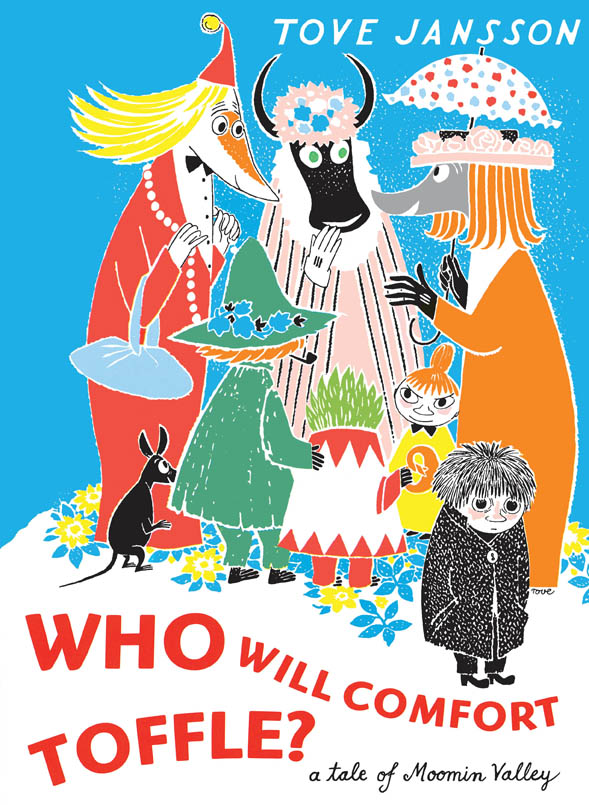 Who Will Comfort Toffle? by Tove Jansson: Our first Tove Jansson picture book was The Book of Moomin, Mimble and Little My, much beloved. And we like this one even better, the story of lonely Toffle who’s content to haul his suitcase about and remain the fringes of society. Then he discovers a Miffle who’s in need of comfort as much as he is, so he makes it his mission to track the Miffle down and discover the pleasures (and comforts) of friendship with her. The last page is unbelievably lovely, and I only wish I’d known of it during that period about five years ago when everyone kept asking me to do readings at their weddings.
On Market Street by Arnold Lobel and Anita Lobel. Our second shopping book, written by Arnold  Lobel (!) and illlustrated by his wife Anita. And it’s an ABC book, and B is for books, so basically this book is perfect, and when T is for toys, we discover a Frog and Toad allusion in the picture. I can’t believe I’d never heard of this one, which won the Caldecott Medal in 1982.
 Press Here by Herve Tullet: A book like none I’ve ever seen, but maybe a bit like the iPad. But better. Because it requires imagination to make it go, not to mention fingers for pressing, arms for shaking, breath for blowing the dots away. A truly engaging book with great design, and a lot of fun to “read”.
January 15, 2012
Heron River by Hugh Cook
 It might have been the bird in the title, or the character called Madeline, but I think it was the atmosphere of Hugh Cook’s novel Heron River that had me in mind of Ann Marie MacDonald’s The Way the Crow Flies. Small town Ontario in the sweltering heat of summer, bucolic idyll with something sinister afoot. I could hear the clink of the ice cubes in the lemonade glass, feel the air-conditioner’s relief. The community of Caithness was created for me in remarkable detail, the main-street with Tony’s Barber Shop, the abandoned mill, the river that cuts the town in two. But people are still uneasy after an unsolved murder not long ago, and fears are heightened after a series of break-and-enters.
The book is set in 1995, nearly here-and-now, but its prologue reaches back to two decades before: a small boy falls into an old abandoned well, and in a deftly-plotted flurry of reading, we’re shown the boy’s dramatic rescue by volunteer-firefighters. We’re also shown that trauma never really goes away, and that what happened that morning will forever bear on those involved. In particular on the boy himself, who eventually recovers but with substantial brain damage.
The boy is Adam, and when we meet him in the present, he’s 26 years old and lives in a group home. His parents’ marriage has fallen apart, so his father is long gone now. His mother Madeline lives alone in his grandfather’s house, now that his grandfather has been moved to a long-term care facility. Madeline feels guilty that she’s unable to care for her father, or for her son either, as she is suffering herself from the debilitating symptoms of multiple sclerosis. Though more than anything else, what she really regrets is those moments of inattention years ago during which her son had his accident and their lives were changed forever.
Hugh Cook’s Adam is a remarkable creation, his point of view fascinating to consider in its limitations and scope at once. Rare is it that we see a character with mental disabilities who is evoked in such depth, so devoid of cliche. We see his struggle to comprehend the world around him, to maintain his dignity even while aware of his vulnerability– the way he never says, “I don’t know” in response to a question, but will say, “I can’t remember” instead.
The other characters have been created with similar sympathy, and most are invested with a fundamental goodness. Madeline herself as she struggles to rise above the difficulties that have befallen her, the paperboy who she hires to mow her lawn (and who has taken to prowling in his customers’ houses when he knows they’re out of town), Adam’s carers at the Group Home who treat their charges with respect, the Native man who’s cutting trees down by the river and tells Adam the story of the creation myth. And then there’s Tara, the police officer, who’s exhausted from her night-shifts but loves her job, even though she knows it comes at the expense of time spent with her children. And even though she knows that the sordid world she sees in her work is skewing her impression of humanity.
We get a glimpse into this sordid world from Tara’s point of view, and also through that of a character called Orrin who recounts an upbringing of abuse and neglect, and who matter-of-factly admits to a horrible act of violence. While the other characters in the book are connected in various ways, Orrin exists outside of that web, and it becomes clear that his entrance into the heart of the story is going to have devastating consequences.
Though I enjoyed this book very much, certain elements took me out of the story from time-to-time. The startling depth that renders this literary world so realized gives me the impression that this book was once a much longer one, and that paring it down caused certain gaps to emerge– where were Adam’s brother and father, whose absences were hardly remarked upon? I found it curious too that in a book with so many absent fathers that mothers were forced to bear the brunt of so much responsibility– there were even imaginary mothers who were to blame. I was also concerned as I read this book that I was unwittingly reading a novel whose religious overtones were all too overt, and there was nearly a point where it crossed the line, but in the end, Cook keeps his resolution subtle enough to be interesting.
Cook’s previous 3 books have won awards and acclaim, he’s a graduate of the University of Iowa Writers’ Workshop, and his story-telling chops are very much on display on this beautifully evocative novel. It was a pleasure to be delivered to summer from the cold of mid-January, and to get lost in Heron River‘s pages.
January 14, 2012
Rambling among the trees
 “The purpose of this bulletin is to make it easier for people to become personally acquainted with our trees. It is believed that the securing of the interest of the people of the province in trees will be an aid toward an understanding of the importance to us of our forests, and thus pave the way for support of forestry principles.” –J.H. White, Toronto 1925
Which is from the preface to The Forest Trees of Ontario (1957 edition) which I found last winter in a cardboard box on Major Street and took home even though it smells like a basement. I love this book, though I confess I don’t know a papaw from a sassafras.
“When I’m in Toronto, I always drop in at the Monkey’s Paw Bookstore. Stephen Fowler, the owner, has an  incredible eye. (I recently came back with a book of transcribed seance sessions, a history of women in uniform, a treatise on baking, and a book of party games for adults.) He had this book called the Native Trees of Canada displayed on a table. I flipped through it, and I immediately knew I needed to buy it. It was a government volume: unmediated and strictly informational. It was filled with very sterile, black and white pictures of leaves, placed on a grid for scale. While looking at them, I had vivid memories of picking at maple seeds on my front lawn, of wet leaves stuck to my shoes, of fallen leaves blowing through the screen door. I knew I wanted to paint them. “– Leanne Shapton, “The Native Trees of Canada”, Paris Review Blog, November 2010
 Leanne’s Shapton’s book of paintings is Native Trees of Canada and it’s beautiful. And if there are two of us out there appreciating these old government-issued volumes, there are bound to be more. Which gives me faith in the world, actually, in readers and books, and the trees whose lives were given so that we can read pages. (Even old ones that smell like basements.)
Also, I have also discovered that the maple in our backyard is a black maple.
(See also my Tree Books list at Canadian Bookshelf, whose compilation brought Shapton’s book to my attention in the first place.)
“It is hoped that the bulletin will combine instruction with recreation for all who care to go rambling among the trees.” –J.H. White
January 12, 2012
How to Get a Girl Pregnant by Karleen Pendleton Jimenez
 Sperm procurement is Karleen Pendleton-Jimenez’ basic challenge as a lesbian who wants to have a baby, a challenge further complicated by fertility struggles. Though the original challenge was pretty complicated from the outset– sperm is hard to come by for these purposes, and if you decide to go through anonymous donors, it’s next to impossible to find matches with your ethnic background, unless that background is white European. With precise, vivid and immediate prose, in her memoir How to Get a Girl Pregnant, Pendleton-Jimenez documents her journey towards pregnancy, which begins very early in her life when she knows she wants to be a mother as strongly as she knows that she’s a lesbian.
As a butch lesbian who wants to be a mother, Pendleton-Jimenez complicates ideas of butchness, and of motherness. But the arrangement has always felt natural to her, and her experiences co-parenting her partner’s children underline this instinct. As she approaches her mid-thirties, she decides to finally take the definitive step towards motherhood–and lesbians don’t do turkey basters anymore, she informs us. Turkey basters are too big, and sperm is far too precious a commodity to unintentionally get stuck up in the bulb at the top. There is also an amusing scene where she poses on her front porch for a photo with the tank the sperm is delivered in: “This may be all the baby gets to see of its biological parents together,” she writes, though upon reflection, she notes that she looks tired and unhappy in the photo. The stress of trying to get pregnant was already taking its toll.
Which would only get worse as she begins to undergo treatments at a fertility clinic, going in for regular visits for monitoring, to check for ovulation, and for fertilization. And in talking about infertility, she breaks a taboo, though this candidness does not come easily. She writes about the pain and isolation of what she’s going through, how women don’t talk about these experiences. She doesn’t want anyone to know, she doesn’t want to be pitied, to be “that woman who’s trying to get pregnant but can’t”, and so she is very much alone in the process. She also addresses the complicated dynamics of being a butch prone on a table being poked on prodded by nurses and technicians, learning to become accustomed to this, and of her strange pleasure in the compliment that her ovaries were “beautiful”. And in the hope each month that this time the pregnancy would take, and the predictable disappointment when it didn’t over and over again.
I know that longing, that desperation to be pregnant. Pregnancy came easily for me, but I remember how badly I wanted it, and identified strongly with Pendleton-Jimenez’ need for a baby. So that when she starts cruising for men at night clubs, I totally get it, and also admire the openness with which she writes, how she makes herself as vulnerable in her narrative as she did in the experiences she writes of. The openness works, because the writing is so good, beautifully unadorned and to the point. Pendleton-Jimenez also manages to write with both poignance and humour, and indeed, I laughed and I cried as I read this book. Like all great memoirs, this is an intimate story that manages to connect with the universal, and the narratives of pregnancy and motherhood are so much richer for it.
January 12, 2012
Nursery Rhyme Comics: 50 Timeless Rhymes from 50 Great Cartoonists by Chris Duffy (ed)
 For me, motherhood has been a portal to the wonderful world of comics, and I’ve been making more frequent visits ever since Little Island Comics opened up around the corner from my house. As a child, I never got past Archie, which is not to say I was not a devoted fan, but Archie is hardly the cream of the comics crop. In the company of Harriet, however, I’ve been working my way through Tintin’s adventure The Red Sea Sharks, which is wonderful, and Harriet loves it too, though I’m pretty sure she understands about none of it. She also has a Silly Lilly book that I quite enjoy, and we enjoy the Moomin storybooks so much that we’re going to have get started on reading the comic strip collections.
I also think that it’s rude to hang out in bookstores and not buy anything, so when we were all there a couple of weekends back, we picked out Nursery Rhyme Comics, which was edited by Chris Duffy. Now, you mightn’t have thought that our household needed a fifth Mother Goose Collection, but we did! We did. If you scroll down to the photo of Harriet reading in bed, you’ll see that this book is what she’s been lost to, and her parents like it just as much. It includes some rhymes we didn’t know before, all the favourites we knew already, and each one reborn in the style of a notable contemporary cartoonist. (I am not very cool. The only one I’ve heard of is Kate Beaton, but I know that she is very cool.)
The old woman who lives in the shoe has a rock and roll band, Jack Be Nimble is petulant and ashamed with a hole in his pants, the King of Hearts is a terrible, terrible tyrant who gets what’s coming to him, Little Boy Blue’s sleeping is cause for a party, the hickory dickory dock mouse is actually a bell ringer. The cartoonists’ styles are remarkably contrasting, each one interesting and vivid in its own way, rendering simple nursery rhymes into stories, and this book a remarkably rich collection.
January 11, 2012
The Canadian Publisher as "important component of civilization"
Here’s what sprang to my mind when I heard about Random House’s takeover of McClelland & Stewart:
“I arrive in Toronto on the day that Coach House Press goes out of business. (Coach House’s recent revival could not be foreseen at the time.) More startling than Coach House’s death is the reaction to its demise. Where past politicians, even those ill-disposed towards the cultural sector, would have felt it expedient to play lip-service to Coach House’s achievements, Ontario Premier Mike Harris launched into an attack on the press’s ‘history of total government dependence.’ Though Harris’ characterization isn’t strictly accurate, I am struck by how many of the writers and commentators who respond to Harris argue from the same set of assumptions: they defend Coach House’s accounting and marketing strategies, arguing for the press as a viable business rather than an important component of a civilization… Canadian public debate has changed in ways that make it increasingly difficult to justify, or even imagine, the sense of collective endeavour that fuelled the writing community only a few years earlier.” –Stephen Henighan, “Between Postcolonialism and Globalization”
(As you can see, I got a lot out of Henighan’s book, which I picked up just after the death of Josef Skvorecky, whose work he addesses in the essay “Canadian Cultural Cringe” and which certainly provided a counterpoint to the Skvorecky obits. And then this Random House news yesterday afternoon. Seems Henighan’s ideas are very relevant at the moment.)