March 30, 2012
Canadian Titles up the Frank O'Connor Prize
It’s the longest longlist ever, but I was so happy to see 8 9 Canadian books nominated for the Frank O’Connor International Short Story Prize, in particular because I’ve read 5 and them and they were all great and deserve more attention. Check out my reviews for Laura Boudreau’s Suitable Precautions, Daniel Griffin’s Stopping for Strangers, Johanna Skibsrud’s This Will Be Difficult to Explain and Other Stories, and DW Wilson’s Once You Break a Knuckle, as well as my rave for The Big Dream by Rebecca Rosenblum, who I am lucky enough to call my friend. Congratulations to each of these fine writers!
Update: HEY! Lorna Goodison’s By Love Possessed is also on the list. I read that one too. It was great.
March 30, 2012
A Barbara Pym kind of morning
 It’s all been very Pymmian, my experience of membership in the Barbara Pym Society. That I’d join a society whose membership includes attendance at events that I never, ever go to, for one. But the Pymmishness really began with a handwritten letter I received in the post about two years ago from a fellow Pymmite who was rallying Ontario members of the society to get together. The very best thing was that the letter writer’s name seemed familiar, and I realized that she was a writer whose essay I’d noted on this very blog about 3 years previously and we’d even had a brief email correspondence. Anyway, we were back in touch and arranged a Barbara Pym tea at my house later that summer. It was a delightful get-together and we all fell in love immediately, and everything was perfect except that I’d put out a ton of food and everybody had already had lunch before their arrival. Further social awkwardness ensued when afterwards a gift was put in the post for Harriet which never arrived. I didn’t want to say anything because perhaps there hadn’t been a gift after all, but then months later, there was an enquiry as to whether I’d received it, and I felt terrible, because all that time they’d been thinking that I was a type of person who didn’t send thank-you notes! Not to mention that the present had disappeared off the face of the earth. Oh, the perils of the postal system…
Anyway, last weekend, my friend Gloria called me (and it’s true that Barbara Pymmites and my mom are the only people who call me ever) to say that she and Judy were getting together this week, and she wondered if I could come along. At the time, I was facing a week of municipal labour unrest which meant no organized activities for my toddler, so I was very happy to accept. We drove out to the suburbs this morning with a blueberry cake in tow, and arrived only a few minutes late. It turned out that that the long-lost present had been found in the post office a few months ago, and so Harriet finally got to unwrap it– a gingham dress bought much too big so that 18 mos later, it fits perfectly. They also gave her a cowboy hat, which I can’t quite believe she didn’t own already.
The table was spread with just as many lovely things as I’d prepared back in 2010, except that we hadn’t had lunch before. We set to wait for the other guests to arrive… but they never did! Oh, we enjoyed ourselves, cups of tea and delicious cake and Harriet gorging on blue cheese. We enjoyed catching up again after many months, but at the back of our minds, we were concerned about where Judy and her husband had got to. The phone rang once and there was nobody there, which only served to up the urgency. We were all very polite and hid the panic, and poured more cups of tea, for what else can you do?
Finally, it was time for Harriet and I to get back to the city, and just as we were leaving, Judy rang. She and her husband had been caught in traffic all morning and finally decided to pack it in and turn around and go back home. Which was too bad, her waste of a morning and that we’d missed her, but we were all really thinking that our gathering had just narrowly escaped a calamity, worst-case scenarios passing before our eyes. We were all a little giddy as we bid our final good-byes.
So we will do it again soon, with Judy this time, and maybe we’ll all finally get it right but it’s funny how much these social situations are precisely the stuff of Pym, the excellentness of the women in particular, of course– Judy is even a vicar’s wife. That there is a timelessness to Pym’s grasp of human dynamics, their intricacies and awkwardnesses. And it’s unfortunate for those of us who have to live it but so fortunate for those of us who get to read it: these kinds of stories will never go out of style.
March 30, 2012
Me on David Gilmour (and the possibility of violence)
 My review of David Gilmour’s “novel” The Perfect Order of Things is now out in Canadian Notes & Queries 84. It is perhaps my favourite of any book review I’ve ever written, because it contains the line, “This is the kind of book that no woman would ever get away with…” and also notes the point at which I wrote “Yuck” in the margins. And surprisingly, I actually liked this book, which is a good thing because otherwise I’d be risking Gilmour punching me in the face in a College Street doorway.
The magazines is on newstands now, and was also featured in last Saturday’s Globe & Mail, which was exciting.
March 29, 2012
My kind-of defense of adults who read (really good) children's literature
 I have never read the Harry Potter books, never had any interest in them at all, and have always been a little bit pleased about this because if they’re truly as wonderful as everybody claims, what a joy it will be to discover them together with my daughter. And it is true that it is through my daughter that I’ve really come to appreciate the greatness of children’s literature. I’ve found such richness in the books we’ve read together, books I’d never read before her, like Arnold Lobel’s Frog and Toad books, Russell Hoban’s Frances books, The Wind in the Willows and The House at Pooh Corner. We’re reading Tove Jansson’s Tales from Moominvalley now, the first of her novels for us after enjoying her picture books, and they are so good. There is such depth, the prose is wonderful to read aloud, the stories are surprising, so strange and perfect. I love the idea of Harriet coming to understand the world through these stories because however fantastical, they’re so real, and they acknowledge the complexities of existence and human relations in ways that just make so much sense.
So I certainly understand why reading children’s literature can be a rewarding experience for a reader of any age, but I also understand where the contrarians are coming from when they scoff at adults mad for novels intended for 12 year olds. Partly because there are so many wonderful books directed toward the adult reader that I despair at what these avid readers are missing out on (and I don’t want to hear about how only YA is readable these days. Clearly these readers aren’t looking [or reading] hard enough). And mostly because it is very rare that a children’s book is so rich that it’s as limitless to the adult reader as it is for the child. Which is okay because adult readers are not who these stories are intended for, but it’s the exception rather than the norm.
Arguments for the value of children’s literature (or any literary genre for that matter) usually fail to acknowledge one salient fact: so much of what gets published isn’t very good. And this is true in particular for genres such as children’s literature, fantasy, or chicklit whose formulae have proved to be so saleable that formula and saleability becomes these books’ guiding force. And then readers and writers (who are perpetually feeling much maligned) step up to a defense of the genre whose blanket-coverage undermines itself. It’s never the very best of the genre that critics are talking about anyway.
Here’s something too: a good reader doesn’t ever restrict herself so much. Any reader who reads only one thing, whether it be YA novels, chicklit, or books written by late-20th century female English novelists, has a very narrow view of both the literary and actual worlds. I have a feeling that may of those readers who’ve been impassioned enough to rise up in defense of adults reading children’s literature are not such narrow readers themselves. That, like me, they’re readers who’ve learned to appreciate the value of children’s literature within the wider context of a varied literary diet. They’ve also been trained as readers by reading adult fiction to see what the truly extraordinary children’s authors like Tove Jansson are really getting at.
March 28, 2012
Julie Wilson and Seen Reading: The Book
 Five years ago, I linked to a new books site called Seen Reading whose premise was entrancing, and the site was the way I first heard of Julie Wilson, the way that so many of us did. Connecting the wondrous delights of reading and public transit, Julie was peering between your covers on the subway, and then imagining what you’d next get up to. The blog was fascinating, to have it affirmed that the book was indeed much alive, and also so celebrated, and, yes, of course, to find out what everybody was reading. And I kept hoping that one day Julie Wilson would see me.
When she did, however, it was not on the subway, but at The Scream in High Park in 2008, and I offered her an avocado scone from my picnic basket. I liked her immediately. And naturally, because she’s Julie Wilson, what she’d been talking about that night was new projects she was up to, and not long after that, I emailed her to see if I could be a part of it.
Here is the most important thing about Julie Wilson: she said YES! What Julie does better than anybody else is give you this sense that there’s something going on, and that you want to join in. And that she wants you to join in too, even if you’re a curious little person with a rash on her neck whose email began, “Hey, remember me? I gave you a scone once?” (Note: the rash cleared up not long after.)
At the time, she was beginning to record readers reading for her Seen Reading site, and we met one afternoon at the Toronto Reference Library, its fountains splashing in the background as I read a passage from Carol Shields’ Unless. I encountered her next at the launch for Rebecca Rosenblum’s short story collection Once, and she recorded me reading a passage from that book in an echoey bathroom, both us perched on the edge of a tub. She had to show me how to say “ennui”.
And I tell you all this not necessarily to name-drop and emphasize my closeness with Julie (because if I was going to do that, I’d probably tell you that in the years since, Julie has eaten bacon in my kitchen, had my daughter fall in love with her, that we’re in the same Book Club, and that we’re partners in crime at 49thShelf. We’ve come a long, long way since my rash cleared up), but rather to make that point that so many of us have had our Julie Wilson moments. She fosters connection, her enthuasiasm is contagious, she wants you to be part of whatever game she’s playing, and she (and her projects) have sold so many books. It is a privilege to know her.
And now this Madam of all things bookish online has a book of her own, and it’s gorgeous. Imagine the force of Julie Wilson meets KissCut Design and Freehand Books indeed, and in fact you don’t even have to imagine: this is a book you can hold in your hand. Julie has gone back to her roots to translate the original Seen Reading into print, bookish transit sightings coupled with her microfictional riffs. And because this is Julie, she couldn’t leave it at that. Her revamped website includes links to a reading guide, events, an online community of literary voyeurs, and more.
“This space will change often because Julie can’t make up her minds” is a line from her site, and thank goodness. The literary world is richer for it.
March 28, 2012
Funny reread
Funny reread of Byatt’s The Children’s Book, and I’m convinced that furious consumption was how it meant to be read, in fact, and that I got it right the first time. When I read 600+ pages in just three days because my life depended on it. This time, I picked it up again and I’ve been so busy the last week or so that I could only manage it in small amounts, amounts too small for me to get caught up in the story before I had to put it down again. And all that picking up and putting down was hard work for a book that was so enormous. I found myself skimming the surface of the narrative instead of getting lost inside it, and the surface of this novel is so many-sided that it was disorienting. I would much rather get lost in a wood than slide down a polyhedron. Also surprised to find the novel so much less “about” the things I’d thought it was about– fairy tales, childhood, families, Edwardian England, history etc– than embodying the things themselves. The effect is overwhelming. It’s a truly brilliant novel but I will have to re-reread it again when I’ve cleared enough space in my head to totally devote to it.
Anyway, I also have to read the biography of E. Nesbit now as per here, which I probably should have just done instead of rereading The Children’s Book. More insight into Byatt’s influences for the novel here.
March 26, 2012
Here and there
 Tomorrow night, UofT’s MA Creative Writing program is celebrated at a gala at the Thomas Fisher Rare Book Library featuring readings by Anne Michaels, AF Moritz, and program students. Find out more here. Charlotte Ashley gives us 5 things to do with your kids while the library is on strike. What can librarians learn from DIY libraries (hint: it’s not about the digital). Heather Birrell reads Carrie Snyder’s The Juliet Stories. And her wonderful post at 49thShelf, “Reading My Way Through Motherhood“. Justine Picardie on writing the end of a marriage. Billeh Nickerson on what’s so funny about the Titanic: “What many folks fail to realize is the sensitivity that it takes to realize the happier parts of our psyches, is often the same sensitivity it takes to fully get the sadness.” A celebration of Judy Blume’s girls. Leah Bobet: “cities are machines for story”. Rohan Maitzen’s “The Unbearable Lightness of Digital”. The Edna Staebler Personal Essay Contest has its deadline on Wednesday. And Anne Fleming has a new collection forthcoming!
March 25, 2012
Impact by Billeh Nickerson
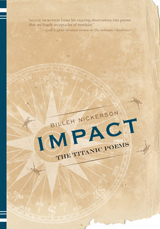 I started reading Billeh Nickerson’s latest book Impact: The Titanic Poems last week in preparation for a feature next month on 49thShelf. I’d picked up the book before I went to bed, and certainly hadn’t planned on what happened next: that I wouldn’t be able to turn out my light until I’d read the book entire, and that the book would make me cry. I had figured that my capacity for crying about the Titanic had been exhausted in 1998 with my teenage melodrama, and also Kate, Leo and Celine. As though by its gigantic cinematic rendering, the tragedy of the Titanic had ceased to be real or have meaning, but it turns out that one hundred years later, poetry was what was required– the opposite of gigantic– to re-instill the story with solidity.
Though what is solid is surprising. The ship itself is a ghost from the start, with rumours of a worker lost in its construction, and in “The Clothesline” the Titanic is an absence, the great ship launched and a Belfast housewife noting the space where it had been, how she’d grown it accustomed to watching it as she hung out her laundry. In four different poems, however, Nickerson describes the riveting process,the rivets themselves,and the teams of men required and their particular skills that put the ship together.
The book’s sections follow the ship from “Construction” to “Maiden Voyage”, in which we learn that the Titanic had 40,000 eggs in her provisions, 800 bundles of asparagus, that the ship’s iconic fourth smokestack functioned solely as ventilation from the First Class smoking room. Nickerson’s poems originate from photographs, official record, anecdotes. He is as much curator as poet, his items unadorned, which seemingly mask the craft at work behind them, but such subtlety is an art itself, the way he lets his items speak. The asparagus stands for itself, for instance, and Captain Smith’s beard, and the photograph of the boy with the spinning top.
And with the next section, “Impact”, it’s the people who speak, the woman being lowered into the lifeboat, the man who must deliver news to the captain of the damage below, the piano player whose instrument couldn’t be carried on deck and whose fingers imagine ghostly keys as the rest of the band played on. With “Voices”, a series of eyewitness accounts from survivors. And then “Impact” again, but this time emotional. Nickerson’s poem “Carpathia” tells of the ship that happened to receive the Titanic’s distress signals and rushed to the rescue to discover the shock of the same emptiness first glimpsed by the housewife in Belfast. The mother recounting her sons being torn away from her body, the carver who’d handcrafted the First Class staircases, various explanations for a dead man’s watch being stopped ten minutes after all the others, and the piece of wood found floating amidst the wreckage which sanded down to become a rolling pin, solidity’s essence.
And then finally, “Discovery”, the ship found and explored in the 1980s, the legacy of its Halifax cemetery, and poem called “The Last Survivor”. In which Nickerson writes, “how strange that the last survivor/ is the Titanic herself.”
March 25, 2012
Ice cream
 The ice cream shop at the top of our road has opened for the season! They remarked upon how enormous Harriet has grown, and they were kind enough to refrain from mentioning that she was also very filthy (and do note, she has since been bathed). In other local news, yesterday I went to the movies for the first time in nearly three years. We saw Friends With Kids, and I really liked it (its portrayal of breastfeeding in particular, which goes a long, long way). We also bought tickets for a train journey to Ottawa, served clafoutis to friends at brunch yesterday, started reading Tales from Moominvalley, finished watching Downton Abbey Season 1, and are having to wait for Mad Men Season 5 to come out on DVD because we do not have a TV. Which is sad, but also nice to know that my dream of continually having Mad Men before me is forever coming true.
March 22, 2012
A splendid day
 “Albert collected good days the way other people collected coins, or sets of postcards.”– Behind the Scenes at the Museum
Oh, we’ve had a good day. Sunshine , popsicles and a brilliant morning in the park with wonderful friends, after which Harriet went straight to nap without lunch (at her own request) and slept for 3 hours. And then we headed down to Queen Street West to Type Books where Kyo Maclear was launching Virginia Wolf and her novel Stray Love, which made it the perfect mother/daughter occasion. The event was great, with snacks (pocky!), music (Waterloo Sunset!), and company (my best friend, Jennie!, who took our picture). It was also nice to meet Kyo Maclear, whose work I’ve admired for a long time. And then Harriet and I took the streetcar home, which was fabulous because transit is Harriet’s favourite part of being alive, and the driver on the Bathurst Streetcar rang his bell for us! Also exciting, I thought, was that the entire Queen St. W. area smelled like farm, which was curious, yes, but mostly importantly, which Harriet recognized before I did, and how wonderful that my streetcar-riding city girl knows what just what a farm smells like.