November 6, 2014
Five Star
 Today I was quite thrilled to find my recent post, “On Uncertainty, Mistakes and Accidental Cake” included on Elan Morgan’s Five Star Blog Roundup. I was thrilled because this was some great company, writing-wise, but also because of how the Five Star Roundup reminds us that we are all readers online, as well as writers, and that there is a whole world of thoughtful writing out there to explore. So do check out the roundup, this week and every week, and many thanks to Elan for including me, and for all her work fostering community and action online.
November 6, 2014
The Canadian Children’s Book Centre Awards
 Such a wonderful celebration of books tonight at the Carlu in Toronto as we celebrated some of the best in Canadian children’s books. Obviously, I am thrilled because Julie Morstad’s How To won the Marilyn Baillie Picture Book Award, and I am a Julie Morstad disciple.As I wrote in my review last year, “The premise is unbelievably clever, but How To‘s genius lies in its simplicity. I love the substance behind its charm as well, that the text is posing and the illustrations are answering such fundamental questions. “How to be happy” is the book’s final statement, accompanied by a two-page spread of children dancing, moving and being together. It’s a lesson as perfect as it is profound.”
 Another contender for the Marilyn Baillie Prize was Where Do You Look? by Marthe Jocelyn and Nell Jocelyn, which we have out of the library at the moment and I just keep renewing. A fabulous puzzle of a book that is, as with any book by M. Jocelyn, a visual treat, but which also points towards the puzzles of language and the complexity of the world, which is the lesson I want to teach my children before almost any other. This book does the trick, and it’s also fun. I think we’re going to have to pick up our own copy…
 Another book we have out of the library that I’m not going to have to purchase is The Man With the Violin by Kathy Stinson and Dušan Petričić, because it took the top prize tonight and everybody in attendance received a copy to take home. And I’m thrilled, because I love this one, based on a true story about violin virtuoso Joshua Bell who played in a Washington DC subway one day, and nobody noticed. Stinson tells the story from the perspective of a small boy who longed to stop to listen, and the story’s amazing power lies in Petričić’s illustrations which really do draw sound, and also highlight the amazingly different ways that adults and children perceive the world. A most deserving winner for sure.
 I was also pleased that my friend Andrew Larsen’s In the Tree House took the Readers’ Choice Award, in particular because I remember him once telling me how his son had told him that his books weren’t funny enough for kids to pick. And now Andrew can say, HA! I love In the Tree House, whose story touched me so much and continues to as I’ve read it over and over again. It’s a book for the ages. So wonderful to see it celebrated tonight. With so many others too—books by Isabelle Arsenault, Ruth Ohi, Erin Bow, and more! It was a really wonderful evening with triumph after triumph.
Canadian children’s publishing is a powerful force, and it’s an honour to be a small part of it.
Also see the nominees’ Seeds of a Story at 49th Shelf.
November 4, 2014
Short Cuts: Hilary Mantel and Martha Baillie
 Could I have chosen a better book to pick up on Halloween than Hilary Mantel’s new short story collection, The Assassination of Margaret Thatcher? Just check out that cover? And no surprise that ghosts pervade the stories in the book, since this is the author of Beyond Black. A woman whose memoir was called Giving Up the Ghost after all (though she hasn’t altogether). I am just a bit Hilary Mantel mad, but I can’t bear enormous historical novels, and so I was quite thrilled about this new book, contemporary Hilary Mantel, the kind I like the very best. And the stories were terrific, the writing exquisite. Lines like, “Then her hands opened. The floor was limestone and the glass exploded.” What writer would set it up that way? Mantel is so smart, so sly. Such deviousness. I love her. Oliver Cromwell, I could take him or leave, but Hilary Mantel in the here and now.
Or at the least in the early 1980s, moments before Thatcher meets her fate: “Who has not seen the door in the wall?… [N]ote the door: note the wall: note the power of the door in the wall that you never saw was there. And note the cold wind the blows through it, when you open it a crack. History could always have been otherwise…”
*****
 Another weird and wonderful book is The Search for Heinrich Schlogel by Martha Baillie, whose Giller-nominated The Incident Report was one of my favourite books of 2009. The new novel comes from a similarly curious sensibility, seemingly created by an archivist with uncanny access to the materials comprising the life of Schlogel, a man who is unremarkable in a number of ways, except that he slips through a hole in time while hiking through the Arctic in 1980, and reemerges 30 years later. Not to even any real end either, and he keeps slipping through our archivist’s fingers (and our own). I enjoyed the book, though also found it at a distance (as it was meant to be), but was compelled throughout the narrative by the strangeness and Baillie’s beautiful writing. It left me baffled, but cast a spell.
November 2, 2014
On Uncertainty, Mistakes, and Accidental Cake
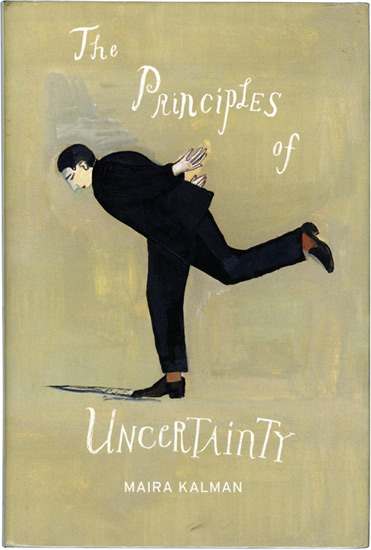 Tomorrow night in my blogging course, we will be discussing Rebecca Solnit’s essay, “Woolf’s Darkness: Embracing the Inexplicable”, which really might be one of my favourite pieces of writing ever, and whose wisdom is remarkably applicable to blogging, as well as to life itself. “To me, the grounds for hope are simply that we don’t know what will happen next, and that the unlikely and the unimaginable transpire quite regularly.”
So I’ve been rereading the essay, following its twists and turns (and thinking about how much the public streets walked by Woolf’s narrator in “Street Haunting” can stand in for the blogosphere, “a form of society that doesn’t enforce identity but liberates it, the society of strangers, the republic of the streets, the experience of being anonymous and free that big cities invented”).
And then there was an excursion to Kensington Market to purchase not a pencil, but boots for the grown-ups in our family, because the shop there that caters to Portuguese construction workers is the best place we know to buy new Sorels. This was yesterday, and we’d woken up to flurries, so it seemed essential that we buy boots immediately. Plus while in the market, we’d get to pick up wood-smoked bagels and sausages from Sanagans for our evening meal. Once the boots were bought, Stuart with stroller was sent on the bagel errand, while Harriet and I took a quick diversion into Good Egg to scope out potential birthday presents for him.
Where I found this book, Maira Kalman’s The Principles of Uncertainty, based on her illustrated New York Times column. I’d never read the column, but I had been reading Solnit’s essay, which references Kalman’s work, her art, this book. And here was the book in my hands, so I had to have it. I came out of the shop with a stack of books, but pleased with myself. “Only one of these is for me.”
When I got home and went through the Solnit essay again, however, I found that I’d been mistaken. While a section of “Woolf’s Darkness” indeed shares a title with Kalman’s book, Solnit doesn’t mention Kalman at all. I’d made the whole thing up. I’d bought the book by accident. Which was kind of interesting to me, because I am so interested in the connections between books, how they speak to one another, and now I’m fascinated too by the idea of the mistaken allusion, the connection that was never there at all. But now it is, because I supposed it was. Our reading lives are such a tangled web.
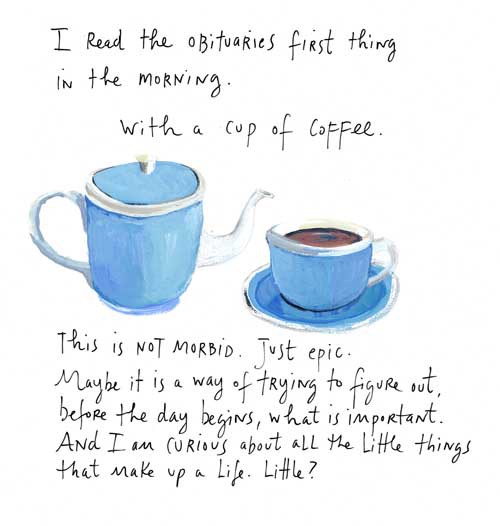
All was not lost though. While Kalman’s book was far from Solnit’s essay (though for me, the two shall be linked forevermore—and they’re actually interesting companions), the book was wonderful. It was as though my mistaken allusion had been a trick to get The Principles of Uncertainty into my hands, where it had belonged all the while.
Full of gorgeous images, funny stories, curious questions, and delightful things. It has an index, as all the best books do, and an appendix with images of postcard collections (one of postcards with waterfalls), collected food packets, a list of all the characters in The Idiot by Dostoevsky, and the family recipe for the honey cake referenced on page 54:
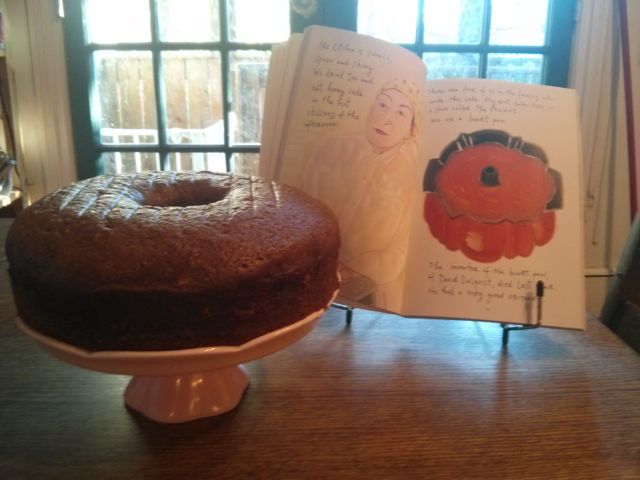
“The kitchen is small, spare and shiny. We drink tea an eat honey cake in the hot stillness of the afternoon.”
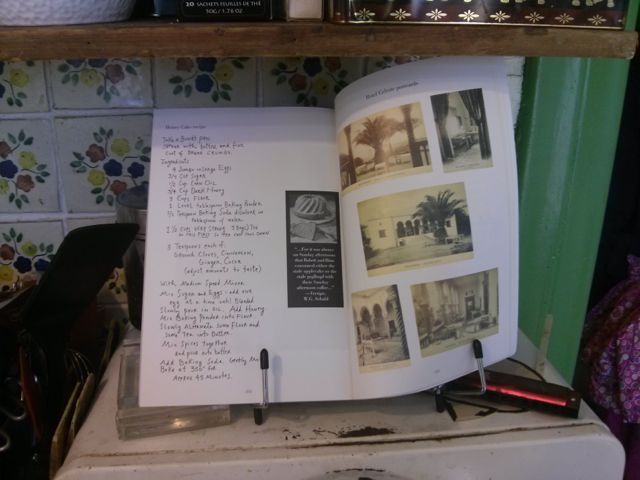
This afternoon, I baked that cake with Harriet, because today had an extra hour within and there was space for such a thing. We had to borrow a bundt pan from our neighbour, Sarit, because we don’t have a bundt pan even though I thought we did. It seems there is no limit to what I’m capable of remembering wrong.
We had a good time baking—it is much less frustrating baking with Harriet now than when she was three and compelled to stick her hands in the batter (and she sneezes in the bowl hardly ever now). I explained to her that we were making a cake from the book that I had bought by mistake, and it’s that a wonderful thing about the universe—that an accidental book can lead to cake in the oven on a sunny afternoon:
“And then the all-clear sounded and people returned, hope undiminished. They returned, so elegant and purposeful to the books. / What does this have to do with bobby pins and radiators and kokoshniks? One thing leads to another.”
Then when we were all done, I proceeded to TWICE pick up the bundt pan (which was constructed of two parts) incorrectly, separating the bottom from the sides and batter seeping out onto the table. (“I heard at least two ‘fucks,'” Stuart inquired after. “What went wrong?”) As I spatula’d up the mess, Harriet patiently parroted what I’d been saying to her about the accidental book as we’d baked, that sometimes mistakes lead us in the most interesting directions.
“I don’t know if it’s quite the same with baking,” I confessed, sorry that everything was not so poetic, but perhaps it is, or it’s just that this cake is forgiving, because it was, and the cake was wonderful. Delicious, moist, and a perfect balance of spice and sweet. One thing leading to another indeed, and what good fortune when the thing one’s being led to is cake.
November 2, 2014
Girls in Disguise
 Harriet made a most excellent Zita the Space Girl this Halloween (thanks to my mom’s sewing skillz), and the swishy cape resulted in her being even more powerful than usual—check out her superheroic stance. We do love Zita, whose super powers result from her strong sense of loyalty, her tenacity, and talent for friendship. Space girl though she is, there is nothing otherworldly about her. When Harriet wore her costume to school, she took along a picture of Zita for educative purposes, as the character is not quite as well known in kindergarten as she ought to be. We were glad that rumours of all the other girls in the class dressing up as princesses had been vastly overstated. It was a good Halloween, albeit soppy. (The photograph here was taken earlier in the week as we went to a Halloween party. On the way home, a couple of big kids recognized Harriet’s costume and told her it was cool!) I kept being afraid that Harriet’s cape would trail in jack o’ lantern candles and go up in flames, but as the cape was drenched, it wasn’t possible. Fortunately.
 We had fun reading Waiting for the Great Pumpkin this year, a new collection of old Peanuts Halloween comics. In which Linus protests to the dubious Sally that he thought all little girls were sweet and innocent and believed everything they were told. “Welcome to 1962,” is her retort. The whole book is funny and wonderful. It was good to read, along with Don Freedman’s Tilly Witch.
 Iris was a pumpkin this year, because it was the costume we had on hand for people who are approximately the size of Iris. It does not seem so unfathomable, however, that she’ll be able to choose her own costume next year. She is pretty articulate already (particularly if you count “screaming” as articulate) and has strong opinions, so we were glad we were able to get her to consent to wear it. She had fun trick-or-treating, and seemed to get into the whole hollowed-out squash/knocking on strangers’ doors for candy groove of Halloween. Some people seemed suspicious that we’d sent her out with her own candy bag, as though we had other intentions for her haul than her consuming it. “No no,” we assured them. “Candy’s fine for babies. And she is particularly a fan of peanut M&Ms…” Just like her mother. Okay.

October 28, 2014
Hello, Sweetheart by Elaine McCluskey
 I love Elaine McCluskey’s short stories, and have been looking forward to her third collection, Hello, Sweetheart, which follows The Watermelon Social and Valery the Great. To begin to read one of McCluskey’s stories is to immediately be struck by the force of her voice, a voice rich with humour, perspective and compassion. Hers is a voice so compelling that it conjures a world, and the reader becomes immersed in that world, entirely on the level with McCluskey’s hapless characters.
They’re hapless, and they’re losers, but she loves them. Their stories are also terrifically funny, even when they’re sad. They’re pure of heart, always. The stories in Hello, Sweetheart take place in Halifax amidst circles that are loosely linked. We begin at the Toy Eros sex shop, where our protagonist has finally landed a job (though she tells her mother she’s working at a bookstore: “Do they know you have three years’ university?” she asks./ “Oh yes,” I lie. “They are very impressed.”) She’s overcome a tragedy that’s not made quite clear, except that it’s resulted in a special kind of clarity: “[W]e all go through life with a great ticking time bomb of tragedy strapped to our chests,” and it’s with this awareness that she regards the curious world she now inhabits.
We all go through life with a great ticking time bomb of tragedy strapped to our chests. For most of McCluskey’s characters, the bomb’s gone off, but this does not mean relinquishing all dignity. I don’t think I’ll be able to explain the point of “Giddy Up,” the man who’s convinced that he used to be a pony, who responds to most inquiries with, “If it doesn’t bother me, then why should it bother you?,” and who manages to draw his own line in the sand and is probably more powerful and free than anyone else in the book is. There’s the man who changes his dog-walking route in order to avoid “the kind of woman who wore rubber boots whether she needed them or not.” An adult woman enrolled in undergraduate courses trying to get over being duped by a guy called Dwayne. A terrifying story that begins with an early morning wake-up and ends with a kidnapping, it all happening so fast that you’ll thumb back through the pages wondering, “How did she take me there?”
“Chez Helene” is a wonderful story in which, like so many of these, the real story is in the subtext, the space between the lines, which is that “people can believe anything they want to. And that’s ok.” (The idea that underlines so many of these stories—this is the definition of compassion.) “Jaw Breakers” is a very McCluskeyian story of a former swim champ whose career trajectory went wrong, and then he begins to lose his father in a curious way, and there goes the ground beneath his feet. Similarly sad is the life of the man falsely accused of sexually abusing children who is then left to make his own way with his shattered reputation—though McCluskey offers him the slightest reprieve from his sorrow.
“Rating Dr. Chestnut” is the story I’ve been waiting for all my life, that which is told through the structure of comments on a RateMyMD.com site. Which is not the only story in the book to engage with life online, other stories with Facebook and text messaging as embedded in the fiction as it is in real life, one even comprising two of those “Ten Things About Me” lists that were uber-memed a few years back. And Margaret, whose whole story takes place in her head as she’s playing a drinking game (alone) while watching Say Yes to the Dress. These are stories that engage so readily with the stuff of the world.
And then the final story, “Hello, Sweetheart,” a story that explains a lot, about grief and mourning, most of the text seemingly delivered from McCluskey to her father shortly after his death. He’s the subject of her second-person narration, and she tells him a story from his funeral. “It was funny, Dad, and you would have laughed. It would have been one of those stories we could have told. Over and over again.”
I finished that last story, shut the book, and clutched it close, and said, “Yes.” The whole project making sense, those stories, the sadness. Some of these stories are a bit rough around the edges, though in McCluskey’s work, form is always secondary to language. There is an exuberance to her work, an energy, that is so compelling to encounter, and there’s nothing else like it, really. She’s one of the best short story writers at work in Canada—which is saying something indeed.
October 26, 2014
Would-Be Pickler Tries Nathan’s Famous
 In my blogging course last Monday, we were talking about blog titles, and I conceded that there was probably an expert out there who—for SEO purposes and issues of general confusion—would advise you not to call your book blog Pickle Me This. But the problem with expert advice (and why expert advice so often doesn’t work for blogs, which are characterized by their refusal to conform to expectations) is that such advice cannot take into account the forces of serendipity.
For example: You christen your blog “Pickle Me This” for no good reason in 2004, thereby enabling a delivery of actual pickles to land on your doorstep a decade later.
 Except that there was a reason I named my blog Pickle Me This. Not a good one, but still.
In 2004, I lived in Japan teaching English conversation to students with whom I usually had very little in common. This lack of commonality made our English conversation challenging. “What is your hobby?” became a conversation touchstone when all else had failed, mostly because the Japanese school system mandated that every student have a hobby. (Those students who were bad at everything usually ended up on sports teams charged with carrying equipment.) Bored housewives were also hobby connoisseurs, with interests including tea ceremonies, ikebana, and calligraphy, though more often than not, their answer to the hobbies question was “learning English,” which brought us full (albeit very small) circle, and made the minutes on our classroom clock tick by oh-so slowly.
 Living in Japan does something to the brain. To this day, all my favourite music is basically assembled from karaoke playlists, I was photographing my lunch before it was cool, and I’m still inclined to squeal, “Kawaii!” when the situation warrants it. Part of becoming “Japanified” was responding the experience of living abroad and discovering how wide the world was, all the while we were cut off from the culture around us by being foreigners. We forgot how to form proper sentences, how to behave, and partook in strange pursuits to the fill the gaps that had appeared in our lives now that they were being conducted so far from home.
 In 2004, I decided that I would learn how to pickle. This would be the beginning of something huge, I imagined. In Japan, anything was possible. I was picturing a sizeable cottage industry, adorable labels. They would say, “Pickle Me This,” the name of my company. One of my students—an avid pickler—wanted to support my ambitions and went as far as to give me a gift of pickling spice she’d made herself. “I want you to be a pickle success!” she told me.
 Except that I was a pickling disaster. Granted, a lot was working against me. My entire kitchen was a hot plate, and I didn’t own a measuring cup. I was illiterate, so could not read food labels to know what kind of vinegar I was employing for my pickling task (if it was vinegar at all). I had no culinary skills then, and struggled with following simple recipes, whose advice, I decided, was usually just a helpful suggestion, as I slung a fistful of something or other into my pot. In Japan, we ate spaghetti sauce that came out of pouches, and I thought that was just fine. So the precision involved in pickling was well beyond my ken.
 You can actually track the trajectory of my very short pickling career, which began with a blog post called “Are Pickles Supposed to Float?” and proceeded on to a post called “Dubious Pickles” the very next day, reporting that the pickles were shrivelling up in their jar. I don’t remember what happened to the pickles after that, but it is quite possible that I insisted on eating them even though they were vile and probably laced with botulism. I have a hard time admitting when my plans have gone wrong. I am a specialist in Stubborn as You Like. But I never made pickles again.
 I’ve called myself a “would-be pickler” in the years since, usually in the bio on the blog that was christened Pickle Me This not long after my failed venture. This blog as been much more successful than the pickles, proving that you can’t win ’em all, but also that just because you lose some doesn’t mean it’s all lost. I was always going to be a better blogger than a pickler anyway. Accepting being so far from perfect is probably one reason I’ve been able to do so well as a blogger too, the pickles were certainly a fundamental lesson in that respect.
 One consolation of failed pickledom is that it doesn’t keep one from eating pickles. Another consolation of failed pickledom is actual pickles on the doorstep from Nathan’s Famous, which are launching in Canada and are available in the refrigerated meat cooler sections at No Frills, Loblaws, and other grocery stores. Because a blog called Pickle Me This comes out on top when PR firms are searching for Canadian blogs about pickles. Perhaps this was part of my plan all along?
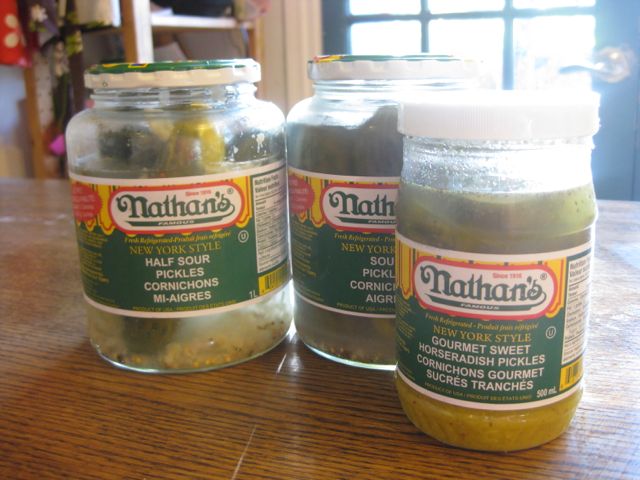 So we’ve been eating pickles all weekend, revelling in the bounty. I’m a bit crazy about the sweet horseradish pickles, though it’s possible I never met a sweet pickle I didn’t like. The sour and half sour are huge and full of crunch and flavour. Iris insists on eating them too, even though she makes the most ridiculous faces while doing so, but she keeps coming back for another bite, and so do I, because they’re good pickles.
And maybe you have to have been responsible for bad pickles to do know how precious a good pickle really is.
(Thanks to the people at Foodfest America for making my pickle dreams come true.)
October 24, 2014
The M Word reviewed in Herizons
 “[Motherhood is] like living in an amusement park—on the edge of a minefield.” –Deborah Ostrovsky
In the Fall 2014 issue of Herizons, Deborah Ostrovsky offers a thoughtful and generous review of The M Word, as well as the single best description of motherhood I have ever encountered. In her review, she connects The M Word to “a strong Canadian tradition of public discourse on motherhood”, including legendary work by June Callwood and Marni Jackson, and the monumental motherhood anthologies, Double Lives and Between Interruptions.
She writes, “You won’t keep this book; you’ll pass it on to friends whose current vocation is to changing diapers, or to friends who want a child, or those who don’t. The M Word is vast in scope, featuring beautiful conversations I can finally share.”
(Update Oct. 27: Another nice review has appeared, this time in The Coastal Spectator, the reviewer calling the book’s ideas “diverse and challenging.” You can read it here.)
October 22, 2014
What to Read in Uncertain Times
 In these uncertain times (though I am unclear about which times were ever certain) with so much fear, hatred and violence in the world, what books should we turn to? Could there possibly be a book into which escape is possible, all the while the experience of reading sharpens our senses in connection to the troubled world around us?
 But in fact there are three, Jo Walton’s “Small Change” series, which begins with Farthing, then Ha’Penny and Half a Crown. We devoured them on our summer vacation this year, detective novels set in an alternate history in which Britain had declared peace which Germany in 1940 and began a slippery slide into Fascism underlined by establishment powers. Such fun absolutely, and yet they’ve never been far from my mind ever since, particularly in light of government response to terror threats in the UK and in Canada lately which has seemed eerily similar to the story Walton writes in her book.
Though this similarity is most deliberate. Walton writes:
 “I wrote these books during a dark time politically, when the US and the UK were invading Iraq without a Security Council resolution on a trumped up casus belli. I was brought up by my grandparents, and the defining event of their lives was WWII, it cut across them like a knife. To find a government I had voted for waging a war of aggression really rocked my expectations. If I’d been in Britain I’d have marched and protested, but I was in Canada, which kept out of that unjust war. My husband is Irish, and Ireland wasn’t doing it either. I think it was my isolation on this that went into writing these books.
I had read a lot of cosy mysteries, Tey, Sayers, Christie, Heyer, and considered the interesting fact that they were about sudden violent death and yet they were written in a way that made them safe, indeed cosy. I thought I could use this to write about fascism, and not in a closed known historical context where we’re safe and sure of the ending either.”
We live in a good world—this is one thing I am not uncertain about. And while art is so often a mirror or a window through which we understand the world, it’s so essential that sometimes we see it from a different point of view, which Walton does so brilliantly here, reframing history in a way that helps us understand and navigate the uncertainty of right now, and strive to be better than we are.
October 21, 2014
All the Squash
 Oh, so little sleep (Iris has a cold and is getting molars) and three part time jobs means that my mind is scattered this week, but I want to take a pause and write about squash. It’s partly the time of year, and also because brand new cookbook The Everyday Squash Cook entered our lives, but no matter the reason, we are squash obsessed. Our Thanksgiving was made rich with acorn squash pie (see Harriet cleaning out the seeds, which we later roasted with the recipe from The Everyday Squash Cook) whose recipe I invented by mistake, but it turned out gloriously—I roasted the squash with the spices and butter in it, and then baked it all in an oatmeal crust. We also had this delicious Roasted Apple and Acorn Squash Soup and it was as easy to make as it was wonderful.
 The squash that continues to challenge me is spaghetti—I don’t buy those recipes pretending the strands are pasta, and neither do my children. It’s okay roasted, but there is so much and the kids won’t eat it, and I don’t like it that much. We receive them often in our organics delivery, however, and I think we may have finally found the solution—a spaghetti squash soup recipe from The Everyday Squash Cookbook, featuring coconut milk for maximum deliciousness and the strands do indeed pass as noodles in a soup. So good.
A mysterious squash turned up on our delivery last week. The Everyday Squash Cookbook has a squash identifier, but I couldn’t find our mystery squash. So I turned to this rather nifty Winter Squash Visual Guide to discover it was a Delicata Squash. I roasted it according to this recipe to learn another thing—that Delicata Squash is the most delicious squash ever.
 More squash? We made Butternut Bacon on the weekend from TESC (you can see the recipe here) and it blew our minds. Easy peasy and it cooks in 20 seconds. And then we were left with a whole bunch of butternut squash, so I used a vegetable peeler to thinly slice it, and made a “pizza” from those slices, inspired by a recipe in Tessa Kiros’ Apples for Jam: mix slices in a bowl with olive oil and flour until slices are coated, then turn onto a pie plate and bake for about an hour. Top with tomato paste, oregano, and mozzarella cheese and bake for 10 more minutes. It’s so good, though Harriet wouldn’t eat it, but that’s not much of an indicator of anything.
One of my favourite squash recipes (which Harriet does eat) is this ridiculously easy risotto that requires no stirring because it bakes in the oven. I usually use butternut squash and it’s very good.
Tonight we’re looking forward to trying the Squash/Sausage/Rigatoni recipe from TESC. I am quite sure it will prove delicious. Check out this recipe for Butternut Brownies, and also this article on squash as one of “Canada’s heritage foods.”