May 18, 2015
The Capacity for Infinite Happiness by Alexis Von Konigslow
 I credit this to living downtown, or maybe there are interesting, creative people everywhere, but I have had some incredible fortune meeting other mothers at the library’s baby time. Most recently, Alexis Von Konigslow whose debut novel is The Capacity for Infinite Happiness, a weird, enthralling, and singularly original book. I was drawn to it by its story of a mathematician, because I love books about math and science, which allow me access to these worlds I’m not otherwise privy to. But I wasn’t as sure about the rest of the book’s description—Harpo Marx, who I wouldn’t be able to tell from Karl, and Passover, when I know as much about the Seder as I do about the Marx Brothers. More over, how do you plot a novel whose points are so divergent, against the setting of a Muskoka lodge, no less? But plotting points is what the book is all about, in terms of math and narrative, drawing connections between ideas, and the pattern that emerges is remarkable.
It’s the story of Emily who seeks refuge at her family’s lodge in Muskoka, a near century old Jewish resort, after a devastating revelation from her mother and frustration with her PhD thesis. She has been mapping social networks, showing how math can chart the connections between people, and she wants to apply what she’s learned to her own family and the lodge, but the lines aren’t matching up. She’s having trouble untangling the connections, figuring out who came from where in her family’s complicated network, and what exactly happened years ago when her great-great-grandparents arrived in Canada escaping persecution in Russia. Her confusion isn’t mitigated by her grandmother and great-aunt’s cryptic ways with history and storytelling—Emily’s questions are never properly answered. Was Harpo Marx really once a guest at the lodge? What is the real story of her family in Russia? And what was her great-grandmother’s tragic secret?
Emily’s story takes place in 2003, and is countered with chapters from 1933 when Harpo Marx was indeed a guest at the lodge. These chapters are from Harpo’s point of view, which might explain their oddness, their dreamlike sensibility. Though Emily’s story is pretty strange as well, her character as eccentric as her ancestors’. She and her friend Jonah, who she’s known since childhood and has feelings for, begin to care for a pet lamp called Jazzy. A kookiness that might be characteristic of the Marx Brothers infuses the entire narrative. It is all very odd and slightly skewed, and would be off-putting and fey in the hands of a lesser author, but Von Konigslow is very good. There is something so absorbing about the novel’s crafting, how its two parts start to echo each other, a formula that begins to emerge as to how they are connected, and this is the mystery for which we are reading. This project is large and ambitious, and fascinatingly realized—when I got to the end, I was breathless. It was such a pleasure to read this book, which is unlike any I’ve ever read before.
And now I want to go and watch A Night at the Opera.
- Purchase The Capacity for Infinite Happiness from McNally Robinson
- Speaking of connections, I liked Pasha Malla’s piece about whether you should trust a review by a writer’s friend. (A nice thing about having a blog is that I can review books by whomever I like.)
May 18, 2015
Night and Day
Night
We are going through a difficult period. I like framing it this way because it suggests an ending, as opposed to, We are going through a difficult eternity. “It’s just a phase,” we keep saying. “Things will get better,” but we’re beginning to sound less sure of this. It has been so long. Nearly two years since I’ve had unbroken night’s sleep. And since we came back from England, things have been awful. Iris moved downstairs into Harriet’s room to sleep, but her nighttime wake-ups have continued, plus it’s started taking her sometimes up to an hour to fall asleep, she requires us lying down beside her to do so, and then she gets up again at 11, at 1. She won’t settle unless she’s in bed with us, which would be okay (and I’m certainly not going to fight a screaming nearly-two-year-old in the middle of the night) except that then she flops and kicks and pinches my upper arms. It is unpleasant. And last night we had a babysitter booked so we could go out to a movie, but Iris refused to go to sleep. Or she would be asleep until we dared to rise and leave the room, and then her eyes would snap open and there we’d be again. Eventually, I gave the babysitter $20 and told her to go home, because we’d missed the movie. And it seems like the baby is holding us hostage, when I dare to frame the whole thing like a power struggle (which I shouldn’t do—it only makes unpleasant realities worse). We can’t go out together to anything that starts before 9pm, because no one else but Stuart and I has the patience to put Iris to bed, and now that she’s only staying asleep for 2hrs after that (if she goes to sleep at all), the world seems to have shrunk to the size of an acorn. I know that there are far worse problems to have than this one, but perspective can be hard to come by when one is having melodramatic thoughts about being subject to tyranny. Five years ago, I wrote a blog post about baby sleep books called The Trajectory of a Downward Spiral, but the trajectory of this plot is more like a head smashing into a wall. Repeatedly.
Day
 But. We have had the most wonderful weekend. A weekend whose wonderfulness is currently under threat as I spend this holiday Monday morose and bereft at the end of Mad Men. The children watched Annie and ate goldfish crackers in Harriet’s room while Stuart and I watched the final episode this morning. It was so absolutely perfect. Overwhelmingly good. I feel about this show like I’ve been immersed in the narrative for six years, swimming around inside it and examining from all angles. I can’t believe it’s over, but then it isn’t really. We rewatched an episode from Season 1 on Saturday night, and it occurred to me that I’ll never really be done with it. But still, I’m sad there is no more to look forward to. So many of my feelings were invested in these characters. It all mattered a lot to me.
 On Saturday, we celebrated summer things with a trip to the Wychwood Barns Farmers’ Market and ate delicious food, and delighted in the fact that our children are old enough to play unattended (in mud puddles, no less) while we sit on a park bench. We also delighted in that our children were so thrilled to take the bus to the market, but were also cool with walking home. So many of my plans for this summer are inspired by Dan Rubinstein’s book, Born to Walk, and I appreciate that Harriet is big enough to be venturing further afield on foot, to be discovering her pedestrian legs without (too much) complaining. But there are also wheels, and so after Iris’s nap, she went on a bike-ride. We’re going to shed the training wheels this summer, we’ve resolved, but this is just one more thing we’re not sure about how to teach her to do—along with shoelace tying. After that, we did our planting, mostly flowers because the squirrels thwart our efforts to grow anything more substantial. Some kale and basil, but otherwise impatiens, and suddenly our deck is beautiful again. The silver maple that shades our house and yard in magnificent bloom. There is a hammock set up underneath it.
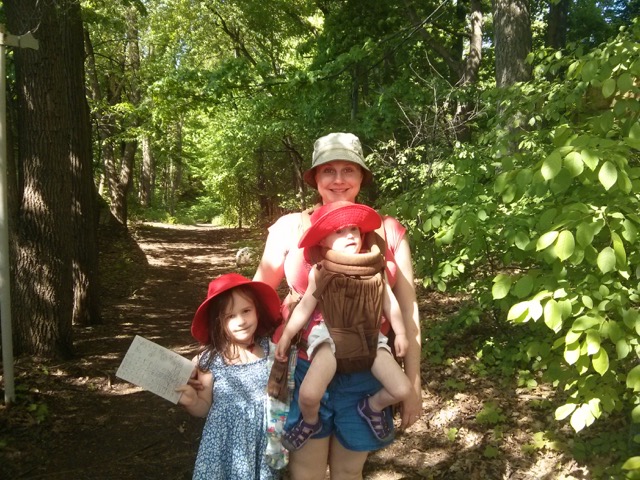 Yesterday, we went on our first ravine walk of what is to be many, as we’ve declared 2015 as #SummeroftheRavines. Once again, this is a plan born of Born to Walk—to explore these wild corners of our city. We didn’t have much of a plan and climbed down into the Rosedale Valley via the path behind Castle Frank Subway Station. Unfortunately, Bayview Avenue cuts off our access to the Don Valley, which we weren’t expecting, so we had to climb back out of the ravine in order to get to where we really wanted to be, and by this point, it was nearly time to quit.

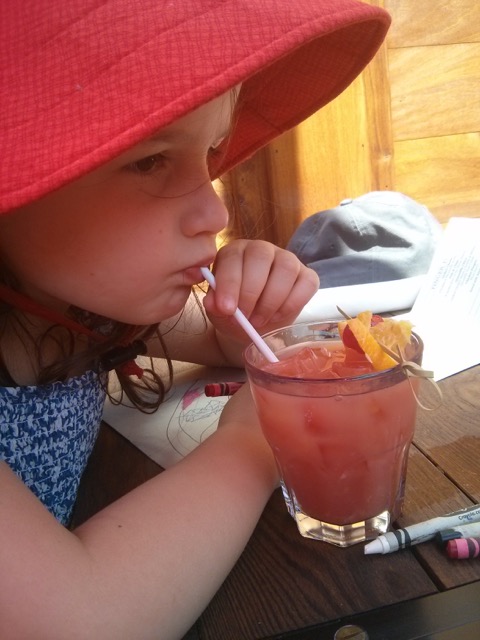 But we had fun and the weather was beautiful, and once again, there are very little complaining. We’d compiled a Ravine Walk Bingo sheet, which gave our walk some incentive, as did the promise of lunch afterwards. We went to the House on Parliament and had the most delicious meal, our first patio of the season. And then back to the hammock. I’ve been reading H is for Hawk all weekend, which is not a great read for the emotionally fragile, I am realizing. But it’s really good, deep and layered, and totally weird. So intense. It is possible my whole family will be relieved when I’m finally completed it.
 Which brings me to right now where I’ve just been delivered lunch. (“Um, if I’d known you were having lunch in bed, I might not have brought you breakfast there.”) And it’s up to me to save this day from my lugubriousness and histrionics. Iris has started being capable of having actual conversations (albeit stilted ones, usually about dogs), which is extraordinary, and clearly her brain is going wild these days. If I’m able to muster perspective, it would be that these development changes are responsible for our sleep woes. If I am able to focus less on the woe. In a few weeks she will be two. Harriet turns six next Tuesday. For our family, the next month and a bit is a season of happy birthdays and anniversaries and so so many reasons for cake. (Another? My sister is having a baby tomorrow.)
It all goes by so fast.

May 14, 2015
Drive by Kellen Hatanaka

Mad Men ends on Sunday, after years and years, and in tribute to my favourite show, I’ve picked a picture book this week with a similar aesthetic. I think Betty Draper even owned that station wagon exactly. Drive: A Look at Roadside Opposites is the second book by Kellen Hatanaka, whose Work: An Occupational ABC was on my Hipster Picture Book list last year. While this new book is similarly focussed on design, it’s got more of a narrative, and I like it even better than the first one.
Drive is the story of a journey toward a summer holiday, from the city to the country, and therefore a natural setting for I-spying opposites. The car is packed with summer things—a barbecue and beach balls—and we can only imagine the Are We There Yets? before they finally arrive.
But in the meantime, there is looking out the window. Big, small. Above, below. Winding roads and straight ones.
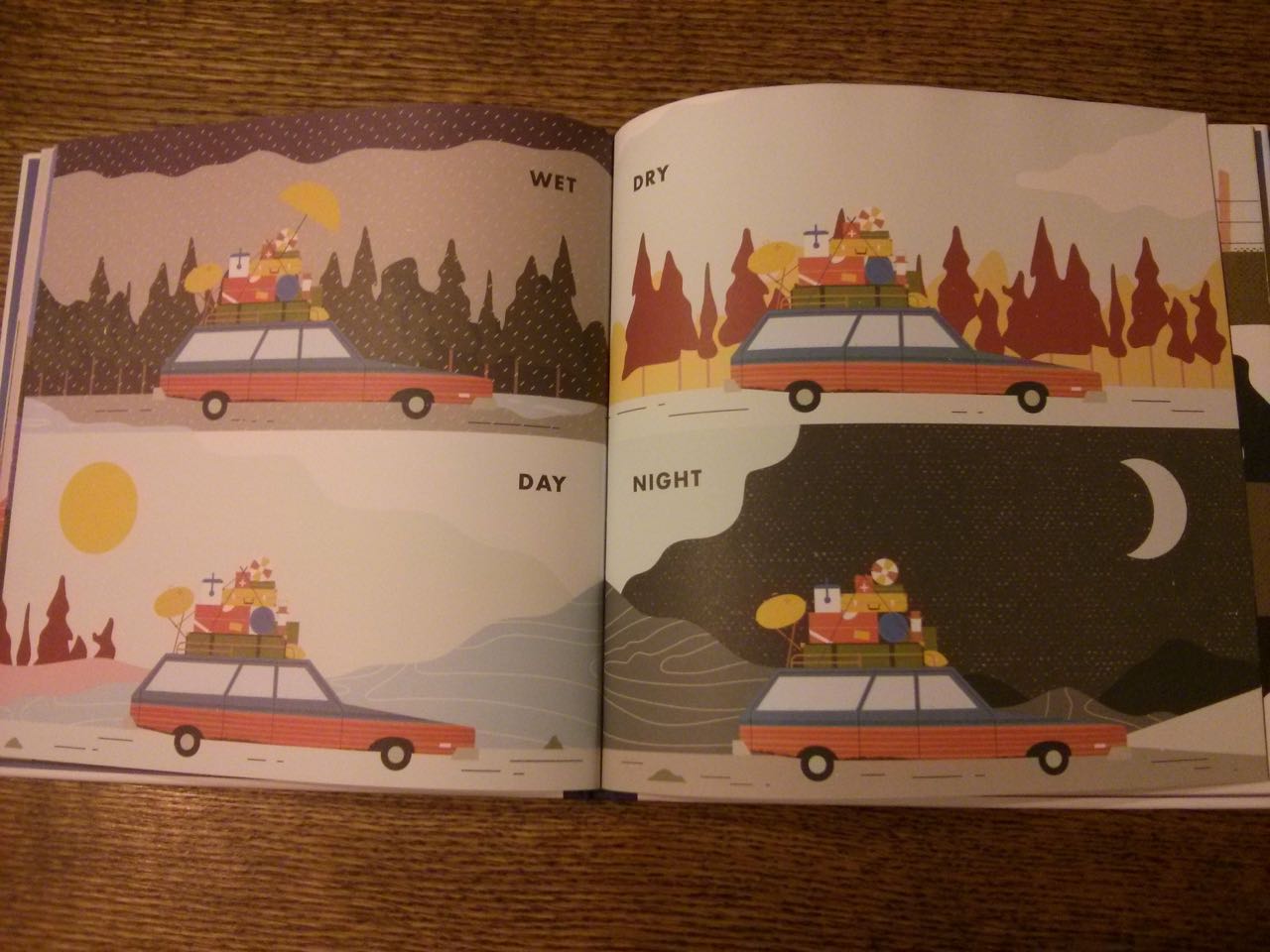
With all of these Don Draper is actually DB Cooper rumours, this page seems particular eerie.

The illustrations are fantastic, full of funny and interesting details. We particularly like the dinosaurs bones under the mountain in the image below. As with his previous book, Hatanaka plays up the unexpected—I love the “Worm’s Eye View” that opens up into a four page spread of “Bird’s Eye View”, the world spread out below, patchwork fields and the winding road, the car viewed straight down on the roof-rack.

At the end, there is a map, a dotted line tracing the journey from place to place and suddenly the whole thing all comes together—the same story from another perspective.

Drive would be an excellent book to take on the road (perhaps along with See You Next Year?), giving a young reader lots to look at when there’s nothing to see out the window, and perhaps inspiring her to look again and closer at the weird and wonderful world whizzing by outside.
- For more on Mad Men and children’s books, see my post, “What Sally Draper Must Have Been Reading“
May 13, 2015
I Can’t Believe It’s Not Better by Monica Heisey
 “A Day in the Life of Pinterest” by Monica Heisey is the most ridiculously funny thing ever, plus it’s in The New Yorker, which is pretty darn impressive, and so it was with admiration that I picked up Heisey’s new book, I Can’t Believe It’s Not Better: A Woman’s Guide to Coping With Life. Heisey is a Canadian writer and comedian in her 20s whose column, “The Grown-Ass Woman’s Guide to Life” for the Toronto website, She Does the City, was inspiration for much of her book’s material. Pieces like, “When It’s Time to Switch to Water” (“You Are Considering Peeing Somewhere That Is Not a Bathroom…”) reminded me a lot of being in my 20s, accompanied by “How to Be a Good Roommate” (good tip: “Do Not Leave a Used Pad in a Container of Half-Eaten Poutine…”), and “Working From Home: How to Do It”. Heist’s advice is either markedly sensible (“Some Notes on Etiquette for the Behaviourally Disenfranchised”: “No one thinks your opinion represent those of your employer, so you can probably relax about this”) or tongue-in-cheek, using humour (“What to Wear to Barf at 30,000 Feet”) to satirize a society that positions women as helpless and idiotic, and seems to like us this way. With pieces like, “Good Mistakes Vs. Bad Mistakes: A Fuck Up’s Guide,” Heisey’s book is less a guide to coping than a manifesto to muck through, eat burritos and figure it all out in your own damn time.
But there are quizzes. I am a bit too old for Heisey’s book (I am only 35, but her bits on “aging” made me want to say, “Bless…”) but the quizzes took me right back to *my* YM days. When I was ostensibly reading to figure out what kind of person I was (ABC, or D), when the reality was that I wasn’t formed yet, but I knew who I wanted to be, and skewed my answers to get the desired result—which was usually D. Which is to say that we were figuring it out in our own damn time even then, we already know the answers but sometimes it’s just nice to have some affirmation. (Heisey’s quizzes include, “Should You Text Them Back?,” “Should You Eat That?”—all answers point to YES—, and “Which Of The Terrible Fashion Mistakes of My Past Are You?” [“You are my sixteen-year-old self’s attempt at ‘boho-chic’…”].)
There is a tendency among the kind-hearted people of the internet to label anything that’s not a list an essay, which is a little bit misleading (and mortifying when I dash off a blog post, and someone shares it with a reference to the e-word). Most of these pieces are too breezy to be essays exactly, which is not to say that they’re less than, but they lack the depth and precision I expect from a really good essay. The book also suffers a bit in comparison with Lena Dunham’s Not That Kind of Girl (several pieces of which really were essays, as I wrote in my review), similarly structured with lists and doodles. If you hated Dunham’s book, you won’t like I Can’t Believe It’s Not Better, though if you liked it, probably add this one to your list. And while there can never be too many women telling other women that they don’t need to wear uncomfortable underwear in order to get laid, “Some Gentle Advice on Underwear” was reminiscent of Caitlin Moran’s How to Be a Woman (a book whose spirit infuses Heisey’s ethos).
Which is not to say that Heisey doesn’t do her own thing. In fact, she’s her very best when she’s doing her own thing. My favourite pieces in the book were removed from the advice-giving—I laughed out loud on the subway reading “Diary of a Bra,” “On Splitting the Bill and Other Nightmares” is indeed a modern day horror story, the Pinterest piece is so absolutely perfect and smart and hilarious, and also, “How to Make Your Apartment Look Like You Read Design Blogs.” Even if some bits of the book are derivative, they still go massively against the grain of what society is telling women all the time, so it’s not like we’re being saturated by these messages after all. And it’s not like it isn’t incredibly brave still for a woman to stand up and be funny, gutsy, and smart (and vulnerable) in public. Not to mention an inspiration.
So, more of this please. As Heisey writes, “Women speaking to women about being a woman remains one of the best parts of being alive and one of the most important things you can do. Do it often.”
May 12, 2015
A God in Ruins by Kate Atkinson
 I’m such an admirer of omniscience, though I’ll admit it’s not for everyone. There are readers for whom omniscience pulls them out of the story, exposing the limits of the fictional universe—that all this is artifice after all—but those very same limits, to me, are the very indicators that there is a fictional universe. It’s the point of reading a book, a whole imagined world to be revealed, and Kate Atkinson is a master at commanding its reins. From her very first book, Behind the Scenes at the Museum, which begins with Ruby Lennox’s conception: “I exist! I am conceived to the chimes of midnight on the clock on the mantelpiece in the room across the hall…”—Atkinson has been part of a grand tradition of English writers (Laurence Sterne, James Joyce, Virginia Woolf, etc.) pushing the bounds of narrative to discover just what a novel can hold and the multitudinous ways a story can be told.
Her last novel, Life After Life, was unabashed in its experimentation. What if, it supposed, a person could go back in her life, over and over again, and have the chance to do over what went wrong before? This was the story of Ursula Todd whose preternatural tendency toward expiration is matched only by her ability to be reborn (“I exist!”) over and over. Her story spans the first half of the twentieth century, encompassing world wars and radical social change. The metaphysical elements of the novel are never clearly delineated—Ursula sort of understands her situation but Atkinson provides no reason for her ability to be reborn and go back in time over and over again. Life After Life is a novel far more concerned with What If? than Why?—to what extent is there predestiny, can we control our fates, what are unintended consequences of that control? Can practice make perfect? What I found remarkable about Life After Life is that Atkinson uses her life-after-life device not just to play tricks, but to build characters too and and develop plot, and how this book of starts comes together to be something altogether whole.
(I am incapable of real criticism of Kate Atkinson. I am simply in awe of her work. But I also thought that Rohan Maitzen’s critical review of Life After Life was excellent, and adds even more texture to a very substantial novel.)
Atkinson’s new novel, A God in Ruins, is not a sequel to Life After Life, she explains in her afterword, but “a companion novel.” It’s the life story of Ursula’s brother Teddy in a version of their family’s life that is slightly different than those portrayed in the first novel. Where Ursula died over and over again, Teddy shows a predilection toward survival, miraculously making it through a career as a WW2 bomber pilot. And it is the war upon which his story hinges—an experience both makes him and destroys him. An experiences that does not become less raw as the war itself fades into history, though those around put it away in the past. “You can only go forward,” is a line delivered again and again in the text, a winky joke at the premise of Life After Life, but also blatantly wrong in the matter of narrative because an author is free to put her story together anyway she likes—forward, backward, and round and round in circles. Posing the questions: what if history never entirely goes away? how does it change as we carry it with us? And how is a conventional existence not unlike Ursula’s in reality: “It felt as if he had lived many lifetimes,” Teddy remembers at one point, and who has not felt this way? What is the cumulation of these lives, these selves? What is the thing that connects them?
The reader follows Teddy through his many lives, which are all lived in the same life—through the trauma of his war experiences (whose violence is unflinching but matter-of-fact), the happy early years of his marriage, his tumultuous relationship with his daughter, Viola, and the injustices she inflicts upon her own children, whom Teddy becomes responsible for. As with Life After Life, there is repetition, details slightly changed, conflicting accounts—reading the novel through a similar metaphysical lens as the previous novel is an illuminating experience. And at the end of the story, Atkinson shows her hand with a twist that shall not be revealed, but it’s wonderful and gut-punching, and demonstrates that we’re in the hand of a master writer. As if you ever had any doubts…
May 10, 2015
Aching testicles, bodacious breasts, and other childhood lessons in anatomy

Image from here.
“My testicles are aching,” my daughter confessed to me the other day, which is the only problem I’ve so far encountered in my experience of having taught her the correct name for anatomical parts. That eventually, one might get mixed up when meaning to say “limbs” and start talking about her balls instead. And maybe this is the danger parents are hoping to avoid, those who pulled their children out of Ontario schools last week in protest of the new sex-ed curriculum. That there are so many body parts and the children aren’t ready, and with everything getting so mixed up, gender fluidity is surely just around the corner. It’s contagious. What else can you expect when it’s scrotums for everybody, and sexual identity is all a slippery slope.
I haven’t actually read the new sex-ed curriculum, because unlike some people, I’m not a total pervert. And I’ve got better things to do than vet school curricula for ways it’s going to warp my child’s mind, because the world is going to warp her anyway, and here is the point where my job as a parent kicks in: I send her into the world and then, when she gets home, together we try to make sense of the mixed messages it’s throwing at her. Like why, for example, in a hyper-sexualized world (ever driven down a highway and looked at a billboard lately?), we are so fearful of teaching our children there is such a thing as sex or that parts of their bodies actually have names.
I can’t do it all on my own though. As Hillary said, it takes a village. From proximity to my body, my daughter has learned about all varieties of skin rash, but that’s only the tip of the anatomical iceberg—there is so much more. And my plan for this education, which I hope will avert much future sextastrophe (the more you know!) involves extra-curricular activities.
My daughter is enrolled at swimming lessons at the university pool, and we strategically avoid the Family Change Room. After her lessons, we head to the Women’s where she has her hair washed surrounded by naked ladies. An invaluable education—how to be subtle, for one thing, and look like you’re not looking, and also how not to pee in the shower, which is mostly “at all”, but if you have to, don’t announce it while you’re doing it.
Mostly, her post-swimming showers are a lesson in the exquisiteness of womankind. Women of all shapes, sizes, and colours, gloriously naked, just having finished some activity that makes her body strong. Beautiful, all of them, stunning in their variety. Contrary to what a series of lingerie ads might have you suppose, there are so many ways to have a body. No two alike. Shockingly, almost all of them have pubic hair. And the bodies themselves are big and small, curved and slender, muscular, wiry, always amazing (because it’s ill-fitting clothing that fails to flatter the body, I find. The body itself requires no flattery at all). Bums, boobs, tummies and, yes, limbs. We’re both kind of mesmerized. What a sorority. You’re a woman, albeit a small one, and you’re part of this, a body-haver. It’s the most incredible way to put the whole thing in perspective.
Of course, it’s not all naked utopia. You’ve got the woman who’s squeezing her ass-zits in the shower, and the other who is shaving her thighs, which is kind of gross because her pubes are flowing across the tiles. But that bodies are disgusting is an important lesson too. And that they’ve got functions, beyond their ability to be stuffed into a bikini and be beholden to the male gaze. We’re getting all of this in the Woman’s Locker Room and I’ve got to shut up about this, or swimming lessons are going to up their fees. And even if they did, I’d probably pay the difference. There is awkwardness, yes, and the pain of aching testicles, but it’s the best basis for sex education that I can imagine—the knowledge our bodies are gorgeous and amazing—and knowing this we’re better prepared to handle whatever this curious world hands us next.
May 7, 2015
Melvis and Elvis by Dennis Lee and Jeremy Tankard
 It’s been over forty years since Dennis Lee invented Canadian children’s literature with the publication of Alligator Pie, following it up with Garbage Delight, The Ice Cream Store, and Jelly Belly, books that have moved seamlessly from my childhood to my children’s, so that we all know Suzy Grew a Moustache, In Kamloops, and Hugh Hugh at the age of two, who built his house in a big brown shoe. Combining the rhythms and touchstones of Mother Goose rhymes with contemporary references (and ones more charmingly dated—I’m thinking the rhyme that mentions Eatons, Simpsons and Honest Ed’s) and unabashed Canadiana and Toronto-Centrism, Dennis Lee has provided most Canadians with their poetic foundations.
And here it is: his latest collection, Melvis and Elvis, is just as good as all the rest.

How does he do it? How has he not yet run out of rhymes? How can something so simple keep seeming so fresh? How can we read a poem that begins, “Mary McGregor/ McGuffin McGee/ Went for a ride/ On the TTC.” and immediately feel as though we’ve always known the poem by heart? How “Is Your Nose Too Small?” (to the tune of “Do Your Ears Hang Low?) so perfectly hilarious? And the collection too with its mix of poems that are tender (“Sleeping With Bears”) and others slightly gross (“In Cabbagetown,” with its exploding bellies) and others naughty (one poem about a stinky friend, and another that ends, “And pounding on your head all night/ Was fun. But very impolite.”). Plus there is a poem about dinosaurs. With a poem about dinosaurs, you can never go wrong.

Dennis Lee is so respectfully and intelligently silly, and so much of the delight of his work comes from words themselves. Because is there anything more fun than rhyming pony with macaroni? Never mind that Yankee Doodle has been doing it for centuries, but in Lee’s “When I Woke Up,” one is reminded of the point of it all. And his rhymes are perfectly complemented by Jeremy Tankard’s illustrations, which seem to combine the otherworldliness (and psychedelic feel) of Frank Newfield’s illustrations for Lee’s first two children’s books, but investing them with far more kid appeal. Returning to the book over and over again, an overarching narrative becomes apparent involving Elvis the Elf and Melvis the Monster of the title, and in the book’s final poem, all the characters from the previous pages assemble to sing a song together, and we delighted in recognition.
May 6, 2015
Small Wonder: A Quarterly Magazine for Kids and Their Grown-Ups
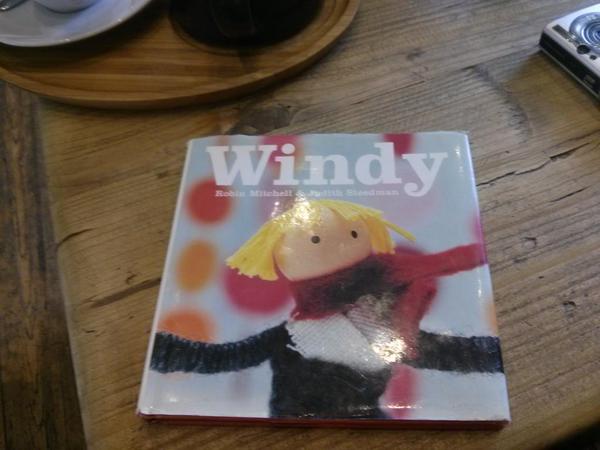 “What a book to discover in a Yorkshire cafe. I want to steal it. No??” I tweeted a couple of weeks ago, delighted to have encountered this wonderful Canadian picture book on a day trip to Ilkley. And I do have a demonstrated history of bibliokleptomania; but no, I determined. The Toast House Cafe in Ilkley was a lovely spot, a worthy home for Windy, I decided. So I left it there for someone else to come across.
But then! The cafe itself joined the twitter conversation I’d been having with CanLit enthusiasts back home about the goodness of Windy and other books in the series by Robin Mitchell and Judith Steedman. “glad u didn’t steal it! I put it in our cafe for others to enjoy. I read it 2 my boys yrs ago.” Oh, how embarrassing. To be caught considering becoming red-handed. And so I tried to pass the whole thing off like a lark, oh, I’d never steal a book, which is a total lie, but at least I didn’t steal this one. (And I hope that no one else does, because I’d absolutely be blamed.)
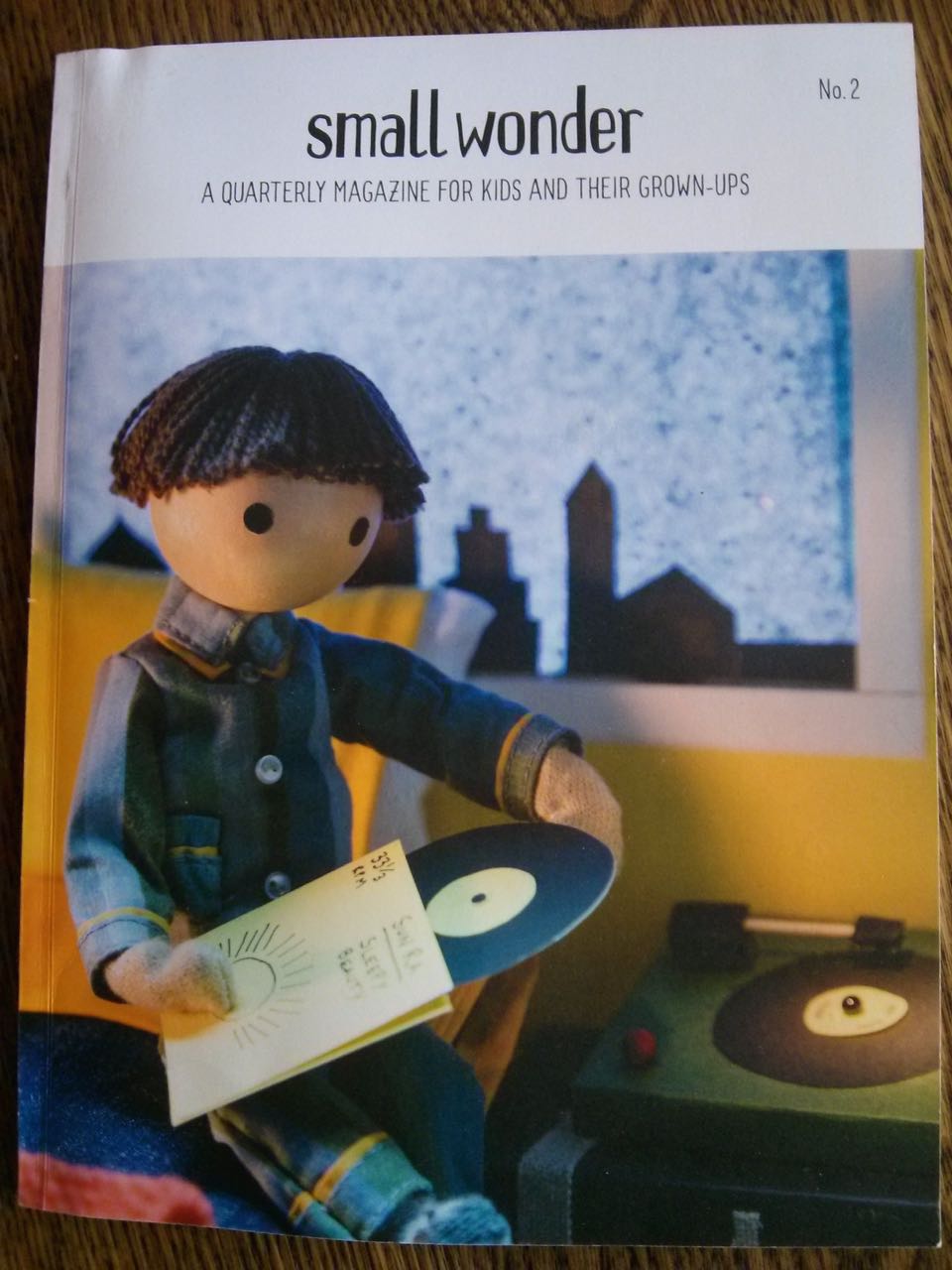 So the creators of Windy got looped into our conversation, and it was here that I discovered that Windy and Friends is now an app. (We downloaded “Sunny’s Dark Night,” and the kids really like it. We will probably get the others.) And from Windy and Friends’ twitter feed, I learned that Sunny is a magazine cover star, and there is such a thing as Small Wonder (subtitled: “A Quarterly Magazine for Kids and Their Grown-Ups”).
So naturally I subscribed, which is far more noble than stealing a book, albeit just as impulsive. But I am so glad I did! Our first copy was waiting for us when we got home from vacation, and it’s just as lovely as I was hoping.
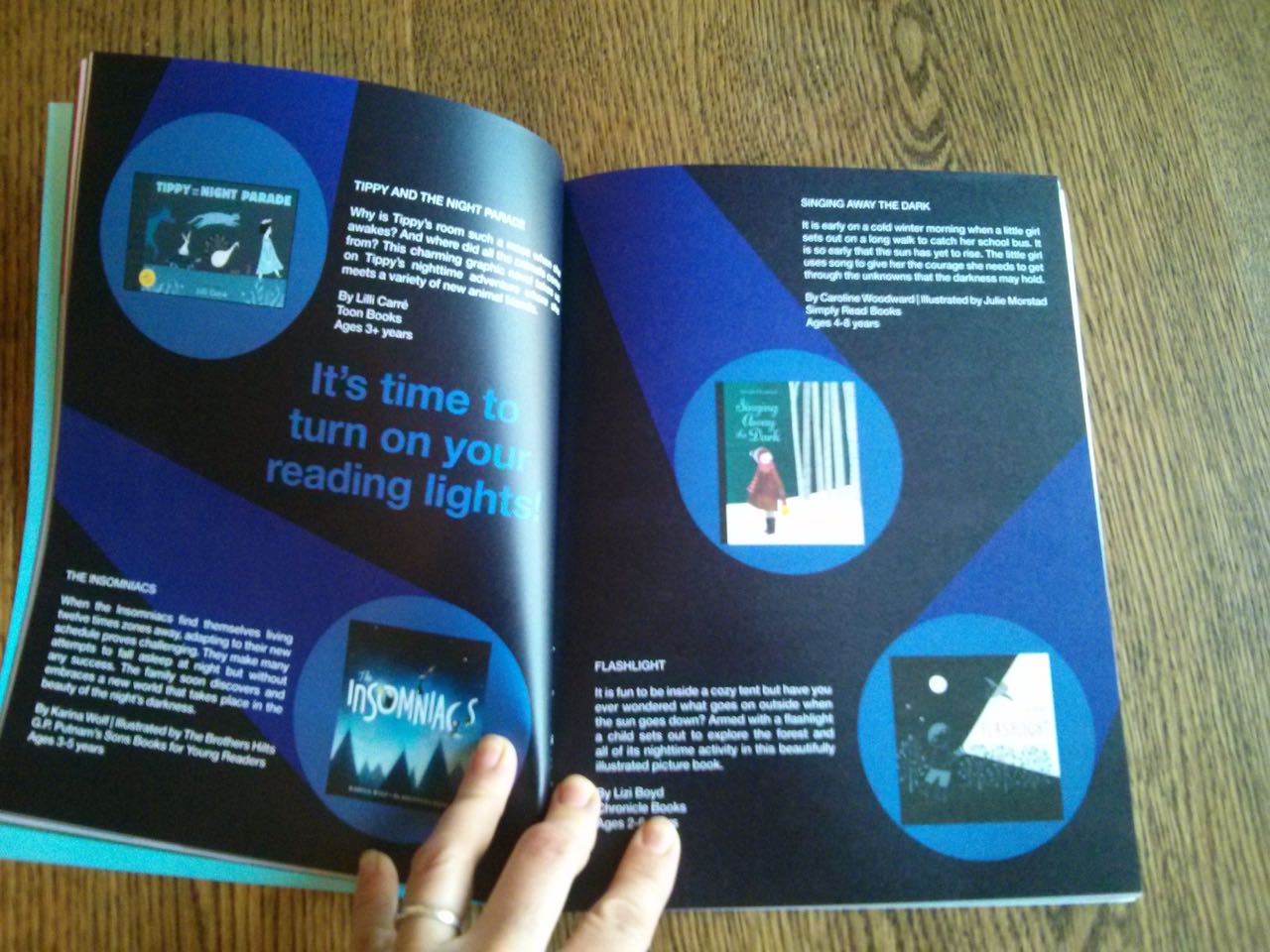
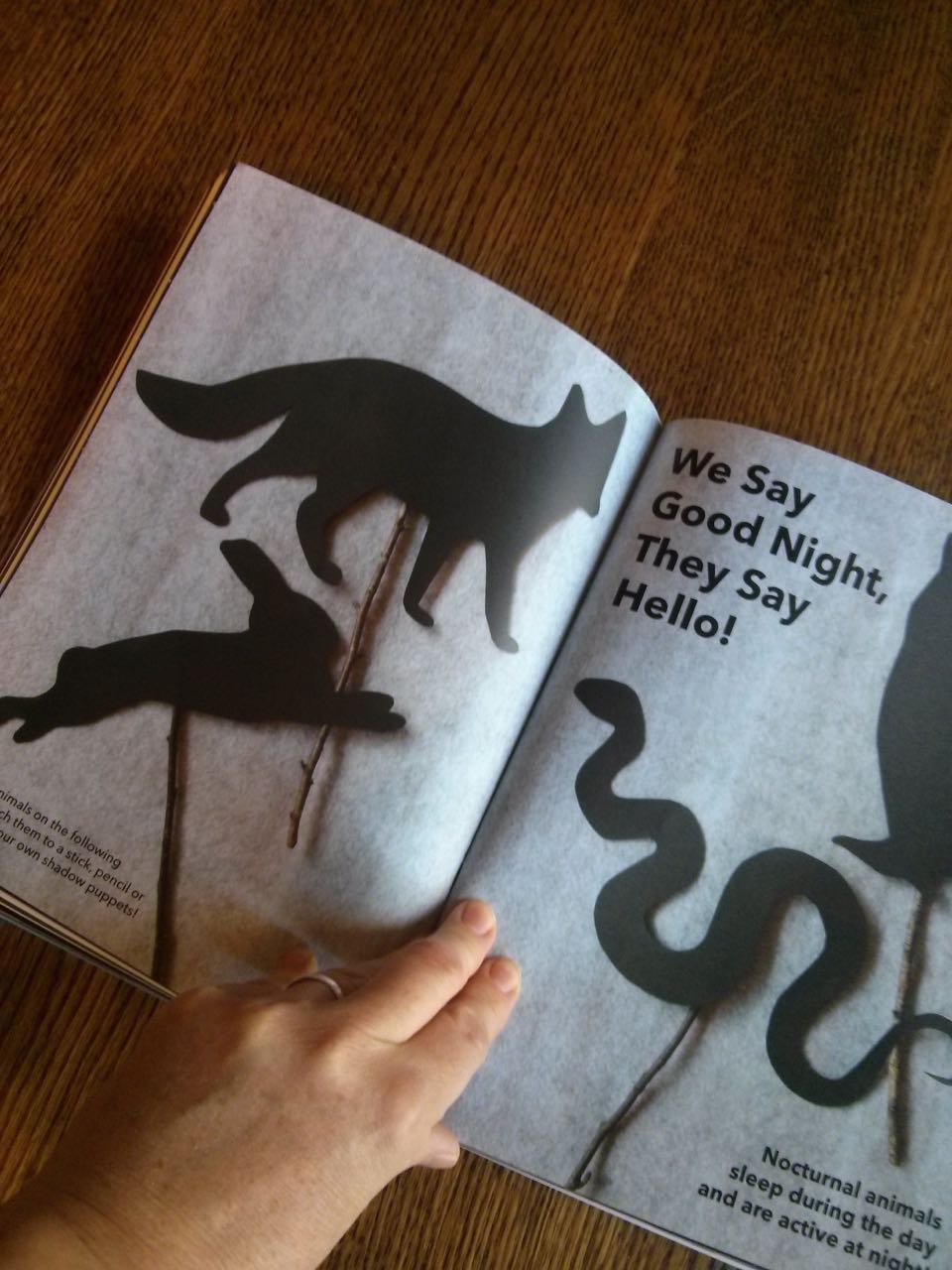
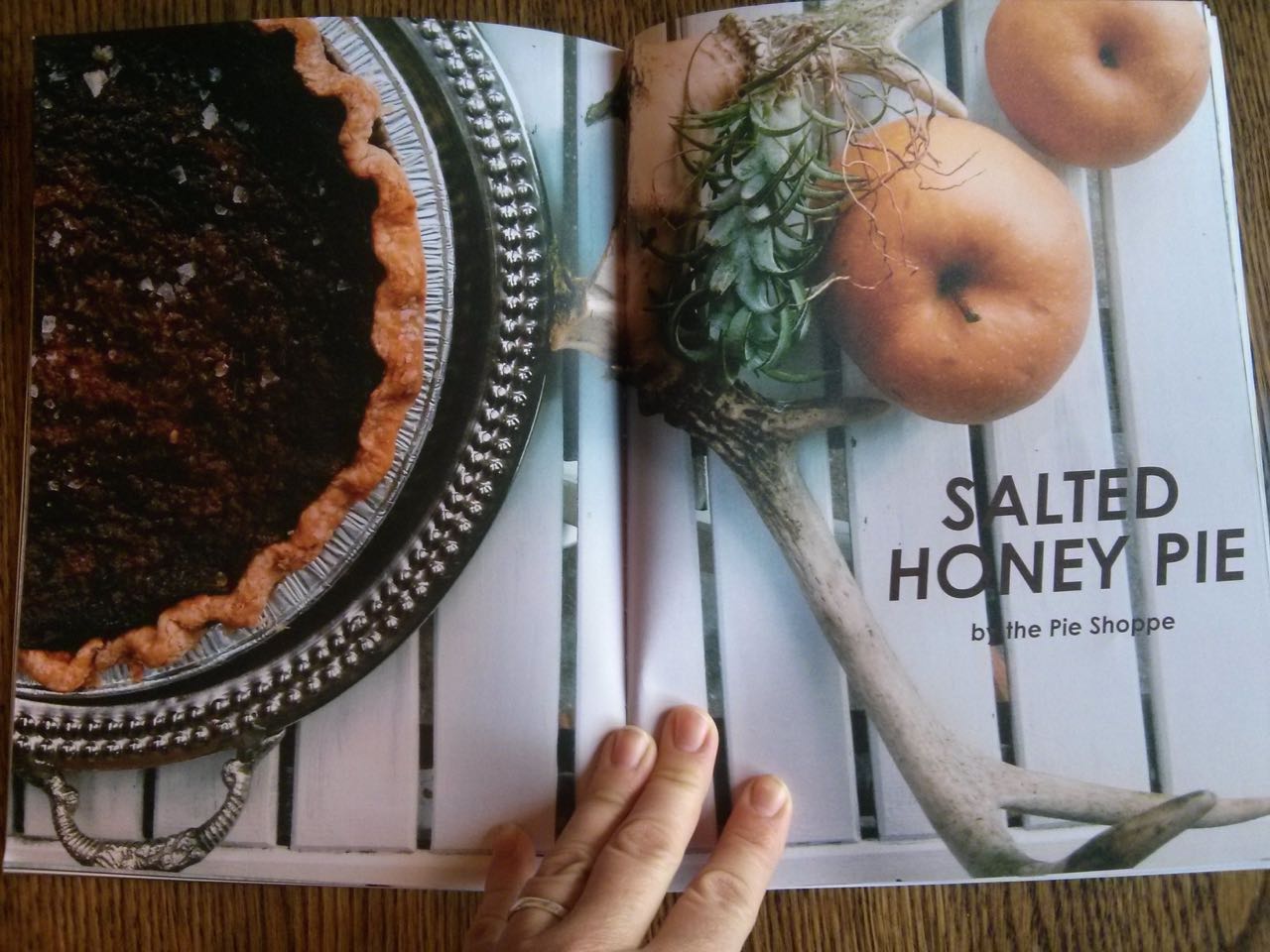
The magazine is a beautiful object with lots of thoughtfulness put into its content. It seems born of an ethos that presumes children are deserving of beautiful things, in addition to stories, adventures and wonder. There is lots of opportunities for drawing, creating, reading and dreaming in the magazine, and the issues are substantial enough that you’ll keep them around for awhile. They also recommend Singing Away the Dark by Caroline Woodward and Julie Morstad, so they clearly have impeccable taste. And pie! There is pie. Plus if you look closely, you’ll see that the pie article AND the animal silhouette feature both have Beatles references in their titles, and I don’t know if that was deliberate, but I’d probably give them credit.
Our first issue is themed for darkness, produced a few months ago when winter was drawing in, and now that winter is done, I’m hoping that means we’ll be getting our next issue soon.
May 5, 2015
Motherhood and Creativity: In Conversation with Rachel Power
 Everything is a circle. I first learned about Rachel Power’s work through serendipity and (what else?) blogging and talking about books. In 2008, the Australian writer and artist left a comment on my blog about the ambiguous ending to Emily Perkins’ Novel About My Wife, and I discovered her blog and her book, The Divided Heart.
At the time, I was pregnant with my first child and so still very much on the periphery of “the motherhood conversations” of which I’d be privy to in the months to come. And so The Divided Heart was my first hint of these, where I first read about maternal ambivalence, the struggle (emotional and practical) for mothers to assert their creative selves, and the myriad ways women find to make it work. It was a hugely important book for me. I read it before I read Rachel Cusk’s A Life’s Work!
And because everything is a circle, The Divided Heart is now back in print as Motherhood and Creativity: The Divided Heart, and where Power left a comment on an interview I’d done seven years ago, I’m now interviewing her—about the book, how it’s changed in its new edition, the ways in which the motherhood conversation has changed since 2008, and how motherhood can connect us to our creative selves and to the world.
****
Kerry: The Divided Heart was one of my foundational texts on motherhood and mothering—I read it while I was pregnant in 2008. Which seems like a lifetime ago now, but I am so pleased that it has found new life as Creativity and Motherhood. The book played a huge role in my own experience of my heart actually not being so divided when it came to motherhood and creativity—you showed examples of how women combine the two, even when the balance is tricky. These women showed me what was possible. So I really like the new title—but how did the title change come about?
Rachel Power: Thank you for those generous comments about the book. It’s very flattering that someone as well-read as you would consider my book any kind of “foundational text”! I know your book has become the same for so many women out there.
 With this new edition, called Motherhood & Creativity, the publishers had some radical changes in mind for the title, which I have to admit I largely resisted. I actually pushed pretty hard to keep “The Divided Heart” in there (it became the subtitle), because I still believe it represents the central drama of the experience for many if not most creative people with children: the desire to be in two places at once; the fear that being properly dedicated to one role inevitably risks neglecting the other. For me, those words introduce the initial question the book is trying to address. But as you say, that doesn’t mean it is full of women who are bogged down by those feelings; rather, it’s full of examples of artists who’ve found ways to forge ahead despite, and sometimes because of, those dilemmas.
As for using the word “creativity” instead of “art” (the original subtitle was “Art and Motherhood”), this felt like a necessary recognition that creativity is an important part of many people’s lives, expressed in different ways, but that doesn’t mean they all identify as “capital-A” artists. That’s why I really wanted craft-maker and blogger Pip Lincolne in this new edition: she has such a strong creative drive—and such a creative approach to life!—but I don’t think she would identify as an artist, as such. I knew that many readers would relate to that.
Kerry: It’s a very different book for me now—not just in title. I’m much more experienced in both motherhood and being creative than I was in 2008, and I relate to different parts of the conversations. How has the book changed for you? Was revisiting it a welcome experience?
Rachel: Like you, of course, I’m much further along in my parenting (my kids are 13 and 10 years old now!), but the issues remain very current to me, so I found it easy to slip back into the mothering and art conversation for the new edition. The demands are different, but just as intense, I find. With my son starting high school this year, I feel like I’m going back to school myself—my weekends have been almost completely hijacked by helping him with his homework!
But one of the main realizations for me, as someone who works full time, is that holding down a day job has been a much greater barrier to creativity than mothering. In the first edition, writer Anna Maria Dell’Oso said that when she was at home with small children she felt much closer to “the centre of her integrity” than when she was at the office, and I totally relate to that now. Finding time for art is a big challenge when your kids are small, but the upside is that in some fundamental way, we are already in a very creative space as parents, even though it’s hard to recognize that at the time.
“Finding time for art is a big challenge when your kids are small, but the upside is that in some fundamental way, we are already in a very creative space as parents, even though it’s hard to recognize that at the time.”
Kerry: What about the book’s actual changes? What else is different in this new edition?
Rachel: The new edition contains around half of the interviews from the former book and the same number again of new interviews. Much like the first time around, I approached women I admire, and was lucky enough to interview one of Australia’s best-loved actors Claudia Karvan; visual artists Del Kathryn Barton and Lily Mae Martin; writers Cate Kennedy, Tara June Winch and Lisa Gorton; musicians Holly Throsby and Deline Briscoe; and craft maker and blogger Pip Lincolne.
The other coup this time around was adding a preface from musician Clare Bowditch, who as an old friend and neighbour of mine, not only witnessed the genesis of this book, but also shared in the early years of child-rearing with me. So apart from my own family, there is really no-one closer to this book than Clare, and her preface is affirming and moving and humbling all at once. I’m very grateful for it.
My introduction and conclusions in the first issue are heavily truncated into one opening chapter in the new book. I had done a lot of research before writing the first edition and basically presented my poor editor with a 140,000-word thesis! This was cut back heavily, obviously, but the new publishers felt that it was still a bit too academic in style. So the new intro is a bit less wordy and hopefully more accessible as a result.

Image by Launch Bubble
Kerry: How did the new edition come to be? What were the signs that the demand for it was out there?
Rachel: The Divided Heart went out of print a while ago, and it was really upsetting me that people couldn’t get their hands on a copy. I was still getting lots of letters and emails from potential readers asking where they could find books, but I only had one copy myself! So it was very exciting to find a new publisher in Affirm Press. Initially, it was just going to be a shortened version of the original. But as we went forward, editor Aviva Tuffield and I decided that it would be good to create a different book, to bring it up to date, and so there was new value for those who already had the original edition.
Kerry: Are you finding the reception different this time around? My sense is that we’re living in a slightly different climate now in regards to talking about motherhood—there is more space for nuance. Though this might be because I’m now in that climate instead of looking on. What do you think?
Rachel: That’s an interesting observation! I think there is definitely more space for nuance in the feminist debate generally, and that we have largely moved on from the dispiriting “mummy-wars” that were dominating the conversation around the time I first published The Divided Heart. Motherhood has definitely taken centre-stage in a way it hadn’t when I had my first child, and so there seems to be less division between the different parts of people’s lives nowadays—and between those who have kids and those who don’t—which can only be a good shift for society, I think. That said, most of the criticisms I’m receiving this time around are the same as last time: chiefly, that this is a bunch of middle-class women indulging their hobbies and complaining about their kids (which is such a tedious misrepresentation of the actual stories it contains).
From the outset, part of what interested me in the subject of artist-mothers was that I saw the unique contribution it could make to the feminist debate, precisely because it is a nuanced issue—both in terms of work/economics and of family/housework. Writer Alice Robinson summed it up beautifully in her recent piece for Overland journal, when she said that “as a stay-at-home parent by day, a writer by night, I am doing what untold numbers of people in each camp, and all those in both, are doing: two challenging but largely unpaid jobs. … each undervalued in the remunerative sense, but fundamental in the cultural.”
“To have a child is to enter into a strange new set of negotiations with society, our partners, our family, ourselves. To also be an artist, it seems to me, is to be dealing with the extreme end of those negotiations.”

Image by Lily Mae Martin
To have a child is to enter into a strange new set of negotiations with society, our partners, our family, ourselves. To also be an artist, it seems to me, is to be dealing with the extreme end of those negotiations, because of the self-driven nature of art and the lack of guaranteed compensation. At a personal level, asserting your need to create; to carve out the time and space that art demands; to feel confident in the validity of what you have to say–requires a special kind of drive and determination for anyone. Doubly so for mothers, whose own interests and desires are expected to be sublimated to the needs of others.
So, in my mind, endeavouring to be both artist and mother raises some of the biggest questions about how we choose to live and view the world: self versus society, partnering versus independence, feminism versus masculine, sacrifice versus self-interest, creativity versus economics… In this way, I think the experience of artist-mothers can speak to the feminist debate at a particularly subtle and sensitive level.
 Kerry: Motherhood is so incredibly interesting, the ideas around it far-reaching and important. I’m thinking about the book On Immunity by Eula Biss, a vast and important sociological text, and in her acknowledgements, she thanks the mothers in her community who made her realize “how expansive the questions raised by mothering really are…”
I didn’t really understand this when I first read your book, when I first became a mother—the ramifications of the ideas you’re talking about, we’re all talking about. (I certainly had no idea that motherhood would be so interesting that I’d end up editing an anthology about it too years later….)
Another interesting thing is that it’s ever in flux. What are the questions and ideas around motherhood that are preoccupying you these days?
Rachel: As you say, mothers are raising the next generation, so their actions and decisions are far-reaching and important indeed! Mothers have a unique stake in the future, and that’s why they are spearheading so many campaigns and movements around the world. In Motherhood & Creativity, writer Tara June Winch, who herself set up onethousand.org (a charity to promote female empowerment), says, “I’ll argue that most NGOs, globally are run by mothers in one way or another.”
 Motherhood is a galvanising force—and one of the best things about writing The Divided Heart was that it connected me to an incredible community of mothers, who think very deeply about the way they parent but also about the world that they have brought their children into. Fathers are there too, of course. But among the families I know, while fathers are very much involved, it’s largely mothers who are still doing much of the logistical work as well as the theoretical thinking behind the parenting—and most of the worrying, sadly!
Personally I have always found mothering hugely confronting; the role presses me to be a stronger, braver, more industrious person than I feel capable of being most days. And we are raising kids in unusually complex times. I’m very conscious of wanting to raise children who feel empowered in a culture that is: 1) largely driven by a consumer-capitalist ethos; and 2) facing potential catastrophe as a result. The big question for me is: how do we raise kids who are critical and creative thinkers, who will make ethical decisions, and who will treat the environment, themselves and other people with respect, when right now all they want is a PlayStation 4 for Christmas?!
I think creativity can play a big role in all of this. I love Pip Lincolne’s comment in the book: “There’s a forgiving, nurturing quality about handmade that should be applied to life. Not everything is perfect, but it was made with good intentions and there were so many little, meaningful decisions along the way. I think that mindful approach is such a good thing and an ace ethos for a family.”
Could there be a better approach to bringing up kids? I reckon Pip has it pretty sorted!
May 4, 2015
Mad Miss Mimic by Sarah Henstra
 I’ve spent the last couple of days enjoying Mad Miss Mimic, the first novel by my friend, Sarah Henstra. It’s not normally a book I would have sought out—it’s published under a YA imprint, and historical fiction—but then there’s that cover, plus I so admire Sarah’s work and intellect. She’s an English Professor at Ryerson University where she teaches courses in Gothic Horror and Fairy Tales and Fantasy, and way back, years before we met again socially, she was my TA for the Literature in Our Time course at UofT, and I never forgot her—not something I can say about most of TAs from nearly 20 years ago.
So I was confident that the book would be smart, and once again the arbitrariness of genre and marketing distinctions are made to me, because I delighted in Mad Miss Mimic. The novel takes place in London during the 1870s, a young woman endowed with good looks and great wealth and she’d be considered a match for any worth gentleman, save the matter of her debilitating stutter and her tendency to compulsively take on the inflection and tones of others’ speech and parrot it back at inopportune moments. But has Leonora finally met her match with Francis Thornfax, a colleague of her brother-in-law who is not unnerved by her outbursts? Alas, she is too smart to be completely won over by his affections, and can’t help noticing shady dealings going on between Thornfax and her brother-in-law, a doctor, whose charity patients keep dropping dead, and there is the matter of her sister’s reliance on laudanum, all this against the backdrop of a series of bombings whose credit is claimed by the Black Glove Gang, acts of terror in protest of the government’s proposed opium ban—which would serve to put a stop to Thornfax’s import business.
Leonora’s affliction (which is imaginary) causes her to be literally silenced in her efforts to hide it, and therefore not so different from most women of her time who were powerless and without a voice In moments of crisis, however, Mad Miss Mimic (the name given behind Leonora’s back to the force which causes strange voices to emerge from her lips) turns out to be a source of strength instead of trouble, and perhaps she is closer to Leonora’s true self that she even realizes—or maybe Mimic needs only needs to be claimed. And all of this is a bit ambiguous, mysterious, and interesting enough to add real depth to the novel, discussed on a symbolic level. Leonora is skirty and she and her talents remain slightly unknowable to her reader, these loose ends worthy of further reflection, all the while a love plot is resolved in a way that is wholly satisfying.
Mad Miss Mimic put me in mind of other books I enjoyed last year: The Miniaturist by Jessie Burton in its vivid historical depiction and Jo Walton’s Small Change series too for its conspiracy theories and bomb plots. For readers who enjoyed these books, Sarah Henstra’s debut novel would be a great suggestion for what to read next.