August 2, 2017
Other Words, Other Summers
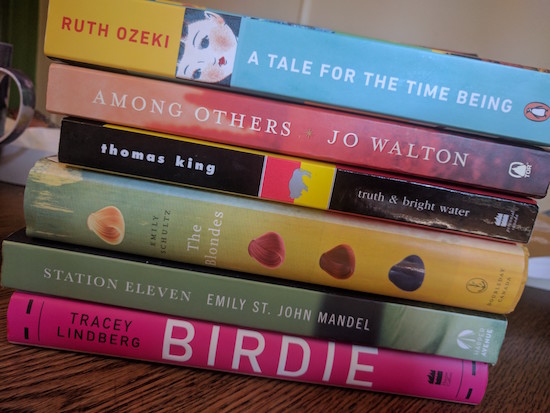
On my CBC Ontario Morning column this morning, my theme was other worlds and other summers, spectacular transporting books you might have missed the first time around which are so timeless that it will never be too late to go back to them. Like this weekend, maybe? You can listen again on the podcast here. I come in at 38.4 minutes.
August 1, 2017
Camping With Louise Penny
I have developed a hammock habit over the last few years, and most lazy summer afternoons you’ll find me in my urban backyard enjoying a warm breeze and basking in the shade of our enormous silver maple. Reading, obviously. And the best thing about a hammock habit is that it can be altogether portable if you’ve got the right hammock, which I do, complete with a foldable frame and a carrying bag. It is the heaviest most awkward portable object imaginable, but it’s mine, and it’s the most essential item in our mountain of equipment when we’re packing the car to go camping.
We’re not natural campers, my family. I’m a bad Canadian and my husband is an immigrant, and so camping (along with ice skating) is an activity we’ve had to work hard to fall in love with—mostly for the sake of the children. But because camping doesn’t involve falling all over perilous slippery surfaces while wearing blades on our shoes, we’ve actually had some luck with this. This summer will be our fourth year pitching a tent out in the wilderness—or rather, more realistically, while my husband is busy pitching the tent, I’ll be setting up my hammock.
The hammock itself is not the only ingredient necessary for a successful camping weekend, however. We need bug spray, and sleeping pads, fire-starters and marshmallows, and we need books. And not just any books. For me, I’ve learned that a weekend camping in the woods is not completely unless I’ve got a big fat Louise Penny novel to be absorbed in. The hammock would be wasted without it.
Miles from the cozy civilization invoked by the fictional Three Pines, with its bistro, B&B, boulangerie and bookshop, I spend our camping afternoons in my hammock wholly wrapt by Penny’s novels, compelled by her character, Chief Inspector Armand Gamache and his call to duty. There will be some sort of crime, either immediately or eventually a murder, and any gruesomeness related to this matter will be abated by the scenes Penny sets in Three Pines, a place as familiar to me as my own neighbourhood is. I pick up these books in anticipation of returning to Three Pines, and to its people, who are complicated, irreverent, brilliant, warm and funny. And there, in the middle of the woods in Ontario, insects buzzing about and sunshine peeking in through the canopy of tall skinny pine trees, there I’ll be.
You can almost smell the croissants warm from the oven, which is saying something, when a fictional redolence can overpower the actual smell of outhouse.
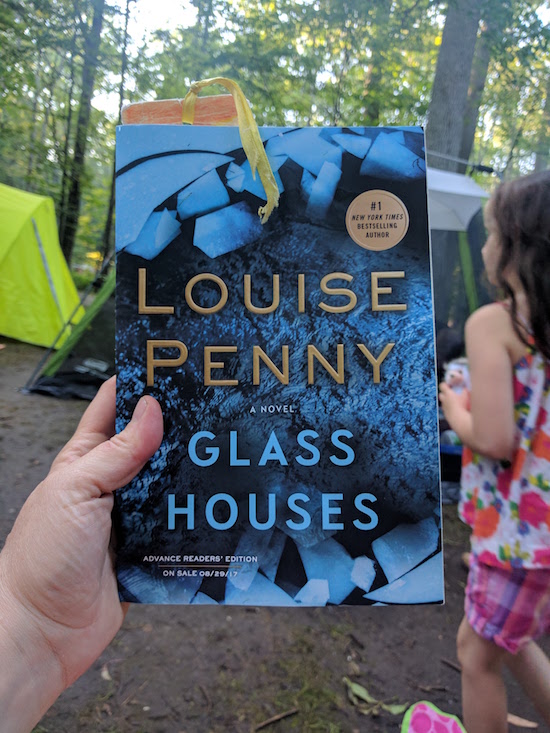
(We had an amazing, albeit bug-infested, camping trip this weekend. Lucky me, I had an ARC of Louise Penny’s new novel Glass Houses in hand. You can see more photos on my Instagram.)
July 27, 2017
Feast: An Edible Road Trip
If might surprise some people to find that I have blogging advice beyond “Blog like nobody’s reading (because often nobody is)” but if you’ve been reading carefully you will also know that I’m a firm believer that a blog needs room to grow and space to wander. And Lindsay Anderson and Dana VanVeller must have known this too when they began their blogging endeavour a few years ago because they gave themselves an entire nation to wander through. Their blog was called An Edible Road Trip and chronicled their adventures (and misadventures) eating across Canada to discover a culinary culture “beyond Kraft Dinner, poutine, Nanaimo Bars, and butter tarts.”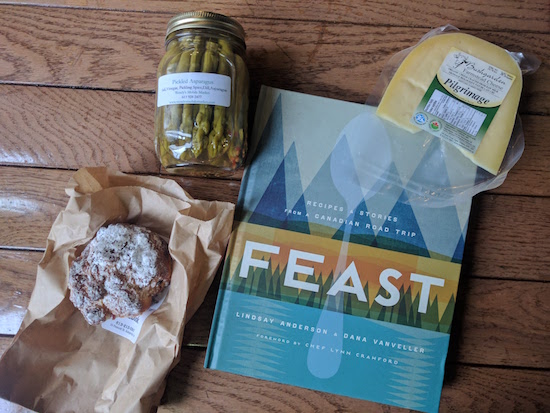
One of the highlights of my spring and book promotion has been travelling to (and eating in!) different places I haven’t spent much time in before. My blueberry scone at the Hamilton Farmers’ Market was legendary, and then the mind-blowing dinner we had in Waterloo as part of the Appetite for Reading Book Club. And it was in Gananoque at the 1000 Islands Writers Festival where I met up with the women behind Feast, the book that grew out of the edible road trip. The book was already on my radar because of the story behind it and also its beautiful design (and you can read their very cool blog post, “Anatomy of a Cookbook Cover”, here). And then I got to listen to their amazing presentation about their journey across Canada and the people they met and the things they learned about—the farmer in the Yukon whose farm you need to travel to via two canoe rides was one anecdote that surprised me and stuck in my mind. Naturally, I bought the book—and their event was spectacularly catered with local farmers’ market fare and the whole thing was totally delicious. Feast, I figured, would be an excellent souvenir.
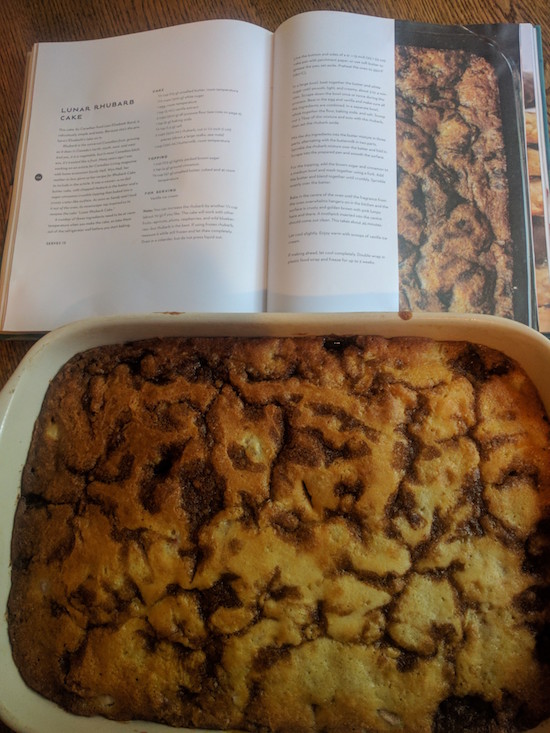
The whole idea behind it was a little bit abstract though, practically speaking. It was May by this point and therefore rhubarb season and I proceeded to bake the Lunar Rhubarb Cake (pictured above) at least three times before June. The recipe doesn’t skimp on sugar, and it won rave reviews at every table at which I served it… But still. A nice cookbook to have, but I wasn’t sure how often I was going to use it. And then we went away for a week in Nova Scotia…
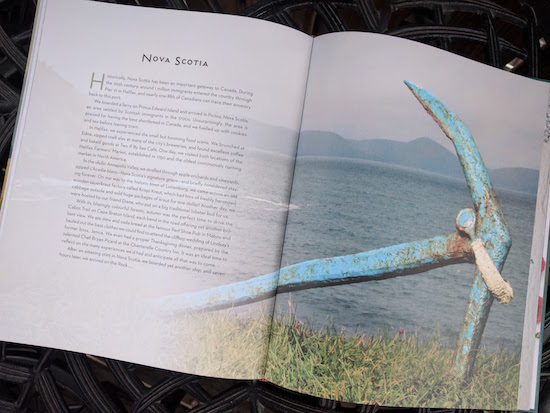
And then suddenly a whole bunch of recipes that had merely existed on the page for me before meant something altogether different. Upon coming home, I reread the Nova Scotia page and recognized all kinds of references and was reminded of the very good places we ate on our trip.
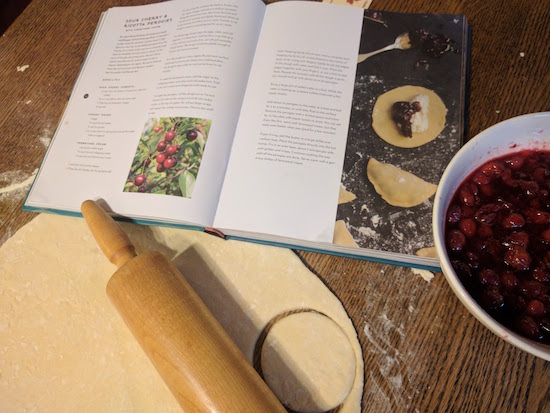
The first thing I made upon homecoming wasn’t from Nova Scotia at all, however, but instead the Sour Cherry Pierogi recipe from the prairies. I found sour cherries at a local green grocer and it sounded so delicious, and so I made them (with help from Stuart who was in charge of construction) and they were SO SO good. And then we got to use the leftover compote for porridge.
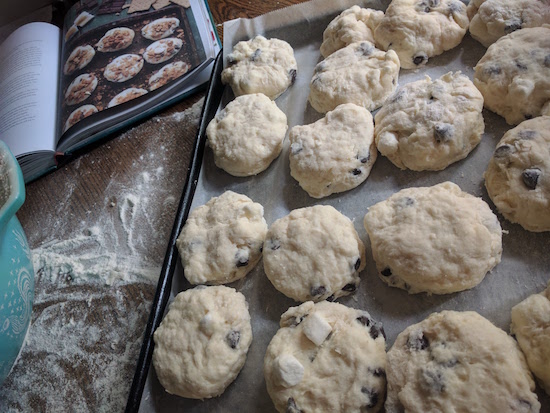
And I’d wanted to make the s’mores scones all along for reasons that should be altogether self-explanatory, but the mission took on a sense of urgency when I reread the recipe and learned it was from the chef at Two If By Sea, whose croissants were so delectable on our trip that we went to Dartmouth twice. So baking these scones was a little bit like a homecoming, even if for a place that wasn’t our home at all—but the food made it all so familiar.
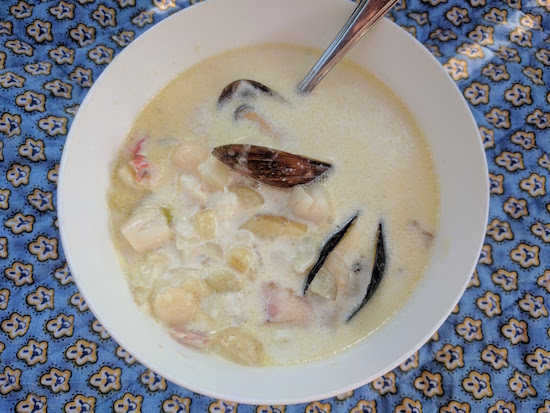
Which is why we made the seafood chowder the following Friday, even though chowder isn’t always the best thing you can be eating when it’s 36 degrees celsius, but we weren’t sorry. I’d got fresh fish at the grocery store that morning and even though it wasn’t the fresh fish we’d become accustomed to (Stuart ate scallops in Lunenberg that he might never get over—in a good way) it was incredibly delicious and made us miss Nova Scotia a little less. And we’ve still got the oatcakes to make, and a few other Atlantic items to try.
And then after that? Well, between the book and our trip, we’ve never been so inspired to and travel to another new part of the country. And in the meantime we’ll be cooking from Feast because Canada is delicious.
July 25, 2017
The Ravines of Smeared Disarray
“English, strictly speaking, is not my first language by the way. I haven’t yet discovered what my first language is so for the time being I use English words in order to say things.”
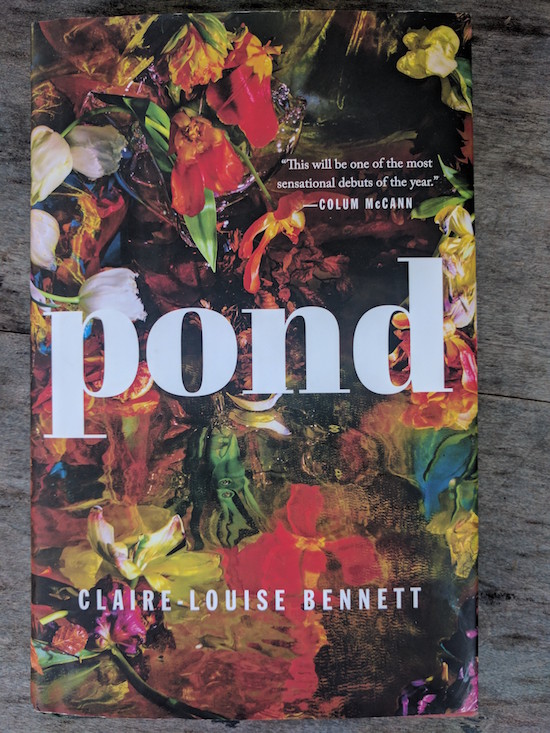
Last week I got tired of narratives that were all too predictable, and so I decided to pick up Pond again, the little book with the gorgeous cover that has been shelved on my staircase since last August. My staircase is book limbo, the books that aren’t to be either shelved or given away. They’re the books I haven’t quite finished with yet, although there is a chance they could linger in unfinishedness in perpetuity. I bought Pond last summer after reading A.N. Devers’ review in which she makes connections from Woolf to Walden, and decrees the narrative as “muddy”:
“Muddiness is not typically a positive description for a narrative, but this mud is sparkling, full of mica and minerals that glitter with color when the sun’s rays hit. It’s through this glistening mud that Bennett’s readers get to mudlark, mucking about in prose that is alternatively deliberate and crisp, surrealistic and unknowable, to find real gems of observation and language.”
I recall that I liked the book well enough, but couldn’t remember any more about it. It hadn’t satisfied me. If it weren’t for the absolutely brilliant cover, to be honest, I might not have even read it all, let alone read it again. (The UK cover was completely unremarkable, not a bit of mica or mineral. It was also marketed as a short story collection there, but as a novel upon its US publication, which is interesting to consider, and also how different the two books must be regarded by different readers as a result of these things.) Anyway, I picked it up again, finally, and was quite delighted to discover inside a postcard I sent myself last summer, which seems sort of fitting with the book’s interiority, and then I got to use the postcard as a bookmark.
The book is curious and amusing, domestic minutia. Disorienting—nobody draws us a map here. The narrator lives in an old cottage on an estate near the coast of Ireland and in one of the stories a neighbour is having a wedding, for which the narrator gives them bunting. And that the narrator owns bunting at all seems kind of incongruous from what we know of her—when does she string her bunting ever—but she’s not telling us everything. In fact, it’s the telling she takes offence to. She is bothered by a sign that’s been put up beside the pond on the property, purportedly to stop children from toppling into it. A sign reading, unsurprisingly, POND: “As if the Earth were a colossal and elaborate deathtrap. How will I ever make myself at home here if there are always these meddlesome scaremongering signs everywhere I go.”
All of which is to say that nothing is labelled in Pond, and everything is mutable, in particular the line between indoors and out, home and away. It’s an uncanny narrative. The lines between then and now are blurry too, in this place so steeped in history, tiresomely so. The thatchers come to do the roofs, and everyone is very excited, but the narrator finds these workers offensive and disturbing. They bother her view. “A leaf came in through the window and dropped directly in the water between my knees as I sat in the bath looking out.”
So yes, I was thinking of Walden and Woolf, and the person who did Thoreau’s laundry, of course. But in the chapter titled “Control Knobs,” I started thinking about Barbara Pym. And about this is a book that contains all my favourite things, actually—jam and bunting—but in a kaleidoscopic fashion. The familiar made unfamiliar, of course, but still, one is home, in a readerly sense. The chapter is decidedly Pymmish in its fixation on ordinary details—the objects assembled in bowls on a window sill, for example, and how light shines through a jar—that are standing in for something deeper, darker and more resonant. Bennett writes, “There are a number of regions in any abode that are foremost yet unreachable. Places, in other words, right under your nose, which are routinely inundated with crumbs and smidgens and remains. And ill-suited specks and veils and hairpins stay still and conspire in a way that is unpleasant to consider, and so one largely attempts to arrange one’s awareness upon the immediate surfaces always and not let it drop into the ravines of smeared disarray everywhere between things….”
This is the chapter where the narrator is referring to the knobs on her stove, which is not a proper stove, but a kind of hotplate one finds in a bedsit, “the two-ring ovens [that] are synonymous with bedsits… One thinks of unmarried people right away, bereft secretaries and threadbare caretakers, and of ironing boards with scorched striped covers standing next to the airing-cupboard door at the end of the hallway.” And then she takes it darker, suggesting that part of its design as an implement for people who live alone in small spaces isn’t just about space considerations, but that one couldn’t kill oneself with such a device, if it came to that. “I certainly couldn’t get my head into my cooker without getting a lot of grease on the underside of my chin for example—and it stinks in there.” Even suicide—as are most things for this narrator—is a matter of practicality.
Strange as though her point of view might be, Pond’s narrator is a sensible woman, preoccupied by compost, which she is meant to empty often, but there isn’t time for that, and so it piles up. She is aware of decay is what I meant, (and of course there is the leaf through the window—this idyl is not perpetual spring), and the bowl gets empties, or else it doesn’t. She refuses to be pinned down. As might be the case in a novel that used to be a collection of short stories, this narrator contains multitudes. “The postbox gets damp, you see, causing letters or so to pucker and leak, so occasionally I am quite diligent about emptying it and other times my mind is such that I just don’t care enough about what happens to other people’s post.” (Do you love that???)
This woman is alone, and unabashed about being not understood, but she is all right. She is nutty, but she had friends, and parties, and lovers. People stop by and sit on her step for a chat, and she has a pot of parsley growing in soil there, though don’t take that to mean she has a propensity for growing things—she bought it sprouted from a nearby supermarket where it was packed in a plastic carton. She isn’t lonely. She has free time, it seems, but “there are always things that must be done.” Check the postbox, sweep the dust out—because the outside keeps on coming in. And she has one of those doors that open in half, after all, so this is inevitable. The home is not apart from the world, but part of it, and therefore the things we do to care for our homes is work of the world as well. The things you could write about a kitchen hearth are as profound as thoughts about a (Walden) POND just say. It makes me think about doorsteps, and thresholds, and the liminal, and sublime.
Strange and surreal too. I’m still not done with it. I’m feeling like Pond might be going back on the stairs, for another day down the road when I want to read a postcard to myself and to have the ordinary and obvious quite complicated. Like housework, it’s a task that will never be finished, a work-in-progress, the stuff of life.
July 24, 2017
Lost Umbrella Empathy
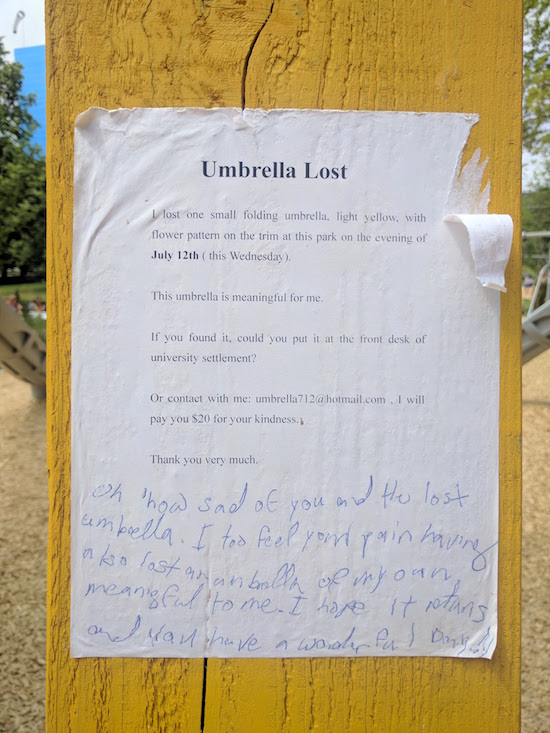
Avid readers here at Pickle Me This will remember that I’ve been keeping track of lost umbrellas in literature for some time now, whose authors have included EM Forster, Virginia Woolf, Cordelia Strube, Barbara Pym, and more. I think the sign I saw in a park yesterday counts as literature, don’t you? Particularly the line, “The umbrella is meaningful to me.” I know all about it; I’ve had many a meaningful umbrella in my time. Clearly I’m not the only one, as the sign’s response makes clear. Umbrella empathy, it seems, is endemic. Oh, I do hope her umbrella will be all right…
July 21, 2017
Mitzi Bytes in the World
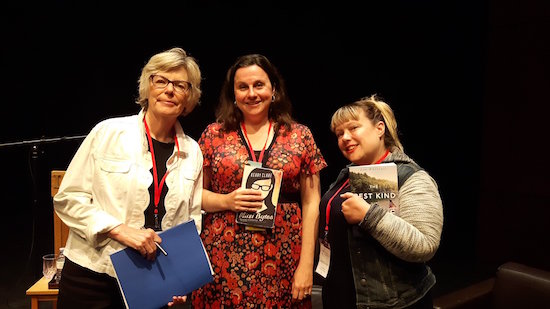
A thing I never had sufficient appreciation for before I became an author is the the work of literary festival volunteers. I’ve attended festivals as a reader, and always had the general impression that these were the kind of events that just kind of happened. But this spring I’ve learned that they only happen because a lot of people work really tirelessly to make it so, and this was definitely the case at the Lakefield Literary Festival last weekend, which was such a pleasure and an honour to be a part of. Having grown up down the highway from Lakefield, the festival has always been on my radar, and then to be invited for an event with Zoe Whittall and Marni Jackson, whose books I enjoyed so much last summer, was utterly fantastic.
Our event was such a pleasure, and I think it wasn’t just me who enjoyed it—you can read about it here. On Saturday morning I taught a session of my blogging workshop, which was made so excellent for me by the engaged and interesting people who’d signed up to be part of it. And while that was happening, my husband and children were enjoying the children’s events. Later that day we’d all head back to the festival for the reception, with delicious food and a perfect ambiance. There were other great events going on all weekend, and we enjoyed our time at the festival so much.
In other news, the Mitzi Bytes e-book (at Kobo or Kindle) is on sale right now for 4.99 as part of Savvy Reader’s 50 Book Pledge Deal. The lovely Theresa Kishkan wrote about how Virginia Woolf haunts its pages in a gorgeous post about summer reading. And I was so happy to see the book reviewed in the Tri-City News as part of a round-up of summer reads, along with a spread of other books that I’ve thoroughly enjoyed in this past while. Librarian Kathy Johnson writes, “This is a dishy and modern Harriet the Spy for an adult audience.”
July 18, 2017
The Weekend Effect, by Katrina Onstad
 The very best phone I ever had was a little red flip phone which was ahead of its time in 2004, but this was Japan where all the phones were from the future. The phone fit perfectly inside my hand, and I remember the grip of it, the ringtone, how coloured lights on the outside lit up when it rang, and mostly what I remember is standing on the train platform at the beginning of another week at work and sending a text to Stuart (who was not yet my husband) that would say something like, “Thank you for another excellent weekend.”
Part of this is that we were living abroad, and I’d been doing so for a few years by then, which had got me into the habit of making the most of my time in a place that wouldn’t be home forever. Part of it too was that we had very few holidays and long workdays, and we were living in a culture that draws a firm line between work and leisure, although with the latter pursued with the same regimented approach as the former. There is nothing casual about leisure in Japan—pursuing hobbies seemed to be more important than actually having passion for the hobbies one is pursuing. While we were living in Japan, I took up yoga, French, cycling, pickling, hiking, and breakdancing, all with varying degrees of failure, and actually contemplated spending a week in silence at a Buddhist retreat, but couldn’t get the time off for that. And the same determined sense of openness and possibility permeated our weekends, which were not actually the weekend, but fell on Thursday and Friday, if I recall correctly. “We take train trips like they’re vitamin pills,” I noted in a poem I wrote about that period, and it definitely helped that the trains were cheap. And so off we’d go on our days off on various adventures, always taking care to return with omiyage, as well as a story to tell.
And so this is the ethos we’ve brought with us through the years, a serious approach to the weekend. I figured that in her new book, The Weekend Effect: The Life-Changing Benefits of Taking Time Off and Challenging the Cult of Overwork, Katrina Onstad would be preaching to the choir, but I picked up the book anyway because I’ve been a fan of Onstad’s writing for as long as I’ve loved weekends. “Weekends are my religion,” I wrote in an instagram post to this effect, somewhat sacrilegiously, I figured, but then I was stirred to encounter in the book on Page 16, “The outline of the weekend is etched in the sacred.” Most religions, Onstad writes, exhort a day of rest—Muslims pray and congregate on Fridays, Jews on Saturday and Christians on Sunday. Perhaps I’m more religious than I know.
Onstad begins her book with history, with the weekend as a labour issue whose origins are much more recent than I would have imagined. Weekends are also an issue of class and consumption, and she explores the idea of leisure and its own changing history. And leisure remains much of the focus of the rest of the book, as Onstad considers what might give a weekend meaning—connection, volunteerism, rest, religion, sports, nature—and those things that might detract from it—shopping, housework, the internet, binge-watching TV. Onstad travels around North America speaking to people who are reinventing the weekend, pushing its limits and making the most of their time off, to demonstrate how the rest of us might do a better job of doing so. And even for me, someone pretty weekend-devout, there was lots of food-for-thought here about how we might make better use of ours, which matters, because—as Annie Dillard wrote—of course, how we spend our days is how we spend our lives.
We’ve got two things on our side in our family—the first is that I work from home with flexible hours, which means that I can get our household chores out of the way during the drudgery of Monday to Friday 9-5 (although this also means that I’ve spent plenty of time on the weekend huddle over my laptop on a deadline, but sometimes that the price you pay). The second is that our children are not particularly sporty and even if they were, we don’t have a car or the inclination to spend those precious weekend days ferrying them to hockey arenas and gymnastics tournaments. There is an upside to the fact that no one in our household possesses the physical prowess to turn a cartwheel, and so it goes. This winter, we didn’t sign our children up for anything, which meant that we had free Saturdays—for things like the neighbourhood community cleanup, and marching with placards on International Women’s Day, and it gave me a real appreciation for the possibilities of openness and where a single can take you—or even two.
July 13, 2017
Nova Scotia Dreams
We went to Nova Scotia for the same reason we go anywhere, which is to say that it was bookstore-related. And also that I have a very indulgent family, it is true, who are willing to come along on these bookshop adventures, even if they’re not quite as crazy about bookshops as I am (and to be half as crazy about bookshops as I am is a lot of crazy to ask of anybody).

But the thing about bookshops is that are frequently located in interesting places, which makes bookshop adventures about more than just the bookshop. They are also about snacks, and lunch, dinner, croissants, good coffee, playgrounds, picnics, toy stores, and more snacks. In this case, they were also about the ocean, playing on gorgeous beaches, seeing big ships in Halifax Harbour, getting so close to PEI that the road turned red, seeing a bear and a deer by the side of the road on the very same day, collecting seaglass, getting sunburned, and eating lobster and all the seafood chowder, and getting a write-up in the Tatamagouche Light.

We went to Nova Scotia because Sheree Fitch had opened a bookshop there, Mabel Murple’s Bookshoppe and Dreamery, in River John, and also because the rest of my family is made up of new Canadians (i.e. nobody has been a Canadian for more than a handful of years) and we wanted to explore a new part of the country. And so as the rest of the country was celebrating 150 years of settler-colonialism, we were up in the sky above it all, which seemed a lot better than the alternative. We also got to see the giant duck from the air.

Mabel Murple’s was built in an old granary, and it was full of colour and books and magic. The books were terrific, the vibe incredible, and the way the sun poured in through those windows. The carpentry was the handiwork of Fitch’s amazing husband, Gilles Plante, and I suspect it was Sheree who supplied the dreams and whimsy…and the colour. The place was enchanting, and while my children have seen a lot of bookshops in their time, even they were impressed. Outside the shop in the sand, someone had scattered tiny purple sparkles, and Harriet and Iris were busy trying to capture some. Opening Day was also the Wordplay festival, so we sat down on our picnic blanket and took in music and readings, plus there were sheep, and a goat, horses and a donkey, a shed that had been painted purple and transformed into Mabel Murple’s house and we were all quite delighted as we peered inside.

And then we got to meet Sheree, who we met for the first time when Iris was an infant and Harriet was four (remember that?). Sheree, who has the most remarkable ability to make a person feel like the most special person in the world. And there were hundreds of there who came to see her, and I think we all came away feeling exactly that way. 
And then we drove up the road from Mabel Murple’s to Cape John, because we hadn’t properly seen the sea yet. Later we’d discover that it’s one of the best beaches in Nova Scotia for finding sea glass. We found some lovely pieces, but mostly just revelled in the goodness of putting our feet in the ocean, feeling the sand and stones beneath them. The sparkles on the wave, those clouds, and that sky. It was one of those holiday moments where we’re all thinking, “This is everything everything everything.”

We were fortunate to get the use of friends’ beautiful home in the North End of Halifax for our home base during our visit, and we explored the city with such pleasure. Fantastic meals, fun by the harbour, the Africville Museum, the Discovery Centre, the Farmers’ Market, the Central Library, Woozles and The Bookmark, and so much more. 
We spent a wonderful afternoon at Crystal Crescent Beach, with white sand and blue water that could almost trick you into believing that you were in the tropics—except the water was cold. 
We loved the Public Gardens, which reminded us all vividly of the book Mary Poppins in the Park, which we read not so long ago, because there was a park keeper and bylaws and everything. It was pretty magic and we got ice cream, and were given a tour by Rohan Maitzen, who I’ve been a fan of online for awhile now and it was very nice to meet properly in real life. 
Tragedy struck on our final morning in Halifax—we ran out of cereal (oh no!) and therefore had to have our breakfast at Two If By Sea in Dartmouth, whose croissants we’d tried early in the week and they were so extraordinary that we had to make a return trip. Sour cherry cheese, guys. It was seriously the most delicious thing ever. 
Someone threw up on the way to Peggy’s Cove, as you do. 
And then we were in Lunenberg! UNESCO World Heritage Site, BABIES! 
There was lobster dinner to die for, and then we spent the next morning with Hirtles Beach to ourselves (the puke bucket subs in nicely for a sand pail, FYI) which was so magnificent (even with grey skies and shrouded in fog) that we felt like we were in a story. 
And speaking of stories, we got to visit Lexicon Books, where I’d be doing a reading that evening. I’d seen photos of the store on social media, but they did not even come close to how great the space was in real life, and how good the books were. 
So there was more, squids in the street, and our excellent B&B, and incredible things to discover ’round every corner in Lunenburg.
The reading that night was terrific, and I was pleased to be there with Johanna Skibsrud and Rebecca Silver Slayter—and I had a good time reading Rebecca’s novel In the Land of the Birdfishes for the rest of the weekend. 
We stopped in Mahone Bay on our way to the airport, to get sandwiches and oatcakes for the plane, and for one last bowl of chowder, not to mention a quick look for sea glass in search of some elusive lavender glass. Which was not meant to be. Next trip, I guess? I hope so.
Quick! Somebody open up another bookshop….
July 11, 2017
Mitzi Bytes in the World—and in the Sun

“You’ve got to have a long view,” is a thing I told a writer last year who was troubled that her book had not been the explosive sensation she’d been hoping it would be. From a reader’s perspective, this seems obvious—there is no such thing as a book best-by date and the number of times it’s taken me ages to finally pick up a book I’d fall in love with is kind of preposterous. But for a writer, there is pressure, for a book to be a hit the moment it’s out of the gate, and while it’s true that there is a limited window in terms of media coverage and award eligibility and things like that, these aren’t actually the literary connections that matter. And now I keep having to deliver my own advice to myself, to remember that the life of a book is long, serendipitous, sometimes subtle, and always surprising. And while my book is now old news as new releases go (literally, so last-season), it’s continuing to have adventures out in the world and I find this so delightful.
And first, if you’re looking to come along on a Mitzi Bytes adventure, tickets are still available for my event at the Lakefield Literary Festival this weekend with Zoe Whittall and Marni Jackson. (I am also teaching a blogging workshop on Saturday morning.) Having loved both Marni and Zoe’s books last summer, it’s especially exciting to be appearing with them on Friday—for it’s a long way from the screened-in porch where I devoured Zoe’s book to a seat alongside her on the festival stage. (!!)

Last Friday, I had the good fortune of reading from Mitzi Bytes at Lexicon Books in Lunenburg, NS, which is one of the best bookstores I’ve ever been to (and we both know that I do get around). It was a terrific night with a packed house, and the good company of the brilliant Rebecca Silver Slayter and Johanna Skibsrud, who were kind enough to include me in their event. I’m so grateful to store owners Alice, Jo and Anne-Marie for having me—and to Jo in particular who was actually reading my book as I came into the store, which is a highlight of my life.
Elsewhere, Mitzi Bytes is featured in the August issue of Canadian Living, as “a compelling look into the personal consequences of the digital age.” One of my favourite readers and writers (and my friend!) Sarah wrote beautifully about the novel on her blog, Edge of Evening (and apparently I stole her life—more about that later…). Katy MacKinnon writes a great piece on the book at The Winnipeg Review, and they declare it a “fun” novel about the capacity of women to be more than just one thing—exactly! And long-time blogger Danielle Donders writes a fantastic review of the book here, which thrills me to no end because long-time bloggers “get” this book in just the way I want them too—as a celebration of the history and evolution of women in blogging, the communities and connections blogs created, and how these blogs have helped so many of us define our sense of self.
She writes, “…a book with a blogger as the protagonist released in 2017? How delightfully anachronistic. And yet, the story feels surprisingly current and relevant today.”
And just a reminder that the #MitziIntheSun giveaway runs until July 31. There’s still time for you to share your sunny Mitzi pic for a chance to win an excellent summer reads gift pack (which I will make sure to get to the winner before summer is gone…).
July 10, 2017
Hunting Houses, by Fanny Britt
 Here’s my true and somewhat embarrassing presumptuous confession: if I were a Governor-General’s Award-winning author, translator and playwright (with more than a dozen plays to my name) then Fanny Britt would totally be my Quebecois alter-ego. I started considering this idea when I published the non-fiction anthology The M Word: Conversations About Motherhood in 2014, and learned that the year before Britt had published an anthology of essays about motherhood called Les Trenchees, illustrated by Isabelle Arsenault—who had also illustrated Britt’s award-winning graphic novel, Jane, the Fox, and Me. I even bought an ebook version of Les Trenchees, although I can’t read French, but I figured if I wanted to read it hard enough I’d figure out how, although I never did. But no matter now, for Fanny Britt’s thoughts on womanhood and motherhood as expressed in her acclaimed novel Les maisons are now available as Hunting Houses, translated by Susan Ouriou and Christelle Morelli. A novel I read on the first two days of my holiday last week and loved completely, and also I hope there is a fictional world somewhere in which Britt’s protagonist Tessa and Sarah from my novel Mitzi Bytes are sitting in a kitchen having the most delicious gossip.
“There’s some solace in thinking your house will live on outside you, like an extension of yourself, a promise renewed no matter the trials or failures, bestowing sudden meaning on sorrow. Personally, I have a hard time swallowing the whole idea because I have no desire to see others blossom where I wilted—but then I’m not that nice a person.”
But then Britt is that kind of writer, I think. The writer who makes you feel as though you’re privy to some incredible intimacy, or even that she’s written her book with the most uncanny regard for the contents of your soul. I am sure I’m not the only reader who’s come away from Hunting Houses imagining that Britt and I have some kind of spiritual connection, that in some actual kitchen we could be terrific friends.
Anyway, it’s always a kitchen, right? Domestic realms. Kitchens and nurseries. Rooms matter, in particular because Hunting Houses’ Tessa is a real estate agent, an occupation that gives her curious access to other people’s lives. Although it’s in the laundry room where the story begins, where Tessa is being shown the house of a new client, Evelyne, whose selling her house due to divorce. “I don’t yet know that I’m at his house,” is the novel’s first sentence, he being Evelyne’s soon-to-be-ex, who Tessa encounters on a subsequent visit. An old flame of Tessa’s, a mostly unrequited seemingly inconsequential relationship, but one that arrives on the tail of adolescence and just before a jarring trauma, so that she never entirely gets over him, Francis. And then suddenly here he is all these years later, and the two of them make plans to meet.
Is she happy, Tessa, in her life? Selling houses becomes a metaphor for the hollowness at her core, a career she came to after a failure to become a professional singer, and then an early voyage into parenthood, which comes to define her. In a way it doesn’t to her husband, Jim, a trombonist, who has achieved a coveted job in an orchestra. But motherhood being not a full enough answer to the question of how a woman spends her time (as I write about in Mitzi Bytes; as Britt writes, “Is Tessa really going to spend the rest of her life working in a bookstore and having babies?”), Tessa requires something more, and so there is real estate. But there is also swimming lessons, and driving her children to school (and fitting awkward projects just-so into the trunk of her car), and Tessa is also in charge of the sweets on sale at her children’s school’s science fair.
“There’s the organizing committee and its numerous meetings, the first one usually held on a dark windy Wednesday November evening during which no one has anything to say about an event to held months later, but it’s the main source of social interaction for some parents, so I go (one out of every three times) since I don’t want to lose my kingdom.”
There is also Tessa’s best friend Sophie, who’s spent ages trying and failing to get pregnant, and memories of their youth together. And Tessa’s feelings about her life and about motherhood are further defined by her relationship to her own mother, which is complicated. Years before when Tessa was small, her mother took Tessa and her brother and fled her small town marriage and world for a single, free but hard scrabbling life in Montreal—and it’s interesting to read about motherhood from the perspectives of daughters whose mothers aren’t 1950s archetypes, a generation skipped. To be the daughter of a generation of women who made the breaks and took the chances, but learned that these kinds of risk aren’t necessarily the answer to every question. That life is much more complicated than that.
With shades of Virginia Woolf and Rachel Cusk in A Life’s Work and Arlington Park (but less annoying), Hunting Houses is the story of a few days in a life, and it also moves in and out of years. It’s a taut read and its momentum comes from Tessa’s voice and the surprising nature of her perspective, and also from the suspense of will-they-won’t-they as she prepares to meet with Francis again. It’s about the unflagging interestingness of other people’s lives and other people’s houses, and the lives we could possibly lead if we came unmoored from our own. “It was the blessed hour when lights go in houses and curtains have not yet been drawn.” Stories, like lit windows, illuminating countless other worlds.






