December 17, 2025
December Enthusiasms

My final “Enthusiasms” newsletter of the year is out! It includes some VERY DRAMATIC NEWS about the whereabouts of my Books of the Year list, and also a link to my recent spot on CBC’s “The Next Chapter” talking about whether literary awards are a scam (spoiler: UH HUH). Read it all here!
December 11, 2025
Castaway

“But I don’t know if you can write a book. I don’t know if I can write a book. I don’t know if I can write THIS book… A writing life, I’ve come to believe, is a yearslong process of casting away everything you once believed for sure.”
New nonfiction from Elizabeth McCracken, A LONG GAME: NOTES OF WRITING FICTION. As wonderful to read as any book by Elizabeth McCracken. I loved it so much. The least annoying book on craft you’ll ever encounter. Or maybe it’s just me, and how much I identify when she writes “(The subtext of all my writing is LOVE ME.)”
December 10, 2025
Gleanings

- each song filling the blue space as I swam my slow kilometer and I kept waiting for one song that I haven’t heard in years and it wasn’t on the list so when I came back home, I found it.
- Joining the silent book club helped me reconnect with the genres that brought me joy before the days of university and seminary. I’ve enjoyed a biography of one of my favourite actors, reread a novel that piqued my attention as an elementary school kid, and now I’m reading the classic Jane Austen novel Pride and Prejudice in anticipation of trying my first murder mystery novel The Murder of Mr. Wickham!
- What if you cherished yourself, I asked my reflection in the bathroom mirror at school, one day last month. It knocked me out.
- I hear this often from these old ladies, a resigned sigh, “but …” they say shortly after sharing their grief, “what can you do?” Perhaps in resignation, perhaps a genuine question, perhaps mostly, the deepest of surrenders, a daily, moment to moment knowing that we can’t escape. No matter how hard we try or how advanced we get or how much we choose to distract ourselves, there’s nothing we can do … it, all of it, all of Life, must be lived.
- Winter always brings a special serenity to woodlands. For me, tramping along forest trails during winter, snow on the ground muffling my footfall, is a deeply spiritual, personal experience. I’m slowly learning to embrace that quietude, and engage in some cold weather forest bathing (Shinrin-yoku). I always look for a sheltered area in the sun, but where the breeze is hindered, a cosy spot with a stump to sit on, all the better to relax and observe nature.
- This is a really entertaining read. There are some dark themes, and some sadness and exhaustion that permeates the pages, but it kept me reading. The look at 90s music, the cost of fame, misogyny in the music world, the world of street art, and the drive toward musical life especially in Jane — it’s all intriguing and slots together really smoothly. With this tough, hard world, I would have loved to see Jane more powerful and less forgiving overall. But it’s a perfect rock n roll story if you’re in the mood for something both nostalgic and edgy. There is a lot to think about, including the ending, and it made for a satisfying read.
- I’m giving you a free pass on everything I also need a free pass on. For example. When we’re friends IRL but you never comment on or acknowledge anything I do online. I give you a free pass because I know the algo is horseshit. I know you want to be invisible sometimes. I know that you’ve seen my stuff to death. I’m giving you a free pass on staying home when it’s cold out and dark. I’m giving you a free pass on saying awkward things and things you don’t mean to say that just pop out of your mouth. I’m giving you a free pass on the French exit, the Irish exit, the Canadian exit. I’m giving you a free pass on forgetting to bring a hostess gift. I’m giving you a free pass on not wanting to do anything that costs money because who has that lying around? I’m giving you a free pass on getting back to me within a week or two and then burying my email and even accidentally deleting it because that can bloody happen.
December 9, 2025
Do Admit: The Mitford Sisters and Me, by Mimi Pond

My own Mitford history began more than 20 years ago when I lived in England and read Mary Lovell’s biography, The Mitford Girls, launching an infatuation that would lead to many more books (the collected letters, the sisters’ own books [but not Diana’s, yikes, a bridge too far], and a pilgrimmage by coach to Chatsworth House once when I was actually quite ill and would end up lying down among the the sheep poo.
The obsession has worn off in recent years—does one need to be young to be dazzled by Mitfords? Perhaps!—but Mimi Pond’s exquisite graphic biography/memoir DO ADMIT: THE MITFORD SISTERS AND ME takes me right back there. To discovering the wonders of their story with all the twists and tragedy; the charm of English aristocratic eccentricity (from a distance, at least); the way they were like The Spice Girls or Little Women in their suggestion of a range of characters available to girls (the rural one! The fascist one!); the compelling nature of their own self-mythology (the nicknames! the lore!); the idea of women with their own agency (for better and for worse!) and suggestion that a woman’s place in history matters.
Pond brings the storied sisters to live in her exuberant illustrations, and weaves their own stories in with her own as a teen growing up in 1960s’ California, ever so far from the storied world of the Mitfords, and the real question is just why they meant so much to her, somebody whose life would never be remotely like theirs. But for Pond, like me, and so many others, it was the promise they offered of the various ways a woman’s life could go, some more sordid than others (Diana spent WWII in the Holloway Prison for Women due to her fascist tendencies, and she wasn’t even the Mitford most primed in that direction!), all of them unfailingly interesting, sometimes inexplicably so.
My favourite thing about Pond’s book has been introducing my daughter to the Mitford sisters through it. “Read this book,” I insisted, forcing it on her, and she was annoyed at first, as she is when I insist anything, and she had a hard time reading the cursive. “I don’t get it,” she kept saying at first. “What’s the point of this? They’re not even interesting. I don’t get it—” And then suddenly she stopped, and became incapable of putting the book down, and that’s exactly what I mean. And now she’s dazzled too.

December 5, 2025
Say Hello to My Little Friend, by Jennine Capó Crucet
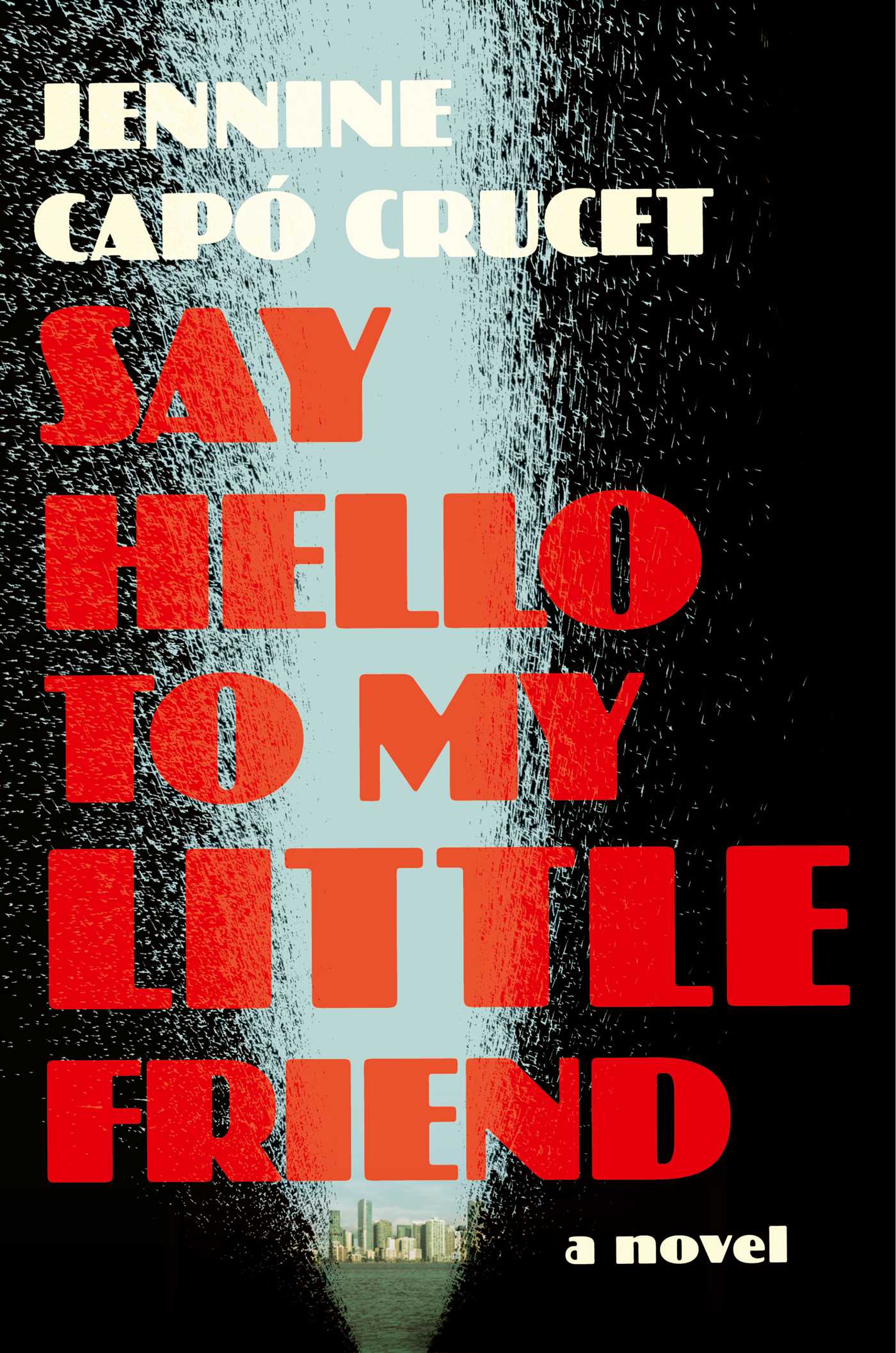
Two very important details about my 2025 are that I developed a baffling obsession with Pitbull (the Miami artrepreneur also known as Mr. 305 AND Mr. Worldwide), a character who continues to delight me in his absurdity and whose collaborator’s contributions are the best part of his tracks, and also I stopped using Google with its built-in AI in favour of Duck Duck Go, an inferior search engine. But maybe Duck Duck is less inferior than I thought, because when I did a search for Pitbull’s recent coffee table-style book (photographs alongside his many aphorisms like, “Life is not a waste of time, and time is not a waste of life”), it delivered me instead the vastly superior literary product, Say Hello to My Little Friend, by award-winning author Jennine Capó Crucet, a novel billed as Moby Dick meets Scarface whose protagonist is a Pitbull impersonator who’s just been served a cease and desist order by the bald man himself.
Having never read Moby Dick or seen Scarface, and merely being obsessed with Pitbull, however, I wasn’t sure how the novel would go over, but wow, it turned out to be the most bananas wonderful book I’ve encountered in a longtime. The story of Cuban-born Miami resident Ismael “Izzy” Rayes who decides to reinvent himself as Tony Montana from Scarface when his Pitbull career comes to an end, the entire premise a statement from the author about the stereotypes and perceptions about her native city, and how these ideas are limits. (Capó Crucet’s Pitbull critique/commentary was one of the most scathing and hilarious parts of the book).
Meanwhile, Izzy develops a curious connection to Lolita, a captive whale in the Miami Seaquarium, who can read his thoughts and who understands him better than anyone, particularly his situation as someone who is far from his native home, separated from his mother, and stuck in his own kind of captivity as to what the possibilities of his life might be.
And together (cerebrally, at least) the two embark on a journey, one that brings Izzy into the orbit of an intense girlfriend who just happens to be his friend’s sister, a whole bunch of iguanas, a criminal mastermind in disguise as a nice and decent guy, and a whole crew who arrived in America on the same raft that delivered Izzy there from Cuba when he was 7 who do not like the questions he’s asking now in an attempt to remember his own past and what happened to his mother.
If it sounds like this novel is a container for everything, I haven’t even told you yet that it’s also a guide to common birds of Miami, and so much more. I read it absolutely dazzled by Capó Crucet’s talent and awed that she’d partly written it out of spite toward the people who thought that Scarface and Pitbull was where ideas about Miami should begin and end, creating a work that’s a thumb on the nose of all that, but also so rich, poignant, and beautiful…
And oh my god, the ending! The ending! (And I’m not even talking about the epilogue that’s in the voice of Pitbull in a pseudo-intellectual vein [“I’ve gotten to see so much of the world because of my music, and yet the more I saw, the more I realized that despite its catchiness, despite the wildly successful branding that calling myself Mr. 305 created for me and my team, it is at its core a falsity. No one person can “be” a place, for one thing.”]
I loved this book so much. Thank you, Duck Duck Go.
December 3, 2025
Pack of Cards

A recent trip to Bellwoods Books (specializing in vintage books by women) delivered the reward of a Penelope Lively book that I hadn’t read yet. (I didn’t even know that such a book existed!) Just look at that gorgeous edition! In a few weeks, I’ll be falling into holiday mode and only reading books that were published before Taylor Swift was born, this title among them.
Bellwoods Books, with its feminist focus, is the polar opposite of the secondhand bookstore in my forthcoming novel, DEFINITELY THRIVING, a place where books by women aren’t shelved under “literature,” but instead the second tier “women’s fiction.”
On her first visit, before she begins a crusade to change the cataloguing, Clemence manages to overcome her aversion to the place and its practices enough to purchase a small pile of books though. “A respectable haul, it is, and of course, all of the books are priced at just a dollar or two, which might be the upside of supporting a bookstore in which women are devalued. At least it’s a bargain?”
December 2, 2025
Simple Creatures, by Robert McGill

My true confession is that wide-ranging short story collections don’t always do it for me, that I like a book to be A Book, complete with common threads and cohesion, but I really liked Robert McGill’s Simple Creatures—a nominee for this year’s Atwood Gibson Writers’ Trust Fiction Prize. Partly because his publisher, Coach House Books, knows a thing or two about how to make A Book (the very fibres of their pages are interesting), and also because it was my introduction to his delightfully ever-so-subtly off-the-wall narrative voice which never fails to be surprising, whether he’s writing from the point of view of a wife watching her 76-year-old philandering husband run races from her wheelchair parked on the sidelines, a PhD candidate writing her thesis on an iconic author whose chronicles of small town Ontario have created their own mythology (and then some), an ASMR Youtuber, or a third person story about an endocrinologist reincarnated as a chimpanzee.
Some of these stories go way back—two of them were published in The Journey Prize Stories in 2003. And while others, no doubt, are of similar vintage, each story in the collection reads as fresh, infused with empathy and curiosity for the human condition, and a warmth and humour that sit in balance. Which is not to suggest that these stories are as simple as the creatures that people them. There’s an uneasiness to their cadence, an uncertainty at their core, and McGill’s willingness to let his characters—and his readers—sit with that is why the collection is so rich and engaging.
December 2, 2025
You are a sophisticated person if you think things are bad.
“We get accustomed to something improving, and we stop recognizing that actually matters. I think as well, there’s an element where for audience, it feels weirdly not smart to consume this kind of coverage. Like, you are a sophisticated person if you think things are bad.
Because you’re smart enough to see it, which actually is not hard to see. I think with solutions there’s no one to blame, which I think is a big part of news coverage and news consumption. Especially, again, in a more social media era, like we’re usually trying to identify very quickly what went wrong.
And in some ways, that’s a great step forward. Like, we’ve experienced these terrible floods in West Texas. The worst and the deadliest floods we’ve had in decades in the US.
And these things used to happen more often. And I believe when they did, the reaction was less, well, what went wrong? Because we didn’t presuppose we had the power to control things like that.
Now, almost instantly you’re going to who failed, right? Like, this shouldn’t happen, who failed? And that is true to a certain extent.
Like, things like that, incident in particular, shouldn’t have happened to this degree. But what that means is that there’s a constant feeling that there’s failure everywhere. Government’s failing, or people are failing, or businesses or institutions definitely are failing.
And I think trying to consume solutions, journalism, means you have to go back against that to a certain extent. If your attitude is that things are wrong, this is challenging that. There might be a bit of a cognitive disconnect, I think, that sort of pushes people away.”
Bryan Walsh – “Solving the Narrative Deficit” on the Hope is a Verb podcast
December 1, 2025
Why I Write?

New essay for paid subscribers. What is the writing life for those of us who aren’t Miriam Toews (which is most of us)? I bared my soul again! Read it here.