February 7, 2018
Instagram Like a Mother
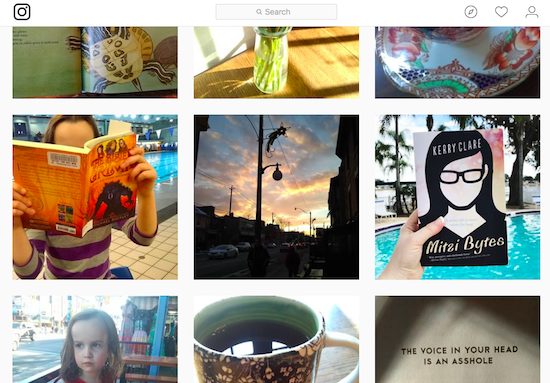
On Sunday morning I knew my panel would be on the second hour of The Sunday Edition, so I was listening when I heard Michael Enright say, “And coming up next we have three smart and funny young women…” And, oh there we are!, I thought, speaking aloud to wonder why he’d be calling us young when our collective age divided by three was at least forty. And then by the time I’d finished my sentence, Enright had already intro’d the segment, which was about Instagram and featuring three guests who were each twenty. Another panel. And I was kind of mortified, because the distance between the person you are in your mind (“a smart, funny young woman”) and how the world actually sees you is something usually best kept to oneself.
As I listened to the segment though, I started to be grateful for that distance, for how far away I am from being twenty-years-old. Because while I think of myself as essentially twenty, give or take a decade, and also more than obsessed with Instagram, that I live in the virtual world differently from these women became quite obvious. We might as well have been on different platforms altogether. They talked about their experiences of taking photos, tens and tens of photos, evaluating the angle of their nose, skin tones, and then the next step in the process is sending these photos to a whole bunch of friends to find out which ones should be posted. And the photos that make the grade are posted—but if they don’t receive the requisite number of likes in a moderate period of time, the photos will be deleted. A failure of nose angle, skin tone, and personal brand.
“That sounds like the worst thing ever,” I thought, listening to the women speak. It’s like they took the essence of being twenty—coming up with a tentative self and testing the waters, putting your face in the world and asking, “Could you like me? Could you like me?”—and made it concrete with an app. When for me, Instagram is all about colour, and wonder, and noticing things. It’s about paying attention, and marking a moment, and no matter how mundane my pursuit or photograph, there’s bound to be at least five people in my community who “like” it and they each give me such a boost. It’s about marking days and moments, seeing the ceremony in ordinary things. And even selfies, much maligned, have made me grow accustomed to and even fond of the way my face looks. I didn’t used to feel like that. Part of it was that I used to be twenty, which is a hard age to have self-esteem at, even with unlined skin and just one chin, which I never appreciated properly at the time, but also Instagram and selfies have helped to decrease the distance between the person I am in my mind and how the world sees me (even if I still overestimate my perception as ‘funny and young’). Instagram and selfies have helped me get to know me better.
“I should teach these women how to Instagram,” I was telling my husband later, the same way I teach people in my blogging courses. To make peace with imperfections, to use the aspirational side of online life to aspire to good things, to use blogging/social media as a space to wander, to grow, to get lost in. To turn the lens outward, and develop your eye as well as your I. “How to Instagram like a Mom,” is what I’d call it, and seeing as twenty-year-old women these days have a penchant for mom jeans, maybe it might even catch on.
“Or you could call it, ‘How to Instagram in a Way That Doesn’t Make You Want to Die,'” said Stuart, “since that’s what you’re selling.”
“Except they’re twenty,” I remembered. “If they had to make the choice between being like me or dying, they would probably choose the latter.”
Because even though it’s been awhile, I remember that about twenty too.
February 6, 2018
Neat Things: A Round-Up
Hands down, the best thing to happen to me last week was my conversation with writers Elizabeth Renzetti and Nicole Blades, and broadcaster Michael Enright, on CBC’s The Sunday Edition. Apart from the excitement of actually being on a show I listen to every week, the conversation itself was such a pleasure to take part in, so much fun and really interesting. You can listen again to it here.
Another wonderful thing is Anne Logan’s kind and generous review of Mitzi Bytes—that the book continues to resonate with readers thrills me to no end. She calls it a thought-provoking novel that goes beyond the limits of Mommy-Lit, and declares it one of the best books she’s read in awhile.
And finally, I loved my friend Suzanne Alyssa Andrew’s piece on owning her power and pulling a winning story from a magazine whose editor she didn’t want to be associated with in light of a sexual misconduct scandal and rabid douchebaggery. When I got to the part in which she quoted me, my head exploded—it means so much to me to know the things I write can empower and inspire others. In fact, I find it empowering and inspiring, even…
February 5, 2018
Things To Do When It’s Raining, by Marissa Stapley
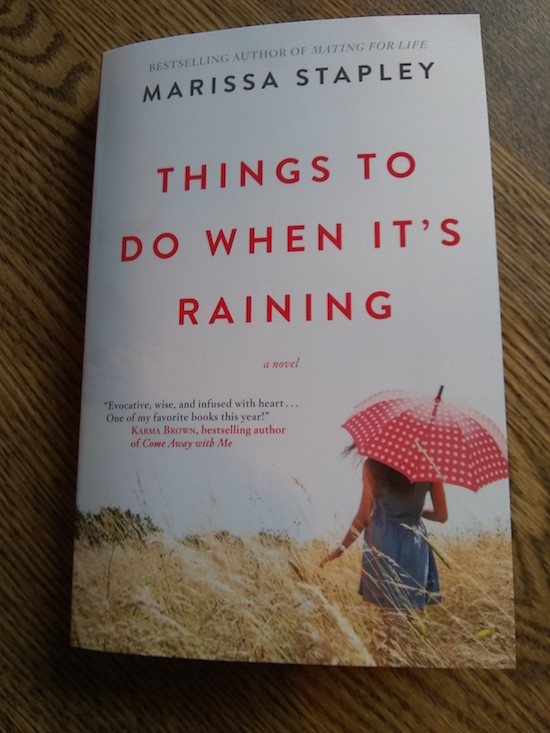
I didn’t know Marissa Stapley when I read her debut novel Mating For Love four years ago, and loved its bookishness, intelligence, and what a pleasure it was to read it. In the years since I’ve come to admire her criticism, her championing of commercial fiction and its writers, and her feminist take on the CanLit community. And I’ve also come to benefit from her community directly, with her support of my own book when it came out last year, and with her friendship. Which means that I’ve been especially looking forward to her second book, Things to Do When It’s Raining, and I’m thrilled that it’s finally here. I read an advanced copy back in January, and I devoured it in a day.
It begins with Mae Summers, whose fiancé has just disappeared along with all of the money people had invested in their business, and who turns out not to be who he said he was. Her life in pieces, Mae decides to go home again, back to the inn in the 1000 Islands where she was raised by her grandparents after her mother’s tragic death. But all is not well at home either—a secret hidden in Mae’s grandparents’ past has returned to the surface and disturbed their relationship, plus Mae’s old flame and first love is back in town, right at the moment when she’s most raw and shaken.
Obviously, with a set-up this riddled with landmines, this is going to be a book with twists and turns, plus an impromptu journey to Niagara Falls. The plot had me fixed, but I was especially in love with Marissa’s prose, her words and sentences, not to mention the amount of wisdom contained within. About life, and about love—this is a story that’s so rich. The advanced copy I read in January didn’t come with the reader’s guide contained in the final book, in which Marissa explains that the story was inspired by one in her own family history, but when I read this it illuminated the story for me, its meaningfulness and resonance. Although part of it too was that it’s also written by a wonderful writer. And I particularly loved the book’s structure, the chapters moving between different characters’ points of view, but each one preceded by an item from the list that gives the novel its title. “Things to do when it’s raining,” written by Mae’s late mother in her youth, so that her voice infuses the novel like the presence of a ghost, so that we know full well what the other characters are missing. And the subtle ways these items tie into each chapter: “Build something. There are tools and scrap wood in the shed. And yes, bandages and ice in the kitchen, in case you accidentally hammer your finger.”
I received a finished copy of Things to Do When It’s Raining, but I’m fully intending to buy one too, which means I’ve an extra now for giveaway. Leave a comment on this post and let me know your favourite thing to do when it’s raining, and I will randomly choose a winner. Canadians only please, for postal reasons. And happy book birthday, Marissa!
UPDATE: Thanks for the comments, everyone! The winner has been chosen via Random Number Generator (i.e. very scientific…)
January 31, 2018
14 Seriously Underrated Reasons to Marry Somebody
- They make excellent sandwiches.
- They don’t snore.
- They are happy to lend you the ‘u’ from their Scrabble tiles so that you can spell “wondrous.”
- They always share their snacks.
- They remember where you left your hairbrush.
- They buy you new shoes when you decide to start jogging. When you quit jogging three weeks later, they never say a word.
- They don’t hold your bad taste in pop music against you, and even dance in the kitchen.
- They know how to build websites.
- They send you texts after you finish doing something new and exciting asking, “How did it go?”
- They go to the gym but don’t talk about it or make you come.
- They will go to the bookstore for you. They will also come to the bookstore with you.
- They are as good at navigating as you are at driving.
- They are good at back rubs.
- They put the kettle on before you’ve even asked.
January 30, 2018
Boat People, by Sharon Bala
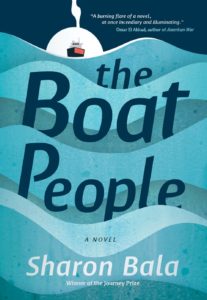 The debut novel by Sharon Bala (who was acclaimed for her short fiction with the award of The Journey Prize last year) is The Boat People, an ambitious, engrossing and absolutely important book that I keep hearing about everywhere—Bala was on The Sunday Edition; reviewed in The Globe & Mail—and for good reason. It’s a book that might be called timely, except that stories like this—of people fleeing war and persecution, chancing everything on survival in a new land, being viewed with suspicion upon arrival, the threat of outsiders and others being manipulated for government propaganda—are as old as stories about people venturing across seas at great peril in search of a better life are. Which is to say: as old as stories themselves. And peoples, and seas.
Inspired by the 2010 story of a ship of Tamil asylum-seekers arriving in British Columbia, Bala’s story begins with Mahindan, a Tamil mechanic who has lost everything except his young son and has bet everything he has on the chances of finding a new start in Canada. The novel begins with the ship’s interception as it reaches Canada, and follows Mahindan through the process of being imprisoned and separated from his son as months go by and his fate is left in limbo—will he get to stay in Canada, or will be he deported to Sri Lanka where nothing good awaits him. Alternate chapters also take us back through his history, showing us how he went from a happily married man with family, friends and a rich life, awaiting the birth of his first child, to someone with (almost—save for his son) nothing left to lose—the gradual reveal of Mahindan’s backstory makes for compelling, powerful reading.
But Mahindan is not the story’s centre, or not its only one; that this is a story with multiple centres and voices and points of view is an important aspect of its construction. Because there’s never just one centre of a story, and all the best narratives refuse to be contained, overflowing to be resonant in all kinds of surprising ways and flowing into other stories. Like the story of Priya, a second-generation Tamil-Canadian who would just like to finish her placement in corporate law so she can become accredited and begin work in mergers and acquisitions, thank you very much. But the fact of her ethnicity means she’s roped into a position with another lawyer in the company who’s working in refugee law and who overestimates her knowledge in terms of Tamil language and culture to assist him as he supports the Tamil asylum seekers with their refugee claims. Like Mahindan, Priya is somewhere she doesn’t belong, and for a while she resists being involved with the asylum seekers and the war her parents had been so intent on leaving behind them when they arrived in Canada. But eventually, she becomes invested, and the ramifications of this are felt deep within her family.
Like Priya, the story’s third central character has also worked to put the past behind her, a third generation Japanese Canadian called Grace whose hard work in the civil service has been rewarded with a role adjudicating refugee claimants. She begins her new position not long after the Tamils arrive, and political tensions are high, and ever being manipulated by Grace’s former boss and mentor, the Federal Minister for Public Safety whose interests lie in keeping the threat of terrorism high. Meanwhile, Grace’s mother is ailing from Alzheimers and the past and the presents are intermingling in her head, stirring stories of the internment of Japanese-Canadians during World War Two, stories that Grace’s family had been careful never to dwell on. Stories of othering, persecution, public safety threats, racism, and so much terrible history that’s so analogous to what’s going on in the present day.
Bala’s prose is beautiful, the narrative so careful woven, and the shape of the novel itself so terrifically undefined in a way that allows the story to go beyond its limits, to pose questions that don’t necessarily have answers, to unsettle its readers in the most powerful way. There is a didacticism at work, but with a depth and complexity that saves the novel from its few too-earnest moments. Further, a little earnestness is nothing to scoff at, and maybe the author of a book this interesting, original and well-written has earned those moments. Especially since this is such an essential book for Canadians to be reading right now.
January 29, 2018
Encyclopedia of An Ordinary Life
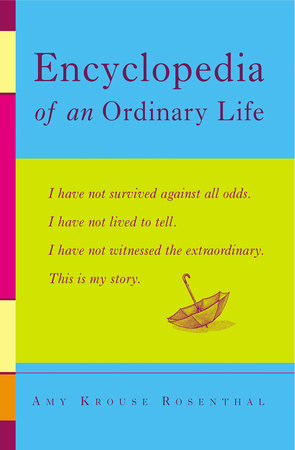 I got Amy Krouse Rosenthal’s Encyclopedia of an Ordinary Life out of the library on Friday and devoured it in two days while annoying everybody in my presence because I’d insist on reading passages aloud while they were trying to play Pokemon or read a different book or conduct a conversation. I loved this book so much, for all kinds of reasons, which weren’t necessarily the reasons its author intended the book to be loved when she published it for the first time in 2004. Except for this one: that she’d intended the book as a document of ordinary life at the beginning of the twenty-first century, and at this it succeeds so wildly, but so much so because life in 2004 seems very far away from 2018, where I read this book now. Answering machines, compact discs, and faxes. There is an image of a Yahoo email message, and I’d forgotten what those looked like—the font, the logo, the peculiar line breaks. The internet exists, but you’re not carrying it in your pocket, your purse. It’s still rife with possibilities for human connection, old friends getting in touch, hearing from strangers. The internet in 2004 was bringing us closer together instead of driving us further apart.
This book had absolutely nothing in common with Ellen Ullman’s Life in Code, which I finished reading a week ago, except that both had me thinking about the internet’s early days and all that possibility for connection. Rosenthal’s book reminded me of how exciting it was to be on the internet in 2004, the access to offered to worlds I didn’t know existed. The first job I had with an internet connection was at the Financial Post during the summer of 2001, which was the same summer I discovered that there was this fantastic literary culture happening in the world right now—that was the summer I bought White Teeth and A Heartbreaking Work of Staggering Genius. 2004 was when I was living in Japan and avidly reading Maud Newton and other book bloggers, and while actually becoming a book blogger still seemed like it was beyond me, living in a world where I had this window onto people doing and thinking and being literary culture was really astounding and transformative to me.
And Amy Krouse Rosenthal’s book gave me that same frisson of inspiration—these glimpses of fascinating people doing cool things. Or even mundane things, which this book is more about, the very point of it. The mundanity of the 2004 internet is also something I missed, as opposed to the YOU WON’T BELIEVE WHAT HAPPENED NEXT… clickbait. Smart people being boring, was the theme of the internet in 2004, or at least the corners of it I frequented. And it’s how I fell in love with blogging, really. The way that smart people being boring illuminated the secret wondrous corners of everyday existence, its various miracles the dancing dust motes (were dust motes actually things that people noticed who weren’t characters in novels).
She also writes a lot about death, which would not be so noticeable were she now, in 2018, not actually dead. It makes this ordinary book much more poignant, extraordinary, necessary, a gift. (See my 2015 post about blogs as “survival gear for our stories.”)
“I shopped for groceries. I stubbed my toe. I danced at a party in college and my dress spun around. I hugged my mother and my father and hoped they would never die. I pulled change from my pocket. I wrote my name with my finger on the cold fogged-up window. I used a dictionary. I had babies. I smelled someone barbecuing down the street. I cried to exhaustion. I got the hiccups. I grew breasts. I counted the tiles in my shower. I hoped something would happen. I had my blood pressure taken. I wrapped my leg around my husband’s leg in bed. I was rude when I shouldn’t have been. I watched the cellist’s bow go up and down, and adored the music he made. I picked at a scab. I wished I was older. I wished I was younger. I loved my children. I loved mayonnaise. I sucked my thumb. I chewed on a blade of grass.
I was here, you see. I was.”
January 26, 2018
Picture Book Friday: The Lost Words

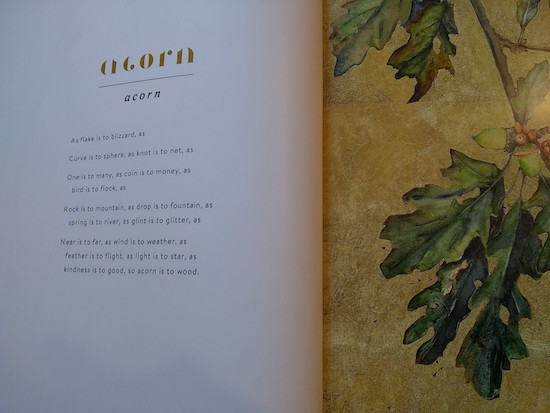
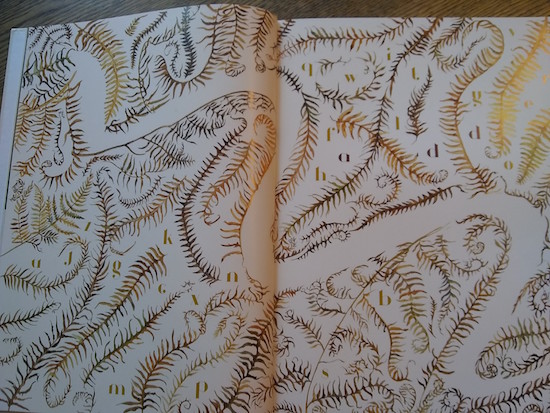
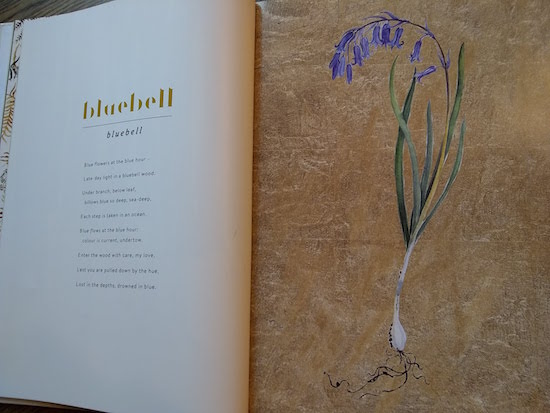
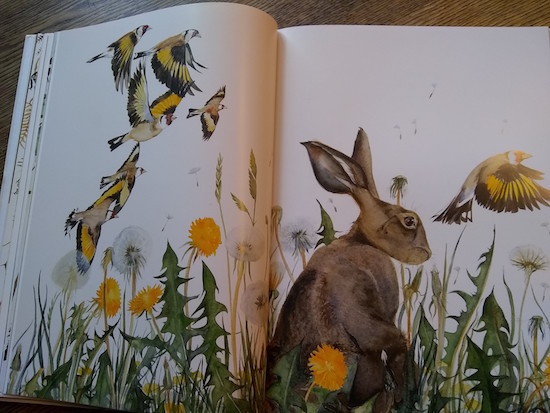
A bit of magic was delivered to our house this week with the arrival of The Lost Words, by Robert MacFarlane and Jackie Morris, which I first learned about via MacFarlane’s essay in The Guardian about how British children are losing the words to describe their country’s natural places. The Lost Words is a book about absence and things that are missing, this theme reflected in the title fonts with their missing pieces, and the two-page spreads in which an absence is shown by white space. The missing thing from each spread is shown on the next page in full colour illustration with an acrostic poem on the facing page, which sounds like the worst idea ever, but these poems are wonderful. “Rustle of grass, sudden susurrus, what/ the eye misses:/ For adder is as adder hisses.” And not poems, even, according to MacFarlane, but spells. “You hold in your hands a spell book for conjuring back these lost words,” he writes in a brief introduction. “To read it you will need to seek, find and speak.” And magic indeed are what these spells are—the one about the conker is absolutely perfect, about how it’s an object so magnificent (and isn’t it?) that it could not be manufactured. “…conker cannot be made,/ however you ask it, whatever word or tool you use,/ regardless of decree, Only one thing can conjure/ conker—and that thing is a tree.”

January 24, 2018
That Random Person on Twitter Isn’t Stalin
 I honestly don’t think about Stalin very often. I read Rosemary Sullivan’s biography of Svetlana Alliluyeva last month and it was actually revelatory to be reminded that Stalin actually happened, that the story wasn’t inevitable, and to glimpse the awfulness of living within that terrible present which would unfold into the brutal and murderous history. When Svetlana moved to America, the idea that she’d enrol her daughter in public school was reprehensible to her, and she had no truck with American socialists, the fellow travellers. Her response to living under Stalin and his successors was not exactly nuanced, or considered, I mean, but then I think that’s probably a lot of ask of anybody.
Still, I don’t think about Stalin very often, but last week I started to think maybe I was alone in this. This was the week that Margaret Atwood published an op-ed defending her feminist credentials, and reiterated that a lack of dude process regarding sexual assault cases was analogous to Stalinist purges, and then someone else on Facebook got upset because a small press declared a poet’s books out of print (after his public announcement that he’d only got them published because he knew the right people to have drinks with) because this was apparently Stalinist-era censorship, and just yesterday a couple of men on Twitter were comparing poets on Twitter to the East German secret police, which wasn’t referencing Stalin exactly, but it’s all in the spirit of the thing.
It turns out that a lot of people are thinking about Stalin all the time. And they see him everywhere they look, on Twitter threads, and Facebook conversations, in the back of the closet, and under the bed, but never, oddly enough, in the mirror. And while one might say that my lack of engaged consideration about Stalin on a regular basis may be to my detriment, because those who don’t know history are condemned to repeat it, I’m not convinced. Because while I don’t think about Stalin very often, I think about him enough to realize that random person on Twitter yelling at Margaret Atwood is not him. And neither are women circulating a shitty men list, or calling out sexual predators by name, or Indigenous people who have thoughts and ideas to express about cultural appropriation. Even if those people are angry. That woman who runs a small press? Not Stalin. That person who is attacking the thing you said, or the story you wrote, or the tweet you tweeted? Not Stalin. In particular if that person is trans, or disabled, or a person of colour (and yes, I know Stalin was also a minority, being Georgian, but that’s not the same thing), because what Stalin had was power to oppress people with, and the people you’re accusing of being Stalin? They don’t have much power at all.
That annoying woman on Twitter whose feed is full of weird politically correct jargon that is very irritating to read is not Stalin. That strange person with blue hair whose preferred pronoun is an unpronounceable word you’ve never heard of is not Stalin. That very earnest person who’s currently going around Twitter calling out anyone with the nerve to be reading Margaret Atwood right now is not Stalin. She’s kind of an idiot, but that’s not the same as being Stalin, and I think a lot of people are having a lot of trouble telling the two things apart. Even the person who’s going to be upset for me for making fun of people with blue hair and weird pronouns two sentences back is not Stalin…unless that person happens to have the power to throw me into prison for an indefinite period of time.
It’s not that I’m trying to minimize the crimes and atrocities of Stalin and his tyranny, in fact I’m doing quite the opposite. It’s because I know that Stalin is possible—and that power can make a person so dangerous—that making distinctions between the man himself and annoying people on Twitter is really important. Making the distinction is also important, because it seems like Stalin-hysteria is a reflexive response to moments in which people who’ve been oppressed are seeking to redress a power imbalance, when one might be feeling as vulnerable as a Romanov in 1917. Except that it’s 2018, and you’re talking about somebody on Twitter with 278 followers, and you’ve decided that your possibly legitimate fear of the USSR happening all over again means that, as a matter of principle even, you don’t have to listen to what other people have to say.
This morning I was delighted with Erika Thorkelson’s essay, “Margaret Atwood’s Books Taught Me To Listen to Women,” and not just because—most refreshingly—she doesn’t mention Stalin or the Gulag even once. It’s a beautiful piece about the importance of listening, which, Thorkelson writes, “requires full body presence. It requires you to soften and let go of the fear, the urge to argue, and the instinct to control the narrative. It takes a comfort with silence and a willingness to accept that your turn to talk may never come, that what’s happening might not be about you at all.”
What’s happening might not be about you at all. What a thing! It might not even be about Stalin…
Thorkelson continues, “The greatest block to really listening is not the noise of the world, but that voice inside that protects us, centers us, rattles with outrage or disbelief.” The voices that tells us that Stalin is hiding under the bed, and that you alone are the last bastion against evil and tyranny, when, in your refusal to listen, it might be tyranny (and/or the shoddy status quo) that you are, in fact, upholding.
January 23, 2018
Winter, by Ali Smith
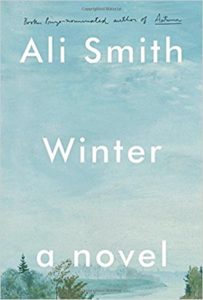 I walked through a blizzard to buy Winter a week and a half ago, the new release by Ali Smith that I’ve been looking forward to since rereading Autumn in the autumn. A novel that helped me so much through the political turbulence that was 2017, contemporary events as rendered by literature so that they were just enough at a distance–it was clarifying, and gave me hope. And so it was strange to pick up Winter, the second book in Smith’s seasons sequence, and see that everything wasn’t okay after all. That one book is not going to cure us of what ails us, and the trouble continues through winter, a season during which nature settles down to sleep:
“God was dead: to begin with. / And romance was dead. Chivalry was dead. Poetry, the novel, painting, they were all dead, and art was dead. Theatre and cinema were both dead. Literature was dead. The book was dead. Modernism, postmodernism, realism, and surrealism were all dead…”
The novel opens the day before Christmas, with Sophia Cleves who is haunted by a disembodied head. Interestingly, this being an Ali Smith book where surrealism is so often present, it doesn’t occur to me until later when we see Sophia through the eyes of other characters, that there is anything unusual about a woman being haunted by a disembodied head. Autumn had the weirdness of people turning into trees, and the head spectre is the strangeness of Winter, and usually these are points that would make me want to give up, but so much else makes me go on. Autumn opens with the absurdity of a character’s engagement with a bureaucrat at the passport office, and Winter does a similar trick with Sophia Cleves’ visit to the bank before they close at noon on Christmas Eve—the insanity and banality of these kind of engagements with the state and/or corporation, the robotic interaction between a human being and a person who’s just doing their job—presumably a human being as well.
Sophia Cleves is not the centre of Winter (the dead of?), which is instead her son Arthur, Art. Who writes a blog called Art in Nature, about stepping in puddles and bird sightings. Art who I was all prepared to sympathize with, all set for him to be my hero—and then we realize that as a hero he’s terribly flawed. His furious girlfriend berating him for his lack of engagement with the world around him, for believing he’s doing his part through his blog posts (which are totally made up; Art never leaves the city), and not seeing what’s going on around them. He tells her, “We’re all right… Stop worrying. We’ve enough money, we’ve both got good assured jobs. We’re okay.”
“Forty years of political selfishness…” she continues. Political divides, the rise of fascism, plastic bags, etc. And he dismisses her, all of it. It’s the way it always been, he tells here. These things are cyclic. Whatever, whatever. We’ll be all right. It’s all fine.
I am Art. This revelation occurred to me around page 58. This, and the fact that I’m a climate change denier , which is a revelation I had on Friday when I got in an argument with my dad about why we see robins around in the winter. “It’s totally normal,” I say, because I read it somewhere once. “Climate change,” says my dad. “It’s getting warmer, it’s scary.” And I become a bit hysterical. I don’t want to be scared. I know climate change is real, but I’m not sure what I’m supposed to do about it in my tiny little life, and so to preserve my sanity I cling to signs that everything is normal. For example, about how when I bought this book, I walked through a snowstorm. A blizzard. In the winter. Things are fine.
The story takes place over Christmas at Sophia’s, when Art comes to stay with his girlfriend, who is not his girlfriend (who has just broken up with him due to his political selfishness) but instead a random woman he meets on the street, an immigrant from Croatia via Toronto with a penchant for Shakespeare who is struggling to get by. When they arrive, it becomes clear that Sophia is not okay, and so they call her estranged sister Iris to come and help, Iris the old hippie, who’d protested against nuclear weapons at Greenham Common, Iris who is the living embodiment of another way to face the world, a way that’s different from Sophia and Arthur’s denial—of seeing, of engaging, and doing her part to change the world. Insisting that, via Greenham Common, she really did.
But it’s not as simple as that, of one way being the good way to live, and the other being bad. There is a moment when Iris and Sophia say to each other, “I hate you.” “I hate you.” And then embrace, and lay down together in bed, and there it is, what has to happen. It isn’t easy. It isn’t neat. But somehow these characters, “see its the same play they’re all in, the same world, that they’re all part of the same story.”
That last line a reference to Shakespeare’s Cymbeline (which I’ve never read or seen!), the play that makes Arthur’s not-girlfriend come to England, in fact. “A play about a kingdom subsumed in chaos, lies, powermongering, division and a great deal of poisoning and self-poisoning”…. “I read it and I thought, if this writer from this place can make this mad and bitter mess into this graceful thing it is in the end where the balance comes back and all the lies are revealed and all the losses are compensated, and that’s the place on earth he comes from, that’s the place that made him, then that’s the place where I’m going.”
Art is how we get there, is Smith’s thesis in this novel. Through Shakespeare, yes, but also by seeing what happens when we put real things in fiction—things like Brexit, and the Grenfell Tower fire. What happens to books when we put the world in it is a question that’s addressed in the most wonderful way, Arthur’s not-girlfriend (whose name is Lux) telling the story of an old copy of Shakespeare kept in a library with the imprint of what was once a flower pressed between the pages. “The mark left of the page by what was once the bud of a rose.” She’d called it, “the most beautiful thing I have ever seen… it was a real thing, a thing from the real world.”
Which was exactly what had made Autumn so powerful to me, and otherworldly too in the ways in which it did engage with the world. It was why reading it again in October was such a big deal, to be present in the novel’s moment. It was why it was especially meaningful to keep reading and discover that the Shakespeare play Lux refers to is housed at the Fisher Library here in Toronto, right at the end of my street. Uncanny, isn’t it? The line between life and fiction blurred in the most fascinating fashion.
My favourite thing about Winter was everything, but I especially loved its connections to Autumn, which are lovely, subtle, and so unbelievably perfect. Except I read somewhere that Spring’s not out until 2020, and how am I supposed to wait that long?
January 22, 2018
The Opposite of Democracy
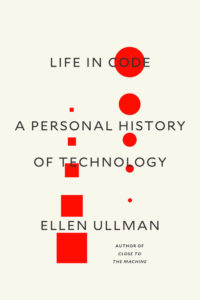 “…the ideal of the internet represents the very opposite of democracy, which is a method for resolving difference in a relatively orderly manner through the mediation of unavoidable civil associations. Yet there can be no notion of resolving differences in a world where each person is entitled to get exactly what he or she wants. Here all needs and desires are equally valid and equally powerful. I’ll get mine and you’ll get yours; there is no need for compromise and discussion. I don’t have to tolerate you and you don’t have to tolerate me. No need to care for my neighbour next door when I can stay with my chosen neighbours in the ether, my email friends and the visitors to the sites I visit, people who think as I do, who want what I want. No need for messy debate and the whole rigamarole of government with all its creaky bothersome structures. There’s no need for any of this, because now that we have the World Wide Web the problem of our pursuit of happiness has been solved! We’ll each click for our individual joys, and our only dispute may come if something doesn’t get delivered on time. Would you rather be at home?”
—Ellen Ullman, “The Museum of Me,” which WAS WRITTEN IN 1998 (!!), from her amazing essay collection Life in Code.






