February 11, 2026
The Barn, by Wright Thompson
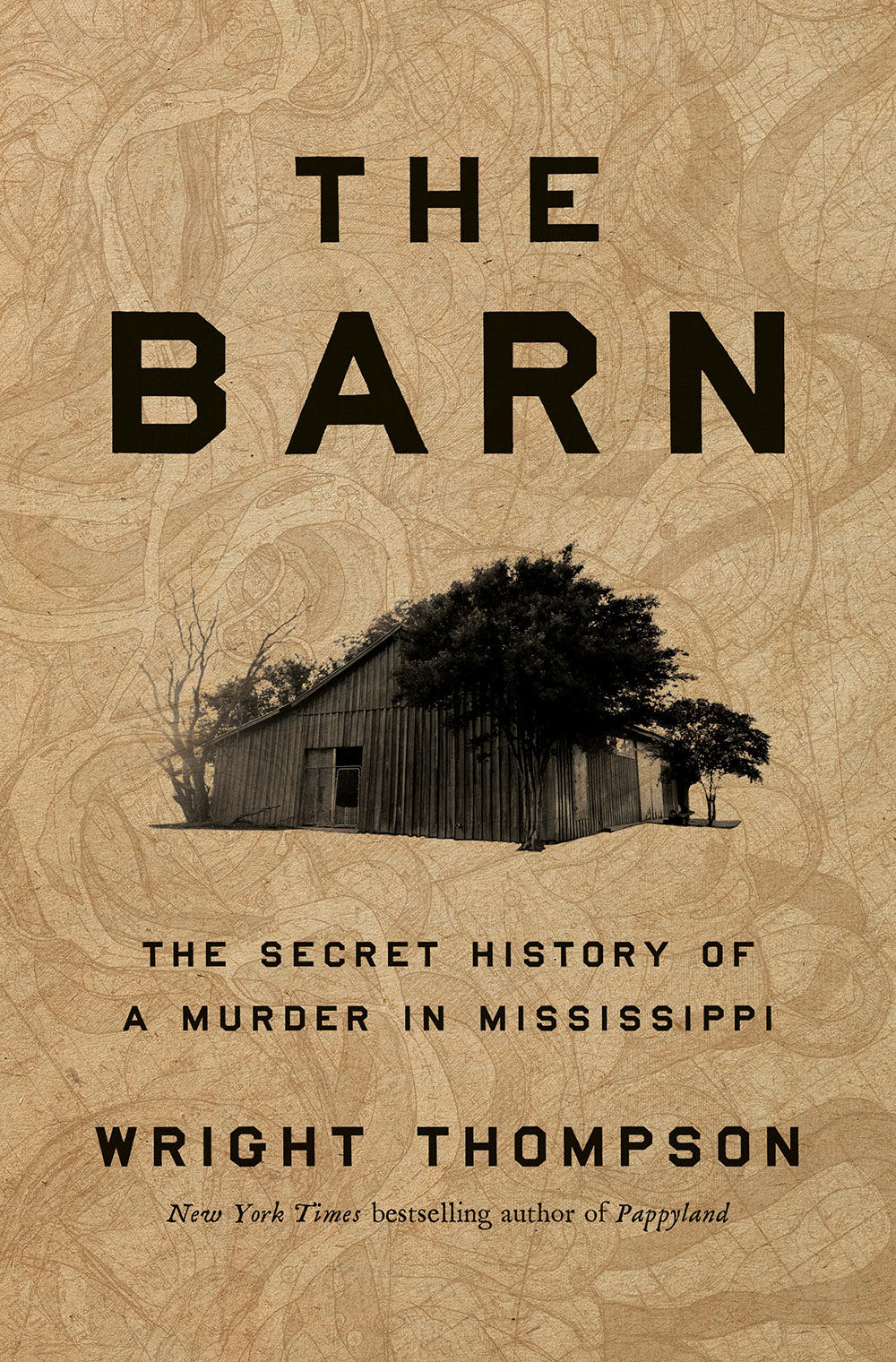
After hearing Wright Thompson—a white sportswriter from Mississippi—on The Bulwark Podcast, I absolutely had to get my hands on his book The Barn: The Secret History of a Murder in Mississippi, which is on one level about the 1955 murder of Emmett Till, a 14 year old Black boy lynched after apparently whistling at a white woman that summer when he was down south visiting his cousins. But which is also about America all told through the history of a thirty-six square mile area in the Mississipi Delta that was—not randomly in the slightest, but instead as a result of its land, its people, its politics, its history, its mythology—where Emmett Till (a child whose family called him Bobo, one of the silly nicknames I’ve given my own children) was murdered in a barn in earshot of plenty of people who did nothing to help. A barn that still stands today, where the property owner stores his Christmas decorations, and he had no idea that Till had been killed there. So many people in the Mississippi—Thompson among them for a very long time, whose family had been farming on nearby land since 1913—never knew the story of Emmett Till at all, and Thompson points out the strangeness of a culture build on remembrance managing to forget so very much.
Thompson never mentions the song in his book, but I’ll never hear Arlo Guthrie singing about the rhythm of the rails ever again without thinking about how Emmett Till rode the Illinois Central line that summer, The City of New Orleans, and came back home the same way in a casket that his mother insisted remain open at his funeral so that everyone could see what the murderers had done to her child. Emmett Till was America’s native son, a product of a terrible and violent history that endures to this day and whose patterns continue with state-sanctioned violence in Minnesota and an establishment that will stop at nothing to maintain their place in a hateful caste system. (He was more than a symbol though, he was also a boy, Mamie Till-Mobley’s son, and Wheeler Parker’s cousin, and his family has worked to keep the memory of his life and the tragedy of his death alive, to make it all mean something.)
There is no then and now in Thompson’s storytelling, instead everything happening at once, layers upon layers of meaning and time, Thompson peeling back the layers to let light shine into the darkness. This is one of the most beautiful, powerful and heartbreaking books I’ve ever read, galvanizing and absolutely necessary.
February 10, 2026
In Winter I Get Up at Night, by Jane Urquhart
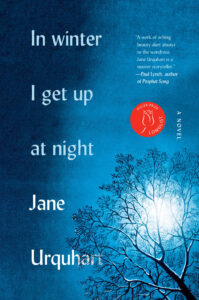
Jane Urquhart’s In Winter I Get Up at Night is plotted more like an epic mural than a straightforward novel. Instead of straightforward chronology, time is a tangle, the past ever present, memory heaped on memory, some of it imagined, some of it otherwise, the line between fact and fiction blurred, mythical figures appearing as men, other men as myth (maybe). As Emer drives down snowy roads in Saskatchewan, on her way to work as an itinerant music teacher at rural schools, she recalls the story of her one great love, and their illicit evenings together at railway hotels. She also thinks about her family’s journey from Ontario to the Prairies, the great storm that unsettled their settling there, and the months she spent as a patient in a children’s ward in the hospital recovering from catastrophic injuries. In some ways, this is a quiet novel, a subtle novel, but only if one is not reading very carefully, skimming over the clearing of Indigenous peoples from the plains, the presence of the KKK in prairie communities, the xenophobia that gets in everywhere. Symbols of Canadiana woven into the tapestry—the railway, its castle-like hotels, Frederick Banting, Pullman porters in all their gallantry, a powerful invitation to look again and consider what the true stories of this country actually are.
February 9, 2026
A Love Affair With the Unknown, by Gillian Deacon
“Unfathomable life is the reality, yes. With a deep breath to calm ourselves, we can concede that uncertainty is inevitable and part of being alive. In fact, we turn toward it; we need the rich mystery of life’s unknowableness. We understand, deep down, that a life that went entirely to plan would be joyless.”
It has taken me a long time, many missteps, four years of therapy, and a pile of books by Pema Chodran to learn to be somewhat not un-okay with uncertainty. A love affair I would definitely not term it yet, but I’ve come a very long way since a decade ago when Twitter was breaking my brain and I was continually refreshing my feed anyway in the hopes that this next update that would make sense of the chaos unfolding and offer some indication that everything, at some point, would turn out okay. Since six years ago as we were heading into a pandemic and I felt I was single-highhandedly responsible for holding the world together. Since four years ago when I walked up Major Street weeping, because a new strain of Covid was about to arrive and I was incapable of imagining anything less than an apocalypse. In my mind, there was what I could control and abject disaster, and nothing in between.
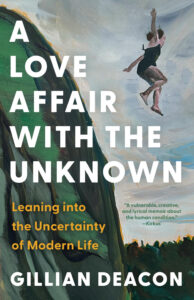
But oh, there is space, so much space, for wonder and possibility, for strength and resilience, for care and community, and—in Gillian Deacon’s extraordinary case—a book like this one, which is such a gift to its readers. A Love Affair With the Unknown is a compelling blend of memoir and reportage about dwelling in uncertainty as Deacon—a popular Toronto broadcaster—finds herself beset by a debilitating and mysterious illness in late 2022. Having previously come through three bouts of cancer, and as someone who works on live radio, Deacon was more familiar than most are with uncertainty, but this new twist in her story was particularly challenging—she could no longer partake in the activities that gave her pleasure, she felt terrible all the time (nausea, fatigue, tinnitus, chills, and more), and worst of all, she had no assurance whatsoever that things were ever going to change, that the rest of her life wasn’t going to be a tiny world defined and confined by illness.
Deacon eventually receives a diagnosis of Long Covid, but this book isn’t about the happily-ever-after (Deacon knows by now there’s no promise of that), instead the uncomfortable in-between when she still didn’t know how it all might shake out. It’s an exploration of the psychology behind our discomfort with uncertainty, the way that too many of us would prefer to skip through the hard stuff and get to the end—Deacon writes about how she used to think she was embracing the maxim to “Feel the fear and do it anyway,” but she was actually jumping past the fear part so she didn’t have to feel it at all. She writes about how difficult it is to be lost, to lose control, but what we miss when we refuse to let go, the amazing possibilities for how fate may unfold. That the greatest fear of all is often that we might not have the capacity to get through challenges, more so than the challenges themselves (it’s a fine distinction, but it matters).
Deacon considers how Salmon Rushdie faced his fears, references Rebecca Solnit’s A Field Guide to Getting Lost, explains attention bias, recommends awe, thinks about art and unpredictability. She notes how the Covid pandemic thew so many of us off the rails (it’s me!), leaving us less equipped to meet this current moment and all its tumult. There’s also the anxieties that aren’t simply all in our head—the reality of climate change especially, fears that are justified, an unknown that holds no promises of everything working out just fine. She also writes about chance and risk and poker (!), about arrogance and humility. About hope. About “figuring out how to stay emotionally afloat in a tsunami of change.”
The crux of it all, for me, has been learning to stay where we are. Not leaping into a terrifying future, not desperately clinging to a past that is gone, but instead being here and paying attention. And A Love Affair With the Unknown is a guidebook to just that, a beautiful, kind, calming and bolstering read, and a book I’ll keep returning to (along with all the Pemas).
February 6, 2026
Big Book Launch News!
(This is a pinned post! Scroll down for updates)

🎉 Celebrate the launch of DEFINITELY THRIVING, with a special 25th-anniversary showing of BRIDGET JONES’S DIARY, the iconic film starring Renée Zellweger, Colin Firth, and Hugh Grant, at Paradise Theatre in Toronto on Thursday March 5. 🎉
Following the film, enjoy a conversation between Kerry Clare and Marissa Stapley, New York Times-bestselling author of LUCKY, about why Bridget Jones still resonates, and the film’s connections to DEFINITELY THRIVING, a novel about people who are perfectly imperfect, and all the love and support that’s required for one woman to make it on her own.
A night out at @paradiseonbloor, Toronto’s prime cinema venue, with books on sale from the good people at @typebooks? DING DONG. 🎥 📖 🎉
Pick up your tickets today at https://paradiseonbloor.com/movies/bridget-joness-diary-definitely-thriving-book-launch-with-kerry-clare/
February 3, 2026
Is This a Cry for Help?, by Emily Austin

Bestseller Emily Austin returns with another compelling novel about a lovable weirdo beset by mental health struggles and the burden of trying to exist as a sensitive human in an uncertain, inexplicable and at times cruel world. IS THIS A CRY FOR HELP? is the story of first person narrator Darcy, who loves her wife, and her career, and who has just gone back to work after a mental health crisis brought on by the death of her ex-boyfriend. But any chance of a smooth return to work is stymied by a campaign against the public library where Darcy works as a librarian by a group of right-wing zealots all riled up by the spectre of the public library as a den of iniquity.
In a dry, wry and understated tone, Darcy brings the reader along on her journey to make sense of this nonsense, and also to try to keep being okay in the midst of absurdity and crisis. We’re privy to her conversations with her therapist, discussions with her wife, and the day-to-day minutiae of life in a public library which serves to underscore the polycrisis of our current moment, homelessness, mental health, poverty, loneliness, polarization, misinformation and so much more converging.
There’s a light touch to all this heaviness, as well as humour, but also a powerful message underlying the story about the importance of libraries, learning, curiosity and understanding in a world that feels increasingly hostile, where so many of us are being pitted against each other. Calmly, and beautifully, through Darcy’s story, Austin suggests that connection is not only possible, but that it’s the only way through.
February 2, 2026
Northern Bull, by Michelle Swallow
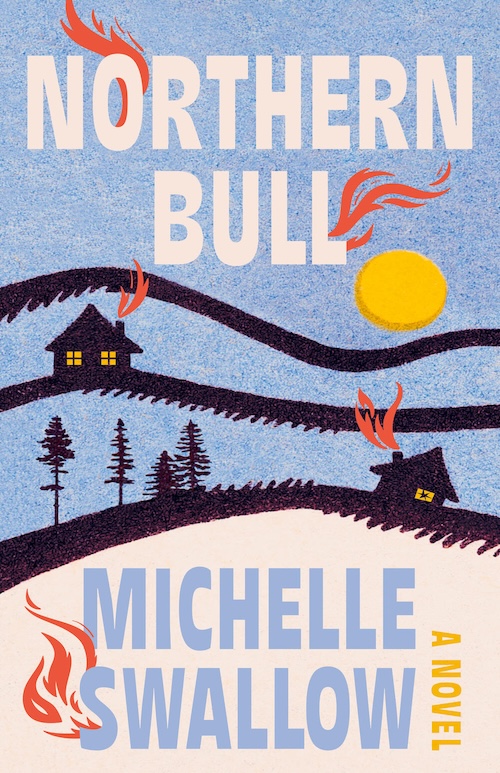
If you can’t beat the winter, you might as well pick up a copy of Michelle Swallow’s funny and heartfelt debut novel Northern Bull, and escape via fiction to Yellowknife, NWT, a place that is likely colder than wherever it is you happen to be. Where the snowpants are as obligatory as pants themselves, but things still get pretty hot, especially between next door neighbours Maggie and Jacques, each of whom is secretly longing for the other, but they can’t come out and say it, and meanwhile Maggie is struggling to write an erotic short story to read aloud at the local burlesque show, and keeps being infuriated by Jacques’ proclivity to steal from her wood pile. He tries to pay her pack with a bit of whitefish, but it all goes wrong after she sees two women leaving his house after an epic night out, a night out so epic that Jacques’ insane friend Craig’s prized moose head goes missing, and Craig tells Jacques that if he doesn’t get it back he’s going to burn Jacques’ house down. Even though Jacques’ house is already falling apart, so full of holes that a weasel’s moved in, and Jacques has no idea where the moose head is anyway, but what else can he do? Can he find the moose head and get to the show in time to hear Maggie read her story? Will Maggie ever actually finish her erotic story, or will she keep dampening the spice by having her characters drink tea?
And that’s only the beginning—the story moves between Jacques’ and Maggie’s points of view, and also includes those of Craig, his roommate Randy, and their friend Vic, an aspiring exotic dancer who hopes to make his big debut at the show Maggie’s reading at. There’s also a missing van, a group of Korean journalists hoping to see the aurora borealis, the story of the moose head itself and how it came to be, a snowmobile race, and a bag full of explosives.
Taking place over 24 hours on a freezing day in the darkness of January, Northern Bull is a romp, as wickedly fun as its weather is freezing.
January 30, 2026
some things you need to know…

Click through for a fun slide show about my upcoming novel (including news about my book launch!).
-Grateful to Quill & Quire for including Definitely Thriving on their 2026 Spring Preview!
January 26, 2026
The Snow Arrived

The snow arrived, and made everything new. It cancelled plans, turned our houses into caves, the cars parked on the road became marshmallows, and everywhere was quiet. When we ventured outside, we were grateful for the paths of others, and where there were no paths, we made our own, and we spoke to the strangers we passed, took in the miracle together of the world transformed, the force that is nature, how small and helpless we all are. How much we need each other. And the snow was a blanket that absorbed some of the sadness and rage at the world’s brokenness, at the violence inflicted by the world’s broken people, and the abject quiet was a reminder of goodness, courage, and justice of ordinary people who can be so incredibly brave. The snow was a blanket that made it harder than usual to deny that we’re blessed with a beautiful world, such a miracle of a world, and that it’s important to stay open to all its wondrous possibilities.
January 22, 2026
Margaret’s New Look, by Katherine Ashenburg
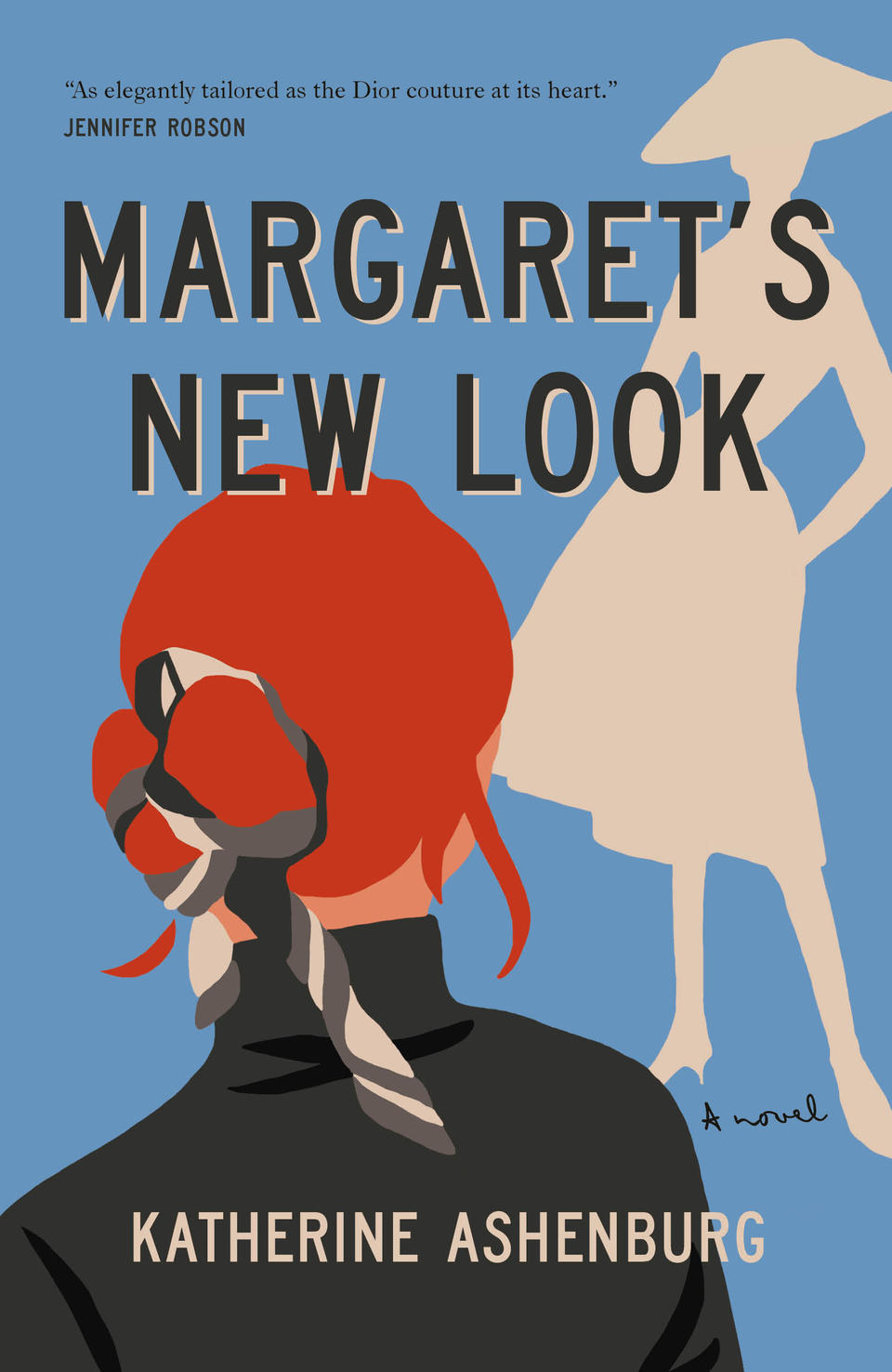
Margaret’s New Look, Katherine Ashenburg’s third novel is a veritable feast—both an ode to and an interrogation of fashion history; as well as a consideration of Vichy France, European Jewish history, and the Holocaust; a contemporary portrait of catty workplace politics, and a mystery set in a museum with some truly delicious detective fiction allusions. As curator Margaret Abrams prepares for an upcoming exhibit featuring items from Christian Dior’s legendary collection, she is distracted by calls from a reporter asking about Dior’s ties to Nazis forces in occupied Paris earlier in his career. And then strange items begin arriving in the mail, questions persist about Margaret’s own family’s Jewish history, and then items from the exhibit begin to go missing, turning up in strange places elsewhere in the museum. Who is behind the sabotage? Is it possible to appreciate beauty for simply beauty’s sake, or must Dior’s collection be embroiled with history and politics, just like so many more sordid things? Margaret is going to have to learn to be unsettled, both personally and professionally, as she gets to the bottom of the mystery in an effort to save the exhibit, although she’s aided by her detective fiction-writing husband and twelve-year-old twin daughters who have their own predilection solving puzzles just like this one. Moving, surprising, and full of fascinating research, Margaret’s New Look is also fun.
January 20, 2026
Sharing the Light, by Monique Gray Smith
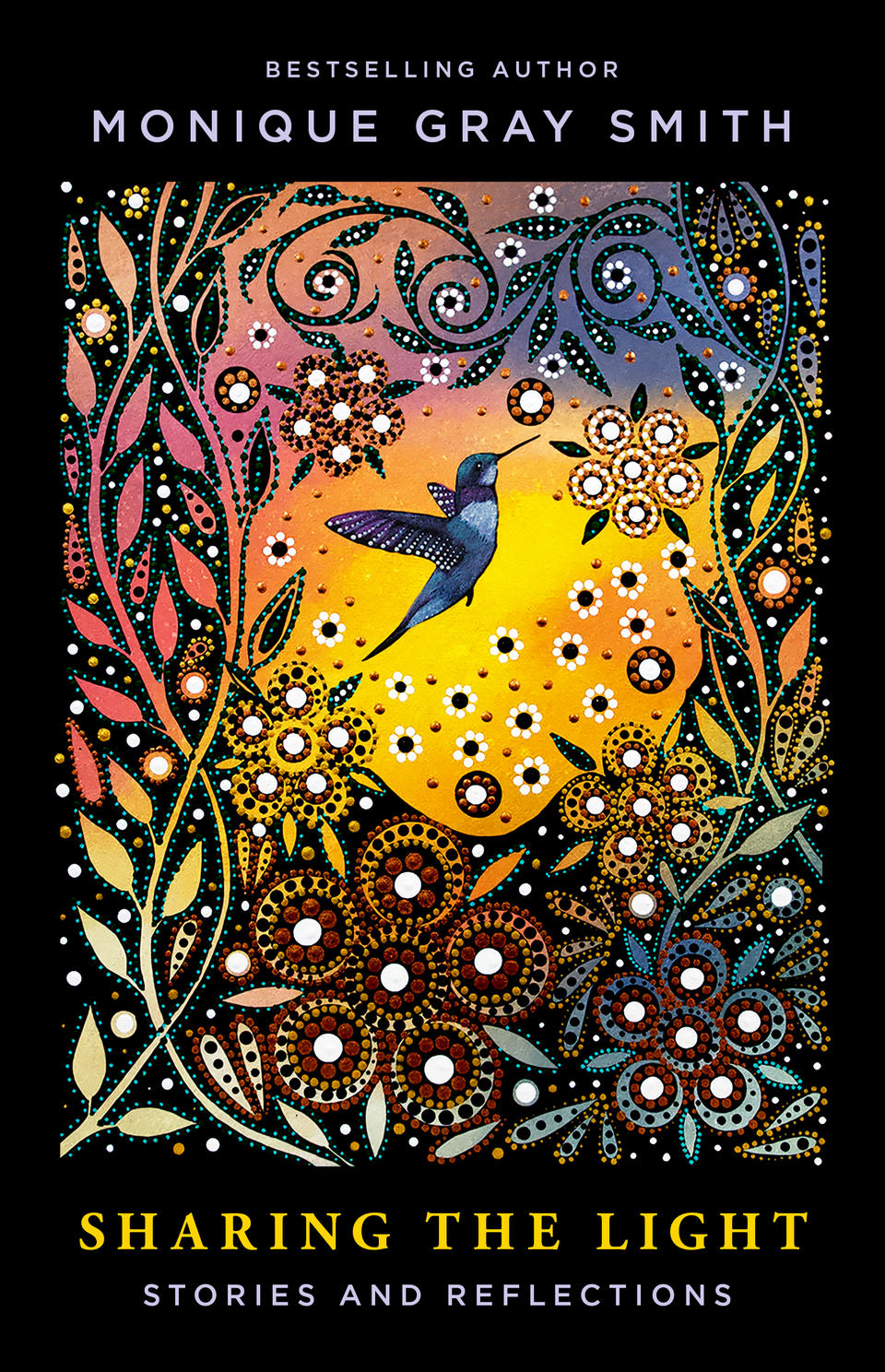
I think it’s because I already know her light that Monique Gray Smith’s Sharing the Light: Stories and Reflections means a little more to me to me than it might have otherwise. Having personally received its brilliant warmth, I can attest to the goodness—though that stunning cover would have attracted my attention all the same.
In November 2019, after her picture book My Heart Fills With Happiness was selected for the TD Grade One Giveaway and distributed to students across Canada, including my daughter, which I posted about on social media, Smith DM’d me to say she would be visiting Toronto to receive an award from the First Nations Community Reads Awards program, and she wondered if she could squeeze in a visit to my daughter’s school, the response from me and the school and everybody an emphatic YES, PLEASE. And what transpired was the most beautiful gathering, Smith sharing her light in the most gorgeous and generous way, the kind of togetherness whose loss I so grieved as the pandemic began not long after, and my children didn’t go to school for a long time.

And then sometime during that sad pandemic year, Smith created a short podcast series called “Love is Medicine,” whose message I clung to as I dealt with my own anxiety and grief about what we were all experiencing, and it helped me so much, such a counter to the messages of doom and gloom that were permeating my consciousness from everywhere else. Instead, with calm and kindness, and born from her own experiences of overcoming adversity, Smith told a different kind of story, one of quiet strength, persistence, possibility, and the hope that is found when we connect to each other.
These same messages are what Smith conveys in Sharing the Light, a book that seems very simple on its surface (some of its pages have just a handful of words), but which is quietly profound, and brave, and not without its twists (the part where she drives 150 miles an hour around a race track!!). Smith writes about gratitude, love, joy, happiness, and hope, about the power and abundance of these elements, and how the simple act of paying attention to them can strengthen our hearts and transform our lives, even in the most difficult of winters.






