April 12, 2010
Joan Bodger's The Crack in the Teacup
 Oh, wow– I just finished reading The Crack in the Teacup, such a tremendous book. As I read it over the last four days or so, I kept clutching its bulk and thinking what an amazing device this is with such transporting properties. Joan Bodger’s life was never, ever boring, from the grandmother who was killed in a shipwreck, to her unconventional girlhood as the daughter of a sailor, her stint in the army working as in decoding, the terrible sadness of her family life, what she learned about story and its power to transform children’s lives (and what I learned about Where the Wild Things Are in reading about this), her fascinating work in early childhood education, the loveliness of her second marriage, her shamelessness (which is learned, and earned with age), her honestly, her passion, that she placed her husband’s ashes in the foundations of the Lillian H. Smith Library which was then under construction.
Anyway, it makes me wonder what came first. Does she tell stories this way because of the stories she’s lived through, or do they only seem to be stories because she tells them as such? Regardless, the rest of us are lucky for them.
Bodger wrote How the Heather Looks which I read last month, and I’m pleased to say that this memoir behind the memoir didn’t run the former for me. If anything, I’m so grateful for the paperback release of How the Heather… because I might not have encountered Joan Bodger otherwise.
April 8, 2010
So Much For All That by Lionel Shriver
 Lionel Shriver breaks all the rules– her best-known novel (and, perhaps, best full-stop) We Need to Talk About Kevin was epistolary, for godsakes. Her last novel The Post-Birthday World is as close to a choose-your-own-adventure for adults as you’re going to get. Her sinfully smart newspaper columns are always out to piss somebody off, and her other novels that I’ve read are uncomfortable, the end-results of fixations. She even dares to be a woman called Lionel.
So it’s no surprise that her latest book, So Much for All That, appears to have a lot wrong with it at first glance. That it’s an “issues” novel, about a topic as timely as the American health care system, and their health insurance system in particular. That, like all Shriver novels, it’s populated by wretched characters who treat one another badly. That one character’s chief occupation is ranting about government control, and taxation, and “mooches and mugs” and these diatribes go on for pages, seemingly only furthering the novel’s political agenda. That nothing much actually happens in the novel, but rather the characters just talk about things that happened, so that expository dialogue is where the action is. That Lionel Shriver characters don’t talk like people– no one is that wry, particularly for multiple dense paragraphs, and nobody actually talks in paragraphs either.
So it will probably surprise you when I report that the book is wonderful. That nobody talks like Lionel Shriver characters, but I wish they did, and eavesdropping onto their conversations for 400 pages still wasn’t enough. That the whole book is conversation rather than action, but that conversation is so vibrant, so pointed and sporting, and brilliant. So Much For That is a satire, the old-fashioned kind. It goes up against the American system and Shriver offers 400 pages of smackdown with more than enough force to sustain itself. It’s a book with a job to do, but the narrative never falters. The plot is gripping, the prose is crafted, the story is sad, but (most essentially) it’s also hilarious.
Shep Knacker has been planning for The Afterlife, but for one here on this earth. For years, he’s been squirreling money away to finance early retirement and the rest of his life in some exotic place where the American dollar goes far. He’d sold his handyman business in the late ’90s and made a tidy sum which has been earning interest ever since, and though it’s a farfetched plan in theory, its achievable in practice. Due to Shep’s conventional streak, his inability to shirk responsibility, however, nobody actually thinks he’s going to follow through.
He’s just about to show them for once and for all, though, the airline tickets bought and he’s made the announcement to his wife (from whom he’s been distant lately) that he’s doing it, he’s taking off for Pemba Island to live out his (still innumerable) days drinking out of coconuts. He’s going, he tells Glynis, with her, or without her. “I do wish you wouldn’t,” she tells him. “…I’m afraid I will need your health insurance.”
What follows is a year in the life of the sick, as Glynis begins treatment for an aggressive form of cancer (and Shep’s bank account for The Afterlife begins its steady depletion). Shriver pulls no punches in her portrayal of disease, and the details of Glynis’ ravaged body are absolutely horrifying. Unceasingly horrifying too, and I’ve never read such a portrayal of sickness. Though the portrayal is multiplied by three– Shep’s best friend Jackson’s daughter has been suffering with a rare debilitating disease since infancy, Shep’s father is elderly and beginning to decline, and then Jackson gets himself into a spot of trouble when elective cosmetic surgery on his penis gets botched. (Critics have questioned this final plot line; I actually kind of loved it, and it delivered the appropriate lightness I required to counter all the rest.)
Lionel Shriver’s books are always, however unconventionally, about family and relationships, and in this novel she shows how disease is a family affair. Moreover, how serious disease becomes the only family affair, and everything else is an extension of it. Her portrayal of Shep and Glynis’s marriage and how the cancer changes it (and the ways in which it doesn’t change it) are hearteningly rendered– Shriver writes a sex scene between them that is the most pointful, perfect and uncliched sex I have ever read in any book. Like every character in this book, Glynis is alternately hateful and sympathetic, a nasty piece of work who you’ve no doubt why Shep fell in love with. She pulls no punches either– sick of false sympathy, of friends who don’t bother (or are just scared to), unwilling to offer redemption to those who come seeking it from her. She is real, striking, scary and wonderful.
The book is bleak. I wouldn’t have considered stopping reading, but it’s a lot of misery to get through, but Shriver makes it all worthwhile with the most wonderful ending I could have imagined. Where there is justice, and goodness, and everybody gets what they deserve, and I’ve never known Lionel Shriver to be such an optimist (or a dreamer).
So it’s too bad this ending is the most storied part about the whole tale, but that’s the world’s fault, and not Lionel Shriver’s.
April 6, 2010
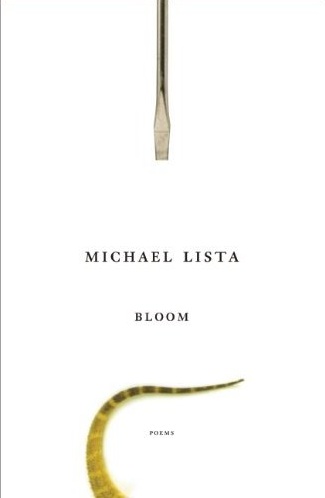
Bloom by Michael Lista
 “Something that has bothered me enormously as a reader of poetry is the failure of poets—especially the so-called avant-garde—to pick up on the formal complexity of the world as revealed by the various scientific disciplines. Biologists have shown us the double-helix, the root not only of physiology but also of behaviour, cognition; chemistry gives us Bach and personality; and physicists are proving we’re more math than matter. And yet so many poets give us a world that looks profoundly out-dated; disordered, solipsistic, self-made, random, positively 20th century. I think a more honest book is one in which the spontaneity of personality is set within the strict—and ancient— clockwork of the world.” –Michael Lista, from “Not Every Gesture Is a Manifesto: An Interview…” by Jacob McArthur Mooney
Say I’m making it
for making’s sake, as humans must
when put before an erector set
whose pieces spell out
Please for the love of Jesus
do not dare assemble us
–from “Do. But Do.”
how when an atom’s centre smashes and cracks
new light explodes from the matter’s collapse
–from “Lotus Eaters”
Michael Lista’s collection Bloom comes with a guide map as an appendix, which might suggest its a book that takes us into unventured territory. And while I’m not sure that Lista’s book is necessarily more “honest” than those of the “so many poets” he mentioned in his interview, this is a fascinating collection nonetheless, in its premise and its execution.
Los Alamos, New Mexico is the guide map, and Bloom tells the story of Louis Slotin, a Canadian physicist working on the Manhattan Project. Exactly nine months after Slotin’s predecessor, Harry Diaghlian, was killed in an accident while “bring[ing] a core of nuclear fissile material as close to criticality as possible”, Slotin himself has an accident, and though he manages to shield the other scientists in the lab from radiation, he dies nine days later. An essential twist in the story is that Slotin died training his replacement, Alvin Graves, who was having an affair with Slotin’s wife.
I don’t know what “close to criticality” means, and neither have I read Ulysses, but even still, I was able to be captivated by Bloom. Each poem in the collection takes another poem as its source material (by poets as various as Ted Hughes, the Pearl Poet, and the Velvet Underground, by poets as cotemporary as Karen Solie, Robyn Sarah and Nick Laird, and plenty of [undoubtedly famous] other poets to whom a reference might bely that I’ve actually heard of them), and Lista refers to his work with the original poems as “English to English translations”. By which he means that his source materials are building blocks, modified to suit Lista’s poetic purposes and the purposes of the story.
Not a thing is original here– just as Slotin’s experience is a copy of Diaghlian’s, and Graves’ was the stand-in in Slotin’s marriage, each poem is a variation on something that has been written before, each of these poems refers to allusions and other texts (as well as a pivotal part of a 1989 movie projected onto John Cusack’s shoulder). And while the product of such an experiment is a little confusing and overwhelming, it’s also navigable and pretty fabulous to contemplate as a whole– the cacophony, so many voices, and such variation is entirely readable.
I am not this book’s intended audience, presuming it was only ever meant to have just one. But I am pleased to now understand how literary remixing could be an art onto itself and not simply plagiarism ala Opal Mehta. The incredibly illuminating Torontoist interview I refer to above (and yes, I was unafraid of cutting and pasting for this review) notes that Bloom is controversial, that readers could resent Lista’s rearrangement of beloved or iconic works (and I wonder too, if his variations might look paltry in comparison?). Interestingly, however, because my knowlege of the source material was so incredibly minimal (indeed, the only poem I’d read was Sir Gawain and the Green Knight back in Major British Writers, and I’m not sure whether to blame the University of Toronto or myself for this) none of these problems existed.
Lista’s poems refer me not to something that’s old, but something that’s entirely new, which was the opposite of his intentions, but it’s a distinctly original result.
March 28, 2010
Solar by Ian McEwan
 I have a feeling that some understanding of quantum physics could open up Ian McEwan’s latest novel Solar tenfold. That this story is operating on all kinds of levels I’m not even perceiving, but then maybe that’s just part of the joke. That I’m the type of person who imagines layers of meaning rather than a single thing (a novel) being what it is.
This is what it this: Michael Beard is a Nobel Laureate, though he ceased to practice actual science years ago. He gets by, as a Nobel Laureate might, nominally serving on various boards and letterheads, and when the novel begins in 2000, he’s Director of the National Centre for Renewable Energy, developing a wind turbine he’s since realized will be useless. His fifth marriage has just collapsed, he’s overweight and balding, he doesn’t mean much to anyone, and not much means much to him. Except potato chips.
The shape of Solar is in direct opposition to McEwan’s Saturday (which was novel through which Ian McEwan and I fell deep in love). Though both books are dense with detail, Saturday‘s momentum was furious, whereas Solar moves at a much more Micheal Beard-ish pace. It plods, it does, though what redeems this pace could be accounted for by the number of times whilst reading this novel I gasped out loud with surprise, shock or horror.
The fact is, I really can’t tell you what happens, because you need to experience the surprise, the shock and the horror for yourselves. What I can say is that physicist Michael Beard experiences the world in physical terms, as an object moving through that world and bumping into things. And it’s these bumps that determines his trajectory more than any kind of established direction: “The past had shown him many times that the future is its own solution.”
His journey takes him from the mess of his marriage to an excursion to the North Pole for an interdisciplinary summit on climate change, to a new relationship and a new career selling solar technology to savvy investors, via a train journey that is rather fraught, and then to America where he’s using science to replicate photosynthesis in order to harvest the energy of the sun and ultimately save the world. Throughout all this, he spends a lot of time in traffic, and the “bumps” that determine where he goes from one step to another are also profoundly physical in their nature– how a head hits a table edge, the trajectory of a thrown tomato, and one vital intersection between a sperm and an egg.
As unattractive as he is, Beard (McEwan writes), “belonged to that class of men… who were unaccountably attractive to certain beautiful women.” And unattractiveness aside, it’s clear how this could be the case– Beard spins a certain version of his experiences that so thoroughly convince him that readers are nearly convinced alongside by such a singular point of view. The thing about a character who bumps through life without thought towards others or any consequences is that he’s sort of vile, but we really can’t quite hate him. The bumbling fool, we start to believe, is just a victim of circumstance; he’s innocent and misunderstood.
It soon becomes clear, however, that not only is Beard a character completely blind to consequence, but consequence is also quite blind to him. On one hand, he’s had us thinking that he’s hardly an agent in his own life, but we see he’s not an object in it either– after the series of events his bumblings set in motion, the pieces fall without any hint that he’d even been there. And this is where I start wishing I understood quantum physics (in addition to marvelling at the fact that Ian McEwan really seems to) because I’m sure there is some scientific theory analogous to this narrative structure which would bring the whole thing together. And mine is the kind of thinking Michael Beard finds himself up against, by relativists who see science as just another way (among many) of looking at the world, instead of understanding that the world is one thing only whether we’re looking at it or not.
I’ve not yet conveyed that this is a funny book, slapstick in some parts, deeper so in others, and darkly too. That McEwan satirizes academia, media culture, and modern life, but in such a way that it’s never clear what way is up and who is meant to be skewered. That even if Michael Beard thought I was a fool for saying so, that this a book with so much going on on so many levels that it just opens up wider and wider the more I think about it, so that one note in the margin just leads to another until the end-pages are covered in scribbles. And that clearly this is a book that I’m not nearly finished with yet.
March 18, 2010
Finnie Walsh by Steven Galloway
 This seems to be the second in a series of reviews of long-ago first novels reissued when writer strikes it big with a later book. I read Steven Galloway’s acclaimed The Cellist of Serajevo last year, and found it to be the most nuanced, interesting book about war I’ve ever encountered. And since Galloway had me obsessed with a book about a sniper (unlikely, I know), I decided his first novel about hockey Finnie Walsh was even worth a go.
The only real problem with Finnie Walsh is that it’s not A Prayer for Owen Meany. I’m not sure if it wanted to be, if it’s a homage or just an incredibly resonant echo, but the similarities between these two books are overwhelming. Owen has certainly inspired his share of devotees, and the more evangelical among them might struggle to accept Finnie for himself, but if you’re like me and found Irving’s book charming but way too long, you’ll probably manage to do so.
The book is narrated by Paul Woodward, son of a mill-worker who throws a wrench into the social order when he becomes friends with the mill-owner’s son. When the book begins, Paul and Finnie are seven years old, on the cusp of beginning their great hockey adventures and taking turns smashing the puck against Paul’s garage door. This creates a racket that keeps Paul’s father from sleeping properly that afternoon, so that he ends up nodding off on his job at the mill on the night shift, and losing his arm to the blades of a saw.
Finnie Walsh, perceptive beyond his years, feels responsible for the accident, and becomes closely bound with the Woodward family in order to atone for what happened. Over the next fifteen years, his fate and theirs are intertwined, and the narrative follows the cast of characters– among them, the oddly charismatic Finnie, Paul’s father (who spends those fifteen years educating himself by reading every issue of National Geographic from its inception), Paul’s sister strange sister Louise and his even stranger sister Sarah (who wears a lifejacket everywhere, and sees the future reflected by her bedside lamp). The narrative itself is somewhat random, often tangential, but these characters are so lovingly rendered that the story is compelling.
In the background throughout, there is hockey. Both Finnie and Paul follow the sport, and the narrative is punctuated by its zeitgeist– the ascent of Wayne Gretzky and then his trade to the LA Kings in particular, and many other players that I’d never heard of before but Galloway spins the stories so they’re epic heroes. Both boys play hockey as well– Finnie is a goalie, and Paul plays defense, and they move up through the ranks in local hockey until they’re both drafted into the NHL when they finish high school. (Which I think is a bit unlikely, no? Or rather, the remarkable nature of it is not made incredibly evident. It’s as though this is all just part of a natural progression, but maybe for some players it is?)
The novel begins, “Finnie Walsh will forever remain in my daily thoughts, not only because of the shocking circumstances of his absurd demise, but because he managed to misunderstand what was truly important even though he was right about everything else.” Which is a truly great opening sentence, but it also makes clear where the narrative is going to take us. So that the journey is the whole point, but Galloway has created a splendid one. For the hockey-illiterate such as myself, this book was a splendid, uplifting ride, but for the hockey-already-converted, this might be the Canadian novel you’ve always been waiting for.
March 11, 2010
House Beneath by Susan Telfer
 On Monday, I read Susan Telfer’s first collection of poetry House Beneath over two nap times, delighting in its branches and its roots (and yes, its stunning cover design too). I would describe it as “a Carol Shields novel compressed into 78 pages”, which is high praise from me– that a book of poetry could have the breadth of a novel (a statement which makes me sound a bit ignorant about poetry and overly devoted to novels, both of which are true) and one by Shields at that.
In her collection, Telfer tells the story of a daughter who is losing her mother just as she’s becoming a mother herself, who has been let-down and betrayed by her father’s addictions, who is struggling to make sense of her parents’ history as she also faces forward to construct a family of her own. The book is explicitly maternal, breasts full and leaking, babies cradled, bodies aging and changing, and ovulating. It is the maternal that makes me think of Shields, of course, but also how photography is used, and the resonance of childhood, and its quiet feminism. Lines like, “On the tangerine trampoline, I/ levitated– all the new ideas/ of the world fell into my mind like/ shooting stars…
Telfer’s poetry is eclectic– “Mercy” is a glose; “Weaning Dance” is a gorgeous villanelle; “No Satisfaction” references The Rolling Stones, Betty Friedan, a family photograph and Dr. Spock. The collection is suffused with music– made-up songs a mother sings to he children, Helen Reddy on the record player, Depeche Mode a party soundtrack, poems are haunted by pianos, one is called “Mother Fugue”, another “Brahms’ Sonata in F Minor, 1853”. Some poems are songs, others dances, and a few are dirges too.
Some of these poem are rooted in pain, some in joy, and others come from a point of quiet solace. Their rootedness is important though– these are poems that are explicitly located, in dream-haunting houses, on the very edge of a continent, in places we don’t always want to go home to (but do).
(Read Susan Telfer’s poem “Staircase“)
March 8, 2010
How the Heather Looks by Joan Bodger
 I was thinking of AS Byatt’s The Children’s Book when I decided I wanted to read Joan Bodger’s How the Heather Looks: A Joyous Journey to the Sources of Children’s Books. Byatt’s novel had stirred my interest in the history of English children’s literature, plus I’ve been reading a lot of it myself lately– we’re currently working on Now We Are Six at bedtime. Bodger’s book was first published in 1965, the story of a journey her American family had taken across Britain in the late ’50s in search of storybook places they all knew by heart. She was a writer herself, her husband John was a reference librarian, and they’d managed to instill a passionate love of literature in their two children, which is no wonder considering they were the type of parents who’d embark upon a journey such as this one.
The book is magical, sparkling. I was familiar with probably only about a third of the works referenced, but I’ve come away wanting to read the rest, and Bodger’s prose is so delightful, the trip itself twisty and turny and marvelous to follow along. Her research is stunning. And how wonderful: the very point is to discover whether maps they keep finding in their books’ end-pages could possibly map onto real places? And the story of what they discover is a wonderful ode to an Britain that was (times two), and a testament to the power of children’s literature.
It is pretty typical, from what I know of England, that this American family on a madcap adventure rarely finds an English person who’s read the work they’ve travelled across an ocean in search of. At the beginning of the book, the family arrives in Whitchurch in search of scenes depicted by illustrator Randalph Caldecott, and they stop at a school to ask for directions. Bodger wonders, “what it would be like to talk to children who walked to school each morning over the very fields and country lanes made famous in the Caldecott illustrations… [T]he experience [of introducing Caldecott’s work to the children] must be akin to holding a child up to the mirror for the first time and letting him recognize what it is that the rest of the world holds dear.”
The children don’t recognize what the world holds dear, however, and even their teacher hadn’t heard of Caldecott. And the Bodgers encounter this time and time again, as they go in search of Narnia, a lost colony of Lilliputians, the Borrowers’ home, of Robin Hood, Pooh’s enchanted wood, Toad Hall and Rat’s house, Camelot, Avalon, The Secret Garden, and Jemima Puddle-Duck’s garden too. Not to say that English aren’t accommodating, however. They meet with AA Milne’s widow, and Bodger stumbles upon an interview with Arthur Ransome. When Bodger has to make an urgent call to the London Library Association, the person who answered her call “did not seem in the least upset that I had asked him to find out where a fictitious water rat had entertained a talking mole.”
The Bodgers rarely find exactly what they’re looking for, but possessing spirit and imagination enough to embark on such a pilgrimage at all, they have enough too to find the magic they’re seeking. Which is partly due Britain itself, its layers of history, its mythical past (and its tea and scones, from which the family frequently takes its sustenance). Due also to the stories, their universal appeal and how they’ve endured. But also to the Bodgers’ particular appreciation of the stories, and of stories in general (and Joan Bodger would go on to found the Story-Tellers School of Toronto). These are parents who take children’s literature very seriously, which has rubbed off on their son who possesses that knowledge of battles, and history, and storybook scenes that only a small boy can. Particularly a small boy who used to rock in his crib to the beat of “Windy Nights” when his mother read the poem to him at bedtime.
In her afterward to the 1999 edition of this book (and Bodger died in 2002), Bodger warns those who might regard How the Heather Looks as a guide to family life, to creating wondrous childhoods. Indeed, however idyllic the family seems, one cannot avoid mention of what would happen to them: Lucy, just two years old in the book (“the only one among us who did not need a guidebook”, young enough to think of nothing walking into the world of storybooks) would die of a brain tumour at age seven, Bodger and her husband would divorce, her husband and son would both suffer from schizophrenia. Whichs idevastating, and terrifying– I have this naive idea that with books, we can steel ourselves against tragedy, that we have any kind of control over that kind of thing at all.
But this unexpected ending doesn’t make the book any less magical, just as the Bodgers’ locating their favourite stories in the real world doesn’t diminish the literature itself. This is the stuff that the world is made of, is all, and a rare, precious thing are writers like Bodger who can see it that way, and then write it down so beautifully too, drawing such illuminating connections. Which is why I look forward to also reading her autobiography The Crack in the Teacup: The Life of an Old Woman Steeped in Stories very soon.
March 5, 2010
Can-Reads Indies #5: Moody Food by Ray Robertson
 Until yesterday afternoon, I was dreading having to write this review. I was about half way into Moody Food and I just wasn’t getting it. I did like the references to 1960s’ Toronto and the Yorkville I only know from ancient mythology; I liked Thomas’s back-story; I liked the Making Waves Bookshop; I loved certain ways Thomas’s understanding of music was described (in particular, what he heard in the vaccuum cleaner when he was a child). But I found the prose awkward, with strangely-claused sentences that were hard to follow. And my biggest problem was with Bill Hansen.
For the first half of the book, Bill was a cipher. He was a non-character, and I couldn’t figure out why any of the others, with their vivid personalities– his cool girlfriend, Christine, his old hippie boss at the bookstore, the enigmatic Thomas Graham himself– why were they even hanging out with him? Bill took responsibility for nothing, had no real talents of his own (so they made him the drummer), didn’t follow through with anything, all of this for no real reason except to propel the plot. Let’s face it– in reality, Christine would never have dated him, Kelorn would never have hired him (and would have fired him once he stopped showing up for work), and Thomas wouldn’t ever have given him the time of day. Moody Food would never have happened. It all seemed like a construct, and that bothered me.
Thomas Graham himself I also had a hard time with– I didn’t buy his charisma. Though I started to see that the problem here was that we were seeing him through Bill’s eyes, and Bill describes himself as “the first and last disciple of Thomas Graham”, plus Bill was doing a lot of drugs, so probably nobody else really bought the charisma either.
So this disparate group comes together to form The Duckhead Secret Society, hooks themselves up with a steel guitar player called Slippery Bannister, they eventually catch the interest of a record producer with their “interstellar North American music”, and the rest is music history. Music history in the “Almost Famous” sense, the Behind the Music downward spiral that by now is a familiar narrative. And for me, once the spiral started, I finally found the book’s momentum.
Thomas and Bill get into cocaine, and then Thomas starts doing heroin, and instead of focusing on their tour and the album they were contracted to make, Thomas becomes absorbed by his magnum opus “Moody Food”. At one point, he’s got a cow in the studio, and he’s got a certain affinity for bovines anyway since becoming obsessed with vegetarianism. Robertson is throwing out these amazing sentences like, “When he hit the desert earth the crunch of his carrot was the only sound for miles.” Thomas is falling apart on stage, but he doesn’t care, and he and Bill spend their nights strung out on coke and writing new material (for which Bill is essential, because he hears music in colours and matches it with passages from library books they steal from all over North America). And Thomas starts referring to himself in the third person, and throwing liver off balconies, and uttering lines like, “The heart gets all the songs written about it and it’s what everybody talks about, but the liver is the biggest thing in you. So how come you never hear anybody talking about the liver? Where are all the songs written about it?”
When Thomas slips too far over the edge, suddenly Bill Hansen makes sense. We’re not supposed to like the guy, much like how we felt about Max from How Happy to Be. Unlike Max, however, Bill lacks wit and charm, and his perspective is remarkably limited: later, a character says to him, “I knew you weren’t bright, but I never took you for stupid.” But he is, a little bit, because he’s just a kid from Etobicoke who’s caught up in a story that’s too much for him. When the Duckhead Secret Society returns from their tour, Thomas holes up in his hotel room until the RCMP catch on (because he’s dodging the draft, and wanted for drug possession). The whole Yorkville scene has gotten out of control, and as a riot breaks out between protesters and police, Thomas Graham urges his band up on the rooftops for one last show that would have been an overwhelming cliche, but hilariously and tragically isn’t, and all of the sudden our perspective (and Bill’s) is whipped back to something resembling reality. How we’ve been following him so up close all this time, but Thomas Graham from far away can actually blend into a crowd.
I really enjoyed this book in the end, and I’m not sure if my early reservations were my fault or the book’s, but I didn’t have any by the time I was finished. That it took me so long to get into it, however (and this is a 400 page book), would have me counting against it. And here’s where this ranking think is stupid– every single book I’ve read as part of Canada Reads: Independently would probably be the very best book on most reading lists, but this is a particularly superlative reading list. Which means that although Moody Food is taking the bottom spot, it’s only because of its very good company, and also that my heart is breaking. But that this entire book list has been a really incredible reading experience and I’m so pleased to have had it.
Canada Reads: Independently Rankings:
3) How Happy to Be by Katrina Onstad
4) Wild Geese by Martha Ostenso
5) Moody Food by Ray Robertson
February 22, 2010
Can-Reads-Indies #4: How Happy to Be by Katrina Onstad
 If Max were a man, there would be no debate about whether or not How Happy to Be is a serious novel. But Katrina Onstad’s Max is a woman, and so we have to discuss whether or not this is chick-lit, and if there is such thing as women’s fiction, and my answer to that one would be that sometimes there is, but not now. That if Max were a man, this novel wouldn’t be so different, except for the scene where she gets her period. I think a man reading this novel would appreciate it as much as I have.
If Max were a man, we’d c0mpare this book to Lucky Jim, but because Max is a woman, someone will mention Bridget Jones. She’s more Jim though, because her behaviour is loathsome rather than lovable, but loathsome is made palatable by being funny. (And I got this whole Lucky Jim thing from writer Kate Christensen re. her first novel In The Drink, interviewed here: “…an august tradition of hard-drinking, self-destructive, hilarious anti-heroes beginning with Dostoevsky’s Underground Man and continuing through Joyce Cary’s The Horse’s Mouth, Kingsley Amis’s Lucky Jim, and David Gates’s Jernigan, three of the books which have inspired me most. Other exemplars of Loser Lit (and there are many) include The Ginger Man, A Confederacy of Dunces, Bright Lights, Big City, Wonder Boys, Miss Lonelyhearts, A Fine Madness, and, most recently, Arthur Nersesian’s The Fuck-up. I was consciously co-opting a predominantly male genre, another reason I worried that no one would “get” In the Drink.”)
I feel bad now about the fact that I have to undermine this book’s femininity (assuming books have genders, but I’ve got a feeling that they do) in order to demonstrate its value. And you’re probably thinking that I’m protesting too much, but I also know that you’d think I was ludicrous to put this book at the top of my rankings. Why? Because it’s a popular novel, because it’s about a wayward youngish woman who finds love at the end, because it engages with pop culture and media culture, because it’s a comedy, because of the scene in which Max gets her period on a first date, the date has to go out and buy her tampons, he comes back with pads so thick that when she puts one on she waddles.
But in many ways, I truly think How Happy to Be is the best of the Canada Reads Independently books I’ve read yet. First: no gimmicks. Like some critics, I will concede that the Hair Hat Man himself was a gimmick. Century had them too (“Does it matter that there was no Jane Seymour? I don’t think so, but I hope you found her convincing.”) In fact, speaking of Century (and these outlandish comparisons are part of what makes a reading challenge like this so interesting), How Happy to Be also takes on “this murderous century”. It’s similarly woven of stories, of true ones and embellished ones, stories about how we tell stories and why, the stories we tell ourselves, those we can’t bear to, those we tell the world, and those that complete strangers tell us while we’re sitting beside them on the streetcar.
More though, about why this book is so wonderful: Katrina Onstad is a stunning writer. She is. “I watched from windows and trees for seventy-two days until Spring came. Her hair was finally longish, down around her ears now, and she looked beautiful again, her high cheeks neither sunken nor overblown. She could catch me. Day 73, she climbed the same tree from a different angle and grabbed my foot. Terrified, I howled like a stubbed toe and she laughed and laughed and my father brought us lunch to the rotted picnic table with only one bench. We sat in a row, my father, my mother, me, eating sandwiches off paper plates, shoulders touching in the summer, our limbs sighing with relief where they met.”
If How Happy to Be had a gimmick, it would be Onstad’s engagement with reality. The novel is a roman à clef of sorts– no doubt the newspaper where Max writes her film column is The National Post (where Onstad was once film critic); The Other Daily‘s vapid girl columnist seems familiar; Onstad counts Ethan Hawke, Jennifer Aniston, and Nicole Kidman among her characters; her fictional headlines mirror actual ones; she skewers a coke-snorting, bitch-slapping media scene culture that is apparently true to life (not that I’d know, of course, as such culture often takes place after 7pm and I haven’t left my house at such an hour since 2004 and that was just to return an overdue library book).
But the punch of her prose and the push of her plot keeps the trick from wearing thin. Max has spent her life looking on and telling stories from the sidelines, but she’s on the edge of something now– not yet recovered from the end of a long-term relationship which broke with “make or break”; desperately unhappy in her job writing about shitty movies whose advertisements pay for her paper; drinking too much; having stupid sex; she doesn’t have furniture or anything fresh in her fridge. “You have run out of repartee. You think of all the time you wasted watching while you should have been remembering what you once knew: how to start a fire with hands and twigs; how to sleep in a snow cave. You should have surrounded yourself with old people and listened to their tales of survival, really listened instead of jotting them down for later. You have entered your thirties without knowledge and you want it in a pile of sticks, a river, your bones.”
She wants her mother, the mother she lost to cancer years ago. And though she’s too angry with him to know it, she wants her father too, who was so paralyzed by his wife’s death that Max could never reach him. She wants roots, something real, and perhaps she might find it in Theo McArdle, who in his absolute goodness is the opposite of the rest of her whole life.
Rona Maynard was right in her pitch: How Happy to Be is a coming-of-age novel. A bad headline for this would be Catcher in the Wry. And now for the reasons that the novel will not be topping my rankings: first, a fairly conventional plot from about midway in is not extraordinary enough to compare with Hair Hat or Century. And also that the whole point of this novel is Max’s singular vision (“I’m being stabbed to death by my point of view”), which is dealt with most effectively, but (redundant though it is to say) is terribly limited, and doesn’t begin to compare with the other books’ polyhedronal approach.
But I love this book. I think it’s an important book, that it sets a standard that all novels about young women should live up to, that it deals with contemporary urban life in opposition to the Can-Lit standard, that it sets a standard of funny that all novels about anyone should live up to, and that it might surprise any male reader who thinks he’s not so interested in stories about women’s lives.
Canada Reads Independently Rankings:
1) Hair Hat by Carrie Snyder
3) How Happy to Be by Katrina Onstad
February 19, 2010
It was me
 All right, I’m not going to deny it. That was indeed me spotted walking through the Annex neighbourhood yesterday, Patrick Swayze’s autobiography glued to my hands and my nose stuck inside. Even though it was cold outside, and my hands were going from painful to numb, and even though this was Patrick Swayze’s autobiography after all, and do I really want to get a reputation as a celebrity-bio-reading flâneur?
But you see, yesterday I had the opportunity to go out all by myself for the first time in centuries, and I wasn’t about to squander that reading opportunity, and really, I couldn’t have even if I’d wanted to, because Patrick Swayze’s autobiography was absolutely addicting. I have an infant, and I read it in a day. I got in trouble for reading it at the table. And from the time I opened the book until I got to the last page, Patrick Swayze and his amazing accomplishments were all that I could talk about.
I’d been under the mistaken impression that Patrick had got his start whilst one day sitting in a luncheonette when this guy came in and said that Arthur Murray was auditioning for dance instructors. Turns out otherwise, that Patrick had been set on the path to stardom from a very young age, and that in high school he danced, sang in musicals, played violin, football, kickboxed, was a competitive roller skater, and got a college scholarship for gymnastics. When a football accident and a dangerous gymnastics landing destroyed his knee, he decided to be a professional ballet dancer (as you do). In order to supplement his income, he became a carpenter and taught himself out of a book, and he also was a singer-songwriter. He became a Buddhist. Later, he would go on to act in Broadway shows, in ice-skating shows, act in movies and television, become a pilot and a rancher. And not least of all, he was a husband for thirty five years to a woman who married him when she was just eighteen years old (and I am more than a little bit addicted to memoirs of long marriages. Perhaps for tips? Perhaps for insurance?).
So Patrick Swayze’s life was more interesting than I ever supposed, and though his journey to success took the standard shape (decades of hard work, followed by meteoric rise), that kind of story is also interesting. The book was also setting itself up to be devourable by being structured somewhat like a “Behind the Music” episode: “And so we were happy, but little did we know that tragedy was lurking around the next corner…” It wasn’t well written (Patrick was fond of paragraphs composed entirely of sentences expressing the same idea of different words), but it wasn’t bad either. The prose was hardly the point.
What fun! I turns out that celebrity biographies are not automatically crap. I might venture to qualify that with “celebrity biographies (of celebrities who are over the age of thirty and/or not reality TV stars) are not automatically crap”, but what do I know about that? Nothing. And in spite of this positive experience of celebrity bios, I fully intend to keep it that way.






