November 16, 2010
Penny Dreadful by Laurel Snyder
 On the rare occasions I read YA, it will be a book I used to love, or a book that refers to books I used to love (such as A Wrinkle In Time, which was why I read Rebecca Stead’s beautiful When You Reach Me). Of course, as Laurel Snyder’s latest novel Penny Dreadful is brand new, I read it for the latter reason. On her blog she’s posted a list of books loved by her protagonist, books referred to in the text– Emily of New Moon, Little Women, Betsy-Tacy etc. etc. And this gratuituous bookishness convinced me that this was a book I had to read.
I wasn’t sold short– we learn on page 5 that Penelope has just finished an Anne of Green Gables book and is having trouble deciding what to read next. Later she wonders if a situation is like a disturbing book with an innocuous cover, “like Bridge to Terabithia“. Penelope Gray’s biggest problem is that her life is nothing like the characters in the books she devours, and she makes a wish that things could get more interesting…
And then they do, but not quite in the way she’d imagined. Through a series of events, her family ends up moving to a small town and encountering a cast of wacky characters, and what with all the wacky characters, a winding river, and the wishing well that started it all, Penny becomes assured of her place in the narrative that is her life. That she will find the hidden treasure after all, and save the day etc. Except that she’s not a character in a book (except that she is a character in the book. Fun!), and has to learn that even if things don’t work out to a perfect conclusion, life can still be okay.
Penny Dreadful is a timeless, lovely middle-grade novel with much bookish appeal. Made very rich by and a fitting tribute to the marvelous works it alludes to.
November 14, 2010
Talking About Detective Fiction by PD James
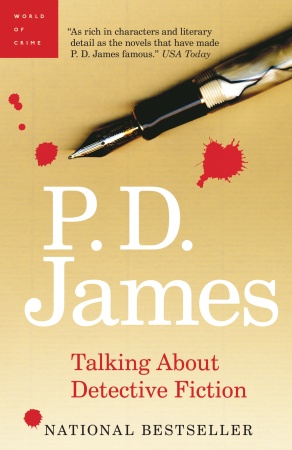 I am a detective fiction neophyte– I only read my second Dorothy L. Sayers last week. The book was Strong Poison, featuring Harriet Vane who’d been introduced to me in the marvelous Gaudy Night. And I thought it was fitting that I follow up Stong Poison with P.D. James’ nonfiction book, Talking About Detective Fiction.
It’s possible that I am exactly P.D. James’ intended audience here. Long prejudiced against genre fiction of any kind, though with a penchant from very young for smutty true crime books, but there you go. I found my way into detective fiction via Kate Atkinson, and her Jackson Brodie. I became addicted to television’s Midsomer Murders (which is based on the books by Caroline Graham). I also like Susan Hill, and recently enjoyed The Dead Politician’s Society by Robin Spano. I particularly adored Sayers’ Gaudy Night which, as James asserts, demonstrates that “it is possible to construct a credible and enthralling mystery and marry it successfully to a theme of psychological subtlety.”
But there is a lot I have to learn, such as that “crime fiction” is an umbrella under which detective fiction falls. The sacred rules of detective fiction, which all the best writers find ways to creatively skirt, including that the criminal must not be a character whose thoughts the reader follows, the detective should never know more than the reader does, no more than one secret room or passage, no intrusion by supernatural elements, no twin brothers or doubles unless the reader has been prepared. That there was no such thing as detective fiction before 1842, because there had been no detectives (or at least not in England– it was the year the Metropolitan Police came into being). The eternal allure of Sherlock Holmes (and one of the funniest parts of the texts is when James questions, at length, the reasons why H0lmes and Watson had continued to share a small flat from which Watson would have to retire to the bedroom when guests came around). James deals primarily with English detective fiction in the book, but devotes a chapter to the very different direction taken by the genre in America, with “hard-boiled” detective stories about Sam Spade and Philip Marlowe. I also particularly liked her chapter “Four Formidable Women”, which included Agatha Christie and Sayers.
I expect the true detective fiction devotee might not find a lot here that’s new, and moreover could even find plenty to quibble with, but all the same, James’ book is clever, funny and engaging, and manages to convey some of the suspense and characterization of her novels. For a reader like me, however, Talking About Detective Fiction is a delight, a fine celebration of a genre I’m looking to know better.
November 10, 2010
The Carnivore by Mark Sinnett
 I first learned of The Carnivore when it was on the shortlist for the Toronto Book Award, and its author Mark Sinnett was reading an excerpt on the radio. The excerpt was intriguing, featuring a husband and wife meeting together on the shore of Lake Ontario as swimmer Marilyn Bell completed her crossing of the lake in 1954. The simple dynamic between the couple belied something darker and deeper, and the historical detail was inconspicuously well done. When The Carnivore ended up taking the prize, I knew that I had to read it.
When Ray Townes is in the final stages of emphysema, he and his wife Mary look back on the course of their marriage, and how their lives hinged on Hurricane Hazel, which ravaged Toronto in October 1954. The couple doesn’t look back together, however, the book consisting of alternating chapters from their two solitudes. The effect of this is interesting, as we learn that each of them has their own secrets about how much they know about the other and what they’ve chosen to withhold.
Ray is a police man who spent the hurricane rescuing citizens clinging to rooftops and washed out bridges. What the newspaper articles profiling his heroics fail to reveal, however, is that his courage that night stemmed from a mania that arose from a terrible act he’d committed, and that while he was supposed to be on duty, Ray had been driving around the city with his mistress. Mary is aware of all of this, however, which is why she resents the rehashing of events as the 50th anniversary of the hurricane approaches. She has never been able to forgive her husband for what he did and what he took from her, and now her own traumatic memories of the hurricane have been awakened– she was a nurse at St. Joseph’s Hospital, and witnessed horrific injuries that night she’d never been able to forget.
Sinnett’s depiction of the hurricane– the rushing rivers, the broken bodies in the hospital, the force of nature that tore its way through a city– are the most compelling aspect of the novel. They are riveting, illuminating and unflinching in their portrayal of a tragedy that seems to have been whitewashed by years of familiarity– like Hazel was somebody’s elderly aunt who came visiting once. Sinnett deftly uses detail in the story to describe the hurricane and the more general atmosphere of Toronto in 1954, his historical fiction not toned by sepia even though the book is structured as a reflection.
The back-and-forth in the narrative, and that the story is told to the reader rather than immediately experienced makes the plot read a little mechanically at times. Similarly the characters, who we’re permitting such a limited perspective of by their own voices and the partner’s perspective. Though some of the gaps Sinnett leaves in the character are interesting– we don’t get all the answers about why they’ve done the things they have, and that space to ponder is particularly engaging.
The Carnivore is a worthy recipient of The Toronto Book Award, a deserving book that will strike a chord with readers from Toronto and elsewhere. A book that uncovers another layer to a city we think we know.
November 8, 2010
On reading Anne Fadiman's Ex Libris
 I realize I’m being startlingly unoriginal in loving Anne Fadiman’s books of essays, not to mention about a decade late, but you see, I spent that decade entirely unaware that Anne Fadiman’s books were in the world, and I now see it as my duty to deliver any other readers from such similar darkness.
I first encountered Fadiman in August when I took her book At Large and At Small: Familiar Essays away with me on vacation. Tragically, its adorable front cover was marred when I used it to kill a mosquito against a log wall, and I was determined that a similar fate would not befall the even more adorable cover of Fadiman’s Ex Libris.
Ex Libris is a book of essays about books and reading, written with Fadiman’s signature exuberance. Though her book’s subtitle is an understatement; she is just about as “common” a reader as Virginia Woolf was. Fadiman’s bookish cred is serious: her parents are both writers, she grew up in an apartment with 7000 books, her husband is a writer and the progress of their relationship can be traced by the dedications on the fly leaves of books they’ve given each other over the years. One of her essays begins, “When I was four, I liked to build castles with my father’s pocket-sized, twenty-two volume set of Trollope.”
Still, however, there is common ground between her and us, which is partly aspirational thinking on our part, but also the result of Fadiman’s generous spirit. And she does have a knack of summing up experience just right: “I’d rather have a book, but in a pinch, I’ll settle for a book of Water Pik instructions”, she writes of her incessant need to always be reading something (which once a 1974 Toyota Corolla manual, twice, in an otherwise literature-barren motel room).
She writes hilariously about she and her husband eventually taking the plunge after some years of marriage, and finally deciding to merge their libraries, about the courtly and carnal approaches to how we mistreat our books, about gender and the evolution of language, compulsive copy-editing, and a wonderful essay about reading aloud with the perfect title: “Sharing the Mayhem.” Some of the book’s best bits feature her hapless husband, and her parents and brother who with her comprise a family like no other. A family that is an institution onto itself, with new word acquisition, literary references and allusions, and compulsive bookishness wholly integrated into everyday life– they are a fascinating window onto a world.
Anyway, I left this book on the kitchen table and something dripped on it, and there’s also now a rip on its upper right edge, but none of this makes Ex Libris less than perfect still, really. And how lucky was I this weekend to be discovering it for the very first time– delight and joy and wonder abound. My life is richer for it.
November 7, 2010
A Fuzzy Realm
 The fact was that I struggled with Sheila Heti’s book, How Should a Person Be? About what it meant to call that book a novel, a novel that contains its author as a character, a book whose gratuitous sexuality I found more off-putting than titillating, a book that read like a punchline to a joke I’d missed hearing told. Though I engaged with the book on many levels, at various points jotting, “This is interesting…” in the margins, and throughout as I tried to understand what Heti’s project was.
Part of the problem, I think, was that Heti came from a point of departure that didn’t quite make sense to me. For instance, that the blow-job is the great art-form of our time, as the novel was to the 19th century. Or that “personality is just an invention of new media… characters exists from the outside alone”. I think I’d also have trouble with any protagonist who remarks, “It would have been so easy to count the ways I’d been betrayed by girls… It was not that way with men.” There are instances in the book where the protagonists’ all-knowingness is subtly undermined enough, however, that I wondered if the glibness was more wry than I gave it credit for, but I was never really sure.
Throughout the book, however, I kept thinking of Joan Didion, not because she and Heti are at all similar, but because Didion’s entire oeuvre seems to address a lot of the questions that Heti is posing. Didion who says that “We tell ourselves stories in order to live”, with Heti eventually answering her own question with Didion’s backwards: “A person lives by telling stories.” Except that the stories Didion tells take her far outside herself, far from home. Whether through actual travel, engaging with different kinds of people, or other works of literature. Didion has this amazing way of telling other people’s stories, but still making herself the centre. A strange, self-effaced blurry centre, but still the point everything else revolves around. And it’s this blur that Heti will engage with.
In trying to answer, “How should a person be?”, I can’t help thinking that Sheila Heti should have just read Didion’s essay, “On self-respect.” The essay referencing a difficult time similar to that endured by Heti’s protagonist, when “[one loses] the conviction that lights would always turn green.” Says Didion, “Although to be driven back upon oneself is an uneasy affair at best, rather like trying to cross a border with borrowed credentials, it seems to me now the one condition necessary to the beginnings of real self-respect.” And that self-respect stems from “character”, which Heti has determined is a societal construction (but maybe she’s being ironic? I don’t know). Joan Didion, however, has no truck with that: “character– the willingness to accept responsibility for one’s life.”
Self-respect, according to Didion, is a kind of investment. It’s not about never failing, never making mistakes, but rather knowing what you’re getting into, meaning what you say and the things that you do. And this kind of thinking, she writes, requires “discipline, a habit of mind that can never be faked but can be developed, trained, coaxed forth”– that there is no magic pill for it, then, or book with all the answers, or a drug that makes everything clear. Self-respect stems from knowing ourselves from the inside, keeps us from being “in thrall” to everything on the outside wherein, “At the mercy of those we cannot but hold in contempt [for if we don’t respect ourselves, how do we respect those who associate with us?] we play roles doomed to failure before they are begun, each defeat generating fresh despair at the urgency of divining and meeting the next demand made upon us.” Which is kind of the entire plot of How Should a Person Be?
Part of my problem with Heti’s book is that some of her questions did make me uncomfortable– what it means to think we’re important enough to be doing something important, or that any of us matter that much, and what that the stories we tell ourselves in order to live feature characters we’ve constructed with such tireless precision. Her honesty may have struck a nerve. But she places herself above reproach in a way that’s really a bit dishonest– in making her art so much about her, we can’t engage with it without engaging with her character, and as a reader, I’m not comfortable with the ethics of that. I’m not sure the material is so well served by existing a fuzzy realm somewhere between fact and fiction.
But maybe I’m missing the whole point– perhaps Sheila Heti never did really want to be the ideal of what a person should be. Perhaps in posing such a notion, she was really making a comment on our shallow, celebrity obsessed culture in which the blow-job is the ultimate art-form. And that in proclaiming the blow-job as the ultimate art-form, she is deriding a culture that might proclaim the blow-job to be the ultimate art-form, but I still don’t really understand what she means by that, so you can see why I’m a little bit lost.
November 4, 2010
Baking as Biography by Diane Tye
One of the best books I’ve read this year is Baking as Biography: A Life Story in Recipes by Diane Tye, which I reviewed for Quill & Quire. The weekend I was reading it, no one wanted to talk to me because I was so frightfully boring, starting all sentences with, “Did you know…?” and “Would you believe…?” and finishing with a fascinating fact from Tye’s book. Of which they were many, as Tye goes through her late mother’s recipe box to reconstruct her life and her times. The book beginning with the most fascinating fact of all– that this woman who baked and cooked for her family for decades once remarked that she didn’t even like baking. It took a few more decades for Tye to understand how interesting this was, and the resulting book explores the history of homemaking, feminism, family and eating, and the complex ways in which we understand all of these things. I loved this book. My review is here.
October 28, 2010
A Short History of Women by Kate Walbert
Kate Walbert’s  A Short History of Women has been declared a novel, and certainly it functions with a similar narrative arc, but it’s a novel comprising 15 distinct sections, some of which have been previously published as short stories. The book spans over one hundred years, and four generations of one family, and though there are echoes of her predecessors in each woman’s experience, it is the disconnects between the women that are in some ways more significant. Each woman even disconnected from her own time and place– minds wander back into the past and turn the same pages over and over, all the while the present is overwhelmingly present, but never seems to be the point. The point never the point either– Walbert’s prose is slippery, no sentence or paragraph ever taking you where think that it will go.
If this were a more straightforward book, I’d tell you first that it’s about Dorothy Trevor Townsend, who attended Cambridge University at the turn of the century, but had to get permission to attend lectures with male students (with the promise that she wouldn’t speak), and couldn’t earn a degree, but a worthless certificate instead. She falls in with an Anarchist, but that all falls apart when he quits anarchy to rejoin his class, then fast-forward to fifteen years later when the whole world has fallen in with war. Desperate to give voice to the suffragette cause, which has lost support as the nation turns to the war effort instead, Dorothy goes on a hunger strike, relentlessly, and eventually loses her life.
The heartbreaking postscript to this story being the rest of the story, which is that Dorothy has two children, and they’ve already lost their father. Her son Thomas is sent to live with relatives in America, while her daughter Evelyn makes her own way, surviving WW1 in the wilds of Yorkshire, and then earning a scholarship to study mathematics at Bernard College in New York City. The invisible underscore to the rest of her life being her mother’s sacrifice, which had been her sacrifice as well, but not a willing one. She lives a life that is rich in its own peculiar way, but is also sadly stilted. Her own sacrifice was that she could only ever have one thing or another, and her story ends with a glimpse of a life that could have been more whole than that.
Evelyn never reconnects with her brother or his family, and years later his daughter Dorothy (who grew up estranged from Thomas) is surprised to discover her extraordinary family history. Throughout the book, we see her make conventional choices of marriage and children, and even flirt with second-wave feminism in the most suburban sense, but her awakening doesn’t come until later in life, until after forty years of marriage when she realizes she’s never been who she’s meant to be. Like her grandmother before her, this realization come with its own sacrifices, but there is a freedom with her age, and a world with mechanisms to support her.
Less supportive are her daughters Liz and Caroline, each different from the other but connected by disdain for their mother’s behaviour. Caroline is discovering that her efforts have not culminated in the life she was expecting, Liz is overwhelmed by quotidian demands, and both of their lives are dominated by fear. Both see promise, however, in their daughters– the possibility of hope. But perhaps there is something inevitable, as Caroline writes:
“I find it is the dark of night when you least expect it… regret, perhaps, but not, it is bigger than that, more epic, somehow, padded and full and weirdly historical: this restlessness, this discontent. You’ve done it wrong, again, and you were going to do it perfectly. You’ve lost the forest for the trees.”
A Short History of Women is a demanding book, in which the reader has to create her own space, take some time to find her feet. However, once accessed, the story opens wide with avenues to consider, new questions, connections made. The women’s experiences resemble one another, but not in ways predictable or parallel, and a reader who comes away with conclusions (if she manages to at all) will have had to wholeheartedly engage with the story in the process, with questions of how far these characters have actually come, and where there’s left to travel.
October 24, 2010
The Life and Opinions of Maf the Dog and of his friend Marilyn Monroe by Andrew O'Hagan
 I am sure I could get to the bottom of whether Marilyn Monroe’s dog (a gift from Frank Sinatra) really had been previously owned by Vanessa Bell, but maybe the joke would be on me then. Or it would just demonstrate that I’d missed the joke altogether, the punchline to a question like, “How do you write a novel about a dog that belongs to Marilyn Monroe, and make it implausibly literary?” If if were to tell you a joke right now, it would probably be something about how I wasn’t quite smart enough for the book about Marilyn’s dog, which is The Life and Opinions of Maf the Dog and of his friend Marilyn Monroe by Andrew O’Hagan.
Most remarkable about this book (and how I could start any number of different sentences this way) is not its pop-culture references, or its grip on Mad Men era current events, but its doggishness. Which is unsurprising for a novel written from the perspective of a dog, but then how many novels have been narrated from the perspective of a dog? Well, quite a few, actually, including Virginia Woolf’s Flush, which is referenced on Page 5, and so here is a novel quite aware of itself and its tongue-in-cheek literary tradition.
“A dog’s biggest talent,” so says Maf, “is for absorbing everything of interest– we absorb the best of what is known to our owners and we retain the thoughts of those we meet. We are rentative enough and we have none of that fatal human weakness for making large distinctions between what is real and what is imagined.” A narrator who borders on omniscience then, which makes Maf the Dog… not such a jarring departure as novels go, dog or no dog, but then this is no “no dog” and O’Hagan never falters with his dog’s eye view, of shoes and pantlegs, and whatnot. The dog stays in the picture– a visit to Marilyn’s analyst raises Freud’s dog Jo-Fi, Maf references other literary dogs including Flush, and Steinbeck’s Charley, from Civil Rights we go to Abe Lincoln’s dog Fido who “gave the future president his love of the untethered”, and so on, and so on. The novel is peppered with footnotes containing such fascinating facts, one of these notes beginning, “A dog is bound to like footnotes. We spend our lives down here…” On page 164, Maf finds part of a journey boring, and so devotes his energy to compiling a list of the Top Ten Dogs of All Time. (Greyfriars Bobby, Lassie, Snoopy, Laika…)
After leaving his home in England with Vanessa Bell and Duncan Grant, Maf travelled to Los Angeles and Frank Sinatra via Natalie Wood’s eccentric mother. Kennedy had just won the presidency, and spirits were high– Sinatra presents the dog to Monroe was a gift, she christens him “Mafia Honey”, and they spend the rest of her life together. Monroe had just come off the tail-end of her breakup with Arthur Miller, had become determined to prove herself as an actress and as a person, carried a thick Russian novel around in her bag, and insisted on trying to read it. She’s studying Method Acting with Lee Strasberg (and O’Hagan’s scene of Marilyn reading from “Anna Christie” is incredible, deep and affecting– a seamless weaving of her lines and her conjuring from her own experience to underline them). She has lunch with Carson McCullers, goes to parties with Lionel Trilling (who notes how “[w]hen Henry James was old and tired… he could be seen moving down the High Street in Rye with his dog Maximilian trotting behind him”), meets President Kennedy (and it’s much less sensational than you’d think– “A lot of depressing shoes at the party,” reports Maf. “I mean Mules.”)
Oh, and Mafia Honey is a Trotskyist, and delivers line about how some people think being themselves is a fine alibi for not being something better, and considers Montaigne “my personal friend”, and pees in Frank Sinatra’s backseat. The Marilyn Monroe he presents to us is a complex character, fascinatingly and lovingly rendered, and more interesting than I’ve seen her in any other tribute. The novel is original, surprising, intelligent, full of brilliant insights, and shows that O’Hagan is a novelist with plenty of tricks up his sleeve.
October 18, 2010
The Journey Prize Stories 22
 In the Canadian literary circles I tune into, everybody bitches about everything. It’s sort of a standard rule. Which makes it notable, I think, that I’ve never heard anybody complain about the dearth of a thriving literary magazine culture in this country. That I’ve never heard a writer tell me that they’d had it with Canadian lit. mags, and now they’re sending everything to some address in New York City or London. That L.A. is where the bucks are. Though no one ever says that here is where the bucks are either, but the bucks are not the point. Though they should be. Why aren’t they? And probably we could all start bitching about that.
We take these magazines for granted, however. These little outfits all over the country, often driven by volunteers, undersubscribed but over submitted to. Whose funding was cut by the Federal Government a while back, remember? These magazines that have provided stellar platforms from which our best writers have launched their careers. Magazines that readers like me have fallen in love with, and thrill to see in my mail box about four times a year.
Of course, I go on about small magazines all the time. I also spend a lot of time celebrating the short story, and the fantastic work being created in the genre by new Canadians writers. And I realize that this all can be a bit overwhelming– what magazine to read? What writers? What stories? How to get a feel for any of this? So I am very happy to answer all these questions with The Journey Prize Stories 22.
Each year, Canadian literary magazines submit their best short fiction for The Journey Prize, which was founded in 1988 when writer James Michener donated the Canadian royalties of his novel Journey. This year’s judges were Pasha Malla, Joan Thomas and Alissa York, and they culled the list down to 12 stories which appear here. The collection was a pleasure to read, an exciting sampling of the diverse forces at work in Canadian short fiction, and an example of the amazing talent being spotted and fostered by our smaller magazines.
The three stories selected for the shortlist were all deserving– Krista Foss’ “The Longitude of Okay” is a gripping story of a school shooting incident and its aftermath, fiercely plotted, and sparsely drawn with perfect detail. Devon Code’s “Uncle Oscar” is told from the perspective of a young boy who is privy to disorder all around him, and orders that disorder in his own way. That young boy’s perspective never falters. And finally, Lynne Katsukake’s “Mating” takes place in Japan, where a husband is reluctantly supporting his wife in a an effort to find a wife for their son, and the narrative is a subtle meditation on family, love and parenthood.
For me, other standouts in the bunch were Laura Boudreau’s “The Dead Dad Game”, which is also a young person’s perspective on a broken world, and that world is realized with such humour, poignancy and quirky charm. Ben Lof’s “When In the Field With Her at His Back” is a disorienting story with all of itself encapsulated within its very first sentence, and yet it manages to be surprising. I loved Andrew McDonald’s “Eat Fist”, in which a young Ukrainian-Canadian math prodigy’s language lessons from a female weight lifter blossoms into her very first love affair. Eliza Robertson’s “Ship’s Log” is the story of a young boy who’s digging a hole to China, perhaps to escape from a home where everything has gone awry, and the gaps in this playful narrative are particularly devastating to great effect. Mike Spry’s “Five Pounds Short With Apologies to Nelsen Algren” begins, “No one ever tells you not to fuck the monkey…” and goes from there, and never falls over its feet with its furious pace.
As I read this collection, I tried to think of a way to link the stories, to find a way to talk about them all together in a review, but they each read so differently, and I never figured out how. But now I see that the small magazine thing was the underlining factor all along anyway– incredible stuff is happening here. And if you want to add your support to a really thriving culture, The Journey Prize Stories is a good place to start.
October 11, 2010
Room by Emma Donoghue
 I am one of the legion of readers who initially found the premise of Emma Donoghue’s Room off-putting. Not because it was horrifying, a woman kidnapped and kept in an impenetrable cell ala Fritzl, who bears a son and has to protect and care for him within such a perilous universe. No, I thought it would be boring, two people, four walls, and the perspective of a five year-old to boot. Until other readers started reading it, and I’d never heard anyone short of raving about it, and I was promised I wouldn’t be sorry. I wasn’t. Room was gripping, fascinating and lovely, and I am awfully glad I changed my mind.
Like We Need to Talk About Kevin, however, it is a book that’s rarely separated from the issues it confronts. Yes, Room posits fascinating questions about motherhood and childhood, but I think extensive focus on these ideas undermines Room‘s literary merit. Because Emma Donoghue has created, with Jack, a point of view that never falters, that remains true. A point of view whose truth is unexpected and surprising, uncomfortable and horrifying. Through Jack’s eyes, the world is truly seen anew, and not just for Jack, but for the reader too. His unquestioning understanding that Room is the entire universe, inhabited also by Bed, Floor, and Eggsnake, and then his mother reveals that there is a world Outside, and now Jack’s faith in the order of things is shattered.
Jack and Ma’s escape from Room is terrifying, and I had to keep from skipping ahead to see that everything would turn out fine (and even when I knew that it would, I had to skip ahead again. To double check). This is plot, this is the stuff, purely unputdownable. Though the whole book has that effect– perhaps it’s the deceptive simplicity of the prose that makes one think there would be no harm in reading just a little bit more, and then they realize they’ve been reading for hours.
It’s true that the plot-drive relents in the book’s final half, but I was so fascinated by Jack’s perspective of the world Outside that I continued to be as gripped as ever. To Jack, Room was a kind of sanctuary, and now freedom in the world outside is full of threats– dogs, and rain, and UV rays, and social constraints that make no sense. It’s a strange dichotomy, amplified by Donoghue’s decision to make Jack’s extended family in the outside world well-meaning and essentially good. And yet even so, relations are impossible to navigate.
So to the issues… The overwhelming sense one gets from Jack’s existence in Room is how well taken care of he is, in spite of. How savvy his mother has been at keeping him safe, making him smart, about exeeding their own circumstantial limitations. She is a hero, is Ma, and Jack is immune to ill because of her love for him. And then when he gets out into the world, there are problems Ma had never considered. “I thought he’d be all right,” Ma says at one point, surprised at how much the force of her love and protection hasn’t compensated for everything– Jack doesn’t know how to climb stairs, how to make small talk, how to play, he is a afraid that the wind might knock him over. He has to wear a face mask for fear of exposure to germs that he’s never encountered in his life.
All of which says fascinating things to me– ultimately that a mother’s love (or a parent’s love) only goes so far, and a child needs more than four walls can give. And yet at the same time, Room gives a fascinating portrayal of how much a parent constructs a child’s universe, the weight of such responsibility.
Room was criticized elsewhere for failing to take on the politics of breastfeeding, of extended breastfeeding in particular. Jack is still breastfed when he and Ma are freed, and Aimee Bender wonders why Donoghue doesn’t use “breast-feeding as an effective symbol for that initial, primal bond between mother and child, a bond that has to evolve over time.” To which I’d answer that Donoghue’s narrator doesn’t think in terms of symbols, moreover that the extended breastfeeding was probably a purely practical matter anyway– a way for Ma to ensure that her son’s meagre diet is well-supplemented. And that their breastfeeding relationship ultimately ends the way most breastfeeding relationships do– quietly, without ceremony. I admire Donoghue’s matter-of-factness in regards to it.
All that notwithstanding, though, I do worry that critical emphasis on the Room‘s portrayal of the mother/child bond will be further off-putting for other readers, the male ones in particular. Because I think Room is a book up anybody’s alley, and Jack’s perspective would be illuminating for anyone. Though beyond the stunning literary achievement of his perspective (which is no small thing, of course), I wonder if ultimately this is not a book of enormous depth; unlike We Need to Talk About Kevin, for example, Room would not be a very different book the second time around. However, let this point not undermine its considerable force as we encounter it the first time through.






