December 15, 2011
Terroryaki by Jennifer K. Chung
 Inside the realm of too much information, you should probably know that I spent a good hour and a bit in the bath last night enjoying Jennifer K. Chung’s novel Terroryaki. And yes, this novel was the winner of the 2010 3-Day Novel Contest, which probably explains its frenetic pacing and shamelessly surfacey plotline, but it’s also about $10 cheaper than your average paperback, its smart design compact enough to fit into your back pocket, and shameless good fun. And perhaps its just the suggestion of its cover, but I came away feeling as though I’d just read a comic book without the pictures (right down to the demon showdown at the end).
Daisy’s sister’s wedding is only 3 months away, but her parents are still disapproving of her fiance for not being Asian enough, or rather for not being Asian at all. ( I enjoyed Daisy’s ever-shrieking mother, and Daisy’s description of her: “She wasn’t a Tiger Mom. She was more like a squirrel”). The family dramas are, at least, taking the heat off Daisy for her lack of drive– she works part time in a teriyaki restaurant, and is a passionless student at the community college. Certainly, Daisy does have her passions though: art and food (and food blogging). She becomes obsessed with a food truck she begins to spot around town with a skull and crossbones painted on it, and the promise, “The Best Teriyaki in Seattle.” The teriyaki is indeed delicious, but the truck has a ghostly aura. It keeps appearing and disappearing mysteriously, and it soon becomes clear that something sinister is afoot (possibly connected with Daisy’s sister’s Fascist wedding planner).
It’s rare to read a novel about a blogger, and Chung has done well in incorporating Daisy’s blog posts into the text, adding an additional layer of meaning. The other thing about Terroryaki was that it was all about food, and so evocatively so that the book left me starving, which, being in the bathtub, I could really do very little about. But apart from this complaint, I liked the book completely.
December 12, 2011
Mnemonic: A Book of Trees by Theresa Kishkan
 “And how many people could write so interestingly about filbert catkins?” asks Theresa Kishkin in her essay collection Mnemonic: A Book of Trees, and it’s a very interesting question, made no less interesting by my not knowing my catkins from my filberts anyway. Which is to say that there is a gap between Theresa Kishkan’s world and mine, between Theresa Kishkan’s brain and mine. This is a woman who keeps the bone of her dead dog’s pelvis on her desk; she writes, “This is not as macabre as it sounds (or maybe it is).”
Kishkan’s essays are very different from others I’ve delighted in during the past year, Kyran Pittman’s, Susan Olding’s, Ray Robertson’s, even Joan Didion’s, all of whom write essays whose points of access were profound moments of identification with my own experience, whose prose illuminated my own experience. But Theresa Kishkan’s essays have nothing to do with my own experience, or when they do, identification is far from the point. Her essays are the epitome of what Susan Olding described in her own esssay, “That Trying Genre”:
Partaking of the story, the poem, and the philosophical investigation in equal measure, the essay unsettles our accustomed ideas and takes us places we hadn’t expected to go. Places we may not want to go. We start out learning about embroidery stitches and pages later find ourselves knee-deep in somebody’s grave. That’s the risk we take when we pick up an essay.
Though the essays in Mnemonic: A Book of Trees are less unsettling than enchanting, and they’ve been echoing in my head in the days since I’ve finished reading, as I encountered the woodsy picture book Singing Away the Dark on Friday, and as my house was filled with the scent of balsam fir when we fetched our Christmas tree on Saturday. I may not live in the woods on the edge of the continent, but clearly I know something of trees- how could I not when this is the view from my bed?
And then Theresa sent me her Canadian Bookshelf reading list, and Singing Away the Dark was actually on it, and so maybe the gap between us is not so wide after all.
Whatever I know about trees though, I’ve got nothing on Kishkan who built her own house from felled logs, is an ever-avid student of dendrology, who wove a bowl from pine needles, remembers reading Nancy Drew under oaks when she was ten, who makes her home in the tree-rich province of British Columbia, spent a season inhaling the scent of Greek olive groves, and connects the beech tree to the homeland of the grandfather she barely knew. Trees are what bind this collection together, however loosely, as Kishkan shares stories from her life, the places she has been, the books she’s read, the music she’s loved, and the people she has known. She uses various trees as mnemonic devices to awaken the past and illuminate the present.
Not since I first read Pilgrim at Tinker Creek have I encountered anything like this, any mind like this. These essays are challenging, rich and surprising, and well worth the close attention they demand from their reader. And lack of knowledge of about filbert catkins ceases to matter anyway, though Kishkan leaves you curious, but the point is to follow where she leads, her path through the woods, and there’s no doubt you’re in the hands of a most capable guide.
December 5, 2011
Kalila by Rosemary Nixon
 Earlier this year when I read Charlene Diehl’s memoir Out of Grief, Singing, I marvelled at the way that fiction holds writers to certain constraints, on the way we have to bend life and draw out connections to build a story. And Rosemary Nixon is aware of this in her novel Kalila, the story of a couple whose daughter is born with inexplicable complications and spends her life in an isolette in the NICU. A novel like this refuses to conform to narrative expectations; as Nixon’s protagonist Maggie tells us, “Stories are meant to lead somewhere. To rising action. Climax. Closure. And they lived Happily Ever After.” Of course, a story like Kalila’s takes on a different shape.
Which means that as a novel, Kalila is not immediately satisfying, that the narrative is set up in a way that puts the reader at a distance, that the approach is clinical, but this was never a story that was going to satisfy. And Nixon knows exactly what she’s doing here: if Maggie appears to be a protagonist in a trance, it’s because she is. If she and her husband Brodie appear to be disconnected from the world around them, from the experience of pregnancy and childbirth, even from the story they find themselves in the midst of, it’s because they’re meant to be. They feel like strangers in their own story, a story in which they never would have cast themselves, one so entirely different than everything they ever expected when they imagined their baby being born, and a reader’s experience is analogous.
Brodie is a high school physics teacher, and his classroom scenes are beautifully choreographed (and they reminded me of Monoceros in this respect, another Calgary book, and Nixon thanks Suzette Mayr as “my writing buddy”, which wasn’t actually a huge surprise). He keeps his mind off his wife’s pain and the plight of his tiny daughter by focusing on particles and waves, on the sound of his students’ happiness, and the strangely bending laws of the universe. And though as a scientist, he knows the way things fall apart, when he’s alone with his daughter, he resorts to fairy tale narratives, and he tells her a story of a tiny princess in a glass castle locked away.
Maggie doesn’t have the diversion of work, but rather the conspicuousness of being a mother without her baby. She struggles with her displacement as nurses and doctors assume care of her child, doctors and nurses who don’t even know what her name is. She longs to love her child in the proper way, but “it’s too late for love at first sight”, she says at one point, and she doesn’t know what to do with herself. Though she notes that the doctors and nurses don’t quite know what to do with her daughter either, whose problems are innumerable and indecipherable, and who isn’t getting any better.
The baby herself is at a remove from all of this, both literally and figuratively. In every sense, she is the unknown variable. There is a coldness to the parents’ approach to their child, a measuredness. They are wary, weary, heartbroken, and numb all at once. An actual acknowledgement of the workings of their hearts at this moment in time would cause either one to stop and break down, but breakdowns aren’t what Kalila is all about. This is a novel about going forward into the unknown, about how a new mother occupies herself at home during the day when her daughter has needles stuck into her head, and about remembering to put the dog out, to eat, to make small talk with acquaitances in the grocery store.
The novel’s restive pace shifts about 2/3 of the way through when Brodie and Maggie decide to bring their daughter home after five months in the hospital, to have the empty space in their lives finally filled. And though they don’t dare utter the word “miracle”, they’re both thinking it. But as Nixon, of course, has already told us, this rising action is never going to lead to closure, to happily ever after. This ending has always been an inevitable thing.
I’m attracted to stories like this for less than savoury reasons perhaps. There’s a voyeuristic element to it, and one with especially self-serving motives. To me, reading books like these is a way to stare down my very worst fears, to not look away for as long as I can, and imagine that somehow this staring might prepare me for all those things one can never be prepared for. Though I’m not fooling anyone, of course, let alone myself. Further, Nixon writes with a precision that doesn’t really tolerate such self-indulgence on my part. In Kalila, there is no such thing as indulgence– it’s all about the story, and the peculiar shape that lives take on when stories shift into such unimagined terrain.
December 1, 2011
Big Town: A Novel of Africville by Stephens Gerard Malone
 I read Stephens Gerard Malone’s Big Town: A Novel of Africville this week as the story of the crisis of Attawapkiskat unfolded in the media, and each story so illuminated the other. The story of a Canadian community whose people live in unheated shacks with no running water, with no access to safe drinking water. A community of people treated as second-class citizens by the rest of the world– Malone writes about how hydro lines were down, Africville was always the last place the electric company came to, and usually when you called the police, they never came at all. A community for which the outside world purports to know what’s best, applying simple solutions to complicated problems, solving exactly nothing, and never mind all that gets lost.
Africville was a black settlement outside of Halifax Nova Scotia, razed during the 1960s by the city for reasons of public health and progress. Malone situates his novel in the community’s dying days, showing that social order had broken down by this time, as it had in so many communities during that turbulent decade. Africville had become conspicuous by its proximity to the town dump, and to the unsavoury characters attracted to its fringes, like Early Okander’s father.
However, Early himself, who is white, a white simple-minded teenager devoted to his young friend Toby, is embraced by the community, and cared for by its residents all the while his father beats him and prostitutes him to his poker buddies on Saturday nights. In contrast to the trailer where Early and his father lives, Toby’s home with his grandfather Aubrey is a domestic oasis, supplied with nourishing food by neighbouring Mrs. Aada who owns the local store, and the company of other neighbours who remember a better time when the community was strong and thriving. It is as a testament to this better time that Aubrey is building a concert hall out of used bottles as a performance space for the Miss Portia White, the world famous singer who’d once lived in Africville and who, according to Aubrey, would be making a pilgrimage home now any day to help restore the community to its former glory.
The novel is meant to be told from Early’s perspective, though Malone refrains from the Faulkner-esque challenge of letting such a limited perspective wholly take over. Which makes Big Town a less challenging read, albeit one less narratively interesting. Malone plays with the ambiguity of Early’s point of view at times, but never so ambitiously, and the read between the lines is more obvious than it would like to be.
In many ways, Malone’s novel has more in common with a book like To Kill a Mockingbird, complete with its own Scout Finch in Early and Toby’s friend Chub, a girl who wants to be a boy and cuts her own hair with paper scissors. Though the story being filtered through the children’s point of view lacks the weight and nuance of To Kill a Mockingbird, however much that’s a high standard to hold any book to. The bleakness is also unrelenting– both Toby and Chub engage in self-harm, Aubrey is battling his own demons, Early’s father’s acts of violence against him are devastating; whither art thou, Atticus Finch?
Though that Malone proposes no saviour is wholly understandable, because certainly Africville never managed to be saved. And though at times I felt that the children’s perspectives were so limited as to simplify the story behind them, that story held fast my attention. Malone has made vivid a time and place thought lost to history, broadening the range of stories that we call Canadian.
November 24, 2011
Midsummer Night in the Workhouse and My Friend Says It's Bullet-Proof
 Midsummer Night in the Workhouse is a collection of Diana Athill’s short stories from the 1950s to the 1970s, published in Britain by the fabulous Persephone Books, and now in Canada by the just as worthy House of Anansi Press. I read it this week, and just happened to follow it with Penelope Mortimer’s My Friend Says It’s Bullet-Proof, first published in 1967 and reissued by Virago Classics in the 1980s. The lone connection between the two, I thought, was that I’d bought another of Penelope Mortimer’s novels Daddy’s Gone a Hunting at the Persephone Shop when we were in England last winter. But then something in the tone of the Mortimer book served to be illuminating the Athill all the way through, and never was this more clear than when I came across the line, “But what? What shall I do? It will all happen. When it’s happened, you’ll know what you did. Not until then.”
Athill’s characters are similarly detached from their own experiences, lately set adrift in narratives beyond their control, and yet they are fascinated by the drifting, by where it’s taking them. They are aware of the growing gap between how they’re perceived by the world and who they actually are, or perhaps by how the former is shaping the latter, and their adriftness allows them to inhabit that liminal space. These are characters all on the threshold of something, and Athill holds them there, poised, right before it really happens and they find out what they’ll do.
In “The Real Thing”, a young girl attends a party and has her first kiss, viewing the entire evening as a rehearsal for something great to come, her faith in herself still wholly unshaken, and her naivete is startling, funny, and heartbreaking. In “No Laughing Matter”, a young woman is rejected by the lover in whom she’d invested so much, and is able to view herself from afar, as had the character in the first story; she begs her future self, “Whatever it may seem to you then, you must remember that now it is like this, that it couldn’t possibly be more terrible. Please, please promise that you will never laugh.”
These are characters who are trying on guises, playing at being the people they will one day become. In other stories, those who are already established in themselves are also playing at something: romances enacted by lovers aware there is no future, characters on vacation daring to become somebody else for a while, what a wife will do when her husband is away, or when she does the unexpected and storms drunkenly after an argument in the dark of night. These are characters toying with the possibilities of narrative, just as much as is the frustrated writer on retreat in the title story. And when she finally finds her inspiration, the story starts flowing, almost just out of her control, and she follows it where it leads her, which is what all these characters are doing anyway.
 Some fifty years old, Athill’s stories read like they’re contemporary, as does the work of Penelope Mortimer, though this could be because so many issues that women writers were grappling with in the ’50s and ’60s are still unresolved. Or at least this seems to be the case when one considers Mortimer’s work, the frustrated suburban wife and mother in Daddy’s Gone a Hunting scheming to get her daughter an abortion, or Muriel Rowbridge in My Friend Says It’s Bullet-Proof who has just lost a breast to cancer and is trying come to terms with what has happened to her and her body in relation to her identity as a woman.
My Friend Says It’s Bullet-Proof is The Golden Notebook meets The Edible Woman. Muriel is a columnist for a woman’s magazine in England, sent to Canada with a contingent of journalists for a cultural discovery tour. She’s the only woman in her group, and this is her first foray into the world since her surgery, and also since her breakup with her married lover. She is conscious of her status in the group, but more so of the prosthetic breast tucked inside her bra. She finds herself connecting on various levels with men she encounters on the trip, and finds that her missing breast and her experience with cancer renders no connection staightforward.
As with Athill’s characters, Muriel has been removed enough from her own context that she is free to experiment in looking at herself (which is also to be being seen) in new ways. New sexual experiences and an affair with a man who’s also known tragedy gives her a sense of renewal:
“She had found, after all this time of searching, an image: myself as I am. I prefer myself as I am. The implications came crowding in on her with the impact of light, air and sound after a long imprisonment. Boldness and freedom were both available. She could do anything she wanted to do.”
November 13, 2011
The Lightning Field by Heather Jessup
 Knowing what I know now of Heather Jessup, it’s not altogether surprising that we had more than a few mutual friends. Heather Jessup is the sort who’s beloved by a lot of people, and the reason why was underlined to me the day she showed up at my door bearing a jar of pickles. Which was, sadly, only a few days before Halifax stole her away from Toronto, and though I was only just beginning to know her, I knew enough to be sorry to see her go. But it was consoling to know I had her first novel The Lightning Field to look forward to, and it’s doubly nice now that the book is read to know it forever has a place in my library.
Partly because it’s a Gaspereau Book. Oh, just to hold one of these! And this one in particular, the dust jacket illustrated with diagrams of the Avro Arrow. Remove the dust jacket itself, and the book itself is patterned with the planes, triangles fashioned together into lines. The book’s typeface is a brand new one called Goluska (“used in advance of… commercial release”), and the note goes on to explain, “Also making brief appearances are Courier New and Adobe’s Garamond Premier Pro.” Beautiful thick paper, such considered design– a Gaspereau book is always something wonderful to behold. And to hold. Except that I always feel like I should wash my hands before I touch one, which makes picking up the books a little difficult.
But I managed to cast aside thoughts of my mucky mitts, and start reading The Lightning Field late last week, and it read as something apart, like nothing I could directly compare it to. It’s the story of a couple, Lucy and Peter Jacobs who meet at the end of WWII, and get married, because it’s what you do. And because they love each other, and because they’ve got dreams. Peter is working as an engineer with the A.V. Roe Company, working on the Avro Arrow’s wing’s, and they’ve built a brand new house on Maple Street in Malton. The children arrive, the years go by, Lucy looks around the cul-du-sac of her life, and imagines, “Is this it?”
And then one day– on the day the Arrow is revealed to the world for the very first time– on her way to the bakery to pick up a cake, Lucy is found unconscious in a field, struck by lightning, burned and comatose. The space between the couple becomes broader through the struggles of her recovery, and the damage become irrevocable when Peter’s dreams are smashed with the cancelling of the Arrow project. The years that follow fail to realign their lives, so spun out by loss of promise.
The Years is the book that this book put me in mind of, structurally speaking. Though The Lightning Field spans more than forty years, nothing is epic in its presentation. As Woolf did, rather than years, Jessup hones in on the moments, and the culimination of these moments into something that is life. And it is very much like life, the novel that she makes. The way the people talk in particular, and the moments themselves with their details– it’s as if Jessup has infused her novel with the essence of the short story in this way. And I’ve never read a historical novel that felt so contemporary, which is all in the prose, of course– Jessup’s writing is charged with energy, and vision, the whole way though.
The whole way through is not a journey without its bumps, of course, though the problems are less remarkable than its strengths. At times it felt as though these characters were so contained in themselves that it was difficult to understand who they were, which was certainly the case in their relations with one another, but as a reader, I wanted more privileged access. And the other problem, which I try to forget because the spell wasn’t otherwise broken, but I can’t– there would have been no CN Tower to see from Andy’s window as his plane departed from the city in 1971 (but then maybe I’d fixate more on this than the average person due to my background in CN Tower fiction).
However, The Lightning Field is not one of those books in which such detail makes or breaks, because the novel is constructed upon something more abstract and true than historical fact. And in this, the book succeeds, and also mesmerizes. Yes, with the detail, even (or especially?) removed from its context– all the bits about flight, and the engineering of a plane’s wing, and Toronto geography, and the music, and the orange colour of a suburban living room wall– so much that Jessup gets totally right. But truly, the effect comes of nothing of what this book is really about having to do with plot exactly, or with character. Context was never the point anyway, and not so simple in this way, the novel is almost a poem. A story of love, and family, and broken dreams, but it transcends that, and becomes about more and less at once, universal and specific, and absolutely transporting.
November 9, 2011
Still Reading Through the Alphabet: Under Covers
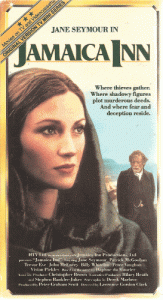 Though I’m drowning in new releases, I am still making my way through the TBR alphabet, currently mired in the unending Ms. And finally got to Jamaica Inn by Daphne Du Maurier (who probably doesn’t belong in the Ms, but who’s to say?). I do love that I have a hideous old paperback with Jane Seymour on its cover– Dr. Quinn Medicine Woman! And that my paperback is a TV mini-series tie-in– how often does that happen these days? Who could ever have imagined that the cover would ever be dated too, hmm? Though I supposed that datedness is the object of a trade paperback, to be read to shreds, battered, and relegated to the dustbin. Except that mine overcame the odds and I scooped it up at a used book sale once upon a time. Must say that it’s my least favourite of the DuMaurier’s I’ve read so far– though the ending surprised me, the main character and the backstory had much less substance than Rebecca or My Cousin Rachel. The plot was less compelling, but there were good bits.
I also read Joyce Maynard’s Labor Day, which everyone is except me has read already. And which everyone has told me is so very, very good, but I didn’t believe them. Partly it was the gross peaches cover (and those hands are all wrong!), the Jodi Picoult blurb (I am not only a snob, but one who once read a book by Jodi Picoult, so I’ve got cred), and the title, which made think that this was a book all about birthing. But it turned out to be completely different than I expected, including really, really good. And perhaps it’s the New England thing, but it read like a book a less-weird John Irving might have written, and someone would have slapped an altogether different cover on that one, don’t you think? Does this look like a book that’s narrated by a teenage boy? But it is, and it’s great, and I’m glad I finally read it, and I’m just sorry that so many other people as prejudiced as I am never will.
November 7, 2011
Dadolescence by Bob Armstrong
 Dadolescence is one of a few books I’ve read this year– along with Kate Christensen’s The Astral, Shari LaPena’s Happiness Economics and even the story “Summer of the Flesh Eaters” from Zsuzsi Gartner’s Better Living Through Plastic Explosives— that considers what it is to be a man apart from traditional institutions of masculinity. Is a man still a man when his wife is his family’s main breadwinner, when he’s spent his career chasing after artistic dreams that haven’t come true, when he’s become decidedly middle-aged and no longer attracts admiring glances from women (if he even ever did)? As outliers on the spectrum of masculinity, the men in the novels I’ve mentioned are dumped into a catch-all house-husband/stay-at-home dad catagory, but they fit in here as awkwardly as they do everywhere.
Though Bob Armstrong’s Bill Angus is a stay-at-home-dad, his son is old enough and independent enough that the novel doesn’t fully examine that experience. Rather, Dadolescence considers what happens to every stay-at-home parent when they begin to realize that their role is becoming obsolete. They’ve stayed home for the kids all these years: now what? Though Bill avoids addressing this question throughout the novel, deluding himself into thinking instead that the PhD thesis in anthropology he’s been not writing for years is ever going to be finished.
His stay-at-home dad neighbour/colleagues have similar diversions. Dave has become obsessed with remodeling his house in order to add resale value, digging up floors and knocking down walls (sometimes load-bearing). The tipping point arrives when he decides to built a turret on his 1950s’ bungalow. Meanwhile, Mark tells implausible stories of his work on a cattle-ranch, as a police officer, influencing Bono, and now he’s gunning for an astrophysics contract with NASA. And Bill is taking this all in, imagining himself turning his neighbours’ experiences into an anthropological study of modern masculinity, supposing himself to be removed from what he is observing, though also terrified that he isn’t.
Meanwhile in his preoccupation with his neighbours, Bill finds himself neglecting his household duties, disappointing his twelve-year old son, and (almost) failing to notice that his wife is drifting away from him.
Dadolescence was written from Armstrong’s play Tits on a Bull, which was performed at the 2007 Winnipeg Fringe Festival. Which means that the voice of the hapless Bill comes through with enormous humour, though it overwhelms the novel itself at times and tells much more than it shows. Bill himself is also such a passive character that the plot lags with him at the helm, and in order to be resolved resorts to some screwballish hinjinx. Nothing is subtle here, everything a little bit over the top, but it’s as funny as it’s meant to be, and more than once, I laughed out loud.
In Dadolescence, Armstrong has captured that difficult period in the life of every Gen-Xer, when it becomes time to unload the vinyl evidence of one’s “youthful audio anglophilia” at a garage sale, and finally begin to grow up.
November 2, 2011
The Vicious Circle Reads Saving Rome by Megan K. Williams
 I’m coming out of first-person plural here, because I loved Saving Rome by Megan K. Williams without reservation. I’m coming to the tail-end of the busiest month I’ve had in years, and the space I’d carved out to read this book– sitting on the couch during Harriet’s nap times, holding the book open with my feet while I furiously knit up this hat— was like a gift to myself every day last week. The reading was a pleasure, the stories so diverse in their approaches to their subject, so strong, convincing, so funny, and underlined a lot of experiences from my expat days. I don’t think I’d enjoyed any other book as much that we’ve read for our club, unless it was a book written by an English novelist in the 1950s. It’s one of the best books I’ve read lately, and I’d recommend it wholeheartedly.
What being in a book club has taught me, however, is that there’s no telling with taste. And that taste is so much what we’re talking about when we’re talking about books, no matter how much we couch our arguments in aesthetics. I also know that being in a book club has made me a better book reviewer (and it has made being a book reviewer that much harder. I second-guess myself more often now. Which, for a book reviewer, is a good thing.)
Anyway, reactions were mixed across the board as The Vicious Circle assembled in the St. Lawrence neighbourhood of Toronto last Saturday morning. We were also dressed as literary characters for Halloween (and one of us was dressed as a genre)– I was wearing a 99 cent 54DD bra from Honest Eds, stuffed with Harriet’s plush balls as Georgina Hogg from The Comforters, but not the sexy version. There was lots of delicious food, and plenty of gossip, and even a baby, then we got down to the book.
It was boring, said one of us, and another of us was aghast. One of us had struggled for a while with not liking the characters, which was disturbing because she’s a better reader than that, but then she realized that she just didn’t care about the characters. That they were boring. That they were living in Rome, but weren’t engaged with the setting at all. They could have been anywhere. “But that’s just the point!” said another one of us, pulling out the old “I’ve got personal experience of it” trump-card, which is a stupid trump-card actually, because a book isn’t good just because it reminds me of when I lived in Japan.
The point though, that one of us continued, is that living abroad and being engaged with a place is exhausting, and can unsustainable, and that Williams’ stories reflect the frustration, rage, ennui and struggle of one who is living where she doesn’t belong. Fair enough, says another of us, but the stories were all the same, the same kinds of people, the same kind of stasis, the non-endings. Even though the characters were married, single, gay, parents, variously? But they all sounded the same, was the problem. It was also noted that the gay characters didn’t get to have sex, that Williams shut the door on their encounter, when it was flung wide open for heterosexual couples.
There was no consensus on best stories, though “Pets” probably was closest to it, particularly the strange pet shop owner. It was noted that Williams’ Italian characters were more interesting than her expat characters who seemed more like stereotypes. Though we also liked the story “Saving Rome for Someone Special” about the perils of living abroad with friends-of-friends always showing up to sleep on your sofa, and what happens when a girl arrives who is certifiably insane. There was some debate as to whether Jonathan is pathetic as he’s presented, and why exactly he’s presented as pathetic. It was felt the ending petered out the same way they all did.
We liked the wit though, the dialogue. We liked that a hamster died of being squeezed to death. We liked the end of “Motion”: “But that day, when her eyes finally fell on it, on Frank’s arrow made of dried corn stalks pointing right, she felt a startling surge of gratitude for being linked this way to another human being, and she followed it.” We weren’t nuts about the two stories that weren’t set in Rome. Some of us liked the first story very much, its “acerbic wit” and others found it frustratingly “mommish”. But then no, exclaims another. The point was what was going on below the surface, how she kept laughing at inappropriate moments and was on the verge of a nervous breakdown.
And so it continued, volleys back and forth over coffee and apple cake, and cupcakes, and guacamole (because there is always guacamole), and always, as always, a splendid time was had.
November 1, 2011
Blue Nights by Joan Didion
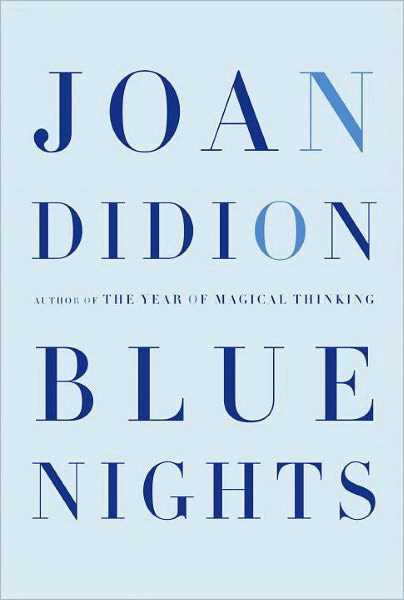 “When we talk about mortality, we are talking about our children,” writes Joan Didion in her new book Blue Nights. And in fact, when Didion is talking about any one thing in this book, she is usually talking about something else, a point which she spends much of the book considering– her struggles of late as a writer to be direct, to get to the point. In particularly in regards to her daughter Quintana, and when Joan Didion is talking about Quintana, she can’t avoid talking about mortality, about the “death of promise”; Quintana died in 2005 at the age of 39, not long after her father’s sudden death one evening at the dinner table (the year after which Didion chronicled in her previous memoir).
When Didion is talking about Quintana, she’s not only talking about her daughter’s mortality, but about her own. The years since her daughter’s death have brought about a general ill-health, a growing frailty that she has struggled to address with various health professionals with very little success. And then it occurs to her– she is 75 years old. Perhaps this alone is the problem, and there is no “fix”. And this has never occurred to her before, that she would eventually (or quite suddenly) get old. “Time passes… Could it be that I never believed it?”
This from a woman whose writing has always been drenched in nostalgia, who from the time she picked up a pen has been eulogizing the way we don’t live anymore and the “all that” she’d said good-bye to. That Joan Didion has never believed time to pass is impossible to consider, except that maybe she never considered herself passing along with it.
“The common denominator of all we see is always, transparently, shamelessly, the implacable ‘I,'” wrote Didion in “On Keeping a Notebook,” from her 1968 collection Slouching Towards Bethlehem, except now she’s 75 and that common denominator seems less a sure foundation. In the same essay, she’d also written, “Remember what it was to be me. That was always the point.” And now more than 40 years later, she doesn’t want to remember anymore.
She writes that well-meaning friends try to assure her through her loss: “You have your memories”. She writes that for many years, she fetishized these memories, saving everything– drawers and cupboards stuffed, mementos pinned to the walls– believing that they would help keep people “fully present”. And when she most important people in her life are lost, she’s left with “detritus of this misplaced belief.” She writes that remembering the past only reminds her of how much she failed to appreciate what she had in the first place.
And when she writes about failing to appreciate what she had, she’s writing about Quintana. She’s writing about her own relationship to her daughter (who happened to be adopted), which is similar to any mother’s relationships to her child, adopted or otherwise. Contemplating that newborn bundle: “What if I fail to take care of this baby? What if this baby fails to thrive, what if this baby fails to love me?… what if I fail to love this baby?”
Except that Quintana doesn’t just “happen to be adopted”, and Didion has realized that failing to acknowledge this was a significant failing of her own as a mother. That Quintana’s mental health problems (which are referred to obliquely; this is no expose) could have been rooted in her own fears of abandonment. That what the “choice narrative” so favoured towards 1960s adoptees left unsaid was the underside of adoptive parents’ choosing, why a child was up for choosing in the first place. And Didion notes that she could never treat this underside, that she chose to avoid it because to highlight her daughter’s origins would be to expose her own terrible fear– that this miraculous child who’d been placed in her arms would somehow be stolen away from her. To acknowledge Quintana’s fear of abandonment, to acknowledge the fact of Quintana herself, would have been to clarify her own feelings and fears about her daughter, which Didion could never bring herself to do.
Except that she’s lost her now, a worst fear realized, and her daughter’s death has served to bring her own death closer. And without her daughter to survive her, when she dies she will “Pass into nothingness,” a phrase from Keats’ she discovers in one of Quintana’s high school exercise books. A phrase that had resonated with the teenaged depressive Quintana, another side of her that Didion had never allowed herself to understand. A side that she’s coming to understand now as she contemplates the end of her own life, and how much her daughter’s sense of mortality and her actual mortality have illuminated her own.
She finds it hard to be direct now. She offers a passage from her novel The Last Thing He Wanted to show the way her prose used to come so easily, that she wrote it like the rhythm it was. But she can’t do that now. She can’t find the right words, she can’t get to the point, she keeps falling, and forgetting, and getting frailer all the time. The point is slipping farther away. But it’s not that she is afraid to die. She writes that she’s getting so she’s afraid not to die, but it’s not that, and it’s not the writing either.
She writes, “The fear is for what is still to be lost,” and she’s writing about her memories of her daughter. “How could I not still need that child with me?” She writes, “there is no day in her life on which I do not see her.”






