February 13, 2013
After Claude by Iris Owens
 “‘…Harriet, Harriet,” she moaned, and it passed through my mind that of all the countless treacheries my mother had perpetuated, naming me Harriet was the most infamous.” (p. 62)
“I can’t describe how impossible it is to pronounce the name Harriet to a hidden audience. When you say it, you need to deal on the spot with the listener’s reactions. To call a child Harriet is to condemn her to mediocrity.” (p. 146)
Of all the literary Harriets, I do believe that Iris Owens’ is my favourite. In her novel After Claude, Owens’ has created an unlikeable female character who manages to be irresistible. Which is amazing, but more than that, she isn’t stupid, or scattered, or zany, and not once does Iris Owens’ Harriet fall off a chair. Here is a rare thing: a comic heroine who does not embody silliness. Which isn’t to say that Harriet is mentally stable, exactly, and she’s certainly not as smart as she thinks she is, but then that is setting a high standard for anyone. Further: she suffers precisely NO self-esteem issues. To be fair, she could probably afford to take on one or two, but how refreshing that she never does. That she’s utterly un-neurotic.
How does Owens do it? I can’t figure it out exactly. I’ve thought a lot in my time about unsympathetic female characters, and how little us readers can bear them. That we’re so much harder on the women than the men who fall into the loser-lit genre. Part of it could possibly be that Owens gives us just a few days in the life of her Harriet so we can bear her that long, and moreover that we can discern that underneath of veneer or self-assurance (and really, it’s a voice that wins you over to it) that Harriet is absolutely powerless. She gets as bad as she gives. As was Jim in Lucky Jim, just say, whereas the unlikeable characters in Christine Pountney’s The Best Way You Know How or Kate Christensen’s In the Drink, for example, were characters with enough agency who’d just squandered it by being irresponsible, by making stupid decisions, by having dreams of Bohemian grandeur that don’t add up to much. Perhaps the problem with female loser-lit is that authors are rarely brave enough to situate their character at rock bottom.
“I left Claude, the French rat,” the book begins, and a careful reader will note a wide gulf between Harriet’s perception of matters and what appears to be reality. We figure out quickly from various cues that Harriet is a parasite, lazy and irresponsible, a person who makes up her own history as she goes along. She’s spent the last six months living with her boyfriend Claude, but he’s had enough and wants her out. He’d first encountered her crying on the doorstep of their building after the friend she’d been staying with the on the first floor had tossed all her belongings out the window (after Harriet had snuck a strange man into the friend’s bed to enact a rape fantasy. Clearly with Harriet, no explanation is ever straightforward). She’d spent a period of time in Europe which she attempts to define herself by, though it’s clear that some kind of similar drama to the others is what had sent her back home to America. And now Claude wants to be rid of her, but Harriet’s not budging, even going as far as to get the locks changed, which is far for Harriet who can’t usually summon the initiative to get out of bed.
Oh, she is horrible and scathing, one of those people who calls the world as she sees it. Likes like this like, about her friend, the former roommate, “How often I used to tell her, ‘Rhoda, stop brooding about your size. Having a perfect figure may be a blessing but believe me, it’s not the only thing in life. A saint may come along who is not primarily concerned with with proportions, but when he does, if you drag him in here, be prepared to administer mouth-to-mouth resuscitation.'” There was just something about the voice that won me over, lines like, “Unless he had magically transformed himself into a book of matches stuck to my ass, he was definitely not in the bed.” Humour, as always, is a relative thing, but I found After Claude absolutely hilarious.
Harriet is one of those women Caitlin Moran writes about in How to Be a Woman, a woman who enacts entire relationships in her mind, except that in her mind, Harriet has reinvented the entire world. Her point of view nearly unbudging–that she is is smarter than everybody around her, envied, beautiful, and that she’s going places even when she’s stopped. And it’s true that many of the people around her are so obnoxious that you start to see her point, that she looks good on them, really. Harriet is so sure of herself that the reader can almost believe it.
But not quite, however much we’d like to. The novel’s final third takes place at the Chelsea Hotel where Claude has finally been rid of Harriet, and she falls into strange company across the hall, an odd party populated by members of a cult and she latches onto their leader as she does to every single man she ever encounters, and he gets the better of her, but not without giving her something in return. The novel ends with Harriet back in her room in her single bed: “I had no thoughts, only a dim awareness of myself listening and waiting.” Which is actually the strongest awareness of herself that Harriet has ever shown us that she has.
Iris Owens’ biography contains the detail that she was “the daughter of a professional gambler”. She made her reputation as a pornographer writing under the name “Harriet Daimler” for the Olympia Press in Paris during the 1950s. After Claude, published in 1973, is one of two novels she published under her own name, and the other was based upon her marriage to an Iranian Prince. So that is Owens, who is anything but boring, and I promise you that her novel is even more ever so much so.
February 10, 2013
Flip Turn by Paula Eisenstein
 Flip Turn, the debut novel by Paula Eisenstein, is a wonderful companion to Leanne Shapton’s memoir Swimming Studies, using fiction to address many of the questions Shapton posed in her book. What does it it mean to be defined in one’s youth by a competitive sport? How can you be yourself without the sport? Does having natural talent hinder one from trying anything that doesn’t come easy? And where does the discipline of competitive athletics come from? Where does it go when the sport is gone? Eisenstein too delves into the peculiar culture of competitive swimming, the smell of chlorine, greeny blond hair, how you should not in fact stow your wet suit in a plastic bag after morning practice but rather roll it in your towel, otherwise it will still be wet for practice later in the later and therefore impossible to put on.
For Eisenstein’s unnamed narrator, competitive swimming offers welcome escape from a horrifying incident in her family’s past. Her older brother had been convicted of murdering a young girl at the local YMCA in their hometown of London ON, and the family cannot help being defined by that event both among themselves and in the wider community. The protagonist of Flip Turn views her swimming successes as a chance to tell a different story about their family life, to change the narrative. If she is good, then her family is good, she figures, which is a heavy burden for a young girl to carry on her shoulders no matter how muscular those shoulders are.
In the pool is the one place where she belongs, where both her mind and her body know exactly what she needs to do in order to be successful. Whereas, at school and even among her teammates, she’s not comfortable in her skin, always feeling like an outsider, partly due to her brother’s infamy or at least her consciousness of it, and also due to the fact that to be teenaged is always to feel like something of a misfit. Home is no better–she is all too aware of the fractures in her family, tip-toeing around her parents in order to be everything her brother wasn’t. Though she has to be careful not to be too successful in her sport–every time her name appears in the local newspaper, she knows that with her surname she only serves as a reminder of the terrible thing her brother had done years before.
Eisenstein’s narrative is told in fragments, which is disconcerting at first but the reader becomes accustomed to the style. This fragmented approach makes sense as well because this character’s world is one that is very much broken, and also because any young person is only figuring out how to understand a world in pieces anyway. Flip Turn has no obvious narrative arc–the trajectory is less of an arc than lengths back and forth across a pool–except that as the story progresses, the narrator’s voice and focus changes, deepens, demonstrating that this character is indeed maturing and that her awareness of the world around her is broadening.
This broadened awareness, however, fails to lead our character to any tidy resolution and, if anything, actually makes her experiences more complicated. Which is pretty much how life works, but it also means that this novel’s abrupt ending isn’t going to satisfy everyone. Though I imagine that anyone who gets into Flip Turn isn’t going to approach its ending expecting anything vaguely book-shaped anyway. What we get here is a portrayal of consciousness instead, a singular voice infused with such tenacity that the reader is left suspecting (or perhaps just hoping?) that this is a character who someday really is going to be okay.
February 4, 2013
A Question of Identity by Susan Hill
 I can’t believe that A Question of Identity is only my third Simon Serrailler mystery. It feels like my connection to these books goes deeper, like these are characters I’ve known for a long long time. Which is a testament to the depth of the books in this series, though I wonder if Susan Hill has finally crossed a line, if the Simon Serrailler novels are now incapable of standing alone. I can imagine that a reader who picks up this one looking for a good whodunnit might be confused by all the attention on Simon Serrailler’s sister, Dr. Cat Deerbon, her work in a hospice, trouble amongst her adolescent children. Would they know what to make of Simon’s stepmother who is hiding some kind of terrible secret about her marriage? And what of Simon’s relationship with Rachel, whose husband is in the final stages of Parkinson’s Disease? Who dun what anyway, that isn’t contained in some rich and wonderful back-story?
For those of us well-versed in the back-story, A Question of Identity is a kind of homecoming. Susan Hill is a wonderful writer whose crime novels are as rich as any literary novel in terms of character, writing, and depth. And what I most appreciate about them are how much they are of this world. In A Question of Identity, a group of readers get together to form a book club to support their local independent bookshop, which is struggling in these tough economic times…
And yes, I admire Hill’s novels’ unabashed bookishness too. Right before a character is killed off, Hill has her compiling a list of books for a lending library she’s thinking of starting at the seniors’ complex she’s just moved to. “She was well into her stride, remembering books she’d loved, wondering if this or that novel was out of print, adding ‘Miss Read’ hastiliy, then ‘Nancy Mitford’ and “Denis Lehane’–one of her own favourites, but possibly a bit too raw for some…. She was enjoying herself, and had just jotted down Daphne du Maurier when she heard a sound…”
So yes, onto the murders. At a (poorly constructed–typical) newly-built seniors’ housing complex in Lafferton, two women have been killed in the dead of night in a bizarre ritual, with no signs of forced entry. Simon Serrailler and his team find a break when they link the crimes to a few committed in Yorkshire years before, except the accused in those cases was shockingly acquitted and fixed with a new identity for his own protection afterwards. Which means that he is now untraceable, and authorities are refusing to disclose any information to police in Lafferton. Simon is faced with having to track down a suspect whose existence has been wiped off the face of the earth.
Somewhat disappointingly, I guessed the murderer quite early on in the book, which says something because I’m normally quite a rubbish sleuth. There just weren’t enough other suspects, and Hill has the suspect finally caught in a sting that felt somewhat artificial. So perhaps as a crime novel this one comes up short, but then I still read it with utter pleasure, and I’m not sure that a good crime plot was ever what I came to these novels looking for anyway.
January 30, 2013
The House on Sugarbush Road by Méira Cook
 There is no expressway into the Johannesburg of Méira Cook’s novel The House on Sugarbush Road. Instead, the roads are twisting and clogged with traffic, detritus, pedestrians on the roadside calling out in a language you don’t understand. This is a novel that is disorienting to encounter, hard to get one’s bearings in; the reader travels blindly along these foreign streets, trusting in the story and its teller. And as the story progresses, the trust builds. While The House on Sugarbush Road is Méira Cook’s first novel, she is widely published (and lauded) as a poet, she worked as a journalist in her native South Africa, and her prose gorgeously reflects the former while her novel’s approach shows the latter. The effect is brutal, surprising, and provokes an incredibly visceral reaction.
This novel was not what I was expecting. Perhaps it’s the sweetness of “sugarbush” but I was all set for the Africa of Alexander McCall Smith. And a wildly unpopular opinion, which I continue to hold, is that his Precious Ramotswe books are terrible. This was also set to be another book about the complicated relationship between a Black maid and the family she’s been loyal to for years and years, but my goodness, you don’t know from complicated. Beauty Mapule, like every other character in this book, is as imperfect as she is true. This is Johannesburg in 1994, just post-Apartheid, but this also means the flip-side of revolution–that the whole world has gone to pieces.
This brokenness and devastation is reflected in the house on Sugarbush Road where Beauty has lived and worked for 40 years in the deaths by car accident of Ilse and Meneer du Plessis, her employers, which occur not long before the story begins. Left behind is the elderly grandmother Ouma who is as much as a relic of another time as the house itself is, and Benjamin du Plessis, the son, who has returned from abroad because he doesn’t know what else to do with what his parents have left behind.
And Beauty Mapule, she hates him. She makes a point of of serving him the most paltry or gristly food portions, steals his pocket change, does whatever she can to make his existence as uncomfortable as possible. She glories in her power here, though she cannot articulate exactly her motivations. She thinks Benjamin is oblivious, but he isn’t. He just doesn’t know what to do about it, this woman who had loved him as a child alongside her own child, and who now makes clear her distaste and scorn.
It is easy to assume that the loss of Beauty’s own child, however, has everything to do with her behaviour. Her daughter Givvie, christened Given, who was taken in an episode of violence that was shockingly common at the time. Her son Lucky certainly fared better in his life, but the life that he has made for himself has little room for a mother who is a domestic servant. He wants nothing to do with his eldest son either, the product of an earlier relationship, and so Beauty has been left responsible for her grandson as well, who has turned out to be a complete disappointment.
Beauty’s stepdaughter, who has found being five months pregnant does nothing to deter the advances of the men who continually become besotted with her at first sight, finds work with Ouma’s daughter, Magda, whose previous maid had disappeared along with most of Magda’s worldly goods not long before. The father of her child is a shady but charming businessman with shades of the devil himself who becomes embroiled in the lives of every character in the novel eventually, the one element that connects in a place where so much has fallen apart.
The House on Sugarbush Road is scattered with phrases in a cacophony of languages, and there is not a glossary to be found. And I love that, that we’re expected to find our own way through this wild book, that Cook doesn’t provide us a guided tour, an opportunity for gawking, for spectacle. We have no choice but to be utterly absorbed in the novel, an experience which becomes devastating toward the novel’s conclusion, which is brutal, inexplicable, the opposite of everything we’re trained to expect from a story.
Except the very best stories, of course, which defy expectations. And so it goes with this one.
January 23, 2013
Mini Reviews: Crusoe's Daughter & Stupid Boys Are Good to Relax With
 Jane Gardam always catches me off-guard, one of those authors who operates without real precedent and so whenever I pick up one of her books, it’s never what I’m expecting. I read Old Filth about two years ago, and found it incredibly bizarre–so traditional its Englishness and its subject matter, but its treatment was a bit like a fun-house mirror. I’ve made more sense of what Gardam is up to since reading this wonderful essay on Crusoe’s Daughter, which posits that Gardam “has, more successfully than most novelists, navigated the narrow stream between the stingy shores of modernism and the grand cliffs of the nineteenth century novel.”
I bought Crusoe’s Daughter (though was disappointed not to receive this edition, whose cover I adore) after Martin Levin noted it as one of his top reads of 2012. I wish to better understand Gardam and her work because it intrigues me so, and also because her admirers tend to be really brilliant readers. It’s the story of Polly Flint, the daughter of a sailor who is sent to live in a yellow house by the sea with two eccentric aunts. The first passage in the book I underlined was a description of a view of trees from a train carriage: “The light showing through them made them look like loops of knitting pulled off the needles.” Oh, can Jane Gardam ever write. And then the line appears again, inconspicuously, closer to the end of the book. There is real method in the construction of this book, which reads as old-fashioned from a distance. Crusoe’s Daughter is actually a novel about novels, or one in particular. In her isolation in that strange house beside the sea, Polly finds escape and company in Robinson Crusoe, whose character’s own isolation she identifies with: “He didn’t go mad. He was brave. He was wonderful. He was like women have to be almost always, on an island. Stuck. Imprisoned. The only way to survive is to say it’s God’s will.”
There was so much going on in this book that I didn’t wholly understand or appreciate, and I’ve never read Robinson Crusoe which probably means I missed even more than I’m aware of. But I was still captivated by the oddness of Gardam’s narrative, by the oddness of Polly herself (who does go mad but only for a little while. She eventually finds salvation teaching Robinson Crusoe and English Literature at a boy’s school). I’m not wholly converted to Jane Gardam yet, but this novel was as such that I’m not going to stop reading her until she finally takes.
**
 I don’t know that I’ve ever been as stupid than the year I was twenty-one, when I came across Susan Swan’s Stupid Boys Are Good to Relax With while shelving books at the university library. I was drawn to the title immediately, of course, as stupid boys were a habit of mine at the time, not just because I was stupid myself (though this was part of the reason) but also because I hadn’t realized I could do any better. Perhaps I thought the title might justify so many of my life choices at the time? But I was so stupid the year I was twenty-one that I didn’t even know how to read a short story collection. I think I was too young to appreciate what Swan was up, and I don’t think I got very far with the book at all.
The best thing about re-encountering a book is that it can be a testament to how far one has come. I would love for this momentum to continue, for my intelligence to be increased by the time I am 45 to the same extent it has improved in the last 12 years. Though that might just a peculiarity of one’s twenties; is there any other learning curve so great? Yes, my taste in men has come a long, long way, but I am also such a better reader now.
Stupid Boys Are Good to Relax With is remarkable for being a book published in 1996 with a laptop computer on its back-cover, with a whole section of the book called “Cyber Tales”, written as a conversation on the internet. In 1996, I wasn’t as stupid as I was when I was 21, but I don’t think I’d ever used the internet. How amazingly forward thinking was Stupid Boys…, which walks a very fine line of being very much of its time but not being dated. I was trying to explain the difference between the two, and I think it comes down to Swan having been aware of the use of technology in her work, and intending it to mean something other than just “modern” (which it most definitely wouldn’t be just a few short years along).
Stupid Boys… is a collection of stories about the way women construct their lives and identities of men undeserving of such an honour (and who are often even unaware they’re so being honoured). Using traditionally structured stories (including some narrated by the famous Mary Beatrice Bradford), and more unconventional tales peopled by characters from classical literature and pop-culture, Swan writes about the compromises women make, and the pleasure and pain of such choices. It’s also a surprisingly remarkable complement to Caitlin Moran’s How to Be a Woman, which is the book I read immediately afterwards.
January 20, 2013
Some Great Idea by Edward Keenan
 For the sake of full disclosure, I’ll inform you that I actually appear as a character in Edward Keenan’s new book Some Great Idea: Good Neighbourhoods, Crazy Politics and the Invention of Toronto. Keenan, a Senior Editor at The Grid, writes in his book about how the Rob Ford spectacle has galvinized a whole segment of the population to take an interest in city politics, of this effect on his own career: “…before, my regular readership consisted largely of insiders at city hall, and political activists. Since Ford was elected, tens of thousands of readers click through online to soak up anything I write about the mayor.” And that’s me, one of tens of thousands. (I’m the one waving.) I didn’t even vote in the 2006 municipal election, the only election I’ve ever sat out since I came of age, but I remember being busy that day, not seeing the point. That election result seemed inevitable, but since Rob Ford took office in October 2010, nothing is inevitable anymore. It suddenly seems worth paying attention to what’s going on around us.
I think I’d be compelled to pick up any book whose author acknowledges that his thinking about Toronto has been influenced by Amy Lavender Harris’s Imagining Toronto. Amy has since become a dear friend, but we’d only met in passing when I fell in love with her book back in 2010, marvelling at how markedly she demonstrates that a city is constructed of stories as much as concrete and steel. Keenan takes this as the premise for his book, whose opening line is, “I have this notion that cities are just a collection of stories we tell ourselves about ourselves.” Near to the end of the book, he writes, “The answers, then, are in the process, just as the themes and lessons of any story lie not in its conclusion but in the unfolding of the plot.” So there you have it: plot. This is not some dry polemic. There is movement here; we get somewhere. Which is exactly what you would expect from a book with a subway on its cover.
Some Great Idea is the history of Toronto since amalgamation in 1998, the story of mayors Lastman, Miller and Ford. Though Keenan emphasizes that Toronto has always resisted being defined by its leadership, so the story goes beyond these three figures. Which isn’t to say that the city hasn’t been marked by personalities, and Keenan selects William Lyon Mackenzie, RC Harris (who was apparently very different from the figure Ondaatje portrayed him as), and Jane Jacobs as three individuals who resisted convention, rebelled against the system and helped to shape the city we live in today.
It’s also the story of Keenan’s own engagement with civic life, in the last ten years in particular (and in this way, Some Great Idea is a nice companion to Samantha Bernstein’s memoir Here We Are Among the Living which documents this same period in Toronto). He’s been in a privileged place, telling urban stories at a time when an awareness of urbanism had taken hold of the city like never before: this was the birth of Trampoline Hall, Spacing magazine, Richard Florida, the Dufferin Grove Park pizza oven, and Keenan ties these factors all together as the story of this place. It’s his place, where he lived in an industrial loft with the woman who is now his wife, where his children were born, where he and his wife became homeowners. It’s a story too that is more complicated than the personas of the men in power suggest–there was a great deal of progressiveness in the city under Mel Lastman thanks to figures on council like Jack Layton; David Miller’s legacy was far more positive than most of us remember; Rob Ford’s “leadership” has engaged Torontonians like nothing before.
Keenan shows that Toronto too is a much larger place than the downtown core highlighted in most civic discussions. He gives the example of Woburn, a neighbourhood within this supposed “city of neighbourhoods”. Except that Woburn isn’t a neighbourhood at all, but it’s the name given to the area where Keenan spent his teen years, near Markham and Lawrence in Scarborough. He has it stand for the inner-suburbs in general. It’s an area that grew up entirely differently than the downtown neighbourhoods, with different interests and priorities, whose populations no longer live the lifestyles the area was so rigidly planned for. You have to understand a neighbourhood like this, its strengths and weaknesses, in order to understand how Rob Ford was elected into office, to understand why someone who lives in that part of the city might see themselves as as taxpayer before citizen, if they even define as citizen at all.
The book’s title is taken from a quotation by Benjamin Disraeli: “A great city whose image dwells in the memory of man, is the type of some great idea.” The peculiarity of this diction, the vagueness of “some” great idea unspecified points to the book’s one weakness, a kind of muddled conception of itself and its purpose. I longed for Keenan to grasp his narrative with more confidence, for less journalistic objectivity. It wasn’t always clear where the story was going, but then Keenan himself was the one who wrote that unfolding not conclusion is the very point. And I will take it.
Because I learned so much about Toronto from this book, its history and its present. Keenan posits diversity as the city’s great strength, and goes on to define a city’s “diversity” as being about so much more than the ethnic backgrounds of its people. He closes with his theory of a city as something ever in the process of being born–“Inventing Toronto”, then, in addition to imagining it. The city as a story each of us is telling every time we stroll, cycle or drive down one of its streets.
Other Toronto links:
-My review of Rosemary Aubert’s Firebrand, “Loving the mayor is a bit like that.”
January 6, 2013
Whitetail Shooting Gallery by Annette Lapointe
 Imagine Alissa York’s Fauna but in rural Saskatchewan and with all the sentimentality stripped away. Imagine lots of sex, kissing cousins, a gunshot to the face, and a set of teeth that get kicked in over and over again. Imagine a family farmhouse, country roads, the kind of place you might want to move to raise your kids if you don’t look too closely. The hockey player, the pastor’s daughter, how he’s giving blow jobs to his teammates, and she’s having sex with her best friend. All those things that go on down in teenage caves in the basement, the kinds of people who live in holes in the ground, poring over pornography, vampire novels, Flowers in the Attic, scarcely coming up for light.
Oh, and horse books. “It’s those damn fillies again. They’re everywhere. That particular shade of sun-drenched blond hair spontaneously generates short fiction for girls when nobody’s looking.” And in a sense, this is a horse book, but not in the way you think. Jen is big, not at all graceful as she scrambles up on her horse’s back. The book begins with gunfire, buckshot in her horse’s neck, and Jen’s own body is full of holes. The shooter was her cousin Jason, the circumstances behind the incident quite unclear, and clarity never really comes, the plot circling around the mystery over and over, as two decades pass.
“Clarity never really comes.” I think this sentence is important, actually, as Whitetail Shooting Gallery baffled me thoughtout, disturbed and troubled me, but it also intrigued me, continually surprised me, never stopped me wondering what would happen next. It’s an anti-pastoral, a complicated portrayal of rural life. It’s the story of Jen and Jason, two cousins whose relationship was always strangely tangled or predatory, who drift apart in their teenage years. Jason is troubled by his shattered family, and while Jen’s family remains strong, her parents don’t really know her. She struggles to reconcile her feelings, her yearnings, her body, with expectations of womanhood. (Significantly, at the arena where Jen teaches figure-skating and Jason plays hockey, the girls’ change room is labelled “Visitors”). She runs around with a pack of wild girls, girls with fleshy bodies, hair, nails and teeths. They’re all a bit feral, and they long for lairs, the kind boys get:
“If Jenn were a boy, she’d have claimed the family basement for her cave. It would be her birthright, She’d have crawled underground and lined her cement cave with clothes and animal hair, and she’d plot how to capture her chosen other-person, how to drag them down into the dark and chew on them.”
The narrative follows Jen and Jascon through their teens, twenties and into their thirties, and demonstrates how each is shaped by their early years, by the peculiarities of the land that bore them, what is possible to be overcome and what isn’t. Both continue to have their closest relationships with animals, Jason with the ferrets and lizards he keeps as pets, and Jen ending up working in a zoo. The line between humans and their fellow-creatures remains ever-blurred, which is one of the most interesting parts of the novel, of so many.
Annette Lapointe’s literary reputation was established with Stolen, which was nominated for the Scotiabank Giller Prize in 2006. And here in her second book, she’s turning Can-Lit on its head, challenging not only her readers’ sensibilities, but also ideas about what a novel should be. And the latter seems to be a requirement for the kind of book that I like best.
December 13, 2012
Mini Reviews: You Never Know and Earth and High Heaven
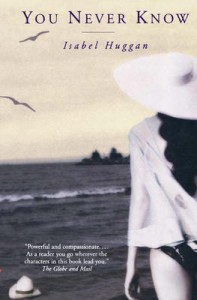 There are times when the books on my To Be Read (But Not New-Releases) shelf sit pitifully neglected, gathering dust (though dust-gathering is sort of a given in our house). And then there are times like now when I’m just barrelling through them, when I could stand to never read another new-release again and what I want is tried, tested and good. When I want something I wasn’t expecting at all.
Since falling in love with Isabel Huggan in October (which is remarkable, really. October was a month during which my love was ridiculously hard to provoke. I hated everybody and everything.) I’ve been looking forward to reading her other books. You Never Know is a collection of short stories published in 1993. Some of the stories have a familiar tone to The Elizabeth Stories, narrated in a child’s voice, or in the voice of one looking back upon childhood. But there is lots of range here too in narrative approach, setting, and character. The story that blew me away was “The Violation”, the story of a newly pregnant woman trying to find a place for herself within the rural community that she and her husband had relocated to. The man who plows their lane stops by for lunch, and she proceeds to misunderstand him and he to offend her in the most subtly brutal, unexpected way possible. The gulf between them is enormous, and both of their situations are heartbreaking.
I would describe the shape of Huggan’s stories as inverted-triangular, like a bouquet of flowers. The surface is broad and pretty, but there is enormous depth there, and it goes down down down to levels you might not want to encounter. The themes of most of these stories relate to the collection’s title: how hard it is to know one other, the untraversable gulfs that lie between us. From the conclusion of the book’s final story: “Why we enter each other’s lives and how we’re meant to fit together is more that is given to us to know. And yet that’s what we want, isn’t it? That’s what we want to understand.”
 And then I read Earth and High Heaven by Gwethalyn Graham, which I found more than a year ago in a cardboard box on Heather Birrell’s front porch. I was aware of the title from a list of English Quebec fiction on 49thShelf. It’s the story of a upper-class Anglo Montrealer who falls in love with a Jewish lawyer, and is surprised to learn that the attitudes of friends and family are not so far removed from those in Nazi Germany and in Europe, where Canadian soldiers were fighting WW2. The war was a complicated issue in Quebec, and becomes even more so against the backdrop of Marc and Erica’s romance. It’s a wonderful Montreal novel, very contemporary in its feel, even as it reminded me of Hugh MacLennan all the while–Barometre Rising in particular, with its strong female character. Apparently Two Solitudes came out in this book’s shadow (Graham’s book won the Governor General’s Award, and was a huge bestseller in the US), and MacLennan resented this, considering Graham’s a lesser book for its “not explaining Canada”, for the anywhereness of her setting. Though that wasn’t the impression I got from Earth and High Heaven. It was very Canadian, particularly so in its setting and perhaps an easier book to encounter than MacLennan’s for not being didactic. It’s a conventional novel, but daring for its time and really well written. I enjoyed it completely and I’m so glad it’s in print. More readers need to know it.
December 9, 2012
High Water Mark by Nicole Dixon
 After chasing Lisa Moore around last week, it was sweet relief to encounter Nicole Dixon’s High Water Mark, finally something to hold on to. Though while these stories structures were conventional, their subject matter isn’t, Dixon going out of her way to introduce themes and ideas not always present in the standard Can-Lit (though if 49thShelf has taught me anything, it is that there is no such thing as “standard Can-Lit”). Her characters are bolshie, flawed, funny, horny, and determined to forge their own paths. They live in tiny Nova Scotia towns, in downtown Toronto, in Sarnia. Friendships are tangled, love lives are messy. These people are teachers, fisherman, wannabe farmers, and t-shirt folders. Nobody is sure of where they stand.
It’s a solid collection, even though the stories have been written over many years and a few have been published elsewhere– “High Water Mark” appeared in The Journey Prize Stories 19. The stories cover a broad range, but they fit together well, and their diversity makes for an interesting read. “High Water Mark” is the story of a teenage girl in tiny Refugee Cove Nova Scotia whose mother has terminal cancer and who has taken over her sister’s job folding t-shirts in a tourist trap since her sister’s baby died. And yes, it manages to be funny. “Sick Days” is one of the two Mona Berlo stories, beginning, “The grade-five students are making Mona Berlo ill…” and it’s an illuminating view into the classroom from a teacher’s perspective, and into the frustrations of having to guide young lives when one is still trying to get her own sorted out. Alcohol helps.
“Saudade” is the story of two women in a band whose dynamic is rocked by the introduction of a third member. “Mona Says Fire Fire Fire” was my favourite in the collection, Mona now relocated to Refugee Cove teaching French immersion and trying to make a place for herself among the locals while she considers a long-distance love. “Some Just Ski and Shoot” is about one woman’s revenge on her ex-boyfriend, which also represents the culmination of a long, long story. In “Happy Meat”, a couple goes back to the land and discovers that sometimes you need more than self-sufficiency. In “What Zoe Knows”, a teenage girl discovers her father is having an affair, resulting in heartbreaking conclusion and more of a glimpse than she’d like to have seen into the complexities of her parents’ lives, their vulnerabilities. And I loved “Diving For Pearls”, about a woman who goes home to work with her fisherman father and considers what to do about an unexpected pregnancy, the trouble of which is underlined in the context of a life her own mother had had to escape from. “An Unkindness of Ravens” about too-desperate love, the most dysfunctional relationship ever, and a subtly brutal ending. And finally, “You Wouldn’t Recognise Me” from the perspective of Zoe’s alcoholic mother who is struggling for forgiveness and to redeem herself after nearly killing her daughter in a car accident.
Stories like “Diving for Pearls” and “You Wouldn’t Recognize Me” are so incredibly nuanced that they left me longing for more of the same in a few of the others. “‘I know we’re expected to teach art,’ the blonde said quietly, ‘but as if I’m going to. Like it’s important.” This from “Sick Days”, from a character too dim for these stories–Mona’s strong perspective could well have been challenged by someone with more substance than that. There is a similar treatment of other women in book–the friends in “Saudade” are so surprised to meet another woman with whom conversation doesn’t “[default] to talk of shopping or TV or complaints about men.” It made me think that these women have been hanging out in all the wrong places, because brilliant women are everywhere, but they seem to be so apart in Dixon’s stories. And finally, there was a strange recurring theme of women settling into relationships and becoming obese, to the point where it was kind of conspicuous, to the point where there was no worse fate than fat, and being married was somehow synonymous.
But still, I really like what Dixon is doing here, and I hope that in her next book she realizes that she doesn’t have to try so hard to do it. “High Water Mark” is an absorbing, surprising, and affecting read whose characters live large beyond its pages.
December 5, 2012
The Selected Short Fiction of Lisa Moore
 To celebrate their 45th anniversary this summer, House of Anansi reissued 10 of their “classic books” as The A List, a gorgeously designed series of eclectic reads, and the first one I turned to was The Selected Short Fiction of Lisa Moore. Because I love Lisa Moore. I was so struck by Alligator when I read it in 2006; found it to be a Woolfian “recording [of] the atoms as they fall”. And then with February in 2009, a book I decided was absolutely perfect. I thought anything could be declared so objectively. As I read the novel, I had no idea of the polarizing reaction readers would have to it, that its reviewers would be alternatively sobbing hysterically or spitting with scorn. Though I’ve reread the novel since, and found it didn’t let me down.
I’d read one of Lisa Moore’s short story collections as well, but I can’t remember which, which is to say everything about its impression upon me. So I was very eager to read the The Selected Short Fiction, to know better the work of this author who has meant so much to me. And what struck me about the collection, which is made up of Moore’s two short story collections and a few unpublished stories, is that the novels are really not such a departure after all. The same setting, kinds of characters, preoccupations. Lisa Moore is brilliant, and it seems that what she creates can’t possibly come from mere imagination but from vision. The line highlighted by Jane Urquhart in the collection’s introduction: “They made love on the grass watching out for broken beer bottles, an aureole of amber glitter around their bodies.”
“Natural Parents” was my favourite (and I am know I’m not the only one who has ever said this)–the cerebral, all the action. The stories were funny, wrought, exhausting, hard to follow, which makes sense, considering this from Moore, from a CBC interview whose link no longer exists: “If the reader knows where you’re going, there’s no point in reading that sentence; they’ll just skip it. It’s not for the sake of being avant-garde that I want it to be unexpected. It’s because I think a real engagement with a book means that the reader has to chase after the story”. All that chasing in a short story collection though is really hard, one chase after another. I love short stories and I love impossible engaging literature, but it’s hard to fit that kind of read into a life. It’s almost like running around in circles. One short story at a time, perhaps, but then I don’t encounter my books that way. I really would much prefer to have to work that hard on a novel, if I have to work that hard at all.
It occurs to me that what Moore is up to in her novels is not really so different though–that Alligator is just as fragmented and hard to follow (and wonderful!) as the short stories are, and that anyone who sees February as anything otherwise is reading it wrong. There is a bare bones, semi-conventional plot to February that is decidedly not the point of the book. It’s what’s going on beneath the surface that matters, that as with the short stories moments far apart in time occur simultaneously. That February is in fact a long short story that takes on a novel’s dimensions, but look close and you’ll see the underpinnings are the very same. (I’ve written a whole essay on the goodness and value of this book. It’s pretty much all I really ever have to say about anything.)
Anyway, this is the great thing about reaching back in time for a book, about a series like The A List. Because on one hand, each book is a new encounter, but one that has the context of casting everything that came after in a whole new kind of light.






