January 12, 2014
Tenth of December by George Saunders
 In 2013, for the first time ever, I’d read almost all of the year’s best fiction, at least as determined by the New York Times. Life After Life, Americanah, The Goldfinch, The Flamethrowers–all of these were huge and satisfying reading projects for me this year. (One would note that these are all books by women. I believe their appearance on this list all together is because 2013 really was a banner year for books by women, but also because it was the year in which Pamela Paul [a woman] became editor of the New York Times Book Review, a most fortuitous confluence of events.) The one book on the list I hadn’t read was Tenth of December, a short story collection by George Saunders, and it had been keeping such excellent company on that list that I decided I had to read it too, for my own reading pleasure as well as for the sake of completeness.
When I started to read, I had no idea what I was getting into. We begin, “Three days shy of her fifteenth birthday, Alison Pope paused at the top of the stairs.” And was there ever a better opening sentence, in terms of rhythm, euphony, use of a moment stopped in time? The smallest pause, and the story begins its movement forward, unrelenting. It is a common complaint of the modern short story that within it nothing happens, and herein the work of George Saunders is resolutely an exception. Although as Alison Pope descends the stairs, where we’re going doesn’t get any clearer. “Say the staircase was marble,” and here we are in the realm of the hypothetical. A strange kind of voice, punctuated by physical gestures, “{eyebrows up}”, catchphrases and short bursts of francais (ballet, it is). And then it is clear–aha! Here were are in the head of a teenage girl, Alison Pope, just three days shy of her fifteenth birthday. She’s home alone and here is her interior monologue, and it is full of affectation and she’s imagining herself as the heroine of our story (oh, but isn’t she though). She is faintly ridiculous, but here is the thing–George Saunders loves her. He believes in Alison Pope, in a benignly teasing way. And it is this kind of faith on which the entire collection is constructed.
In a sense, Alison Pope is a type, and so Kyle Boot, her neighbour (over-helicopter-parented neurotic nerd) but they’re both invested with specificity in their oh-so realized voices, and moreover, Saunders permits both of them (and all of his characters) to go beyond type. As Alison is descending her stairs, she is contemplating big questions in her peculiar sunny way: are people good and is life fun? Alison Pope is voting yes, and then comes a knock at her door, the cruel world fighting to get in. Conspiring to rid the sun from the world of Alison Pope, and the only person positioned to save her from such a fate is a most unlikely hero, Kyle Boot. Here is plot; here is a man with a knife. Because there are men with knives–George Saunders knows that. But he also knows that they don’t always win. That shadow doesn’t negate the light.
I tore through these stories in a hurry, leaping from one to another and having to re-find my feet on each landing. We move from skewed domestic tales (Tom Perrotta meets stylistic innovation?): to a convicted murderer partaking in pharmaceutical experiments which ultimately offer him a chance at redemption; a story in form of a pseudo-motivational email from a middle-manager; the diary of a man in some distant future who is disappointed with his life and decides to make his daughter proud by investing in the latest fad–foreign women displayed as lawn ornaments–and thus begins the downward spiral of his life; the amazing, explosive story “Home” (which it occured to me I’d read in the 2011 New Yorker Summer Fiction issue) about a war veteran returned home broken to his imperfect life; and the title story in which a nerdy boy with an overactive imagination (whose mom is my favourite person in the whole book, and the boy’s perception of her is beautiful and heartbreaking) meets in the woods a terminally ill man who is determined to end his life.
Though very different in tone, Saunders’ collection has the same preoccupations as the Giller-winning Hellgoing by Lynn Coady, moral questions in an amoral world. What is good and what is evil? Are there such things as either? How do we know how to be in a world without God? And is it possible to even get the chance to answer these questions when the speed of life’s locked in at status-quo?
I come to Saunders without context, save for the New York Times list, but in reading the book made another CanLit connection–Jessica Westhead and her short story collection And Also Sharks. This one quite similar in tone and approach, funny and broken characters who show their cracks, created in utmost sympathy. Stories which remain solidly on the side of goodness, even as they acknowledge the realities of life itself.
January 9, 2014
The Silver Button and Wanderlust
 I have been besotted with Rebecca Solnit ever since reading The Faraway Nearby last fall, so I was very pleased to receive two more of her books for Christmas. I read Wanderlust: A History of Walking first as it was written before the other, and I loved once again being absorbed in a Solnitian world where the connections between books and place are so strong, and where one thing leads to another, just as one step does. (“One foot in front of the other,” is Harriet’s mantra as we embark on the 1.3 km walk to school every morning. It is a long walk if the walker is 4 years old, particular lately through snow and ice. ) And it is because one thing leads to another that one can’t sum up a Rebecca Solnit book properly, and I therefore must resort to ecstatic sharing. I loved learning about how closely the history of English garden design connects to the history of walking, about how the idea of walking being natural takes for granted civilization (i.e. law and order), and the gender politics of walking and (for women) the sexualization of the street—how different is the term “tramp” depending on to whom it is applied.
The first paragraph of Wanderlust:
Where does it start? Muscles tense. One leg a pillar, holding the body upright between the earth and sky. The other a pendulum, swinging from behind. Heel touches down. The whole weight of the body rolls forward onto the ball of the foot. The big toe pushes off, and the delicately balanced weight of the body shifts again. The legs reverse position. It starts with a step and then another step and then another that add up like taps on a drum to a rhythm, the rhythm of walking. The most obvious and the most obscure thing in the world, this walking that wanders so readily into religion, philosophy, landscape, urban policy, anatomy, allegory, and heartbreak.
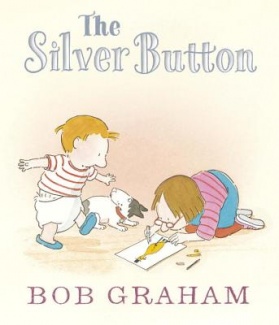 Which reminds me of the exquisite picture book that I bought Harriet/myself for Christmas this year. The Silver Button is a new book by Bob Graham, one of our favourite authors and the force behind the wonderful Oscar’s Half-Birthday. It’s a story that takes place within a single moment, illuminating the connections, the beauty and the perfections of the world. The perspective moves from a space on the floor in a single room to eventually comprise an entire city and beyond toward the global as Jodie puts the finishing touches on her drawing of a duck and her brother Jonathan rises to his feet to take his very first step. “He swayed, he frowned, he tilted forward, and took his first step. He took that step like he was going somewhere….”
These two books are an unlikely but absolutely perfect pair.
January 5, 2014
Penelope Fitzgerald and the Holiday Read
 After we’d gone book-shopping on our recent trip to England, I sat down to read that weekend’s Guardian Books with its books of the year round-up, and found reader after reader citing Penelope Fitzgerald: A Life by Hermione Lee. Now, my relationship with Penelope Fitzgerald is complicated. She’s an English author called Penelope, which is usually all it takes, but I find her books difficult, inexplicable. There is something there but it’s just beyond my range as a reader. In short, I’m not one of those who “gets” Penelope Fitzgerald. But in my failure to grasp her work, she fascinates me. (If more difficult writers wrote short books, this might be something I experienced more often.) I also love a good biography, and so after reading so many recommendations for the book, I was awfully sorry to find myself stranded on the Fylde Coast with nary a bookshop for miles and miles.
The airport bookshop, I decided, would be my salvation, so I was awfully sorry to discover that the WH Smith in Manchester Airport Terminal 3 barely had books at all, let alone this one. (My expectations were high: it was at the Manchester Airport WH Smith that I bought my first Elizabeth Bowen novel in 2009. I don’t know if this was a different terminal, or if all the airport bookshops have been economic downturned.) We returned home to Canada without the book, and I requested it for Christmas, then was informed that it would be for sale in Canada until after the holidays. So ever it was not to be.
Until just before Christmas, a friend who knew none of this managed to get her hands on a copy and wrapped it up just for me. Penelope Fitzgerald was mine! I started to read it on Christmas Eve, and this fantastic book became the centre of my holiday.
What a life! Daughter of a prominent family, from a world that is never to return after WW2. Her father edited Punch, her stepmother was Mary Shepherd, who illustrated Mary Poppins, who was the daughter of the illustrator of Winnie the Pooh. Her mother was at Oxford with Dorothy Sayers and Rose Macaulay. Even the incidental intersections: the house her parents were meant to rent when Fitzgerald was 2 was inhabited by Katherine Mansfield and John Middleton Murray.
Fitzgerald finishes at Oxford and writes book and theatre reviews for Punch, scripts for the BBC. She marries Desmond Fitzgerald, her “Irish soldier”–one of many men in the book who are also shattered by their experiences of war. The embark on a career as literary bohemians, editing a literary magazine together and having three children who add to the disarray of their household. (In the background: miscarriages, at least one stillbirth. Fitzgerald becomes a larger than life character by her biographer’s hand, but still remains elusive.)
Several rented houses are fled from suddenly. The literary magazine folds. Desmond Fitzgerald gets into trouble. Penelope begins supporting her family by teaching, after a stint working part-time in a Suffolk bookshop. She moves them all back to London, where they really cannot afford to live, so she secures them lodgings on a leaky barge which becomes their home from 2 years. (The Penelope Fitzgerald books I’ve read are Offshore [which won the Booker Prize in 1979], The Bookshop and Human Voices, all of which are illuminated by these insights into her biography.)
The barge sinks… Which is a major challenge to Fitzgerald as a biographical subject, so much of her archive winding up at the bottom of the Thames. There is much hardship as she struggles to secure housing for her family, eventually ending up in a council flat in South London where she is happy enough to be settled. And here begins her literary career, publishing her first book at age 60. She writes a biography of her father and his brothers and poet Charlotte Mew before turning to fiction. And it is from this point on that she’s an overnight success. Etc. etc.
What a book! It makes me want to go back and reread the Fitzgerald novels I’ve encountered, to see if finally I can grasp them with such knowledge of their context. It makes me want to read everything she ever wrote, in particular her penultimate novel The Blue Flower, said by many to be a masterpiece. To understand her as un-English makes it all so much clearer, to think of her work in the context of Beckett’s. Her complexity as a person, as a character–impossible and infinitely loveable. Unabashed and brilliant. When she died, I cried. I have to get my hands on her collected letters, because I just want more more more of her.
December 21, 2013
Love, Nina and Mutton
 During our disastrous English vacation, I did manage to get some excellent holiday reading in, mostly because my mother-in-law’s intensive grandmothering meant that I was on mother-holiday. And it was great.
I discovered Love, Nina: Despatches from Family Life when India Knight tweeted about it, a collection of letters by Nina Stibbe, a young woman from Leicester who moved to London in the 1980s and got a job working as a nanny for books journalist Mary-Kay Wilmers, editor of the London Review of Books. India Knight is the ex of Andrew O’Hagan, who blurbs this book, which is a fine glimpse into literati inner-circles. In the Guardian Best Books of the Year round-up, film director Stephen Frears cited the book, then said, “But I would say that since it’s about my ex‑wife and our children. Letters from their Leicester nanny. Very funny and sharp.” Another review called it “‘Adrian Mole meets Mary Poppins” so you can see why I had to read it.
Imagine a sitcom in which everybody is writer, and Alan Bennett is the too-familiar neighbour. In fact, imagine any book in which Alan Bennett is a character at all, one who has dinner with the family (Wilmers and her two sons) every evening, and critiques Stibbe for her use of tinned fruits and vegetables in her cooking. There is mischief and hijinx, there is this unique community through the eyes of someone outside it blessed with a nice dose of realism (if a bit sweetly naive at times), character development and incredible dialogue. Mary-Kay Wilmers is a most formidable comic creation. These are Stibbe’s letters home to her sister from during her early years in London, and they’re absolutely delightful.
**
 And then I read Mutton by India Knight, her fourth novel about alter-ego Clara Hutt. In this instalment of Clara’s story, an old friend returns from years in America and she’s looking younger and better than ever. What’s her secret? Why yes, it’s extensive plastic surgery (and yoga and she drinks a lot of water). Clara herself isn’t getting any younger and she starts considering drastic measures on her own part. She’d always had these ideas about growing old gracefully, but that was before she started growing old, of course.
The novel is funny, rambling, and I adored every single digression, but then I can’t quite get enough of India Knight and her novels which are basically extensions of her newspaper columns. Instead of plot, we are treated to “what India Knight thinks of everything”, but for some of us that’s absolutely the book we came to read.
December 4, 2013
Are You Ready to be Lucky? by Rosemary Nixon
 While it’s true that silence greets most literary books entering the world, there is something conspicuous about the polite silence that tends to greet a literary novel about a middle-aged woman. Now part of the problem with such an assertion, of course, is that it’s often one uttered by authors who’ve written unremarkable books about middle-aged women, books whose silence is understandable (and even a victory. If only David Gilmour’s next novel could meet a similar fate). But in the case of Rosemary Nixon’s Are You Ready to be Lucky? (and Shaena Lambert’s Oh My Darling, while we’re at it), the silence is nothing short of an injustice, for the book itself and all the readers whose worlds would be so enriched by it.
So let’s break the silence then, shall we? Rosemary Nixon’s collection of linked short stories is one of the funniest, most original books I’ve read this year. I started reading it on Friday, found it hard to put down, and had devoured it by Sunday afternoon. Are you ready to be lucky, indeed.
The first sentence of this book: “Roslyn high-steps up Bantry Street on an icy Alberta evening buffeted by the late-December gusts, holding high her sixty by forty centimetre tray of pineapple stuffed meatballs, trying not to look like a woman who, at the yearly No Commitment Book Club gift exchange, received a can of gravy and two books called How to Seem Like a Better Person Without Actually Improving Yourself and The Zombie Survival Guide: Complete Protection From the Living Dead.”
The last sentence of the book is: “You fucking keep on playing.”
And let me tell you about everything that happens in between.
Roslyn’s just been dumped by her long-time husband, awful Harold. Carrying her pineapple stuffed meatballs, she’s on her way to a party, on the way to meet her fate. The party’s at the home of her friend Stella, a woman for whom being dumped has become a lifestyle. At the party, Roslyn meets Duncan Bloxham, and he chooses her. (Her delight of this fact is indicative of the slim pickings for divorced women in their 40s.) Her whole life having already fallen down around her, Roslyn sees no harm is getting carried away by the moment, and it’s not long before the two are married. Duncan is a pathological liar, a conman, an Imperialist asshole with a cruel streak and a terrible temper, however charming with his British accent. He’s the kind of character of whom the reader will wonder, “What does she possibly see in him?” Except Nixon tells us: the sex is fabulous. By the virtues of his cunnilingus, Roslyn hangs onto Duncan longer than she should, staying by his side on various adventures before finally kicking him out of her life.
We follow the couple to a community of British ex-pats in Spain in “Costa Blanca News”, and while I liked this part, there was a little too much “blimey,” the other characters rife with British stereotypes. In “Left”, Roslyn and Duncan are in England where she meets his family, and the true depth of his idle deceptions are made clear to her. Duncan is the most fascinatingly obnoxious character, so incredibly annoying that you’d like to hit him, and he calls to mind real people. Actual Duncans exist–you probably know this if you’re a middle-aged divorced woman. Nixon just has the chutzpah to put him down on paper.
In “The Sewers of Paris”, poor Stella has been dumped again, and she contemplates the one trip she took with her ex, a vacation from Paris far from the romantic ideal whose highlight was a tour of the city’s sewers. And in “Besides Construction,” we meet Lloyd, handyman hired to fix the crooked house that Roslyn bought after her marriage to Duncan ended. And the two of them dance around the idea of attraction to one another, Floyd a salt-of-the-earth type, not Roslyn’s type at all, but then lately, who is?
“In Which Floyd’s Odometer Passes the Million Kilometre Mark” is a story structured as a pinball machine, which it has in common with the whole book, actually. These are characters who wind up and bounce off one another just to see where things go. There is no traditional narrative structure in the book as a result, no tidy endings, no pat conclusions. The game goes on. “You just keep fucking playing.”
We meet Duncan again, back in Spain with another new wife, and later with even another, this one who he’d bought through the mail and who keeps her shit in the fridge. The story after that one is my favourite, in which Roslyn is en-route to her son’s wedding and drives her car into a deer. Yes, her son, Roslyn’s son Theo, whose wellbeing has been consistently kept in the back of her mind as she bounced from one adventure to another post-divorce. As she hits the deer, thereby ensuring that she’ll show up to the wedding late and rattled, if at all, she is listening to Jann Arden’s Good Mother on the radio, and the irony is not lost.
It is rare that such humour is balanced with incredible prose, cliche-free and striving to be something new with every sentence. This is a book that satisfies, not because it goes down easy, but because it fulfils a need in the reader for something that’s so profoundly good.
December 1, 2013
Wood by Jennica Harper
 Jennica Harper is the poet whose books I stay up reading late into the night. She has uncanny ability to zero in on my fascinations, articulate questions I’ve vaguely wondered about, to use the very things located in the world around me (songs, cultural lore, television characters, celebrity references) and spin their own mythology. In a recent conversation, she asked, “Is there such thing as a “gateway poet”? That’s what I’d like to be.” And she has certainly succeeded at this, most recently with her latest collection, the beautiful, quietly powerful Wood.
Wood is meticulously packaged, the trunk-ring design from the cover repeated on the endpapers.The package is important, first because it’s beautiful, but also because Wood is a project of parts rather than strictly a whole and how these parts fit together is a huge part of the book’s appeal.
The first section is “Realboys: Poems for, and from, Pinocchio”. Like much of Wood, this is a story about progeny and disconnect. Pinocchio who is not quite a son, whose burgeoning sexuality extends the “wood” metaphor further (ha ha), who takes on Gepetto’s disappointment that he won’t grow to be a man–Gepetto, the man who made him! Who longs for the accoutrements of manhood without really understanding what they are. The only thing that isn’t rigid here is language: “I make things hard.”
“Liner Notes” is section 2, a long-poem from the perspective of a young woman 10 months into her first serious romance, thinking over the matters of her life as she cares for a disabled child and listens to “Crimson and Clover” by Tommy James and the Shondells. “Tommy James and the Shondells went on vacation in 1969/ and never got back together…” The connections between the band, the song, the girl and the child in her care. She is on the cusp of adulthood, and the child stands for an unspoken possibility for the rest of her life, a possible narrative thread. She is playing house, experimenting with roles, hypnotized by the melody “over and over”, by her own power, by the possibilities still before her. The child is a window onto a way of life that nobody ever imagines, evidence that life takes on its own trajectory. And what does the child know about being a realgirl, about being being human? What does she know about being beyond human?
“There are various interpretations of the meaning of “Crimson and Clover”/…Many continue to believe it’s simply about being high, floating, synesthesia/letting go.”
“Papa Hotel” is imaginings on the father figure as iconic Hollywood movie stars, continuing the father-child (dis)connection theme that began with Pinocchio. Like the previous section, it’s an exercise in the hypothetical (wood/would!). Or the poet is imagining a context for inexplicable behaviour instead? “My Father, As Jack Nicholson”: “A man who knows a pretty girl when he sees one, and he’s always seeing/ one. He reads waitresses’ tags, calls them their names…”
Next is “The Box” (wooden?), poems about Harry Houdini and his wife, about their marriage–“They had no children”. The poet imagines herself into the experience of Wilhelmina Beatrice Rahner: “Now I’m the wife of the Handcuff King.” Poems about the tricks of their life together, and about their “Dream Children”. And then in “Wife”: Her imagined children are your imagined children. For all you know/ she was content, childless, her small womb unstretched, a balloon/never blown. Her belly skin taut ’til the end. You want her to want/ those children. Then she’d be missing something, like you…”
“Would” comes next, poems from the point of view of “you” in the preceding section, with a few variations. Once again, we’re delving into the hypothetical, including a poem about Lizzie Borden’s parents supposing that they, like the Houdinis, had had no children. The last line of a poem about the impossibility of real-estate is “Once more, knock wood for the happy ending.” A poem about miscarriage, another about the prospect of childlessness (and with these, we see a connection between this longing and Pinocchio’s), and then “Ring in the Grain” (see cover image, of course) about birth from the point of view of a witness, a record of the event addressed to the child front one cognizant enough to articulate the profoundness of the moment, note the details of the blur.
And then finally, “Roots: The Sally Draper Poems,” which you may have already read because they were published online last winter and then went viral and were quoted on Slate, which is pretty amazing. The poems are clever in their conceit, but their power goes beyond cleverness or pop-culture connections. This is Sally Draper specifically, buying a present for her specific father, for example. I loved the line in “Sally Draper: Upwardly Mobile”: At home, my mother had it made and brought to her by the help. Something/ I think about when I pour.” “Sally Draper Contemplates the Interstellar Mission” reaches back to Harper’s first book, The Octopus and Other Poems, while this whole sequence engages the same intimate knowledge of the teenage mind as her second book, What It Feels Like For a Girl. More hypothetical exercises, disconnected dads, an abortion, red lipstick. Last night of the book: “Would that be so bad?”
Wood appears to have emerged from several different projects whose connections were secondary, and yet how these connections function–how these poems speak to one another, echo one another, underline and overwrite–is the book’s most compelling quality. It’s a kind of puzzle to discern how these pieces fit together, and each reread will unearth a new layer of understanding (or perhaps another ring in the grain?). Which is good reason then to stay up reading late into the night.
November 18, 2013
GlobeBooks Review: Ann Patchett’s This is the Story of a Happy Marriage
 I had the great privilege of reviewing Ann Patchett’s new book, the essay collection This is the Story of a Happy Marriage, and my review appeared in The Globe and Mail this weekend. The book was an absolute pleasure to read and reread, and to explore in writing.
“Patchett expounds on her craft with the verve of Annie Dillard in The Writing Life, but with both feet on the ground. She also makes explicit her influence by Joan Didion, revealing in Do Not Disturb that she’s been rereading all Didion’s books, which shows, and works to her detriment because she isn’t Joan Didion, which also shows. Though to be Joan Didion (who, it must be noted, got her start writing for Vogue) is a lot to ask of anyone, and some of Patchett’s best essays are of Didion’s calibre. She may well prove to be to the contemporary mythology of Tennessee what Didion is to California, with her own particular bent*.”
Read my review here!
*I kind of see Patchett as the anti-Didion, actually, particularly when she throws out the line, “I didn’t worry much about snakes” in her essay “Tennessee”. If you’ve read much Didion, you’ll know what I mean by that.
November 17, 2013
Eat It and A Recipe for Disaster
 Eat It: Sex, Food & Women’s Writing is both a standalone book, and the latest issue of The Feathertale Review. Its editors have assembled a smorgasbord of Canadian women writers who write about food from a wide range of perspectives. Standout pieces are Amy Jones’ “Emotional Eating in the Digital Age”, stories by Jessica Westhead and Kathryn Kuitenbrouwer, essays about women and poisoning, Chinese penis cuisine, and a perspective on an eating disorder that I’ve never before encountered, and a fabulous ode to dairy (yum). The book is smartly designed, and even has an index referencing all the foods mentioned in the volume. It made me hungry, but I devoured it.
**
 I figured that A Recipe for Disaster & Other Unlikely Tales of Love by Euphemia Fantetti would be fitting companion read, and I was right. This slim little volume is sometimes about food, mostly about hunger, and makes connections between these and Catholicism. Fantetti’s characters are lovelorn, sometimes desperate, and blessed with a darkly humorous edge. I loved this book’s subtle sweet, sweet subversion.
November 16, 2013
The Goldfinch by Donna Tartt
 For nearly two weeks, I was reading The Goldfinch, carting it everywhere I went, having to pull out a bigger purse in order to accommodate its heft at 771 pages, my hand cramping as I read it while breastfeeding. I ripped the dust jacket when I tried to tear off a sticker, and then took the dust jacket off altogether when it started getting tatty from the travel. After that, I put the book down on the table on something green, and then the cover started to disintegrate when I wiped the stain off with a damp cloth. I don’t usually treat my books so poorly, but The Goldfinch is so large and solid, a piece of furniture nearly. It has presence, is lived with, is experienced. And it is interesting to think about my wear-and-tear on the book when I consider how much of the book is about what time does to physical objects. The Goldfinch is about its thingness just as much as it is about its text.
Part of this is because The Goldfinch is an event, a new Donna Tartt novel being a once-in-a-decade experience. I bought it the day it came out and for once got to be reading what everyone else was reading, which was fun as we marked our progress on Twitter. The book has been receiving mixed reviews, but those which are positive are ecstatic, and everybody on my Twitter feed seemed to be enjoying it as much as I was.
In some ways, my destruction of The Goldfinch is a tragedy, because the book itself is exquisitely designed, with thin pages and a subtly beautiful cover, though the cover seems to anticipate my treatment of it–food stains aside, the wear seems like part of the design. And on the flyleaf is a rendering of “The Goldfinch” by Carel Fabritus, a 17th century Dutch painter. It’s this painting which the book revolves around, this story of Theodore Decker whose own live turns on an explosion at the Metropolitan Museum of Art which killed and his mother and many others when he is thirteen years old.
The novel is a curious mix of old and new, strangely so at times. Though perhaps it’s just me who is surprised when a novel so steeped in longing and nostalgia refers back to a time in which email and emojis were a thing. What a thing to consider–how the present becomes the past, and how the past devours the future so that we look back and it’s there. Theo is writing his story from Amsterdam a decade and a half later, where something is desperately wrong and we’re not quite sure what, and then we forget about the present day altogether as Theo takes us back to the museum, and the explosion: “when I lost [my mother] I lost sight of any landmark that might have led me to someplace happier, to some more populated or congenial life.”
Instead, he is traumatized by the incident, and left alone, by default falling into the care of a friend’s wealthy family. Compounding his trauma is fear of consequences to his actions directly following the explosion: listening to the curious instructions of a dying man, Theo removes “The Goldfinch” painting from the disaster scene, takes it with him, keeps it hidden. He tells this secret to no one, but lives in fear of its discovery. He tells us that he couldn’t tell anyone what he’d done for fear of repercussions–his whole life is unstable, he’s terrified of being thrown into foster care, he imagines being imprisoned for theft, and all this seems illogical because he’s so young and because of what happened. Surely her would have been forgiven? But I wonder now if really Theo didn’t tell because he knew that if he did, it would be taken from him.
The unreliability of Theo as a narrator, apparent or otherwise, as one of the book’s most fascinating features. He is a compelling storyteller, his story utterly gripping, and yet I was quite far into the book before I remembered that Theo had been at the museum with his mother only because he’d been suspended from school after some wrong-doing. What had he done, I wondered? I went back to check, and then realized that Theo claimed that he doesn’t even know, that it may have been fuss over a cigarette. He brushes past this. Situating himself as the hero of his story, or at least its victim, but it is remarked that Theo knows what to say and do to impress his friends’ parents, that perhaps Theo is not entirely genuine.
But these thoughts onto turn up here and there. Mostly we’re caught up in the twists and turns of his life, how his estranged father arrives back on the scene and whisks Theo away to live in Las Vegas where he’s making a living as a shady dealer. Here, Theo befriends the inimitable Boris, similarly lost, neglected, and prone to trouble. The two friends get up to trouble of their own, with drugs and petty theft, but Boris provides Theo with the first stable force he’s had in his life since he lost his mother.
The plot turns on coincidence, tragedy, collision and fireworks. There’s nothing subtle about this structure, though this is a book that is very aware of itself–Theo remarks upon the power of misdirection, the force of coincidence and chance. He ends up back in New York living with Hobie, a friend connected with the dying man he’d encountered in the museum. The friend deals in antiques, repair and reconstruction, and Theo begins working for him, making a racket selling forged pieces. He’s still hiding his copy of The Goldfinch, hiding this secret as desperately as he hides the painting itself.
Meanwhile (and this is a novel with a whole lot of meanwhile), he’s long been in love with a red-haired girl who’d been with the dying man and shares his experience of the tragedy, he is very addicted to drugs, he continues the orbit the world of his wealthy childhood friend. That friend’s mother has turned into a Miss Havisham figure after her own tragedy, the red-haired girl is called Pippa, and Hobie is a kind of Joe Gargery. The only explicit Dickens reference here is to Oliver Twist, however, the Artful Dodger in particular, in relation to Boris, though Tartt is subtly trickery here, and I think we’re meant to wonder if Theo himself is just how artfully dodgy in his own right.
I really liked Zsuzsi Gartner’s critical review of this novel from a few weeks back, because engaging with it even if only to disagree made me think deeper about The Goldfinch. She is also terrifically right about that Velveteen Rabbit moment, but I think Tartt is far too capable and tricky a novelist for us to write these off as shortcomings. The substance of the book is as such that its shortcomings seem inherent to its very fabric, and one can read into them to discover the novel’s deeper meaning. I am not sure that Tartt intended to write a realist novel, as Gartner asserts. Tartt, in reference to art, considers paintings which appear realist from afar, but upon closer look are constructed of dots and brush strokes–but then what isn’t? (It’s also worth noting that novels which insist on their novelness are the kind that I love best.)
It occurred to me that this novel so steeped in its thingness and in things was terribly complementary to Pinterest, so I created a pinterest board for The Goldfinch. Definitely a stupid way to waste a previous hour of Baby’ s nap on Thursday afternoon, but it turned out not so much. It was fun to go through the book again in search of things to pin and to include accompanying text, and an excellent way to further engage with the text–it turns out that 771 pages just weren’t enough for me.
November 12, 2013
The Fire Dwellers: Margaret Laurence and Bettys Friedan and Draper
 If Margaret Laurence’s The Fire Dwellers were published today, critics would be lauding its uncanny sense of the contemporary moment, how Laurence dares to voice the unspoken truths of motherhood, her pitch-perfect portrayal of the subtleties of maternal ambivalence. Published in 1969, Laurence’s fourth novel belongs with Atwood’s The Edible Woman and Phyllis Brett Young’s The Torontonians as essential Canadian novels born out of the world of The Feminine Mystique. Which puts the book’s contemporary moment-ness in question, but then the lessons of The Fire Dwellers don’t tend to be the kind we pass on to our daughters, however much to their detriment. Not that they’d listen anyway. Isn’t it funny how the history of feminism is so profoundly uncumulative? How we have to learn it for ourselves over and over, and it’s a revolution/revelation every time?
But then The Fire Dwellers is largely about su ch disconnectedness, between generations, between spouses, friends, between the personal and the political, and—in the case of protagonist Stacey MacAindra—from one’s self, from one’s own life. Stacey is 39, sixteen years married, mother of 4, and according to the sensationalist copy on my Seal Book paperback, she’s looking for a lover. Which isn’t really true, though it’s probably a good way to sell a paperback. Anyone who has read the book, however, will tell you that she is looking for is herself beyond her oppressive roles of wife and mother. Roles which aren’t strictly oppressive; “They nourish me and they devour me too,” she writes of her children, and it’s in this in-between where she’s stuck, imagining the various ways she is destroying her children (by being overbearing, by too much attention, with her anger, all of these suggestions underlined by “helpful” magazine articles suggesting as much) and/or all the ways they would be destroyed anyway if she somehow managed to get away from them.
 Through the novel, Laurence plays headlines from television news programs, broadcasting war, turmoil and unrest around the world. In one sense, the headlines are juxtaposed with the domestic, but we soon come to see that these are parallel, that the home-front is no safe haven after all.
“I can’t forget that piece in the paper. Young mother killed her two-month-old infant by smothering it. I wondered how that sort of thing could ever happen. But maybe it was only that the baby was crying, and she didn’t know what to do, and was maybe frantic about other things entirely, and suddenly she found she had stopped the noise. I cannot think this way. I must not.”
Children are hit by cars and killed, neighbours attempt suicide, Stacey and her husband worry about money, she fears that Mac is sleeping with his secretary, her youngest still isn’t talking (and what has she done to her to make this go wrong, Stacey wonders), and just as terrifying as the suffocating demands of motherhood is considering who she will be once the demands are rescinded, when the children are older. Who will she possibly be then?
 Laurence’s The Diviners is so central to my literary consciousness, and I couldn’t help but see Stacey in the context of the Manawaka she’d fled from as a young woman, and in relation to Morag Gunn whom she’d stood apart from as a child but whom she’d have so much to talk about if they met up again in adulthood. And I was surprised to discover that Morag didn’t even exist when Laurence wrote The Fire Dwellers—The Diviners would be published 5 years later in 1974. But in The Fire Dwellers, you see the roots of The Diviners taking shape, its ideas and experiments with narrative and form.
Stacey MacAindra is Betty Draper, is calling out for Betty Friedan, though fat load of good a book is going to do her. (I always find it interesting when people critique Betty Draper’s character for her obviousness to Friedan, as though one day every woman in America read The Feminine Mystique, and society flicked a switch). Stacey MacAindra is also so many of us, as we remarked at my book club the other night. “Maybe we all turn into Stacey MacAindra sometime…” as I tweeted last week. Women for whom the day is never long enough to encompass all the things we want to do, all the people we want to or need to be. Women for whom motherhood and selfhood become a battle, with wifehood thrown in for good measure. You’d throw it all away, if you weren’t tied to it inextricably.
Stacey’s green slacks are dated, and so is her slang, but absolutely nothing else is in this novel which 45 years later is a challenge to and a reflection of the world at once.






