January 24, 2016
Busker, by Nisha Coleman
 I picked up Nisha Coleman’s Busker on the recommendation of Isabel Huggan, so it wasn’t surprising that I loved it. It begins with Coleman, fresh out of university, following a man to Paris with romantic Parisian intentions, but the romance turns out to be more of an awkward misunderstanding. Leaving Coleman stuck in France without a visa, or money, or even a home, but what she does have is a violin. So she begins busking on the streets of Paris, and finds her way into the city through a kind of back door, and also finds a way into her truest self and the kind of life she wants to lead—a coming of age, of sorts. And from her perspective on the fringes—she’s in France illegally, busking itself is illegal in Paris although tolerated, and street performing is inherently fringey, sidewalks begin marginal as they are—she is able to tell a Paris story that’s very different from those we might have read before, those that are all Shakespeare and Company and Mavis Gallant. Busker is something different entire, a rich and generous portrayal of misfits and weirdos and the rhythms of urban life.
I kept laughing out loud, which is a mark of literary achievement. Though I also cringed—as one who has never mastered air-kisses, I recoiled at Coleman’s recounting of her first bisous and how she actually made cheek contact. She writes about being asked to play her violin in a hair salon, but how her own unruly do caused a great upset when she arrived. Or the man she met who wanted to perform songs he’d written, which turned out to be “sex songs” with lyrics like, “The horny bull wants a bouncy ride.” And she meets a lot of men, Coleman, and in the beginning, being lonely, takes them up on their invitations, until she realizes that she’s setting herself up for a lot of awkward interactions. She longs for the company of women friends as well, but these kind of relationships are harder to find. Not to mention that at the beginning of her time in Paris, Coleman hardly speaks French.
It is interesting to read a book about a character as solitary as Coleman is throughout much of the time she writes about. The stories she tells are of people she encounters, other characters who come and go, so there is little interpersonal development throughout the narrative. What sustains the narrative and brings all these stories together then is the development Coleman shows in her own character and understanding of it. She’d previously studied violin in university, but after suffering from performance anxiety she quit to do a major in psychology instead. Busking in Paris, however, Coleman finds her way back to the violin, and writes fascinatingly about how busking is not a performance, but about being part of a bigger scene. She writes compellingly too about the politics of street performance, scoping out prize spots, getting shut down by the police, engaging with other musicians and performers. About balance too—that her lifestyle is a kind of freedom and she’s brave to pursue it, but it’s also a method of avoidance: “I can’t fail at this because busking is an ongoing condition, not a means to an end.” And perhaps she gets a bit too comfortable in her Paris life, something that needs to be checked. “After all, Buscar is a Spanish word that means to search.”
What makes Busker so compelling is that Coleman is usually searching, is open to experience, and curious and wondering. She’s also funny, her prose is impeccable, and not she’s not afraid to make herself vulnerable in the narrative. Though it’s impossible could she ever hope to avoid seeming vulnerable in a book that begins with her in such a precarious situation, but the her faith in a city, its people, the world, pays off. In a time when we’re constantly being urged to harden ourselves against a cruel world, Coleman’s book reminds us of the miracles that can happen when we instead open up wide.
- Purchase Busker from McNally Robinson Booksellers
- Check out Coleman’s very cool companion to her book, Busker: The Interactive Experience
January 17, 2016
One Hit Wonders, by Patrick Warner
 I added Patrick Warner’s novel, One Hit Wonders, to 49thShelf’s The Next Gone Girl list, a list of suspenseful novels about wives with secret lives. Because it belongs there for a few reasons—this is a novel with twists and turns, about a husband who discovers after his wife’s death that perhaps he didn’t know her at all, and it has the whodunnit element—who is responsible for the body lying on the floor? Suspects include her husband, Freddy, an antisocial novelist trying and failing to follow up his runaway hit first book whose proceeds he now easily lives off of; the has-been golf pro with whom Lila was having an affair and who had got her hooked on cocaine; and two small-time crooks who’d been caught up in a plan to rob Freddy of his millions. What makes this book different from the others though is Freddy’s unabashed complicity in its construction; it’s his second novel all along. But not a memoir—this is fiction. He’s creating conversations he never heard, imagining places he never went, and interactions he was never a part of in order to have the whole story make sense. Which makes us wonder if he’s complicit in other ways. Is there a truth to be uncovered at the bottom of all of this? And isn’t that we ask such a thing of fiction kind of an amazing thing?
This is a novel about story-making, about empathy and where it can take us. Our own empathy—why is it that we long to get inside the heads of twisted people and be immersed in troubled lives—and also Freddy’s as he imagines himself into the minds of the men who orchestrated his wife’s downfall. He tells us, “I feel dirty after all that. And yet my task is to empathize with these characters, walk a mile in their shoes. The trouble is I have trouble with empathy. It seems to sit on the delusional end of the sympathy spectrum, perhaps at the point where sympathy runs out and something darker begins. Empathy is only a confidence trick, a species of legalese, a way of making the afflicted believe you are walking in their shoes. Empathy is the tool that gets you through the door. But who is to say what you will do once inside?”
And isn’t that passage wonderful? Warner is a wonderful prose writer, a critically acclaimed poet, and author of one previous novel, double talk, which was nominated for the International IMPAC Dublin Literary Award. And while One Hit Wonders might frustrate readers more interested in gritty realism than a look into fiction-building whose reality can fizzle out into nothing just when you think you can almost touch it, others will be most impressed at the genre-blurring metafictional achievement Warner pulls off here. I’m still not completely sold on the ending, but endings tend to be a bit like that, as Lila’s Freddy would attest.
January 13, 2016
Hotels of America, by Rick Moody
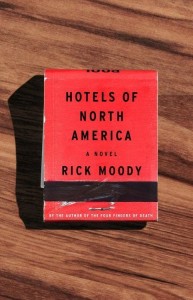 Reviewed by Kerry, Toronto Canada. Rated 3 out of 5 stars I bought a copy of Hotels of North America, by Rick Moody, because I was intrigued by the idea of a novel comprising online hotel reviews. I am not being facetious when I write that online hotel reviews are actually one of my favourite kinds of literature, and I have passed many an hour reading aloud ones written by English people, who tend to be very cranky and have strong feelings about the temperature of toast. And part of the reason I love these reviews so much is because of the narrative one senses beneath those few hundred words, the rage and fury that bubbles to the surface, the idea one gets of what the writer left behind as he embarked on his disappointing getaway. And the narrative, rather than the hotel amenities, is what Moody’s Morse—a prolific and popular reviewer—focuses on, the reviews themselves posted in alphabetical order but referring to hotel visits spread over decades of Morse’s curious and mysterious life (which has lately been particularly peripatetic). Usually the hotel itself merely serves as a platform for Morse launching into an episode from his past, involving his broken marriage, a troubling love affair, his itinerant work as a motivational speaker, the various schemes he’s embarked upon with his current partner, K. Some of these episodes are funny, and more than once I laughed out loud. A few are poignant, and each piece is a thoroughly worthwhile vignette. Cumulatively though, the novel lacked momentum—strange for a novel about travel, although the problem is that Morse never gets anywhere. So that I’d put the book down and not be compelled to pick it up again, though I was happy enough once I had done so. And while I am not sorry I read this book, and I’d recommend it to interested readers on the basis of Moody’s writing, I will probably not read it again. Was this review helpful?
January 10, 2016
Birdie, by Tracey Lindberg

Last week writers Lee Maracle, Drew Hayden Taylor and Tracey Lindberg spoke on CBC’s The Current about the idea of First Nations book club month (responding to Minister of Indigenous and Northern Affairs Carolyn Bennett’s recent proposal) and what the experience is like being an Indigenous writer in Canada. The program was excellent, and the show was stolen by Maracle, who was indomitable, admirably cantankerous, and an excellent articulator of her situation and that of other First Nations women writers.
Maracle explained, “The balance in reading is not there for Indigenous women. 70% of book buyers are women, but 80% of books sold are men’s—it doesn’t matter what colour you are., So I think that’s a problem in Canada. If you just say Indigenous books, I think Tom King, Drew Taylor, Richard van Camp will get on the list [of suggested titles for a book club], and myself and Tracey will be at the bottom or at the middle.” The numbers back up her experience; in 13 years, for example, Canada Reads has never featured a book by a First Nations women writer—though I suspect this is a wrong that will begin to be righted upon the announcement of this year’s shortlist, which may very well include Tracey Lindberg’s Birdie. In fact, I hope it does.
Birdie is an example of what riches Canadian readers are missing when they’re overlooking First Nations women writers—a novel about women’s lives and experiences, the connections between them, and what happens when those connections are broken. (Think about more than 1000 missing or murdered women across this country—what must those absences be doing to families whose ties are already strained by centuries of colonial atrocities?) Though Birdie is most importantly about a particular woman, Bernice Meetoos, nicknamed Birdie, who has turned up in Gibsons, BC, after years of drifting, a pilgrimage to the place where The Beachcombers was filmed. In her bag, she carries decades-old clippings of Pat John, an actor from the show—”a healthy, working Indian man.” She’s preoccupied by thoughts of John, as well as taking guidance from The Frugal Gourmet, whose PBS cooking show is broadcast on the CBC. Things have not been quite right with Birdie, even more so than usual (and she spent four years living on the streets of Edmonton after all). She’s secured a job at a bakery and even has a place to live, a local woman to watch out for her—but then something breaks. She goes to bed, doesn’t eat, scarcely breathes, won’t be roused. And as ever when help and comfort are needed, it is the women who come.
First, Bernice’s cousin, Skinny Freda, the two of them raised like sisters, although the circumstances of Freda’s parentage are scarcely delineated. And then she sends for their Aunt Val, who’s had her own ups and downs, but is a motheraunt to both women as Birdie and Freda are sistercousins to each other (and such compound words abound throughout Birdie, suggesting that English proper is not up to the task of telling this story, just as the novel as we know it is inadequate to contain it, and therefore chronology is disrupted, notions of realism challenged, the whole book infused with elements of First Nations storytelling and mythology—Lindberg should be celebrated for her pushing the limits of what “the novel” can be). From her bed, in a kind of dream state, Bernice relives the traumas she’s endured, chief among them childhood sexual abuse by her uncles, which culminated in a terrible act of violence (justice?) that leaves her estranged from her family, alone. Until the women come.
Also present, if not physically, is Bernice’s mother Maggie, invoked in the novel’s prologue and epilogue, whose own problems make her not wholly responsible to what happened to her daughter. Bernice’s landlady too, while not Native, becomes part of this collective of women watching over Birdie, suggesting the possibility of womanhood as a connection that goes beyond culture; what happened to Birdie is particular to her situation, but there is a universality to women’s experience. There are so many things that every woman understands—and we see from being close to each character in this collective that each woman has her own tragedies that she carries within her,
Surprisingly, Birdie is not a heavy book, even with all the violence and tragedy. It’s as funny as it is sad, and more than that, it’s vibrant—powered by the voice of a woman who seemingly lies unconscious, which is kind of ironic, but there’s a lot going on inside Birdie’s mind, even as she’s got one half-opened eye on The Frugal Gourmet. As a character she’s rich and realized, and Lindberg never makes her a victim of her circumstances, her agency retained even in her lowest moments. Her very act of retreating into her mind, while passive from the outside, is a powerful gesture, and necessary for healing, for the possibility of a future.
January 4, 2016
Holiday Reading Joy

One day back into our routine, and I find I’m happy to be here. It’s been so long, with the sick-filled holidays and my three-plus weeks of pneumonia, and while I was nervous about this return to the real world, I find it much more pleasant and even more relaxing than where we’ve been lately. Although, granted, this is after just one day. Get back to me, perhaps, at the end of the week. But the one thing I do miss about the holiday was the reading—it was wonderful.
I was reading not-new and not-notable books in the weeks before Christmas, and enjoying the experience entirely. But then I picked up Niagara Falls All Over Again by Elizabeth McCracken, and found myself reading notably in spite of myself. It was so terrific. I’d adored McCracken’s short story collection, Thunderstruck, and I spent last Christmas Day sobbing while reading her exquisite memoir, An Exact Replica of a Figment of My Imagination. I read her The Giant’s House last summer, and liked it well enough, but it lacked the immediacy of her other books. And I had been reluctant to finally pick up Niagara Falls… because it was about men, a comedy team who find fame on the vaudeville circuit and in the golden days of Hollywood—nothing about that grabbed me. But the book did. Oh, its pacing, and energy, and to be so sad and so funny, and so completely realized. Truly, one of the best not-new books I read in 2015, and I’m so pleased that I finally did.
After that, I read Cassandra at the Wedding, which I bought at Ben McNally Books right before Christmas. I bought this one on the recommendation of Sarah from Edge of Evening, and was so pleased that I did. As Sarah writes, Dorothy Baker conjures Joan Didion in her setting but is entirely different in tone and approach—more wry than wrought, humour bubbling to the surface even in the darkest moments. It’s a book about twin sisters that seems like a great companion to Libby Crewman’s new novel, Split. About the connection between sisters and what happens when it’s severed, and how one person’s reality can be interpreted by another. Like so many books published by New York Review Books, Baker is doing fascinating things with narrative voice, and I appreciate how hearing from the slightly-deranged Cassandra’s sister Judith turns the whole story on its heel.
Then I read Inside Out, which is an essay by Rebecca Solnit with paintings by Stefan Kurtan. I’d asked for it for Christmas because I love Rebecca Solnit and wish to read everything she’s ever written, and also because it’s an essay on the subject of houses and homes, which I find really interesting. And it was. I loved her thoughts on materials and materialism, and the home as an extension of the female body while the automobile is that of the male (and therefore mobile), which connected to all kinds of things I’ve been thinking about Mad Men as we’re rewatching Season 1. Reading Rebecca Solnit is never not satisfying, and the book is beautiful.
I read Because of the Lockwoods next, by Dorothy Whipple. A Persephone Book, which is never short of extraordinary. I bought it in April when we were in London, because we’d been visiting Lancashire and she’s a Lancashire author and also because she is compared to Barbara Pym, similarly ripe for a revival, says Harriet Evans, but even a better writer. Whipple (whose unfashionable name is perhaps part of the reason she’s so fallen out of favour, writes Evans) is meant to be utterly readable, her novels absorbing. But I was dismayed to discover that they’re also 500 pages long, and you know how I feel about long books. It was one thing to carry such a doorstop across the sea, but then to actually pick it up and read it? Clearly I needed a holiday, a bit of space in which to make the long read happen—but then the book turned out to be everything Evans said. I read the whole thing in 2 days and now want to read everything in print by Dorothy Whipple. The novel was engaging, surprising, rich with complex characters and situations. I really loved it. Was dismayed to read that Virago Books was so thorough anti-Whipple. Thank goodness for Persephone for bring her back in print.
And then finally, I read The Magician’s Book: A Skeptic’s Adventures in Narnia, by Laura Miller, which was a marvellous celebration of reading, of literary criticism, and of the Narnia books and their creator, as well as critiquing the considerable problems with the two latter points. As we’re smack in the middle of reading the Narnia series (all of us for the first time!) in our family, I was glad to learn so much more about them and their context, and there was no shortage of fascinating Narnia and CS Lewis trivia, so that I become as uninteresting as I always do whilst reading excellent non-fiction (avidly sharing details, beginning every sentence with, “Did you know…) We’re reading Prince Caspian now, and I’m loving it all the more for Miller’s book.
November 19, 2015
My review of Split, by Libby Crewman
 My first professional book review was of Libby Crewman’s The Darren Effect in Canadian Notes & Queries in 2008. It was a good book, but a messy one, and I suspect my review probably achieved a similar effect, which sadly was not an aesthetic statement, but was just me figuring out my way. But it also meant that I was looking forward to Crewman’s follow-up, Split, which was published by Goose Lane Editions in September. I read the novel twice as summer turned into fall, and it’s a story that has stayed with me since, in its oddness and perplexities, its curious sideways appeal, but also in the vivid moments that Creelman so stunningly evokes.
A remarkable feature of Split, Libby Creelman’s second novel (after 2008’s The Darren Effect; she is also author of the acclaimed 2000 story collection, Walking in Paradise) is that it isn’t split. Whereas Creelman’s previous book was an impressive tangle of multiple storylines suggesting this short story writer was still finding her way into a different literary milieu, Split—for the most part taut, controlled and smartly plotted—signals Creelman’s arrival proper as a novelist. This new book is an ambitious, assured and most accomplished whole.
This wholeness is doubly (ha!) impressive considering the novel’s movement between two moments in time—2008 on the eve of both Barack Obama’s first election victory and widespread economic meltdown, and during the hot summer of 1975, the year after Nixon’s resignation and just months after the last American troops were removed from Vietnam. The former is the novel’s present day, during which Pilgrim Wheeler returns to her hometown in rural Massachusetts to find her childhood world drastically changed, and must finally reconcile with a tragedy that had wrenched her family apart decades before.
November 15, 2015
Heyday, by Marnie Woodrow
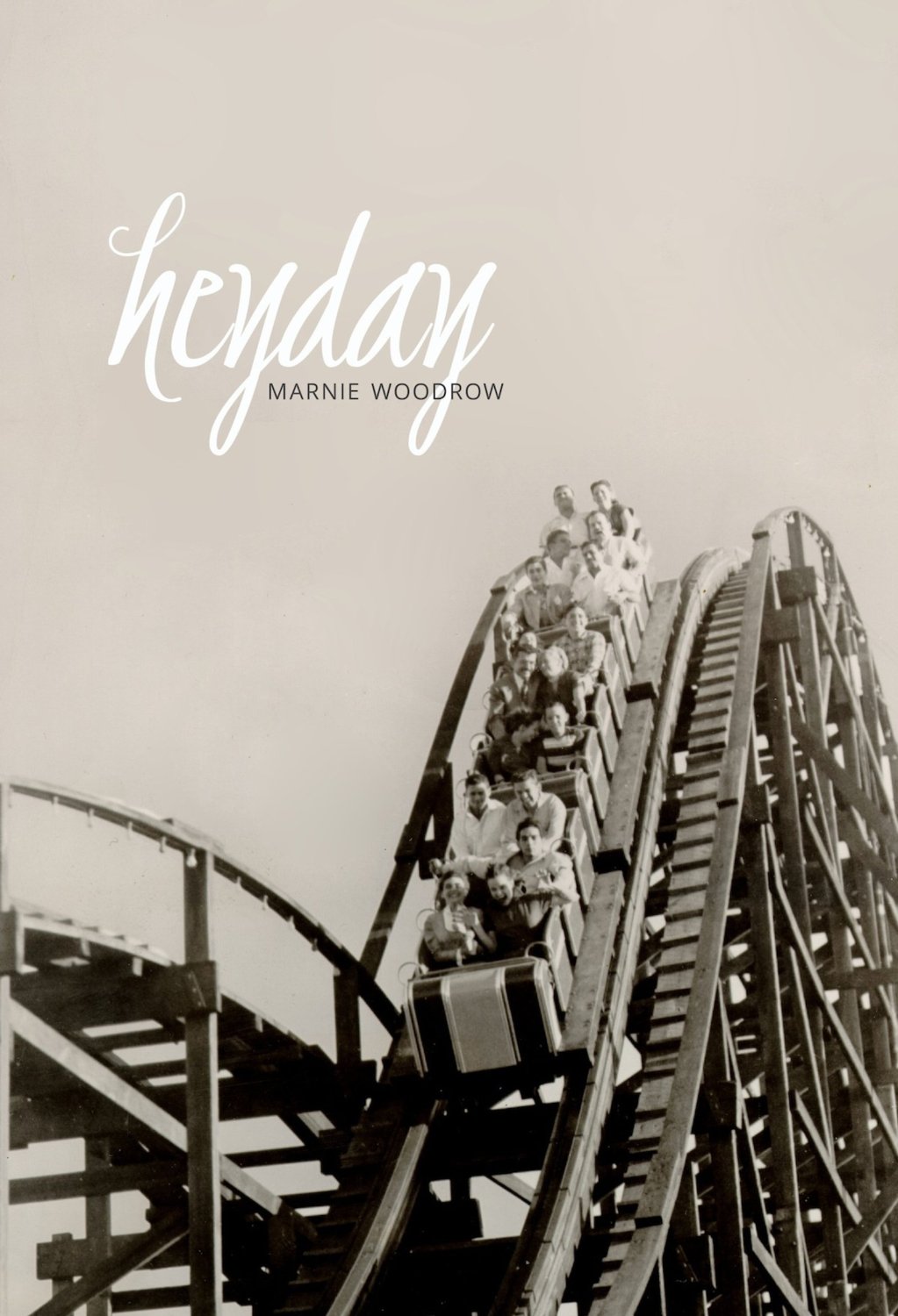 “It had something to do with Mary Pickford. With beauty. With the Figure 8 ride on a hot June day at just the right moment in time.”
Heyday is the first novel by Marnie Woodrow since the acclaimed Spelling Mississippi more than a decade ago. It’s a book that artfully weaves two stories, one in the present day as Joss mourns the loss of her longtime partner, Bianca, to whom she was never fully committed, and the other about two young women, Bette and Freddy, who meet one day on a roller coaster in 1909. And what connects these stories both is the Toronto Islands, peaceful Ward’s Island where Joss lives alone now but in her grief feels smothered by the attentions of the close-knit island community, and Hanlan’s Point on the other side, which in 1909 was a bustling amusement park, called “Canada’s Coney Island,” and where Freddy and Bette encounter each other for the very first time.
Bette is a single-rider, unnerved by the boy who takes the seat beside her as the roller coaster ride begins, and then intrigued as he whips off his hat to reveal a shock of blonde hair—the boy’s a girl after all. And a friendship begins between them, cultivated over a mutual love of swoops and turns, twists and plummets. Although the girls are worlds apart otherwise. Bette is the daughter of upper-class parents, her father an ardent spiritualist, her mother busy with campaigning for woman’s suffrage, and both parents too involved in their own affairs to pay sufficient attention to their youngest daughter who is mourning the recent loss of her beloved grandmother. Their lack of attention means that she’s able to escape from the confines of home during that summer, however, and make her way across the harbour to Hanlans, where she spends her time becoming utterly bewitched by the charismatic Freddy who works as a ticket-taker in the movie theatre. Although Freddy has secrets of her own, running from a dangerous past that is never far behind her. And as affection between the two girls grows—as they make plans for a future together, daring to consider running away together to New York City, to the actual Coney Island—it becomes clear to Freddy that their relationship might be putting Bette’s life in peril. But does she dare risk it? Or must she sacrifice their friendship to ensure her friend does not become snarled up in her own torrid past?
The novel’s historical detail is evocatively realized, and uncompromising in its sense of immediacy and richness of atmosphere. The sections of Heyday (from the respective perspectives of Bette, Freddy, and Joss) flow together naturally, the past and present timeline subtly connecting with small details. Though how the two sections relate beyond geography is not clear until the novel’s end when it becomes clear that one story might just be a figment of the other. But the spell Woodrow casts is so magnificently done that it doesn’t occur to the reader even to mind this.
November 8, 2015
Us, by David Nicholls
 “It’s like a Richard Curtis film,” will be the kind of description that sends half of you running, but (surprise, surprise) I’m in the other camp, and so I was all up for reading David Nicholls’ novel, Us. It’s the story of Douglas, a rather buttoned-up fellow whose wife Connie confesses late one night that after twenty-five years of marriage, perhaps she’s ready to leave him. Although it’s a tentative thing, her declaration, and they’ve already scheduled a summer trip across Europe with their teenage son that she’s determined to go through with. Leaving Douglas, who’s never too sure of himself in the first place, on particularly unsteady ground, and what ensues is continental hijinx and mayhem, bittersweetness and a bit of heartwarming.
The story weaves together the story of their trip with that of their relationship, starting with their first meeting at a dinner party, an unlikely connection between them. Connie is warm, passionate, artistic, while Douglas is an awkward biochemist, but each awakens something in the other, and Douglas finds himself in love for the first time in his life, moreover bowled over that Connie loves him too—he makes her laugh, he calms her storms, and their worlds are so different that each is fascinated with the other. Their relationship progresses, they move in together, buy a flat, and get married, which is straightforward enough, but life itself never is. There are bumps in the road, and there are tragedies, in particular the death of their daughter soon after her birth, an experience that tears them away from themselves, each other, and the entire world, before they’re able to reassemble to the pieces of the universe into something recognizable again, and even though they do, it’s something from which neither of them ever fully recover—Douglas in particular, who we know from his own evasions in the narrative lacks the emotional vocabulary to fully process what has happened to them. Though the experience also cements them like nothing else—no one else knew their baby, or loved her, and they resolve together to never forget her. Even the birth of their son not long after, while something like a balm, doesn’t take the pain away.
As their son grows, though, there becomes a new kind of pain. Life changes and Douglas leaves the job he loves in academia to better provide for his family, working long hours and commutating to a pharmaceutical company. And he begins to find himself displaced within their family home, that his wife and son are connected in a way that excludes him, and that his attempts to be the kind of father he wants to be—and even more, for his son to be the kid of boy he wants him to be—all fizzle, setting off a chain reaction of upset and disappointments. He loses his humour. His son has no respect for him, and doesn’t even like him, and no wonder. And then there is Connie, at four o’clock in the morning: “I think our marriage has run its course, Douglas, and I think I want to leave you.”
On their trip to Europe, Douglas becomes determined to prove to Connie that he is the man she fell in love and to their son that he is worthy of his love and respect. But things go very wrong before they’ve any chance of being right again. And it was some of these bits of the novel (which is 400 pages) at which my attention lagged. The addition of a sex-mad Australian accordion player to this cast was a good one, and the travel setting allowed Douglas to grate on his family’s nerves in a way that was particularly exacting. But it was the interactions between these characters that I loved best, and so Douglas wandering the streets of Amsterdam was always going to be less compelling, no matter who he meets on his wanderings.
Resolutions were also a bit pat as well, although I’d heard the Richard Curtis comparison, so what was I expecting. Curiously though, the novel is spattered with very literary epigrams: Penelope Fitzgerald, Lorrie Moore, Elizabeth Taylor (not that one), Henry James and Isaac Newton. Allusions as scattershot as Douglas’s attempts at harmony, or the travel itinerary that eventually transpired. Suggesting the novel comes with a certain literary heft, which is strange because its narrator isn’t at all the type. Surely this novel isn’t the type either. But then the references are also elsewhere woven into the text itself, and perhaps the project itself is to determine what kind of novel one can write about a man who doesn’t read novels. The inner life of a man who conducts himself as though he has no inner life, the stereotypical Englishman—perhaps a generation late. The kind of man who peruses his son’s social media accounts, and wonders with terror (at least I think it’s with terror): “Good God…how might I have fared in a world where people were free to say what they felt?” How far would the novel have to stretch to accommodate a narrator like that?
While the novel should have been shorter, I can determine that I liked it very much, most particularly for the complexity of its characters. Connie is just as flawed as Douglas is, and while initially they complement each other, it’s easy to see how the years roughen their edges and have them rub up together all wrong. She thwarts him just as much as he thwarts himself, and it’s all so terribly human and wrong. The novel is notable too for its portrayal of marriage—it reminded me of a line from Lorrie Moore’s Bark, that marriage “was like being snowbound with someone’s demented uncle.” But how does one get there? The path is never so straightforward. And David Nicholls has done a remarkable job of showing us the way.
November 3, 2015
Rumi and the Red Handbag, by Shawna Lemay
 I am not a handbag person per se, but as a fervent believer in the secret (and sacred) lives of things, I’ve been really looking forward to Shawna Lemay’s novel, Rumi and the Red Handbag. And also as a fan of Lemay’s blog, Calm Things, and something that I found really wonderful about the book was how clear it was for those of us in the know that Lemay’s blogging is a huge part of her process. This is a book about handbags (among other things) by someone whose long-time blog was called “Capacious Hold-All,” after all, which is from Virginia Woolf’s diary, her description of what she wanted her diary to be. And so it seems that handbags are literary objects right from the novel’s departure—how could a reader ever have doubted?
Rumi and the Red Handbag is a slim, heartbreaking and perfect read, rich with gorgeous prose, and depth and texture. Infused with allusions, explicit and otherwise, it’s a hushed and quiet celebration of women and their lives and their words and the secrets they carry. There is the Woolf, of course, and references to Clarice Lispector, who I’ve never read, but now I have to, and Charlotte Bronte, Jane Austen, Sylvia Plath. Plus vintage Harlequins—this is a book that permits great reverence to women’s stories and women’s spaces.
Our narrator is Shaya, on the run from academia and her unfinished thesis about the secrets of women writers. She takes a job at a consignment shop where she spends one long Edmonton winter in thrall to her young colleague, Ingrid-Simone, whose haphazard education consists of snippets and quotations and lines gleaned from library books that have a tendency to fall off the shelf right into her hands as she meanders her way through the stacks. She’s preoccupied by questions of the soul, by ideas in general. She floats around spouting lines in a manner that is one hand a bit simple and precious, but then she is young and it reminded me of the way my friends and I used to try to pin the down the world with bits and pieces once upon a time. I certainly remember that impulse, and Lemay captures it so well: “For Ingrid-Simone, the idea of hoarding thoughts, holding so many threads of ideas like cupped water as you knelt, knees grinding into finest gravel, thirsty by a mountain stream, did not terrify or oppress her instead exhilarated her.”
When things get a little too ethereal, Lemay balances it out by startling moments of revelation taking place under fluorescent lights at the Shoppers Drug Mart cosmetics counter, and also at Wal Mart. For while this is a novel concerned with questions of the soul, those questions are connected to the material world, in particular with the things that come and go from the shop where Shaya and Ingrid-Simone spend their days. Purses in particular are Ingrid-Simone’s things, and inspired by Shaya’s literary passions, she begins creating miniature purses inspired by writers and books: the first is a tiny capacious hold-all ala Virginia Woolf, authentic right down to a miniature pencil which inspires the writer’s walk in “Street Haunting.”
And so each woman inspires the other, and they learns from each other, and Ingrid-Simone reignites Shaya’s desire to start writing again, jotting words and ideas on post-it notes, “threads of ideas” (and there again we have connections to clothes and to textiles), like the way her friend thinks. Though all the pieces together still do not solve the inherent mystery of Ingrid-Simone—what secrets is she fleeing from? What is her connection to a curious red handbag? And there are other mysteries too—what about the goings-on of the shop’s proprietor, and also how can customers become so consumed by their own lives that they fail to acknowledge the humanity of service staff? A question that wears down on both Ingrid-Simone and Shaya as the long winter goes on.
With spring, however, comes revelations, and departures, and a journey that ends at the Museum of Bags and Purses in Amsterdam, a place Ingrid-Simone had long dreamed of making a pilgrimage to. A place that underlines her philosophy that there is a connection between a woman’s handbag and her soul. It’s a place for secrets, yes, and essential things, and for her stories. Especially for her stories.
For what is a handbag anyway but a place to keep a book?
October 28, 2015
Another Margaret, by Janice MacDonald
 I really loved this piece about campus novels and academic mysteries that Janice MacDonald wrote for 49thShelf back in September—referencing Dorothy Sayers’ Gaudy Night, of course. So I’ve been looking forward to her latest novel, Another Margaret, her sixth book in the Randy Craig series set in Edmonton, Alberta. Which is also the first book in the series, a reworked version of an out-of-print 1993 book called The Next Margaret, MacDonald’s first to feature Miranda Craig, a hapless perennial academic with a penchant for sleuthing.
On the occasion of her 20th reunion—grad school at the University of Alberta, and her pal Denise has roped her into being part of the organizational committee—Randy’s mind drifts back to her MA studies and her fraught relationship with her thesis advisor. She’d gone back to school as a mature student to study up-and-coming but little known Canadian novelist Margaret Ahlers—yes, another Margaret, along with Laurence and Atwood—on whom her advisor, Dr. Hilary Quinn, had written critical works. But Dr. Quinn turns out to be oddly unforthcoming on the subject of Ahlers, and it is not long after announced that Ahlers herself has died. And whatever her connection to Dr. Quinn, it now seems complicated in a way that Randy is determined to get to the bottom of.
But the course of an academic detective story never did run smooth, and suddenly somebody else is dead—was it murder?—and Randy has got her fingers on a floppy disk that seems to contain a another novel by Ahlers. But the novel turns out to be a detective novel. A “brilliantly subversive detective novel,” but still: had Canada’s Great Literary Hope upped and gone genre? And if she was murdered, was that why?
“All that territory staked on the next Margaret Laurence, or Margaret Atwood, and she turns out to be the next Margaret Millar!”
MacDonald does a terrific job capturing the seasons of the academic year: the heightened expectations of autumn, and then come April, everybody is crying. The send-up of academia is fun and smart, and also important in what Randy’s work as a sessional instructor has to tell us about the precarious nature of academic work at the moment. I also enjoyed the novel’s glimpses into Canadian literary culture, including a funny bit when Randy starts a fake book blog to get an advanced copy of yet another new Ahlers novel that comes out right before the reunion—a novel that Randy knows could not have possibly been written by Ahlers herself.
 The prose style was clunky in places, and some of the leaps of logic (both taken by Randy and required by her reader) were a bit absurd, and then once there’s the stabbing with the plastic picnic knife—well? Well, that’s how you know that the whole project is done in the spirit of fun, not taking itself too seriously, but executed well enough that admirers of academic mysteries can come along for the ride. And I really glad I did. Another Margaret was a lot of fun, and a great introduction to the Randy Craig series. I’ve been been feeling unwell this week and the weather has been autumnal in the not-so-golden sense, and so this has been the perfect kind of story to curl up in.






