February 22, 2015
And the Birds Rained Down by Jocelyn Saucier
 I approached And the Birds Rained Down, by Jocelyn Saucier, translated by Rhonda Mullins, the opposite of how I found Raziel Reid’s novel, When Everything Feels Like the Movies. The latter with so much hype, all my expectations, but I knew nothing about Saucier’s novel except that it had won several awards when published in its original French. And this is typical. Here is where the Canada Reads theme of “breaking barriers” first becomes relevant to And the Birds Rained Down. As critic J.C. Sutcliffe writes in her article, “On Not Reading Books from Quebec“, French Canadian Literature is barely on the radar of most English Canadians, French Canadian Literature barely accessible outside of Quebec. Except for the publishers—small publishers in particular, like Goose Lane, Anansi, and Coach House (who published this one)—who translate these books into English. Not so much breaking barriers as building bridges from one place to another.
And the Birds Rained Down is a quiet book, a tidy book, a comforting book. The most comforting book you’ve ever read about mass destruction, trauma, mental illness, suicide, marijuana, and love. It begins with a photographer arriving deep in the forest in Northern Ontario at a clearing where a stream cascades into volcanic rock. She’s come to interview a survivor of devastating fires that had taken place nearly a century before, but she’s come too late. He’s died, of natural causes, she’s assured by that two old men with whom the man she’d come to see, Boychuck, had created a community away from the world, their only connection to it two pot farmers. She’s been travelling the province photographing survivors of the fire, documenting their experiences. And while the other two men can’t contribute to her project, she’s intrigued by their company and drawn to return. And the photographer is not the only disrupter to this bucolic idyll. Not long after her departure, one of the pot farmers shows up with his Great Aunt who has been her whole life in mental institutions and refuses to return. Her arrival in the community changes the dynamic forever.
It’s not so much what the story is about, but how it’s told. And the Birds Rained Down is the kind of book you’d expect from a setting deep in the woods at the end of a road by a waterfall. It’s otherworldly with many elements of fairytales. An all-seeing narrator guides us through the book’s various sections from different characters’ points of view, though we are not so guided that there is not mystery here, or surprise The novel’s first paragraph is, “In which people go missing, a death-pact adds spice to life, and the lure of the forest and of love makes life worth living. The story seems far-fetched, but there are witnesses, so its truth cannot be doubted. To doubt it would be to deprive us of an improbable other world that offers refuge to special beings.”
This is the most different of the other Canada Reads books I’ve read this year, quieter in its intentions, subtler in its message, more playful and nuanced (though this makes me think of “Like life is always fucking subtle,” and how sometimes books have to be huge and devastating to get their points across). A mysterious book that’s lyrical, lovely, and rich with story and stories. It doesn’t really do anything except be a book (and it does that so well), which is a political statement in itself I think.
February 16, 2015
When Everything Feels Like the Movies by Raziel Reid
 Back in high school when everybody was watching My So-Called Life, I used to tune in and wonder why Angela Chase had ditched her normal friends to galavant with Rickie and Rayanne. I mean, I liked Angela’s hair, and dyed mine the exact same colour (although it didn’t take because my hair was too dark—probably safer that way), but the misfit friends didn’t gel with me. I’d turn the channel back to Party of Five. Similarly in real life, I would encounter characters with as much regard for the status-quo as Rickie and Rayanne (and I encountered them often—I went to an arts-focussed high school, a social environment far more welcoming than most), and I found these people baffling, even threatening. Because there was this thing called normal whose rules I was desperate to follow, and it was unnerving to come across someone who didn’t even play the game.
The one legacy of those years is that while I’m more broad-minded, I still don’t like “edgy”, and when something is described as such, I don’t think it’s for me. I am still annoyed at having had to read about people taking a shit in books as disparate as Franzen’s Freedom (ugh) and Heti’s How Should a Person Be? In most “edgy” books, there comes a point at which a character pulls out a blade and starts carving things into her arms and legs, and I’ve read that book already. It’s possible that edgy is boring. Or that I am boring, and more partial to reading books about spinsters and brewing proper cups of tea. I would like there to be a Bechdel test, but for women over the age of 65 who are crocheting tea cosies, and basically if your book doesn’t pass it, I’m just not interested.
So I was nervous about Raziel Reid’s When Everything Feels Like The Movies, even though it had been awarded a Governor General’s Award, had been run through the mud by a deplorable right-wing columnist (for being “a waste of taxpayer dollars” no less), and there had been censor-like calls to have the GG Award removed—circumstances all of which, obviously, made me want to run out and buy a copy of the novel right away). When the book was selected for Canada Reads 2015, I went right out and did so, intrigued by the opportunity to discover what the fuss was all about. And I am so glad I did.
It was devastating, like a trip back in time. Although Raziel Reid’s references are uber-contemporary, the atmosphere he creates of high school—its geography, social structures, how students pass their time, the rate at which time passes—was completely as I remembered it from back in the days before we had cameras on our phones, or phones at all, or twitter or Facebook or anything like that. It’s a culture onto itself, and while Reid’s character Jude is a misfit—he wears make-up, women’s clothing, has a troubled home-life, few friends or allies—misfit is the wrong word because he’s irrevocably a part of that culture. Because he’s too young to get away to someplace better, because he has so little agency over his existence. It’s not the right word either because a misfit describes an anomaly and there are a lot of kids out there like Jude—including one whose murder inspired Reid’s text.
When Everything Feels Like the Movies is convincing from the very start, Jude’s point of view perfectly executed and consistent. In order to create a sense of agency over his life, Jude imagines high school as a movie set, the complex social structures comprising players with their parts. And his part is unabashedly himself, for there is no one else he can be (and the alternative would be being no one at all), moreover his self-definition is limited by others’ expectations of his behaviour, and he plays right into that role. Jude and his friend Angela are crude, stupid, vindictive, reckless, and cruel in the manner that all people are when they are learning about words and responsibility and the power to hurt and shock (and be noticed). In this way, they’re not so different from their more conventional classmates. Every single one of them is scared, insecure, terrified of being found-out, and trying to be bullet-proof. And this is what I don’t think I knew back when I was in high school, wondering why my gay classmate couldn’t just act a bit less flamboyant. He scared me because we was me. We are each of us not so far apart after all.
But such platitudes mean nothing at the time, mean nothing in Reid’s book which is perfectly plotted towards a devastating conclusion alluded to in its first sentence. When Everything Feels Like the Movies is exactly the kind of young-adult fiction I appreciate, in which there is a gap between the protagonist’s sense of his experience and how I perceive reading as an adult. Though that gap is further complicated by the movies conceit, by which Jude’s experienced is reflected in a million mirrors and cameras—his sense of self at one multiplied and broken into pieces. He is so thoroughly in control of the narrative, never breaking character and rarely displaying any vulnerability, that there is something almost triumphant about the story, as much as it is heartbreaking—how he owns it. Except that he doesn’t own it at all, or rather his ownership is an act of desperation. Or is it? (and here is where the mirrors are important, reality staring back at you a thousand times, so it’s impossible to know where life ends and its reflections begin, or if the distinctions even matter).
Like Ru, while the text is straightforward and easy to read, it’s deceptively complicated, riddled with clues and traps. Similarly to Thomas King’s The Inconvenient Indian, it’s tone attempts a certain casualness which nearly belies the care with which the book is constructed. I’m not really sure how this novel fits in with the other two, though I’d be loathe to rank them at all because they’re all pretty extraordinary. These are not books that need to be pitted against one another, but indeed they’re books that need to be read.
February 10, 2015
Ru by Kim Thúy
 My favourite thing about Canada Reads has been the reading, the strange context that arises from particular and unlikely groupings of different books, how books become oddly illuminated by these connections. For example, it would never have occurred to me to read Ru by Kim Thúy in light of The Inconvenient Indian by Thomas King. It hadn’t really occurred to me to read Ru at all, actually. I figured everyone had already read it for me. And I had been expecting something familiar—an immigrant’s tale like I’d encountered before, a literary tradition beginning with Frances Brooke in the 18th century, right on to Susannah Moodie, and Jane Urquhart with Away, and so on and so on.
But Kim Thúy’s novel turned out to have a lot more in common with Thomas King’s book than a two hundred year old settler tale. First, Thúy similarly jettisons chronology, her narrative weaving in and out of time, the past forever present. And as King uses his own experience and story-telling voice (lyricism) to inform his factual non-fiction, Thúy uses the same tools for her autobiographical novel. The boundaries of genre are blurred, as boundaries continue to be blurred through the entirety of Ru, the uselessness of borders being one of the book’s central themes.
A slim and quiet book, Ru is powerful as a disturber of binaries. Between North and South Vietnam, French and English Canada, between then and now, here and there, day and night. An Tinh, the narrator, immigrates to Quebec in the 1970s, escaping Vietnam via a Malaysian refugee camp. But she returns to her home country years later, lives and works there. The narrative moves between her time in Hanoi as an adult, her childhood in Saigon, her years growing up in Quebec, her present existence working and living in Montreal, a mother two to sons (one of whom is autistic, which becomes an interesting branch of this novel which is so much about motherhood and daughterhood, not to mention mother tongues and mother countries).
The trajectory of An Tinh’s tale is a hopeful one: from peril to safety, from poverty to prosperity, from war to peace, from dream to reality. Though it’s more complicated than that: there is trauma and loss, and An Tinh addresses a fellow immigrant from Vietnam, “our own ambivalence, our hybrid state: half this, half that, nothing at all and everything at once.” But still, it’s the everything that the reader takes away from the novel. It is a story of fullness.
And yet. To read about the uselessness and blurring of borders in the context of The Inconvenient Indian is a peculiar exercise. I can’t help but think about the forced assimilation, a national policy for centuries. That perhaps the template of Ru, while analogous to First Nations experiences in some ways (trauma, an ever-present past), is far too simplistic to apply to King’s history. We’ve done enough breaking barriers and blurring borders over the years, and perhaps a far better approach now might be to begin to respect them.
February 8, 2015
Cover Before Striking by Priscila Uppal
 My husband still talks about it, a book of short stories he read in 2008. It was Bang, Crunch by Neil Smith. “That fucking story about a glove.” He has no truck with it. I try to explain, to defend the narrative voice. “But it’s a story from the perspective of a glove.” And I suspect there is a sizeable percentage of the population for whom this point remains inarguable.
Which is relevant to Priscila Uppal’s short story collection, Cover Before Striking, because of the story from the perspective of, well, a pair of feet. Which is to say that this is not a book for everyone, a cozy book like a duvet to curl up in. But then Priscila Uppal has never made a point of making her readers cozy—her Projection: Encounters With My Runaway Mother is one of the sharpest, most devastating, uncomfortable memoirs I’ve ever read. (It’s also brilliant—I contacted her not long after reading it and invited her to contribute to The M Word and [full disclosure!] she did.)
In addition to her memoir, Uppal is widely celebrated for her work as a poet (and a sports poet in particular), an editor, and a novelist. Cover Before Striking is her first collection of short fiction, stories written over the course of her career and now published together. This makes for a disparate and somewhat unsettling collection whose unifying thread is that its author pushes the limits of the short story as she does other forms (and in moving between forms). Uppal is not a master of the short story, but instead she seeks to disturb it, resulting in a book that’s unfailingly interesting, but definitely not recommended for anyone who didn’t like the story about the glove.
A preoccupation throughout the book is all things domestic, expectations of this setting and set-up thoroughly subverted. The first story, “Recipes for Dirty Laundry,” is ostensibly about stain removal, the nature of the stains revealing sordid truths about women’s experiences: rape, sadness, caregiving, heartache. “The Boy Next Door” has a cozy title, but its reality is revealed in the story’s first few sentences: “If I told you my mother ran away with the boy next door, I wouldn’t be lying. Except that he was a man, not a boy. And a priest, not my father.” In “Wind Chimes,” a man deals with the legacy of his late mother, her collection of wind chimes, each one corresponding to someone who’d died.
The feet story, “Sleepwalking,” should not be thrown out with the glove—it’s a neat premise, well-executed (with soul, as well as sole), about a pair of feet fed up with their lack of attention who seek revenge by leading the body to which they’re attached on a series of dangerous nocturnal adventures. In a similarly plotted story, “Blind Spot,” a wife stalks her cheating husband all over town. The title story is from the perspective of a pyromaniac.
My favourite story of the collection was “Mycosis”, an unconventional story of women’s life-giving force, in which a young woman discovers fungus growing in her bathroom, and its cultivation becomes a preoccupation that takes over her entire apartment and her whole life. A simple flower garden turns predatory in “The Lilies.” Sex gets aesthetic (and inter-planetary) in “The Still Body is the Perfect Body.” In “At Your Service,” a woman narrates her sister-in-law her own funeral, and “Vertigo” is the story of a champion diver whose mother’s death leaves her unable to leap, for which reason she becomes subject to rigorous scientific examination.
These are stories rife with sharp edges, strange perspectives, and danger lurking in familiar places. Usually weird, and never boring, the fruits of Uppal’s talent remain remarkable regardless of their form.
February 4, 2015
Keeping the Peace by Colette Maitland
 I was having trouble paying attention to Colette Maitland’s short story collection, Keeping the Peace, as I was waiting for Harriet finish her dance class the other day. A couple behind me were having a discussion about her ailing mother, now in the hospital, her father with dementia and unable to process what was happening, and how she keeps having to drive back and forth to their town to help take care of things. I’d stopped reading the book, but it didn’t feel as though I had, and I realized then that the appeal of Maitland’s stories are the access they offer to life’s most private corners, that to read them is to be eavesdropping just like I was.
Like the cover design suggests: these are ordinary people, and there’s just something about the light, and the angle is just a little off-centre.
The collection begins with “Shoot the Dog,” about a woman whose financial manager husband has fleeced the whole town and taken off with her Volvo, who finds solace in the company of a lonely neighbour. The story ends in an act of violence and a moment of uncertainly coloured by that violence—it is a striking and powerful note to start on. Death and violence remain in the background of many of the stories that follow, the domestic scene certainly no idyll. In terms of theme as well as place, the best of these stories reminded me of those in Bronwen Wallace’s People You’d Trust Your Life To, which I’d recently reread. Although Maitland is more effective at capturing characters at a remove from the world, alienated from those around them. Moments of intimacy were not as convincing and there was a hollowness to some of the dialogue.
Part of the problem, I think, though, is any collection with 19 stories in it is going to lag a bit in places. This collection trimmed down would have been stronger, with more moments of bite and punch like the first story sets us up to expect. Even still though, Maitland has presented her readers with a whole world to get lost in. The collection was recently shortlisted for the ReLit Award, and it’s deserving of such celebration.
January 28, 2015
The Inconvenient Indian by Thomas King
 “You see my problem. The history I offered to forget, the past I offered to burn, turns out to be our present. It may well be our future.” –Thomas King
Thomas King’s The Inconvenient Indian: A Curious Account of Native People in North America is a curious contender for the Canada Reads debates, which this year is mixing fiction and non-fiction for the first time. Its scope is outsized compared to the other books. It comes with a moral imperative so great that a reader might be shamed to offer up a different book instead, a book championed for, say, its aesthetic concerns. It’s a book that might be difficult to discuss in its own right, outside of its subject matter.
But let’s for just a moment do such a thing.
For in all my years of reading, I don’t know that I’ve ever read a more curious “curious account” of anything. A history whose narrator shrugs away any claims of authority, chronology abandoned, national borders ignored, a narrative tone that’s sarcastic and a bit snarly. Plus haunted by the spirit of King’s wife, Helen, much esteemed, offering her own feedback from somewhere in the background: give examples, don’t generalize, and other editorial suggestions. What is the historian who offers up lines like, “I don’t know. I wasn’t there”? King’s supposed insouciance, his humour, his edge—with wry understatement—all rhetorical devices. There is a begrudgingness here, King offering up a book his readers have done nothing to deserve except be ignorant. This history is painful and terrible, and to tell it all chronologically, straightforwardly would be to be writing the same thing over and over again. The way he’s done it, at least, King gets to have a little bit of fun.
“I never knew,” I said to my husband, when I finished reading this book on Sunday afternoon, “what they meant when they said that we stole their land.” I’d assumed it was in a general sense—Europeans arriving on these shores and planting a flag, the First Nations people displaced with that one gesture. What I never knew, and only learned from reading The Inconvenient Indian, is the way in which First Nations land has been stolen over and over again. First Nations people moved and moved again, and displaced and relocated. This in itself traumatic—I’d known about the Cherokee Trail of Tears from reading King’s novel Truth and Bright Water—but then there was more, one example being the General Allotment Act of 1887, which broke up Indian reservations into individual pieces. Though to divide that land evenly between its inhabitants would make for too much land per person, the government decided, so they came up with an arbitrary amount, split that, and the rest became surplus land—theirs. Or the golf club in Vancouver whose land came from the Musqueam Nation, via agents in Ottawa—the Musqueam never even saw the agreement—with a long-term lease far below value. Later, the government signed a deal with developer to turn 40 acres of Musqueam land into a subdivision, also at rock-bottom prices fixed without increases for decades. When the Musqueam were eventually able to raise the rents to market rate, the homeowners refused to pay and took the case to court.
I knew about Indian Residential Schools, a terrible tragedy whose effects are trickling down through generations. But I never knew that one in two children in residential schools lost their lives there. King asks, “What would have happened if the residential schools had been public schools instead? Schools in Toronto, San Francisco, Vancouver, New York? What would have happened if the children who were dying were White? What would have happened if one of them had been your child?/ Sure It’s a rhetorical question.” King also asserts that “tragedy” is the wrong term with which to describe the residential schools. “It suggests that the consequences of residential schools were unintended and undesired, a difficult argument to make since…the schools were national policy.”
The underlying argument in The Inconvenient Indian—when casinos and garbage dumps become rare economic opportunities for First Nation communities; when land and rivers on reserves is ravaged by industrial waste from corporate neighbours; when it’s argued that the Indian land wasn’t being “used” anyway; when Native people are seen as unable to manage themselves without government handouts, all the while “Air Canada, AIG, Bombardier, Halliburton, General Motors, and the good folks at Alberta’s Tar Sands Project manage on their own without relying on government handouts”—is that capitalism is the problem. King writes, “there is little chance that North America will develop a functional land ethic until it finds a way to overcome its irrational addiction to profit.”
And there is so much more—on racism, historical perceptions, First Nations men murdered by police, First Nations women murdered by… well, who knows who, because no one can be bothered to investigate, the history of the AIM and activism throughout the 1960s and 1970s, and Oka and Ipperwash, the dots connected, pieces fitting, a shocking context, the same patterns, disregard and abuse repeated over and over, a hundred years ago, a decade ago. Which is why history is a slippery thing here, and why some critics would prefer the past be forgotten altogether—it’s simpler. King writes, “Using this approach as a template, one could write a book about the United States dropping two atomic bombs on Japan without having to mention World War II.”
I was thinking about this as I read the newspaper on Saturday, an editorial about the death of a Native child after her parents had halted her chemotherapy. “So far, no one has stepped forward to appeal the decision [to halt the treatment], probably because of an oversensitivity to the native rights issues that the judge allowed to cloud what should been a simple decision to protect the life of a child.”
An oversensitivity to native rights issues.
Has there ever been such a thing?
Which is not to say that the death of the child is not tragic, that she should not have been protected, that there are any easy answers in this situations, that there are any easy answers at all. But it is a failure to acknowledge complexities that has always been the problem, a tendency to fit people into boxes, for the human part of the matter (humanness, with all its foibles) to be disregarded. For someone, like say Christie Blatchford writing about Caledonia, or whoever wrote that editorial, to think that some matters are simple, that the weight of history might be sloughed off altogether. Hence the reason King subverts history, authority, chronology in his book—this is a story that has to be told another way.
The Inconvenient Indian has been sitting on my shelf for three years. I bought it for my husband who is an immigrant and wanted context to what he was hearing about First Nations issues in the news. He read it but I hadn’t. I’d been meaning to get around to it, and am pleased that Canada Reads has provided me with the incentive to finally do so. (Though I do wish a book by First Nations woman writer had been on the list this year—I learned by a campaign in November that in its history, Canada Reads had never featured such a book. I’m going to make an effort to seek out books by First Nations women for myself this year.)
I do wonder if the other books selected for Canada Reads are going to be unfairly pitted against this one, if there will be an unequal distribution of importance—it seems obviously slated to win. Who’d argue that? But someone will, and I wonder too if that will seem to trivialize The Inconvenient Indian when that happens. It seems like potentially an awkward exercise. But if the point is that the book gets read, then I think it’s a good thing. For me it’s always been the reading more than the debate that’s been the chief appeal of Canada Reads anyway.
- Update: Check out this list of books by Canadian First Nations and Inuit women writers. Lots of great reading suggestions.
January 27, 2015
Loving the Difficult
 “In a time of cutbacks to services for women and children, for the arts, the difficulties faced by young mothers today who also want to write are enormous. But they do have, as generations before them didn’t, literary mothers who have been mothers themselves and given us a literature richer for that experience. They have transcended or changed the meaning of “women’s literature.” Canada’s voice in world literature is, as often as not, a women’s voice, a mother’s voice, now being joined by the voices of women around the world.” –Jane Rule, “Our Mothers,” from Loving the Difficult, which I finished reading last night while overlooking the swimming pool observing my daughter’s bizarre inability to float.
I liked this book a lot, although overlap between essays was a bit repetitive, and some were far more insightful than others. I was intrigued by details of Rule’s childhood in California, details that reminded me of Joan Didion’s biography and autobiographical essays—they are near contemporaries. Their writing styles are not the same, but they seem to have a similar eye on the world. I’d be interested to read Rule’s posthumous autobiography, Taking My Life, to see how it might connect with Didion’s Where I Was From. I also liked the book as a piece of swim-lit—Rule was a lifeguard throughout her life, and one of her final essays on her pool (yes!) is one of the very best in the book. Other good pieces were on grief, losing her partner of many decades, on gay marriage (“You be normal, or else…”), on writing, on writing and money, a piece on parallels between being a lesbian and being left-handed, and so many passages that begged to be underlined.
January 19, 2015
Born Out of This by Christine Lowther
 Christine Lowther’s essay collection, Born Out of This, is a wild book about life on the margins, in terms of geography, culture, and environmental activism. It also reads like notes in a margin, rich with references to literary texts, song lyrics, poetry (in particular, works by Lowther’s mother, the poet Pat Lowther), and musings on life and nature, the view from her window. Which is not just any window. Christine Lowther makes her home on a house float off the Clayoquot Sound, on the west coast of Vancouver Island, anchored just off shore. A greenhouse sits on an accompanying float, where bees buzz and somehow slugs appear. After the pleasure of reading Sarah Henshaw’s The Bookshop That Floated Away last month, I was pleased to encounter another woman who makes her life on the water. And what a life it is, Lowther partaking in the labours required to keep her house maintained and sound, commuting to work via kayak (and later, motorboat), watching wolves from her deck, swimming with a seal, and (yes) shitting in a bucket. She writes wonderfully about her views of nature, of being immersed in it and still apart from it at once, about the complex and difficult relationships between humans and wild things, between people and place. She writes about the freedom and claustrophobia of rural life, and also about how her idyllic surroundings are not so at odds with her punk roots: “if anyone thinks it’s not punk to live out in nature they should visit during a storm.” Nature is teeming too with death as much as it’s full of life, the opening piece in the collection presenting a stream choked with the bodies of dead salmon, though it’s not strictly a system of binaries: “This landscape of gore nourishes and fertilizes the trees and berry bushes.” And so too is death a shadow in Lowther’s own life; in “Gifts from Lands So Far Apart,” she explores the ways in which the loss of mother was connected to landscape, and this loss subtly haunts the rest of the collection. (The following essay begins: “An infant harbour seal cries for its mother…”) Lowther also explores the roots of her own environmental and political activism, her essay, “We Tremble in Response: Famished for Grief,” an excellent complement to Nancy Lee’s recent novel The Age, both works exploring Vancouver in the early 1980s and a sense of inevitable catastrophe in the nuclear age, the sitting perched on the edge of the world in more ways than just one. Other essays, about community gardening in Vancouver and wildlife in the city, underline Lowther’s connections between here and there, her principle that the rural and urban are not so much at odds, and that indeed their sensibilities mingle.
January 14, 2015
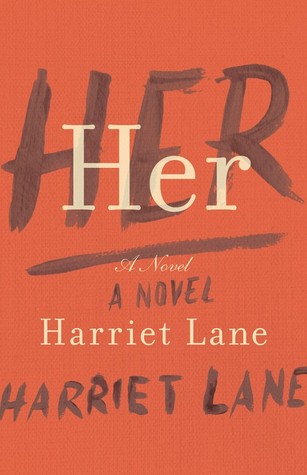
Her by Harriet Lane
UPDATE: I can’t believe I forgot to note the extraordinary ends to which Lane uses the sinister implications of classic children’s literature, including Goodnight Moon and “James James Morrison Morrison Weatherby George Dupree”. So very good.
There is such a descriptor as sippy-cup sinister.
“I’m reading a terrifying book about a woman with a newborn,” I told my husband, who went pale then, because a woman with a newborn is the most terrifying thing he’s ever known.
“I’m tired of female pain and also tired of people who are tired of it,” write Leslie Jamison in “Grand Unified: Theory of Female Pain,” from The Empathy Exams, and I sometimes feel similarly about the reading of the burdens of motherhood.
It’s a burden documented in vivid detail in Her, the second novel by journalist Harriet Lane. The novel is a mash-up, one scene after another presented from two points of view. One from Emma, recently a mother of two, in her late thirties, struggling to get the stroller up the steps as her three-year-old clamours for her attention, and the baby cries, and she contemplates her life, wondering where her once-self—a successful journalist, happy and carefree—has got to. And then the other, from Nina, who spies Emma from a distance, knows her from long ago, and becomes determined to work her way into the other woman’s life to enact some form of revenge.
To Emma, hoever, Nina—a successful painter, her own daughter nearly grown—is a saviour, always turning up at the right time, offering Emma exactly what she needs, providing a glimpse of the world outside, of the life she’d like to have. Nina is a respite from the drudgery of a schedule Emma describes as full of tasks all both so urgent and tedious, breaking the day into useless pieces, rendering the whole thing as just scraps. But why is Nina so interested in her? It’s a nagging question, but one that Emma pushes to the back of her mind, which is already overwhelmed by lack of sleep, stress, financial worries, marital strife, and general ennui. She’s so vulnerable, which Nina recognizes instantly, and realizes she can prey on.
Which makes Her so compelling, so beyond those other narratives which tire me whose only virtue is their honesty, is that the truths revealed about new motherhood are just the starting point. From here, Lane has created a psychological thriller so convincing in its reality, so ominous in its mundanity, so sippy-cup sinister in a manner I last recall reading in Emily Perkins’ excellent 2008 book, A Novel About My Wife.
Nina gets closer and closer to Emma, welcomed into her home, caring for her children, and while we know along she has nefarious intentions—presented in the alternating chapters which, like Emma’s, are written in first-person—we don’t know why she’s out to exact revenge from Emma, who doesn’t remember her at all. We don’t know either which form her revenge will take, though as the novel progresses, indicators emerge, signs and signals that are so terrifying, all hurtling towards the novel’s very end, which is completely and utterly devastating. Not to mention amazing. But don’t say I didn’t warn you.
It’s a page-turner, but the reader will be slowed by Lane’s prose, the pitch-perfect imagery and descriptions, which are to be savoured. By the nuance too, suggesting the motherhood (and everything) is a many-sided reality after all. And the reader will be chilled by Lane’s suggestion that danger lurks even in the safest of places, that the most heightened maternal vigilance might never be enough.
January 11, 2015
The Devil You Know by Elisabeth de Mariaffi
 The stakes were high for Elisabeth de Mariaffi’s The Devil You Know. On Wednesday morning, I walked 2km at -25 degrees to get a copy, because I’d been hearing such good things about it and it seemed like exactly the kind of book you want to hang out with curled up warm while the blizzard howls. A mystery, a thriller, a book set in Southern Ontario during the 1980s and early ’90s, during which a series of young girls were kidnapped and sometimes found murdered, otherwise their faces depicted on posters for years afterwards under the heading, “Missing.” Years later, “aged-enhanced” images of these children would be updated, but we’d still recognize them. I’ve noticed that reviewers have been responding to the book personally, viscerally. There’s a whole generation of us haunted by these missing girls—I could plot my own history by theirs, from Nicole Morin to Alicia Ross. (I was too young to know about the disappearance and murder of Sharin’ Morningstar Keenan in 1983, though she was taken the very playground where my children play.)
Evie Jones, rookie reporter and protagonist of The Devil You Know is similarly haunted, not least because she’s currently covering the Paul Bernardo case as he and his wife are arrested for the murders of Kristen French and Leslie Mahaffy in 1993. But also, in particular, because her own childhood best friend was one of the dead girls, Lianne Gagnon, whose story is a fiction conflating the cases of Keenan and Allison Parrott, who was last seen getting into a car with a strange man near Varsity Stadium eleven years before. Leanne’s killer was never found. And when a strange man begins appearing on Evie’s fire escape and elsewhere, a dark figure skirting on the periphery of her life, she begins to wonder if it’s Lianne’s killer returned and if there’s something that he wants from her. Her fears are dismissed by those around her, but she can’t shake the feeling that she’s under threat, and no wonder—her own history, and the stories of women in the world that she covers in her job, do absolutely nothing to suggest otherwise.
It is suggested—perhaps too strongly, my one criticism of this book, for the signs are there and the reader surely can read them—that Evie’s job as a crime reporter is part of her need to control the forces in her life, that she seeks out stories like Bernardo’s and the stories in missing and dead girls, in order to be in command of the narrative for once. And by those concerned for Evie’s wellbeing, it is suggested too that her need for control is a bad thing, that it’s detrimental to her mental health, and that it’s this desperation making her imagine the footsteps at the door… I mean, never mind the actual footsteps at the door.
But with Evie, de Mariaffi dares to posit instead that female agency is a salve instead of a symptom. Evie Jones is far from perfect, but she’s smart, unflinching, shameless, and brave. The hero of her own story, certainly.
In her research, employing a brand new tool called the internet, Evie starts looking back at the records of what happened to her friend, and learns that there is more to the story than she ever knew. The big picture that emerges as she puts pieces together begins to suggest that the story of Lianne’s disappearance is less random than Evie ever supposed, and that she can trace the case back to a place that’s closer to home than she can bare to imagine. And that all the trouble (and the footsteps) might not be in her head after all.
The Devil You Know is a gripping, fast-paced book that I had to be torn away from, an excellent crime book with strong female protagonists, in scintillating company with those by Laura Lippman and Gillian Flynn. But there is more to it than that. More than just nostalgia too, though it’s a part of it. de Mariaffi was long-listed for the Giller prize a couple of years ago for her short story collection, How to Get Along With Women, which included her acclaimed short story, “Kiss Me Like I’m the Last Man on Earth,” which I first read in The New Quarterly. And while it seemed like a leap for a writer to go from literary short stories to a thriller, once I began reading The Devil…, the connection seemed quite straightforward to me. Partly because of the nostalgia that infuses both the novel and the story, 1980s Toronto in startling specificity. But also because of how much short story writing sets one up to write a plot driven novel—this has never occurred to me before.
Short stories are all about atmosphere and their scenes, one moment standing in for many, representative of a broader picture. Nothing is extraneous, and so too is it with a crime novel, plot-driven, which just really means one scene after another. Though perhaps with some writers and books, the reader doesn’t notice the scene, so preoccupied is she by plot, but the scenes stand out in The Devil You Know. A gripping, fast-paced book that I had to be torn away from, and I kept noticing the scenes, which were like tiny short stories contained within. The plot is the book’s foundation, but the story rises far and large above it.
It was terrific, and definitely worth a walk in the cold.






