March 28, 2016
Ice Diaries, by Jean McNeil
 To me a paradox is a comforting thing, with its suggestion of the unknowability of universe and therefore possibilities well beyond our narrow expectations of experience, ideas surpassing our rigid understanding of black and white, hot and cold, fire and ice. To me it’s comforting too that a single thing can be two things at once, that all the easy answers are the wrong ones, because any of us who bother to think already know that this is the case. And if you’re the kind of person who also has these proclivities, than you too will probably be fascinated to spend a while lost inside Ice Diaries, the Antarctic memoir by the Governor General’s Award-nominated author Jean McNeil.
It’s a memoir freely acknowledged by its author to be a creation, about a continent without terra firma, a huge expanse of space in which there is nowhere to go, where everything is white but so much of the year is darkness. The Antarctic is a place where few people ever go, but those who do are compelled to return. A place of toughness and fragility. Inhabited by scientists, except that McNeil is a writer send along on their expedition. A Canadian, who has lived in Britain for more than twenty years. In this 400+ page book, the paradoxes abound.
For me this was a slow read, structured similarly to McNeil’s journey to the Antarctic by sea, an experience she says she was grateful for, because the Antarctic is not to be simply arrived at, but instead acclimatized to, otherwise the effect is much too jarring. We also find ourselves in the opening chapter in the Falkland Islands, a stepping-off point to the Antarctic, and this is two years after her Antarctic journey. Because while it’s the fashion to begin a story in the beginning, most of us don’t realize we’re there until the middle—time is not so tidy. Which is also the reason that a narrative strand of Ice Diaries is concerned with McNeil’s violent childhood in the Maritimes, as well as a summer during her teen years during which women were being stalked and murdered in her small town and McNeil met her father for the first time, experiences that become conflated. And while these passages seem a bit extraneous to the Antarctic chapters, it is interesting to consider the ways in which they’re linked. And so too how McNeil’s early life may contribute to the claustrophobia and dread she feels at the end of her Arctic sojourn when the sun begins to disappear and McNeil fears she may never get away from there.
McNeil is a tremendous writer who brings the Antarctic landscape to life (! another paradox for a place with so little life) with the deftness of her prose, and her memoir is rich with fascinating details—such as that one must remember to apply sunscreen under one’s chin as the reflection of sun off the snow can cause third degree burns. This journey through the topography of the continent at the bottom of the world is one through the topography of her consciousness, and both emerge from the story known and still unknown at once.
March 20, 2016
Becoming Lin, by Tricia Dower
 Although coming-of-age books tend to feature adolescent protagonists, Tricia Dower’s novel Becoming Lin not only demonstrates that such “becomings” can occur elsewhere (and even more than once) in a lifetime, but also represents an arrival for the author herself. For this book, Dower’s third—after the acclaimed 2008 story collection Silent Girl, which put feminist spins on Shakespearean narratives; and the 2012 novel Stony River with its sinfully delicious Peyton Place bent—is absolutely her finest yet. Becoming Lin is the kind of book that you’re sorry when it’s finished, bereft to leave behind a world that has held you so fast.
It’s a novel about the 1960s, about idealism and reality, about the narrow confines of a wife’s identity and that of a mother. Familiar themes, all of these if you’ve read books like Margaret Laurence’s The Fire Dwellers or watched Mad Men, but themes made fresh with the nuances of the novel’s point of view, the carefulness with which these ideas are examined. In Becoming Lin, the prose is mostly inconspicuous, but what grips the reader is the evolution of Lin’s consciousness, and the complexity that arises from the absence of polarities—unusual for a history of a decade so constructed of extremes.
Linda Wise is sheltered, overprotected by her parents in their sleepy New Jersey town, particularly since her sexual assault years before (which occurred in the novel, Stony River). At the age of 23, she sees an opportunity for herself when she meets the charismatic Ron Brunson, a guest pastor at her family’s church one summer. Ron preaches social justice, and shares stories of his experiences on Freedom Rides, for which he spent time in jail. Ron’s values seem to accord with Linda’s own, but with the addition of the possibility of actual action, something she’s found hard-to-come-by in her hometown, studying at a women’s college toward a social work qualification. The two end up sitting side-by-side at a church dinner, and Dower marvellously constructs the dialogue that brings them even closer. Ron mentions to their table that his chances of getting a church of his own are lessened without a wife, who’s expected to take on (unpaid) roles in the congregation—among them counsellor or administrator-typist. Someone mentions he should put a wife-wanted ad in the newspaper, and Linda’s not quite listening to this.
“I type. I can do the bulletins,” she volunteers, with characteristic bad timing, in essence responding to the want-ad, and while the moment is awkward, Ron Brunson is game.
After a whirlwind courtship, they are married, and Linda (who is happy to have her new husband truncate her name to the more sophisticated-sounding “Lin”) follows Ron to his congregation far across the country to rural Minnesota, where she soon finds herself playing the careful and conservative role of the minister’s wife—not quite what she’d signed up for. Typing bulletins is not even the half of it. Most troublingly though is her husband’s reticence to voice his opposition to the Vietnam War, a point of view that could put his job at risk. And here is where a lesser novel would have irrevocably split the couple, wife going off to radical pursuits and leaving her dull husband behind, but instead Dower has Lin give Ron the courage to realize that opposing the war is his duty as a minister and as a Christian. Theirs is a true partnership, however much a complicated one.
And it is complicated, this we know from the outset, as chapters for the first half of Becoming Lin alternate between two timelines, one of the newlyweds negotiating their new life together, and the other of Lin half a decade later, now a mother to a young son with whom she is moving to the nearby city of Hopkins to begin a new life for herself. A temporary experiment, this is meant to be, though the reader is not made privy to the details at the outset—we know that she and Ron are still married, it’s his name on her apartment lease, that he takes for granted she’ll return home to a year from then. And the story here is familiar to me as well, because I grew up watching Three’s Company and One Day at the Time on television—sitcom scenes of single moms and apartment complex social dynamics. Though the problems Lin is grappling with here—and so too are the other single mom friends she encounters—are not so easily resolved in neat half hour episodes. It’s a brave new world of women’s lib, access to abortion, and career gals, though the notions of justice that have followed Lin throughout her life continue—she’s working for a company in which promotion is not accessible to women employees; her friends contend with deadbeat dads who don’t support their families, she gets groped on busses and feels somewhat unsafe just walking around in her own life.
In the intervening years, Lin and Ron had been wrapped up in the anti-war movement, stirring up resistance from their neighbours and gaining the unfortunate attention of the FBI. Her faith in God and religion has wavered, her husband’s remaining steadfast, and this has become a great divide between them. Their year apart then is an attempt to bridge that space, Ron wishing her to take the freedom and responsibility she longs for, and again, it’s a strength of the novel that he remains (for the most part) a sympathetic character, their connection a true one, albeit one with weak spots and failings. And that the religious character (he’s such a square, man!) does not become the bad guy, that he too is on the side of social justice, but his position is complicated too, just like life is.
In essence, Lin has two becomings in this story, and it’s important to note that one is not necessarily the undoing of the other. That progress is a process, and so is it for feminism, coming in waves as it does, some change rolling back on other kinds, and there is contradiction and disagreement, which might look like disarray from a distance, but it’s a becoming, indeed.
March 17, 2016
Barbados Book Report
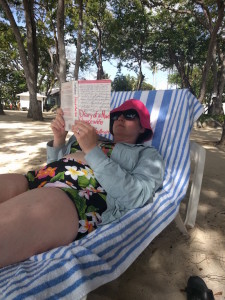 I promise that I am nearly finished writing blog posts about Barbados, but I haven’t talked about the books yet. We brought so many books to Barbados, twelve or so, books for me and books for Stuart, and it made our suitcase quite heavy and wondered if it was really wise to travel with more books than sunscreen, but my intuition than it was indeed turned out to be correct. Because there was so much time to read, and even enough time that there was enough time to read…and also do other things besides reading. (I am also not sorry that we brought twelve physical books with us, a few of them hardcovers, because on the journey home I found a forgotten Kindle in the pocket of the seat in front of me, belonging to someone called Pat who’d lost more than 100 books all that once. If I’d forgotten a book in an airplane [which, by the way, would never ever ever happen] I’d still have eleven more available for my reading pleasure. There is nothing I’d rather carry more than books. And I would rather carry books than nothing any time.)
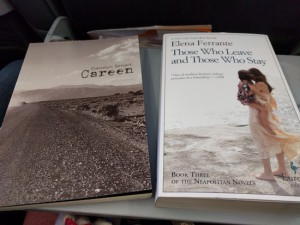 My first book was Those Who Leave and Those Who Stay, the third book in Elena Ferrante’s Neapolitan novels series. As I’ve said, it’s a series I’m not mad for, but am intrigued by, and I’ve enjoyed each subsequent book more than the previous (which makes sense—I’m perpetually bored by stories of childhood and adolescence). And this was the one I’ve been most looking forward to, for the characters are mothers now and Lena is a writer, and these storylines compel me. And they did. I read most of this on the 5 hour flight, dipping in and out of Carolyn Smart’s collection of Bonnie and Clyde poems, Careen, for diversion. I enjoyed it so much, and was most struck by the tension between the two friends when Lena becomes pregnant and is determined to do pregnancy and motherhood properly, to prove her friend’s struggles with it had been personal failings rather than circumstance. And there are even a few days where it seems possible, until the whole thing goes to pieces, and she loses herself as so many women do (not knowing too that all this is such a temporary situation—she imagines motherhood as a fixed state). This was the first Ferrante books I seemingly devoured in that way one is meant to. I really really liked it.
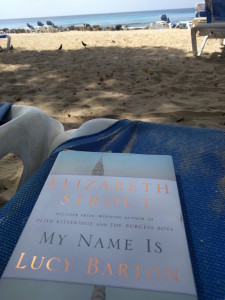 Next up was My Name is Lucy Barton, by Elizabeth Strout, which Ann Patchett and others had proclaimed as Strout’s best book yet. I’d come belatedly to Olive Kitteridge, but really liked it, and had been looking forward to this one, but it kind of disappointed me. I mean not entirely, because it was interesting and also short, a consideration which meant my investment was not overwhelming. But this was also problematic because I bought the book in hardback, paid $30+ for it and felt I’d paid a lot of money for something slight and unfinished. Which was inherent to the project, I supposed, but I was never able to quite figure out how, or what the point was, or why this wasn’t a novel proper. Though it being short, I think I will go back and explore it again, see what I missed. It did actually seem an uncanny read after reading Ferrante, echoes of one with the other. The very premise of Lucy Barton reminded me of the part in The Story of a New Name in which Lena’s mother comes to Pisa to care for her when she is ill, an anomaly in the story of their relationship, as it was for Lucy and her mother, and so too the circumstance of each woman’s positioning against her past and her family, and the insurmountable nature of class.
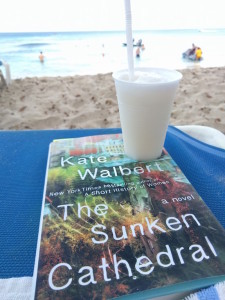 After that, I read The Sunken Cathedral, by Kate Walbert, whose A Short History of Women I’d enjoyed so much a few years ago, and it came recommended by Nancy Jo at Book City. It also seemed like a strange choice following My Name is Lucy Barton, also set in New York City, delving into ideas of motherhood, art, and friendship. Although I felt I wasn’t quite in the right mindset for it. It’s even more fragmented than Lucy Barton but less annoying so—the pieces are so disparate that it makes the project seem like more instead of less. All the same though, I couldn’t make the pieces (each of them compelling in their own rights) fit together to mean something greater than the parts. Was I reading it wrong, I wondered? Why couldn’t I focus enough to have the whole thing make sense? And then I found this New York Times book review that kind of confirmed by feelings and suggesting the problem wasn’t entirely me, and I liked the book better after that, accepting it on its own terms.
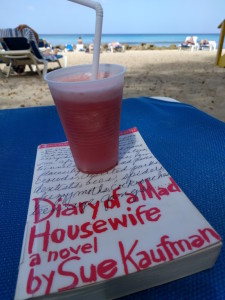 And then I read Diary of a Mad Housewife, which I was absolutely mad for. I’d ordered it after reading Laura Miller’s article on the resurgence of the housewife novel, which interested me because I think Mitzi Bytes fits into the genre. And it was fantastic. How can this book be out of print? It’s funny, sharp, and a marvellous exercise in narrative voice. I’ve never seen the award-winning film, but now I’d like to. As the introduction indicated in my edition, this 1967 anticipated books like Bridget Jones Diary and Candice Bushnall’s Sex and the City columns, and fits well into the genre of Betty Draper books I kind of love, which includes Margaret Laurence’s The Fire Dwellers, The Torontonians by Phyllis Brett Young, and the obligatory Betty Friedan. I appreciate that it’s a book about marriage and motherhood that does necessarily think marriage or motherhood is the singular problem, but that the problems go deeper than that. Also seemed an extension of The Sunken Cathedral in its considerations of New York and motherhood. These novels were continuing to speak to one another.
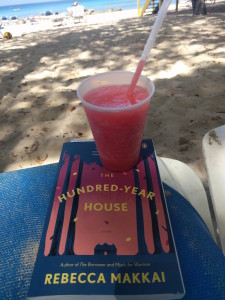 Following that, I read The Hundred Year House, by Rebecca Mekkai, which is our book club selection for this month and as I’d read online that it was a bit of a beach read, it seemed fitting to bring with us. It was a strange book that I didn’t entirely understand until I was further into it, and also not until I’d read about her first novel, The Borrower, which was rich with references to classic children’s books including The Westing Game, by Ellen Raskin, and the suddenly it all made sense, that this book is similarly a puzzle mystery but for grown-ups. The story moves backwards over the twentieth century to reveal the secrets behind a house, the eccentric family that owned it, and the visitors at an artists’ colony housed there for several decades. On the whole, it was a bit forgettable, but I enjoyed it. Curious echoes between it and Mad Housewife as well—both have characters who are hit in the face by mean men called George.
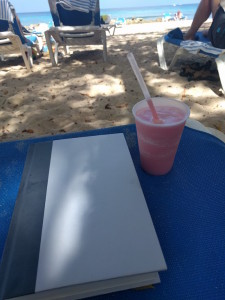 I had to take the dust jacket off for the next book, because my friend loaned it to me and then I took it to the beach, which puts books in perilous situations. The book is The Faithful Place, by Tana French, whose books I adore. My third Tana French, and perhaps my favourite. (I am reading them in order; each book is narrated by a minor character from the previous one. And I was so thrilled to discover a new one is forthcoming in August!) I don’t recall connections between this one and others I was reading, but I was so entirely absorbed in the novel that I wasn’t thinking about anything else. It’s about a Dublin detective, Frank Mackey, who returns to his estranged family when a suitcase is discovered in an abandoned house on their street. The suitcase belongs to his first love, a girl who jilted him on the night they were meant to run away together. And now maybe it turns out that he wasn’t jilted, and that someone close to both of them actually killed her.
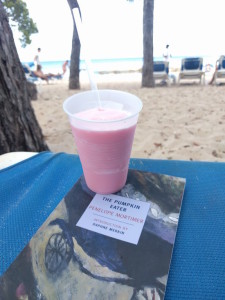 The Pumpkin Eater, by Penelope Mortimer, was after that, the fourth book I’ve read by Mortimer, although it reminded me much more of Our Spoons Came From Woolworths, by Barbara Comyns, in being a rather devastated telling of the realities behind fancy bohemian lives. These poor women. (Both novels are autobiographical as well.) It’s about a wife who has been as partial to philandering as she is to bearing children, but when her umpteenth husband starts cheating on her, it’s all quite different. It’s a spare novel, much of it dialogue and we don’t even know the main character’s name. I didn’t enjoy it as much as I’ve enjoyed later novels by Mortimer—I liked My Friend Says It’s Bullet-Proof and Home, novels written after this one and Daddy’s Gone a Hunting. But I also think it’s far from a beach read and one perhaps not best appreciated under the influence of a daiquiri. And so I’m going to be reading it again.
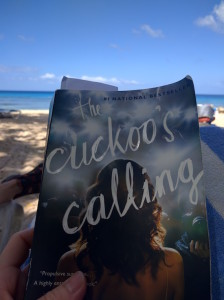 And finally, my bonus book (for it was from Stuart’s stack). The Cuckoo’s Calling, by Robert Galbraith i.e. J.K. Rowling, her foray into detective fiction, the first in a trilogy. And I loved it. For me, I’ve always connected J.K. Rowling (whose work I’ve not read before, apart from a read aloud of the first Harry Potter a couple of years ago) with Kate Atkinson, both of their career successes undertaking similar trajectories, and so it seemed fitting that this book reminded me so much of Atkinson’s Jackson Brodie novels (although Galbraith’s is much lighter in tone, less brutal and violent). Anyway, The Cuckoo’s Calling was great, and I look forward to following its characters through the other books in the series.
Since returning, I’ve been immersed in great Spring 2016 books, and I have a few really good ones I look forward to telling you about.
March 8, 2016
In Time of Need, by Shakirah Bourne
(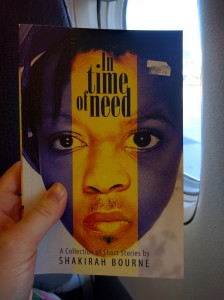 Or, the alternate blog post title: “Barbados in Words Part I” )
In the future whenever I think about the challenges of fostering a thriving literary culture in a country like Canada (pop. 35 million—as opposed to the US’s 318 million) I’m going to think about the population of Barbados, which is 285,000. Literacy rates are sky-high in Barbados, but there aren’t many bookshops outside the capital city of Bridgetown, which made our vacation last week particularly unique in our experience—this trip was just five minutes away from being the only one we’ve ever taken that did not involve bookshop pilgrimages, and from which we’d come home with fewer books than we’d left with.
Except…that after finally making our way through airport security, five minutes past when our boarding time had started, a bookshop appeared before us at the Grantley Adams International Airport, like a vision. A terrible husband would have suggested that instead we get on the plane, but my husband knew better, and so into the shop we went, me in pursuit of a single thing: a literary book by a Barbadian writer who was a woman. And there is was, In Time of Need, by Shakirah Bourne, a self-published title I knew nothing about, and after all, time was a-wasting, so bought it and rushed for the plane. And I happily read In Time of Need all the way home.
It’s a collection of stories, many of which have already appeared in Caribbean literary journals (including Arts Etc Barbados, which is edited by Bajan-Canadian Robert Edison Sandiford), and which was awarded the Barbados Governor General’s Award for Literary Excellence last year. The opening story, “Getting Marry,” is from the perspective of a young boy confused by his parents’ decision to become married (“because I could have swear that them was married every since”) who decides that getting married is all about kissing and cake, and decides to get in on the action himself with a young friend, only to witness a very adult moment from his hiding spot under the cake-lady’s table. The story is fixed in the boy’s point of view and rich with the slang and colloquialism of his language, but then the voice we encounter in the next story is entirely different (from the pov of a young woman who’s just been sold into sex trade, though she doesn’t realize it), and still the next, “The Last Crustacean,” which is narrated by a crab—all of which is to say that this is a fast-paced eclectic collection, a veritable grab-bag of good stories.
I loved “Sheep Don’t Stand Still,” with its fabulous twist, about a woman who thought she was living How Stella Got Her Groove Back with a Bajan lover she’d met on the beach, but who finds out more than she bargained for when he dies suddenly and she goes back to Barbados for the funeral. “If Dogs Could Talk” is a terrific story, one-sided dialogue by a woman being interrogated by police after her cousin is accused of murder. “Four Angry Men” is about politics and takes place over an afternoon at a rum shop. These are stories about domestic violence, child abuse, and family ties. “I Didn’t Know” has the most wonderful opening paragraph: “I first met Betty when her son stole my car. As I watched her punch him in the face and force my car keys from his pocket, all the while begging God for forgiveness, I decided we should be friends.” Another stellar selection was “The Five Day Death of Mr. Mayers,” a story of happenstance and misunderstanding, one thing leading to another with hilarious results. And I loved “A Tear for Miss Cinty,” about a young girl who doesn’t appreciate her mother’s devotion to an elderly neighbour until her own mother is old herself, and left so much alone.
This was all certainly a side of Barbados I was not privy to from the vantage point of my all-inclusive deck chair, but the colours, the sun, the flowers, the food, the slang and rhythms had become familiar to me and immersion in Bourne’s literary worlds was the perfect way to make my vacation last a little bit longer. So nice to bring a little piece of that place home.
February 26, 2016
We Oughta Know, by Andrea Warner
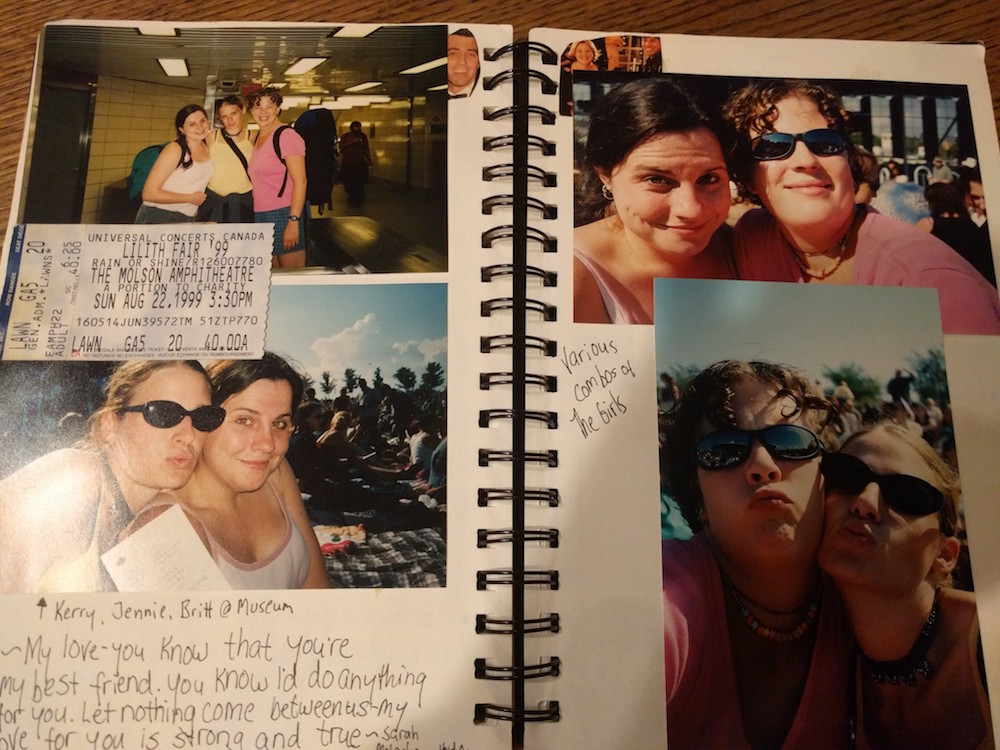
The very first real concert I went to (i.e. not with my dad) was to see Sarah McLachlan on tour for Fumbling Toward Ecstasy, a CD I’d recently purchased from Columbia House for a penny. This was in grade nine, I think, 1993 or 1994, with my best friends Britt and Jennie. Britt’s dad drove us there, to the theatre in Lindsay, ON, where we were part of the amazing, intimate performance, and I saw a girl with dreadlocks who kind of looked like a boy, which left me flummoxed. There is a connection, I think, between having seen Sarah McLachlan, powerful and awesome at her piano, on the guitar, and that Britt and I would spend all of high school performing at talent shows and low-rent concerts playing pop covers on our acoustic guitars, singing in harmony. We really took it for granted, all those amazing women who articulated our feelings so well, whose lyrics we scrawled in our scrapbooks. It was the times we were living in. It seemed inevitable that we’d see Sarah McLachlan against six years later at a much larger venue, us sitting high up and far away on the grass, watching her perform with Sheryl Crow, Deborah Cox. I think the Dixie Chicks were there. Biff Naked on a side stage. Women in songs were in the ascendence. “Women in Songs” was the name of a popular CD series here in Canada in the last few years of the decade, and that the collections were feminist or even that these were women at all seemed to use kind of incidental as we drove down the main street in our town singing along with Natalie Imbruglia as she bared her heart with “Torn.”
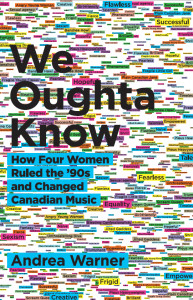 In her book, We Oughta Know: How Four Women Ruled the ’90s and Changed Canadian Music, Andrea Warner articulates that whole scene, and the remarkable fact that four Canadian women were leading the charge of women in song: Celine Dion, Sarah McLachlan, Shania Twain, and Alanis Morissette. These four women too are (along with Diana Krall) are the only Canadians on Canada’s best-selling artists lists, coming in above the Beatles. And even more remarkably, they all made their mark during a five year period in the mid-1990s. What was going on exactly, Warner wonders? How did they do it?
Dion, McLachlan, Twain and Morrisette are not musicians usually linked together, more often viewed in terms of their differences—the good girls and the bad ones, the authentic musicians versus the manufactured ones. Warner makes the interesting point that as a teenager, she regarded these women as she regarded the members of The Babysitters Club, definitive types, not allowing for complexity of character. Making assumptions: how could Dion with her entrepreneurial skills be a Feminist with all her love schlock, and the same with Twain and her bared midriffs? Exhibiting the same narrow-mindedness that led critics to be baffled by Morissette’s “Jagged Little Pill” (which, incidentally, was the only album my husband and I ended up with two copies of when our CD collections merged):
‘The sweetness of “Head Over Feet,” the sensitive sprawl of “Mary Jane,” and the quirky landscape of “Ironic” were baffling to the easily confused, particularly to those who were committed to painting Morissette as a screaming, seething ball of rage. How can she be angry but so gentle here? Well, how can you have both a right hand and a left hand? It’s simple, provided you’re not someone who hates women. People contain multitudes and women are people; therefore women contain multitudes.’
In her book, Warner takes us track by track through the albums that rocketed these women to stardom, and also examines her own feelings toward them and how coming to admire Dion and Twain for their talent and hard work is a part of her coming to terms with her own notions of feminism. She also takes inspiration from 90s music heroines and blends the personal in with her cultural analysis, discussing how her parents’ separation and own ideas of love and marriage influenced her perspective on Dion’s music, or how McLachlan’s devastating Rarities, B-Sides and Other Stuff (which I always used to put on when I was at my most angst-full, just to feed the pain) intersects with her grief around her father’s death. She also examines how these four women were regarded by the music industry, by the media, the sexism and stereotypes and the system that is set up so that women are unable to succeed, for example, the rule against playing two songs by women in a row on the radio, which is what galvanized Sarah McLachlan to start The Lilith Fair to show that women aren’t merely to be pitted against each other, but can stand together. Fascinating too to consider the stupid Lilith Fair backlash, that it was reverse sexism. I remember being gibed about “lesbians” by certain morons in my company at the time who knew I was going to the concert, as though most rock festivals are not enormous cockfests (which are distinct from “enormous-cock fests”) and why don’t we ever talk about that?
Warner is a music critic for CBC Music and Exclaim, and a warm, engaging writer who celebrates the power of girls and women and their voices, and critiques the culture that made all this happen. An appendix in We Oughta Know includes a long list of other Canadian female acts who made their mark throughout the 1990s—Alannah Myles, Amanda Marshall, Jann Arden, and others—making clear that the four women spotlighted in her book are not merely some freak phenomena.
“The ’90s were a remarkable decade for girls like me, and ultimately, the woman we would become. When you come of age in a time when women have voices, take up space, are visible creators and entrepreneurs, it never dawns on you that silence is the rule and these women, your idols, are the exception.”
February 10, 2016
Frankie Styne and the Silver Man, by Kathy Page
 My first proper job after graduating from university was temping as admin staff for a social services agency in the English Midlands, and it was a job that blew my mind in terms of what it taught me about the possibilities of narrative. My job required me type out reams of notes scrawled on yellow notepads and other paper scraps, and render these into a coherent story, and it was fascinating. I worked in Fostering and Adoption and wrote up family trees and histories for families pursuing these avenues, and then moved into Children and Families and supported social workers with overflowing caseloads working to protect vulnerable children and/from their parents (who were often unfathomably idiotic—or fathomably so; indeed, there was an entire basement room with paper files stacked to the ceiling of cases that stretched back generations).
I had this job concurrent to the Victoria Climbié murder inquiry, which delved into the systematic failure to protect a small girl who had been tortured and murdered by her guardians. The details of this failure are shocking, and yet they weren’t altogether: I’d seen how resources were scarce, how social workers were often impossibly tasked, and wondered too how far the social safety net would have to stretch in order to account for every possibility of unthinkable human evil. “The ends and edges of what [people] could have done or could do,” which is a line from Frankie Styne and the Silver Man, by Kathy Page.
Frankie Styne is a new edition of Page’s novel, first published in 1993, and it put me in mind of my favourite Hilary Mantel novels, her first two, Every Day is Mothers Day and Vacant Possession, dark comedies about the dark edges of humanity and their successful attempts to outmaneuver meddling social workers. Page’s social worker is Annie Purvis, who we know first from the point of view of her client, Liz Meredith, who’s just been moved into a terrace house with her baby. Liz has spent her time most recently living on a railcar after becoming estranged from her family, but since her baby’s birth (compounded by the fact that he has developmental abnormalities) she’s become tangled up in “the system”. Although she diverts all attempts to get her installed with a phone (living as she does by her grandmother’s advice to “Always avoid ties that bind”), she could do with a television, but in the meantime, she contents herself by listening to conversations between the troubled couple next door and imagining a different kind of reality existing on a planet far away, that life itself is merely the plot of a cheap pulp novel she’s somehow been stuck in.
A novel kind of like those penned by Frank Styne who lives next door to her, though they’ve barely met, and she’s never heard of his novels. Styne is a recluse, done in by a facial deformity and a lifelong struggle with sexual dysfunction, but now his latest book has been nominated for a major award and he’s going to have the press on his doorstep. Which drives him to become embroiled in a revenge plot of his own, sadistic fantasies that outdo any possibilities that have turned up so far in his books.
What impact do Frank Styne’s horror novels have upon the world? Is the impact more or less than the effect of Annie Purvis’s attempts to care for clients such as Liz Meredith and her son? Does Liz really require Annie Purvis’s meddling? And Page does such a terrific job of creating sympathy for each of her characters that we’re gunning for Liz, that we understand why she doesn’t take her son to a clinic after his foot is injured—because it’s true that they’d only take him away from her. And we know too that “they” is a group of people around a table, Annie Purvis and her associates, and they’re making their own gambles about the ends and edges of narrative possibility. That Annie Purvis has struggles of her own, a husband who resents the demands of her job. That all these people in close proximity affect each other in ways that no one can predict and that could never be plotted on a graph. That, contrary to Mrs. Thatcher’s assertion, there is such a thing as society after all, but what it is isn’t always pretty.
Frankie Styne and the Silver Man is dark and funny, painful and uplifting, marvellously satirical but never cynical, and thoroughly invested with good faith. Kathy Page is a marvel. This is the very best book that I’ve read in ages, and if I read another half as good in the next few months, that will constitute an extraordinary literary year.
February 7, 2016
Patrin, by Theresa Kishkan
 And so #TodaysTeacup continues, the Instagramming of my daily cup of tea, the end of the week marked with #CupAndSaucerFriday. I used to think I had too many sets of cups and saucers, but now it seems as though I don’t have enough. On Friday I took down the last of my cup and saucer sets to use, and was surprised to find that this one set is not from England—not Regency China, or Paragone Fine Bone China, or Coalport. No, this set was from a Czechoslovakian company called Altrohlau. Which was strange because I have Czechoslovakia on the brain, one of the settings for Theresa Kishkan’s beautiful, mysterious novella, Patrin—a novella in which the characters drink Earl Grey.
 I first read Theresa Kishkan in her essay that won the Edna Staebler Personal Essay Contest, and which was included in her essay collection, Mnemonic: A Book of Trees. Unsurprisingly, trees factor prominently in Patrin as well, in patterns of leaves on a quilt inherited by the title character from her grandmother, a Roma from Czechoslovakia who’d immigrated to Canada and become estranged from the rest of her family. When her grandmother dies, Patrin tries to discern the quilt’s pattern, hoping they might provide clues to her family history, which is otherwise lost to her now, the answer to the questions: from where and what did I come?
The novella weaves together several timelines from throughout the 1970s—Patrin embarking to Europe on her own and having her heart broken by a Gypsy musician; spending time with her grandmother in Edmonton after her father’s death, them sleeping together under the quilt; Patrin working in a bookstore in Victoria later in the decade, isolated from the world, trying to decode the mysteries of her own self; and Patrin journeying to Czechoslovakia to do exactly that in 1979, supposing the pattern of trees and leaves on her grandmother’s quilt might be a map of the area in Moravia in which her foremothers had lived and travelled almost a century before.
The world Patrin finds in Czechoslovakia is shadowy and mysterious, the elusiveness of Patrin’s own story underlined by Soviet-era suspicion and paranoia. A friend of a friend takes her on a journey to Moravia to find if her quilt-map line up with actual places after all, and if any history of her family remains. And here the story takes on dimensions of a fairy tale, rich and verdant with a touch of magic, with an ending that in retrospect was inevitable, and is also perfect.
 There’s another teacup too—Patrin takes stock of her “batterie de cuisine” as she moves into her own apartment on Oak Bay Avenue in Victoria in 1974, including a mug “from a potter on West Saanich Road” with a ceramic frog at the bottom. We have a mug just like that, a #TodaysTeacup feature from a few weeks back, Patrin wending its own way into my world, surprising patterns emerging, real life as art’s echo.
January 31, 2016
Bearskin Diary, by Carol Daniels
 Carol Daniels’ first novel, Bearskin Diary, is driven by a remarkable protagonist, powered by compelling narrative voice and an extraordinary point of view. Sandy Pelly was part of the “Sixties Scoop”, a First Nations child taken from her parents and set adrift in the fostering and adoption system. Her story, unlike so many others, turned out mostly well—she was adopted by white parents who were loving and supportive, who did their best to fight against the racism omnipresent in the society in which they lived, and she was well loved by her grandmother, her Ukrainian “Baba“, who instilled in Sandy a sense of her own self-worth and an instinct for story-telling. But the loss of her heritage and culture is deeply traumatic, a loss whose effects Sandy can’t even articulate properly—she doesn’t know what she’s missing. But she knows she’s missing something, not least of all a place where she belongs. There is a disturbing remembrance of Sandy at five-years-old trying to scrub away the brown from her skin.
Things are going well for Sandy. Against the odds, she’s making it as a TV reporter, a rare position for a First Nations woman in the 1980s (and not so common these days either)—and we’re shown the racism she has to contend with from co-workers. She and her best friend Ellen enjoy regular Girls Nights, and it’s at one of these that she meets Blue for the first time. A Metis police trainee, she is instantly attracted to him, for obvious reasons, but also because she sees a glimpse in him of what she’s missing in herself. Blue is similarly alienated from his culture, however, and their relationship proves complicated—she throws caution to the wind and decides to follow him to Saskatoon, where he lives and works, but after a period of domestic bliss, she realizes he’s still distracted by a previous relationship that might not be as far back in the past as she’d been lead to believe. While this revelation is devastating, however, Sandy has other preoccupations—she’s managed to find a great job in her new city, and has just received a troubling tip about Saskatoon police officers taking First Nations women into isolated areas and raping them, getting away with it over and over again. And as she’s grappling with just how to tell that particular story, Sandy is also connecting with local First Nations Elders and discovering the richness of a culture that’s been denied to her for her entire life.
I read the book in a couple of days, and found it fast-paced and really absorbing. Although I was compelled by the story itself and its main character, more so than the novel’s structure, the container that held it. While Sandy was a rich and textured character, secondary characters were more one-dimensional. There were also strange shifts in point-of-view throughout the text. But it also occurs to me that critiquing the book by English literature standards is also beside the point—Bearskin Diary is part of a different tradition and has a more mythological structure, with expansiveness instead of depth, with depth in the places that I didn’t look for it at first. It’s chronology too is remarkable, the present moment dissolving into the past—each one containing all those that came before. It’s a novel with the feel of the oral tradition—and indeed it’s the voice that draws the reader in.
Which makes reading Bearskin Diary really a pleasure. In a time in which it’s never been more important that First Nations’ women voices are heard (and read), Daniels’ novel is definitely one not to miss.
January 24, 2016
Busker, by Nisha Coleman
 I picked up Nisha Coleman’s Busker on the recommendation of Isabel Huggan, so it wasn’t surprising that I loved it. It begins with Coleman, fresh out of university, following a man to Paris with romantic Parisian intentions, but the romance turns out to be more of an awkward misunderstanding. Leaving Coleman stuck in France without a visa, or money, or even a home, but what she does have is a violin. So she begins busking on the streets of Paris, and finds her way into the city through a kind of back door, and also finds a way into her truest self and the kind of life she wants to lead—a coming of age, of sorts. And from her perspective on the fringes—she’s in France illegally, busking itself is illegal in Paris although tolerated, and street performing is inherently fringey, sidewalks begin marginal as they are—she is able to tell a Paris story that’s very different from those we might have read before, those that are all Shakespeare and Company and Mavis Gallant. Busker is something different entire, a rich and generous portrayal of misfits and weirdos and the rhythms of urban life.
I kept laughing out loud, which is a mark of literary achievement. Though I also cringed—as one who has never mastered air-kisses, I recoiled at Coleman’s recounting of her first bisous and how she actually made cheek contact. She writes about being asked to play her violin in a hair salon, but how her own unruly do caused a great upset when she arrived. Or the man she met who wanted to perform songs he’d written, which turned out to be “sex songs” with lyrics like, “The horny bull wants a bouncy ride.” And she meets a lot of men, Coleman, and in the beginning, being lonely, takes them up on their invitations, until she realizes that she’s setting herself up for a lot of awkward interactions. She longs for the company of women friends as well, but these kind of relationships are harder to find. Not to mention that at the beginning of her time in Paris, Coleman hardly speaks French.
It is interesting to read a book about a character as solitary as Coleman is throughout much of the time she writes about. The stories she tells are of people she encounters, other characters who come and go, so there is little interpersonal development throughout the narrative. What sustains the narrative and brings all these stories together then is the development Coleman shows in her own character and understanding of it. She’d previously studied violin in university, but after suffering from performance anxiety she quit to do a major in psychology instead. Busking in Paris, however, Coleman finds her way back to the violin, and writes fascinatingly about how busking is not a performance, but about being part of a bigger scene. She writes compellingly too about the politics of street performance, scoping out prize spots, getting shut down by the police, engaging with other musicians and performers. About balance too—that her lifestyle is a kind of freedom and she’s brave to pursue it, but it’s also a method of avoidance: “I can’t fail at this because busking is an ongoing condition, not a means to an end.” And perhaps she gets a bit too comfortable in her Paris life, something that needs to be checked. “After all, Buscar is a Spanish word that means to search.”
What makes Busker so compelling is that Coleman is usually searching, is open to experience, and curious and wondering. She’s also funny, her prose is impeccable, and not she’s not afraid to make herself vulnerable in the narrative. Though it’s impossible could she ever hope to avoid seeming vulnerable in a book that begins with her in such a precarious situation, but the her faith in a city, its people, the world, pays off. In a time when we’re constantly being urged to harden ourselves against a cruel world, Coleman’s book reminds us of the miracles that can happen when we instead open up wide.
- Purchase Busker from McNally Robinson Booksellers
- Check out Coleman’s very cool companion to her book, Busker: The Interactive Experience
January 17, 2016
One Hit Wonders, by Patrick Warner
 I added Patrick Warner’s novel, One Hit Wonders, to 49thShelf’s The Next Gone Girl list, a list of suspenseful novels about wives with secret lives. Because it belongs there for a few reasons—this is a novel with twists and turns, about a husband who discovers after his wife’s death that perhaps he didn’t know her at all, and it has the whodunnit element—who is responsible for the body lying on the floor? Suspects include her husband, Freddy, an antisocial novelist trying and failing to follow up his runaway hit first book whose proceeds he now easily lives off of; the has-been golf pro with whom Lila was having an affair and who had got her hooked on cocaine; and two small-time crooks who’d been caught up in a plan to rob Freddy of his millions. What makes this book different from the others though is Freddy’s unabashed complicity in its construction; it’s his second novel all along. But not a memoir—this is fiction. He’s creating conversations he never heard, imagining places he never went, and interactions he was never a part of in order to have the whole story make sense. Which makes us wonder if he’s complicit in other ways. Is there a truth to be uncovered at the bottom of all of this? And isn’t that we ask such a thing of fiction kind of an amazing thing?
This is a novel about story-making, about empathy and where it can take us. Our own empathy—why is it that we long to get inside the heads of twisted people and be immersed in troubled lives—and also Freddy’s as he imagines himself into the minds of the men who orchestrated his wife’s downfall. He tells us, “I feel dirty after all that. And yet my task is to empathize with these characters, walk a mile in their shoes. The trouble is I have trouble with empathy. It seems to sit on the delusional end of the sympathy spectrum, perhaps at the point where sympathy runs out and something darker begins. Empathy is only a confidence trick, a species of legalese, a way of making the afflicted believe you are walking in their shoes. Empathy is the tool that gets you through the door. But who is to say what you will do once inside?”
And isn’t that passage wonderful? Warner is a wonderful prose writer, a critically acclaimed poet, and author of one previous novel, double talk, which was nominated for the International IMPAC Dublin Literary Award. And while One Hit Wonders might frustrate readers more interested in gritty realism than a look into fiction-building whose reality can fizzle out into nothing just when you think you can almost touch it, others will be most impressed at the genre-blurring metafictional achievement Warner pulls off here. I’m still not completely sold on the ending, but endings tend to be a bit like that, as Lila’s Freddy would attest.






