January 13, 2025
Like Mother, Like Mother, by Susan Rieger
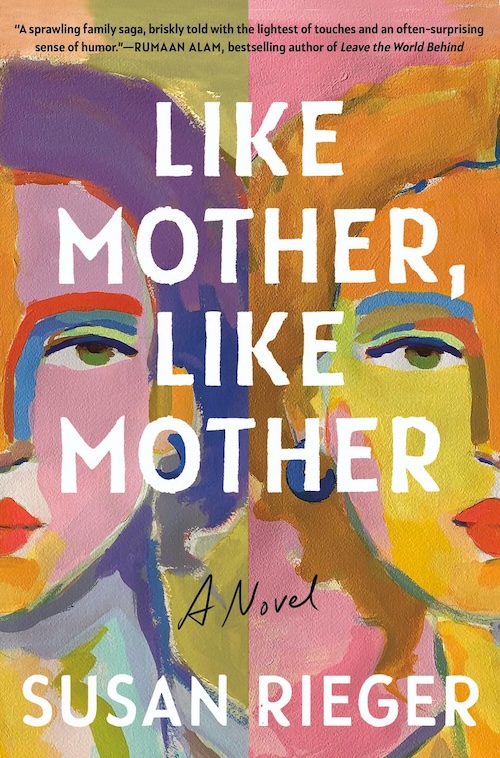
Admittedly, it’s an odd book, Susan Rieger’s third novel, Like Mother, Like Mother, told almost entirely through through expository dialogue by characters who talk like people in golden age film, the protagonist dead in the opening sentence—”Lila Pereira died on the front page of The Washington Globe.” I wasn’t sure in the opening chapters that the writer would be able to pull this off at all, but soon I was in the thrall of Rieger’s rigorous prose and compelled by its energy, and the Ephron-esque punch punch punch of this story, which is an ode to the knots and tangles of family ties and also to the culture of journalism.
Lila Pereira may be dead, but Rieger resurrects her immediately to show her style, unique, brutal and awesome at once. When she was two, her mother had been taken taken away to die in an insane asylum, her children left to fend with their abusive father. Lila decides that she’d be just as ineffectual as a mother herself, and only consents to have children when she falls in love with and marries Joe Maier, who she knows will be a perfectly good mother himself and accepts her otherwise refusal of the maternal role. Which sounds good in theory, but Grace, their youngest daughter, resents her mother’s devotion to her work and absence from home, writing her pain into a roman a clef about a monstrous mother, which backfires when Lila dies not long after publication and Grace looks awfully unsympathetic.
After her mother’s death, Grace takes on the job of finding out what really happened to Lila’s mother all those years ago, using her own journalistic chops (not far from the tree) to uncover the mystery, and everything that happens after that is a pleasure to behold.
January 10, 2025
Chrystia, by Catherine Tsalikis
It was 2018 and I was riding the subway with my husband and kids toward Bloor/Yonge Station when I started eavesdropping on the family behind us who were discussing the ongoing postal strike, the parents asking smart questions and the kids (who were a little bit older than mine) asking smart questions back, all of them engaging with ideas. Intrigued, I turned around to spy on them, and will admit that the thing I noticed first was that the parents in this very smart family were schlumping about in track pants (ie they were about as well put together as I was). It wasn’t until we’d all disembarked from the train that I realized the mom in question was Chrystia Freeland (my Member of Parliament since 2015; her office sends me a card every Christmas, sometimes two by accident) and by then they’d disappeared up the escalator.
“As her friend,” wrote Katharine Lake Berz a few weeks ago in a Toronto Star about Freeland in the wake of her departure from the federal cabinet, “I have witnessed in her something vanishingly rare in public life: [Chrystia’s] character never wavers, whether she’s addressing world leaders or chatting about her children over coffee.” It was a description that resonated with my own fleeting impression of her in the wild, and which was only underlined by Catherine Tsalikis’s just-released biography.
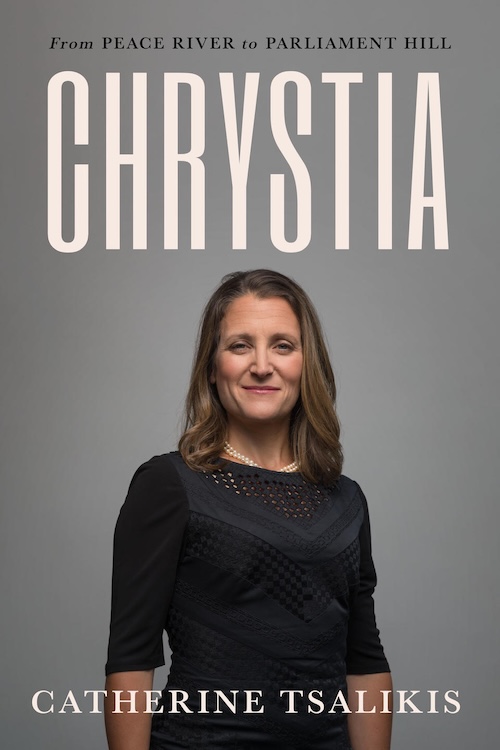
Chrystia: From Peace River to Parliament Hill, was supposed to come out in February, but House of Anansi Press rushed it into onto shelves just before Christmas following Freeland’s unexpected announcement which led to the Prime Minister’s stament last week of his intentions to resign. And now some are hoping Freeland will step up for Liberal leadership; others crossing their fingers that she gives someone else a chance to go down with the ship before taking on the top job herself. What happens next is anyone’s guess but regardless, Freeland’s story is inspiring and fascinating, and this first book by Tsalikis—an international affairs journalist who became inspired to write this biography in 2020 when she was on parental leave with her first child—does a terrific job rectifying the dearth of stories about Canadian women in public life (as opposed to their quite happily self-mythologizing male counterparts).
Tsalikis traces Freedland’s origins from the stories of her grandparents, on the paternal side, a Scottish war bride who married a farmer from rural Alberta, and maternal, whose lives were defined by European war and turmoil in the first half of the 20th century and immigrated from Soviet Ukraine to Canada in 1948 after their daughter, Freeland’s mother, was born in a displaced persons camp. Freeland was born three weeks premature in 1968, just small enough to be tucked into a desk drawer when her mother—age 20, and finished her first year of law school—returned to work at her father-in-law’s law practice two weeks later. Freeland’s parents would later divorce, but her father’s rural Alberta roots and her mother’s Ukrainian nationalism (and progressive activism) would give their daughter’s character a strong definition. Her brightness shone from a young age, and Freeland would take part in a high school program in Italy, earn her undergraduate degree from Harvard, become labelled as a troublemaker by the KGB during a university exchange in the last days of Soviet Kyiv, and struggle just a little bit to balance the writing of her masters thesis at Oxford (where she was a Rhodes Scholar) with her reporting on the fall of the Soviet Union for the Financial Times.
Chrystia follows Freeland’s story through her years in journalism, her triumphs and professional misses, that unwavering character cited by her friend an absolute through-line, a trait which earns her much admiration and success, but also foes including Vladimir Putin and JAN WONG (who are the true main villains of this story). Tsalikis compiles her story from interviews with friends and former colleagues, and close family members (Freeland’s aunt and sister are key sources), as well as Freeland’s own journalism (she has THOUGHTS about Hillary Clinton as a potential presidential candidate in 2008), and profiles in magazines including Chatelaine and Toronto Life. The result is the portrait of a figure for whom loyalty is a fundamental trait, but who also is unafraid of standing up for what she feels is right, which has included the forces of democracy in the former USSR and as a counter to tyrants all around the world, which puts into context the recent events that didn’t make it into the book, making sense of why Freeland chose to step away from her former boss when she did.
What I loved most about this book, apart from learning the details of Freeland’s extraordinary life and also the finer grains of politics and diplomacy that I may not have understood as well during the years I was watching history unfold via a Twitter timeline, is Chrystia Freeland as an example of somebody who stands up tall before authoritarian forces (which is no small thing when you’re five foot two), how her courage and steadfastness have made her a force to be reckoned with, never to be underestimated. Chrystia Freeland is so far from an ordinary person (however she might ride the subway in such a guise) but there is a lot we can learn from her example about how to respond to our current moment, of how to be clear-eyed and fearless in the face of authoritarianism, and how we might live the values that we know to be true.
January 6, 2025
SPACE

Our Christmas tree was wonderful, lush and redolent until (almost) the very end, and once it was gone, we had so much space it was almost like getting a new room, and so we tidied it. Too many books, as always, so I got rid of a lot of them, and then freed up an entire shelf by relocating my encyclopedia set (circa 1987, Berlin Wall forever) to a space on top of another bookcase that had previously been occupied by crap and clutter. Which means SPACE, my books with room to breathe, my personal library with room to grow. And speaking of SPACE, here is ORBITAL, by Samantha Harvey, which (I will confess!) I was not much looking forward to reading because I’d read her previous novel DEAR THIEF—pitched as a fabulous novel that not enough people were reading, a mark of the state of publishing together—and I didn’t like it at all, perhaps because I don’t actually know the song “Famous Blue Raincoat” on which the novel is cleverly based. So when ORBITAL won the Booker Prize, I didn’t rush out and buy it, but requested it from the library instead, finally sitting down to read it over the holidays, and IT WAS SO GOOD. Yes, it’s me, as ever, with the least hot takes, but I adored this book, which is set on the international space station over the course of a single earth-day, and it really was a love song to our planet and to people and the possibilities when we choose to be our better selves. The image that has stuck on my mind is the floating astronauts at the window watching the earth down below, Harvey giving us the whiteness on the bottom of their very clean socks, which is a perspective I’d never even started to imagine. When I was finished reading, I pushed it onto my teen, who read it in an evening, and then her dad read it too, and we had to buy our own copy because we all loved it so much—and with the relocated encyclopedia there is even room to shelf it now. And I barely know about controversy the book was embroiled in either (it was targeted with bad reviews on Goodreads for supposedly glorifying Russia [um, it definitely does not]) because I’ve spent very little time on social media in the past month, which I’m not sorry about at all, a choice that has freed up mental SPACE for me to read and think and be, and I’m going to carry all that with me into a hopefully spacious new year.
December 5, 2024
The Mighty Red, by Louise Erdrich

I loved THE MIGHTY RED so much, one of those books I managed squeeze in before the calendar year is out, and I’m so glad I did, because it’s easily one of the most wonderful novels I’ve read in 2024. Like the river of its title—which originates in Minnesota and North Dakota, and flows north through Manitoba (where I’ve visited it in Winnipeg!), ultimately to Hudson’s Bay—this novel holds vast amounts of geological time, and history, and sediment, and strangeness, and ghosts, and kindness, and cruelty, and it flows and flows and flows. It begins with Crystal Frechette, who works the nightshift hauling sugarbeets and listening to talk radio, worrying about her daughter, Kismet, and perhaps she should be, because Kismet (who’s just finished high school) has found herself within the sights of Gary Geist, high school jock who’s still not over a recent local terrible tragedy that nobody ever talks about. Even though Kismet is sleeping with nerdy Hugo, Gary proves to be somehow irresistible and the two are married, which feels as wrong to Kismet as it should, but everything has been wrong for her family since her father absconded with the church renovation fund and her mother realized she’s on the verge of losing her house to a very dodgy mortgage. Light, quirky and breezy in places, The Mighty Red is also weighted with substance at the very same time, a story of the land, and the connections to it by Crystal and Kismet, who are Indigenous (Erdrich is a member of the Turtle Mountain Band of Chippewa), Gary’s mother whose family’s farm was lost a generation ago, farmers who are working on an industrial scale and seeing their soil being ruined by Round-Up, other farmers trying natural methods of controlling pests and organic farming, the whole story feeling a little bit Barbara Kingsolver, and I mean that in the best possible way. This is a story about love, and family, and books and reading, and gardens and weeding, and the 2008 economic crisis, which is also the story of how we got to 2024, and it’s really about everything, like the river at its heart. Awesome and eternal.
December 3, 2024
COLOURED TELEVISION, by Danzy Senna
TOO REAL is my main criticism of recent publishing satires like YELLOWFACE and now Danzy Senna’s COLOURED TELEVISION, just because it’s personal, strikes close the bone, offering a terrifying glimpse into the parts of my psyche I’d prefer not to look at. Apart from the trauma of that, however, I really liked this novel, even through witnessing its main character’s descent into disaster made me want to yell at the page, “Don’t do it.” COLOURED TELEVISION is a novel about race and class in America, about academia, about Hollywood, and marriage, and parenthood, and precarity, and about everything—possibly to a fault, but by design. After taking ten years of complete her magnum opus, a novel her artist husband has nicknamed “the Mulatto War & Peace,” Jane Gibson reconsiders the many life choices that has kept her family from reaching the middle class stability she longed for in her bohemian childhood. They’re currently spending a year house-sitting for a friend in the Hollywood Hills, and Jane’s been hoping selling her novel will finally turn their fortunes around. When this fails to transpire, she tells some fibs and steals a friend’s idea, hoping to pull off the plot twist and happy ending she’s been waiting for. Unsurprisingly, things do not go well. But they’re biting and funny and the book has real heart.
November 18, 2024
The Knowing, by Tanya Talaga
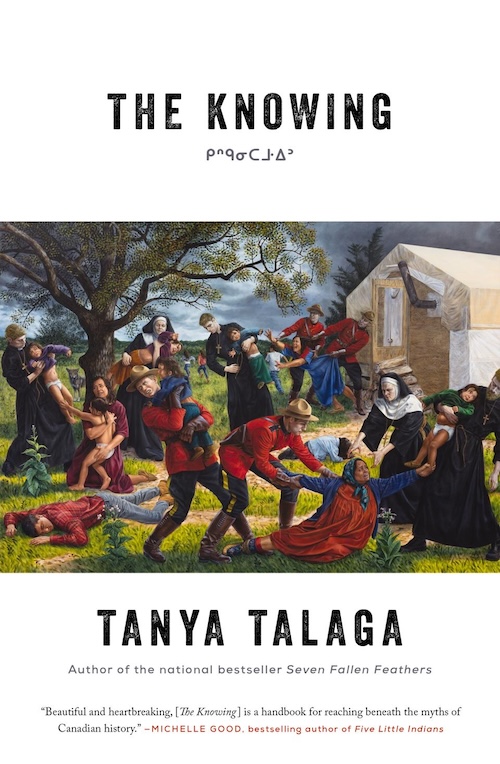
As opposed to “The Knowing”—which Tanya Talaga explains in her book of the same name is a sense among Indigenous people of the truth as to what happened to themselves and their relations as part of the genocidal residential schools system in Canada—there is the fact that I knew nothing. Not an excuse, a plea for absolution, just a fact, and so I came to this book most humbly, a book that began with Talaga’s journey for the details of what happened to Annie, her great-great-grandmother, buried in an unmarked grave off the QEW expressway in Toronto, on the former grounds of a psychiatric hospital. Through her own research, in conjunction with the work of so many others, Talaga is able to piece together the story of Annie and her family, one of colonization, subjugation, but also survival (though sometimes not), and her quest for facts and records is its own thread in this many-threaded work, the obstacles in her way (poor record keeping, destroyed documents, other unavailable, and more) telling their own story of colonial power which continues to this day.
November 14, 2024
Senescence: A Year in the Canadian Rockies, by Amal Alhomsi
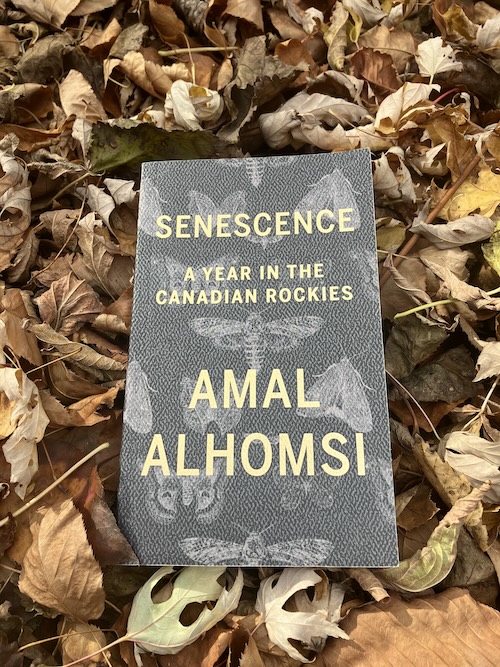
SENSESCENCE: A YEAR IN THE CANADIAN ROCKIES, by Amal Alhomsi, is as much about a year in the Canadian Rockies as Annie Dillard’s first book was about a creek, which is to say that it is about that, but it’s also about everything, about seeing, and being, and (dis)connection to nature, all from the particular viewpoint of a Syrian writer based in Alberta’s Bow Valley, which is not one encountered enough in nature writing. A tiny book that you can slip in your coat pocket, this one was one gorgeous gift after another.
“On the bank of the Bow I was duped. The world seemed still until it wasn’t. What use is a root if the earth it’s embedded in keeps spinning. This motion without consent is dizzying. You open a book and blink a few times, and before you know it, you are now where Mongolia was. A sea sponge, after nestling in a good spot, will move two millimetres an hour simply by breathing. In the morning I inhaled and there was a terrible noise; currents and killdeer and cudweed against the wind. Now there’s a fire near, and ash is riding the air like snow. I have done nothing but breathe, and the noise is now numb. Smog has a silence like ice, like blood. I have done it again; I came here to test the waters, then I was knee-deep in time, then I was swallowed.”
November 13, 2024
What She Said, by Elizabeth Renzetti
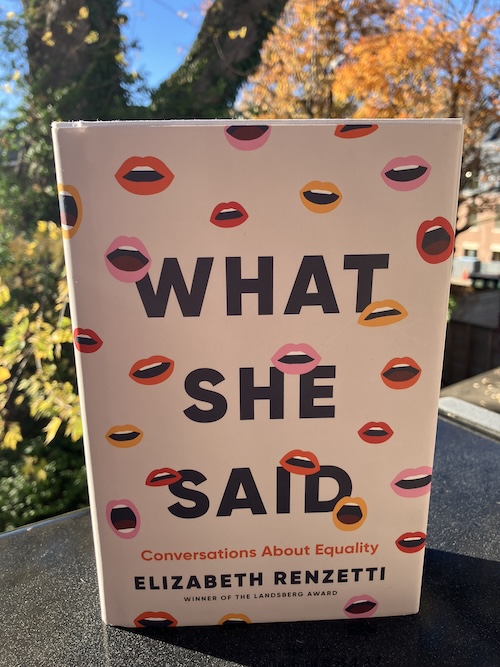
I can’t find an archived copy anywhere, but I swear I listened to Gloria Steinem about ten years ago in conversation with a supposedly feminist male radio host who would very soon after be exposed as a sexual predator, and what she was telling him was that when she’d first learned about patriarchy and sexual inequality decades earlier, she’d decided that there was nothing more urgent than letting other people, the people with power, know about it. Because once they knew, she thought, surely they would want to change things, to make the world more fair for women and girls. But then eventually, she explains, she realized that it wasn’t that these people didn’t know, it was that they didn’t care, and that whole lives, careers, industries, cultural identities were actually tied up in patriarchal systems and structures which were so much more deeply entrenched than she’d ever understood, and ten years ago I thought I knew what Gloria Steinem was talking about, but I had actually had no idea. The feminist backlash roller coaster ever since then is the very worst ride I’ve ever been on.
It’s a mindfuck that my excellent friend Elizabeth Renzetti has been documenting throughout her journalism career, including with her first essay collection, SHREWED. And now her follow-up, WHAT SHE SAID, six years later, finds readers at a moment, post pussy-hat, that is somehow even worse, in which we keep being told not to believe the evidence before our very eyes—that Kamala Harris was “unqualified,” for instance. That abortion bans are about anything more than controlling women’s bodies. That our men and boys are hurting, and we need to be thinking about their feelings, instead of having a societal conversation about the reasons for domestic violence rates being sky high.
It makes no sense, but the gift of WHAT SHE SAID is that Renzetti connects the dots enough that it almost does, and the reader can breathe a sigh of relief: it’s not just you, and it’s not just me, it’s the patriarchy (and it’s all around the world). Renzetti writes about sexual harassment and the reasons women don’t report; about gender inequality in the caring professions, which mean our most vulnerable suffer; about the disparities in women’s health, and how the politics of oppression are inextricably linked to the politics of reproduction; about who tells the stories in Hollywood; about the fraught relationship so many women have with money (and their entitlement to earn it); about whether women have a sell-by date; why it’s so hard for women leaders to be elected in politics; about the incredible abuse hurled at women in journalism; about the links between domestic abuse and terrorism; and about how the world is not designed for us (and the bros who are charged with engineering the future don’t see any problem with this status quo. And then finally (SPOILER ALERT), in her epilogue, Renzetti comes out as a Swiftie: “She bestrides the world like a tall, multi-instrumental, cat loving colossus… She is Taylor Swift, and there’s no one like her.” (If you’re a Toronto Star subscriber, you can read this beautiful, empowering essay online right now. I actually cut out the two page spread from Saturday’s paper, and I’m going to save it forever…)
She is Elizabeth Renzetti, and there is no one like her either, as brilliant (I promise you) as she is funny (and she is so very funny—that this book of brutal things can be filled with lines that made me LOL is really something). Medium height, but a cat lover too, and when this world enough to make your head start spinning, her book will help you realize that you’re not crazy and messed up, it’s just that the world is, but we are not alone in it.
November 12, 2024
Heartbreak is the National Anthem, by Rob Sheffield

“The Eras Tour is a journey through her past, starring all the Taylors she’s ever been, which means all the Taylors you’ve ever been.” —Rob Sheffield
The first time I heard Taylor Swift, it was 2009 and I was driving a rental van to The Junction to pick up a secondhand (recalled) drop-side crib I’d bought off Craigslist for my six-week-old baby, and “Love Story” came on the radio, and I just loved it (that bridge! That key change! How it recalls Katie and Tommy on the old porch watching the chickens peck the ground!).
Although Swift would remain otherwise peripheral to my experience for a while longer, until my daughter (by then 6) arrived home one day from daycamp reporting a song called “Bad Blood” that she’d overheard kids singing, and wanted to hear more of, and there was no going back after that (which was fine, because who doesn’t need a little music in our minds saying “It’s gonna be alright”?).
We’ve been a crew of Swifties ever since, mishearing the lyrics to “Blank Space,” going back to turning “Red,” being unsure about “Reputation” but eventually won over, leaning into the cringe on “Lover,” being rescued from pandemic doldrums by the magic of “Folklore” and “Evermore,” wondering about the auto-tune on “Midnights” and belting out the killer tracks on “TPD.”
And while we did not win the ticket lottery for her Eras Tour in Toronto, I am leaning into the shimmer of #Tayronto this month in lieu of more dreadful things I could be paying attention to, and part of that project was anticipating Rob Sheffield’s HEARTBREAK IS THE NATIONAL ANTHEM, a fun and engaging journey through the weird, wonderful, over-dramatic and TRUE world of Swift’s music and her remarkable career.
“Champagne Problems” was playing in the donut shop when I took this photo. Taylor Swift is omnipresent, and neither she nor I would have it any other way.
November 7, 2024
Loved and Missed, by Susie Boyt
“If we had spoken then it would have been to apologise to each other endlessly and then to apologise for apologising…until there was a high tower of sorryness and of sorrow between us, in recognition that for some reason our lives were rather difficult compared to other people’s. Although, of course, we were well up to it because we were strong, because we were brave and intelligent, although if we were being completely honest, it was a bit much.”
I knew nothing about Susie Boyt or this novel going in, except LOVED AND MISSED had been recommended by a writer friend who said I’m enjoy it, and it was unusual for me to start reading a text this way, just me and the very first line, that first paragraph. But I was hooked, by this spare and pointed narrative voice, by Ruth, whose adult daughter Eleanor is an addict, and the novel profiles their engagement, the eggshells upon which Ruth has to walk in order to have access to her daughter, the bright face she puts on, not a single word that might ruffle or offend, and the reader has to go between the lines a bit to understand what the story is, because Ruth is careful, reticent. She gets on with things, as she does when she begins caring for Eleanor’s daughter Lily, the baby’s presence bringing warmth and purpose into Ruth’s world. She notes that her friends don’t look upon her with such pity now that she has her grandchild to care for, that there is some envy even, which doesn’t happen to Ruth very often, her personal life—single mum, troubled daughter—usually discussed by these friends in hushed tones.
Ruth is very aware of how she’s seen. She’s an experienced and capable high school teacher, and she notes the disconnect between of her professional success and her relationship with her own daughter, with Eleanor’s troubles. Although Lily is more of a tribute to her care, and the quiet narrative shows the joy and comfort Ruth takes in their domestic arrangements, in their closeness. The novel is slim, but follows Lily all the way into her teenage years, and nothing much actually happens, really, except the kind of daily care and gestures that happen all the time, that are what a life, a family, is made of. In Lily, Ruth finds a bit of redemption, her pattern with Eleanor not perpetuated…although the final chapters of the book show that the truth is more complicated, and older, deeper patterns are actually still at work. That there are secrets that Ruth carries close to her heart, and shame that goes unspoken.
This is a novel about love and care, their joys and disappointments, about friendship and motherhood, the people who carry us, the people who save us in ways they’ll never really understand. Strange and quiet and so so good.






