September 6, 2009
Mothering and Blogging: The Radical Act of the MommyBlog by May Friedman and Shana L. Calixte (eds.)
 First, a note to everyone who now lands here after google searches regarding “maternal ambivalence”, particularly those who google “ambivalence about the baby’s birth”– fear not. I am the one who cried on the operating table before my c-section because I’d decided maybe I didn’t want a baby afterall, but it really did work out okay in the end, and it will work out for you too. Ambivalence, I like to think, just means you’re just considering all sides, and really, you’d be stupid not to.
Anyway, those readers land here because of my post from last spring “On mommy blogs, maternal ambivalence and my worst tendencies”, a post in which nothing was resolved and I talked around in confusing circles. Since then, I’ve come not closer to conclusions, I’m still troubled about both “mommyblogs” and my feelings toward them, and even having become a mommy myself hasn’t changed my perspective so much at all.
Perhaps resolution is not the point, however. Mommyblogs contain multitudes, and so to think just one thing about them is sort of limiting, which I’m quite sure about now, having read the excellent collection Mothering and Blogging: The Radical Act of the MommyBlog, edited by May Friedman and Shana L. Calixte. A collection of academic essays containing multitudes itself, and reflecting the wide range of responses that mommyblogs prompt. A microcosm, perhaps, of “the mamasphere”, with dissenting voices, personal stories and experiences shared, academic discourse in an accessible way, these various points of view in a heteroglossic rabble.
I come away from this collection entirely comfortable with my lack of conclusions, understanding really that it is thinking about these issues that is the point. I’m still not convinced that most mommyblogging is a radical act, but just considering why or why not is important, and that there are many issues at stake here. Stand-out essays including, Jennifer Gilbert’s “I Kid You Not: How the Internet Talked Me Out of Traditional Mommyhood”, Lisa Ferris’ “Kindred Keyboard Connections: How Blogging Helped a Deafblind Mother Find a Living, Breathing Community”, Jen Lawrence’s “Blog For Rent: How Marketing is Changing Our Mothering Conversations”, and “Schadenfreude for Mittelschmerz? Or, Why I Read Infertility Blogs” by May Friedman.
I’d never considered mommyblogging marginalization, or the politics of the mamasphere, the implications of corporate marketing, or– for a form so built on self-identification– what it would be read from the perspective of a lesbian mommy in a multiracial family, for example. This is some can of worms.
I see now that whatever my feelings about mommyblogs, to dismiss their importance would be wrong, and that so many bloggers tend to write for themselves and each other, so it doesn’t matter much what I think anyway.
August 23, 2009
Swimming by Nicola Keegan
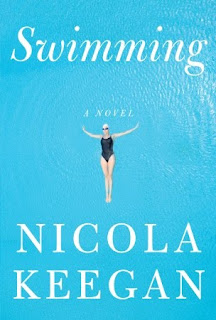 Swimming begins, “I’m a problematic infant, but everything seems okay to me.” Narrator Philomena, draped in rolls of baby fat, goes on, “I live simply; when something doesn’t seem okay, I scream until it is again… I am nine months old and the longest I’ve slept at one time is one hour and forty three minutes.” Poised on the edge of the pool before her first aqua babies class, she is slipped into the water and finds herself “liberated from my fleshly prison of gravity.” Philomena swims and she swims, kicking and rolling, amazing all those poolside, and when pulled from the water, she spits up, pees on her father, and then falls asleep for fourteen hours.
Her parents keep checking on her after: “It is an unspoken fact that they can finally love me now that I’m out cold. They bask in this love, as waves of breath ebb and flow, causing the dome of my stomach to stink, then swell. The silence of the household has opened a space for hope.”
I elaborate this first chapter in such detail in order to explain that Swimming isn’t what it sounds like. The journey of a girl from a small Kansas town swimming to Olympic stardom, an American-type story. Interestingly, however, Keegan turns out not to be American at all, and it shows in her writing. Her narrative reminiscent of Kate Atkinson’s in Behind the Scenes at the Museum, both books dark and hilarious in turns, eccentric family histories beginning with the narrator’s birth, except in the case of Philomena, this birth actually takes place that moment she first gets in the pool.
Only in this first chapter, however, do we get a sense of Philomena in the pool– how it feels to kick, to float, to duck underwater. Though swimming remains her passion throughout her life, “passion” isn’t the right word exactly, because swimming is more a means to an end, which is survival. Sink or swim? She chooses the latter, so that instead of swimming as the main exploration of the narrative, the sport is a metaphor for how Philomena lives her life. Tracing it back it to its very origins, she says, we all start out swimming anyway.
Despite her aptitude for all things aquatic, Philomena receives little encouragement from her parents regarding swimming. Once again, this won’t be the expected tale– of prodigies worked to the bone, of childhood lost. Her preparation for her olympic career isn’t years and years of practice and determination, but rather an eccentric family to start with, compounded by tragedy. In her mid-teens, Philomena starts swimming to save herself from nothingness, to avert her mind from traumatic memories, and her natural ability is still apparent. So that she catches up fast and she begins to win. Winning itself the object, the race, ripping through the water instead of focusing on what’s around her. She becomes the omniscient narrator of her own life, with all the distance that might imply, and her friends and family she renders brutal caricatures, because this is how life is bearable.
Swimming is Keegan’s first novel, which is obvious at times. Not that the book reads like a novice effort, but instead it’s clear that Keegan has poured into Swimming absolutely everything she’s got. The shape of the book is not quite perfect, but its substance is something remarkable. So that I hope that Keegan has not exhausted her store, and I look forward to seeing where her talent takes her.
August 15, 2009
The Incident Report by Martha Baillie
 Something happens when you work in libraries for too long, even part-time. I learned this the day a patron came to the circulation desk asking to borrow a stapler, and I had to explain why this was against our policy: “If we gave it out to you, then we’d have to give them out to everyone.” It was a sorry power trip, from up there on my desk-high perch, and I even felt like kind of a hero. Averting mass stapler lending, which really means holding off CHAOS in the library, the foundation of our society. Where would we be without me?
But I was not the worst case. One librarian where I worked had seen fit to apply labels to every object at the circ desk and the place where that object was to rest. “Pencils” said one tin, “erasers” said another. “Paper Cutter” lived in the “Paper Cutter” place. “Coats” on the closet. This was the Dewey Decimal System gone mad!! I wrote “Floor” on a post-it note, and placed it underfoot. My colleagues, being librarians, failed to see the humour.
But I love it. I don’t think I’ve always been like this, but after a cumulative five years of library work, my own books (and CDs) are always in alpha order. Out at the library, I am always made steady by the sureness of call numbers– that everything will be where it is supposed to. I used to relish shelf-reading, and not just because I got to browse the stacks, but whenever I found a volume out of place and put it back where it belonged, I’d performed a task even more worthwhile than keeping would-be stapler lendees tamed. I love libraries. I love cataloguing. May the god of order forever reign.
At the Toronto Public Library, as I now know, employees are instructed to log incidents which take place on their shifts. Martha Baillie’s novel The Incident Report is made up of such logs, Miriam, her protagonist, seeing fit to order her life to fit the confines of these reports. Perhaps a way to order chaos indeed, as her job sees her engaging in bizarre (and sometimes dangerous) interactions with those on the fringes of society. Her incident reports “resembling a pack of cards” stacked in a desk drawer, containing records of what you might expect (and what you couldn’t possibly imagine but some of which probably comes from truth [Baillie is a librarian in the Toronto Public system]), but also episodes from her personal life (which include a man she meets while sitting on a park bench during her lunch break), and from her history (usually about her father, and a tragedy in her past).
Miriam’s strait-laced recounting of library incidents is very often amusing, but also poignant, this underlined by Baillie’s exquisite prose. The every-day becomes captured for its singular moments, its eccentric characters, and the library as a marvelous backdrop. Baillie goes further, however, with excellent plotting, this potentially gimmicky book distinctly a novel, with romance, mystery, suspense, darkness, and tragedy (oh god, the gasp I uttered near the end, I could not believe it, I wanted to turn back the pages and have it happen a different way, but alas, there is only going forward).
This is a clever little book, but not too clever, for it is mostly beautiful. Rich with literary allusions that aren’t the point, but still round out the universe. And rich too with story, which goes to show that you can make stories happen anywhere.
August 13, 2009
The Thing Around Your Neck by Chimamanda Ngozi Adichie
 Inevitably, Chimamanda Ngozi Adichie’s Orange Prize winning novel Half of a Yellow Sun was going to be a tough act to follow. (We at Pickle Me This adored this book back in 2006). But in a curious way, Half of a Yellow Sun anticipated Adichie’s new excellent collection of short stories, The Thing Around Your Neck in its wide range of voices and points of view. We find similar scope in Adichie’s stories, which take place during different points during this century and the last, are voiced by first, second and third person narrators, whose characters are male and female, and young and old, and are convincingly realized for all this variousness.
The voices are all African, however, which makes The Thing Around Your Neck a difficult work to approach. Adichie actually critiqueing this difficulty within her stories, many of which take place in America, dealing with the ignorance Americans view Africa with (and of course, Americans would not be alone in this). In the story “The Thing Around Your Neck”, a Nigerian woman working in Connecticut begins a relationship with a distinctly Africa-philiac man, and notes that, “white people who liked Africa too much and those who liked Africa too little were the same– condescending”. In the story “Jumping Monkey Hill”, a Nigerian writer called Ujunwa attends an African Writers Workshop near Cape Town, and the white instructor critques stories for not being “reflective of Africa, really,” or for being “agenda writing… [not] the story of real people.” (Interestingly, however, the retort to that is that the story actually happened to the writer, and I do know that a story having happened in life does not necessarily make it plausible in fiction, but anyway…)
So I’m not sure if it would be condescending to say that I liked these stories very much. I do know, however, that one of the reasons I do so like Adichie’s writing is that reflecting Africa is not necessarily their agenda. First, because she goes to great lengths to show the variousness of “African” experience (it is an enormous continent after all), and because even when her work tells stories from important points in history (as in Half of a Yellow…), it is the story that makes the history come to life, and not the other way around.
My one criticism being that the voices and experiences of African women in America were a bit samey– they arrive with big dreams, are disillusioned by their visa sponsor, work at dead-end jobs, and remark upon Americans’ obesity. Which might mean that this experience is all too ubiquitous, perhaps, but I was not convinced. The stories themselves were strong, however, and in their perspective reminiscent of those in Jhumpa Lahiri’s collections: immigrants navigating the perplexing foreign land that is the USA, and this reframes the familar for a reader like me. And then that the African stories, even at their most dramatic (and there is certainly action here) show the every-day in a land so far away.
The Thing Around Your Neck sounds like a cacophony, voices on top of voices. And this collection certainly makes evident that Adichie is up to the short story form.
July 25, 2009
Where We Have to Go
 I’ve just finished reading Where We Have to Go, a novel by my former classmate Lauren Kirshner. It’s the coming-of-age story of Lucy Bloom, a cat lover and an ALF lover with far too many odds against her. Featuring a truly great first line, “The night before my eleventh birthday, I dreamt I was five feet off the ground and flying through the No Frill grocery store on a royal blue Schwinn.”
Zoe Whittall in the Globe & Mail wrote, “Kirshner tempers any potential for melodrama with an expert eye for specific detail and the curt, cruel dialogue of teen girls hell-bent on destroying each other despite their abject loneliness. She is also adept at writing perfect pop-cultural detail: the emotional resonance of Alf, a hamster named Charlie Sheen, lite-brite pegs in Lucy’s pockets, all situating the story in a particular moment in recent Toronto history.”
Check out more praise and information about the book at Lauren’s website. This month she’s also been writer in residence at Open Book Toronto.
July 2, 2009
February by Lisa Moore
 Lisa Moore’s first novel Alligator was a revelation when I first read it. It was a novel composed of sentences, each one as meticulously and surprisingly crafted as the next, and I’d never read anything else like it. As a whole, however, the novel didn’t completely satisfy. This might be asking too much of a book that did so many other things, but still, the project wasn’t completely realized. With February, however, breathtakingly, Moore has built on her promise and in this, her second novel, she has created a brilliant literary achievement.
Now, I realize that by only reading books I’ll probably like, and only writing about books I do like, I may come across as a bit hyperbolic in my literary praise. Indeed, I do love an awful lot of books, but February is something different. A cut above even the very best of the rest, her is my favourite book I’ve read it ages. Casting its spell from the first sentence, crafted as marvelously as I’d expect, I was completely swept up in this novel that reads (as Alligator did) like nothing else I’ve ever read before.
February is the story of Helen, a Newfoundlander whose husband was killed in the Ocean Ranger Disaster in 1982. (Helen is fictional; the disaster is not). The story is focused in late 2008, beginning when Helen’s son telephones her to inform her that a woman he’d spent a week with seven months ago is now pregnant with his child. He is calling to find out if he’ll be made to do the right thing, whatever the right thing may be, and so he will by Helen’s guidance, because she is a distinctly honorable woman. Which is different than being deliberately so. Much of Helen’s life has been an accident, but her goodness is still palpable to the reader. Which is Moore’s first great achievement– that goodness can be interesting, worthy of a story. Moore’s second achievement being her depiction of Helen and her husband’s absolute, pure and total love. A portrait of a good marriage even, which is even more rare in fiction than real life. A marriage so good that there’s really no getting over it, no moving on or forgetting, and Helen’s loss is so heartbreakingly rendered, captured in the details and avoiding any points cliched or saccharine.
February is a novel about moving forward, about never letting go and doing the right thing. Its characters are vivid and wonderful, their thoughts positively “thought-like”– twisting, interrupted, irrational– as Moore’s style continues on in the same surprising vein, her technical innovation perfectly realized. The story is as funny as it is sad, and that sadness has meaning beyond itself. It’s a rare thing– a perfect book. I would call it one of the best books published in Canada this year, but I’m taking my chances on it being one of the best books from anywhere.
June 30, 2009
Update
So, I’m not going to say I’ve mastered nursing, I’ve certainly learned plenty in the past five weeks, and it’s getting better all the time. I will lay claim, however, to having mastered reading while nursing. Which I don’t do all the time for fear of child neglect or that she’ll grow up to think her mother is a hard cover, but I am pleased to say that I’ve got a lot of reading done lately. I read Catherine O’Flynn’s What Was Lost in a hurry, and enjoyed it very much. I’m now absolutely obsessed with Lisa Moore’s February, which I think will win the Giller Prize this year, if anyone’s betting. And this morning I bought The Ten Year Nap by Meg Wolitzer, who I’ve never read but have heard great things about (including from Jessica Westhead). So the moral is that reading is possible in this new life, as are banana pancakes, park bench afternoons, Midsomer Murders, laughter and ease. I have avoided daytime television thus far, which I’m quite proud of. New pleasures are late evening walks, respect for quiet, baby bathtime, board books and almost-smiles. And that’s starting to make everything else worthwhile.
June 26, 2009
Trouble by Kate Christensen
 Kate Christensen writes like a man, which has caused misunderstandings in the past because she also writes like a woman, this misunderstanding compounded when she writes about women (as in her debut novel In The Drink, which, as I’ve written before, failed as the chick lit it wasn’t). All of by which I mean that Christensen’s writing voice lacks a gender, this bringing forth interesting results in her challenges of feminine and masculine notions.
In her latest novel Trouble, Christensen assigns the familiar bottoming-out-down-in-Mexico role (as in Under the Volcano) to a woman, or in fact to two of them. Strait-lacey psychiatrist Josephine has flown down at the last minute to comfort her friend, aging rock star Raquel Dominguez, whose reputation has endured a massive assault via celebrity gossip blogs. Josephine is not in much of a position to comfort, however, having just decided that her marriage is over and determined to immerse herself in the hedonism Mexico seems to offer. Both women have behaved badly, and are not at all concerned with seeking redemption.
‘”All I can say,” said Raquel, “is that it is not fun to be a woman and to fuck up…”
“Maybe women are expected to behave better than men,” [Josie] said, “because we are better than men. The world without women is Lord of the Flies. The world without men is Little Women.”
In Trouble, Christensen subverts any idea of betterness, Josie’s own perspective being rather limited (as Christensen herself has pointed out). For a psychiatrist, her assessment of everybody is remarkably wrong, and it turns out she knows herself just about as badly. She’s not better than anyone, including her troubled friend and the men in their lives, but she manages to remain immune from any real “trouble” by regarding her Mexican experience as an “experiment”. Raquel, however, is more troubled than Josie suspects, and an act of negligence/indulgence on Josie’s part leads to tragedy.
This is a novel that begins mid-conversation, and follows its characters over a very short period of time. The result of this is distance from the characters and the story, Josephine’s first-person narration in particular making no dramatic gestures to draw us closer. As readers, we are given copious description, mundane dialogue, small-talk and gratuitous sex, and it’s hard to find Christensen’s over-arching thesis. I’d posit this is because there isn’t one, or rather because there are several. Numerous literary allusions underline this, to Under the Volcano, to Joan Didion’s work, and to A Passage to India, which I’ve not yet read, but must now, because the end of Trouble suggests it might be the key what Christensen is up to.
As in her first novel, however, it’s clear that one major intention is to play out familiar literary tropes (the bottoming-out character, “in the drink”, plenty of scenes taken up by descriptions of bullfights) with a female cast in the starring role. Moreover, a somewhat-unlikeable female character, which is rare in fiction, and hard for some critics to stomach or understand. That us liking Josephine was never Christensen’s point, and that identifying with her is something you’d only do if you were frightful (or unbearably honest). These are demands not often made of male lead characters, and Christensen plays with this twist to do novel things with her fiction, to tell a story that’s not often told.
Trouble is not her very best work. As Josephine’s perspective is limited, so is the entire book’s, and the story’s shape is too fragmented to be wholly satisfying. Perhaps it’s the nature of Josephine’s solipsism, but the secondary characters she describes remain unrealized, and unreal. But by being a Kate Christensen novel, this book is worthwhile, and probably more worth reading than most of its peers on the shelf. For Christensen writes well and fearlessly, with a dirty sense of humour, and any novel by her is an event nevertheless.
June 22, 2009
CNQ
Canadian Notes & Queries is one of my favourite magazines, and now you can check out their brilliant new website. In particular, may I refer you to my review of Libby Creelman’s novel The Darren Effect which I enjoyed very much.
June 6, 2009
Clearest, starkest brilliance
 “Motherhood is a storm, a seizure: It is like weather. Nights of high wind followed by calm mornings of dense fog or brilliant sunshine that gives way to tropical rain, or blinding snow. Jane Louise and Edie found themselves swept away, cast ashore, washed overboard. It was hard to keep anything straight. The days seemed to congeal like rubber cement, although moments stood out in clearest, starkest brilliance. You might string those together on the charm bracelet of your memory if you could keep your eyes open long enough to remember anything.” –Laurie Colwin, from A Big Storm Knocked It Over
That I’ve read an entire book over the past twelve days means that all is not lost. And indeed, there have been numerous “moments standing out in clearest, starkest brilliance,” though these don’t include the hours we spent in the Sick Kids Emergency when Harriet when just four days old (she was fine, thank goodness, but that experience was like staring straight into hell), her much too-much weight loss that has had both of us struggling to make up for it ever since, that I may have cried as much as she has, and the overwhelming dread at the thought of her Daddy returning to work on Monday. But we’ve enjoyed taking her out for her first walks in her carrier, trying to figure out what she likes (not much, but we suspect being in her carrier is a comfort), getting massages from Daddy, midwife visits where she’s gained an ounce every day, the sun shining through the windows, all the support we’ve had from family, friends and our most excellent neighbours, and that she’s received so good wishes from all over the world. Harriet has also received post every day, though she’s not yet old enough to realize how exciting that is. We’ve also been fortunate that I’ve come through my surgery so well and easily. My crush on the surgeon went into high gear in the days after her birth (which, in spite of the operating room, was as gorgeous as any birth could be, and I don’t feel I’ve missed anything) because he looked like Paul Simon circa 1970s, and because of what a good job he’d done, and what a beautiful baby he’d delivered (though about three nights ago at three o’clock in the morn, I was sorely tempted to go firebomb his house). It’s been a very difficult time for all of us this past while– I’ve never been much inclined to work hard at things I’m not loving, and this isn’t a job I can pass along to anybody else. Though I’m finding, ever-increasingly, those moments standing out in clearest, starkest brilliance when I don’t want to.