October 1, 2010
Two best books I’ve read this year: Mammoth and Light Lifting
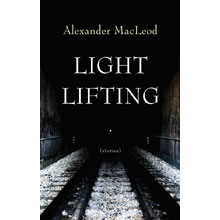 Alexander MacLeod’s short story collection Light Lifting never wavers, one solid story after another, and the effect is devastating, gripping, overwhelming. I could hardly believe that the book was this good, and so when I discovered that a friend was reading it at the same time that I was, I got in touch right right away for confirmation. Her take: “This guy is the real thing.”
Short stories whose absolutely evoked universes reminded me of Alice Munro in their expansiveness, whose subtly horrifying endings were a bit Flannery O’Connor. Stories so engaged with the stuff of this world, the living and the doing– laying brick driveways, changing an explosive diaper in a disgusting truck stop bathroom, learning to swim, cycling in the snow, crossing the finish line in a track competition, searching for lice, outrunning a train. So vivid that it’s hard to believe it’s fiction, which is why I had trouble remaining composed at the end of the story “Light Lifting”.
These are stories that hinge on a single moment, when one thing turns into another, and yet these single moments are so emblematic of larger stories that each of these stories is a lifetime, is a novel, and utterly satisfying from beginning to end. MacLeod also manages to bridge the literary gender divide, which I found remarkable– how he writes like a woman, and how he writes like a man, and how such distinctions cease to matter with incredible work like this. I am full of awe, amazement, will be foisting this collection on everyone I know, and not a single one of them will be the least bit sorry. They’ll all feel as lucky as I do to have experienced this incredible collection.
(See Light Lifting on the Giller longlist.)
**
Larissa Andrusyshyn’s debut collection of poetry Mammoth is a study in paradox– how death brings the knowlege of what  finally endures; the entire universe made containable by the neat equations of its basest parts; that it is poetry unleashing the magic implicit in algebra, taxonomy, molecular biology, zoology. “Snakes are not made from scratch”, Andrusushyn demonstrates on the basis of its useless hip bone, and so neither are these poems, which have been created from the stuff of life, from the world. The story of the mammoth carcass from which a genome is harvested becomes conflated with another extinction, that of the narrator’s father, and as the scientist diligently searches for what endures, so too does the poet.
Poems such as “Portrait of the Liver at the Open Mic” use humour to break the body down to its parts, show how these parts both function and decay, and to examine the language we use to understand these processes. “Diagram of Flightless Bird” and “Vestigial” connect these parts of ourselves to what came before us, and posit that we carry all history and the universe within ourselves– that we are not made from scratch either. The mammoth and the father return near the end of the book, the poetry asserting that we do not bury our dead after all. That we are a sum of our parts, of now and all that came before us.
Andrusyshyn’s book is understated and stunning, slim and expansive, hilarious and sad. Thoroughly engaged with a sense of wonder (“Voyageur”) and a sense of play (“The Mammoth Goes to School”). I had such fun reading (and rereading) this collection, and I know I’ll return to it again and discover something new. It’s a book that manages to not only be transporting, but also to deliver us home.
September 20, 2010
The Sky is Falling by Caroline Adderson
 Caroline Adderson’s wonderful The Sky is Falling will not be outsmarted. The novel, in which Doris Lessing’s The Good Terrorist meets the short stories of Chekhov, is narrated by Jane Z., who opens the paper one morning to find a face she hasn’t seen in twenty years. The face belongs to Sonia, once Jane’s roommate, once a friend and possibly something more than that, and also a co-member of a movement campaigning for nuclear disarmament in the early 1980s. Sonia has just been freed from prison, after serving a twenty year sentence for a crime that will be the novel’s climax. The narrative flips back and forth between 1984 and 2004, as Jane explains what happened to her and her friends, and how her past connects with the very different life she lives now.
This is a novel deftly composed of fragments and allusions, whose construction is remarkably assured for this, and yet there are these moments throughout where something slips– a certain detail, an incongruency, we know one thing and then we’re told another–, and these moments take us outside the story for a moment. Poor editing, we can chalk it up to, and avid readers are encountering this kind of thing more and more these days.
And then. And then.
As I said already, Caroline Adderson’s novel will not be outsmarted, there are no slips. How Pascal was said to be a friend of Dieter’s, but Dieter doesn’t even appear to know him, and it’s not Adderson who’s slipped up here, but Jane, and her remarkably limited, unfiltered perspective. Or rather, a perspective that’s filtered solely through a lens of Chekhov stories and the Russian language she’s studying in her second year at UBC, and the stories are more real to her than her life is. She’s more of an agent in these stories, which she manipulates in her essays to suit her own political purposes, than she is in her own life where she is always on the periphery. She reads her life rather than lives it, and her readings are very often wrong.
Jane is the daughter of a Polish immigrant, she’s a foreigner in Vancouver where she has come from Edmonton for university. After a year of living three buses away from the campus with her eccentric aunt, she wins a spot in a shared house because she’s viewed as unthreatening enough to not steal somebody’s boyfriend. Here, she meets Sonia and the other housemates, all of whom have their own reasons for political action (and Adderson should be commended for her treatment of this ensemble cast). For Sonia, it’s a genuine desire to save the world (or perhaps to be the saver of the world, more particularly), and Adderson does a fine job of illustrating the heightened state of Cold War politics in 1984, with Star Wars, the Doomsday Clock, a rubber Ronald Reagan mask hanging by its eye-hole from a nail in the wall, and the Korean airliner that had been shot down by the Soviets the autumn before. To the insular group feeding off one another, all these were signs that the end was nigh, and to Jane, even more insulated within that insular group, it seemed her eyes were opening to reality for the very first time.
Twenty years away from all that, Jane is able to understand her own naivete– not necessarily that the end wasn’t nigh, but that she had a chance of changing any of it. She is just as powerless now as mother to a teenage boy who she fears is slipping away from her– it’s not his big leather boots she minds, or the piercings in his face, or his sullen friends, but that he’s becoming a stranger to her. Though Jane’s sympathy for teenagedom is admirable– Adderson has depicted the trappings of adolescence in a realistic way that would make Tabatha Southy proud. When Jane’s son finally seems interested in his mother, it’s only in her own surprising past, and Jane questions the ethics of using the allure of her past mistakes to connect with her son again. To what ends will he end up using her story?
The Sky is Falling is a great, smart and engaging novel that will appeal to Chekhov lovers, and make Chekhov seem appealing to the unconverted. Adderson’s allusions do not burden the story, but they serve to illustrate Jane’s lack of worldliness, and invest the whole novel with rich under-layers of meaning. The past and present strands of the story come together in a marvelously clever ending that both promises a brighter future, and also acknowledges that the thing about the future is that it’s always just escaping one’s grasp.
September 16, 2010
Sandra Beck by John Lavery
 I could say that I’ve never before read a book like Sandra Beck by John Lavery, but then I would be lying, if only because I once read the book Elizabeth Costello by J.M. Coetzee. These two books are only alike in the strangest ways, both being oddly fragmented novels that aren’t quite novels. Both being about a woman who is never entirely present, who is never ever seen from the same perspective twice. Both novels even end with similarly strange conclusions at customs desks, though Sandra Beck in general, I think, is a less perplexing shade of weird.
It is true, however, that I’ve never read prose quite like John Lavery’s. His sentences are acrobats, flinging from trapezes with no sign of a net. His narrative goes backwards and forwards, overlapping and backing up again on itself. His writing manages to be gritty, ribald, and really beautiful, though it’s also challenging and takes a while to get a sense of the way it flows. The book eventually establishes a momentum, even dipping in and out of time as it does, but then just when you think you know what it’s doing, you realize you know nothing at all. Sandra Beck is the kind of book you could read thirteen times in a row, and it would be a different novel every time.
The book’s first section is from the perspective of Josee, daughter of Sandra Beck, who is everything to her daughter, and also at the same time, never enough. Who manages to be at the periphery of Josee’s life, but also at its centre. Sandra Beck walks with crutches, is perpetually busy as manager of the Montreal Symphony Orchestra, is married to Montreal police chief Paul-Francois Basterache, and though Josee refers to her mother as “my happiness”, she also makes her daughter miserable. Josee is in the midst of adolescence, has the voice of a child but is conducting a bizarre affair with a clarinetist’s birth-mark. Witnessing her mother from a distance at the section’s climax, Josee has the revelation that she has never known Sandra Beck at all.
The second section takes some years after the first, as Josee is now grown-up and self-sufficient, allegedy teaching theatre to children in Bogota. Almost 200 pages of a drive from Lennoxville to Montreal, the reader is an invisble passenger in the backseat of Paul-Francois’ LeSabre, and he’s addressing us directly. P-F, so I’ve been told, has appeared before as a character in Lavery’s short stories, and I can see how the writer can’t quite get enough the guy. He’s the police-chief, and a television personality (on the local crime show C’est le loi/It’s the Law, an ardent husband, impatient father, and a wonderful meandering storyteller who does not fear contradiction, the complicated nature of life. He is bilingual, and so duality is his thing. P-F makes the journey fly by, recounting his relationship with the elusive Sandra Beck. The difference in their mother tongues standing in for the differences between any two people, and that inevitable failure to communicate exactly what one means. “When you love someone, you often understand perfectly what they’re going to say before they say it. It’s when they say it that you find yourself struggling to grasp what they’re attempting to tell you.”
I’ll admit that it took me a long time to understand where the story was going, and that even once I was swept up in the momentum of P-F’s story, I sometimes still had a hard time trying to grasp what he was telling me. That I found Josee’s section a bit tedious at times. But when I got to the end of the story (and it hit me with a brutal wallop), there was no doubt that I’d just experienced something quite extraordinary. And yes, this is a novel that begs to be encountered for a second time, to bring the pieces all together, but even disassembled, this puzzle is oh so worth the read.
September 1, 2010
On having read The Slap
 “One of the striking things about so-called literary fiction is that it tends to be not morally simplistic,” says Jonathan Franzen in his recent Globe & Mail interview, which means that Christos Tsiolkas’ The Slap might be about as literary as they get. Though I’m not so sure that lack of moral simplicity is that simple. What kind of fiction does a book get to be when everyone in it is totally awful?
But let’s go back to the beginning. I heard Christos Tsiolkas on a rerun of Writers and Company, and liked the sound of The Slap: a story that takes place at a suburban barbeque in Melbourne Australia, where a man slaps somebody else’s misbehaving child. The novel explores the ripples effects of that action, and also deals with the cultural climate of that country: the sons of Greek immigrant communities, their wives whose families come from India, the blonde-haired, blue-eyed “Australians”, the aboriginees (and in this case he’s converted to Islam, and changed his name to Bilal).
I saw The Slap in a bookstore when I was on vacation, so I scooped it up, and arrived home to find that the book had been long-listed for the Booker Prize, and was being called “unbelievably misogynistic”. I read it anyway, because it had appealed to me, but also as a kind of experiment in reading something I wouldn’t normally read.
Tsiolkas defends his book by saying that a book isn’t misogynistic just because its characters are. Which I agree with entirely, but I think the book is misogynistic if the hatred of women it expresses is so unrelenting, so pervasive that when you get to the end of the book and consider an underlying message, that message is probably, “Mothers are the source of all the world’s problems”. Nothing in the book refutes this. Motherhood, so says every narrative strand in this enormous book, makes women “selfish, uninterested, unmoved by the world”. (Women without children do receive a get out of jail free card).
The women in The Slap are all intelligent, interesting people, but each of them is complicit in her own degradation. Each of them is slim and beautiful, married to brutish men who like to have sex with prostitutes. They also treat their wives like prostitutes when they have sex with them, and pretend their wives are the prostitutes. That their wives are also the mothers of their children inspires a bit of tenderness, but it’s usually fleeting. The word “cunt” gets thrown around a lot. These men hate their wives, and they hate their lives, but mostly they hate their wives. Seethingly. Every single one of them.
Also, everybody does drugs. Everybody. It’s kind of boring actually, pill popping as a plot device. Is this really suburban reality? Do I not see that kind of thing in my own life because I live downtown.
So why did I like this book? Because it’s a soap opera. Because Tsiolkas is a master of plotting, and I raced through this 500 page book to see what would happen next. Because, although I didn’t like the answers, the novel posed provocative questions about motherhood and feminism. Because the novel is divided into sections, each from the point of view of a different person who’d been at the barbeque where the slap was slapped, and so we’re taken farther and farther into the future each time from a different perspective. The story becomes so layered, and multi-dimensional. Because each section adds pieces that fill out the past, sometimes to completely horrifying ends. Because where do we put our sympathy– disturbing to consider. Who do we cheer for in a crowd like this? What does it mean that we too want to see the kid get slapped? Want to slap him? Because the ending was totally wonderful. Because each character was so vivid, and how get to know them from within and without. Because the novel was unabashedly of right now. Because it was unabashedly everything.
Though I think it could have been more abashed. Seriously, I’m not an idiot. I know that Huckleberry Finn isn’t racist, is what I mean, because anti-racism is its underlying tenet, but all I took away from The Slap was that women are everything that’s wrong with men, which is everything that’s world with the world. That men hate women, blame them for their ills and justifiably so. And there was nothing in the book that refuted this. What am I supposed to make of that?
In the Guardian piece, Tsiolkas responds to such criticism: “I would call them lazy readers. I think they are confusing the writer with the character. I think there’s a laziness now in how we read. We read for confirmation of who we are, rather than for a challenge of who we are.” Which I get at some level, and he’s managed that challenge very effectively, but I don’t think my reaction is purely personal. Or maybe I just don’t think I really need to be challenged about who I am as a person who is not a worthless piece of shit based upon my gender.
August 14, 2010
Far to Go by Alison Pick
 Alison Pick doesn’t just take on history in her latest novel Far to Go, but she takes on what it is to take on history– can the fragments of history be turned into fiction or fact, and how much truth should we expect of either?
Ostensibly, Far to Go is the story of the Bauer family, secular Jews living in the Czech Sudetenland when Hitler annexes the region in 1938. Told from the perspective of their Nanny, Marta, the novel follows the family to Prague where they go to escape Nazi persecution, and recounts the anti-semitism that rises in Czechoslovakia so that the Bauers have nowhere left to flee to. Having been reluctant to leave their home, where Pavel Bauer is an affluent factory owner, a patriotic Czech, and respected throughout their community with his wife Annaliese, it becomes too late for them to receive the exit visas necessary to get out of the country, so they decide their only option is to send their young son to safety through the Kindertransport, which placed children from Nazi-occupied countries with families in Britain in 1938 and 1939.
Marta’s point of view provides an interesting perspective on the family, as she does not take for granted her loyalty to them. Though the Bauers have been good employers, her life is tied up with theirs in uncomfortable ways, and the tide of anti-semitism sweeping the country is difficult to avoid altogether. Her loyalty to their son Pepik, however, is never questioned, and Pick has created a fascinating dynamic between a mother-figure who is closer to the son than his mother is. The story of Pepik’s departure and his subsequent experiences (from his own point of view) are heartbreaking, and the plot hangs on many twists that are artfully constructed.
In places, however, the narrative seems artificial, clunky with exposition in that way that historical fiction can sometimes be, but then Pick frames the story with a present-day narrator who suggests all is not what it seems with the Bauers, creating enormous suspense as the novel progresses. These sections are also written in a tremendously powerful prose that suggests the novel is in the end of a writer who knows exactly what she is doing, that we should put our trust in her and let the pieces come together (and indeed they do– this is a novel I flew through). Pieces which include letters and fragments of letters from characters in the story, filed as historical documents noting the writers’ deaths in Nazi concentration camps.
“I wish this were a happy story,” the novel begins, “A story to make you doubt and despair, and then have your hopes redeemed so you could believe again, at the last minute, in the essential goodness of the world around us and the people in it.” Laying all the cards on the table, such a novel this isn’t, but also (and notably) there is nothing manipulative about how Pick uses her subject matter either. Truly, parts of the book are devastating, but the story leaves its reader with far more than just emotion, evoking intriguing questions about history and truth (and loneliness, and memory, and human kindness). Far to Go serves as a testament to the power of story, to the importance of historical record, and a tribute to the amazing power of art, and what it can render from fragments.
July 28, 2010
The Lovers by Vendela Vida
 I will never forget my experience of reading Vendela Vida’s previous novel Let the Northern Lights Erase Your Name. I’d brought it away for the weekend, dipping in and out of between various activities, and I wasn’t sure what to think. The prose was so spare, the plot seemed aimless, and the font was just too big for a book so slim. I wasn’t sure if I’d been wasting my time, as I sat down to read the final stretch as our train got close to Toronto. I’d been to a wedding and won the centrepiece, so there was a bucket full of flowers on the seat beside me, and in those last few pages, Vida turned her entire novel inside out and into a story that was so affecting and devastating, I felt like an idiot for ever having doubted.
Her latest novel The Lovers lacks the punch of Let the Northern Lights…, but it has an effect that’s more sustaining. And it’s funny how often I’ll pick up a book of commerical fiction and sing its praises because, wonder of wonders, there be plot there! Forgetting that plot and literary fiction are not mutually exclusive, and thank you Vendela Vida for reminding me.
Because something is particularly ominous from the book’s beginning, Yvonne waiting in the airport for the ride she has arranged along with her vacation rental. It’s been two years since her husband’s death, and she’s venturing out into the world again, on a trip to Turkey to get away from her memories and remember those that she’s forgotten. She has been to Turkey before, on her honeymoon twenty-eight years previously, but the place she finds this time won’t be familiar.
Yvonne hasn’t been able to find her ride because she’s been waiting 0n the wrong side of the airport, which sets a precedent for everything to follow. All outcomes the opposite of her expectations, everything resembling something from afar that turns out to be different at close range. Returning to Datca, she finds the hotel where she and her husband stayed is now abandoned and crumbling. The holiday house she’d chosen from the internet is not as close to the sea as she’d been promised, and there are sordid books on the shelves, a sex swing on the third floor. She leaves the door open and an owl gets in.
Vida’s writing is angular, full of edges to grip, and– as Yvonne finds Turkey– everything is almost ordinary, but not quite. I’ve read about birds in the house, but never owls, and never about the stench the owl carries with him, and how between the owl and sex swing, Yvonne fears the house will restrict all of itself to her and she’ll have to sleep on the roof. Vida articulates the awkward details of human interaction so perfectly– Yvonne finds another American who pronounces a Turkish name differently than she has, and she wonders which of them is right (if either?). The experience of an American tourist in a poor country, how Yvonne vows to buy goods from a different local merchant every day, and then finds she can’t tell them apart. The local boy who Yvonne befriends on the beach, who she gives cash to for shells he will dive for, and the local people start talking about their relationship.
Are things as ominous as they seem, or is Yvonne simply paranoid? Has the sex swing tainted her experience and now everything seems sordid? She begins to reflect upon her marriage, and find it was not all it appeared either, that the banalities that frocked her with her widowhood did not begin to describe her experience of loss, or how complicated her marriage had been. There remains the matter of the owl in the house though, and then one afternoon when the boy on the beach is diving for shells, he swims out and disappears.
Yvonne plants herself at the centre of this drama, as Western tourists tend to do when they’re at large in the world, but she will soon discover that her role in all of this is actually incidental. Not that her actions don’t have consequences, but the consequences matter far more than she does. That in order to come to terms with her own loss, and what has happened since, she not only has to transport herself as she already has done, but she has to transport herself outside of herself. To get lost if she’s ever going to get found.
A wonderful, gripping, thoughtful book. Vida’s novel is the third in a loosely-linked trilogy about women in moments of crisis, but she has done something different and stronger with each one. A novelist who takes nothing for granted about the form, seemingly rediscovering it each time she revisits it, she makes much out of little and the effect of it lingers long after the last page is read.
July 14, 2010
The News Where You Are by Catherine O’Flynn
 Catherine O’Flynn’s two books have been imperfect novels packed solid with goodness. The News Where You Are, like her first novel What Was Lost, chronicles contemporary life in the English Midlands, its bleak dose of “All the lonely people, where do they all come from?” nicely countered with humour, pop culture references, and an underlying faith in the human spirit. Her characters are vividly realized, their dialogue sharp, and the settings evoked with perfect detail. The plots and subplots are absorbing, both novels a pleasure to read, and so in the end all is forgiven even when they don’t quite work as wholes.
At the centre of The News Where You Are is Frank Allcroft, who serves less as a character than as an anchor for the various strands O’Flynn is weaving here– anchor fittingly, because Frank is a local news anchor, O’Flynn depicting the details and minutiae of his job in fascinating detail, and also showing him reflecting on the changing media scene, questioning the place for folksy local in a fast-paced globalized world; Phil Smethway, his old friend and mentor has died six months previously in a mysterious hit and run; Frank is finally beginning to admit to himself how much his mother’s unhappiness has always affected him, and he is also trying to reconcile his feelings regarding his architect father, whose buildings have one-by-one been demolished since his death; Frank makes a point of attending funerals of those whose lonely deaths he reports, and then one of these people turns out to be connected to Phil…
(Frank’s frosty co-anchor, responding to one of his famous corny jokes, asks him, “What the hell am I supposed to do? If I laugh, I look as if I’m mentally ill. If I don’t laugh, I look as if I hate you.” I can’t find another place to fit this in, but I want to repeat it because it’s funny, because it’s a dynamic I’ve never considered, and though a lesser author would make the co-presenter simply hateful and hating, O’Flynn opts more for the more interesting angle. Her characters are always surprising).
It sounds like a hodgepodge, but it isn’t, and in the end the whole thing comes together more effectively than What Was Lost. Too much is going on for this to be a masterful novel, but its strands are all compelling and they comprise the stuff of this world in a way that’s both familiar and surprising. Also a bit shamelessly heartwarming–though its premise(s) are sad, O’Flynn injects enough humour, enough pointed observation about the absurdity of everyday life, and provides Frank with a wonderful family whose solidity is never questioned. Without overdoing it then, O’Flynn gets the bleakness of contemporary England, the centuries of histories underneath the feet, which makes the recent past almost seem disposable, and how “the future” is now something looked back upon with nostalgia. What was lost and what remains.
June 20, 2010
The Particular Sadness of Lemon Cake by Aimee Bender
 The Particular Sadness of Lemon Cake begins with Rose Edelstein, aged eight, helping herself to a bite of cake and becoming overwhemed by an awareness of her mother’s profound sadness. This awareness is devastating, and has enormous implications: that her mother is human, that life is complicated, that Rose is powerless to control the world around her. Childhood naivete ends at this point, when Rose realizes that she can taste people’s feelings in the food they create– her mother’s sadness makes family dinners unbearable, she eats a friend’s sandwhich and is “envious… that this lightness was where she came from”, and so the vending machines at school supply her with sustenence, the relief of their bland and innocuous factory flavour.
Aimee Bender is known for her short stories, and this seems like the perfect premise for one of these. The novel reading like an extended short story itself– the perfection of the details, the minute observation, the sense of play and whimsy, the genre-bending, the fantastic. And yet this is decidedly a novel too, with great expansiveness, development, and enormous weight. Cake-like, airy and solid.
There is so much that Bender gets absolutely right. Her narrative voice is a stellar achievement, Rose reminiscent of Ramona Quimby as the book begins, and yet undercut by a darker tone that takes over as the book proceeds. Bender manages a perfect balance of wide-eyed child and wry observer (see “[Dad] always seemed like a guest to me. ‘Welcome home,’ I said.” vs. “he loved her the way a bird-watcher’s heart leaps when he hears the call of the roseate spoonbill, a fluffy pink wader calling its lilting coo-coo from the mangroves”.) The story is perfectly timeless, flying on its own steam, freed from the cumbrousness of period. It has the tone and appeal of a YA novel– elements of A Wrinkle in Time in addition to Ramona. And yet, YA this is not– the sadness is heavy, the emotions complicated and awful, and too much for even Rose to understand.
With amazing acuity, Bender shows Rose’s reaction to her burden of empathy– how she eats an entire slice of the cake in an effort to convince herself that everything is fine, that she made up her feelings, but Rose only feels her mother’s sadness more, and how she tries to console her mother but doesn’t know what she wants or needs, and how Rose tries to explain that she can taste a hollow in her mother’s cake but can’t explain it well enough, and how after so much explaining, she eventually keeps it to herself.
Rose’s ability to taste feelings actually becomes secondary as the novel progresses, fading to the background– this is a novel with most of its two feet in reality. Understatement makes Rose’s affliction almost plausible, and we’re not meant to consider it too much anyway, but the story continues to be about her family’s dynamics, and how Rose deals with knowledge of her mother’s sadness as her older brother begins to retreat into his own world. It’s also about food, taste and eating, and where our food comes from, how little most of us actually consider this. And it’s about childhood, and things better unlearned, and a yearning to return to a simpler place that has been tainted by what is known now.
And so onto the bandwagon I jump, late for the party as always. Go Aimee Bender, whose novel is perfectly unlike anything else, and also perfectly perfect.
June 13, 2010
Wolf Hall by Hilary Mantel
 Everything I knew about Henry VIII before Wolf Hall, I learned from Herman’s Hermits. And I’d planned to keep it that way, because I really can’t stomach historical fiction. Even when it’s written by Hilary Mantel, who I’ve read through suburban black comedies, ghost stories, memoirs and literary fiction (my two favourites of hers have been Eight Months of Ghazzah Street, A Change of Climate, and An Experiment in Love).
But then Wolf Hall won the Booker Prize, and it was nominated for the Orange Prize. And something else happened, though I don’t remember what Steph read it at Crooked House and included an excerpt as part of her babies in literature series, but it all led to me purchasing Wolf Hall when we were in England last fall. The book sat on my shelf for months and months, however, until I decided to tackle (most of) the Orange list, and so last Friday, I finally cracked the great tome (650 pages) open.
Once in a while I tried to remember why exactly I so disliked historical fiction, particularly since I never actually read any of it, but reading Wolf Hall did make my feelings quite clear to me. That the genre necessitates 650 page books, for one thing. In non-historical fiction, wouldn’t an editor do something about a book in which all of the major male characters are called Thomas or Henry? And a pace that goes so quickly, too quickly, and then you find yourself having to refer back to earlier passages, but how is one to find these in a 650 page book??
But, Wolf Hall was readable. It was. I was mainly reading it so I could finally say I actually had, but I found myself enjoying it too. It’s not an easy book, with so many characters and such a dense plot, and Mantel’s prose is not always immediately accessible (and yes, the pronouns were a struggle, but there’s a reason for it. “He” is usually always Thomas Cromwell, to show that Cromwell was everywhere.) But the story, about Cromwell’s rise and rise from lowly blacksmiths’ son to chief advisor to the King of England was fascinating, and Mantel has made Cromwell a complex, sympathetic and wonderfully-difficult character.
I didn’t really understand how fascinating this novel was, however, until I reread its review from the London Review of Books (which I’d read when it was published, but got nothing out of having not yet read the book, of course). The review explains that Mantel’s real genius is rendering a three-dimensional character of Cromwell, about whom little is known, and allowing his mystery to remain fundamental to him. And that nothing within her novel is without significance, in fact more often than not, peripheral characters and details would go on to be instrumental in historical events to follow, though this significance is only hinted at in the novel (and then glossed over entirely by readers such as myself for whom Henry VIII had merely been married to the widow next door, and she’d been married seven times before…). Even the novel’s title Wolf Hall refers to a place only barely mentioned in the story, and the suggestion of a visit there comes in the very last paragraph (and here, according to the LRB review, would begin “the undoing of Anne Bolelyn”).
I recently read that Mantel is at work on a sequel to Wolf Hall, and now I’m quite stunned to find that I’ll not be able to help but to read it. Because the whole 650 pages here was merely in anticipation of what comes next, and what comes next is the rise of Jane Seymour, who was a lowly lady-in-waiting in this book, and the downfall of the Bolelyns, and even (though a few years beyond this) Elizabeth I (who here is just an ugly red-headed baby). To discover that Spanish Mary (in Wolf Hall, petulant, teenaged, and put-out by having just been made a retroactive bastard) becomes Queen herself somewhere down the line– seriously, these are the most tantalizing spoilers ever.
You couldn’t make this stuff up.
May 31, 2010
The Lacuna by Barbara Kingsolver
 It took me about 200 pages to get into Barbara Kingsolver’s latest novel The Lacuna. Usually, I would not persevere so much through a book that wasn’t satisfying, but this is Barbara Kingsolver, it’s been shortlisted for the Orange Prize, and I was intrigued by reviewers who’ve had such different reactions and assessments. I’m so glad I kept on though, because the last two-thirds of the novel totally gripped me, I’m now sure that it’s one of my favourite novels this year (or ever), and when it ended, I was absolutely heartbroken.
The Lacuna is the story of Harrison Shepherd, half-American and half-Mexican, a man who is a foreigner no matter where he goes. His lonely childhood spent in Mexico, in the shadow of his errant mother always on the hunt for a new man with some money. Against a backdrop of revolution, Harrison learns skills both in survival and the culinary arts. After a period of schooling back in America (during which he is witness to the Bonus Army riots), Harrison returns to Mexico and becomes a servant in the household of Diego Rivera and Frida Kahlo, mixing paints and making dinners. When Rivera’s friend Trotsky arrives in Mexico, Harrison becomes his secretary, and when Trotsky is murdered, Kahlo helps him get out of the country. Settling down in Asheville, North Carolina– and still traumatized by Trotsky’s death, and unable to leave his house– Harrison becomes a novelist, writing stories of Mexican history from the perspective of the common-man. In the era of McCarthyism, however, Harrison’s ties become suspect, and this tragic period in American history takes Harrison as its victim.
The book is composed of fragments, from Harrison’s diaries, letters and newspaper clippings, all compiled by a mysterious someone called Violet Brown. The fragmentation was what put me off at first, as well as copious description of Mexican landscapes, but as Harrison’s life began to be tied up with those of such interesting people as Kahlo and Trotsky, I got hooked on the plot. And then as the story went further, details of Harrison himself became clearer and I found him to be an incredibly sympathetic and compelling figure.
A lacuna is a hole, an empty place, and Harrison himself is quoted as saying that, “The most important part of a story is the piece of it you don’t know.” Plenty of reviewers have found that empty space to be Harrison himself, that the soul of this novel is hollow, but I thought otherwise. Of course, he is an elusive character, the “eye” much more so than the “I”, but his vision is so clear that we’re given to understand everything around him. That although we’re not treated to a view of Harrison himself, the Harrison-shaped space that’s left out is so well-defined at its edges that he’s real, multi-dimensional. The space ceases to be hollow at all.
What the lacuna is indeed, however, is this whole book itself. These fragments were what went untold from Harrison’s official story, what he– determined that he would not have to justify himself or answer to anyone– persuaded his secretary Violet Brown to burn one afternoon, but she didn’t. She’d gone against his wishes and kept all his papers: “If God speaks for the man who keeps quiet, then Violet Brown be His instrument.” Interestingly though, the book still contains numerous gaps, not least of which being those imposed by Brown herself, the “unimportant” pieces she offhandedly admits to omitting from the whole. A reader can’t help but wonder if she’s the lacuna here, that she might have shaped these records with her own kind of agenda and what particular spin has been the result of this.
Because the lesson of The Lacuna itself is that history is a series of accidents, that what becomes official record is just circumstance. Harrison writes to Kahlo, “The power of words is awful, Frida. Sometimes I want to bury my typewriter in a box of quilts. The radio makes everything worse, because of the knack for amplifying dull sounds. Any two words spoken in haste might become the law of the land. But you never know which two. You see why I won’t talk to the newsman.”
There are obvious parallels made between the paranoia of 1950s’ America, and the American political climate today, and also between the outraged responses to Harrison Shepherd’s work (usually by people who have never read it; “Why does a person spend money on a stamp, to spout bile at a stranger?”) and responses Kingsolver herself has received to her writing. Sometimes these parallels are too obvious, Kingsolver’s history taking on a determinedly teleological bent, but these instances are rare enough to be forgiven, particularly since these connections are the whole point– that we are tethered to history, like it or not.
Kingsolver has rendered history here with such richness and colour, resurrected real-life figures through the wonder of fiction, and with the the astounding power that is her reputation as a novelist, she has imagined her story into a world that is decidedly real.






