February 16, 2012
Leaving Berlin by Britt Holmstrom
 Leaving Berlin by Britt Holmstrom opens with an epigraph from Carol Shields’ The Stone Diaries: “It is inevitable that each of us will be misunderstood; this it seems, is part of twentieth-century wisdom.” Which sets up two expectations that Holmstrom takes care to meet, the first that these are stories about (dis)connections between people, and also that we’re entering a Shieldsian universe.
And indeed, Holmstrom writes with a similar approach to the short story to Shields’. Her narrators are omniscient, she’s an orchestrator, she doesn’t go in for plot and explosions, and her stories aren’t linear at all. Instead they’re structured like nesting boxes, each story holding other stories inside to be unpacked, and inside those are stories more. So that an single story here can consist of two women sorting their laundry who’ve never had an intimate conversation, or strangers sitting in a train station waiting room, or two women sitting beneath the Eiffel Tower who don’t say a word to one another, and yet feelings, misapprehensions, misunderstandings, and prejudices cause characters to delve deep into their own histories, and whole stories are spun (and stories upon stories). Much like, just say, a story can be written about the absurd sight of an older woman in short-shorts unabashedly mowing her lawn.
These stories are connected by their characters, who are usually unassuming women whose simple theories of the universe are being tested; by their geographies, which are usually small Canadian cities, or European cities as envisioned by the inhabitants of small Canadian cities; by the references to art, artists, music and musicians which recur throughout; and by the marriages, which are usually passionless and horrible. And the connections between women, positive or otherwise. And I absolutely knew I loved this book with “The Company She Kept”, about a group of office mates who become obsessed with a colleague who spins preposterous stories about her exotic life which can never be quite proven false, though the women all know she’s lying, of course. But why does she go to so much trouble to do so? Why would you borrow a punch bowl if you were never going to use it? And as these questions are endlessly fascinating, these women’s fascination takes them beyond limits of their comfort, changing the course of their lives in the process.
“Under the Eiffel Tower” is an exercise on the distance between the way we see ourselves and how others see us, about Carol, a woman whose fear of heights kicks in at the last minute and she’s left to sit and wait as her husband and their party ride to the top of the Eiffel Tower. On a nearby bench is a woman who is probably a Gypsy, though that idea makes Carol uncomfortable. Is it racist to suppose someone is a Gypsy? And thoughts of this woman take her back to a story her mother told from her own childhood in Denmark about playing with Gypsy children, which leads Carol to a story from her own life about a brief (and uncharacteristic) love affair years ago with a fellow traveler who gave her a St. Christopher medal she wears around her neck (though the story of why he gave it to her is not so straightforward). And it’s the medal now that a small boy has his eye on, a Gypsy boy who’s already had the never to ask her for her change, a boy who Carol assumes must belong to the woman on the bench beside hers. Though is that a racist thought too? And as Carol gets up and finally walks away, it is revealed that Carol’s judgments of the woman and boy have been right and wrong in the most shocking ways.
I also loved “The Rebel Doll”, about a Canadian woman who goes to visit her sister in the northwest of England, and forges a connection with a young girl in the train station waiting room. When the woman’s sister makes a casual statement about the woman’s mothering of her own children, however, the nature of the woman’s connection to the young girl is illuminated in ways that surprise us as much as it does the woman.
I loved the characters who were summed with lines like “…an alcoholic misfit who at the age twenty-eight had drowned his litter of ambitions to avoid the tiresome responsibility of having to look after them.” Holmstrom pulls no punches, takes no prisoners, which at best gives her prose a most delicious biting effect, but at worst renders some characters and plots as one dimensional. I really enjoyed “The Sky Above Her Head” about a woman who’s trapped in the ties of her family and takes the sweetest revenge at a prairie gas station (to a Mungo Jerry soundtrack, no less), but I wondered if anyone could be so unrelentingly unsympathetic as that sister was? The effect is decidedly amusing, and I certainly smiled, but such touches lacked the depth of others.
Leaving Berlin is a bit different from most Canadian short story collections I’ve read lately (and I’ve read plenty) in two significant ways that have to do with its author’s biography. First, that Holmstrom was born in Sweden, and her collection reflects such an international awareness of the local, and also what it means to be foreign, even though the foreigners here are usually Canadians abroad. And second, that this isn’t her first book– Leaving Berlin is her fourth book since 1998, and the book lists Holmstrom herself as having been born in 1946. And you sense that with this book, that here is a writer with experience in both writing and life, and who is not striving in the same way as a young writer still learning and yearning to prove herself might be. Which is to say that there is sureness here in Holmstrom’s voice, a real maturity, and what a pleasure it really is to encounter a writer in her prime.
January 19, 2012
Mini-Review: How It All Began by Penelope Lively
 I read this book for pleasure purely and have no time to review it here, but couldn’t not post anything about it in case you never learned how wonderful this book is and how much you have to read it. How It All Began is the latest by Penelope Lively, who I’ve loved ever since Moon Tiger. This is a story about story, about the chaos theory as applied to history, to life itself, to narrative. When Charlotte Rainsford is mugged in the street, a whole chain of events is set forth that forever changes the lives of people who never suspect the ways in which their worlds are connected. And it’s interesting because these characters spend the entire book reading books, talking about stories, and making clear the ways in which the way stories go in real life and the way they do in books is markedly different– all the while unsuspecting that they’re fictional characters themselves. Oh, that cheeky Penelope Lively who constructs her universes to be so much like the one that we know, and manipulates her people with such deftness that we can nearly forget she’s there, but not completely. I do adore her authorial presence, which is always felt, its charm, and her preoccupations with history and happenstance. There’s a Carol Shields reference in this one, which is not far off the mark. How It All Began is the best book Lively has published in ages (which is saying something, because she’s always pretty good).
November 1, 2011
Blue Nights by Joan Didion
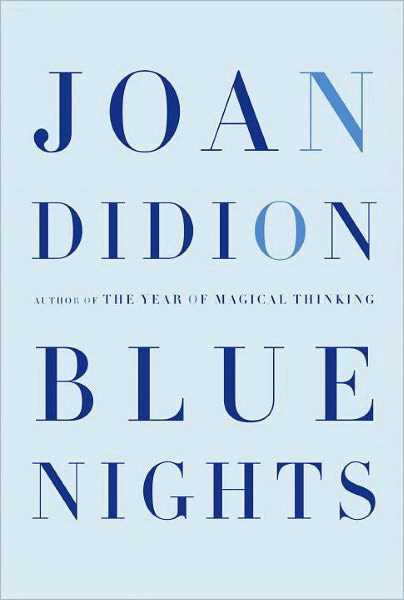 “When we talk about mortality, we are talking about our children,” writes Joan Didion in her new book Blue Nights. And in fact, when Didion is talking about any one thing in this book, she is usually talking about something else, a point which she spends much of the book considering– her struggles of late as a writer to be direct, to get to the point. In particularly in regards to her daughter Quintana, and when Joan Didion is talking about Quintana, she can’t avoid talking about mortality, about the “death of promise”; Quintana died in 2005 at the age of 39, not long after her father’s sudden death one evening at the dinner table (the year after which Didion chronicled in her previous memoir).
When Didion is talking about Quintana, she’s not only talking about her daughter’s mortality, but about her own. The years since her daughter’s death have brought about a general ill-health, a growing frailty that she has struggled to address with various health professionals with very little success. And then it occurs to her– she is 75 years old. Perhaps this alone is the problem, and there is no “fix”. And this has never occurred to her before, that she would eventually (or quite suddenly) get old. “Time passes… Could it be that I never believed it?”
This from a woman whose writing has always been drenched in nostalgia, who from the time she picked up a pen has been eulogizing the way we don’t live anymore and the “all that” she’d said good-bye to. That Joan Didion has never believed time to pass is impossible to consider, except that maybe she never considered herself passing along with it.
“The common denominator of all we see is always, transparently, shamelessly, the implacable ‘I,'” wrote Didion in “On Keeping a Notebook,” from her 1968 collection Slouching Towards Bethlehem, except now she’s 75 and that common denominator seems less a sure foundation. In the same essay, she’d also written, “Remember what it was to be me. That was always the point.” And now more than 40 years later, she doesn’t want to remember anymore.
She writes that well-meaning friends try to assure her through her loss: “You have your memories”. She writes that for many years, she fetishized these memories, saving everything– drawers and cupboards stuffed, mementos pinned to the walls– believing that they would help keep people “fully present”. And when she most important people in her life are lost, she’s left with “detritus of this misplaced belief.” She writes that remembering the past only reminds her of how much she failed to appreciate what she had in the first place.
And when she writes about failing to appreciate what she had, she’s writing about Quintana. She’s writing about her own relationship to her daughter (who happened to be adopted), which is similar to any mother’s relationships to her child, adopted or otherwise. Contemplating that newborn bundle: “What if I fail to take care of this baby? What if this baby fails to thrive, what if this baby fails to love me?… what if I fail to love this baby?”
Except that Quintana doesn’t just “happen to be adopted”, and Didion has realized that failing to acknowledge this was a significant failing of her own as a mother. That Quintana’s mental health problems (which are referred to obliquely; this is no expose) could have been rooted in her own fears of abandonment. That what the “choice narrative” so favoured towards 1960s adoptees left unsaid was the underside of adoptive parents’ choosing, why a child was up for choosing in the first place. And Didion notes that she could never treat this underside, that she chose to avoid it because to highlight her daughter’s origins would be to expose her own terrible fear– that this miraculous child who’d been placed in her arms would somehow be stolen away from her. To acknowledge Quintana’s fear of abandonment, to acknowledge the fact of Quintana herself, would have been to clarify her own feelings and fears about her daughter, which Didion could never bring herself to do.
Except that she’s lost her now, a worst fear realized, and her daughter’s death has served to bring her own death closer. And without her daughter to survive her, when she dies she will “Pass into nothingness,” a phrase from Keats’ she discovers in one of Quintana’s high school exercise books. A phrase that had resonated with the teenaged depressive Quintana, another side of her that Didion had never allowed herself to understand. A side that she’s coming to understand now as she contemplates the end of her own life, and how much her daughter’s sense of mortality and her actual mortality have illuminated her own.
She finds it hard to be direct now. She offers a passage from her novel The Last Thing He Wanted to show the way her prose used to come so easily, that she wrote it like the rhythm it was. But she can’t do that now. She can’t find the right words, she can’t get to the point, she keeps falling, and forgetting, and getting frailer all the time. The point is slipping farther away. But it’s not that she is afraid to die. She writes that she’s getting so she’s afraid not to die, but it’s not that, and it’s not the writing either.
She writes, “The fear is for what is still to be lost,” and she’s writing about her memories of her daughter. “How could I not still need that child with me?” She writes, “there is no day in her life on which I do not see her.”
October 2, 2011
Outside the Box by Maria Meindl
 My friend Maria Meindl has written one of the best books I’ve read this year in Outside the Box: The Life and Legacy of Writer Mona Gould, The Grandmother I Thought I Knew, and it’s a book that proves fascinating on all different kinds of levels. First, Meindl’s book is a history of magazines and radio broadcasting in Canada during the mid-2oth century, demonstrated by the experiences of Mona Gould who made her entire career as a freelancer in poetry, copy-writing, feature-writing, radio broadcasting, and column-writing between the 1930s and the 1960s. She wrote for publications including Saturday Night and Chatelaine, worked as a publicist for the Red Cross during WWII, was affected by the split between commercial and literary writing that took place during the 1950s, published two books of poetry, and her most famous poem “That Was My Brother” in included in anthologies and textbooks to this day. In her radio broadcasts, she’d have to find subtle ways to work word of her program’s sponsor into her scripts. At times, Gould was published in the same periodicals as poets as notable as PK Page and Margaret Avison, but never achieved the same prominence herself, and from this failure to remarkably ascend, her story has a great deal more to tell about the wider world of publishing and broadcasting in her time than those of those whose experiences were so singular.
Which is not to say that Mona Gould was not remarkable or singular. At her best and worst, there was no one else quite like her, and Meindl has done a tremendous job of portraying such a complicated woman and the ambivalence involved in family relationships. Though she certainly had the resources at her disposal– Outside the Box is not just Mona’s story, but is also the story of Maria’s years-long efforts to catalogue Mona’s archives for the Thomas Fisher Library at the University of Toronto. Boxes upon boxes she’d inherited after her grandmother’s death, and she writes about how the boxes were conspicuous in the archives– everything slung into boxes willy-nilly, the boxes themselves tatted and from anywhere, and the papers within covered with dust and cat-hair, and she’d discover open tubs of vaseline, and on the back of one pile of of papers was stuck a colostomy bag. The boxes were a mess, and cataloguing them often appeared an impossible task. More burden than gift, as her grandmother had so often seemed to be to Maria. And yet there was richness to be found, and a Mona Gould to be discovered who was distinct from the alcoholic, mean-spirited woman she remembered as having come between her parents in their marriage. Letters written to lifelong friends, papers that demonstrated that Mona had worked hard for her success and it had not simply appeared to her, as she sometimes spun it. That this woman who put herself above feminism and craved approval from men had battled discrimination throughout her career. Maria had been aware that her grandmother had been something of a liar, but the truth behind these stories is often more fascinating than she’d ever imagined.
The book also has much to say to a society so fixated on the cult of personality, celebrity, which Meindl shows is not an altogether modern phenomenon. It is likely that Mona Gould worked as hard on cultivating her “brand” as she did her writing (though, obviously, she would not have put it that way), craving attention and admiration, and in the end, she’d prove a victim of society’s fickleness, and to the changingness of fashion.
Ultimately, however, Outside the Box is a story of inheritance, of coming to terms with where we’ve come from and who we are. In exquisite prose and with a fascinating mastery of chronology, Meindl makes this her own story as much as Mona’s, the story of how becoming settled in her own life and happiness required her to make peace with her family’s past, to unpack the metaphoric baggage that was as heavy as all those boxes and boxes her grandmother had left her.
September 15, 2011
The Antagonist by Lynn Coady
 The jocks in my classes at university were always kind of fascinating. Mostly because one didn’t encounter them very often– I went to Uof T whose sports programs were notoriously poor-perfoming. But also because their academic skills always came as a kind of surprise, and because some of them were so big that they couldn’t fit into those chairs that had the desks attached, and had to sort of get wedged in, and I remember how completely uncomfortable these guys looked, how they rendered the world lilliputian, but somehow they were the freaks.
The jock, Rank, was only one of the many characters in Lynn Coady’s The Antagonist who I recognized so completely, who made me think, “I know these people.” Like Rank, I was also “born in a small town”, and so I recognized his father also, a guy called Gord who starts every sentence with, “That little fucker…” And the deadbeat, and his fat friend, and then the middle class versions of these guys who Rank encounters when he gets out of that small town and goes to university (and tries and fails to wedge himself into one of those impossible desks).
Or maybe what I mean is that Coady’s book had me realizing that I didn’t know any of these people at all, actually, and that my recognition of these type had no real connection with these characters’ inner workings, the circumstances of their lives. Coady has taken all kinds of familiar tropes here– foundling child grows up to be Paul Bunyan, to have the strength of Superman, local boy does bad and local boy does good, and local boy does everything he can to escape being created by a father who didn’t create him after all, or at least not biologically-speaking, and by the time Coady is through, these tropes are as unrecognizable as the types are, and here we’ve got a startlingly original novel with incredible depth and devourability.
Not that this is a novel without precedent. Coady’s last novel, 2006’s Mean Boy was a hilarious satire of university creative writing programs, and it had many of the same metafictional elements as The Antagonist (which is, in its own way, also a campus send-up). It even had an antecedent to protagonist/antagonist Rank, a big strapping drunk guy who’s prone to homicidal rages.
Rank is the whole story here, however, it’s his fingers at the keyboard tapping out a message to ghost from deep in his past. Or perhaps the ghost is himself, his younger self, who he’s just encountered in fictional form in a novel written by a former friend. A big strapping drunk guy who’s prone to homicidal rages, and Rank has recognized himself in his old friend’s story. Coady’s novel is Rank’s response to this recognition, a letter to the author to set the record straight.
Coady handles the structure (an email) so elegantly, with flourish (“Consider this the first chapter”), but eventually the structure fades away for the reader and the story runs the show. Rank (whose name is actually Gordon Rankin, Jr. He notes the moment of his uncomfortable awakening that he’s spent most of his life instructing people to call him “Stinky”) goes back to his childhood and adolescence to get to the root of his true story, the awkwardness of being a fifteen year old boy in a giant man’s body, and the expectations this body has foisted upon him. Which are mainly his father’s, that he’ll take care of any punks hanging around their family business, and with his outsized strength, this gets him into serious trouble.
Stories of a subsequent court case are woven around a later plot-line involving Rank and his friends at university (which he attends after achieving an unlikely hockey scholarship), and the inevitability of Rank once again conforming to type. The plot gestures toward this second story culminating in another act of violence, and there is also mystery surrounding what exactly happened to Rank’s mom, both of which make for compelling reading, even more-so because of the immediacy of Rank’s own voice, and the urgency of his message as he types the story home. He’s incredibly likable, but he’s terrifying, and there are these moments at which he undermines himself, and others where the story does it for him. He’s also a narcissist who can’t bear to look in the mirror, so convincingly embodying all of these contradictions, and the result is one of the most fascinating fictional creations I’ve encountered in a very long time.
And what’s even more fascinating, of course, is that he’s his own creation here, competing with someone else’s version of him, which opens up all kinds of questions about story and character, and the execution of both in real life. Embodying even more contradictions: Rank writes, “Even now, speaking to me from twenty years ago, you had me pegged./ Which makes no sense when I think about your book. How could it you could have me so nailed down and still get everything wrong?”
Lynn Coady has arrived with this amazing novel which combines its depth with broad appeal, and her trademark humour is also on display to balance out the story’s heaviness. She also manages to finally bring together the various plotlines in such a satisfying way, though this didn’t mean, of course, that I was any less devastated to have to stop reading because the story was over. (I was. I was. This is a novel that casts a spell.)
August 28, 2011
This Will Be Difficult to Explain and Other Stories by Johanna Skibsrud
 It’s not quite what you’d explect, This Will Be Difficult to Explain and Other Stories, Johanna Skibsrud’s first collection of short fiction. Though what we’re meant to expect from Skibsrud is hard to tell exactly– she’s the author who published her novel with an artisanal small press then won the Giller Prize, the recent overnight success with (now) four books under her belt, the poet whose novel concludes with a court transcript. Johanna Skibsrud appears to exist in order to defy our expectations, and so perhaps it’s smart to just abandon them altogether, and take the stories as they come.
The book is slim, and the stories are diverse– presumably, the collection itself has been quickly assembled on the tail of Skibsrud’s Giller fame. Nothing hasty about the assembly of the stories themselves, however, which display the precision some readers found lacking from The Sentimentalists. There are links between a few of them, and each one portrays a character who is “caught at exact point of intersection between impossibility and desire”. Each one demonstrates, as described in the story Fat Man and Little Boy, “that things happen, not at any particular or recordable time, but at an indeterminate midpoint. Somewhere, that is, between the verifiable and measurable tick and the ensuing and otherwise unremarkable, tock… in that incalculable interval of both space and time.”
The collection reminded me of Mavis Gallant’s Home Truths, with its stories of expats, continent-hopping themes, and also the ability of the narrative to telescope in and out of time. In many of the stories, young Canadian or American protagonists are bumbling their way through France, though they’re never aware of the bumbling until after the fact. Skibsrud is good at “after the fact”, her stories full of deft reveals and fitted with fantastic endings.
In “The Electric Man”, a young woman reveals herself to a mysterious man who reveals nothing of himself; in “The Limit”, a single father struggles to connect with his daughter and clings to a landscape which makes his own limits clear; in “French Lessons”, which deals with the struggles of translation, Martha (who we’ll see again in other stories) receives a startling glimpse into an old woman’s loneliness, hears the message on the wrong beat, and responds with inappropriate laughter; “Clarence” is the story of a young local newspaper reporter who inadvertently interviews a corpse (and this ending was my favourite, I think); in “Signac’s Boats”, we meet Martha again, who’s struggling with the immovable limits of her perspective (but then “limits are real”), even as she puts herself out in the world, and then she’s stunned to realize that love is a new kind of limit, “that it simplified her, when she’d thought it would have made her more integral, more complex.”
“Cleats” was my favourite story, I think, the one that really had me thinking about Mavis Gallant (and not just because of Paris). This long, wonderful novel in a story hinges over and over on sudden shifts of perspective, on carpets pulled out from underneath you. A mother’s complicated relationship with a grown daughter as the mother struggles to make her way in the world after leaving her marriage. Another mother-child relationship is sharply depicted in “Angus’s Bull”, another mother who notices with unease that her child “notices everything”. And then “Fat Man and Little Boy” is the story of Martha’s friend Ginny who goes to Japan to visit an old friend, and finds herself strangely moved and unmoved by the Peace Museum at Hiroshima, by thoughts of her own uncle who worked at Los Alamos and is now dying of cancer, by the fact that nothing is ever one thing, that each singular moment contains the entire world.
Skibsrud’s preoccupations become evident throughout this excellent collection– with limits, and how we fixate on them and/or reject them, with where we come from and where we go, with who are parents are and how we fixate on them and/or reject them, with history and the impossibility of fully inhabiting just one single moment. Clearly Johanna Skibsrud is as at home in the short story form as she is throughout the rest of them, and my expectations have been more than met. I’m more intrigued by this author than ever before, and convinced that Ali Smith was onto something after all.
August 16, 2011
Never Knowing by Chevy Stevens
 I’m really not a snob, I’ve just got a problem with bad books, and this is why I struggle so much when I try to read popular fiction. Which is why I’m always so elated when I discover a book that proves that bad books and popular fiction are not synonymous, that finally I too get to be swept away by a thriller that holds me right to the end. And in this case, the book was Never Knowing by Chevy Stevens, a book I love with the same part of me that loves loves Laura Lippman (and also with the part that really loved Scream.)
Sara Gallagher has always believed that discovering the identity of her birth mother would bring her some closure, to fill in the missing pieces of the background of a life that has turned out pretty well. She runs a successful business, is well-loved by her young daughter, is engaged to be married to a man who she loves. But Julia, her birth mother, is cold and hostile when she finally meets her, and Sara senses there is more to the story than what she’s been told. With a little prying, Sara discovers that her birth mother is the only surviving victim of the notorious Campsite Killer, and that the Campsite Killer is her father.
When Sara and Julia’s identities are leaked onto an online crime forum, suddenly the whole world discovers the story, including Sara’s own parents who are angry that she never told them she was searching for the truth about her past. Even worse, however, the Campsite Killer himself, still on the loose and killing after all these years, finds out that he has a daughter, and is determined to make a connection. Sara is forced into a complicated situation as she must satisfy her own curiosity about the father she never knew, reconcile that she’s the product of a monster, assist the police in their investigation by forging a relationship with the killer, and also not let her self or her family come into danger. Sara is being used by the police and by the killer for their own ends, and the situation strains Sara’s own relationship with her daughter and fiance as her wedding date approaches.
With Stevens’ previous novel Still Missing, Never Knowing is structured in first person narrative, with Sara talking with her psychiatrist. The structure works, carefully controlling how the tension builds throughout the novel, and the narration never suffers from unnecessary exposition– it all unfolds quite naturally. Sara’s voice is strong and it makes her character clear. Stevens complicates the plot with domestic drama– Sarah has never seen eye-to-eye with her domineering father, she can’t stand one of her sisters, her fiance is jealous of the police officer who’s working closely with Sara on the case. Her daughter is acting out in response to all the attention Sara is paying elsewhere, and her daughter’s behaviour, as well as Sara’s own impulsiveness have her considering the possibilities of her genetic inheritance.
What I loved about this book is that Sara’s were responses were that of a real person, rather than a plot device. She keeps those around her informed of what’s going on, we don’t have to tell her, “Don’t go down into the basement!” because she knows better. She’s a smart woman whose wits are being tested, but she’s got her self-preservation instincts in tact, and her first priority is protecting her daughter. Which becomes more and more difficult as the Campsite Killer gets closer, and though it’s clearly never going to end well, Sara’s adamant that she’s going to end it nevertheless.
August 11, 2011
I'm a Registered Nurse Not a Whore by Anne Perdue
 Anne Perdue’s collection of short stories I’m a Registered Nurse Not a Whore is the answer to the question, “What should I read after the brilliance of Alexander MacLeod’s Light Lifting?” Like MacLeod, her stories venture into darkness, their plots take you places, her characters offer a remarkable range of humanity– the alcoholic would-be dry-waller who lives in a rooming house, a teenage dishwasher, a single woman daring to get pregnant on her own, a newlywed couple overwhelmed by the pressures of home ownership. Perdue is funnier though, with a sharp dialogue reminiscent of Jessica Westhead’s, and her stories also had these moments I’ve come to think of as John Cheever moments– the vat of wax! The barbecue! These incidents of horrid absurdity in the midst of the everyday. My husband had to ask me to stop gasping as I read this book, and I really haven’t been able to think about a barbecue properly since.
I love this book, absolutely devoured it, which is fitting for a collection whose stories are larger than bite-sized. These are longer-than-short stories, with twists and turns and plenty of room for depth, and they’re so well-paced, they read up fast. The first story hung me up a little bit with points of view that didn’t seem consistent, but the rest were a smoother ride, the kind of short stories I’d recommend to people who might not know that they like short stories yet.
In “The Escapists”, a couple at an all-inclusive Mexican resort display their complete lack of social graces, and receive awkward glimpses into the true nature of the bond between them. “Inheritance” makes clear the weak foundations on which suburban idylls are constructed, as a husband and father drives himself mad trying to live up to his own expectations. “Ca-Na-Da” is a novel in 45 pages, the story of a woman whose son is a stranger to her, and who finally has to face the consequences of a lifetime of not facing the world, or being honest with it (or herself). In “Pooey”, a middle-aged woman whose family takes dysfunction to a new level decides to go against every rational instinct, take a leap of faith, and have a family of her own.
“I Serve” says the button on the book’s cover, which was gorgeously designed by Anne Perdue herself. And her characters do serve, in the jobs that they do, and in the places that they’ve assumed for themselves in society. Yet there are moments, if only in their minds, –and some are impossibly small but still vivid– in which these character break free of the confines of those places, and dare to serve themselves. Here we the readers become the gasping champions of their glorious liberation.
July 28, 2011
The Astral by Kate Christensen
 Kate Christensen’s Trouble was the first novel I reviewed on my blog after Harriet was born, and the novel was disappointing. (Less disappointing was the review I wrote–I can’t quite believe how lucid it reads. Perhaps I secretly paid someone to write it while I was busy lying on the carpet sobbing.) Being a novel by Kate Christensen, however, Trouble was still well worth the read and better than most of the other books out there. So you can imagine how much it thrills me to declare that Christensen’s latest, The Astral, is her best book yet, and the finest book I’ve read in ages.
The Astral is the story of a man at the end of his marriage: Luz, Harry Quirk’s wife of thirty years, has just thrown them out of their home in The Astral, an apartment (which actually exists!) in Brooklyn’s Greenpoint neighbourhood. She’s come across his latest manuscript of poems, love sonnets, and she’s convinced he’s written them for another woman. Refusing to indulge his insistance that the poems are the product of his imagination only, she destroys the manuscript and banishes Harry from their marital home. Harry finds refuge with his good friend Marion, a recent widow, which only serves to anger Luz further because she’s convinced he’s been sleeping with Marion for years. Though he hasn’t been, not for years or for ever. Harry had had one indiscretion twelve years ago, but other than that, he’s been an pointedly loyal husband.
The Astral follows the months after Harry’s banishment, its effect on his children, and he and Luz’s wider group of friends. As with most of Christensen’s work, the narrative is fixed solidly within the perspective of an unlikeable protagonist, though she invests Harry with a certain charm– I think she tends to go easier on her men than her women. Charm meaning that he’s convincing though, almost, but there are certain moments when it becomes clear that he’s wholely devoid of self-knowledge. A line like, “I’d never had a drivers’ license myself, but I knew bad driving when I see it.” But he brings you around, Harry, and it’s not such a bad place, being in his head. Everything he does is usually justifiable, he knows everybody else’s problems. and then there’s the incredible scene when he storms his wife’s therapist’s office and threatens to maim her, then she proceeds to reduce him to a psychological pulp using his own tricks (but better). Suddenly, it’s not clear what is what anymore.
And what is what is never quite resolved. Like Lionel Shriver at her best, Christensen writes a veritable keleidoscope of relative perspectives, and the effect is as unsure and perilous as reality. Like Shriver too, Christensen is hilarious, though her caustic is far less caustic and her work is more palatable. The two writers are similar also in that their novels are driven more by ideas than characters (or even plot) so that we can see the seams sometimes, the work of an author trying too hard to make her people go where she wants them to go. We also get some woodenness, some terrible dialogue– Harry answers a question regarding his son’s wellbeing with, “Karina and I were just out there. He’s immersed in this cult, he’s marrying the leader, and they think he’s the Messiah.” But there is a self-awareness there, one gets the sense that Christensen is winking. At one point during a too-earnest conversation, somebody asks, “Who’s writing this dialogue?”
And the answer is Kate Christensen, who clings to metaphor as much her protagonist does. Marriage is poetry: “I believe in rhyme and rhythm. But my adherence to form is loony. I make it much harder for myself than it has to be. I follow arcane rules that went out of business a hundred years ago.” Marriage is also a kind of cult like the one that has sucked in Harry’s son, and though this plotline has the air of the ridiculous, it’s never exploited and works within the bigger picture. Everything in the book is really working for a higher purpose, which makes the pay-off worthwhile because you get this book in the end. A story of the disparate selves within one man and within one marriage, and the reconciliation of the former that comes when the marriage is finally dissolved.
(If you’re thinking you might be interested in this book, read Kate Christensen’s Book Notes at Largehearted Boy, and then there will be no doubt left in your mind.)
June 5, 2011
The Forgotten Waltz by Anne Enright
 “You think it’s about sex, then you remember the money,” notes Gina, the narrator of Anne Enright’s fabulous new novel The Forgotten Waltz, and that statement just about sums up the book. Though it’s hard to forget about the money, the embarrassment of riches, real estate fortunes (characters who feel inadequate about not owning four houses)– it’s there from the very beginning of the novel, whose story unfolds from the turn of the century with Ireland’s economic boom, and comes crashing down with its eventual bust (which I, with my minimal interest in economics, learned about in this fantastic Vanity Fair article “When Irish Eyes Are Crying”).
The Forgotten Waltz is all about real estate, in the tradition of Howards End. And like The Last September, another Irish novel which I read last week, a personal story is cast against a national backdrop. The personal story is about another kind of real estate, about taking what isn’t your own. Still suffering from the fallout of her extramarital affair, from having fallen in love with another woman’s husband (who is somebody’s father too), Gina recounts the story of her own journey from boom to bust. The story, however, just like the story of the economic boom, is hardly straightforward: “I can’t be too bothered here with chronology. The idea that if you tell it, one thing after another, then everything will make sense./ It doesn’t make sense.”
Enright won the 2007 prize for her novel The Gathering, though I found her memoir Making Babies and her short story collection Yesterday’s Weather much more resonant. The way these two books zeroed in on domestic detail, on objects and what her characters did with them, and Enright’s doing that here once again. Quite different from the focused detail itself, however, is her conversational, meandering prose, with issue-skirting and repetition, and the effect is to cast a spell of its own. And how this woman can craft a sentence: “The Danes who did the refurbishment put in irrigation the way you might do the wiring so the place is a thicket, and though I am cynical about these things (the idea that a few plans makes us more ‘green’) I even voted for the canaries, at some meeting, only to be outvoted on the grounds of canary shit.”
Enright is funny, in particular when considering tender things, as anyone who’s read her mothering memoir is already aware. She writes with more sympathy than Rachel Cusk, whose writing is similar (I just read her The Bradshaw Variations, and there are all kinds of connections between the two novels.). Enright is fully attuned to the strange dynamics of modern society and all its accoutrements– the mobile phone text messages that are integral in Gina and Sean’s affair are perfectly worked into the novel’s weave. And she is careful to include more traditional methods of obsessive love, Gina sitting outside his house at night, for example, watching the lights inside go off one-by-one.
Each chapter is titled with the name of a pop song, whose musicality complements the nature of Enright’s prose, but also serves to contrast perceptions of love with its more sordid realities. Sure, “It’s in His Kiss”, agrees Enright, but then she examines what “it” is exactly, and the possibility that one kiss can take a character places she never intended to go and won’t be able to turn away from.






