July 19, 2012
Threading the Light: Explorations in Loss and Poetry by Lorri Neilsen Glenn
 “The essay wants to go its own way. In an unstable world, we want to know what we’re getting, and with an essay, we can never be sure. Partaking of the story, the poem, and the philosophical investigation in equal measure, the essay unsettles our accustomed ideas and takes us places we hadn’t expected to go. Places we may not want to go. We start out learning about embroidery stitches and pages later find ourselves knee-deep in somebody’s grave. That’s the risk we take when we pick up an essay.” –Susan Olding, The Trying Genre
In Lorri Neilsen Glenn’s essay collection Threading Light: Explorations in Loss and Poetry, we’re given a sense of what we’re getting with its first sentence, “This parcel of essay and verse and anecdote…”, and I love parcels. But it’s true that the reader embarks on the book with just just a vague idea of the parcel’s contents, unsure of where the sentences will lead. The title doesn’t help much either–my husband spotted the cover the other night, and was concerned a book exploring loss and poetry might send me melancholic (and as he has to live with me, he has a right to be concerned).
But it’s not like that at all; light is the word. The book takes its title from the painting by Mark Tobey which, Neilsen Glenn tells us, inspired John Cage to understand that “[w]hen we pay attention to anything–a bird wing, a man sleeping on an open grate, the horizon–it becomes a magnificent world worthy of your attention.” In her bookish parcel, Neilsen Glenn pays attention, digs to the foundations of her preoccupations, and most of these surround instances of loss, the irresolvable– a boyfriend’s suicide, her son’s disability, her mother’s death, the death of a friend, others’ losses, the crash of Swissair Flight 111 not far from her home ( a sound she thought was thunder). Compassion, late blooming (arm-in-arm with motherhood), war and sons, the domestic (“Whatever our differences, there is still laundry”), decades flying by, community and retreating, the art of losing, the gaps in women’s history, encounters with cultural others, on writing communities and the generosity and respect necessary for such communities to thrive. She is drawn to cemeteries, the graveyard in Halifax where the Titanic’s victims are buried, Margaret Lawrence’s grave. The shadows, of course, which come with the light. “The dead carry knowledge that the living cannot. It is we, here, now, who are in the dark.”
The book is the story of Neilsen Glenn’s own progress toward spirituality and poetry. Her narrative is circuitous, undulating, and if I traced it with a pencil, it would end up looking like the Mark Tobey painting. Which means that I’m having as much difficulty as the subtitle is in describing to you precisely what this book is, but I will tell you that the experience of reading it was was a pleasure. That it joins my list of amazing essay collections by Canadian women, books which I might line-up side-by-side and point to when I tell you, “Here’s my personal philosophy. Here’s what it’s all about.”
June 27, 2012
The Forrests by Emily Perkins
 New Zealand author Emily Perkins’ last book was 2008’s Novel About My Wife, a curious and absorbing novel about a woman with a mysterious past who remains unknowable to her husband, and how motherhood seems to bring about her undoing. On the surface, it was an easy book, accessible, full of familiar references; and yet something so strange was going on under the surface, such darkness, an ambiguity that was frustrating and also thoroughly engaging. It was a novel that didn’t wear its literary-ness on its sleeve, but something underlying seemed to suggest that Emily Perkins was no ordinary author.
And with her latest, The Forrests, that fact is established. The novels starts off slow and it’s hard to find one’s footing in the narrative, mostly because there isn’t a narrative yet. We are treated to scenes from a childhood, from an eccentric family. The Forrests are four children, including two sisters Dorothy and Evelyn, so close that they’re practically twins, and their parents whose lapses in responsibility are painfully obvious to their children. The parents break up, then reconcile, and their children mostly make their own way, rudderless. Dorothy marries young, and Evelyn drifts, and both are irrevocably bound to Daniel, a family friend who is part-lover, part-brother to both of them.
The novel finds its plot in adulthood, in much the way life does. Perkins is particularly adept at showing the peculiar connections of marriage and motherhood, and how these impact the sisters who are living parallel lives. Gradually, the novel’s focus becomes Dorothy only, illustrating the unsustainability of family as an institution, or at least of this family. I found it curious to note that The Forrests contains secondary characters called Meg, Jo, Beth and Amy, all of them peripheral and never interacting with one another– the modern family and its connections are fragmented, illusory.
We follow Dorothy through the storm of motherhood, into middle age, to old age, to the point at which “time becomes measurable.” Perkins has not fixed her novel in time with many specific cultural references, and so the story has a contemporary feel from the start, a sense of immediacy. And as Dorothy’s awareness begins to diminish as she ages, we see that the seemingly random scenes at the novel’s beginning were actually the pivotal moments of her life in the grander context, the flashes of light that will remain when everything else is confused and dark.
The Forrests is like The Stone Diaries, but edgier, and structured as the interior of its subject’s mind rather than her scrapbooks, and it’s enormously successful. Rachel Cusk, Virginia Woolf. Vividly human characters, gorgeous writing. It’s full of surprises, twists, turns and moments of illumination, quiet but profound in its brilliance, and devastating to have to finally put down.
June 17, 2012
Sue Sorensen's A Large Harmonium
 Please, let me tell you about Sue Sorensen’s A Large Harmonium, though it’s distinctly possible that I already did because I spent last week telling everyone about it, urging them to read it, this smart, hilarious book that delighted me so. “I say I will buy the Jiffy Markers myself,” is the novel’s first line, and I was hooked for Woolfish reasons and because I had no idea where a line like that might take me.
The line is delivered by Janet Erlicksen, a university English professor who’s on the cusp of a mild mid-life crisis. The novel begins in April with the school term ending and she must contemplate a summer before her without the scaffold of routine– what then to hang her days on? She considers writing an academic book about bad mothers in children’s literature, or penning a murder mystery in which her mother-in-law is the victim, or starting an online academic journal, but none of these ideas gets far off the ground. She’s also distracted by a sense that her husband Hector is in love with another woman, and she’s ever distracted by their three-year old son Little Max for whom distraction is a main occupation.
In 12 chapters, the novel takes us through Janey’s year month-by-month, incidents in her life, and those of her family and her friends, and it’s Janey’s voice and her humour that drives us, as well as turns in the plot that are never quite what you’d expect. And I love this novel quite simply because it’s doing all my favourite things: it’s funny, it shows a mother for whom motherhood is just part of a complex identity, it shows a rock-solid marriage (in spite of Janey’s suspicions), abortion shows up in the life of secondary characters but as a sad and ordinary thing rather than a plot-point, unabashed feminism shows up too, children’s literature is taken seriously, and it’s an academic satire that really is. (Janey presents a paper on the absence of talking animals in Canadian children’s literature. “It is far more fun to present a research project about something that is not there than something there is. I can get people riled up, outraged. Where are the talking animals? Who has repressed the talking animals? I could make my scholarly reputation.”)
Winnipeg resident Sorensen has much in common with Carol Shields, who was another, except that her tone is darker and more overtly hilarious. The novel’s pace is brisk and easy, which is not to say “light”, because there is depth here, but the story goes down just as well. Just as Shields did, Sorensen’s got a grasp on joy and how it factors amidst life’s absurdities. This is a wonderful novel with broad appeal. It’s absolutely the funniest and one of the best books I’ve read in ages.
May 6, 2012
Author Interviews at Pickle Me This: Heather Birrell
 In February 2008, I spent one of the most perfect days of my entire life sitting on the grass in San Francisco’s Dolores Park, reading the journal Hobart in Canada/America, which I’d purchased the day before at the legendary City Lights Bookstore. And it was in that journal that I first encountered the work of Heather Birrell with the short story “My Friend Taisie”. Later on the next year, Heather turned up in the also-legendary “Salon de Refuses” issue of The New Quarterly, and I made a note on my blog that her story “Impossible to Die In Your Dreams” had been my favourite of the collection. (I also attended a panel discussion about the Salon of which Heather was a part. You can go here to see amusing pictures of Stuart and I looking extraordinarily bored).
Heather emailed me after I’d mentioned her work on my blog. At the time she had a newborn daughter, and I was newly pregnant, and of motherhood she advised me: “time does shrivel, but it also expands in marvellous ways.” Which was true, but also a very kind lesson in restraint, I note in retrospect. Heather and I finally met in person in Kathryn Kuitenbrouwer’s kitchen one day about two years ago, and I’ve adored her steadily ever since.
Heather Birrell is the author of the story collections Mad Hope and I know you are but what am I? Her work has been honoured with the Journey Prize for short fiction and the Edna Staebler Award for creative non-fiction, and has been shortlisted for both National and Western Magazine Awards. Birrell’s stories have appeared in many North American journals and anthologies, including Prism International, The New Quarterly, Descant, Matrix and Toronto Noir. She lives in Toronto with her husband and two daughters where she also teaches high school English.
Heather’s new book Mad Hope is mind-blowingly excellent. She very kindly answered my questions via email throughout this past April, beginning on a very sunny Easter weekend when both of us were ill.
 I: “Where do you get your ideas” is a profoundly uninteresting question, but I want to come at it from a different angle. As I’m reading Mad Hope, I keep encountering these moments of profound identification where I want to write “Exactly” in the margins and underline it twice. And it’s for really oddly specific details, like the expressionless Iranian midwife, or following up a trip to the abortion clinic with Swiss Chalet. Or Jordan’s gait: “His hip dipped and his arm swung like a creature who had chosen– righteously– to remain less evolved.”
And I know exactly who or what you’re talking about. I’ve probably even seen it, or read it– your stories also reference magazine articles I’ve encountered, email-forwards I was receiving as recently as last summer. Part of it is because so often you’re writing about– and so effectively too– the very city I live in, so of course I find it all familiar. But I’m still intrigued by how you employ the stuff of the world in your fiction, by your command of the material. And am I right to suppose that this very stuff– email forwards, post-abortion dipping sauces– is where you get your ideas from? Can you talk about your process?
HB: Oh, I’m so glad you had the ‘Exactly’ reaction! I love that sensation of somehow being known by the author as I read. I think those descriptions, expressions, shards of ‘true’ story you reference definitely serve as starting points for me but they don’t mean much until I’ve actually got some kind of more amorphous/abstract driving force in mind. Annie Dillard talks about ‘writing your own astonishment’ — I love that. There is such a range of issues, incidents, images that have the power to astonish — and they are different for everyone. I tend to think of my astonishments in the same way I might consider arguments if I were writing an essay — in other words, there’s something I’m trying not to prove but perhaps to convey in the best possible way, but my tools are less logical than metaphorical, narratorial.
In the story ‘Drowning…’ I wanted badly to write about suffocating mother-love, how the weight of mothering can be crushing at times… Then there were other bits and pieces preoccupying me: the time my husband nearly died of an asthma attack; an article I read about sole survivors of terrible catastrophes — that loneliness; what it means to teach kids with backgrounds very different from my own; and the email forward of the title of course! (This all sounds quite autobiographical, doesn’t it? But it isn’t always, and I’m not sure it even is here.)
So all these disparate threads, all these astonishments, somehow came together… How? I’m not being coy when I say I’m not really certain. It really does often feel that once a story is finished or near-finished I wiggle out of it like an old skin and it feels quite separate– an artifact unrelated to me.
 I: These stories give the sense that you must read a lot, and widely. I could be wrong, but then I can’t imagine any way but reading for someone to learn, to know, as much about the world as your stories seem to convey you do. You mention elements of the autobiographical, yes, and I also see startling powers of observation at work (in particular in your portrayal of teenagers), but mostly Mad Hope seems to be the work of an author who reads widely. Is that true? What is the connection between your reading and your writing? What do you like to read?
HB: I am a reader, I am a reader, she intones quietly to herself. It has seemed for so long that my reading habits have been patchy and piecemeal. I have two small children; my sleep has been ragged for the last four years, so I suppose I have become more discriminating in some ways, but also hungry for narrative in any form as a means of escape from the more mundane aspects of motherhood. Because I often read in snatches, periodicals have been perfect lately — so I’ve been reading a lot of The New Yorker and The New Quarterly, and recently Brain, Child (which I discovered through your blog) — and big fat page turners that can be picked up, put down, and easily abandoned if need be.
Having said that, there are writers I return to (writers I could never abandon), writers I think of as unofficial mentors. Deborah Eisenberg. I adore her writing– it’s intricate, it’s smart, it’s funny, it’s city, it’s political. And her stories are long, which is more my rhythm when it comes to story reading and making. I tend to gravitate towards stories whose narrators are crouched in close to their characters, whose characters are complex, layered. I like unconventional story shapes too– stories that bulge out of themselves a little bit. Alice Munro, because her stories are masterful and mysterious. Anne Enright is a more recent discovery. I loved The Gathering, a novel that reads like a short story, and The Forgotten Waltz and her fabulous memoir Making Babies: Stumbling into Motherhood. Mary Gaitskill’s most recent collection, Don’t Cry, blew me away. It is so very fierce and wise. I find reading all of these writers incredibly permission-giving — ‘You can do that?’ they make me exclaim. It’s a wonderful and daunting feeling to have as a writer, to have the gauntlet thrown down in that way…
I am also incredibly inspired by the filmmaker Mike Leigh. I love how he manages moments of connection between his characters. His is a kitchen sink realism that recognizes the gritty, grimy, but also the gleaming moments that occur between people. And he does family dynamics — the secrets, the sadness, the omissions, the overwhelming love and sense of duty, the guilt, the fun, the fatigue — so very well. The way he builds to peaks of drama is so subtle and genuine — it’s really impressive. I also find him a very ‘moral’ artist, for want of a better term. He has such integrity, and his convictions are so present in his work but he is very seldom didactic. I think he’s a genius.
I: With what would you recommend your readers follow up Mad Hope? This is not a rhetorical question. In fact, this isn’t even really an interview question. But all I know is that I finished your book last weekend and the two short story collections I’ve read since (Other People We Married by Emma Straub and The Girl in the Flammable Skirt by Aimee Bender) have paled in comparison. Have you ruined reading for me, Heather Birrell? What would you advise me to do? (And I promise, we’re going to get back to talking about your book with the next question. Or that’s the plan, at least.)
HB: You are kind. And too smart and voracious a reader to be stymied by the likes of me. I’m pretty picky with short story collections now. I know what I like and don’t have a lot of patience for what I don’t. Plus I really do like to feel challenged. Jim Shepard’s Like You’d Understand Anyway is pretty great — the man goes to crazy, faraway places in his fiction and creates amazingly authentic worlds. And Amy Bloom’s Where the God of Love Hangs Out is the work of a writer who really understands people and acknowledges their mystery. She’s a taboo buster too, which I like. So I would advise you to have a cup a tea and a scone and keep on truckin’, Ms Kerry Clare.
 I: I want to talk about your story ‘No One Else Really Wants to Listen’, which is structured as a series of posts on an online pregnancy forum. And the structure is so interesting because it allows for such a variety of points of view, believable absurdity and for clashes between characters that would happen nowhere else in the actual world. One of your characters writes, “And as for the internet—we have both been busy with it.” Do you think the internet and online forms of communication represent similar opportunity for writers using it in their fiction? What’s its potential?
HB: Short answer: Yes. People talk to each other through e-mail, online forums, texting, tweeting. And writers have always been interested in how we talk to and at each other. Having said that, the story you’re referring to didn’t start out as a ‘pregnancy forum’ story. One of the characters, Wings, arrived pretty fully formed on the page, and I wasn’t really sure what to do with her. She’s kind of obnoxious and over-the-top and I felt she needed someone or something to temper her in some way. At the time, I had been experimenting with using multiple points-of-view in my stories and simultaneously reading a lot of pregnancy/baby forums, so adding these voices seemed like a natural move. But it took me a while — and the nudging of my editor — to figure out that I didn’t have to represent everyone in my story just because everyone showed up in a free-for-all forum. I had to locate the story in the cacophony and then winnow it down a bit. And we decided we didn’t want the story to be too cluttered up by some of the formatting you find online — that in the end, it was the words that were important. But you’re right that the potential of this form is that it brings together people (characters) who might not otherwise meet, and that is terribly exciting.
As for the possibilities of the internet as a story making and delivery system — I think they are myriad. There are opportunities for a loose and nimble kind of creation — pass the story type stuff — online workshopping, and of course more traditional online publishing (Joyland). And there are apps out there right now, I’m thinking of Storyville in particular, that will deliver stories to your device in very readable formats. And I’m sure the possibilities will only increase as the technology changes and people change and grow with it. (I will confess here that my engagement with technology is sometimes reluctant, and I can only create new work using old school pen and paper. I think the world of the internets can be difficult to navigate and there are times I need to completely disengage from it in order to maintain any semblance of personal equilibrium.) (more…)
April 16, 2012
Malarky by Anakana Schofield
 If Hagar Shipley met Stella Gibbons, the end result might be Anakana Schofield’s Malarky, but then again, it probably wouldn’t be, because Malarky refuses to be what you think it is. And moreover, it probably wouldn’t be because the book is meant to be chock-a-block with allusions to James Joyce and Thomas Hardy. Don’t tell anybody, but I still haven’t read Ulysses (and hence the Gibbons instead of the primary sources), but I have read Malarky, and it was brilliant, which I know for certain even with the burden of my literary ignorance. And that I can pronounce a book as wonderful even whilst unable to access its higher planes of greatness is certainly saying something for the book itself, which is mostly, “You’ll like it too.”
Schofield’s heroine, Our Woman, if she can be summed up at all, will be summed up with the explanation she gives for the period of despair she suffered after the birth of her first child: “Then I had a cup of tea and six weeks later, I felt better.” There is so much that goes unspoken of, silences to be filled with the rudiments of life as a farming wife, of motherhood, of friendship with her gang of local women (“…not a day passed when several of them didn’t meet. They were like tight ligaments in each other’s life, contracting, extending and sustaining the muscle of each other, house to house, tongue to ear”).
The bottom falls out, however, when she discovers her son up to unmentionable things with the neighbour’s boy. Our Woman’s stress is compounded by a woman she meets in town who confesses to her that she’s been doing unmentionable things with Our Woman’s husband. In response, Our Woman goes out into the world determined to do a few unmentionable things of her own to learn a thing or two, but the situation becomes more complicated– her son takes off to join the US army and local rumour has it that he did it to get away from her, and also her obsession with what she saw him doing becomes a kind of fascination, a desire to be close to him in an impossible way that suggests local rumours could be true.
But it’s hard to tell. Malarky is very much of the world– the Irish economy, wars in Iraq and Afghanistan, the plight of immigrants, mental illness, grief– and yet, its interiority is impermeable. When Our Woman spies her son shirtless in the barn, she notes, “He must have been freezing, his pale body bleary and quivering, trousers at his ankles.” However perversely, she is ever a mother, urging on a sweater. But she’s not just a comic figure; Schofield evokes Our Women with remarkable sympathy: “Mainly she had wanted to hit him about the head and shout these aren’t the things I have planned for you.” Malarky is a journey beyond the limits of love, an equally sad and hilarious portrait of motherhood.
“Malarky is like nothing else, and what everything should be,” is something I wrote down this weekend. First, because it’s as funny as it’s dark, and also because it dares readers to be brave enough to follow along an unconventional narrative. Though the winding path is only deceptively tricky– Our Woman’s voice is instantly familiar, and the shifting perspectives remain so intimate and immediate that the reader follows. Consenting to be led, of course, which is the magic of Malarky. This is a book that will leave you demanding more of everything else you read.
March 25, 2012
Impact by Billeh Nickerson
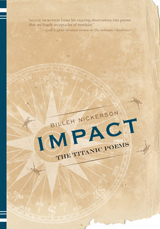 I started reading Billeh Nickerson’s latest book Impact: The Titanic Poems last week in preparation for a feature next month on 49thShelf. I’d picked up the book before I went to bed, and certainly hadn’t planned on what happened next: that I wouldn’t be able to turn out my light until I’d read the book entire, and that the book would make me cry. I had figured that my capacity for crying about the Titanic had been exhausted in 1998 with my teenage melodrama, and also Kate, Leo and Celine. As though by its gigantic cinematic rendering, the tragedy of the Titanic had ceased to be real or have meaning, but it turns out that one hundred years later, poetry was what was required– the opposite of gigantic– to re-instill the story with solidity.
Though what is solid is surprising. The ship itself is a ghost from the start, with rumours of a worker lost in its construction, and in “The Clothesline” the Titanic is an absence, the great ship launched and a Belfast housewife noting the space where it had been, how she’d grown it accustomed to watching it as she hung out her laundry. In four different poems, however, Nickerson describes the riveting process,the rivets themselves,and the teams of men required and their particular skills that put the ship together.
The book’s sections follow the ship from “Construction” to “Maiden Voyage”, in which we learn that the Titanic had 40,000 eggs in her provisions, 800 bundles of asparagus, that the ship’s iconic fourth smokestack functioned solely as ventilation from the First Class smoking room. Nickerson’s poems originate from photographs, official record, anecdotes. He is as much curator as poet, his items unadorned, which seemingly mask the craft at work behind them, but such subtlety is an art itself, the way he lets his items speak. The asparagus stands for itself, for instance, and Captain Smith’s beard, and the photograph of the boy with the spinning top.
And with the next section, “Impact”, it’s the people who speak, the woman being lowered into the lifeboat, the man who must deliver news to the captain of the damage below, the piano player whose instrument couldn’t be carried on deck and whose fingers imagine ghostly keys as the rest of the band played on. With “Voices”, a series of eyewitness accounts from survivors. And then “Impact” again, but this time emotional. Nickerson’s poem “Carpathia” tells of the ship that happened to receive the Titanic’s distress signals and rushed to the rescue to discover the shock of the same emptiness first glimpsed by the housewife in Belfast. The mother recounting her sons being torn away from her body, the carver who’d handcrafted the First Class staircases, various explanations for a dead man’s watch being stopped ten minutes after all the others, and the piece of wood found floating amidst the wreckage which sanded down to become a rolling pin, solidity’s essence.
And then finally, “Discovery”, the ship found and explored in the 1980s, the legacy of its Halifax cemetery, and poem called “The Last Survivor”. In which Nickerson writes, “how strange that the last survivor/ is the Titanic herself.”
March 20, 2012
Among Others by Jo Walton
 Jo Walton’s Among Others begins with a story that is already over. Twin sisters in South Wales who can see and communicate with fairies were brought to battle with their mother who used magic for ill. One sister was killed and the other was injured, left with a maimed leg, the fragments of her life, and only the books she could carry. Readers are dropped into the story abruptly, right in the middle of a conversation between the surviving sister, Mor, and her aunts. Since the accident, we’re told, she’s run away, spent time in a children’s home, then was given up to the guardianship of her estranged father. And now she’s been enrolled in an English boarding school where her vow to cease practicing magic should be easy to keep as there is little magic there to come by.
Here is a story with its own mythology, though the background is not laid out for us. As the novel is structured as Mor’s diary, she feels no need to illuminate facts and details, and so much of what’s gone on is hazy, vague. There is also the question of Mor’s own reliability– approaching this book from a literary angle, the sense is that she is so steeped in the tradition of science fiction that she’s ceased to understand what is impossible in reality. Except then there come these moments where the magic is undeniable, and genres are blurred: science fiction and English boarding school lit (and of *course* Jo Walton has read Charlotte Sometimes), realism and fantasy, children’s stories and adult novels. The magic is undeniable, yes, but the story itself is also so absolutely rooted in the world that I was as hooked as everybody said I would be.
It is books that save Mor from her dismal life (and oh, how Walton illuminates this, the pain of what she’s lost), and also the friendships she discovers through books and reading. She is pleased to learn that her father is also a Sci-Fi fan and he lets her borrow from his library– this becomes the one connection between them. An outcast at school, she’s excluded from games due to her disability, and spends hours in the school library where she appreciates the warmth of the school librarian. She’s also asked to join a Sci-Fi book club at the bookshop in town, where she finds friendship, intellectual stimulation, and even love. The perfection of this happy ending is perhaps the most fantastic element of all, but it’s everything we hope for her.
The straightforwardness of this narrative is complicated by Mor’s own insistance that good things have only come her way because she’s conjured them, however. She notes that so much of her recent fortune is too good to be true and puts it down to a spell she’d cast when she was most lonely. Of course, this can be read as a typical teenage approach to reality– that the universe exists to serve you only, that there’s doubt that other people even exist except in terms of their relationship to you. Is her reality any less real though because she believes it’s magic? Does it really matter if the result is the same?
To Mor, lines are blurred between worlds real and imaginary, which is fitting for someone who quite literally lives in a book, I suppose. Tolkien’s universe is as real to her as her own is– she’s convinced he saw the fairies too– and so are countless other literary worlds referenced that I was less familiar with. To those who know these worlds well, Among Others will be a pleasure, and to those (like me) who are absorbed by books, are grateful for their company, or even for those who just appreciate a good story, the novel will also ring true.
(Also, my favourite line in the novel was, “They weren’t evil after all, they were just odd in a very English way.”)
March 5, 2012
Author Interviews@ Pickle Me This: Carrie Snyder
 I read Carrie Snyder’s first book Hair Hat in 2010 when it was one of five books selected for Canada Reads Independently, and had started reading her blog Obscure CanLit Mama around the same time. In the two years since, I’ve enjoyed getting to know Carrie through her blog and following her Juliet stories on their path to becoming The Juliet Stories.
I read the book last week and I promise you, it’s one of the best Canadian books you’re going to read this year.
Carrie was generous enough to answer my questions about her book via email from her home in Waterloo. The Juliet Stories was published by House of Anansi Press and is in stores now.
I: Although The Juliet Stories is fiction, it has roots in your own biography. As a reader, I tend to engage very little with these connections because they tend to limit the text rather than broaden it, but I know that most audiences find them interesting. How do you feel about this? Are you comfortable with such an engagement? Do you think your book is richer for these connections to your own story?
CS: First, thank you for opening with the elephant-in-the-room question. Without a doubt, “Is this real?” or “Did this really happen?” are questions asked most often about The Juliet Stories. Complicating my answer is the fact that yes, standing behind the scenes is my own family’s story. I did live as a child in Nicaragua, while the contra war was underway, and my parents were peace activists; further, one of my brothers had cancer as a child.
As a reader, I completely understand the fascination and desire to link the writer’s story to the story the writer has written. I’m reading Mordecai Richler’s biography now, almost through it, and there have been plenty of aha! moments of recognition. Humans like piecing together puzzles — in this case, the puzzle of how a writer takes an image or a moment or a place and weaves it into a story.
And there are so many different ways that the real can be used in fiction. An incident that remains mysterious and will never be answered — that could make an excellent starting place for a story. Personally, I often use settings that are familiar and likely recognizable, mainly because I can’t seem to imagine space/place in the same way that I can imagine plot or character. So a reader who recognizes a place might be fooled into believing the story is real simply because the setting is real. In that case, making biographical connections between me and The Juliet Stories would be entirely unhelpful.
I could pick apart The Juliet Stories crumb by crumb, identifying where various fragments arrived from (and it would no doubt be surprising and probably disappointing and not at all what readers might expect), but the question is: would the exercise get us anywhere very interesting? For purely critical purposes, I doubt the links add depth. After all, the whole point of creating a story is to build a fictional world replete with its own codes and themes and particular beauty and logic. And none of that actually exists in my real life. Which is at the core of why I write (and read): in order to create symmetry and wholeness.
Nevertheless, I wouldn’t dismiss biographical connections altogether. There must be some deeper psychological reason we, as readers, find these links compelling — that’s what interests me. Why do we want it to be real? Why do we want to know what experiences are sleeping under the surface?
I: I suspect readers’ interest is piqued by the rich texture of your narrative—even without the biographical elements, there is so much sleeping beneath the surface here. I’m halfway through the book now and sensing so many gaps—what Juliet doesn’t notice, wasn’t privy to notice or chooses not to notice from her childhood perspective, and also the circumstances of her life as an adult, from which this story is being told. How did you come to this particular point of view, a strange omniscience that straddles then and now? That point-of-view is so important in the spell your book casts for its reader, but I imagine it must have been difficult to navigate as a writer, to finally achieve that balance. Or did it come naturally as you were writing?
CS: The voice seems so natural to me now that I’m struggling to remember its creation. Once the voice arrived, it didn’t feel created, it felt found. That said, this was not a book that got written overnight, and in fact it began life as a novel from the perspective of the mother (whose name has always been Gloria), and then tried to be a memoir (a very short-lived attempt of no more than 10,000 words), and finally, at last, along came Juliet’s telling (her name was Mary in earlier manuscripts). But as soon as it became Juliet’s story, the voice came too. And once the voice came, the technically aspects of the story-telling style flowed naturally.
That said, there was a still a lot of finicky, tedious work to be done, finessing the voice. I completely trusted my editor’s wise and kind eye on the manuscript. I trusted her to tell me when the voice was too authorial. Too writerly. Too self-conscious. With her guidance, I removed many passages that I’d originally loved writing. But the secret to the voice and the point of view is that not much is needed in order for it to work. Those moments when we’re slipping forward in time, or we understand that there is an older Juliet looking over what is happening—those are like salt. Too much would spoil the meal; but just the right amount adds flavour.
As a reader and as a writer, I’m drawn toward the mysterious, toward those gaps you mention. So much of life is unknown to us, unregarded, or misunderstood, or lost in the moment. As you probably know from reading my first book, Hair Hat, I have an ongoing fascination with the individual’s interpretation of a shared experience. I think I’ll always be puzzling out the mystery of memory and perspective, exploring what’s missing, and leaving gaps for the reader to fill in. I don’t think the writer needs to tell the reader what to think. I think the writer needs to leave room for the reader to make her own connections. Here’s my writing philosophy: It changes the reading experience to be part of what’s happening.
I: Do you ever think about the kinds of readers who don’t like those gaps, don’t know what to do with that kind of responsibility? I’m thinking about a comment Lynn Coady made (which I’m paraphrasing because I think I only heard of it via a live-tweet from the Giller Prize gala) about it being the writer’s job to do the work of a book, not the reader’s. How do you respond to that?
CS: Hmmmmm. A long hmmmm. I guess I’ll respond by saying that it’s not my intention to make work for the reader, or to make the reader do the work. Rather, I’d say that I trust the reader. And I hope we’re going somewhere together, and I hope that it’s interesting to both of us. It’s not that I don’t think about that kind of reader, it’s just that I’m not that kind of writer. If I tried to connect all the dots I’d gum the whole thing up, it would look and sound artificial because that’s not my talent or my gift. In writing, as in life, I’ve had to accept what I’m good at, and what I’m not. It’s humbling, frankly. But also quite freeing.
I: There are points in the book where it seems so obvious that Gloria is the place from where these stories spring. It’s subtle, but there is a real attentiveness to Gloria’s point of view which shows us that Juliet has spent years putting herself in her mother’s shoes, imagining her mother’s experience. And I love these tracks in your writing, which have not quite been covered over in the finished book. (more…)
March 4, 2012
Arcadia by Lauren Groff
 I fell in love with Lauren Groff in 2008 with The Monsters of Templeton, a crazy novel with its own sea-creature. When I read her short story collection Delicate Edible Birds in 2009, I discovered that I’d actually been in love with her since 2006 when I first read her work with the short story “L. DeBard and Aliette” in The Atlantic. And it has been a pleasure to love a current author so unabashedly in a time when so many books disappoint, though her latest novel Arcadia would make or break our winning streak. So it with great joy that I find I’m able to repeat word-for-word an excerpt from my Monsters of Templeton review four years ago: “I finished reading this last night near 1am, and couldn’t sleep for a long time, just thinking about it, and smiling.” Groff is not only as good as ever, but she’s better and better.
Lauren Groff is a rule-breaker, a boundary-pusher, a genre-blurrer. There’s nobody else quite like like her writing right now, and she writes on the shoulders of those who came before her, with references in her latest book to Greek myth, Melville, the Brothers Grimm, and Eliot. She also writes with a deep appreciation and awe for history, for the role of story within history, and for the epic. Her first novel had a larger-than-lifeness about it, which is not so unusual for a book a writer has been working her life for, but it’s less usual for a second novel and for it to be pulled off so successfully too.
Arcadia starts at the beginning of the world, Arcadia, a hippie commune in New York State near the end of the 1960s. It’s the only world Bit has ever known, Bit short for “Little Bit”, tiny from the day he was born, his early life spent with his loving parents Abe and Hannah in the Arcadia bakery truck. As the community grows and progresses, we see the Arcadians unable to isolate themselves from the evils of the outside world– even in Arcadia, Hannah suffers from profound depression, there is infighting among the community leaders, problems with drug-addicted runaways who keep turning up, and trouble getting enough food and resources to keep everybody fed and healthy. Bit and his peers suffer from extreme deprivation, and yet are also granted the security that comes from being so firmly knit into a community fabric and feeling a sense of belonging. When the balance tips too far the other way, however, Bit’s parents finally make the decision to leave, and he’s cast out into the world for the first time at the age of 14.
I was having a discussion with my husband yesterday about the difficulty of settling into science fiction or fantasy novels whose whole worlds have to be created in order for the story to finally start, and I had similar difficulty getting into Arcadia, coming to understand the specificity of this singular place, its peculiar vernacular, social and political structures. I like my fiction very much here and now, and Arcadia seemed so far afield from both these things. I wasn’t always altogether sure what the point was, what the payoff of my efforts would be. I’m not a sci-fi/fantasy person, and while Groff is not a sci-fi/fantasy writer, she plays with the tropes and structures of genre in her literature– she’s the one who put the sea-monster in her novel after all (but then she is also the writer who made me love a novel with a sea-monster in it. Miracles will never cease).
So although I enjoyed the book from the very start, I wasn’t swept away by it until half way through when we find Bit grown, twenty years since we saw him last, living in New York City with a young daughter. And suddenly, I had a sense of everything Arcadia had been working toward, and Groff’s method became apparent, this novel’s massive sense of scale and its ambition. Bit has married and had a child with Helle, an Arcadian he’d grown up with who’s been troubled for years, and has recently disappeared leaving him responsible for the care of their 3 year-old daughter. He is left to navigate his grief, the practical matters of single-fatherhood, and the fact of his still-alienation from the world around him, his idealization of his childhood. He’s still close to the other Arcadian children he grew up with, in fact they’re the only people he’s close to in the world, because no one else understands the peculiarity of his situation. He goes out on a date with a perfectly nice woman, but is unable to take things any further when she tells him, “I read Atlas Shrugged in college and thought, Oh my God, everything’s coming into focus, finally. You know what I mean?”
And of course he doesn’t, but he’s not entirely alone. He does feel a profound sense of connection with the city and its inhabitants. He notes that New Yorkers did not recover from the Twins Towers attacks in the the way he had expected, that what they had lost was
“not real estate of lives. It was the story they had told about themselves from the moment the Dutch had decanted from their ships…: that this place was filled with water and wildlife was rare, equitable. That it would embrace everyone who came here, that there would be room, and a chance to thrive, glamour and beauty. That this equality of purpose would keep them safe. “
Bit understands, Groff writes, “that when we lose the stories we have believed about ourselves, we are losing more than stories, we are losing ourselves.”
When we find Bit again, it’s 2018 and the entire world is in peril. Low-lying nations are being swept away, Venice sunk, and an epidemic is sweeping the world, drawing closer to New York City. Ordinary life goes on against this backdrop, however, and when his father dies and his mother is left alone to suffer the last stage of ALS, he must return with his daughter to Arcadia where his parents had returned to build a home for their final years. And it is here where Bit must make peace with where he came from, forgive his parents for their mixed legacy, and find a way to finally begin facing forward in his life, his own story, even as the end of the world seems to drawing nigh.
February 22, 2012
Afflictions and Departures by Madeline Sonik
 In her essay collection Afflictions and Departures, which has been shortlisted for the 2012 Charles Taylor Prize for Non-Fiction, Madeline Sonik stitches her personal stories to the fabric of her time. Her narrative voice is blessed with startling omniscience, with the benefit of hindsight, and with an acute awareness of both how the extraordinary can be illuminated by ordinary detail, and also of how the ordinary and extraordinary are so often intricately connected. Sonik’s prose reveals her poet’s skill, as does these essays’ use of imagery and symbolism, but the broadness of her vision and the deftness with which she fits together surprising pieces of reality is evocative of Joan Didion’s masterful non-fiction.
In “First Passage”, Sonik imagines her parents’ passage on the Queen Mary in 1959, a glamorous voyage toward hope and possibility that would stand out in contrast to the disappointment of the rest of their lives. As the journey is a point of departure for the collection, it is also such a point for Sonik herself whose conception takes en-route. And so the voyage is also envisioned as a point of departure for absolutely everything that follows after: “It is 1959, a year before birth control pills are made available to women, twenty-three years before the AIDS epidemic makes condoms available everywhere and politically correct. The sun is rising through a starboard hatch.” That the Queen Mary’s rudder weighs 140 tons and that in 1970, and that Sonik’s father will become a violent alcoholic is given equal emphasis, and by the end of 1959, the USSR will have taken satellite photos of the far side of the moon.
In “Korean Moon”, Sonik reflects on her father’s war, The Korean War, humanizing and showing sympathy for a character who’s such a monster in the rest of the book.
“Shadows” is a short study of the dark side of the late ’50s and early ’60s, before the darkness became omnipresent for a while and veneers were cracked once and for all (or for a while). A typical paragraph: “I am whisked away, swaddled in pink flannel, and tucked into a hospital nursery crib far from my mother’s ward. In future years, irreversible brain damage and mental retardation will be linked to the lead-based paint that coat baby cribs. A decade from now, ninety percent of children under the age of six will have elevated lead levels in their blood and the government will ban the use of lead-based house paints. Studies will show that newborns who do not bond with their mothers in the sensitive period after birth risk emotional despondency and insecurity. But right now, as a nurse prepares my first bottle and my mother, still numb, prepares to light a cigarette, the daffodil sun is still shining and we are all blithely ignorant.”
In “For Posterity”, Sonik begins with a ride on The Maid of the Mist, considers Niagara Falls and concepts of love and romance, which brings a connection to the nearby Love Canal (whose name has surprising origins) whose contaminated ground’s toxins are leaking into the Niagara River and turning up scores of dead fish along the shores which they don’t see from the boat, so busy are they marvelling at the majestic power of the falls. She then thinks about suicides, Niagara Falls’ underside, about her parents’ own troubled relationship, and about all she didn’t yet know about love and everything that life would teach her.
In “Easter”, Sonik explores the inner lives of families, what goes on behind the row-on-rows of tidy doors that line their neighbourhood streets. This idea reappears in other essays, the sounds and signs of child abuse going unremarked upon, broken marriages, the inner lives of mothers, the secret worlds of cemeteries and the play they inspire.
“Fetters” deals with her own teenage drama juxtaposed against the backdrop of her father’s slow and painful death from cancer: to the boy who’s just broken her heart, she asks, “‘Just say with me until my father dies.’ It’s a ridiculous request and I don’t know why I ask it…. It shouldn’t surprise me in the least when he says, “No,” but it does… I can’t stop myself from babbling and pleading for him to reconsider. My father is dying. He’s not expected to live beyond the week.’
“Flush” begins with Sonik noting that she was born in the year the toilet made its cinematic debut (in Psycho), and marks the pivotal points in her life at which a toilet has functions as a surprising centre. Containing a line that would be fitting as this entire collection’s subtitle: “I didn’t know then, and it would be years before I learned…”
Afflictions and Departures is a beautiful book, fusing fact and feeling, the specific and universal, the domestic with the whole wide world, and the effect is a dazzling synergy.






