March 21, 2013
Roost by Ali Bryan
 The first thing you need to know about this book whose blurb promises “laugh out loud funny” is that I really did. The first time it happened, I was in the bathtub (where I am often found these days), where the acoustics amplified my hysterics in a fashion most disturbing for the rest of my household. The triggering line was, “I even tried to remind her that you borrowed her pants.”
The second thing is that once I’d finished reading this book, I wasn’t done with it yet. It’s a light and funny read, not necessarily what you’d imagine might resonate, but then I found I kept bringing it up in conversation. “That happened in Roost!” I’d exclaim. My kid would do something funny and I’d shake my head: “Just like Roost!” I’d say.
And the third thing was that when my husband finished reading Fahrenheit 451 the other day and didn’t know what to read next, I put Roost into his hands, that book I kept talking about. He started laughing out loud way earlier on than I did, and I’m enjoying that he’s enjoying it so much.
It’s a hard (and rare) balance to strike, a book that is as funny as it is smart, and I find this can be particularly the case with books by and about women, partly because critics tend to judge the concerns of womanhood as insubstantial anyway and also because writers do have a tendency to bring forth humour at the expense of their female protagonist’s strength and intelligence–see “And the trouble(?) with comic heroines”.
But Ali Byran gets it right in Roost, her first novel, the story of of Claudia who would have failed as a domestic goddess, if she’d ever thought about being a contender. She works full time, is the single mom of two kids whose irrepressible spirits are exhausting to behold, and has the example of her brother’s perfect family to compare her own to whenever she’s required to feel inadequate, which is often.
The dynamics shift though when Claudia’s mother suddenly dies, and the hapless Claudia is left to pick up the pieces of her extended family by sole virtue of being the daughter. Her father as a widow is faring disastrously, her brother is consumed by his wife’s own problems (post-partum depression, for which he has zero understanding or sensitivity), and things around her own home are as chaotic as ever. Moreover, her ex-partner is beginning to resist being at Claudia’s beck and call, and she sees that her reliance upon him for support is going to have to change.
Roost is funny for its frank portrayal of domestic life, in the tradition of Erma Bombeck or Jonathan Franzen in The Corrections. Claudia’s kids are wonderfully realized and irritatingly present in true toddler fashion, nonsensical, so weird, sticky and lovable. But this novel is more than that: Claudia herself is fantastically real as well, and fittingly, “mother” is only one dimension of her identity. Bryan is in command of her material, sometimes unbelievably–I loved when Claudia on a business trip ends up with someone else’s suitcase, ends up wearing the clothes inside out of desperation, except they’re maternity clothes. This all could been gone terribly wrong, been much more silly than meaningful, but Bryan makes it work, and the scene where Claudia and the suitcase owner finally connect, the ever-awesome Claudia stepping up with emergency lactation consulting, was incredibly moving (and funny, of course).
What I love best about this novel is that nobody ever changes. There is no great revelations. Claudia’s brother is still the jerk he was when the novel began, there is no fix for her father’s heartache, and even Claudia begins to see that her ex is moving away into a life of his own. But all the same, it’s okay, or it’s going to be. This is not a How the Failed Housewife Learned to Get Along With the Vacuum kind of tale, but instead it’s about how Claudia learns to draw on her reserves, that herself exactly as she is has the capacity to roll with the punches better than anyone else. When life is messy, bumpy and hard, it’s because that’s what life is, and not because you’re doing it wrong.
January 30, 2013
The House on Sugarbush Road by Méira Cook
 There is no expressway into the Johannesburg of Méira Cook’s novel The House on Sugarbush Road. Instead, the roads are twisting and clogged with traffic, detritus, pedestrians on the roadside calling out in a language you don’t understand. This is a novel that is disorienting to encounter, hard to get one’s bearings in; the reader travels blindly along these foreign streets, trusting in the story and its teller. And as the story progresses, the trust builds. While The House on Sugarbush Road is Méira Cook’s first novel, she is widely published (and lauded) as a poet, she worked as a journalist in her native South Africa, and her prose gorgeously reflects the former while her novel’s approach shows the latter. The effect is brutal, surprising, and provokes an incredibly visceral reaction.
This novel was not what I was expecting. Perhaps it’s the sweetness of “sugarbush” but I was all set for the Africa of Alexander McCall Smith. And a wildly unpopular opinion, which I continue to hold, is that his Precious Ramotswe books are terrible. This was also set to be another book about the complicated relationship between a Black maid and the family she’s been loyal to for years and years, but my goodness, you don’t know from complicated. Beauty Mapule, like every other character in this book, is as imperfect as she is true. This is Johannesburg in 1994, just post-Apartheid, but this also means the flip-side of revolution–that the whole world has gone to pieces.
This brokenness and devastation is reflected in the house on Sugarbush Road where Beauty has lived and worked for 40 years in the deaths by car accident of Ilse and Meneer du Plessis, her employers, which occur not long before the story begins. Left behind is the elderly grandmother Ouma who is as much as a relic of another time as the house itself is, and Benjamin du Plessis, the son, who has returned from abroad because he doesn’t know what else to do with what his parents have left behind.
And Beauty Mapule, she hates him. She makes a point of of serving him the most paltry or gristly food portions, steals his pocket change, does whatever she can to make his existence as uncomfortable as possible. She glories in her power here, though she cannot articulate exactly her motivations. She thinks Benjamin is oblivious, but he isn’t. He just doesn’t know what to do about it, this woman who had loved him as a child alongside her own child, and who now makes clear her distaste and scorn.
It is easy to assume that the loss of Beauty’s own child, however, has everything to do with her behaviour. Her daughter Givvie, christened Given, who was taken in an episode of violence that was shockingly common at the time. Her son Lucky certainly fared better in his life, but the life that he has made for himself has little room for a mother who is a domestic servant. He wants nothing to do with his eldest son either, the product of an earlier relationship, and so Beauty has been left responsible for her grandson as well, who has turned out to be a complete disappointment.
Beauty’s stepdaughter, who has found being five months pregnant does nothing to deter the advances of the men who continually become besotted with her at first sight, finds work with Ouma’s daughter, Magda, whose previous maid had disappeared along with most of Magda’s worldly goods not long before. The father of her child is a shady but charming businessman with shades of the devil himself who becomes embroiled in the lives of every character in the novel eventually, the one element that connects in a place where so much has fallen apart.
The House on Sugarbush Road is scattered with phrases in a cacophony of languages, and there is not a glossary to be found. And I love that, that we’re expected to find our own way through this wild book, that Cook doesn’t provide us a guided tour, an opportunity for gawking, for spectacle. We have no choice but to be utterly absorbed in the novel, an experience which becomes devastating toward the novel’s conclusion, which is brutal, inexplicable, the opposite of everything we’re trained to expect from a story.
Except the very best stories, of course, which defy expectations. And so it goes with this one.
December 16, 2012
Pickle Me This 2012 Books of the Year
As ever, it’s been a good year for books, and I’m only sorry that not everyone has yet been given the chance to fall in love with all the books that I loved best this year, but these are all books with good long shelf-lives and I know you will be happy to encounter any of these whenever you happen to do so. Just make sure you do.
 Here We Are Among the Living by Samantha Bernstein: I loved this memoir-in-emails, this wonderful Toronto book about coming of age in the shadow of 9/11 and the legacy of the Baby Boomers. From my review: It’s a book I emailed my friends about, my friends who were sitting around a booth with me at a College Street diner on the night of September 11 2001, and I told them, “This is our story.”
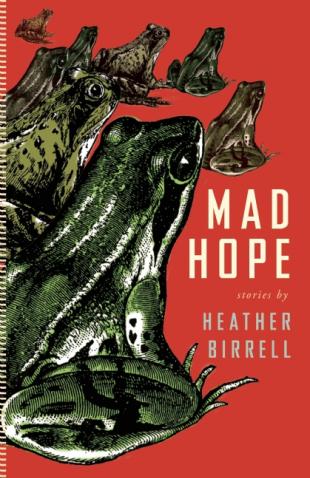 Mad Hope by Heather Birrell: Heather is my friend, but I have no compunction about including her book on my list with some objectivity because I really had no idea of the depths of her brilliance until until I read it. It’s a beautiful, rich, meticulously-curated short story collection, and it’s turning up on year-end best-of lists all over for good reason. Mad Hope is excellent.
 The Book of Marvels by Lorna Crozier: This is the book I kept talking to strangers about on busses, reading them the line about forks: “It’s the only kitchen noun, turned adjective, attached to lightning.” From my review: …one of the few books I’ve ever encountered that dazzles you when its dust jacket falls off: the book is argyle. Its design is splendid, and the contents will not disappoint, guaranteed to appeal to anyone who loves words, and stories, and the thingy-ness of things.
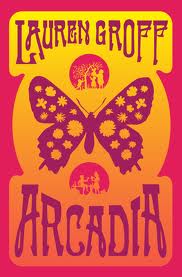 Arcadia by Lauren Groff: Groff is my favourite American writer, with so much more substance than hype about her, and in her second novel Arcadia, she just keeps getting better. From my review: Lauren Groff is a rule-breaker, a boundary-pusher, a genre-blurrer. There’s nobody else quite like like her writing right now, and she writes on the shoulders of those who came before her… She also writes with a deep appreciation and awe for history, for the role of story within history, and for the epic. Her first novel had a larger-than-lifeness about it, which is not so unusual for a book a writer has been working her life for, but it’s less usual for a second novel and for it to be pulled off so successfully too.
 The Forrests by Emily Perkins: One of a number of brilliant books this year that we haven’t heard nearly enough about. From my review: The Forrests is like The Stone Diaries, but edgier, and structured as the interior of its subject’s mind rather than her scrapbooks, and it’s enormously successful. Rachel Cusk, Virginia Woolf. Vividly human characters, gorgeous writing. It’s full of surprises, twists, turns and moments of illumination, quiet but profound in its brilliance, and devastating to have to finally put down.
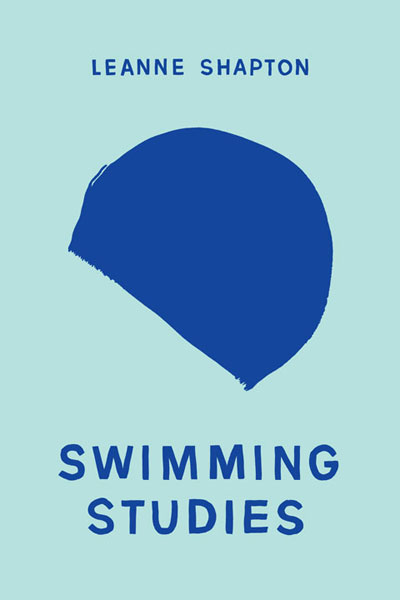 Swimming Studies by Leanne Shapton: Oh, sweet summer time and this gorgeous book I bought one sweltering day on a walk home from the swimming pool. From my review: Swimming Studies is a difficult book to explain, and I’m glad that I get to review it in my blog so that I don’t necessarily have to. That I can simply say that the whole thing just works, for no reason I can really fathom. Leanne Shapton writes about ponds and pools she has known– the Hampstead Heath Ladies Pond, the pool at the Chateau Laurier, the baths in Bath, and so many others. She writes about morning practice: “Ever present is the smell of chlorine, and the drifting of snow in the dark.” A many-page spread displays her extensive bathing suit collection. She includes drawings of her teenage swim teammates, with brief biographies for each: “I’m not crazy about Stacy since noticing that she copied onto her own shoes the piano keys I drew on the inside of my sneakers.”
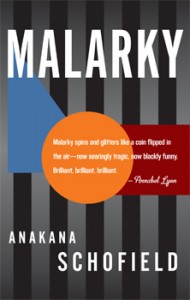 Malarky by Anakana Schofield: According to everybody that matters, this was one of the best books of the year, and when it comes out in the UK next year, the whole world is going to know it. From my review: If Hagar Shipley met Stella Gibbons, the end result might be Anakana Schofield’s Malarky, but then again, it probably wouldn’t be, because Malarky refuses to be what you think it is. And moreover, it probably wouldn’t be because the book is meant to be chock-a-block with allusions to James Joyce and Thomas Hardy. Don’t tell anybody, but I still haven’t read Ulysses (and hence the Gibbons instead of the primary sources), but I have read Malarky, and it was brilliant, which I know for certain even with the burden of my literary ignorance. And that I can pronounce a book as wonderful even whilst unable to access its higher planes of greatness is certainly saying something for the book itself, which is mostly, “You’ll like it too.”
 The Blondes by Emily Schultz: I devoured this book in a weekend, and as soon as I was finished it, I started to read it again. From my review: Hazel’s few friendships and alliances with women are shattered as individuals try to navigate their respective ways to safety… But Hazel ultimately finds herself entirely powerless to her biological destiny and to patriarchal tyranny when the plague and its circumstances make impossible her choice to terminate her unwanted pregnancy. Schultz shows how change creeps in little by little so that to a feminist academic, lack of access to abortion can become almost remarkable. The Blondes is powerful and solid, gripping and scary.
 The Juliet Stories by Carrie Snyder: A wonderful book, and the world thought so too because The Juliet Stories was nominated for a Governor General’s Award this year. I called it “one of the best Canadian books you’re going to read this year,” and as the year draws to a close, I’m standing by that declaration.
 Afflictions and Departures by Madeline Sonik: The best part of my life is that I got to spend this year coming up with excuses to put this fantastic book’s cover on the main page of 49thShelf. Winner of the City of Victoria Butler Book Prize and shortlisted for the 2012 Charles Taylor Prize for Non-Fiction. From my review: Sonik stitches her personal stories to the fabric of her time. Her narrative voice is blessed with startling omniscience, with the benefit of hindsight, and with an acute awareness of both how the extraordinary can be illuminated by ordinary detail, and also of how the ordinary and extraordinary are so often intricately connected. Sonik’s prose reveals her poet’s skill, as does these essays’ use of imagery and symbolism, but the broadness of her vision and the deftness with which she fits together surprising pieces of reality is evocative of Joan Didion’s masterful non-fiction.
 A Large Harmonium by Sue Sorensen: This book came out last year, but I only discovered it in June, and I’ve been recommending it steadily ever since to readers who have not been disappointed. From my review: Winnipeg resident Sorensen has much in common with Carol Shields, who was another, except that her tone is darker and more overtly hilarious. The novel’s pace is brisk and easy, which is not to say “light”, because there is depth here, but the story goes down just as well. Just as Shields did, Sorensen’s got a grasp on joy and how it factors amidst life’s absurdities. This is a wonderful novel with broad appeal. It’s absolutely the funniest and one of the best books I’ve read in ages.
November 18, 2012
Here We Are Among the Living by Samantha Bernstein
Non-fiction by women turns up with a predictable lack of frequency on literary prize lists, in particular when the non-fiction is of a personal bent. And so when I saw that Samantha Bernstein’s Here We Are Among the Living was on the longlist for the BC National Award for Canadian Non-Fiction, I absolutely had to check it out. Described as “a memoir in emails”, a chronicle of coming of age in Toronto at the (most recent) turn of the century, written by the youngest child of Irving Layton, this promised to be a book that was something different, a book that I might just happen to be the ideal reader for.
It begins with a prologue, 1999, Samantha writing to her friend Eshe about a road trip to Montreal with her friend Michael to attend a tribute to Irving Layton, the father she barely knows. Much of the journey is Sam negotiating her relationship with her famous father and with his legacy, but also becoming conscious of a developing attraction between her and Michael. When the book begins, we’re two years into the future, Sam and Michael’s relationship over but something lingering between them. It’s a few days after the terrorist attacks of September 11 2001, and Sam is once again writing to Eshe, who has just started university studies in New York. She writes about her response to the tragedy, about her anger at other standard responses, about her frustrations with her mother who once espoused hippie ideals but turned her back on them with middle age. And so we go, from 2001 to 2005, the story of a girl growing up, finding her place in the world. At the book’s beginning, she’s just dropped out of UofT, is working at Starbucks, is living with her mother and cherishes their closeness just as she’s resentful of it.
Part of my attraction to this book is that Bernstein is documenting my time– she’s two years younger than I am but just a bit more worldly enough that our lives had their parallels. There was something peculiar about being 22 when the Twin Towers fell, on the threshold of a world that appeared to be crumbling. And for me, the Irving Layton part of Bernstein’s story functioned as a metaphor– how are we as a generation to find our place in the world in the enormous shadow of our parents’? So many of our values were their values once upon a time, but they outgrew them. Their culture remains our culture. What does it mean that we’re taking on their cast-offs? Will their cast-offs just destine us to make all the same mistakes?
Here We Are Among the Living is also a stunning record of an important time in the history of Toronto, of the burgeoning civic awareness that developed as the city turned into the new century. Bernstein writes of one Sunday when a shopkeeper bought a row of parking spaces in Kensington Market, and gave the road over to pedestrians, which turned into pedestrian Sundays. For years, her friends’ hang-out was a loft in old factory building down on Cherry Street, that would be turned over to demolition crews with the development of the West Don Lands. Her memoir includes Toronto under SARs, and the great blackout of 2003 (which is also depicted in Grace O’Connell’s novel The Magnetic World, and it makes me wonder where else it will turn up in literature yet-to-be-born).
And it’s not just recent history, but also geography. I was living in Toronto in 2001 as well, but my experience of the city was confined mainly to the university campus. Beyond Bathurst was the Wild West, and I never went north of Bloor except to see a movie at the Cumberland. Whereas Bernstein navigates the city like someone who has lived here her whole life, like somebody with a car. She writes about the peculiar circumstances of her upbringing, on the fringes of Forest Hill, on the fringes on the middle class (her mother drove a Saab, but it was 17 years old). She spent her childhood growing up on Thelma Avenue in a house her mother owned, and talks about its bizarreness, “a lower-middle-class street in a rich area” and I’ve checked out Google streetview–it’s still just as odd. She spent her teenage years in high-rises on Walmer Road, and at Yonge and St. Clair. She cris-crosses neighbourhoods, takes in the College Street scene, her boyfriend’s comfortable home in Riverdale, her eccentric friend who lives in a storefront converted from a dental office. She comes to understand, reluctantly, the futility of trying to make the best parts of the city forever stay the same.
Here We Are Among the Living is a documentation of intersections between the personal and political, like some of my favourite non-fiction books— Afflictions and Departures by Madeline Sonik and Subject to Change by Renee Rodin. It’s the story of the profound ways in which an ordinary woman understands her place within the wider world. I think the book also deserves attention in light of the success of Sheila Heti’s How Should a Person Be, as Bernstein is engaging with the very same question. She writes, “All kinds of confused, difficult people have still done some good in the world; we aren’t the first ones tripped up by our own natures, who don’t know what to do or how to act. But in our uncertainty, trying at least to flesh out ideals we have stick with, create lives that won’t betray us too much.” And her book resonated with me where Heti’s didn’t, for a few reasons. That she called it true, for one, and that she asked the questions earnestly. And also that her characters are in their early ’20s rather than their late ’30s, and that in the trajectory of the book they grow up, that they actually come closer to understanding the kind of people they want to be. A lot of people do.
Which is not to say that all the enthusiasms of one’s early ’20s are to be thrown away with age. Samantha Bernstein grows up, but I found it interesting to read her older brother’s supposedly wise lectures on the value of capitalism and the goodness it has brought to countries like Greece and Spain. In light of the recent economic turmoil of these two countries, her youthful idealism does not seem so misplaced. She begins the book by dropping out of school, but finds herself by going back to academia, another school and another program and a bit more experience under her belt. I also find the structure of this memoir quite remarkable, a testament that electronic communication has value, that it’s capable of being literature, that young people have something to say and their own way to say it.
I don’t think this book is for everybody. It’s a bit too long, not always as profound as it imagines itself to be, is an exercise in self-indulgence, and yet I connected with it on so many levels. It’s a book I emailed my friends about, my friends who were sitting around a booth with me at a College Street diner on the night of September 11 2001, and I told them, “This is our story.” It’s a book that’s important for anyone who cares about women’s non-fiction (and if that’s not you, what’s wrong with you?). I loved it, and it’s truly one of the most remarkable books I’ve read this year. I’m so glad that the folks at the BC National Award for Canadian Non-Fiction think so too.
November 7, 2012
Desperately Seeking Susans

When I heard about Desperately Seeking Susans, an anthology of Canadian poets called Susan, I was instantly delighted and knew this would be a book I’d have to get, and not least of all because it would probably include a poem by Susan Holbrook. So you can imagine my excitement when it all came together and I learned keeping Holbrook company would be Susans Briscoe, (Suzette) Mayr, Telfer, Olding, and Sorensen (oh yes, she of the A Large Harmonium fame!). The anthology (so reads its jacket copy) “brings together Canada’s most eminent Susans… paired with Canada’s emerging Susans”. It’s also edited by Sarah Yi-Mei Tsiang, who wrote the wonderful Sweet Devilry (which won the Gerald Lampert Prize in 2012) and is author of a few of our favourite picture books.
Now I have very good intentions when it comes to poetry; unlike many people, I even buy the stuff. But I find sitting down to read it altogether challenging sometimes, because I’m a book devourer, and poetry doesn’t always lend itself to being digested in such a manner. And so it says something about Desperately Seeking Susans that I read it over the weekend, and that reading was such a pleasure. Not that many of these poems could be read in one go– I had to read most of them twice or three times but the nice thing about the anthology was the range of poems, that each one would require a different kind of mental muscle, and so I never got exhausted. Every time I turned the page, I would discover something different and new.
Discovery is the key here. Not being the most avid poetry reader, here is where I’ve discovered some of those “eminent” poetic Susans for the very first time– Goyette, Elmslie, Ioannou. I loved the range of subject matter, from “The Coroner at the Taverna” by Susan Musgrave and “9 Liner” by Suzanne M. Steele about the war in Afghanistan, to poems about children, about elderly mothers and fathers. I love that the book’s epigraph is a poem called “Susan” by Lorna Crozier, and that the book has been blurbed by Susan Swan. I loved the first poem, “First Apology to My Daughter” by Susan Elmslie, which ends with the tremendous last line, “I taught you the ferocity of hunger,” Sue Goyette’s heartbreaking, beautiful poems about grief, Susan Holbrook’s “Good Egg Bad Seed”, which I had to read in its entirety to my husband before we went to bed on Saturday night (“You subscribe to Gourmet magazine or you don’t want fruit in your soup./ You get Gloria Steinem and Gertrude Stein mixed up or you get the Bangles and the Go-Go’s mixed up.”).
I loved Susan Glickman’s “On Finding a Copy of [Karen Solie’s] Pigeon in the Hospital Bookstore”, imagine a poem like Suzannah Showler’s with the fantastic title, “A Short and Useful Guide to Living in the World”. I was always going to love Susan Olding’s poems, which are “What We Thought About the Chinese Mothers” and “What the Chinese Mothers Seemed to Think of Us”. I could go on and on; there is everything here.
I love this is a book founded on such a fun premise, and how the richness and quality of the work did not have to suffer for that fun. It is an essential addition to the library of any Susan, or to anybody who loves poetry, or anyone who doesn’t know yet how much she really does.
September 14, 2012
NW by Zadie Smith
 I don’t remember exactly where or when I purchased White Teeth by Zadie Smith, but I know that it was sometime during that wonderful summer of 2001, when I worked on King Street East and spent my lunch hours in Little York Books and Nicholas Hoare. When I spent the money I was supposed to be saving for my tuition on books instead, stacks and stacks. I bought White Teeth in paperback, and I don’t remember how I heard about it, but I know that it changed my life, my relationship to literature. For the first time, I realized that literature existed beyond survey course syllabi, that great books were being written in the here and now, and by people not much older than I was.
Ever after, a new Zadie Smith book has been an event, except perhaps The Autograph Man, which I don’t remember. A Zadie Smith book is one that I have to get in hardback, and so it was with great pleasure that I handed over 30 plus dollars last week at Book City for a copy of her latest, NW. Her first novel since On Beauty from 2005, her first book since the essay collection Changing My Mind in 2010.
From that book, the essay “Rereading Barthes and Nabokov”: “The house rules of a novel, the laying down of the author’s particular terms–all of this is what interests me. This is where my pleasure is.”
The house rules of NW are difficult to discern upon first encounter. This author’s terms are particularly demanding. And yet, when I had to reread the novel’s rather Woolfish first section “Visitation” in an effort to orient myself to Smith’s geography, it was with pleasure, to immerse myself in the text again to understand how Smith has “record[ed] the atoms as they fall upon the mind in the order in which they fall” (so said Woolf herself). A deep, tangled, engaging book, NW has a surface accessibility, streets smooth enough to glide along, but then think too hard and you’re tripped up, pulled down into the Underground. So much going on here (most of it, actually) underneath the surface.
The first section of the book is structured conventionally, a first chapter followed by a second. The narrative itself is loose and elastic, unstuck, unhinged, words played with and pushed into shapes (both literal and figurative). It’s the story of Leah Hanwell who is lying in a hammock in her back garden in North-West London, a nice garden with an apple tree, but it’s still a council flat and not far from the troubled housing estate where Leah had been raised. She hears a phrase on the radio, “I am the sole author of the dictionary that defines me,” and thinks about writing it on the back of her magazine. Her reverie is interrupted by a knock at the door, a manic young woman in a headscarf who’s clutching a utility bill; “I live here,” the girl says, around the corner. She says her mother has been taken to the hospital and she needs money for a cab to get there. She and Leah share a cup of tea in the kitchen, not such a collision of worlds after all. The girl remembers Leah from high school, came through a few years later. Leah gives her 30 pounds and sees her off.
The girl reappears throughout the rest of the section, by chance (because they’re neighbours after all), but Leah becomes obsessed with her. The girl who never paid back the money, who ripped off Leah just as her husband had predicted. Leah, the ginger-haired girl of Irish origin is married to Michel, French by way of Africa, who is determined to progress in his new country, to make his way trading stocks on the internet in the evening. He wants a better life for his children, the children Leah doesn’t want to have. When she discovers she is pregnant, she has an abortion, and Michel has no idea. “Why must love ‘move forward’? Which way is forward?”
The way forward is clear for Felix Cooper in the novel’s second section, its chapters labelled by postcode. Geography is central to Felix’s experience (on the Tube, “Felix established a private space of his own, opening his legs wide and slouching”), the world is not his for the taking and so he has to define his territory. As he moves through the city, his identity is fluid, based on the perceptions of others. Things are looking good for Felix– he has moved away from the estate where he grew up, he’s got work apprenticing with a mechanics, and he’s got a girl who convinces him that anything is possible. He wants a hot car to impress her. He wants to cut ties his past, his mother, his brother, his struggles with addiction, and bad relationships, including one with a creepy Miss Havisham type he just can’t seem to quit. It becomes apparent, however, that however much Felix desires to change his life, he’s forever turning in circles, living out the same scenes and postcodes over and over again.
Next, we meet Natalie Blake, whom we’ve encountered already in the book’s first section, Leah’s friend since childhood. Natalie’s section comprises 185 short paragraphs, numbered. The way forward for Natalie is focussed, fast, propelling her out of the community she came from to academic success in university, a law degree, a successful career, lots of money and marriage and motherhood. We’ve seen Natalie and her husband Frank in their back garden through the eyes of Leah, a world away, barely human in all their polish. And here we are shown beneath the sheen, that Natalie is even more dissatisfied with her own life than Leah is, that her social mobility has left her foundationless, with a life built on aspirations. There is a cost to being the sole author of the dictionary that defines one, or maybe the point is that for some authorship is only an illusory purpose, and how much is missed by years spent becoming rather than simply being.
The pieces of this novel do not fit together neatly, and its characters’ lives are similarly chaotic, sordid, their emotions messy and complex. While I have outlined various pieces of the novel’s plot, to focus on plot too much is to miss the point. NW is a story about city life, about people in proximity and lives rubbing up against one another, roughly and otherwise. It is a novel of impressions, falling atoms and all that, rather than plot. It will also most likely be an entirely different novel each time you read it, as frustrating and challenging as it is illuminating and rich. Noise and melody. And yes, a novel that’s tearing down the house and remaking all the rules.
The pleasure was all mine.
August 28, 2012
Swimming Studies by Leanne Shapton
 It occurs to me that I could write a swimming memoir too. I was never, ever a competitive swimmer, but my life has been punctuated by pools, shores and bathing suits. There was the pool in Bangkok in 2004, with my husband, who was my boyfriend, when we were marooned in the city after missing a flight and we went swimming together for the first time in our two years together and discovered a whole new level on which we connected, that we both adored the water. There were the turquoise rectangles and kidneys that dotted the backyards of my childhood suburban landscape, the yards you’d calculate to be invited into on the very hottest days.
I learned to swim at Iroquois Park in Whitby Ontario, and then at the Allan Marshall Pool at Trent University after my family moved to Peterborough. I met my best friend at the Trent pool, at swimming lessons when we were both 13, and seven years later we’d be swimming together at a reservoir when someone pulled a body out of the water.
There were hotel and motel pools with my sister when our family was on vacations. Our backyard pool during my teenage years. The Hart House Pool at UofT, which I swam every day when I was pregnant (which was the same time at which I’d become obsessed with reading books about swimming). And also the Turkish bath in Budapest, where I once went swimming a long time ago when I was pregnant but did not want to be.
And this is the impact that Leanne Shapton’s beautiful books always have on me, her own experiences or her imagined ones leaving me awash in my own thoughts, memories and questions– see my posts on Native Trees of Canada and Important Artifacts. For me, her books point away from themselves, even in their remarkableness and their beauty as objects. (Shapton is a book designer, as well as an author and illustrator.) Which is not to say that her latest, Swimming Studies, is not an incredible book, one of the best I’ve read this year. In her curious collection of sketches-cum-memoir, Shapton teases out the connections between her past as an Olympic swimmer and her present day experiences as an artist in New York City. How did she get from there to here? How do her two selves inform each other? Are they really so separate after all? How does the discipline required for athleticism inform an artist’s life?
Swimming Studies is an exercise in nostalgia, a love letter to places where we no longer belong. I was never, ever a competitive swimmer, but I remember the kids in my class who always smelled like chlorine, which made their skin flake and their hair turn green. I remember their t-shirts that said, “No Pain No Spain.” I remember Victor Davis and Alex Baumann, and in 1984 I was in the crowd at an Anne Ottenbrite Parade, celebrating her gold medal, the very first parade I’d ever seen that didn’t end with reindeer. I found it all fascinating and strange.
But I remember too having strong feelings about the logos on my sweatshirts. Shapton writes, “When I follow a trend (plastic bracelets, neon lycra), I get nervous. Mosquitos and wasps are attracted to my fluorescent-yellow sweatshirt. I spent an unhappy year in seventh grade trying to look preppy with the wrong ingredients…” She writes of her older brother, “I was always watching Derek for signs of what was possible, how to make decisions, what to like and how to tell. I knew he wanted to lose me, and I tried to keep my distance, but I wore the same Converse All Stars as he did, the same jeans…” One chapter begins, “My first visit to Ottawa was with my sixth-grade class…” I know these reference points, Phil Collins playing on the car radio. Watching through windows for your mom’s headlights, for her car to pull into the lot to take you home.
Swimming Studies is a difficult book to explain, and I’m glad that I get to review it in my blog so that I don’t necessarily have to. That I can simply say that the whole thing just works, for no reason I can really fathom. Leanne Shapton writes about ponds and pools she has known– the Hampstead Heath Ladies Pond, the pool at the Chateau Laurier, the baths in Bath, and so many others. She writes about morning practice: “Ever present is the smell of chlorine, and the drifting of snow in the dark.” A many-page spread displays her extensive bathing suit collection. She includes drawings of her teenage swim teammates, with brief biographies for each: “I’m not crazy about Stacy since noticing that she copied onto her own shoes the piano keys I drew on the inside of my sneakers.” About quitting swimming twice, and how the swimmer inside her cannot be shaken, and how she’s had to learn to live with her. Paintings of pools, of figures in the water. A chapter on her obsession with Jaws, with Jaws as metaphor. Her fascination with athletics, with athletes who aren’t champions: “Their swims, games, marches aren’t redemptive. Their trajectories don’t set up victory.”
It works, and maybe you have to understand the lost world that she’s conjuring in order to really get it, or maybe you just have to understand the nature of lost worlds at all.
**
 I bought my copy of Swimming Studies on Saturday on the way home from a splendid afternoon at the Christie Pits pool, the pool that this wonderful hot summer has given us many occasions to appreciate. Our visit was particularly notable because the water slide was on, and also because it was the debut of my brand new bathing suit which I’ve been waiting all summer for. It’s my mail-order bathing suit, an idea that was always going to turn into a saga. It’s the Esther Williams Class Sheath, which I purchased after seeing it endorsed by trusted bloggers at Making It Lovely and Girl’s Gone Child. It arrived too late for our vacation, but actually fit (albeit snugly, requiring me to do a funny little dance in order to get into it). And it’s lovely, so I was happy to have an opportunity to wear it when summer came back to us this weekend. We didn’t bring our camera when we went to Christie Pits, so I decided to wear my suit again the next day at the wading pool, just so you can see how excellent it is. No ordinary bathing suit would drive me to post a photo of me wearing it on the internet, let me tell you. So maybe this is the beginning of a new internet meme called Book Bloggers in Bathing Suits? Like all proper book bloggers, however, with our sensitive skin and lack of propensity for pin-up-ness, I’ve had to delay this big reveal for a week or two because I was waiting for a rash to go away.
August 20, 2012
The Book of Marvels by Lorna Crozier
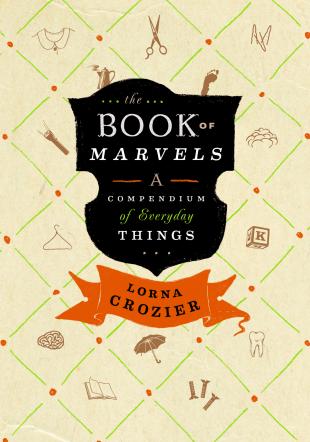 The most disappointing book I ever received was a book of household tips containing such wisdom as how to clean decanters and select bathroom soaps, and poet Lorna Crozier’s new book The Book of Marvels: A Compendium of Everday Things is that disappointing book’s most polar opposite. Fitting for a book that renders ordinary objects extraordinary, Crozier’s book itself is an extraordinary object, one of the few books I’ve ever encountered that dazzles you when its dust jacket falls off: the book is argyle. Its design is splendid, and the contents will not disappoint, guaranteed to appeal to anyone who loves words, and stories, and the thingy-ness of things.
Arranged in alphabetical order, The Book of Marvels is a dictionary of sorts, each definition illuminating the extraordinary lives of objects that we rarely look at twice. Sometimes Crozier will regard a familiar object from an unusual point of view (“Bed: Solid. Immovable. It does little more than take up space in the room it gives its name to, but at night the bed could be any kind of boat…”), use it to tell a story (“The shoe the old dog dropped on the step at dusk… It’s a man’s shoe, black, with a built up sole, as if the owner is a 1950s’ child of polio. Perhaps he’s not lame, just short, and the partner of this show is also heightened…”), invent mythologies (“The first rake was a hand. The older the better, rachitic fingers permanently bent, a scraping tool of bone and flesh…”),or uncover the hidden life within (“All doorknobs are twins, joined at the centre by a bolt narrow as a pencil, inflexible, unvertabraed. Though they move as one, they never get to see each other. They are like siblings separated at birth by a war, by a wall of stone and razor wire”).
I can tell you that I delighted in reading this book on the bus last week, in being the woman seen reading an argyle book called The Book of Marvels, in nearly falling down every time the bus lurched because I’d let go of the hanging strap in order to frantically underline all the best bits. Sometimes the underlines were because the idea was so right, so perfect: “Flashlight: It feels neglected. Too often it’s merely a case for carrying dead batteries.”Or: “The mop lacks the mystery of the broom. No one thinks of it steering through the stars.”
Or the writing: “Shovel:… You’d swear it is a noun but it’s a verb, in stasis, waiting in the shed for a shift of circumstance or season.” And there is this: “Snail: It sails without sails in the garden, so slow, if it were a ship, there’d be no wind.”
The one I went around reading to everybody on Friday was from Fork: “It’s the only kitchen noun, turned adjective, attached to lightning.”
And oh, how I loved: “Whatever it’s called, its country of origin, in a past life the umbrella must have harmed the wind–the wind, without doubt, plots its undoing.”
The Book of Marvels was the title of Marco Polo’s travel writings, and also those of traveller/adventurer Richard Halliburton, and is a title that would set up high expectations for any book, even without the allusions. Lorna Crozier not only meets these expectations, however, she exceeds them, in her excellent argyle book which affirms with delectable language that the world’s wonders are all around us.
August 14, 2012
The Blondes by Emily Schultz
 I appreciated Emily M. Keeler’s piece about pre-natal narratives and connections between Emily Schultz’s The Blondes and The Handmaid’s Tale, but it was actually Atwood’s The Robber Bride that The Blondes had me thinking of. Because while The Blondes certainly has a post-apocalyptic feel (as have so many other books this year, books as different as Gillian Flynn’s Gone Girl and Lauren Groff’s Arcadia), fundamentally, The Blondes is a novel about how women betray one another. From the first page: “For women, power comes by subtle degrees. I could write a thesis on such women–and I nearly did.”
The narrator is Hazel Hayes, and she is addressing her unborn child, mostly because she has no one else to talk to and nothing else to do. Also because she wants to put the pieces of her story back together, to understand the story for herself. She has been a graduate student in New York City, studying “aesthetology”, the study of looking. Her work has been unfocused, mainly because she’s just run away from an affair with her (married) professor in Toronto, Professor Karl Mann (born Karl Diclicker, and many of Schultz’ name-choices are so delightfully Dickensian– in New York, Hazel’s made her home at the Dunn Inn, Hazel’s own name with its ambiguous colouring and haziness, the woman who she appeals to for saving is called Grace). Things become even more complicated when Hazel discovers that she’s pregnant, and her attempts to get home to deal with the problem are stymied by the effects of a mysterious plague.
The plague is “Blonde Fury”, the media label applied with alacrity, as instances of fair-haired women acting out murderous fits of rage begin to take hold in New York and quickly spread through the world. And this premise was all I really knew about this novel before I read it, imagining the book as some kind of fashionable zombie romp, but I’d got it all wrong. First, because the plague itself is very much of this world, complete with scientific explanations involving melanin and double-X chromosomes. And second, because the plague itself functions just as effectively as metaphor as it does plot-driver, compelling the reader to rush through the pages (and I’ll put it to you like this: this was a 380 page novel that I read in a single weekend when I was out of town) and then to go back to the beginning and re-experience the story again in all its depth.
Just as in her studies (and in her life), Hazel imagines herself to be at a remove from womanhood, she situates herself on the periphery of the plague as well, consumed as she is by her personal problems. However, she is actually a witness to the first known attack, when a blond woman throws a teenage girl onto the subway tracks. When Hazel tries to back to Canada not long after, she’s injured when a pack of flight attendants go on a rampage at the airport. When she later tries to cross the border in a rental car, she’s detained and kept under quarantine, and though she seems to go unaffected by the virus, it’s unknown whether her own hair color actually makes her more susceptible–although Hazel has long dyed her hair an unremarkable brown, her natural colour is red. (“What was orange, but a variation on gold? Red-gold. A thing ablaze.”)
She also displays some of the symptoms of blonde fury herself– panic attacks, feelings of rage, depression. Which isn’t so surprising really, considering how general the symptoms are. “The threat becomes abstract, and the fear is almost as intense as the disease itself.” The public is urged to avoid contact with the apparently afflicted: “The thing about the disease is that it’s based on connection.” And so women turn on women in futile attempts to protect themselves.
But this is nothing new, of course, this idea that women are manipulated in order to undermine their power as a mass. Even before the plague, we see that Hazel’s study of female beauty is personal, that she admits to a fear of beautiful women, that she sees these women as “others”. In her affair with her Professor “Mann”, she has set herself in opposition to his wife. She smiles apologetically to men being harassed by women in the street. When she finds herself pregnant, she admits, “The academic feminist part of me felt defeated: devastated by biology, I had run out to get by hair done as a balm.”
Hazel’s few friendships and alliances with women are shattered as individuals try to navigate their respective ways to safety. When Hazel is put into quarantine, she leaves a friend at the border; she takes advantage of her oldest friend; she leaves vulnerable women stranded so as not to put herself in harm’s way. “Power comes in subtle degrees.” “If you come from very little, why give up privilege?” But Hazel ultimately finds herself entirely powerless to her biological destiny and to patriarchal tyranny when the plague and its circumstances make impossible her choice to terminate her unwanted pregnancy. Schultz shows how change creeps in little by little so that to a feminist academic, lack of access to abortion can become almost remarkable.
The Blondes is powerful and solid, gripping and scary. And if it had a soundtrack, I”ve no doubt that this song would be on it.
August 7, 2012
Above All Things by Tanis Rideout
 Ever since I started thinking about these things, the question has occurred to me: what is this literary reflex triggered by books so far away from here and now that convince us that said books are great? Even though some of our best writers write books with titles like Small Ceremonies and or depict parents picking nits from each others’ heads, why are Canadian readers (and awards juries) so swept away by sweeping, by largeness, by grandeur?
And it doesn’t come any bigger than the the Mount Everest in Tanis Rideout’s first novel Above All Things. The second-biggest topic she tackles is the British Empire and its crumbling. There is a mention of Toronto in the novel, guaranteed to get us all a little giddy, but then George Mallory really doesn’t think much of the place: “Cold. Even after Everest. And grey and dark. The cold there pinned up down.”
That Rideout’s book and its inevitable acclaim will serve as fodder for brand new versions of the “Is Canadian writing un-Canadian?” argument, however, should not undermine the fact that the novel is actually quite extraordinary, really wonderful. Smartly designed with an arts and crafts font, a cover image meant for mass-appeal, marketed as “The Paris Wife meets Into Thin Air“, but yet there is a singularity to this novel. As I read it, I kept thinking, “If every book was as good as this, maybe publishing wouldn’t be in trouble after all.” It’s an ambitious task she takes on, what with empires and mountains, but Tanis Rideout pulls it off, takes the summit. I’ve been disappointed by so many novels lately whose mechanics have been evident beneath their surfaces, whose writer’s stretching has been all too clear, but Above All Things is so perfectly formed, not only a novel to get lost in but one whose literary-ness will surely take you higher.
Above All Things comprises the parallel stories of Ruth Mallory, and her husband George, the latter the mountaineer whose infamous ill-fated Everest attempt makes the novel’s outcome clear from the start. There are several links to Virginia Woolf– the novel’s opening chapter is titled “The Voyage Out”; Woolf herself appears as a character in the book, a contemporary of the Mallorys, well-known thanks to George’s Bloomsbury connections; and Ruth’s own story is told in a Mrs. Dalloway fashion, the hours in the day of a woman with a party to plan, who will buy the flowers herself.
Though it’s not a party she wants to have, necessarily, but she’s having it anyway to put a brave face to the world, to attempt to distract herself from her husband’s absence. It’s his second Everest attempt, though he’d promised he wouldn’t try it again. There is also the time he spent on tour in America, and the years he spent away at war, and so Ruth is accustomed to his absence, but it doesn’t make it easier. It doesn’t make her less resentful either, or less angry, as she meditates on all he’s chosen over her again and again, what it is to come second to a mountain.
Meanwhile George’s own story is told in alternating chapters, taking place over months where Ruth’s is in a single day. His pace furious, the stakes high, and he’s able to avoid meditation for the most part. Rideout goes into considerable detail about the practicalities of an Everest climb in 1924, the minutiae necessary to complete the task, and we begin to see that the boundaries between domestic and wild, between men’s stories and women’s, are not as solid as they seem. George’s single-mindedness means another point of view is required to complete his sections, and Rideout uses that of Sandy Irvine, a young climber only too eager to follow in George Mallory’s footsteps.
Above All Things is a love story, and also a puzzle– is it Mallory’s love for Everest or the love of his marriage that the title refers to? What is a love story whose trajectory is two people moving further and further apart? Rideout writes of her inspiration from the real life letters that George and Ruth wrote to one another, and of how she used the letters as a jumping-off point to change these historical characters to fictional people. She subverts notions of marriage to show it as a many-textured thing, rife with compromise and betrayals upon which love itself doesn’t necessarily hinge. The story also has contemporary resonance in our time in which men are still being urged towards a “duty” that involves dying for their country, in which we’re still learning how to be in a world whose corners are nearly all explored.
So what does it mean then, that I’ve been swept away again? Impressed that this Canadian writer has imagined her way into these historical lives, imagined her way to the top of the world? I’m getting savvier though, and I can tell you this: sometimes the same old arguments have nothing to do with the matter, and I also know a really good book when I see it.






