April 21, 2014
A Tale for the Time Being
 It was during the summer of 2001 that I started flexing the muscles that would soon come to constitute the foundation of my self, by which I mean that I started book buying in earnest, books that weren’t secondhand paperbacks on my course lists. It was a pretty fantastic time to be buying books. I wasn’t worldly enough to be aware of Toronto’s independent bookshop scene, but I lived at Bay and Charles and was pretty thrilled by this huge and marvellous Indigo shop that had opened up around the corner, and around the corner from there was Chapters, another mega-bookshop, and this was back when mega-bookshops actually sold books. You know, I have nostalgia for those days, when I thought Chapters and Indigo were wonderlands. Like the World’s Biggest Bookstore, but with comfy chairs, and no dingy lighting. Plus, that summer I was working on King Street East, and at lunch time, we’d stop in at Nicholas Hoare and Little York Books, and suddenly my paycheques weren’t going so far, but there I was with The Portable Dorothy Parker and Zadie Smith’s White Teeth, and I was this close to being a grown-up person who could buy books whenever she damn well wanted to. It was delicious.
Though I think I got it on sale, Ruth Ozeki’s My Year of Meats. A hardcover on the remainder shelf, and I bought it at the Bloor Street Chapters. (I loved that store. I still resent the clothing store that later took over the space.) It may well have been the first hardcover I’d ever bought in my life, remaindered or otherwise. It was a monumental acquisition, fun, smart and quirky. As with White Teeth, it brought me an awareness that literature was being written right now, which had never occurred to me as I was plugging away at my English BA. That there was literature beyond my course lists, Joseph Conrad, orange paperbacks, and the New Canadian Library. Ruth Ozeki was a revelation.
And so I’ve been happy to be revelling in her wonderful new novel, A Tale for the Time Being. Everybody on earth already read this book last year and it was listed for all kinds of awards, but I only just got to it now, and it’s so wonderful. So full of everything, and there was the part that reminded me of Back to the Future, and the other that reminded me of A Swiftly Tilting Planet. It was heartbreaking, strange and really beautiful. Definitely worthy of all the acclaim.
This week, I also read Hetty Dorval by Ethel Wilson, who I’d never read before, and that was great too. I was inspired to finally pick it up by Theresa Kishkan’s blog post, and it was partly so great to read because I was reading the Persephone edition.
April 6, 2014
My Real Children by Jo Walton
 Jo Walton’s previous novel, Among Others, was one of my favourite books of 2012 and won the Hugo and Nebula Awards, which you can’t say about most books that are my favourite books of any year. I appreciate that because of Jo Walton, for me “the Hugo and the Nebula Awards” are now words that flow from my fingers like “Giller” or “Booker” do. Having made her start with fantasy in 2002, Walton’s writing moved in a science fiction direction with her alternate history “Small Change” series (which I can’t wait to read soon), and then proceeded to be altogether genre-busting with Among Others, which, in its unabashed bookishness, was embraced by passionate readers of all stripes. And now she has produced another such genre-busting book with My Real Children, the story of a woman with memory problems who can swear she’s lived two lives.
At first glance, the story recalls the movie Sliding Doors (Gwyneth and a fictional uncoupling, or not–remember?), or Lionel Shriver’s The Post-Birthday World—stories about the possibility of two destinies hinging on a single moment. But it also brings to mind Kate Atkinson’s Life After Life, the twentieth century told through the experience of a character who gets to live it more than once. But where Walton’s take is particularly compelling and original, as it was with Among Others, is the way her fantastical elements exist in a so-solid reality, leaving it up to the reader to decide where the line between fantasy and reality begins to blur, if it exists at all.
Patricia Cowan is confused, we are told, and some days she’s even “Very Confused”, as the nurses document in their notes on a clipboard at the end of her bed. Is it simply her dementia, or can she remember two lives? Her different children come to visit, there are subtle differences between two care homes where apparently she resides, her different memories. Could this be possible? Is it just senility? Which conclusion is more plausible? And it’s a testament to the spell Walton casts that these questions don’t even matter. To Cowan herself, they certainly don’t.
The “sliding door” moment, that instant in which Patricia Cowan’s life cleaved in two, takes place in 1949 when she agrees to marry Mark. And also when she doesn’t. Up until this point, she’d been swept along in time, losing her brother in WW2, receiving a place at Oxford (because all the men were away, she says, explaining away her success with the tide). She does well at school, finds a teaching job. But Mark’s less-than-romantic proposal is the definitive moment in which she becomes an agent in her fate. When she says, “Yes,” she finds herself “Tricia”, in a loveless marriage, wed to a tyrant who keeps her powerless and miserable. Saying, “No,” results in Pat, some temporary heartbreak, but then fulfilment found in travel, a writing career, a life partnership with a biologist called Bee.
So which are her real children, Patricia Cowan wonders? The four children she had with Mark? With the son who became a rock star and died young of AIDS? Or the three children she had with Bee, two her biological children and all three fathered by the photographer, Michael? And as the reader is taken through the chronology of these family lives, it becomes clear that Patricia Cowan’s lives took place against political backdrops as different as their domestic ones. As we suspect all along and is confirmed in the book’s final chapter, it’s a butterfly-flapping-its-wings scenario. Is it that Tricia, with a life otherwise devoid of purpose and therefore with time to devote to campaigning for the Campaign for Nuclear Disarmament, is key to the eventual obliteration of such weapons? Whereas Pat lives in a world where nuclear weapons are used more than once, radiation seeping through the atmosphere to disastrous consequences decades later. The Soviets land on the moon. LBJ is implicated in the death of President Kennedy. IRA bombings, Cuban missiles, nuclear exchanges between India and Pakistan, gay marriage made legal in the 1980s, mandatory identity cards, Google in the 1990s, US and Russia aligned against Europe, or American returned to its pre-WW2 isolationist stance. The possibilities are fascinating, how one thing just leads to another. Like a book. Life a life.
As I read this book, I thought less of Kate Atkinson and Sliding Doors and more of Hermione Lee’s Penelope Fitzgerald biography, which I read in December. Not because Walton and Fitzgerald are anything alike in terms of style, but rather that Fitzgerald and Patricia Cowan are near contemporaries with similar experiences–plans and legacies interrupted by wartime, coming of age in an era overseen by a new establishment, Oxbridge educations that culminate in disappointing marriages and women (in the case of Tricia/Trish) who discover their true capabilities later in life. I suppose it says something about Walton’s skill that her novel calls to mind a Hermione Lee biography, that Patricia Cowan’s two lives seem so convincingly lived.
As the bookish Walton undoubtedly knows, one book always leads to another. I mean, she clearly knows this sort of thing because she’s referenced Penelope Farmer’s Charlotte Sometimes and Margaret Drabble before you even hit page 16. Eventually, as the end of the book drew nearer (and oh, when it finally happened, I was gutted. I might have wished Patricia Cowan had life after life so that I could have gone on forever reading them…), I was thinking about Lauren Groff’s Arcadia, which similarly spans realistic historical periods to end up in a dystopian future. The atmosphere at the end of My Real Children is much the same, showing lives impacted by huge and sweeping histories but the details of these lives being the narratives that matter, the only constants in a history constructed of flux.
March 30, 2014
In Love With Art by Jeet Heer

It’s funny that comics have an aura of exclusivity. They’re so of-the-people, pulpy, low-rent accessible. I grew up reading comics, but then these were Archie comics, which aren’t real comics, and so I’ve lost my footing in this world already. Legendary comics store The Beguiling is around the corner from my house, but I’ve never been there for many of the same reasons I’ve never walked into Prada, just a bit further east on Bloor. But then they opened a sister shop nearby, Little Island Comics for kids, and I have a kid, so we went there, and our family’s comics love has been growing ever since. Harriet and Stuart are currently reading Wonderland by Tommy Kovac and Sonny Liew over and over, I read Jane, the Fox and Me last week, Harriet is obsessed with Wonder Woman and the DC Comics I Can Read books, she adores Binky, we got our first Silly Lilly book a long time ago, and bought Jack and the Box at Little Island just the other day (after this great recommendation by Michael Barclay). Parenthood has been my gateway to the world of comics, and I’m so grateful for that.
Silly Lilly and Jack and the Box are published by TOON Books, a series of stylish, smart, well-designed comics for kids packaged neatly as hardcover books. TOON Books was founded by Francoise Mouly, who is better known (as much as Francoise Mouly is considered “known” at all) as the partner of Art Spiegelman, of Maus fame. Using interviews and archival research, Jeet Heer has written a short biography of Mouly, In Love With Art, in an attempt to bring Mouly out from her husband’s shadow, though it’s actually Mouly of the two whom I know best, from her work as founder and Editorial Director of TOON Books and also by her long-time position as Art Editor of The New Yorker with its iconic covers. I may not have known Francoise Mouly’s name, but it turns out I’ve been paying attention to her work for a long time.
In Love With Art is part of Exploded Views, a new series of short books published by Coach House Books, books that in their immediacy read like extended magazine articles. Heer, with his signature mix of down to earth and erudite (and the world’s best vocabulary—who knew that “shanghai” was a verb?) has created a fascinating, absorbing book that made me grateful for the mild temperatures that allowed to me to continue reading (mitten-less) even after I got off the subway and was walking down the street. It’s a book that fit in my coat pocket and I read it in a day, but kept talking about it after with everyone I ran into. “Francoise Mouly. You think you don’t know her, but you do. You’ve got to read this book.”
It’s a fascinating story of a woman in a man’s world, of her childhood and formative years coming of age in France around 1968. She studied architecture, developing an design aesthetic that she’s applied to every project she’s done since, including low-grade jobs like “colourist”, overriding general consensus that jobs like this don’t matter. Not a comic writer herself, instead she’s a comics editor–who even knew there was such a thing? And part of the reason you’ve never heard of her is because her greatest impact has been in helping well-known artists to create their best work. With Spiegelman, she edited the RAW comics magazine for years, work from which is reproduced in In Love With Art in full colour, alone with her memorable New Yorker covers.
I was as surprised as anyone to discover that I, a woman who grew up reading Archie’s Pals and Gals, was this book’s ideal reader, but then it’s not so surprising after all. Women’s lives, women’s stories, women’s art, women for whom motherhood is a kind of answer—it’s been my thing all along. Consider my view exploded then. In the best way.
March 23, 2014
The Age by Nancy Lee
 My review of The Age by Nancy Lee appeared in The Globe and Mail this weekend:
It seems fitting, if sinister, to suggest that something in the air could be responsible for a strange tension emanating lately from the nation’s western edge. The Age – the long-awaited first novel by Nancy Lee, who won acclaim with the short-story collection Dead Girls– joins terrific recent fiction by Zsuzsi Gartner and Caroline Adderson to form a subgenre of Vancouver literature that puts the “domestic” in domestic terrorism. These works explore female characters’ relationships to extremism to complicate notions of home and family.
Lee’s title refers to two pivotal ages, her plot born of their intersection. The first is the age in which her story takes place, 1984, which, thanks to Orwell, was always going to be a storied year, even if Soviet warships hadn’t been gathering in the Atlantic with the Doomsday Clock ticking close to midnight. It would be a peculiar time in which – and here’s the second title reference – to come of age, seemingly on the brink of annihilation, as is the case for Gerry, Lee’s misfit protagonist.
Read the whole thing here.
https://www.youtube.com/watch?v=L2BviXN6yhk
March 17, 2014
After Alice by Karen Hofmann
 What a pleasure is spending a weekend devouring a book, and for me this weekend, that book was After Alice by Karen Hofmann, which I absolutely adored. It was the most unCanLitty CanLit I’ve encountered in ages, the story instead calling to mind English novelists like Anita Brooker and Daphne DuMaurier, and then Wallace Stegner, Barbara Kingsolver and Joan Didion in its evocation of place. This is a debut novel by Hofmann, whose previous poetry collection was shortlisted for the Dorothy Livesay Prize in 2009, but she writes with a touch so rich and deft that there is nothing of the debut about it.
There’s a lot going on here: Sidonie Von Täler has retired from her academic job in Montreal designing computer models for psychology experiments. Sidonie herself is something of a cold-fish, so this seems a job to which she’d be unusually suited. We’re locked into her point of view, and it soon becomes apparent that something is just askew–she is a synesthete, displays some symptoms of Aspergers in her perception of the world. Which is not to say that Sidonie’s point of view is the point of this story, that this is a novel or that she’s a protagonist we’d ever refer to as “quirky” ala Come Thou Tortoise or the Dog in Nighttime, but just that she’s a bit peculiar. Her point of view is fascinating, and her voice is sharply defined.
She’s returned to the Okanagan Valley where she’d fled from years before. In her childhood, her family’s orchard had been one of the biggest in the area, their land defining every circumstance of their existence and their status in the community. Sidonie, ever awkward, had been raised in the shadow of her beautiful sister, Alice, whose tragic later circumstances we’re not made aware of until later in the book. Upon her return, Sidonie gets to know her sister’s sons and their own family’s. She’s also close to her niece, Cynthia, whom she’d raised after Alice’s death, and Cynthia’s son, Justin, though much goes unsaid between all of them, Sidonie choosing to believe that she prefers her independence to the complications and niceties of family ties.
And you can’t blame her–Sidonie is brilliant, accomplished and self-succificent, having left a life rich with culture and a couple of close, rewarding friendships back in Montreal. She’d married well–an architect who built Habitat 67 in Montreal, where they’d lived until their marriage ended. She looked upon her marriage not warmly, but as coolly as she did everything. Some might find her life lonely, but there is no sign that she does. But something has driven her to come home, to a past that refuses to stayed packed away in boxes.
After Alice has mystery at its core, and while its approach is most literary, Hofmann has combined that approach with well-tuned plot that makes this book a page-turner. It is also very much a book about place, though not sentimentally so–Sidonie doesn’t do that–but instead the details of the land and what grows there, what it means to work that land in terms of economics and physical labour. It’s a novel that might take a place on the shelf beside Kingsolver’s Animal Vegetable Miracle or The Hundred Mile Diet in its consideration of the terroir, what the land does to its people. And what times does too, Hofmann weaving past and present together, Sidonie’s family home casting a spell that makes it difficult for her to tell where one of them finishes and the other begins, though it’s really that points like this just don’t happen.
Hofman’s prose is lyrical and effective, if a little in need of tautness. And her ending is a little bit too tidy and choreographed, though still with its surprises. But these are minor quibbles for a novel so ultimately satisfying, and so I welcome Hofmann’s refreshing voice with this wonderful book, one of the most interesting and exciting that I’ve encountered in ages.
March 11, 2014
Bark by Lorrie Moore
 I’m still discovering Lorrie Moore, which is a pretty lucky place to be in as a reader. The first book I read of hers was Anagrams, and I just thought it was weird. I really liked The Gate at the Stairs, and then I read Birds of America but I mustn’t have been reading carefully because I don’t even remember it. So when I opened up her latest collection, Bark, I didn’t have the same expectations that her much more devoted readers might have had. I wouldn’t have been able to tell if it was a good Lorrie Moore or a middling Lorrie Moore. As I read it, all I could think was, “So, this is Lorrie Moore,” which was a pretty fantastic revelation.
The stories themselves are many-angled, surprising, full of perfectly articulating revelations. On divorce: “It’s like a trick. It’s like someone puts a rug over a trapdoor and says, ‘Stand here.’ And so you do. Then boom.” Or, “It was like being snowbound with someone’s demented uncle. Should marriage be like that? She wasn’t sure.” And, “A life could rhyme with a life—it could be a jostling close call that one mistook for the thing itself.”
No super-narrative tricks or sleights of hand are going on here. As short story shapes go, these ones are mostly standard, riddled with quirk, but then there is this extra-perspective at play in which characters call out surreality of their situations. “He had never been involved with the mentally ill before…” it is noted of a character in the first story, “Debarking,” a guy who’s dating the bizarre quirky kind of woman who turns up in many a short story, a manic pixie dream girl gone very very wrong. All of these are stories of a world gone askew, and its people definitely know it, however powerless they may be against its forces.
The surrealism and sense of askewness is unsurprising. These are stories of America in the first decade of the twenty-first century, the first story situated sometime in the months after 9/11 and before the invasion of Iraq in 2003. The final story begins the day after Michael Jackson died in 2009, and doesn’t offer much hope for the decade to come: “I tried to think positively. ‘Well, at least Whitney Houston didn’t die,’ I said to somebody on the phone.” Foreclosures, banks and big-box bookstores, both. War, fear and Abu Grahib are the backdrop to these smaller stories of domestic disappointment. It got to the point where I was underlining references to decapitation, and there were more than a few. I got the sense that this is a book haunted by the story of Daniel Pearl.
While many of these stories have been published elsewhere, they’ve been collected seamlessly into a curious, fascinating whole that is as much worth remarking on as the stories themselves. The stories are linked by weird decapitation references, and the word “bark” which comes up again and again in a variety of contexts. Trees for one, the bark their protection, as is the case with dogs (which also come up again and again). The question of whether bark is, in fact, worse than bite—just one of many things we’re told that’s patently not true. I wonder if Moore’s bark, our bark, is in fact humour—what saves us from this savage life.
February 28, 2014
Review in The National Post: Know the Night
 I reviewed Know the Night: A Memoir of Survival in the Small Hours by Maria Mutch in the National Post, and writing the piece was like building something out of materials which are more exquisite than anything I’ve ever worked with. The book is weird, wonderful and enthralling, and to call it a memoir about parenting or autism is to reduce the book to something finite, which it isn’t. The book is bigger than all of that–it’s about books, jazz, lists, loneliness, the whole world, and it’s a love story too.
‘”There is nothing quite like caring for a child alone, while the rest of the world is sleeping. In the dark, reality loses its shape, time slows as the clock ticks towards sunrise. It is easy to become unhinged. In her first book, Know the Night, Maria Mutch documents her own experiences during what she calls “the small hours.” For two years her oldest son, Gabriel, slept very little. She was either up caring for him, or, anticipating he would soon awaken, be unable to sleep herself. It was an arrangement Mutch calls a product of “parenting’s alchemical gist: the love for the child … mitigates everything else; what would seem anathema to others becomes … the status quo.'”
February 2, 2014
Sanaaq by Mitiarjuk Nappaaluk
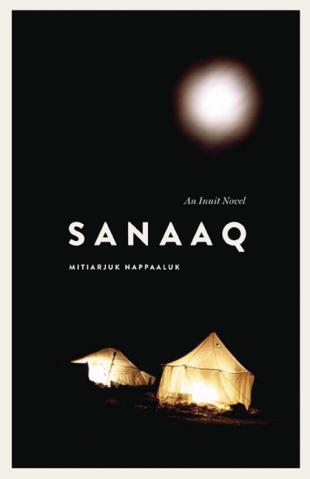 While I loved Keavy Martin’s review of the Inuit novel Sanaaq by Mitiarjuk Nappaaluk (transliterated and translated from Inuktitut to French by Bernard Saladin d’Anglure, and translated from French to English by Peter Frost in this new edition by University of Manitoba Press), a review which placed the novel in its context but also took it beyond the context—this is not “merely” a novel written by somebody who’d never read one, but a work of literature onto itself, something to be understood or even just experienced rather than contextualized—, I do think she overstated the challenge this book poses for the inexperienced reader. All set for a challenge was I, but instead I found myself enjoying myself, not so lost in an unfamiliar environment. The novel comes with a glossary of terms, but I could deduce most words by how they were used. The novel’s foreword by Bernard Saladin d’Anglure set the story up well for me, and in terms of the novel’s episodic nature? Well, obviously this was just an Inuit version of Armistead Maupin’s Tales of the City (I am only being half facetious here), so I knew what I was getting into.
Sanaaq is a young widow with a little daughter living as part of a semi-nomadic community in Northern Quebec. The novel’s 48 episodes show the rhythms of their daily life and its seasons, with all the usual drama implied–marriage, love, familial strife, hardship and loss, tragedy, and happiness. Oh, and tea. These characters are as preoccupied with tea, its having and its making, as characters in any English noel I’ve ever read, so I actually felt quite at home. For the reader unfamiliar with Inuit culture and traditions, the stories contained in this novel are rife with interesting details–about the hunting and storage of food, for example, or how the women in the book are always sewing and repairing their boots, and the logistics of Igloo-building. It’s not a portrayal of an Arctic idyll—life can be difficult and dangerous; I found it interesting to see how the dogs were regarded as pests, forever getting into food supplies and causing trouble, having items thrown at them. At one point in the story, Sanaaq is a victim of spousal violence, injured so badly by her husband that she must be flown to the south for medical treatment, and this is treated in the text with unflinching detail of the emotional complexity of the matter. But there is humour here too, and genuine human connections.
As we move through the novel’s 48 episodes, changes in Inuit life become apparent through contact with the qallunaat (non-Inuit people), which begins first with the sound of an airplane overhead, and then becomes more regular and embedded in ordinary experiences—Sanaaq’s husband is taken away to the south for work, her daughter becomes a Catholic convert, old people begin receiving social security payments.
The narrative skirts omniscience in a way that seems curious to the reader who is accustomed to the English novel. There is a matter-of-factness to the telling, perhaps related to its origins—it was written in a shorthand that can be written as quickly as it is spoken, and so this written novel has an oral nature. There is also a simplicity to its delivery that only comes across as such because a whole layer of the narrative is inaccessible to me as a reader (and I think that this is the challenge for this reader that Martin was writing about in her review). Saladin d’Anglure’s foreword makes clear that the apparent simplicity of Nappaaluk’s novel is undermined by the Inuit symbols and stories referenced, as well as details of Nappaaluk’s own life and members of her community. In short, this is only a straightforward story because I’m not smart enough to know it isn’t otherwise.
Sanaaq can and should be discussed beyond the story of how it was written, but the story is still pretty fascinating—Mitiarjuk Nappaaluk was asked by a missionary to write down phrases of the Inuktitut language so that he could develop his vocabulary, and what she delivered him instead was his long work of fiction, which she completed over many years. As Martin writes, “Mitiarjuk’s work has long been celebrated in Inuit communities, and… she received major honours before her death in 2007—she was awarded an honorary doctorate from McGill and was named a Member of the Order of Canada.” And now finally her work has been made available to be read by English readers, for pleasure just as much as enlightenment.
January 26, 2014
Dear Leaves, I Miss You All by Sara Heinonen
 Weather-wise, it’s been a long, hard winter. The kind of season in which you think it must surely be March by now, but then it’s not even February, and there is no single month which is longer than February. The other night, we were reading Barbara Reid’s book Picture a Tree, and upon gazing on the “A tree can be a tunnel” page, I suddenly exclaimed, “I miss green leaves so much,” and then my aha moment–so that was what the title of Sara Heinonen’s book meant. It was so clear that it was strange that it hadn’t been always.
I found my way into the stories in Dear Leaves, I Miss You All in a similar way. With the first few, I had trouble finding my footing, didn’t understand Heinonen’s project. Was there even a project at all? Her places (which are mostly Toronto, and sometimes Hong Kong) are a strange borderland between here and there, apocalyptic realism. The world we know, but the sky’s a funny colour. At first, I wondered if there wasn’t much to these stories, save for some starkly defined edges nfused with clarity of vision or humour. I read “Notes from the Fallen” and it made me think of Cynthia Flood’s “Care”, but “Care” was so much more (action-packed, experimental, difficult, daring). Heinonen’s first story, “The Edge of the World,” about teenagers trying to imagine a future once the economic engine of the world had sputtered out and their parents had settled into various forms of regressive malaise (the mother who is addicted to watching owls on a web-cam. I loved this). People kept disappear into holes, sniffing poultry, falling and not getting up again. I didn’t know what to think. I was disoriented in these stories’ universe.
And then. Reading “Walking Along Steeles After Midnight”, more of the same, I thought. Set at the north edge the city (borderlands), a banquet-hall, a woman going nowhere in her marriage and her life. She leaves the party, she’s offered a ride. It’s insisted that she takes it, but no. “I want to feel my boots sink into the thick new snow on a deserted suburban sidewalk… It’s just a matter of how to refuse the ride.” And aha, finally I get it. Figuring out how to refuse the ride, how not to be taken for one, to blaze one’s own trail, small and significant acts of courage in the dark. From this point on, I decided that I loved this book.
Also: trees. As Heinonen’s biography notes, she’s a landscape architect by trade, which might be related to these stories’ fascination with all things concerning arbour. Dear Leaves, I Miss You All—indeed, the splendour of trees, their solidity and munificence, wonderfully evoked.
The Barb and Benny stories throughout the book—were they bordering on caricature, I wondered in the beginning? But I came to understand them as funny and lovely instead, a subtly subversive and surprising riff on domestic themes set in the east end of Toronto. Barb is a neurotic environmentalist, intent on sewing polar-fleece onesies for her husband and son so they can keep the thermostat down. And now her neighbour is set on pruning (*butchering*) the horse chestnut tree whose nuts keep dropping in his swimming pool (which is now open until the end of October, thanks to global warming). The paragraph in this story that I read aloud to my husband while laughing included the line about Barb’s son, Carson: “He’d recently purchased a chinchilla without our permission and named it Gandhi.” The story ends with a party, a storm, Gandhi in a tree, diehards in a castle, bouncing and missing what’s coming.
In “The Chairs in Bjorn’s Room,” a newcomer to Toronto attempts to woo a pretentious furniture designer. In “The Bloom”, a woman contemplates a former colleague who is afflicted with a cherry tree bough protruding from her abdomen. In “The Blue Dress”, a woman who’d moved to Hong Kong on the coattails of her lover’s career makes a decision about her future, perhaps the first one of her life. I loved “Night of the Polar Fleece”, in which Barb is trying to channel her anxiety into fiction, and stumbles upon a writers’ group in a bar on the Danforth in a blackout during a snowstorm. While wearing her fleece suit, which makes it awkward to take her coat off. She is beginning to learn, through her earnest son, that sometimes you have to take a break from being the change you wish to see in the world.
“Ghost Woman” is about a widower, an immigrant from Hong Kong whose daughter has shrunk away from his control and all his dreams for her. In “Closer,” a heartbroken driving instructor projects his own pain onto a student who has a sad story of her own. And then “May Day Mayday”, Benny and Barb and it’s a silent spring. Or maybe it isn’t. “The sky has gone strange again,” says Barb. “I don’t know what to prepare for.” But inside, “the house is fragrant, vibrating with the crescendo of Benny’s heartfelt song, energized by Carson’s tapping on the computer keyboard, hopeful with ceilings I painted sky-blue.”
This is a book that ends in the kitchen, “where something good is possible.” The casserole cooking doesn’t cancel the strange sky, and anything terrible could fall apart at any time whether outside or in. But for the moment, there is dinner on the table.
This is mercy, this is grace.
I look forward to reading what Sara Heinonen writes next.
December 6, 2013
My Top 10 Books of 2013 has 22 books in it.
It’s been an amazing year for books. And this is the first time I’ve felt like this for a long time. This year, I’ve read books that broke my heart, books that changed my world, books that articulated everything I wonder about, books that changed my mind. This was a year of highs and lows, a year in which I needed certain books more than ever, and these in particular are the books that spoke to me so clearly. It was such an amazing year for books, in fact, that my Top 10 Books of 2013 has 22 books in it. The abundance is the very point, and I have no desire to narrow it down.
 Americanah by Chimamanda Ngozi Adichie:
I love a book so textured that the answer to my criticisms are contained inside its very pages. I reached page 335 to find a tirade by Ifemelu’s boyfriend’s sister who is about to publish her first book, a memoir about growing up black in America. She explains, “My editor reads the manuscript and says, “I understand that race is important but we have to make sure the book transcends race…” And I’m thinking, But why do I have to transcend race? You know, like race is a brew best served mild, tempered with other liquids, otherwise white folk can’t swallow it.” Explaining an anecdote, she says, “So I put it in the book and my editor wants to change it because he says it’s not subtle. Like life is always fucking subtle.”
 Life After Life by Kate Atkinson:
There is texture to a book like this, and the pleasure of seeing secondary characters from a wide variety of angles–Ursula’s mother in particular whose role in the novel’s conclusion was ingenious. Life After Life is a long book, as befitting a life lived over and over again, and I savoured its slowness, the returns to where I’d been before, places and people I was happy to revisit. I appreciated the specificity of its detail, the brilliance of its writing, its genre-blurring, its daringness in reframing the shape of a narrative, and yes, this is Kate Atkinson, so there is going to be that too.

Bush’s novels are always planted much more in concept than narrative and plot, and they are markedly unusual for this. They are also remarkable for their realism, details that plant the stories deep in the ground, on very specific sidewalks and streets, so that a book about a mother orbiting the Earth in Outer Space seems not so far from one’s own experience at all (as in her first novel Minus Time), and so too with this this novel about a journalist driven to explore a(n alleged) crime committed an ocean away amidst a community of street children turned circus acrobats. And this is just one way that this novel turns in on itself as we read it, for it is a story about how we project our own experiences upon those of others (and indeed, as Madeleine Thien read the novel through the lens of race, which never even occurred to me).

What I love best about this novel is that nobody ever changes. There is no great revelation. Claudia’s brother is still the jerk he was when the novel began, there is no fix for her father’s heartache, and even Claudia begins to see that her ex is moving away into a life of his own. But all the same, it’s okay, or it’s going to be. This is not aHow the Failed Housewife Learned to Get Along With the Vacuum kind of tale, but instead it’s about how Claudia learns to draw on her reserves, that herself exactly as she is has the capacity to roll with the punches better than anyone else. When life is messy, bumpy and hard, it’s because that’s what life is, and not because you’re doing it wrong
 The House on Sugarbush Road by Meira Cook:
There is no expressway into the Johannesburg of Méira Cook’s novel The House on Sugarbush Road. Instead, the roads are twisting and clogged with traffic, detritus, pedestrians on the roadside calling out in a language you don’t understand. This is a novel that is disorienting to encounter, hard to get one’s bearings in; the reader travels blindly along these foreign streets, trusting in the story and its teller. And as the story progresses, the trust builds. While The House on Sugarbush Road is Méira Cook’s first novel, she is widely published (and lauded) as a poet, she worked as a journalist in her native South Africa, and her prose gorgeously reflects the former while her novel’s approach shows the latter. The effect is brutal, surprising, and provokes an incredibly visceral reaction.

The key to this book, I think, and its usefulness for us, lies in a particular word that occurs at least twice. First, when she returns to her family’s London home and comes upon their back garden in early morning, the sight of a snail making its way across the patio table: “They would be so stirred by this.” Later, she writes about her husband who’d grown up on a council estate in East London, and his first trip to the Natural History Museum when he was six years old. At the sight of a life-sized model of a blue whale: “this was the most stirred he’d ever been.”
To be stirred then, to have our quiet disturbed. Perhaps this is why we should read this, or any book. A gentler version of Kafka’s frozen sea, and I like that. Not fortifying, but instead (and not merely) our reason for being.
 The Pure Gold Baby by Margaret Drabble:
It’s such a strange novel: we are taken through the decades of a group of mothers in London and learn which marriages ended, which children succeeded, which others went wayward (and how there was no telling of who would be who). This is a novel about friendship, and how we tell each other stories, about how we become characters in the stories of one another’s lives. It’s about mental health, public health, institutions. It’s a novel full of facts, pages of passages that read like non-fiction. It’s about progress, and the illusion of progress.
Pure Gold Drabble, is what it is. And so naturally, I loved it.

Jennica Harper is the poet whose books I stay up reading late into the night. She has uncanny ability to zero in on my fascinations, articulate questions I’ve vaguely wondered about, to use the very things located in the world around me (songs, cultural lore, television characters, celebrity references) and spin their own mythology. In a recent conversation, she asked, “Is there such thing as a “gateway poet”? That’s what I’d like to be.” And she has certainly succeeded at this, most recently with her latest collection, the beautiful, quietly powerful Wood.
 Oh My Darling by Shaena Lambert:
And I love that, that here is a collection where I can tell you about the book, its themes, its shape, rather than just telling you the plots of three or four of the stories I liked best.Oh, My Darling doesn’t actually reference Clementine, which wikipedia has revealed to me is actually a satire (because who would write a song about a drowned girl whose feet were so big she had to wear boxes instead of shoes?) But its preoccupations are just as morbid, and so darkly humorously so at times that I am sure that Lambert knew about the satire. That tireless refrain, powered by blustery, lust-ery, souls laid bare. So much feeling for something seemingly shallow. Sound going nowhere. Just imagine how it would echo in a cavern, in a canyon, excavating for a mile…
 Cottonopolis by Rachel Lebowitz:
But most remarkably for this book that uses language to build a museum is that the language itself is easily and unabashedly the work’s most remarkable aspect. I love the stories here, the history, but I can’t help but catch my mind on a line like “The trill of the/ robin, the trickle of the rill.” Or my favourite poem in the collection, “Exhibit 33: Muslin Dress” which turns language inside out in order to sew the whole world up into a tidy purse: “Here are the railway lines and there are the shipping/ lines. Here’s the factory line. The line of children in the/ mines. The chimney lines. There is the line: from the/ cotton gin to the Indian.”

Rebecca Lee’s short stories share the same approach as Sarah Selecky’s, the same intimate first-person narration, close attention to detail that sets these characters as very much of this world (lines like “Lizbet basically knew how to live a happy life, and this was revealed in her trifle–she put in what she loved and left out what she didn’t”)–as well as dinner-party settings and fork on the cover. But on the other side, Lee’s marvelous telescoping endings and ultimate broadness of perspective remind me of the stories in Jhumpa Lahiri’s The Interpreter of Maladies. (I think “Bobcat” may join Lahiri’s “The Fifth and Final Continent” as one of my favourite short stories ever.) These stories were written over two decades and accordingly the collection lacks a certain cohesion, except for (and this is significant) the solidity of Lee’s voice.
 The Love Monster by Missy Marston:
We come along with Margaret on her trip to rock-bottom, though the omniscient narrator also embraces Margaret’s mother, her co-workers, even the evil ex, the alien, and invests them with a powerful sympathy, an investigation of the kernel of sadness which lives within us all. The lines, the straight-talk, the music that Margaret plugs into her ears, the disasters–this Canadian book is hilarious, and will never, ever win the Leacock Prize (which is some kind of endorsement). It’s funny, and quirky, but not cute, and it’s terribly profound. Really amazing writing.
 The Woman Upstairs by Claire Messud:
Messud’s novel is also structured as a fun-house, trap-doors and booby-traps springing up if the reader makes the mistake of taking Nora at her word. Which is a difficult mistake to avoid–Nora’s voice is so forceful, persuasive, she perpetually speaks in generalizations and second-person address designed to make us feel comfortable, familiar. “Don’t all women feel the same?” she asks, and you’d be hard-pressed not to respond with a nod, but then, no! There is no such thing as “all women” anyway, and besides, Nora Eldridge is clearly unhinged. On top of being an unreliable trickster of a narrator, she is also blatantly wrong, about so many things, but most notably in her insistence on regarding the world within the limits of gendered binary terms. In this way, the novel recalls Carol Shields’ Unless, another book in which an enraged female narrator stamps her ladylike foot at the systematic repression of womankind, institutionalized sexism which completely exists, but her singular focus upon this obscures a far more complicated reality. Which is not to say that Nora Eldrige’s or Reta Winter’s rage is misplaced, that either should cease their foot-stamping, but just that there is ever and will be ever more to the story.
 Are You Ready to be Lucky? by Rosemary Nixon:
So let’s break the silence then, shall we? Rosemary Nixon’s collection of linked short stories is one of the funniest, most original books I’ve read this year. I started reading it on Friday, found it hard to put down, and had devoured it by Sunday afternoon. Are you ready to be lucky, indeed.
 This is the Story of a Happy Marriage by Ann Patchett:
But Patchett does channel Didion in Fact Vs. Fiction when she writes, “We all turn our lives into stories. It is a defining characteristic of our species.” And this is the triumph of her book, how it turns the self-help trope inside out. Ann Patchett doesn’t have the answers, but what she has instead are stories and – like life itself – these can be more complicated and unfathomable than we’d ever believe of fiction.
 How the Light Gets In by Louise Penny:
What is the attraction of Louise Penny’s novels, my reservations with her prose still being what they are? I think part of it is the intimacy she creates, between reader and place in her remarkably evoked village of Three Pines. And also the intimacy between the characters themselves, so much between them that doesn’t need to be explained, allowing the novels to progress in ways that are surprising. And finally, the intimacy of her narrative, her shifting points of view which enable us to understand her world from a wide range of perspectives. Which is not to say that her readers know everything. In fact, in this book in particular, the plot is operating on a whole other plane that readers are not even aware of until an incredible twist at the conclusion, and I promise that you never see it coming.
 The Children of Air India by Renee Sarojini Saklikar:
This poetry collection is beautiful, devastating, difficult and important. Difficult in terms of subject matter, but yet the narrative was so compelling, N herself leading the reader through so many lives and stories, plot and intrigue. Throughout, I needed to take short pauses because it all was a little too much, but then I’d pick the book right up again, the poetry accessible and fascinating, rich with history and voices.
 Where’d You Go, Bernadette? by Maria Semple:
Apparently Maria Semple’s novel Where’d You Go, Bernadette? was one of the biggest books of last year, but perhaps I wasn’t paying attention. Someone who was paying attention, however, was Stuart, who took note when I picked this book up in the store and casually remarked, “I’m kind of interested in this one,” and proceeded to buy me the book for Mother’s Day. I saved it for postpartum, because I had a feeling, and oh, what a good feeling it was. Two nights ago, Iris’s all night eating/fussy fits began, and I was so glad to have this book on hand. My mind is fuzzy and there is no way I could write a coherent review, but it’s an endorsement, I think, that on Saturday night when I was up from 12am until 5am feeding the baby, all I could really think of was, “Yes! I get to read more Bernadette!”
 The Faraway Nearby by Rebecca Solnit:
And so it’s like this, a fantastic journey through a terrain with someone who sees deeper into the world than you’ve ever begun to imagined. Solnit is author of a book with the title A Field Guide to Getting Lost, and she makes digression into an art here, though it always winds back around eventually, the narrative accumulating. Winding, threading, Rapunzel and Penelope, spinning and spinsters. She makes connections between virtual threads and literal threads and fabric, and it all comes down to stories. It always does. “Moths drink the tears of sleeping birds.” What shape should a book be in a world where that is a fact?

For nearly two weeks, I was reading The Goldfinch, carting it everywhere I went, having to pull out a bigger purse in order to accommodate its heft at 771 pages, my hand cramping as I read it while breastfeeding. I ripped the dust jacket when I tried to tear off a sticker, and then took the dust jacket off altogether when it started getting tatty from the travel. After that, I put the book down on the table on something green, and then the cover started to disintegrate when I wiped the stain off with a damp cloth. I don’t usually treat my books so poorly, butThe Goldfinch is so large and solid, a piece of furniture nearly. It has presence, is lived with, is experienced. And it is interesting to think about my wear-and-tear on the book when I consider how much of the book is about what time does to physical objects. The Goldfinch is about its thingness just as much as it is about its text.
 Projection: Encounters With My Runaway Mother by Priscila Uppal:
It has become standard to refer to memoirists as “brave”, but I can’t help doing the same for Uppal, with the caveat that “brave” means something totally different here, something substantial. First, Uppal’s bravery in staring down this woman, her mother, who is clearly unhinged and exists in the alternate reality her love of movies provides. Uppal dares to confront her, but also dares to understand her, however unforgivingly. She is also brave to not forgive, or to have her story not adhere to standard narratives, to have a happy ending. She refuses to compromise, but also manages to see her story from all points of view. She is brave to take a story with so much pain and turn it into art that’s so extraordinary.
 The Interestings by Meg Wolitzer:
The structure of The Interestings is fascinating, the novel weaving back and forth through time without great shifts, effortless for the reader to follow and seemingly effortless for the writer too, though I can’t imagine that this was really the case. And yes, it is so interesting, a book so terrific to be absorbed in and whose end (at page 468) arrives too soon.