May 29, 2010
The Birthday Haul
 We were inspired by Carrie Snyder and her gift-free birthday idea, because our apartment is small, the planet’s resources are limited, plastic lives forever, and Harriet already has a lot of stuff. And because we had every intention of spoiling her ourselves, of course, as did the rest of our families. But we wanted to celebrate Harriet’s first birthday with our friends as well, so when we invited them to the birthday party, we asked that lieu of gifts, they bring a board book for donation to The Children’s Book Bank.
I know that the Book Bank is in need of board books in particular, and now that I know Harriet, I understand why. Board books are basically edible, which doesn’t bode well for second-hand. And did our friends ever deliver– check out this stack of goods. How wonderful to spend a beautiful afternoon in such splendid company, and have this to show for it. It also gives us an excellent excuse to make a trip to the Book Bank ourselves, because it’s really a magical place.
May 4, 2010
House Post 2
 I’d been thinking about houses anyway, on account of Meghan Daum’s wonderful book, when I found this book at a yard sale for 50 cents on Saturday. A House is a House for Me by Mary Ann Hoberman and illustrated by Betty Fraser was published in 1978, and I can’t decide whether I like the text or pictures better. Never mind, they’re perfectly complementary.
The book starts off fairly tamely– a hill is a house for an ant, a hive a house for a bee, webs for  spiders, and nests for birds, and then the refrain, “and a house is a house for me.” The story continues through various other abodes, returning to that house for me– which might be a treehouse, a fort under a tablecloth, a snow fort, or a huge cardboard box. But then things get a little bit crazy: “Perhaps I have started farfetching, perhaps I am stretching things some…”. Because a carton is a house for a cracker, a sandwich is a house for ham, a hat a house for a head. Because “once you get started in thinking, you think and you think and you think. How pockets are houses for pennies, And pens can be house for ink.”
 The illustrations are to get lost in, managing to be both exploding and detailled at the very same time. Full of secrets, jokes, and delightful things, and flowing right off of the page. I love the be-spectacled duchess, in bed with her knitting, her books and her banjo. And yes, the tea page, which was created with the sole purpose of thrilling me, I think.
“A box is a house for a teabag. A teapot’s a house for some tea. If you pour me a cup and I drink it all up, Then the teahouse will turn into me.”
March 20, 2010
Dogs in (children's) books update, and other children's lit bits and bobs
 In an attempt to overcome my aversion to literary dogs, I went to see the exhibit “The Little Dog Laughed…” this afternoon at The Osborne Collection of Early Children’s Books. Harry the Dirty Dog was featured, and also Alice’s dog Dash, and Farley Mowat’s Dog Who Wouldn’t Be, Snoopy, the Poky Little Puppy, Cracker “The Best Dog in Vietnam” (what a distinction!), Eloise’s dog Weenie, and Maurice Sendak’s dog Jennie from Higglety Pigglety Pop. A lovely display of books old and new, literary dog paraphernalia, and dog art. If I enjoyed it, just imagine what someone who likes dogs might think.
In other Toronto Library children’s book news, I followed everybody’s advice and  requested The Night Kitchen. I loved the kitchen cityscape, and the story, and I get behind anything to do with cake in the morn. I also got out Brundibar, upon the recommendation of our wonderful librarian. Today when we were at Lillian H. Smith, I got a bunch of other books, including A Day with Nellie, and Miss Nelson is Missing which I probably haven’t thought about in twenty years but upon glimpsing immediately realized that I used to be obsessed with.
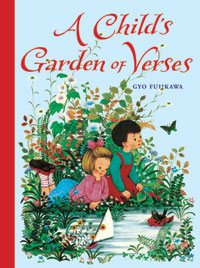 If all this wasn’t enough, yesterday we made our second trip to Mabel’s Fables. I bought a gorgeous edition of A Child’s Garden of Verses illustrated by Gyo Fujikawa, whose illustrations are absolutely timeless. As Robert Louis Stevenson’s poems seem to be too, after 125 years (and I was inspired to seek them out after reading How the Heather Looks). The classic nature of this purchase is balanced out by our others, which were (delightfully) Sandra Boynton’s The Belly Button Book, My Little Word Book, and Baby Touch Colours.
March 8, 2010
How the Heather Looks by Joan Bodger
 I was thinking of AS Byatt’s The Children’s Book when I decided I wanted to read Joan Bodger’s How the Heather Looks: A Joyous Journey to the Sources of Children’s Books. Byatt’s novel had stirred my interest in the history of English children’s literature, plus I’ve been reading a lot of it myself lately– we’re currently working on Now We Are Six at bedtime. Bodger’s book was first published in 1965, the story of a journey her American family had taken across Britain in the late ’50s in search of storybook places they all knew by heart. She was a writer herself, her husband John was a reference librarian, and they’d managed to instill a passionate love of literature in their two children, which is no wonder considering they were the type of parents who’d embark upon a journey such as this one.
The book is magical, sparkling. I was familiar with probably only about a third of the works referenced, but I’ve come away wanting to read the rest, and Bodger’s prose is so delightful, the trip itself twisty and turny and marvelous to follow along. Her research is stunning. And how wonderful: the very point is to discover whether maps they keep finding in their books’ end-pages could possibly map onto real places? And the story of what they discover is a wonderful ode to an Britain that was (times two), and a testament to the power of children’s literature.
It is pretty typical, from what I know of England, that this American family on a madcap adventure rarely finds an English person who’s read the work they’ve travelled across an ocean in search of. At the beginning of the book, the family arrives in Whitchurch in search of scenes depicted by illustrator Randalph Caldecott, and they stop at a school to ask for directions. Bodger wonders, “what it would be like to talk to children who walked to school each morning over the very fields and country lanes made famous in the Caldecott illustrations… [T]he experience [of introducing Caldecott’s work to the children] must be akin to holding a child up to the mirror for the first time and letting him recognize what it is that the rest of the world holds dear.”
The children don’t recognize what the world holds dear, however, and even their teacher hadn’t heard of Caldecott. And the Bodgers encounter this time and time again, as they go in search of Narnia, a lost colony of Lilliputians, the Borrowers’ home, of Robin Hood, Pooh’s enchanted wood, Toad Hall and Rat’s house, Camelot, Avalon, The Secret Garden, and Jemima Puddle-Duck’s garden too. Not to say that English aren’t accommodating, however. They meet with AA Milne’s widow, and Bodger stumbles upon an interview with Arthur Ransome. When Bodger has to make an urgent call to the London Library Association, the person who answered her call “did not seem in the least upset that I had asked him to find out where a fictitious water rat had entertained a talking mole.”
The Bodgers rarely find exactly what they’re looking for, but possessing spirit and imagination enough to embark on such a pilgrimage at all, they have enough too to find the magic they’re seeking. Which is partly due Britain itself, its layers of history, its mythical past (and its tea and scones, from which the family frequently takes its sustenance). Due also to the stories, their universal appeal and how they’ve endured. But also to the Bodgers’ particular appreciation of the stories, and of stories in general (and Joan Bodger would go on to found the Story-Tellers School of Toronto). These are parents who take children’s literature very seriously, which has rubbed off on their son who possesses that knowledge of battles, and history, and storybook scenes that only a small boy can. Particularly a small boy who used to rock in his crib to the beat of “Windy Nights” when his mother read the poem to him at bedtime.
In her afterward to the 1999 edition of this book (and Bodger died in 2002), Bodger warns those who might regard How the Heather Looks as a guide to family life, to creating wondrous childhoods. Indeed, however idyllic the family seems, one cannot avoid mention of what would happen to them: Lucy, just two years old in the book (“the only one among us who did not need a guidebook”, young enough to think of nothing walking into the world of storybooks) would die of a brain tumour at age seven, Bodger and her husband would divorce, her husband and son would both suffer from schizophrenia. Whichs idevastating, and terrifying– I have this naive idea that with books, we can steel ourselves against tragedy, that we have any kind of control over that kind of thing at all.
But this unexpected ending doesn’t make the book any less magical, just as the Bodgers’ locating their favourite stories in the real world doesn’t diminish the literature itself. This is the stuff that the world is made of, is all, and a rare, precious thing are writers like Bodger who can see it that way, and then write it down so beautifully too, drawing such illuminating connections. Which is why I look forward to also reading her autobiography The Crack in the Teacup: The Life of an Old Woman Steeped in Stories very soon.
March 7, 2010
Feeding the inward eye
“I suppose that an American’s approach to English literature must always be oblique. We share a language but not a landscape. In order to understand the English classics as adults, we must build up a sort of visual vocabulary from the books we read as children. Children’s literature is, in some ways, more important to us than it is to the English child. I contend that a child brought up on nursery rhymes and Jacobs’ English Fairy Tales can be better understand Shakespeare; that a child who has pored over Beatrix Potter can better respond to Wordsworth. Of course it is best if one can find himself a bank where the wild thyme grows, or discover daffodils growing wild. Failing that, the American child must feed the “inward eye” with the images in the books he reads when young, so that he can enter a larger realm when he is older. I am sure I enjoyed the Bronte novels more for having read The Secret Garden first. As I stood on those moors, looking out over that wind-swept landscape I realized that it was Mrs. Burnett who taught me what “wuthering” meant long before I ever got around to reading Wuthering Heights. Epiphany comes at the moment of recognition.” –Joan Bodger, How the Heather Looks
March 1, 2010
Freedom to Read Week: Outside Over There by Maurice Sendak
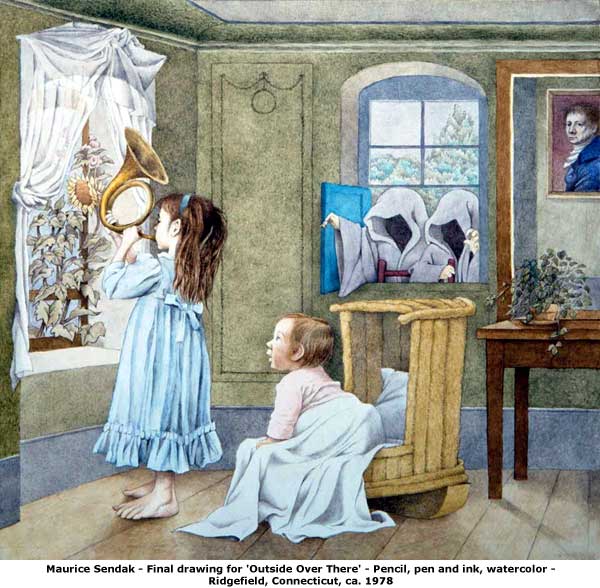 I wasn’t planning to observe Freedom To Read Week, but my Toronto Public Library local branch (big ups the Spadina Road massive!) made it particularly easy, with a display table sent up prominently by the check-out. I grabbed Outside Over There by Maurice Sendak, because I knew I’d have time to get through it, and also because I’d never heard of it before.
Now, here’s my confession: I’m not crazy about Where the Wild Things Are. It’s kind of cute, the boy in the wolf-suit, but overwhelmingly benign. (I have not read the Dave Eggers novel, but I’m going to. I have heard many good things about it, and perhaps it might open my mind to the Wild Things‘ depths?). Perhaps part of it is the playfulness of Sendak’s illustrations, as compared to Outside Over There whose pictures are positively sinister.
Apparently Sendak saw Outside Over There as the conclusion to a trilogy with Where the Wild Things Are and The Night Kitchen. (I don’t remember The Night Kitchen. I suspect this should be remedied). These three books, said Sendak, “‘are all variations on the same theme: how children master various feelings – danger, boredom, fear, frustration, jealousy – and manage to come to grips with the realities of their lives.”
So I read Outside Over There, and my immediate reaction was, “Ban the thing! Think of the children! The children!” Or at least I could see how one might jump to that response, because the book is utterly mystifying. The pictures are really frightening, the text is weird and jumbled, the story doesn’t make a whole lot of sense, and the whole book is troubling, in the way that so much about it is just not quite right, but exactly why remains elusive. I could not imagine wanting to read this book to a child, I could not imagine wanting this book to be read to me as a child (because truth be told, I always steered pretty clear of anything about goblins).
But on the other hand, if I could have got past the goblins, I could see how these would be pictures to get lost in. The baby is also a terrifically-drawn baby, who is screaming on one page and looks exactly like my daughter. Ida, the girl in the story, is the only illustrated little girl I’ve ever seen who looks like Virginia Woolf. And in the background of the pictures, strange scenes are set that aren’t explained and we’re left to wonder. To wonder too about the story, about Ida who is left to look after her sister while her father is at sea and her mother is (we assume) depressive. “Ida played her wonder horn to rock the baby still– but never watched.” So that the baby is kidnapped by goblins, Ida has to rescue her but makes “a serious mistake” that is never explained. She finds the goblins, all of whom have been transformed into fat babies. Ida only frees her sister by playing a song on her horn that turns the goblin-babies into a dancing stream but left her sister, “cozy in an eggshell, crooning and clapping as a baby should.” She returns home and makes a promise to always watch her sister and her mother, for her father, who “will be home one day.”
Weird weird weird. And how amazing is a picture book that pulls its readers so deep inside it but leaves them only mystified? A story that can’t be tied up neatly, or even properly understood, and must be returned to and considered, and flipped through again and again. Which isn’t to say that the book is necessarily good, or remotely satisfying, but there is something to it, surely. If I could only just begin to put my finger on what it is…
This 1981 NY Times Review of Outside Over There suggests the book has depths I’ve not begun to plumb– complex themes, sexual connotations, that “Mr. Sendak’s illustrations are evocative in so many different ways that for a self-conscious adult mind to enter the world of Outside Over There is to risk becoming paralyzed by the book’s allusiveness.”
According to this resource on challenged books, Outside Over There has been challenged, surprisingly, not for being maddeningly weird, but for references to “nudity, religion and witchcraft.” None of which I’d picked up on– is it possible my mind isn’t sick enough for this sort of thing? I think only the babies are nude, but are not babies often nude? (And now that I’ve started reading objections to banned books, I can’t quite quit. The Lorax “for criminalizing the forestry industry.” Murmel Murmel Murmel for “depict[ing] human reproduction”. And it would be so funny, if it weren’t actually true.
I am so glad that there exist children’s books that are so puzzling and complex and you’re never finished reading them. How much credit does that accord children’s minds, I think, and it’s brilliant. Even if the book troubles me in its vague, weird way– that kind of a reaction from pictures and a couple hundred words of text is really quite remarkable. And I’m even glad that someone wanted to ban this one, because otherwise, I might not ever have read it.
February 25, 2010
Zoo-ology by Joëlle Jolivet
 Really, this was going to be another post featuring Library Books My Child Loves So Much That I Had to Go Out and Buy (which this time was Peek A Little Boo by Sheree Fitch), but that post is going to have to be interrupted by another feature called Other Books I Bought While Out Buying a Copy of that Library Book My Child Loves So Much. (And yes, I think I have a problem).
I cannot be blamed, however, for Zoo-ology by Joëlle Jolivet is absolutely the best book ever. It’s also just knocked Rose MacCauley’s Pleasure of Ruins out of first place for tallest book in the house, and we don’t event have a shelf that will accommodate it. (Oooh! Shall we start an oversized section? What fun!).
 I’m taking very seriously the “How to Raise a Naturalist” section in E.O. Wilson’s wonderful book The Creation, and I cannot help but think that Zoo-ology will go a long way toward cultivating a sense of wonder about biodiversity. Each enormous page bursts with vivid animal illustrations (that almost look like lino-cuts), with animals familiar and otherwise. And each double page spread is organized quite magically: “In the trees”, followed by “In the seas.” “At night” and “Black and White”. And there’s “Underground” and “On the seabed”. “Spots and stripes” just might be my very favourite.
Each animal is labelled and the book’s index reveals facts about the creatures: “Harp Seal:  the young of this species has a beautiful, pure, white coat”. “Fritillary butterfly: The caterpillar of this butterfly feeds on violets”. “Chipmunk: The chipmunk belongs to the squirrel family, but does not live in trees. It lives on the ground, where it hunts for nuts and fruit.”
Oh, the stuff I’ve learned since becoming an avid reader of picture books– for example, I can now name you all the different cars on a freight train. It has been many many years since I was this aware of how much is still left for learning.
February 15, 2010
Oh, for a cup of tea and crumpets
 ” ‘Do you know, Wilmet–‘ the dark eyes looked so seriously into mine that I wondered what horror was going to be revealed next– ‘he hadn’t even got a teapot?’
‘Goodness! How did he make tea, then?’
‘He didn’t– he never made tea! Just fancy!’
‘Well, one doesn’t really associate Piers with drinking tea,’ I said.
‘He drinks it now,’ said Keith. ”
–from A Glass of Blessings by Barbara Pym
February 5, 2010
News and news
 My goodness, haven’t things around here been anticlimactic since Family Literacy Week ended. You want to know the best thing about Family Literacy Week though? That it was totally made up. True story. Family Literacy DAY was the real deal, but I thought one day wasn’t enough, so I dragged it out for another six, and then people started walking around thinking it was legitimate. At least two people that I know of! This is certainly not the first rumour I ever started, but it’s probably one of the more productive ones. It was a very good week, and I am so grateful for everyone who contributed. And I am sorry if I misled you…
 Since then, however, I’ve been busy with deadlines, and preparations, plus I’ve been exhausted thanks to this baby whose sleep habits are beyond appalling. Thanks to all of this (save the baby), however, we are on the cusp of some very exciting things. Amy Jones is coming over tomorrow afternoon for her interview (and I’ve baked scones for the occasion.) I’m starting Wild Geese tomorrow, and my Canada Reads Independently update will be posted this weekend. And sometime soon I’ll be rolling out my gorgeous new website over at my own domain! I hope you’ll all adjust your links accordingly, and follow me there. Stay tuned for the official announcement…
Of course, lately I’ve also been reading. Barbara Pym’s A Glass of Blessings, and Canadian Notes and Queries. From the latter, I especially enjoyed Clark Blaise’s story “In Her Prime“, Seth on Canadian Cartoonist Doug Wright, Ray Robertson (of the Canada Reads Independently Moody Food) “In Anticipation”. I’ve been reading Sylvia Plath’s The Bed Book with illustrations by Quentin Blake, and The Tree of Life by Peter Sis on the recommendation of Genevieve Cote. I’ve been reading Annabel Lyon on writing and motherhood. Mark Sampson on email interviews. Steven Beattie’s “The problem of sustained reading in a distracted society”. Meli–Mello celebrated Family Literacy Week also last week, and this week she’s talking about toys.
January 29, 2010
Family Literacy Recommendations from a Literary Mom: Carrie Snyder
 In between mothering her four children, writing fiction, a blog and a parenting column, and all the other things that people do, Carrie Snyder found a few spare moments to write this beautiful piece about reading with her children. Carrie Snyder is the author of Hair Hat (which is currently competing in Canada Reads: Independently). Her most recent publication was three stories in The New Quarterly 112).
My favourite picture book of all time is A Day with Nellie, by Marthe Jocelyn (the original version, not the board book, which cuts some of my favourite sections.) This book has been with our family since my eldest was a toddler. He and I read it so often that we had it memorized. Both of my daughters loved it, too, and my youngest is now 22 months and “Nellie!” is far and away the first book he goes looking for on our shelves.
The charm of this book is in its simplicity. A preschool-aged child goes about her day: from waking to getting dressed, greeting her friends (mostly stuffed animals), eating breakfast, and so on. She plays indoors in daddy’s shoes. She plays teacher in the backyard–her students include the neighbours’ cat. She makes mud, slips and falls, gets dirty, takes a bath. Each page subtly illustrates a new concept: textures on the breakfast page, emotions on the naptime page, numbers on the picnic lunch page, et cetera.
But what elevates this book to greatness is Jocelyn’s original fabric artwork. It looks touchable.  Each page is beautiful and colourful, and we could look at it for hours (and we have, and we do!). The pictures are full of narrative all on their own, which makes them perfect for the pre-reader. There is so much to point to and talk about in each picture. Nellie pouring water on her head. Nellie watching the big kids come home from school. (Particularly poignant for me, now, as I remember reading it with my eldest and watching out the window as the big kids walked home from school–and now he is one of those big kids walking home from school). I’ve never yet gotten bored of the book. And that’s high praise indeed.
The second book in the series is the best known and perhaps also the best place to start: Little House on the Prairie. The television series based on the books bears little relationship to them: there is no superficiality. This is the real thing. The writing is quite astonishing. It is straightforward, classic, and true. It amazes me every time I read it (I was about seven when my mother first read the series to us, and I’ve re-read it many times since). There is little to no analysis in her writing, no self-consciousness, just pure storytelling. That leaves room for questions, for interpretation, and it means that the experience of reading the books as an adult changes them: my perspective as a parent added new flavours and nuances to the story. Best of all, all of my children were drawn into her writing, even my eldest who is a boy. And it lead to many imaginary games of Laura and Mary and baby Carrie.