June 11, 2018
Hanging On The Telephone
 I used to talk on the phone the way I browse the internet today, aimlessly, for ages and because I was bored. I used to lie on my bed and talk for hours, winding the coiled cord around my fist and then unwinding it over and over again until the cord lost its coils altogether. I used to call up people for absolutely no reason, and if nobody answered, I’d move on to the next number in my phone book, and then the one after that. I used to talk so long on the phone that my parents would come on the line and yell at me, which was always mortifying, but that wasn’t so bad because everybody’s parents were yelling at them on the phone sometime. Sometimes in the late 1990s, it was difficult to call people with big brothers because the line would be busy and the brothers were on the internet.
When I was small, the phone was mounted on the wall in the kitchen, and eventually I would be taught to answer it, to say things like, “Yes, just a minute please,” or, “No, she isn’t, but can I take a message?” (although in my teenage years, I would have difficulty taking a message and then actually delivering it). In the mid-1980s, my family got “portable phones”, which were large with antennas, and at least once someone left one on the car and then drove away and lost it. A few years after that, I used to go to sleepovers where we’d go through the phonebook and call random people we sort of knew from school, or just dial strange numbers altogether, and say provocative things like, “Hi! Is this Kentucky Fried Chicken? Do you have any breasts?” I used to also spend hours perusing the phone book, tracking down vital info about the people I knew, like what their dad’s name was, and what their address was. Some of the people listed in the phonebook were our teachers.
I remember rotary dial, and my fascination with the little piece on the end of the dial that caught your finger and kept you from dialling around and around and around. I loved the way you could poke your fingers in the holes, and the letters attached to each number, whose purpose I could not understand. My grandparents’ phone was not attached to the wall, and it had a long cord, so you could carry it into the next room and even close a door for privacy. I remember, “Please hang up and try your call again. This is a recording.”
My parents had an antique telephone that still hangs on the wall in my mother’s house, a big wooden box with a face (bells for eyes, a big honking speaker for a nose) and I loved that phone’s expression, and how you could make the bell ring by turning a crank on the side. This phone has confused my children’s sense of chronology, however, as they now associate it with my mother, and imagine it was the kind of phone they had when she was a little girl, and therefore she is approximately 170 years old.
I used to have a plastic Fisher Price phone with a face that you pulled on a a string, but so did everybody, so I don’t have to tell you about this.
Some of the very best song about phone calls are “Sylvia’s Mother”, “Tell Laura I Love Her”, “Hanging On the Telephone”, “Beechwood4-5789”, “867-5309 Jenny,” “Hotline Bling,” and “Hello.”
When I was a teenager, my yearning for a phone in my room was overwhelming, and I wrote out a detailed three page plan in order to convince my parents I was responsible enough for this privilege. When I went to university, I had to stand in a very long line-up in order to secure a telephone line of my own, and this was amazing because then I got to record musical messages on my voicemail that I changed weekly and usually were thematic. It was at this point too that the telephone company put a $20 limit on monthly long-distance charges, which was revolutionary, and also meant that you could call people before 6:00 and not have to declare bankruptcy. And therefore I could call my friends in their university dormitories across the country, because this was still easier than having to go to the library to send them an email.
Around this time, some people started getting cell phones, but it was complicated, because they were wary of you calling them because they could be charged for the phone calls. Which I think was the beginning of me being put off phoning people. After university, I moved to England and then Japan, which were miles ahead of Canada in terms of mobile phone technology (like the phones had cameras, guys!) and maybe it was living in radically different time zones from the people I loved that got me accustomed to not receiving phone calls. When we moved to Canada, phones were crappier and plans were expensive, so I didn’t have a cell phone for years, which was fine, and here was the point where the only people who ever phoned me were my parents. I used to have everybody’s phone number in my head, but I don’t even know my own cell phone number. There was about two years where I did have a cell phone, but it didn’t have a SIM card, so basically my cell phone was a tiny expensive computer whose Wifi I utilized and carried around in my handbag.
(I phone my husband at work all day long, and he phones me in the half-hours in between that. We generally talk about nothing. I am always delighted when the phone rings and call display tells me it is him. This is how I know it’s love, fifteen years and a half years after we met. He is mostly the only reason I still have a phone.)
I hate talking on the phone now. I don’t like being bothered. I don’t like to call anyone, because I don’t want to bother somebody else. Sometimes there is a sweet spot where I’m making dinner or washing dishes, and you can phone me then and I’ll be glad to talk, but otherwise, I’d rather you didn’t.
My children don’t know how to use the phone. The only people they talk to on the phone is their grandparents, and they lack the skills to have a proper conversation this way. Recently I watched my daughter attempt to dial a number, and realized she’d never done it before. And last week our phone kept ringing off the hook because there was an election on Thursday and we’re one of the handful of people left in the province with a landline, and everyone wanted to make sure we got out to vote. The phone rang on Wednesday and I was indisposed (i.e. sitting on the toilet scrolling through Instagram) and I called to Harriet to answer it. I heard her say, “Hello,” and then nothing else. I came back downstairs and asked her what happened. She said they’d asked to speak to her mother, and she didn’t know what to do. “So I hung up,” she said. She didn’t see why this was unreasonable.
June 5, 2018
Comedy Girl

A thing I’ve learned recently is that a really good pair of sunglasses (plus lipstick) can do remarkable things for one’s self-esteem. Pictured above is me en-route to my comedy debut (and retirement) last week, the recital for the Comedy Girl Toronto class I signed up for way back in the fall and was terrifically unnerved for when April came around and the class was no longer theoretical. But I did it, slowly, slowly. In the first week, I learned that telling a funny story was not the same as telling a joke, and by the fourth week I was concerned because my jokes still seemed at risk of never becoming funny. It was also a remarkable thing to be a novice, to be a student in a classroom for the first time in years. The first class was strange because I had to swallow my instinct to be a smart-ass and make wisecracks, because I was not the funny one. None of us were the funny ones, although we all secretly fancied we were, or else why be there in the first place—but if we were already funny, what was the point. And so I shut up, and listened, and followed directions, and piece by piece our acts started coming together (although only half of our class would make it to the finish line). I worked so hard on my jokes, changing word orders, recording it over and over again—and I began to identify with the adult students in my university classes who I always resented because they were such keeners and made the rest of us look bad. If I can’t be funny, I thought (because the lesson of the class is that I’m less hilarious than I think I am) at least I can be unbridledly enthusiastic? Two weeks before the end though, I came up with a joke that was actually funny, which was a tremendous milestone—maybe one day I’ll tell it to you. I also memorized my whole set, which was a feat I didn’t think I was capable of, because I have a hard time remembering a ten-digit-phone number. And Wednesday night was the triumph, our grad show, which was so terrific because the audience was kind and generous. It was the best, and I’m pretty proud of having risen to the challenge. Grateful to the friends who came to the show as well, because taking an evening out for someone’s amateur comedy show is no small thing. I am certainly a lucky lady.


April 19, 2018
What that chip means
 Everything about the world that I didn’t learn from reading I know about from the stretch of city block below our front windows which are usually open in the summer. Every few months, a couple breaks up while sitting on our garden wall, and other couples break up elsewhere but not before fighting on our curb in the middle of the night. I’ve learned so much from snippets of conversation from people passing by, from people riding by on their bikes screaming at someone on the phone, and from the disproportionate number of individuals who stand outside rapping, beat-boxing or singing acapella. We still wonder about the person who once breezed past on his skateboard while demanding of someone on the phone this curious question, “Who goes deep inside you?” Who indeed?
I don’t get out much. And can you blame me? I’ve got British crime dramas on Netflix, and plenty of books, and venturing outside would only mean engaging with all the weirdos outside my door. Next year I’m turning forty, I work from home, and I’m pretty ensconced in my bubble. I like my bubble. But the price of my bubble is that whenever I go outside of it, I’m tremendously uncomfortable. It is most likely that I’ve been more socially awkward in my life than I am right now, but I’ve never been so aware of it. It’s like walking around with a sign on my back, but I’m not wise enough to decipher it—so I imagine every possibility.
The other week I spent the afternoon in a coffee shop while waiting to pick up my daughter, and while the place had a certain charm and also wifi, it was kind of shitty. But crowded, so the only place available to sit was at this counter at a window where the sun was too bright even though it was overcast. Two hours on a stool made my back hurt, because I am old, and there was no place to rest my feet because the part of the wall that was under the counter was a part of the wall that was nearly falling off the wall. But the tea was good, and there was baked goods. I had work to do, so I sat at my laptop, feet dangling, and listened to curious conversations from young Bohemians, like about whether it was a good idea to apply for a job at Soulpepper (“because of all the drama” [ha ha, but it wasn’t a joke]); about “Savoury Scone Lady” who comes and clears them out of the cheddar thyme scones on most mornings and refuses to make a special order so that they never have any left for the rest of the day, “But it’s good for business,” and there’s the quandary; and about the differences between math metal and Dungeons and Dragons metal, which are both genres of nerd metal—who knew? What a think to imagine yourself as a central character, and then to receive these glimpses into worlds, cultures, stories, in which you do not remotely factor.
It was not a bad afternoon. It was just strange to think about how much of the world goes on without me, how much of the world manages not even to ride its bike past my house screaming obscenities. My angst was existential, but then it usually is. I’d posted a photo on Instagram of my tea cup, which was a chipped cup. And then someone posted a comment: “Oh, Kerry, I don’t even want to tell you what that chip means.” I didn’t know this person. I thought, “If you don’t want to tell me, then why even let me know the the chip has meaning?” I’d just assumed it was part of the wall-falling-off-the-wall aesthetic of the place. I’m pretty accustomed to crockery chips—have you looked in my cupboards? But it turns out that I had been had.
Because I am totally normal, I went for the logical conclusion regarding what that chip means. Naturally, it’s the mug they all ejaculate in. Obviously. All coffee shops keep such a mug in reserve, maybe having a ceremonial communal wank at closing time on Fridays. And everybody knows about this except me, and I’m such an idiot that I unwittingly took a photograph as evidence and posted it on Instagram.
I couldn’t think of any other possibility, and did what I always do it times of distress, which is, I called my husband. I said, “I think I drank from the jizz cup.” He said, “The jizz cup? What’s a jizz cup?” I said, “It’s the cup they keep at hipster coffee shops and all ejaculate into, and then they serve people with ugly winter coats their tea in it.” He said, “What are you talking about?” I said, “I don’t know, but this person on Instagram doesn’t even want to tell me what that chip means, and what else could it mean?” He said, “I don’t know, but probably not the jizz cup.” He said, “There’s no such thing as the jizz cup.” And I said, “How do you know? As Princess Diana’s butler Paul Burrell once reported the Queen informed him, ‘There are powers at work in this country about which we have no knowledge.’”
We googled it. I am still not sure what the chipped cup means, to be honest, and maybe I am only underlining my humiliation, but the most we were able to discern was that chipped mugs are extremely unhygienic. Chips can harbour all kind of bacteria that cause disease…but honestly, who cares? It’s the reason I was born with an immune system. And if I seem particularly blasé about it, it’s only because it’s better than the jizz cup.
April 5, 2018
Love and rope and goddamn determination
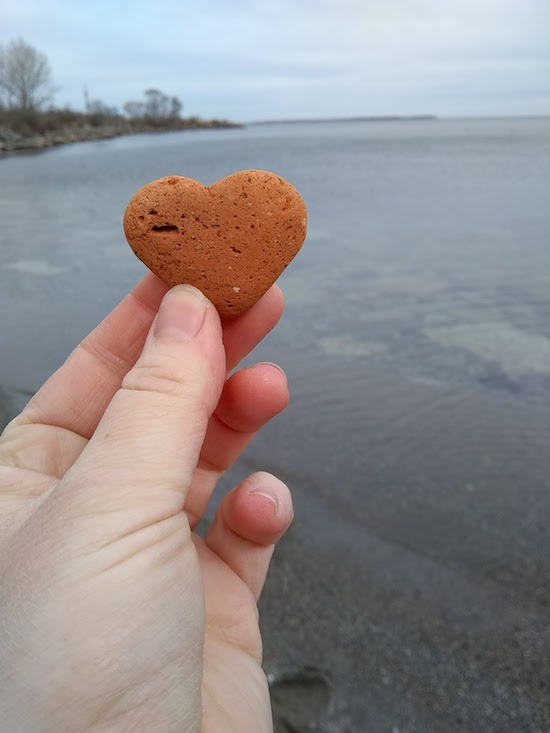
“If there is wisdom, it’s nothing I know. It’s all just birds and storms and hauntings. We look behind and scoff, as if those ahead aren’t doing the same.” —Rachel Lebowitz, The Year Of No Summer
I’ve been thinking this week about conciliation, about reconciling disparate things. All week I’ve been reading Ausma Zahanat Khan’s latest Esa Khattak novel, A Dangerous Crossing, which takes place in communities of migrants and refugees in Lesvos, Greece, who are hoping to be in transit to elsewhere. The thing about the book is how Khan shows how civil war has undermined notions of community. A point I’d never considered—how Syrians arriving in Canada don’t necessarily want to live among other Syrians, because after a Civil War there’s no longer an assumption that these people are your neighbours. The notion of a camp in Turkey for refugees who are dissidents from Assad’s regime, and who need to be protected from other Syrians who were brutalized and traumatized by these very forces. And then in the Greek camps, Greek Neo-Nazis on the fringes—there’s a terrifying scene of a group torching one of the camps. All the other countries being stingy about helping people in need, and amongst those people in need will inevitably be some who are corrupt and criminal—particularly since these are qualities that would help one survive in a war zone. And there will be rotten people in every population—including amongst the NGO and aid workers, those there to help but who instead are preying and abusive. How far go the waves of people’s capacity to be broken and awful?
I’ve also been listening to the CBC Podcast Finding Cleo, by Connie Walker, this week, another story of violence and trauma, improbable connections, and the ways in which abuses are replicated over and over. I’ve got three episodes left, but have been riveted by the story telling, by the personal stories, but also how the personal stories stand for what happened to thousands of Indigenous children across Canada for generations (and keeps happening today). A failure of systems, just like in Khan’s novel, and a failure of humanity. All these broken parts—how do we make something out oflf the pieces? Conciliate. Not to make a story, as Connie Walker has done so brilliantly, but instead to create something tangible that offers more than a promise that the story we tell in the future could be a different one.
I became unnerved on Tuesday evening after commenting on a Facebook thread (I know: why?) about my recent essay on family and abortion. This reminds me of a comment I’d heard years ago with Gloria Steinem in conversation with Jian Ghomeshi (I know, right?) about how when she first woke up to the message of the women’s movement, she thought creating change would be as simple as just explaining things so people would understand. Which was my intention with the essay, really. I will lay it all out and people will get it. Or if they don’t get it, they will still comprehend that there are things beyond their understanding—what a thing. But no.
I hope that some readers did come away from the piece with a different understanding of abortion than they had before, but these weren’t the ones posting on Facebook. I decided to leave polite comments anyway, thinking that even some dim awareness that the person who wrote that piece was a human being could represent progress. A tiny light bulb. I said, “Thank you for reading. I hope you might have learned something from considering my point of view.” But no, again.
“I have learned nothing,” one person responded. “I’ve just had it confirmed that we live in an evil world where people try to justify murdering children.” And sigh. Because what do I do with that? Furthermore, I know that many people who hold these beliefs do so because of deeply entrenched personal experiences—parenting a disabled child, experiencing miscarriage. These people’s convictions are so fundamental to who they are—I understand that. But what do we do with that? How do I, as a person without religion, reason with someone who tells me that one day I will have to atone to God for what I’ve done? And what does that person, for whom faith is everything, do with the fact that my own beliefs undermine the foundation of their moral universe? I could see how that would rankle. How do we put these pieces together? (Although the other person would posit that we don’t, that it’s the next world, the world I don’t believe in, in which all the pieces will finally fit.)
Can you see how my sleep on Tuesday night was restless and uneasy? And then I woke up on Wednesday morning and the weather was calling for high winds, and we were to beware of falling trees and flying objects. Which seemed, as my friend Nathalie put it, like perfect pathetic fallacy. I’d been wary of such things all week, metaphorically speaking, at least. And how exactly is one supposed to take care? Even wearing a helmet won’t suffice, and also wearing a helmet would be totally weird.
I was still thinking of my exchanges with the pro-lifers, the one who could not comprehend what I meant when I said that my daughter had really only existed when she was a five week old fetus because I was visualizing her as a baby, the one I desperately wanted and already so desperately loved. Because a five week old fetus is almost literally nothing, is what I meant, physically speaking. Pregnancy at five weeks is overwhelmingly perilous, but even still, I bought my daughter her first book when I was five weeks pregnant and read it to her before she had ears. But no. The woman on the Facebook thread didn’t get it. I’m not going to go back and recall what she said, but it was something along the lines of how horrifying it was that I’d be so narcissistic as to think that a person’s existence was determined by my perception alone. Which was ironic, because this person had no qualms about thinking that a person’s existence could be determined by her perception alone. Which was kind of my point all along, the way that one person’s embryo is another person’s baby. But this person was not in the mood for duality; she didn’t understand at all.
I was still thinking about this exchange when I read my All Lit Up Poetry Cure for the day (I’ve signed up to receive a poem a day in my inbox from All Lit Up Canada for National Poetry Month). The poem was “Five Weeks” by Rob Taylor (and aren’t they doing an uncanny job of very specifically curing our existential ailments; who planned that?):
Anonymous. A lima bean, they say.
No eyes or brain beneath
the flesh and blood and membrane
of my wife. But O my burning baby
anchors love within me. One day
you’ll wonder if any of this matters,
if you and it share a common bond,
if Love’s a word we pin to things
thin-skinned enough to pierce…
And here is where I thought perhaps there were answers. That I could send this poem to the woman on Facebook, and say, “This! This exactly.” Though I feel as though she’d appreciate the poem just as much as I’d appreciate her advice about what to tell God when I finally get to heaven.
While my own heart was mollified with the “Five Weeks” poem, it was still very windy, and I didn’t know how to watch out for falling trees and flying objects, let alone to make sense of the tragedy of Syrian refugees and cultural genocide. But then another poem arrived via one who knows well that poems are an everyday necessity—Vicki Ziegler. The poem was “Problems with Hurricanes,” by Victor Hernández Cruz:
A campesino looked at the air
And told me:
With hurricanes it’s not the wind
or the noise or the water.
I’ll tell you he said:
it’s the mangoes, avocados
Green plantains and bananas
flying into town like projectiles.How would your family
feel if they had to tell
The generations that you
got killed by a flying
Banana…
Which is just it precisely, reconciling the miracle and and amazingness of life itself with the absurdity of flying bananas. Later, “If you are going out/ beware of mangoes.” Always, I am aware of mangos. Of the strangeness, the sweetness, the awful violence, the golden flesh, the miracle of life, the inexplicability of everything.
“You think sometimes that things are holding still, or that just one thing is happening. That the volcano is erupting. That the Thames is freezing. That these men are fishing. That this couple here is drinking coffee, and all that is happening is the coffee in the cups, but all this time, the earth is changing, the babies and men and women are blowing off the cliff, or being held on by love and rope and goddamn determination.” —Rachel Lebowitz, The Year Of No Summer
February 7, 2018
Instagram Like a Mother
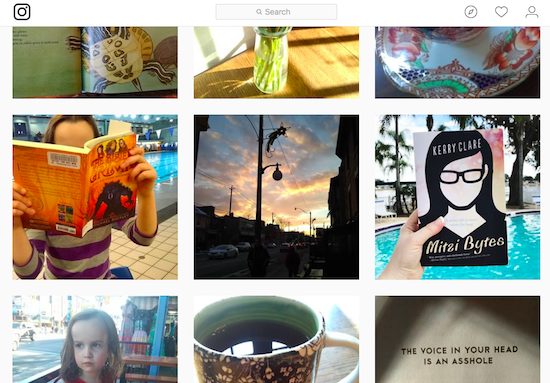
On Sunday morning I knew my panel would be on the second hour of The Sunday Edition, so I was listening when I heard Michael Enright say, “And coming up next we have three smart and funny young women…” And, oh there we are!, I thought, speaking aloud to wonder why he’d be calling us young when our collective age divided by three was at least forty. And then by the time I’d finished my sentence, Enright had already intro’d the segment, which was about Instagram and featuring three guests who were each twenty. Another panel. And I was kind of mortified, because the distance between the person you are in your mind (“a smart, funny young woman”) and how the world actually sees you is something usually best kept to oneself.
As I listened to the segment though, I started to be grateful for that distance, for how far away I am from being twenty-years-old. Because while I think of myself as essentially twenty, give or take a decade, and also more than obsessed with Instagram, that I live in the virtual world differently from these women became quite obvious. We might as well have been on different platforms altogether. They talked about their experiences of taking photos, tens and tens of photos, evaluating the angle of their nose, skin tones, and then the next step in the process is sending these photos to a whole bunch of friends to find out which ones should be posted. And the photos that make the grade are posted—but if they don’t receive the requisite number of likes in a moderate period of time, the photos will be deleted. A failure of nose angle, skin tone, and personal brand.
“That sounds like the worst thing ever,” I thought, listening to the women speak. It’s like they took the essence of being twenty—coming up with a tentative self and testing the waters, putting your face in the world and asking, “Could you like me? Could you like me?”—and made it concrete with an app. When for me, Instagram is all about colour, and wonder, and noticing things. It’s about paying attention, and marking a moment, and no matter how mundane my pursuit or photograph, there’s bound to be at least five people in my community who “like” it and they each give me such a boost. It’s about marking days and moments, seeing the ceremony in ordinary things. And even selfies, much maligned, have made me grow accustomed to and even fond of the way my face looks. I didn’t used to feel like that. Part of it was that I used to be twenty, which is a hard age to have self-esteem at, even with unlined skin and just one chin, which I never appreciated properly at the time, but also Instagram and selfies have helped to decrease the distance between the person I am in my mind and how the world sees me (even if I still overestimate my perception as ‘funny and young’). Instagram and selfies have helped me get to know me better.
“I should teach these women how to Instagram,” I was telling my husband later, the same way I teach people in my blogging courses. To make peace with imperfections, to use the aspirational side of online life to aspire to good things, to use blogging/social media as a space to wander, to grow, to get lost in. To turn the lens outward, and develop your eye as well as your I. “How to Instagram like a Mom,” is what I’d call it, and seeing as twenty-year-old women these days have a penchant for mom jeans, maybe it might even catch on.
“Or you could call it, ‘How to Instagram in a Way That Doesn’t Make You Want to Die,'” said Stuart, “since that’s what you’re selling.”
“Except they’re twenty,” I remembered. “If they had to make the choice between being like me or dying, they would probably choose the latter.”
Because even though it’s been awhile, I remember that about twenty too.
January 31, 2018
14 Seriously Underrated Reasons to Marry Somebody
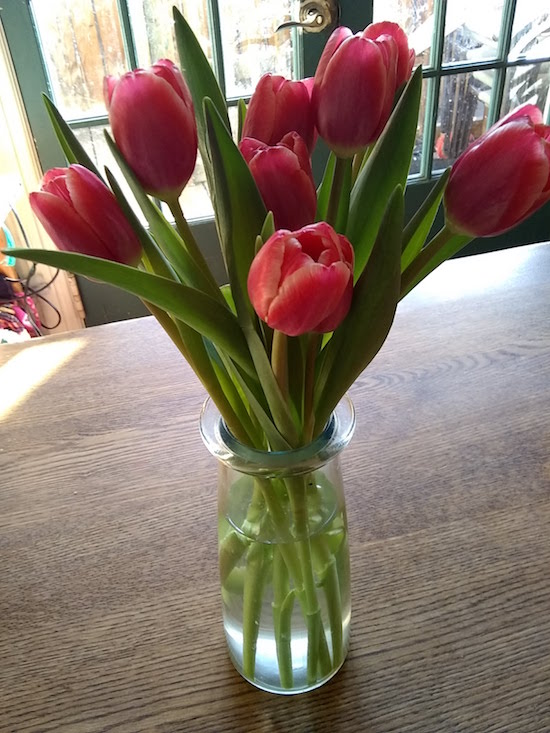
- They make excellent sandwiches.
- They don’t snore.
- They are happy to lend you the ‘u’ from their Scrabble tiles so that you can spell “wondrous.”
- They always share their snacks.
- They remember where you left your hairbrush.
- They buy you new shoes when you decide to start jogging. When you quit jogging three weeks later, they never say a word.
- They don’t hold your bad taste in pop music against you, and even dance in the kitchen.
- They know how to build websites.
- They send you texts after you finish doing something new and exciting asking, “How did it go?”
- They go to the gym but don’t talk about it or make you come.
- They will go to the bookstore for you. They will also come to the bookstore with you.
- They are as good at navigating as you are at driving.
- They are good at back rubs.
- They put the kettle on before you’ve even asked.
January 17, 2018
There Will Be Blood
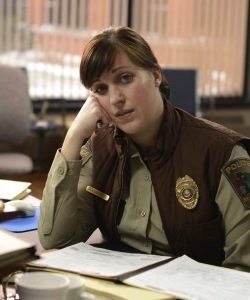 So the post I was going to write last week, before I got all riled up and furious, was a story about flossing, and also about Fargo, the perils of watching too much TV, and how excellent it is that I finally (after a decade) discovered a television show I like as much as Mad Men. And I will situate the beginning of this story about fifteen years ago when I had this fervent belief that flossing was unnatural and even harmful. “I’ve just got an aversion to anything that makes me bleed,” was the way I used to put it, but then I got health benefits, in addition to a lot of cavities, and started a serious relationship with my dental hygienist (seeing her at least once every six months) and now I find I’m putting my money in the pockets of Big Floss on a regular basis.
Basically, this is a story about life in my thirties and the wild incredible risks I take in my every day life. And about how I started watching Fargo in November was immediately infatuated, its characters living large in my mind after each episode ended. I was thinking about Molly Solverson all the time, and how both seasons one and two are partly about being a woman in a man’s world and negotiating with reality on those terms. And also how, like Mad Men, Fargo is a show that throws out the conventions of storytelling, skipping large blocks of time, having important details like weddings happen off-scene. And what I loved best about Fargo was how it doesn’t manipulate its viewers, how we usually know what the outcomes are going to be—who survives and who doesn’t, will they fall in love or won’t they—so that the details that keep us riveted are not those you’d usually expect, that it’s a different kind of tension. Not the what, but how. And how the writers have to come up with different ways to surprise us, hold us, than the usual twists of narrative.
I was also intrigued by the show’s questions and considerations of morality and character, and good and evil, which recalled Mad Men in their complexity, nuance and lack of a clear answer (which is why its all so interesting). The presence of a moral centre made the exploration of evil and villainy so much more palatable and the violence less troubling than it might have been. Mad Men was much less fixed that way—everyone was always selling out someone. (And now I’m thinking about the scene with the tractor in “Guy Walks Into an Advertising Agency,” and in its gory absurdity it was absolutely Fargo-esque.)
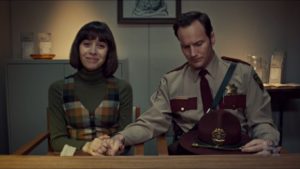 Usually I just watch TV one or two nights a week, because I tend to spend most of my evenings reading, but because the holidays are not for moderation, we got to watch Fargo every day. Which had a downside, because I started talking with the accent and saying, “You betcha” and became more than a little bit obsessed—our children had to ask us to stop talking about Fargo because our behaviour was not just alienating, it was boring. We finished up Season 1 in the week before Christmas, and went straight into Season 2, which was so different but I came to love just as much, although it was Season 1 that hit me hardest. The season finale was so full of tension I could hardly stand it, and kept having to leave the room and get away from the waiting for something to happen (which was never going to be the thing you saw coming after all…).
I’d left the room to get dental floss, because not only have I sold out to the dentist, but also because one of the great pleasures of my every day these days is the experience of going to bed. But I couldn’t stay away too long, not wanting to miss whatever happened next in the show, as much as I couldn’t stand to wait for it. So I came back, floss in hand, and perched delicately on the arm of the sofa, watching the screen over my husband’s shoulder. Dental floss wrapped around my two index fingers, so that my hands were essentially bound, and the floss and my fingers doing their work in my mouth so that I was basically gagged as well—a vulnerable position if ever I saw one, but at least I wasn’t dressed in just my underwear and running away across a barren Minnesota plain in the dead of winter. A season of Fargo had made clear that certainly things could be much worse.
But then I fell off the couch. In a few seconds that stretched out into an eternity in my mind, and I could see it all happening as it did. “This is completely ridiculous,” I thought, as I teetered on the edge, unable to call out to my husband to steady me, unable to reach out for support. Bound and gagged, I plummeted to the floor, landing with a crash that must have disturbed the downstairs neighbours. Free-falling is less romantic than it sounds, and nobody ever writes songs about the landing. It’s been nearly a month, and my wrist and elbow have been aching ever since.
But I continue to be cavity-free.
January 15, 2018
“The umbrella exists in a state of flux…”
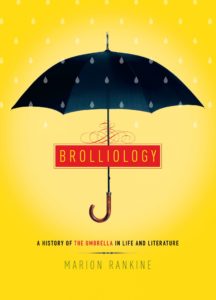 “Nowadays, in a time when most umbrellas aren’t worth the stealing and are tossed aside like sweet wrappers when they fail, umbrella theft and ‘frightful moralities’ have been largely replaced by general indifference. Like pens, plectrums [guitar pick: who knew?], and Tupperware containers, the umbrella often seems an entity that is not owned but exists in a state of flux, travelling from person to person, taken up and left behind according to various states (or absences) of mind. Think of umbrellas doing endless loops on the Circle line, the inevitable bundles in the corner of lost property offices, the umbrellas in the staff room that nobody seems to own, or forgetting which they do own, they are afraid to take one away lest it actually belong to someone else. I would suggest that modern-day umbrella ownership has less to do with a specific object than the category as a whole: one possesses an umbrella, not their umbrella.” -Marion Rankine, Brolliology: A History of the Umbrella in Life and Literature.
November 30, 2017
Eating all the pies
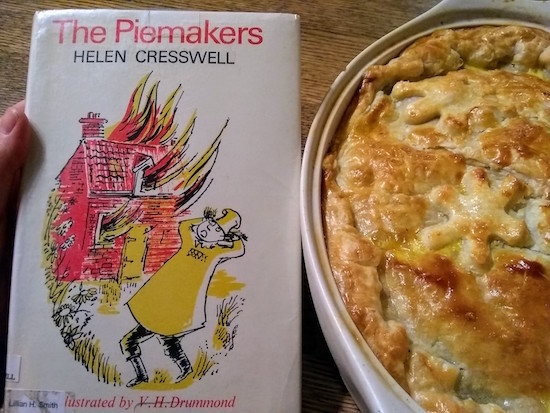
I felt very liberated when I read in a cookbook about pies that one should use store-bought puff-pastry always, because attempting to make puff-pastry from scratch was just stupid. I don’t really know if the author of my pie book is an authority (according to wikipedia, she’s an interior designer and pies are just a sideline) but I’m not going to ask too many questions, because puff-pastry makes pies so easy. Savoury pies, I mean, as in for a meal. I still have pretty strong feelings about pastry from scratch for fruit or dessert pies. But puff-pastry means you could have a meat pie on the table as an easy weeknight supper. And we were all over that while we were reading The Piemakers, by Helen Cresswell, which our librarian recommended to us recently and we read-aloud with pure delight. A story that reminded me so much of The Borrowers in tone that I kept forgetting that the characters were not miniature—although the giant pie dish in which they float down the river didn’t make the scale any less confusing. It’s about a family of pie-makers—the daughter is called Gravella, named for Gravy—and it all goes wrong when they get the opportunity to bake a pie for the actual king. (Too much pepper, cough cough.) But then they get another chance to redeem their pie-making reputation, and everyone in the village pitches in, and (spoilers!) the result is a pie-making triumph. We loved it. But it made us hungry. And let me tell you the other best thing about store-bought puff pastry? That it’s sold in packages of two.
October 26, 2017
Dozens of Umbrellas
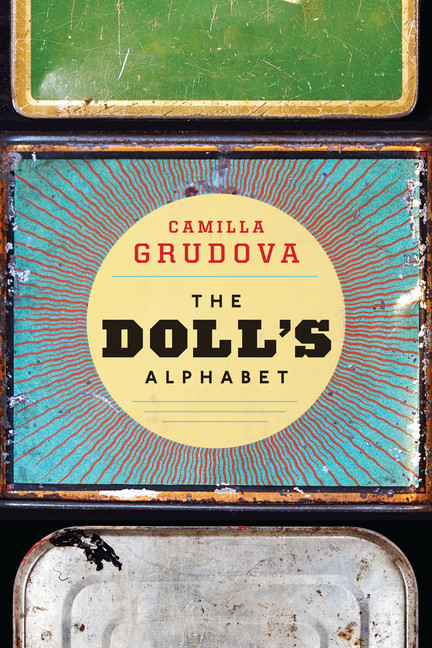
“In the meantime, I found work in a dollhouse shop. We sold tiny things to put in them, from lamps to Robert Louis Stevenson books with real microscopic words in them. Peter got a job in a graveyard, installing tombstones, digging graves, helping with Catholic burial processes, and cleaning up messes. He would find diaphragms, empty bottles of spirits, squirrel kinds left over from hawks’ meals, and dozens of umbrellas. He brought the umbrellas home, until our apartment started to look like a cave of sleeping bats. I had an umbrella sale one Saturday when he was at work:
ALL UMBRELLAS TWO DOLLARS AS IS
It was an overcast day so I did well for myself. ”
—From “The Mouse Queen,” by Camilla Grudova, in The Doll’s Alphabet