November 4, 2008
Novel About My Wife What Happened?
At least a few times a day, according to my webstats, somebody will land on this site because they want to know “Novel About My Wife””What Happened”. And these poor people must perpetually go away quite disappointed, because neither my book review nor interview with the author are especially illuminating in that respect. I mean, if you’re looking for some plot summary, then I’m your man, but I’ve a feeling these people are seeking something a bit more specific. Something more like, what in heaven’s name was all that chaos at the end?
Full disclosure: I’ve got NO idea. Author Emily Perkins knows, and I know this because I asked her. In the vaguest terms though. What a waste! I had in front of me the only person who could answer that all-consuming “What happened?” question, but I thought it would be rude to pry. I figured if she’d wanted me to know, she would have put it in the book, but I did want to know if she knew. If what happened to Ann Wells was ever nailed down as a fact.
Perkins said, “No, I do have it. And I had written versions where the gaps were more filled in, but in the end I just thought the thing about Tom is that he is trying to investigate or work out the truth of his wife, but the point of the book for me is that he’s left it too late. He had his chance to look her in the eye and be with her in a real way and he was so busy, caught up in himself, romanticizing her and being in love with the mystery and not wanting to know. I didn’t want to let him off the hook for that…”
And so we’re implicated too as readers, because the text is Tom’s creation. His blindness becomes our own, which is annoying for a reader who has been invested in Ann as much as possible, unlike Tom. Annoying that we’re invested in Tom’s point of view rather than Ann’s, but that’s interesting too. A pretty powerful narrative device.
I can be a generous reader. If a book or a story is good enough, I am willing to make concessions. The best lesson I ever learned as a reader was in my graduate creative writing workshop, when we were told to look at what we determine as flaws in our classmates’ stories,
and to try to understand what the writers might have been doing. Not even what they were trying to do, but just imagine everything is deliberate. Imagine this author actually knows what she’s doing, and as a reader that was such a revelation. It wasn’t as though the stories became perfect then, but new doors were opened for analysis and understanding. We learned that just because a story isn’t the way you’d like it to be doesn’t necessarily mean that story isn’t the way it is supposed to be.
Which means that when I first read Novel About My Wife, and when I read it again, though I was not wholly satisfied with so much unknowing, I thought the narrative gaps had some purpose. Of course I had suspicions of what might have happened to Ann, and with the rest of the story so full, I was content with my own speculations. (I have also learned to love short fiction, as I’ve mentioned before, which has well equipped me to be able to make much of pieces I am given.)
Not everybody else was so content though. I started thinking when I read this review, and the following line in particular: “Perkins’s attempt at ambiguity draws the reader in, but does not completely provide the insight needed to satisfy.” Which is entirely right, and I had really failed to consider whether satisfying the reader might be the point. I still don’t think it’s the entire point, but perhaps it’s more important than I considered. Alternatively, could readers be looking for satisfaction in all the wrong places?
Update: for a bit more insight on what happened to Ann, check out the fascinating comments on Rachel Powers’ blog.
October 31, 2008
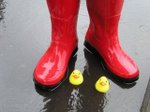
Someone left The Good Book out in the rain
 On Sunday during a walk in the rain, I came across The Good News Bible lying on a ledge. Perhaps a sign, but I didn’t notice it; I took a photo instead.
October 26, 2008
Pickle Me This reads about werewolves
 I would never have read Living With the Dead had I not heard Kelley Armstrong read as part of the Kama Reading Series last year. “New York Times Bestselling Author” though she is, Armstrong did stick out in this group of literary writers. The first story she read that night had been published in an anthology about Vampire birthdays– “Really,” she had to say, because no one in the audience would have believed in such a thing (in vampires or anthologies about vampire birthdays). We weren’t exactly her kind of crowd, but Kelly Armstrong wooed us. Self-deprecating, hysterically funny, and a wonderfully engaging reader, she was a star of the show that night, which was something for a woman who’d had a problem with her GPS and ended up in Mississauga instead of at the ROM. I was very glad she made it to the right place eventually.
So I wanted to read her latest book, from her “Women of the Otherworld” series, because Armstrong herself seemed terrific. But also because I never would have read it otherwise, and I am eternally curious about my own tastes and prejudices. I have an appreciation for popular fiction, but I avoid “genre” like the plague, which isn’t entirely fair, because I’ve never even been exposed to it.
It’s not strictly bookish, though, my aversion to genre and fantasy. I don’t even like The Princess Bride, which frustrates some people to no end. I think it all stems from when they made us watch The Neverending Story one rainy day in grade one, and after being traumatized by the horse sinking into the quicksand, I wanted nothing imaginary ever again. Which is strange considering how much I love fiction. The truest literary form I know, but I like fiction to recreate the world I live in and not make itself another one.
I never got into watching Buffy or Angel, until we moved to Japan. There was only one English channel on TV, so you could take it or leave it, but even when I left it, my husband didn’t and as our apartment was only one room, I couldn’t help overhearing. I couldn’t stop paying attention either, because Buffy and Angel were really good shows. Well, except for the vampire/fantasy stuff, which I tuned out to. Without those elements, these would have been perfect shows for me.
Which was the way I felt about reading Living With the Dead. That it was a fun, plot-driven novel, and I could even overlook the werewolves and half-demons when they weren’t integral to the story. The story of Robyn Peltier, PR rep. for an obnoxious celebutante for whose death she has just been framed. She enlists her friends– said werewolf and demon (though Robyn doesn’t know this about them)– for support as she tries to prove her innocence, and also tries to avoid a strange violent woman who is determined to stay on her trail. The woman wants something from her, but Robyn does not know what. For there is so much she has to discover– including the true identities of her friends, who she can trust, and who she can’t.
That I wasn’t in love with Living With the Dead isn’t the book’s fault, for I don’t suppose I was ever meant to be its ideal reader. For some people, I think, the demons and werewolves would be main attraction, but I still don’t get that. That I read the book all the way through and enjoyed it, however, is a credit to Armstrong’s excellent plot. So it’s not the book, it’s the genre. Could be that such books require significant investment? Living With the Dead— a pretty long novel at 372 pages, containing a folklore and vocabulary all of its own– demands more effort than I would typically allot to my pop-fic. You really have to want to get this stuff, the werewolf nitty-gritty, but unfortunately I just wasn’t that determined in the end.
October 13, 2008
My turn for Whats and Whys
Rebecca Rosenblum ponders why she reads the books she reads, the last ten books she has read specifically, concluding that reading is social, however solitary in practice. Her post inspiring Naya V. to consider some of her own bookish choosings. And inspiring me as well, though findings may not be so revelatory as I’ve written here about how I came to some of these already. Nevertheless.
- Forms of Devotion by Diane Schoemperlen (now reading), because Rebecca Rosenblum gave it to me for my birthday and now it is time.
- The Transit of Venus by Shirley Hazzard, because it was a paperback portable for vacation, and because it came recommended via the impeccable taste of Rona Maynard.
- The Boys in the Trees by Mary Swan, also because it was a paperback. Because it was longlisted and shortlisted for the Giller. Because it was Rona-recommended, and recommended by Maud Newton and Stephany Aulenback as well. (Oh, and now by me too. This is the best book I’ve read in ages).
- Between Friends: A Year in Letters by Oonagh Berry and Helen Levine. I picked this up at the Victoria College book sale not just because it was a collection of correspondence but because reading a newspaper feature when the book came out inspired me to embark upon a similar writing project with my friend Bronwyn.
- Good to a Fault by Marina Endicott, because I wanted to all the books on the Giller list by women (which was easy as there were only two).
- Flowers for Mrs. Harris by Paul Gallico. Also bought at the book sale, and I was originally attracted by the gorgeous (only slightly damaged) pink dust jacket, and then I remembered that I’d read writer Justine Picardie raving about this novel on her blog.
- What It Feels Like for a Girl by Jennica Harper. Jennica is my favourite poet, and her first book The Octopus kept me up all hours the first time I read it, and so naturally I would read her new book the second I could get my mitts upon it.
- Babylon Rolling by Amanda Boyden. I don’t remember why I read this book at all, perhaps for no real reason, which is probably the reason I was so surprised to love it.
- When Will There by Good News? by Kate Atkinson. Um, because Kate Atkinson wrote it. And everything she touches is gold– except for Emotionally Weird, but I’ve forgiven/forgotten already. Everything else though.
- The Diving Bell and Butterfly by Jean-Dominique Bauby. My spectacular Amy Winehouse costume won me this book as a prize at an Oscar Party back in the winter, but I hadn’t got around to reading it. My husband had, however, and was obsessed with it, and insisted that I read it too, and it was as wonderful as he promised. And now we can finally rent the movie.
September 25, 2008
Astrobiology
From our Rap Songs Commissioned to Drum Up Interest for Unfashionable Topics file (see Hip Hop Wordsworth Squirrel), we bring you “Astrobiology”, NASA’s rap about the search for life in outer space.

September 13, 2008
Oishi-desu, ne?
 In Japan, one lives to eat, or at least one travels to eat, for every city or region is famed for some kind of delicacy which must be indulged in on a visit. (In our city Himeji, it was conger eel.)
It is also important that when you do travel someplace, to bring back omiyage— a (n often edible) souvenir– for friends and co-workers back home. It is a slight not do so, and every city– and the train station in particular– will have numerous gift shops full of such delights.
When we lived in Japan, I had a co-worker whose boyfriend was working in the city of Nagoya, and she’d often go to visit him on her days off. And though her visits were quite regular, she never dared an omiyage lapse, and she would usually bring us back uiro— the snack for which Nagoya is famed. Uiro is a sweet snack of pounded rice, loaded with sugar. It comes in a block that appears kind of waxy, has a consistency not dissimilar to cheese, and I love it. I am a uiro glutton, which was fine as most people were unable to get past its strange appearance and texture, so there was always plenty for me. I still keep an eye out for it in the Asian shops around the city, but not a sign of it have I seen.
Last month before our neighbours left for their trip to Japan, I’d asked if they’d be going to Nagoya. I was being a bit flippant– their trip would be a whirlwind, wedding and honeymoon all in one– and really I just wanted a chance to reminisce about the pleasures of uiro. But I should have known– Japanese people take omiyage very seriously, and any kind thing a Japanese person has ever done for me has been mindblowingly beyond the call of duty.
They got back this week, and we were hanging out in the backyard last night when I was presented a box of uiro. It turns out that their shinkansen had passed through Nagoya, making a brief stop. My neighbour asked the attendant how long the stop would be, and she said one minute and a half. My neighbour tells his wife, he’s going to chance it. He says that if he doesn’t get back on, he’ll take the next train and meet her at the end of the line. But he makes it. In 90 seconds, he managed to buy my heart’s desire, get back on the train, solidifying all suspicions I’d ever had regarding his superheroism. As well as his wife’s patience, their generosity and all-around infinite goodness.
So we’re savouring the uiro at the moment. Tiny slices, we want to make it last. What a fabulous surprise! It’s as good as I remembered.
September 1, 2008
Very Strange
 When I realized in June that the colours of my dress coordinated so perfectly with a Miriam Toews novel, I thought it was a marvelous sort of coincidence. But what to make of it now, Toews’ new novel The Flying Troutmans such a perfect match for my other favourite summer dress? Have I failed to notice book designers rummaging through my closet for inspiration?
September 1, 2008
Her reading aloud had killed
“When Lydia was alive, my grandmother seemed content with her reading; either she and Lydia took turns reading to each other, or they forced Germaine to read aloud to them– while they rested their eyes and exercised their acute interest in educating Germaine. But after Lydia died, Germaine refused to read aloud to my grandmother; Germaine was convinced that her reading aloud to Lydia had either killed Lydia or had hastened her death, and Germaine was resolute in not wanting to murder Grandmother in a similar fashion.For a while, my grandmother read aloud to Germaine; but this afforded no opportunity for Grandmother to rest her eyes, and she would often interrupt her reading to make sure that Germaine was paying proper attention. Germaine could not possibly pay attention to the subject– she was so intent on keeping herself alive for the duration of the reading.” –John Irving, A Prayer for Owen Meany
August 22, 2008
Alternatively…
Alternatively, from a rather strange book called Great British Short Novels (circa 1970, which I bought for a quarter and from which I am currently rereading Heart of Darkness) we find this:
“Given its narrow confines, a short story cannot probe character beyond a few basic traits. It cannot allow for great scenic detail or elaborate plot to illuminate the conduct of its protagonist. Effective as a means for providing sudden insight or creating a powerful emotional impact, it cannot diffuse its focus to include anything beyond the immediately relevant.” –from “Introduction: The Art of the Novella” by Robert Donald Spector