July 23, 2009
Weird Books I've Loved
 I like to say that I love books of all kinds, though that’s not strictly true. There was a time, however, when it almost was, when I was little and covetted the most bizarre volumes. Books I’d snobbishly deem unworthy of capital-B Bookishness if I was consulted now. But then, oh. My library contained numerous books such as Mysteries of the Unexplained (“How ordinary men and weomen have experienced the Strange, the Uncanny and the Incredible”). I was obsessed with these books, and they always had photos of “ghosts” on staircases, and even kind of looked like ghosts if you just squint your eyes a bit (and otherwise they looked like a white glare). Also stories of children as reincarnated witches, and green children discovered living alone in the countryside.
I also had a book that explained the meaning of one’s dreams. I’d covetted this, hoping that the underlying theme of all my dreams would turn out to be, “You’re going to have a boyfriend one day”. I think my book was a Dream Dictionary, alphabetical, of course. With entries like, “Dreams of unicorns symbolize a longing for an idyllic age”, or perhaps something that makes even less sense, like “Unicorn dreams mean you’re worried about rain.” Trouble was, I never dreamed of unicorns, or anything else that could be alphabetized. And I never really needed a dictionary to decode the fact that perpetually dreaming of being chased by outsized dogs might mean acute anxiety.
I also had a baby name book. This was long before babies were a remote possibility (though don’t think I didn’t go through the entire volume to figure out the perfect first and second names for each of my four (!) future children. I think that was around the time I wanted to name my kids Bianca). I really did read the whole thing multiple times, and I’m still not sure what the attraction was. How helpful was it really to know that Margaret meant “pearl”? Name meanings are about as helpful as dream analysis. But I might only think this because my name is a kind of terrier.
July 21, 2009
On women's fiction or women in fiction, again
“Lisa Moore gets better and better,” I wrote last month under “Recently Discovered” whilst reading her latest novel February. And then an esteemed acquaintance of mine emailed me asking, “When?” For he was reading February himself at that moment, and wasn’t getting into it at all. “A fairly conventional historical romance” was his initial assessment, disappointingly, because he’d enjoyed Moore’s previous work, and he wondered when he’d discover the brilliant bits of February that had so appealed to me.
I probably shouldn’t have told you that. What I really want you all to do is go out and read February, and to love it just as much as I did. In fact, I really thought that love would come with no trouble, that my feelings towards the book were so straightforward as to be universal. “It’s a rare thing,” I’d written, “a perfect book”, and I really thought that much was obvious. (And reviewer Caroline Adderson certainly thought so too.)
So I was surprised to find that another fine reader had found the book so unappealing. “When does the book get good?” he asked, of this book that had won me over with its very first sentence, “Helen watches as the man touches the skate blade to the sharpener.” Here was a book very much in the present, very much in the physical world, and I’d never read a novel that started as such, and so I wanted to read on.
Perhaps it was lazy to just figure the differences in our opinions had to do with gender. “Maybe this is a women’s book?” I suggested, and he replied a bit put-off by both my suggestion and also by a writer who would write a book that would shut male readers out. Turns out reviewer Alex Good had made an assertion similar to mine in his Toronto Star review: “This is a deeply maternal universe. Time and again, sympathy, solicitude and kindness for strangers are evoked. There are “geysers of love” and motherly feeling for vagrants, gas station attendants and of course the unborn. There is no sense of evil, aside from nature’s rage in the sinking of the oil rig, and hence no conflict. The narrative doesn’t progress so much as gestate, roiling around through a series of flashbacks until the hatching and matching at the end.”
Exactly! Good has encapsulated what I loved about the novel exactly: the pervasive good, the ruminating narrative, the sense of gestation resulting in such a satisfying conclusion. Except, of course, he means none of this in a good way. And I wonder about this, and reviewing in general– about how a description such as his is shorthand for “this book is bad/not literature”. And about how “this book is bad/not literature” gets to be a shorthand for simply, “It didn’t grab me.”
Is a novel bad because it’s a “women’s novel” or a “man’s novel”? As a woman, I don’t find Hemingway bad, even with all the bullfighting. Of course, there are novels that don’t fall into gendered catagories, and though universality is to be desired, I think that my very favourite novel Unless by Carol Shields (which is a maternal universe, if ever you’ve read one) is actually better for its specificity. I can understand how Unless might not be immediately appealing to a lot of men, but surely they could overlook that to see its literary merit.
But then, what is “literary merit”, right? Someone will inevitably argue “aesthetics”, but no one has ever been able to explain to me how “aesthetics” is not just a fancy way to explain away books one doesn’t like. In his review, Alex Good faults February for lacking conflict and a “fast-paced, forward moving” plot. So, in essence, he faults the book for not being a different book altogether, for not being the kind of book that would appeal to him, and I’m not sure that’s altogether fair.
I write this not as an attack on Alex Good’s review (which was actually far more interesting than most reviews I read) but to expand upon the ideas the review prompted for me. To remark upon my surprise that February did not appeal to everyone, and to ponder what “gendered” writing is all about. Good says the gendered nature of the book is not what bothered him, but rather “that those [gendered] parts of it are so transparently the stuff of commercial fiction.” But what does that mean? Rings, to me, like that common dismissal of women’s writing in general being un-literary and merely the stuff of commerical fiction. (Strange that Good suggests a fast-paced, forward-moving plot would have saved the material from being commercial fiction, for isn’t plot what commerical fic is made of?)
Has Lisa Moore let her readers down by writing a “women’s novel”? This very question, I think, is dismissive and sexist. But irrelevant, then, if there’s no such thing as a “women’s novel” at all. And is it dismissive and sexist to say that there is?
July 16, 2009
Good Text
From the Descant blog, Katie Franklin on her feminist erotic bookclub and desire for books: “In The Pleasure of the Text Roland Barthes insists, “the text is a fetish object, and the fetish desires me” (Barthes 27). As a librarian I see how the public forms relationships with their books. Patrons come in exacerbated if the paperback they’ve put on hold hasn’t come in yet: “What do you mean my book hasn’t come in? I need it now!” Such outbursts of desire, which may seem more natural in the bedroom, are often common expressions at the circulation desk of the library. However, I don’t blame them for their yearnings. Everyone is entitled to some good text.”
July 13, 2009
Bits and pieces
I am so excited to read the final volume of the Anne books— I wasn’t aware such a volume existed, and wonder if it’s actually finished, as its form sounds quite fragmentary. But no less, my favourite Anne books were the last bunch (House of Dreams, Rainbow Valley, Anne of Ingleside and Rilla of Ingleside), precisely for their dealings with “serious” and “darker” themes this book supposedly contends with– I couldn’t help but think about Anne’s stillborn baby in light of Montgomery’s own experiences, Leslie Moore’s marriage, WW1, the pied piper and Walter’s death, when Anne fears Gilbert has ceased to love her, etc. Guardian blogger discusses the “dark side” of Green Gables. Bits of A.S. Byatt’s The Children’s Book called Rainbow Valley and Rilla of Ingleside to mind, actually, and Dovegreyreader interviews Byatt here. Speaking of interviews, Rebecca Rosenblum answers 12 or 20 questions. And speaking of nothing at all, 30 Rock ripped off the Muppet Show, why our federal tax dollars should not fund jazz, and Russell Smith on baby slings (he says do avoid the polyester).
July 13, 2009
Fiction inspired by fiction
How one book leads to another is something I’ve always found fascinating. I’m now reading A Passage to India, as inspired by Kate Christensen’s Trouble and its Marabar Caves reference. Kate Sutherland asked about this recently (on FB, I think): fiction reading inspired by fiction reading, and she cited reading The Epic of Gilgamesh because of The Girls Who Saw Everything. I know that I watched Vertigo after reading Francine Prose’s Goldengrove, but can’t think of any other fiction I’ve read directly inspired by fiction off the top of my head. I’ve been meaning to get around to reading Great Expectations as inspired by Mister Pip, but as I haven’t yet, I don’t think it counts.
July 9, 2009
Awful Library Books
 My friend K. (of the unfortunately now-defunct Pop-Triad) sent me a link to my favourite website of the day, Awful Library Books, which includes texts such as the one whose cover is seen here. The site features books that might be listed as “required weeding” from American public libraries, and I enjoy the bloggers’ commentary as well (“I think the guy in a wheelchair is saying to the woman, “Do I really have to dress like Mr. Rogers?”). You’re also invited to send your own submissions.
June 21, 2009
A different kind of swim lit
The story is tragic, and I don’t wish to undermine that, but I am so absolutely intrigued by this part: “As her family told The Globe in a lengthy letter responding to an interview request, ‘She even combined her two passions for reading and fitness by figuring out how to read a book while swimming laps.’” I can’t even begin to imagine how this could be accomplished. A book enclosed in plastic wrap? A page skimmed at the end of every lap? An audio book and a waterproof Sony sports walkman? Regardless, I am impressed.
May 22, 2009
Yellow House
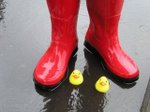
 Our house is being painted. Anyone who knows our house will also know that this is very good news. That no longer will we live in the shabby blue house, but in the freshly painted yellow one. I think this counts as upward mobility. We are very excited, and glad Baby won’t have to be embarrassed at its premises. We’re also getting a great deal on the painting (ie we’re renters, and so someone else is getting the bill). The only downside is that the last few days I’ve had to endure such disconcerting sights as this one.
May 22, 2009
Books Without Which
Here is a list of books without which I would have had to imagine up my own anxieties throughout my pregnancy. Thankfully, however, these works came with their own inspiration.
- The Monsters of Templeton by Lauren Groff: Willie Upton returns to her hometown “in disgrace”, and what happens in her pregnancy is a plot hinge I’ll not here reveal, but you should read the book to find out why I thought I was crazy.
- Middlesex by Jeffrey Eugenides: We wanted to find out our child’s gender, but nobody would tell us. So ever since I’ve been convinced that it doesn’t have one. Time will tell.
- Like Mother by Jenny Diski: A baby without a brain! It can happen! It happened to Diski’s Frances, but she was horrid, but then sometimes I am too.
- The Fifth Child by Doris Lessing: The Lovett’s fifth child is a monster who destroys the family, not to mention kicks the crap out of poor Harriet’s womb. The perils of banking too much on domesticity and cozy kitchen tables.
- Novel About My Wife by Emily Perkins: The pregnancy goes just fine, and baby Arlo is a dream, but the whole experience brings Ann’s repressed demons back to the surface. I don’t actually have repressed demons, but what if they’re just really repressed?
- Rosemary’s Baby by Ira Levin. Speaking of demons. Because how can you be sure your baby is not the spawn of Satan? And I mean really sure.
- We Need to Talk About Kevin by Lionel Shriver. Was it nature or was it nurture? Regardless, somewhere along the line Eva went wrong, and brung herself up a high school killer. And it could happen to you (ie me).
- The Baby Project by Sara Ellis. I actually read this book twenty years ago, but skimmed through it recently in a book store because I thought it might be cute. No. SIDS, oh my, and then I started to cry. So the anxiety isn’t going to stop with the birth, it seems. No bumpers on the crib for Baby!
- The Girls by Lori Lansens. I didn’t read this while I was pregnant, so didn’t notice the potential trauma of the birth scene, but then I gave it to a friend who was pregnant, and let’s just say she was plenty relieved to see just one head and four limbs at her first ultrasound.
- Consequences by Penelope Lively. If I read a lot of 19th century literature, surely I’d see even more mothers dying in childbirth. Which is one reason I’m really glad that I don’t read a lot of 19th century literature.
May 14, 2009
The Pattern in the Carpet by Margaret Drabble
 Oh, but I do wish A.S. Byatt and Margaret Drabble would settle that petty spat about the tea set. You see, they’d have so much to talk about. I just finished reading Drabble’s latest book The Pattern in the Carpet, whose reviewer in The Telegraph was quite correct with “What a puzzle: Margaret Drabble’s memoir cum history of the jigsaw cum paean to her rather dull aunt shouldn’t really work. But somehow, in the end, it seduces.” It did. I’d also listened to the Guardian podcast of an excerpt from the beginning of the book, and so the whole of the book I read in her voice.
It was a very strange book, the kind they don’t let you write unless you’ve been publishing for nearly fifty years and they indulge you. Such permissiveness a good thing, because the book is fascinating. (I’m not sure it will come out in Canada. It is a very English book. Estimates of a limited audience here might be correct, but then again they may not be). The book, of course, is a puzzle in itself (though if I were English, I’d call it a “jigsaw”), made up of memoir, family history, and the history of the jigsaw puzzle. Which comes to encompass a history of games, of amusements and pastimes. (And why does pastime not have two s’s, I wonder, but anyway…) Also a history of childhood, and children’s literature too. Told most unsentimentally, and Drabble admits she’s never had much of an interest in childhood, or explored it in her fiction. But she’s looking backwards now, in light of her own age and her husband’s illness, perhaps because, she admits, she dreads of looking forward.
But The Pattern in the Carpet is hardly a personal indulgence. Drabble was indulged instead in being permitted to publish a book that “shouldn’t work”, whose pieces do not fit together neatly, and together form a whole that is quite difficult to explain/contain. Entire chapters as digressions, anecdotes fitted in for no other reason than that they’re interesting, moving from jigsaws to mosaics, to the city as a jigsaw, production and marketing of children’s games, and reconstruction of ruins, and the “Teas with Hovis” cups and saucers from her auntie’s bed and breakfast. Something called a warming pan, and how Drabble’s mother liked electric blankets, but for Drabble herself the novelty wore off and she sticks with hot water bottles now.
I loved it. Now I’m pretty partial to Margaret Drabble anyway, and have readily embraced her admittedly strange more recent novels that might have put her long-time readers off. But I suspect these readers will find the new book appealing as well, even if they lack interest in the subject matter (and I really couldn’t have cared less about jigsaw puzzles before this book. Now I’m just a little bit inspired). The book is a veritable curiosity shop, scattered with sharp thinking, wonderful questions, and Drabble’s meticulous prose.
But yes, she needs to talk to her sister. Byatt also has a new book out, The Children’s Book, which I was resisting. I don’t love A.S. with the same lack of reserve with which I love Drabble, plus The Children’s Book is 600+ pages and I’m having a baby in a week and a half. The book might just be heavier than the baby, but then I read this review at Dovegreyreader Scribbles, and more thoughts upon the novel over at Crooked House. And now I simply must have it, baby or not. Particularly because of how it relates to The Pattern in the Carpet, to childhood as an invention and its literature. I’m looking forward to it. And maternity leave pre-baby has brought on the return of my ability to focus, and so this whole “reading” idea is not as idiotic as it might seem in the time being.