July 5, 2010
Reading like a pirate
Harriet has learned to point, so now she’s the master of her index finger, and this afternoon she mastered it directly into my left eye. Which means that I’m just now back from the walk-in clinic, after four hours of being last in the queue because everyone else was hemorrhaging. It was the longest uninterrupted stretch of reading I’ve had for as long as I can remember, even better than the two hours I spent waiting for a passport last summer. Someone reading a Nora Roberts novel kept trying to talk to me, but I was hardly going to waste such a precious opportunity on small talk, particularly not with someone reading a Nora Roberts novel. No wonder she was distracted, but I wasn’t, which was wonderful. To read for hours, without stopping, without the compulsion to check my email, lacking the means to do so. Seated in a comfortable chair just made for ophthalmology, never minding the fluorescent lights, or that I periodically had to cover up one eye and read my book like a pirate. I read the second half of Katha Pollitt’s book, and reread (for the fifth time) the first third of Slouching Towards Bethlehem. I was actually disappointed when the doctor finally arrived, but not so much when he told me that I was fine. Just a tiny scrape on my cornea, and nothing a little over-the-counter wouldn’t fix, and then it was out of the air-conditioning and and into the heat, and onto the subway to read my way home.
June 27, 2010
Unsad Lemon Cake
 This is a slice of the lemon chocolate cake I baked after reading The Particular Sadness of Lemon Cake last week. I think I may have a new compulsion to bake every fictional cake that I encounter, or maybe it’s just any fictional cake I encounter as written by Aimee Bender, who writes about food and eating in such a concrete, tangible way, rendering the ordinary extraordinary. Whose description simultaneously blows your mind and has you going, “Yeah, I know exactly what you mean…” Anyway, the cake was good, and devoid of sadness. I wonder what kind of fictional cake I’ll encounter next?
June 22, 2010
Important Artifacts 2
I’ve been thinking more about “thingness” as narrative since reading Carin’s comment on my last post (and it was her review that brought me to read Important Artifacts and Personal Property… by the way). She remarked that the hipster aspect of Lenore Doolan and Harold Morris’ life together was probably to emphasize its emptiness, that it all looked very slick but was without substance. That a couple can’t build a life together on vintage bathing suits alone. And so Shapton’s text was to be a counter-narrative to the thingness then, making clear what was going on beneath surface? I’m not totally convinced, but it’s an interesting idea to consider.
What I am convinced of, however, and what the book makes clear, is that these glimpses we’re given into other people’s lives (whether by auction catalogues, lit windows or Facebook data) is often so deceiving. Partly because what we glimpse is so contrived, (which is Shapton’s entire point), particularly since social media is such a performance. Because I’m all too aware of the view of my window from the sidewalk, because I’ve actually spent my whole life cultivating such a view, but you’re never really going to know what happens when I pull the blinds down, are you?
Motherhood is the best example of this, particularly its presentation via social media. I was devastated last year when my daughter was born, and I found my feelings in the days afterwards so far from the obligatory “Kerry is totally and utterly blissed out and in love with her gorgeous new daughter” status update. Everybody writes statuses like that, and I absolutely couldn’t, and at that point I didn’t know how many moms were just more capable of lying than I was (or of being “blissed out in love” in addition to having a pretty terrible time, but the terrible time itself they never cared to mention). All all of us have a “just given birth, baby on the chest” photo somewhere in our Facebook stash, but it so doesn’t begin to tell my story. We let it stand in for the story, because it’s more comfortable that way, but that doesn’t even begin to stand in for the real thing.
Of course, it’s not supposed to. Online anywhere is not the best place for private life anyway, and there is something to be said for keeping some things to yourself. But I must say that I was fooled by the Facebook motherhood narrative. The blissed out love, the dreamy photos, the quiet baby asleep in a bouncy chair– it did not convey the effort it took to get that baby to sleep. The effort it took to get that mom out of her pyjamas. I felt so incredibly inadequate for not being able to put myself back together as easily as my FB friends had, for being thoroughly miserable when I should have been blissed out in love. I had been expecting blissed out love because I’d perused so many of the pictures. And how could a picture lie?
But they do. They don’t just withhold– they totally lie.
There is no longer such thing as a candid shot, if there even ever was.
June 21, 2010
Harriet gardening
 You probably shouldn’t let your baby dig in soil with a spoon. Because while spoons are good digging implements, they’re also good for delivering items to the mouth, and though Harriet’s spoon/mouth coordination is not always right on track, it certainly was the time she ate a giant spoonful of soil… So it was kind of a milestone, times two if eating dirt is also a milestone. Is it?
June 19, 2010
Important artifacts
 I just finished reading Important Artifacts and Personal Property from the Collection of Lenore Doolan and Harold Morris, Including Books, Street Fashion, and Jewelry by Leanne Shapton, the devourable if gimmicky story in the form of auction catalogue. And thought I do think it must have been exhausting for Doolan and Morris to be so insufferably hip at all times (did these people never buy anything at The Gap? did they ever tire of the kitchsy salt-and-pepper shakers and vintage everythings?), I loved the book a lot, though in the same way I like peering through strangers’ windows, looking through people’s bookshelves, and perusing Facebook albums of people I’ve never met.
If Shapton’s intention is to tell a story through physical objects, however, it’s worth remarking upon that she doesn’t succeed. Sure, the story is told, but it’s words as usual that do the job– lists stuck into paperbacks, exchanges scrawled on theatre programs, letters unsent and otherwise, emails, and postcards. In essence, Important Artifacts is an epistolary novel, the artifacts themselves serving as espistle storage devices.
Without the epistles, the objects lack in resonance (though they do add a postmodern layer of veracity to the narrative in the same way the family pictures in The Stone Diaries turned that book into something much fuller than a novel). The objects don’t tell the whole story though, just as a view through a window doesn’t, or a bookshelf, or any infinite number of Facebook albums– but why are these things so compelling all the same?
I wonder if– outside of fictional realms– such fragments come closer to a kind of truth than anything else can? And I wonder how much of the pleasure lies in making the connections by ourselves.
June 14, 2010
I am having an affair
 …with this yardsale-purchased breadbox. We have decided to move in together.
June 12, 2010
Fiction on the way
I don’t read much on public transit anymore, because I’m usually carrying my daughter in the Baby Trekker and entertaining her by making faces at our reflection in the windows. But today I had a trip with two subway legs, then the streetcar, and by the end I’d had enough, lamenting that there is no Poetry on the Way these days, because I really was craving a little reading break. When I got on the subway to go home, however, I was pleased to board a car full of book ads, and one of these was a book excerpt. It was wonderful! I don’t care that it was an excerpt from Sophie Kinsella’s Twenties Girl, which is certainly not a book after my heart, but it won it a bit today anyway. As I stood there hugging a pole, going through enough text to give me a taste of a story. It was the only remotely entertaining subway ad I’d encountered all day (and I’d encountered more than a few!). A wonderful idea, and I think more marketers should do this…
June 11, 2010
Words that Harriet can respond to
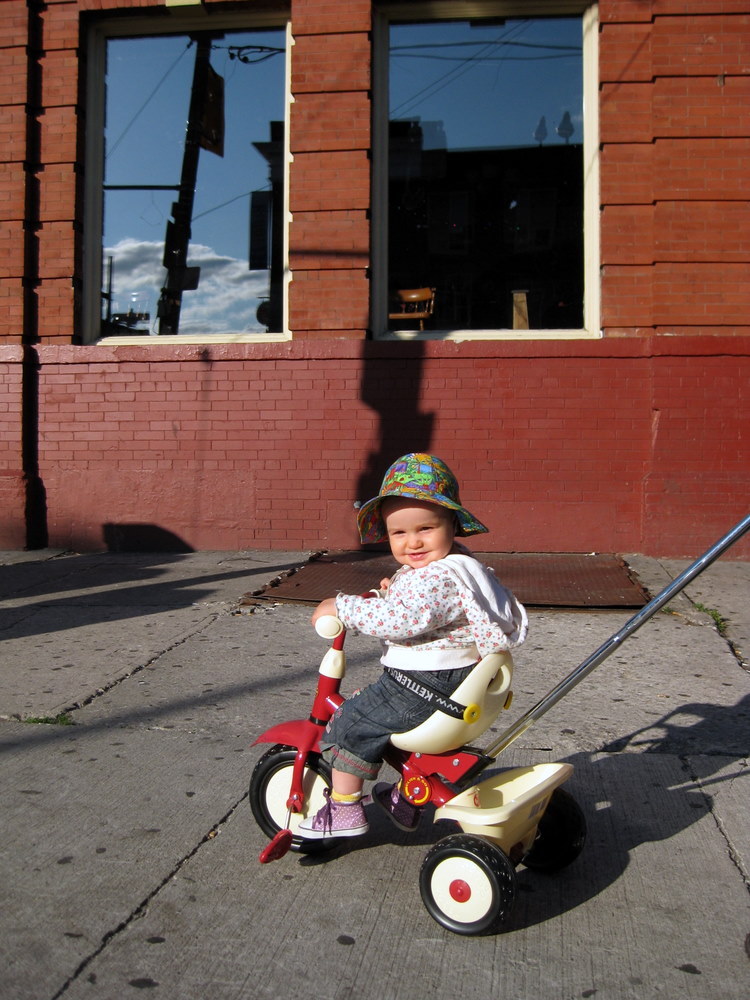 1) Teacup
2) Miffy
3) Book (which is always whatever book I am reading, not any of her own)
4) Tea Party
5) Eeyore
6) Nose
7) Harriet
8) Mommy and Daddy
9) Hat
10) Monkey
11) Blocks
12) Big Dog and Little Dog
13) Elephant
14) Hairbrush
15) Please
16) Bellybutton
June 6, 2010
Literary Bananas
 The most recent object of my fruit obsession was the wondrous pomegranate, and before that I was nuts about avocados. For the past six hours, however, I can’t stop thinking about bananas. It’s not the first time– when I was pregnant, I ate bananas all the time, and obsessive-compulsively baked with them. Yum, those trimesters were banana pancakes, banana bread, banana cake, banana SPLITS, and my daily snack of a banana stuffed with chocolate chips melted for thirty seconds in the microwave.
This latest banana fixation is a bit different. It all started a few weeks back when we visited the Royal Botanical Gardens, checked out their banana biodiversity display, and learned that there actually exist thousands of varieties of banana, that sometime in the middle of the last century the “Cavendish” was decided as the banana of choice for exporters, and these days it’s the only banana around. Which means that bananas in general are threatened, because biodiversity has been completely undermined and as the Cavendish is under threat by a menacing fungus, we may be on the fast track toward the banana version of Silent Spring.
And then today I ate a plantain for the first time in my life. I fried the pieces, using this recipe, and topping it with sheep’s milk feta from Monforte Dairy, and it was the most extraordinary treat I’ve had in ages. I was so busy marvelling at the flavour that I scarcely noticed my husband polishing off the whole plate of them, and he’s just lucky I like him a lot or I really might have considered divorcing him. Instead, we decided to go out and find another plantain, and so tonight’s after-dinner walk was devoted to seeking out banana biodiversity in The Annex neighbourhood.
Results were poor. We went to five grocery stores and found nothing but Cavendish varieties. Finally, at an Asian grocery store at  Bloor and Palmerston, we found another plantain. (The first one had come from Augusta Fruit Market in Kensington. I wonder if we’d sought banana biodiversity in Kensington, perhaps we’d have better luck? But I doubt it). We both do remember seeing red bananas at our local grocery store once years ago, and we bought them, but either red bananas are terrible or we didn’t let them ripen, because neither of us remembers this experience positively.
Plantains though, oh wow. And bananas in general– like anyone with a baby, I bow down to these. We had a fun snack of black beans and bananas a few weeks back, that suggested to me that the lovey fruit is more versatile than I ever imagined.
Anyway, now I am going to read the book Banana: The Fate of the Fruit That Changed the World. (And you can bemoan these hyperbolic titles all you want– heaven knows that I have–, but it’s sort of nice that when one becomes obsessed with any object, one can rest assured that a recent book has been written devoted to it. These are not such terrible times in which we live, save for the banana biodiversity threat, but I digress).
Have been thinking about other literary bananas too– did you know that the term “banana republic” comes from an O Henry short story (though I do, only thanks to Wikipedia)? The first one I could think of off-hand was the bananafish, from “A Perfect Day for…”, which (allegedly) had six bananas in its mouth, tragic being that it was. I think literary banana peels are quite ubiquitous, but I’m not sure they count. It’s the flesh that I’m talking about. And there’s Banana Yoshimoto, who is probably the most literary banana going. But I can’t help thinking there must be a whole bunch more out there (ha ha).
Um, this post is also certifiable proof that I lead a life much unencumbered.
May 27, 2010
Dear Carrie Bradshaw
I never understood why it didn’t work out with Aidan. My sister has tried to explain it to me, how you and Aidan didn’t have *it*, and how apparently you found *it* with another man who was never very nice to you. This all reminds me a bit of that book that came out a few months back that implored women to “settle” and defined “settling” as marrying someone who is kind, stable, and good. Undermining the value of *it*, it seems. But in your case, didn’t *it* really come down to a closet?
I liked you, Carrie Bradshaw. When I was lonely and sad, I loved that you were a Katie Girl, and it gave me courage to be myself. I know it is pathetic to get courage from HBO, but it was the turn of the century and I was a bit shallow, and so were you, but that wasn’t the whole of it either, was it? I loved your friendships, and I loved your friends. I loved your voice overs, and your laptop screen. Neither of us could have been so entirely shallow, really, because I’ve never known a shoe that wasn’t orthopedic, but I liked you, Carrie Bradshaw, still.
I liked you, though you’ve done harm. You have! The number of women I know who don’t believe it’s love unless it’s tumultuous– that’s down to you, CB. Who believe that tumult=passion. Not to mention a predilection for really expensive shoes and bags, and really expansive debt. I’m not sure that before you, these things were considered normal.
I liked you though, but I don’t think I like you anymore. I’ll never really know, because I haven’t seen your latest movie and I don’t plan to, but I saw a preview and I’m disappointed. Unsurprised, but disappointed. Because in your new movie, you appear to take a look at your life (the not-so-nice, emotionally unavailable man you married, your closet) and determine that the problem is marriage. That marriage is boring, and passion gets stale, and then you run away to become the Sheik of Araby (and here, the preview lost me).
Though I am still a bit green when it comes to marriage, that I’ve been doing it for five years is nothing to scoff at. And I’ve been pretty good at marriage, actually, right from the get-go, when I made a decision to marry a man who wasn’t an asshole. It was him, actually, who took me away from a life in which courage was HBO. So yes, in a way, it seems I required a man to save me, but he saved me from you, Carrie Bradshaw, and your fashionable post-feminism. And I’ve been pretty happy ever since, having put away the angst, the drama, the tumult, and without that baggage, I’ve gotten a lot of really good things done. If he hadn’t come along, I really do fear that I might have whiled away my twenties wearing a necklace with my name on it, and I wouldn’t even have been you because you’re a fantasy. I would have been wearing orthopedic shoes and I would have still been sad.
Marriage is wonderful, Carrie Bradshaw. It is a fine institution, and of course, it’s what you make it. And it’s not for everybody, maybe even not for you, but I resent how you deride it. I resent that the same women who’ve spent their twenties thinking it’s not love unless somebody’s throwing things are going to think that marriage should be more of the same. And that when the throwing stops, that’s boring.
Carrie Bradshaw, you’re boring. You make adolescents look mature. If you were real, I’d throw something at you, and that’s not love.
Yours sincerely,
Kerry






