November 16, 2010
The Royal Wedding: My Hunger For Good News and Happy Endings
 I don’t believe in fairy tales, except for the “happily ever after”, and I think that’s meant to be the part that’s suspect. Even so, it’s totally baffling why I started crying this morning upon hearing on the radio that Prince William and Kate Middleton had become engaged. I don’t really care about celebrity weddings, I think any country in this century would be better off without a royal family (unless, of course, I was the queen), princess fetishization makes me sick, and back when Prince William was everybody’s favourite pin-up, he was never ever mine– so why am I so overjoyed? Why am I fully prepared to set a clock for whatever o’ clock in the morning one day next summer, and all set to run out right away to buy a commemorative plate, or cup and saucer?
I was only two when Diana married Charles in 1981, though I do remember the excitement of Prince Andrew’s wedding to Sarah Ferguson a few years later. What I remember most about the first royal wedding, however, is that my Nana had their commemorative plates displayed in a rack in her dining room, and that we totally loved Diana. To be so unjaded– I long for that. I learned the expression “on the rocks” from the headline of a supermarket tabloid a few years later, and I remember my mom reassuring me that Chuck and Di were not so– the newspaper was a rag, she said. It hadn’t occured to me that Prince Charles might want to be somebody’s tampon, never not even once.
This evening in a nostalgic mood, I referred to the authoritative text on the 1981 Royal Wedding, which was The Secret Diary of Adrian Mole aged 13 3/4. How he felt it was his “patriotic duty” to hang bunting in the street, and his disappointment in his father whose celebration consisted in hanging a Charles and Diana tea towel on the door. “ROYAL WEDDING DAY!!!!!/ How proud I am to be English!/ Foreigners must be sick as pigs.”
Anyway, I do believe in “happily ever after”, though the world keeps conspiring to prove me wrong. Not always, however– miracles happen. Remember the time my next door neighbour rose from the dead? And now Tabatha Southey has gone and been returned to the Globe and Mail, because they were clearly nothing without her. So maybe William and Kate will stay as happy as they look, and I’ll never have to explain what “on the rocks” means to Harriet, or if I do it will only be in the context of Jordan or some Kardashian.
November 9, 2010
Soap and Water
CBC Metro Morning was so delightfully bookish this morning, with pieces including an interview with Giller juror Michael Enright who had nearly read himself to death these last few months. And an interview with Dr. Alison McGeer about the decision to take magazines out of waiting rooms at Women’s College Hospital. Which was shocking for a few reasons, including 1) They still have waiting rooms at Women’s College Hospital? 2) But who will subscribe to Highlights for Children? 3) Who cares!? Doesn’t everybody have a novel in their purse already??
Since Harriet was born (which was nearly 1.5 years ago!), waiting rooms have offered me more uninterrupted reading opportunity than anywhere else. When she was about two months old, I waited for over two hours at a Passport Canada office while she slept in her stroller and I read (oddly enough), Between Interruptions: Thirty Women Tell the Truth About Motherhood (which was about thirty times more truth than I needed at that moment, by the way. Reading it was totally exhausting).
I had to go to the dermatologists early this summer and Harriet stayed home with my Aunt, while I got an entire subway journey there and back AND an extended waiting room round with Sarah Selecky’s marvelous This Cake is For the Party. There was a large screen TV in the waiting room too, which was blasting an episode of The View which made me very depressed about the state of the world, but Selecky’s stories really helped.
And then the legendary night this summer after Harriet poked me in the eye, and I waited in the walk-in clinic for six amazing hours reading Slouching Towards Bethlehem. It was also the middle of a heat wave, and the clinic was far more air-conditioned than my house was. I was almost disappointed when the doctor could see me then, though relieved to discover that I would not go blind.
All of this to say that I will not miss the old copies of Macleans then, or Shape, or Women’s Day, but then maybe I should have read them more, if only to absorb the diseases they’re apparently crawling with, so I’d get sick, go back to the doctor’s, then get to read some more.
November 7, 2010
A Fuzzy Realm
 The fact was that I struggled with Sheila Heti’s book, How Should a Person Be? About what it meant to call that book a novel, a novel that contains its author as a character, a book whose gratuitous sexuality I found more off-putting than titillating, a book that read like a punchline to a joke I’d missed hearing told. Though I engaged with the book on many levels, at various points jotting, “This is interesting…” in the margins, and throughout as I tried to understand what Heti’s project was.
Part of the problem, I think, was that Heti came from a point of departure that didn’t quite make sense to me. For instance, that the blow-job is the great art-form of our time, as the novel was to the 19th century. Or that “personality is just an invention of new media… characters exists from the outside alone”. I think I’d also have trouble with any protagonist who remarks, “It would have been so easy to count the ways I’d been betrayed by girls… It was not that way with men.” There are instances in the book where the protagonists’ all-knowingness is subtly undermined enough, however, that I wondered if the glibness was more wry than I gave it credit for, but I was never really sure.
Throughout the book, however, I kept thinking of Joan Didion, not because she and Heti are at all similar, but because Didion’s entire oeuvre seems to address a lot of the questions that Heti is posing. Didion who says that “We tell ourselves stories in order to live”, with Heti eventually answering her own question with Didion’s backwards: “A person lives by telling stories.” Except that the stories Didion tells take her far outside herself, far from home. Whether through actual travel, engaging with different kinds of people, or other works of literature. Didion has this amazing way of telling other people’s stories, but still making herself the centre. A strange, self-effaced blurry centre, but still the point everything else revolves around. And it’s this blur that Heti will engage with.
In trying to answer, “How should a person be?”, I can’t help thinking that Sheila Heti should have just read Didion’s essay, “On self-respect.” The essay referencing a difficult time similar to that endured by Heti’s protagonist, when “[one loses] the conviction that lights would always turn green.” Says Didion, “Although to be driven back upon oneself is an uneasy affair at best, rather like trying to cross a border with borrowed credentials, it seems to me now the one condition necessary to the beginnings of real self-respect.” And that self-respect stems from “character”, which Heti has determined is a societal construction (but maybe she’s being ironic? I don’t know). Joan Didion, however, has no truck with that: “character– the willingness to accept responsibility for one’s life.”
Self-respect, according to Didion, is a kind of investment. It’s not about never failing, never making mistakes, but rather knowing what you’re getting into, meaning what you say and the things that you do. And this kind of thinking, she writes, requires “discipline, a habit of mind that can never be faked but can be developed, trained, coaxed forth”– that there is no magic pill for it, then, or book with all the answers, or a drug that makes everything clear. Self-respect stems from knowing ourselves from the inside, keeps us from being “in thrall” to everything on the outside wherein, “At the mercy of those we cannot but hold in contempt [for if we don’t respect ourselves, how do we respect those who associate with us?] we play roles doomed to failure before they are begun, each defeat generating fresh despair at the urgency of divining and meeting the next demand made upon us.” Which is kind of the entire plot of How Should a Person Be?
Part of my problem with Heti’s book is that some of her questions did make me uncomfortable– what it means to think we’re important enough to be doing something important, or that any of us matter that much, and what that the stories we tell ourselves in order to live feature characters we’ve constructed with such tireless precision. Her honesty may have struck a nerve. But she places herself above reproach in a way that’s really a bit dishonest– in making her art so much about her, we can’t engage with it without engaging with her character, and as a reader, I’m not comfortable with the ethics of that. I’m not sure the material is so well served by existing a fuzzy realm somewhere between fact and fiction.
But maybe I’m missing the whole point– perhaps Sheila Heti never did really want to be the ideal of what a person should be. Perhaps in posing such a notion, she was really making a comment on our shallow, celebrity obsessed culture in which the blow-job is the ultimate art-form. And that in proclaiming the blow-job as the ultimate art-form, she is deriding a culture that might proclaim the blow-job to be the ultimate art-form, but I still don’t really understand what she means by that, so you can see why I’m a little bit lost.
November 4, 2010
Found things
1) Who knew metaphors were so useful? Who knew a box could be so poetic.
2) The very best postbox in our whole neighbourhood. Also has a delivered package waiting in the door. Coincidence?
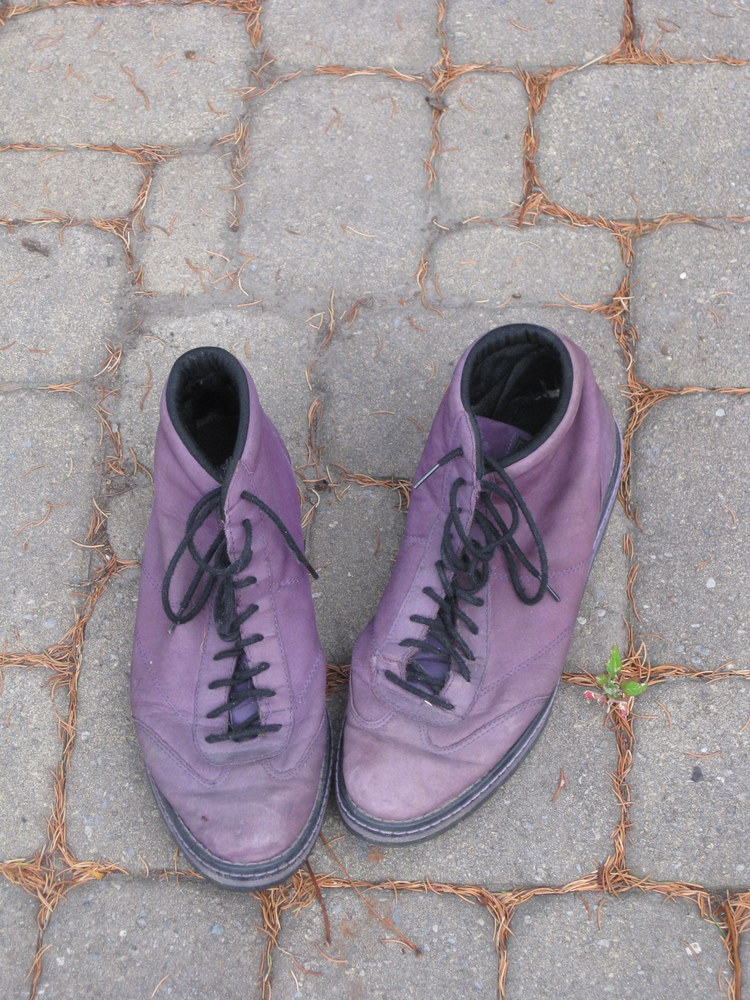
3) We found Mabel Murple’s shoes abandoned on the sidewalk!


October 27, 2010
Do the Grandpa
Stuart was excited to discover the 20 Awesomely Untranslatable Words from Around the World, in particular “Iktsuarpok”, which is an Inuit word meaning, “To go outside to check if anyone is coming.” Iktsuarpok actually is translatable, at least into our family shorthand, in which “to go outside [or to the window] to check if anyone is coming” is to “Do the Grandpa”. Both of us remember pulling up to our grandparents’ as children, and seeing Grandpa appearing at the window because he’d been listening for our car. Which is to say that both our Grandfathers had either keen ears, or rather empty days, or maybe they had both sometimes, or traded one for another as their lives got longer. Or maybe it’s to say nothing in particular at all, because both of us from time to time find ourselves Doing the Grandpa too.
October 20, 2010
Harriet has a meta moment
 Okay, I’ll admit to not being exactly capitivated by the plots, but 17 month old Harriet is absolutely obsessed with the Hello Baby Board Book series by Jorge Uzon. These books have only lived in our house for a very short period, but Harriet keeps taking them off the shelf and demanding they be read to her. When she isn’t demanding they be read to her, she is struggling to walk around the house holding all four books at the very same time. Clearly, Uzon has found an audience for his beautiful photography.
Our favourite part of all the books, however, is in Go Baby, Go! when the baby discovers another baby within the pages of his book. And the amazing thing about this is that he has discovered the Night Cars* baby! We love Night Cars, and pointing to the baby (who, when he finally falls asleep, has an adorable tendency to stick his bum into the air) is Harriet’s favourite part of the book (except for the fire truck). So to see the baby in her book pointing to the baby in her book, and then to point to that baby herself– I think Harriet is discovering that the bounds between fiction and reality are ever-blurry. Or maybe I’m just projecting.
*Do you know Night Cars? The absolutely gorgeous urban bedtime book by Teddy Jam, who was aka the late novelist Matt Cohen? I bought this book for Harriet when I was four months pregnant, and signed the inside cover “from Mommy and Daddy”, which was kind of amazing then. And still is. Its rhymes punctuate our days– “Garbage man, garbage man, careful near that dream. It could gobble up your garbage truck, and then where would you be?” Also notable for being a book about *Daddy*. And donuts.
Anyway, I didn’t know this book either until I heard Esta Spalding reading it as part of Seen Reading’s Readers Reading almost two years ago. And I am very glad I did.
October 5, 2010
Lionel Shriver and Carol Shields
I never plan to read Lionel Shriver and Carol Shields, one right after another, but it keeps happening, and every time it does, it underlines to me how much their work has in common. Not tone, of course– you don’t have to tell me twice. But they’re always writing about the same things, about intimacy, domesticity, about love, and marriage and relationships. The parallels are really uncanny– I think I read The Post-Birthday World and The Republic of Love together before, and the similarities blew me away. Now I’m rereading Small Ceremonies (Shields’ first novel, and stay tuned for me singing madly about just what a fantastic novel this is) after We Need to Talk About Kevin, and though two novels might never have been more different, they share many of the same pre-occupations. As demonstrated by the following two excerpts:
“My fantasy house would be old, Victorian. If it had to be big it would be high, three stories and an attic, full of nooks and crannies whose original purpose had grown obsolete– slave quarters and tackle rooms, root cellars and smokehouses, dumbwaiters and widow’s walks. As house that was falling to bits, that dripped history as it dropped slates,that cried out for fiddly Saturday repairs to its rickety balustrade, while the fragrant waft of pies cooling on counters drifted upstairs. I’d furnish it with secondhand sofas whose floral upholstery was faded and frayed, garage-sale drapes with tasselled tiebacks, ornate mahogany sideboards with speckled looking glass. Beside the porch swing, struggling geraniums would spindle out of an old tin milking pail. No one would frame our ragged quilts or auction them off as rare early American patterns worth thousands; we’d throw them on the bed and wear them out. Like wool gathering lint, the house would seem to accommodate junk of its own accord: a bicycle with worn brake shoes and a flat tire; straight-backs whose dowel rods need regluing; an old corner cabinet of good wood but painted a hideous bright blue, which I keep saying I’m going to strip down and never do.”
“The house that I once held half-shaped in my head was old, a nook-and-cranny house with turrets and lovely sensuous lips of gingerbread, a night before Christmas house, bought for a song and priceless on today’s market. Hung with the work of Quebec weavers, an eclectic composition of Swedish and Canadiana. Tasteful but offhand. A stufy, beamed, for Martin and a workroom, sunny, for me. Studious corners where children might sit and sip their souls in pools of filtered light. A garden drunk with roses, criss-crossed with paths, moist, shady, secret.”
September 30, 2010
On the loss of another great columnist
Dear Mr. Stackhouse [Editor of The Globe & Mail],
I wrote to your paper when you cut your books section down to nearly nothing, and I received a kind reply thanking me for my input. I am sure this message will elicit a similar message, if any, but please do allow me to say how saddened I am that Tabatha Southey will no longer be writing her vibrant, brilliant, relevant, smart and hilarious column in the Saturday Globe. Reading it aloud was a Saturday morning ritual in our family, and between the column’s absence and the now-tiny books section, it’s clear to me that you’re not that interested in me being one of your readers. Which is a shame, because I’ve been a devoted one, who understands the importance of a strong national newspaper, and relishes print for print’s sake. The whole thing makes me very sad, and I think we’re all going to look back on this time in journalism with a great deal of regret. I do already.
Sincerely,
Kerry Clare
[And seriously– no Tabatha Southey & Karen Von Hahn in The Globe, no Katrina Onstad in Chatelaine— these are publications that are killing themselves. It’s totally stupid.)
September 29, 2010
Things in the bag
 The following is a list of things in the bag that Harriet carries around the house and cries when we take away from her:
1) Two plastic teacups
2) Belinda-Mona’s shoe
3) Harriet’s shoe
4) Whatever socks Harriet is meant to be wearing
5) A can of sardines
6) A plastic saucer
7) A small tin pie-plate
8) A coaster with a picture of the Sargeant Pepper’s Lonely Hearts Club Band album cover on it
9) A pink crayon
10) Conkers
September 18, 2010
Dear Graphic Designers
 Dear Graphic Designers,
If you would like to buy your product solely based upon its packaging, please create a package that looks like the Clipper Tea tea box. I will buy it. I don’t care what you are selling, but I will buy it. And then I will bid you a “Well done” for creating a cardboard box that makes me feel like a better person for simply possessing it.
Love, Kerry






