May 7, 2008
Elizabeth Hay Blog Tour Stop
I am so excited to announce that over the next few weeks, Pickle Me This will be a stop on Elizabeth Hay’s upcoming blogging tour of the Canadian North. Her award-winning Late Nights on Air was one of my favourite books of 2007 (and read my review here). Other stops have included The Book Mine Set, The Library Ladder and Metro Mama. Now over to our guest blogger Elizabeth Hay…
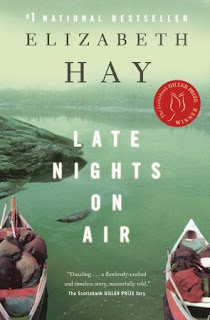 May 8, Dawson City, Yukon: Last night we walked back to the hotel from the bar at Bombay Peggy’s and though it was close to midnight, it could have seven in the evening. The light is uncanny. The sun goes below the horizon, but not far below, turning the depths of the night into radiant dusk.
To get here we drove the Klondike Highway north from Whitehorse. Even in the aftermath of massive forest fires marked with white signs – forest fire of 1998, forest fire of 1953 – the sky and the contours of the land made for unbroken beauty. Night before last I did a reading in the village of Mayo, attracting a handful of interesting folk, and afterwards we walked along the dike next to the half-melted Stewart River. May is a good month to be doing readings from a radio novel since the air is full of sound – break-up, birdsong. They say the best place to see wildlife is on the edges between habitats, and it seems to me that’s the best place to see nervous life of all kinds – on the edges. In the case of Late Nights on Air, that would be the edge between listening and speaking.
We rolled down the hill to the bathroom in our sloping motel room in Mayo. At least one of the rooms in that motel had something I coveted, an ElectroMaid from the 1950s, a self- contained unit of three burners and tiny sink with fridge below. Perfect for anyone with a love of the past and gypsy-like inclinations.
In Dawson City I made something of a faux pas, not taking off my shoes when I entered the library. Dawson’s streets are dirt, in keeping with its true-to-the-past historic self, and everyone protects the library’s indoor carpets. Again, people were receptive, informal, generally relaxed. Yukoners strike me as fiercely proud of the Yukon and eternally glad to find themselves here. Lulu Keating, the filmmaker, has made her home in Dawson. Over drinks in Bombay Peggy’s (former brothel and now an elegant hotel with lurid overtones), she and others at the table seemed altogether pleased with their lives in this isolated, culturally rich, dreamboat of a place. Charlotte Gray, a friend from Ottawa, is the current writer-in- residence at Berton House and she has slipped into life here with graceful ease.
We’ll take the Klondike Highway south to Carmacks for another library reading tonight. Tomorrow, Teslin. Then on Friday I’ll leave the Yukon and fly to my old stomping grounds of Yellowknife in the Northwest Territories – setting for Late Nights on Air.
May 6, 2008
But Not Quite
I heard today’s quote on the radio, from an American woman who’s had enough of the Democratic Primary:
It’s almost enough to make me turn off the television.
May 6, 2008
Novel About My Wife by Emily Perkins
 (Read my interview with Emily Perkins here.)
It was interesting, the many ways Emily Perkins’ Novel About My Wife complemented my recent reading of The Girl in Saskatoon. Both books about the impossibility of recreating life out of words, as well as the struggle to define a line between reality and otherwise. Which becomes doubly interesting in Perkins’ case, the recreating as fictional as its result.
Like Sharon Butala, Perkins’ Tom Stone writes in an attempt to put a life back together, his wife Ann’s: “If I could build her again using words, I would: starting at her long, painted feet and working up, shading in every cell and gap and space for breath until her pulse couldn’t help but kick back into life.”
But Tom is also at a disadvantage: “Some facts are known… Other things I can only take a stab at.” His wife had been particularly elusive, an Australian exile in London content to have long ago cast her past away. Part of what had attracted him– Ann’s mystery what he’d fallen for in the first place. That mystery part of the reason why, after Ann becomes pregnant with their first child, her increasingly strange behaviour is not confronted, ultimately leading to her tragic death.
“She wasn’t one of those women who hate their feet, who hate their bodies… Her body was open for viewing. It was the one of the ways she distracted you from what was inside her head.” And Tom has been happy to be distracted. Now that Ann isn’t there to distract him anymore, he writes to address her unknowability, the fact of which is infinitely underlined by her death. Toms lays out the “known facts” and takes stabs through speculation, drafting several versions of the events he still does not understand that led up to what fell apart between them.
Tom and Ann and what happened to them are singularly emblematic of nothing– this is how I know this is a good story. The endpapers now positively covered in my scrawl, as I noted key points, facts, ideas. All emblematic of nothing, I say. Emily Perkins understanding that nothing is so simple to profess to summation, and instead my notes and ideas are expansions– this is the kind of book that takes you there.
About what it was exactly that happened to Ann, because, like Tom, we get pieces of the puzzle but some are missing and certainly out of order. What Tom knows and what he doesn’t, his detachment disturbing at times, and his subtle address rendering him a complex and interesting first-person narrator. The story itself grappling with issues, but not so much as to make a statement. More so to consider: any illusion of safety in a society fraught with danger, such fraughtness intensified during pregnancy during which danger lurks ’round every corner. How once bad things happen in our lives, the limits of possibility are expanded. What is to be a man, to be a “guardian”, in such a place where any horrible thing is possible. How “space is what we crave and fear”, and it is in this context that we turn to one another.
I am being terribly general, and I could write about this book forever, but I will focus on one thread. Tom writes of his staid, middle class parents from whose existence he escaped into his own: they are “so certain of the parametres of their universe, where normality began and ended.” And whether by choice or fate, Ann and Tom do not inhabit such a comfortable place. Much of Novel About My Wife is about negotiating life within these unsure parametres: where family is distant, the streets are dangerous, God is dead, love is ephemeral, one need never grow up and childhoods can hold traumas so dark and unimaginable.
Perkins has created a puzzle of a puzzle. I read this book in anticipation of the ending the first time, and then the second time I pored over the text in search of clues. But both times I was entirely caught up in both this extraordinary story and its more ordinary concerns. Its exploration of love, intimacy, marriage and parenthood. Perkins’ characters demonstrating as much as anybody does: what it is to live in the world today, and how life happens. A fascinating story on a multitude of levels by an exciting and capable writer.
May 6, 2008
Some links
Scroll down for Margaret Drabble’s letter to editor about sorry states of affairs at the British Library. More on Virago Modern Classics– this time from founder Carmen Callil. Listen to an interview with Sharon Butala on Sounds like Canada (from April 29). Writer Rebecca Rosenblum on creation (but not creationism– which is really a strange ism when you think about it). Crooked House passes on some Olivia love, among other children’s lit links.
May 6, 2008
Elaine Dundy
From Maud Newton’s blog, I discover that the writer Elaine Dundy has died. Except that I’ve never heard of Elaine Dundy before, but being currently afflicted with an obsession for the alligator pear, her novel The Dud Avocado caught my attention. Though I don’t know what the book has to do with avocados, but my obsession doesn’t really have much to do with them either (more their essence, naturally). And so I’m going to read this novel, which means I’m jumping onto a just-deceased author bandwagon again, however I feel less bad about it than usual. Elaine Dundy, who once wrote a book on Elvis, is quoted on the source of sources as saying, “I didn’t know that Elvis was alive until he died”.
May 5, 2008
It isn't Saturday
 This weekend was one highlight after another. To meet my beloved Bronwyn, and realize we live in the same city again after more than five years– she and Alex came around Friday night and we went out for dinner and it was so nice to welcome them home. On Saturday we went to the ROM to see the dinosaurs, the early typewriter exhibit, and then the Darwin: The Evolution Revolution, which was absolutely extraordinary. So fascinating, inspiring, exciting, beautiful and educational– simultaneously. If you get the chance to go, you’d be crazy to miss it. Speaking of crazy, we spent last night watching EastEnders omnibuses my mum-in-law had sent to us– that Bianca! And also eating Dairy Milks she’d enclosed in the package. Also baked were tiny pies, whose We Help Mommy allusion was not considered until later. Today we went to the garden centre, and bought pots and pots of flowers and veg for our urban deck garden. And then Erin came for dinner, and we sat drinking wine as the sun went down. Commenting that the only problem with today was that it wasn’t Saturday.
May 4, 2008
Unmistakably hers
In the Paris Review Interviews, II, from Toni Morrison: “There is no black woman popular singer, jazz singer, blues singer who sounds like any other. Billie Holiday does not sound like Aretha, doesn’t sound like Nina, doesn’t sound like Sarah, doesn’t sound like any of them. They are really powerfully different. And they will tell you that they couldn’t possibly have made it as singers if they sounded like somebody else. If someone comes along sounding like Ella Fitzgerald, they will say, Oh we have one of those… It’s interesting to me how those women have this very distinct, unmistakable image. I would like to write like that. I would like to write novels that were unmistakably mine, but nevertheless fit into African-American traditions and second of all, this whole thing called literature.”
Defining what to me are “the two kinds of books in the world”. How extraordinary it is as a reader to come across those “unmistakable” books. To be turning the pages and think, I’ve not read anything quite like this in my entire life. And how vastly different that is from “Oh we have one of those…” These derivative works have their own place of course, they are made to be read, but more easily forgotten.
There is a certain energy you get whilst reading something entirely new. A frisson of infinite possibility, of personal discovery. I felt that way as I read Emily Perkins’ Novel About My Wife. Here was something I could not explain away by anything I’d read before. This feeling only intensified as I went back and read her previous novels, and gained an understanding of that voice that was “unmistakably hers.”
It’s happened before– the first time I read Grace Paley or Laurie Colwin are two examples I can think of. Immediately afterwards, entire back catalogues have to be explored. And these explorations become journeys into whole worlds we’ve only glimpsed yet. My own literary universe expanding again.
May 4, 2008
Read it four times
Interviewer: Some people say they can’t understand your writing, even after they have read it two or three times. What approach would you suggest for them?
Faulkner: Read it four times.
(From The Paris Review Interviews, II)
May 4, 2008
The House at Midnight by Lucie Whitehouse
 There is a lot going on in The House at Midnight. Too much? Is this a tale of friendship, a ghost story, academic-gothic ala Tartt? With classical allusions and the Bacchae– but really? Requisite clever trendy urbanites, Oxford grads the lot of them, and a healthy dose of zeitgeist. A group of friends and a house cut off from the world, and whatever unfolds. One might ask, Lucie Whitehouse, what are you doing?
And we would ask Whitehouse, the author, because her novel is so obviously constructed. Her hand is always right there, pushing the plot forward, making her people speak. There is nothing organic here, perhaps Whitehouse with her literary agent background knowing too well what it takes for a book to succeed. Leaving absolutely nothing to chance.
All this sounds like criticism, and it sort of is. Because Lucie Whitehouse is not untalented. What she has done here is create an immensely readable book that I devoured in a day. Narrated by Joanna, whose friend Lucas has just inherited a country house from his uncle. A perfect place, he feels, for their friends to gather on weekends, a break from London. They’ve all been friends for nearly a decade now, still close but branching out in separate ways. The house’s isolation serving heighten their bonds and widen their rifts. Joanna sensing something sinister pulsing within the house’s walls, and her fears turn out to not be unfounded.
So if Whitehouse set out to write a piece of decent popular fiction, she has definitely succeeded, “popular” overriding the other elements of the book I’ve already noted. The story light enough, a bit of smut, and though the shocking end is not quite all it wants to be, still a good book for a plane journey. My reservations however, because I get the feeling Whitehouse was striving for more, ticking boxes rather than writing good prose, to straddle “literary” and “marketable” at once– it’s all a bit obvious. The two categories are not mutually exclusive of course, but here they appear to be. Definitely falling on the side of marketability though, so you’ll probably find you like it anyway.
May 1, 2008
Woolf on book blogs?
“But still we have our responsibilities as readers and even our importance. The standards we raise and the judgments we pass steal into the air and become part of the atmosphere which writers breathe as they work. An influence is created which tells upon them even if it never finds its way into print. And that influence, if it were well instructed, vigorous and individual and sincere, might be of great value now when criticism is necessarily in abeyance; when books pass in review like the procession of animals in a shooting gallery, and the critic has only one second in which to load and aim and shoot and may well be pardoned if he mistakes rabbits for tigers, eagers for barndoor fowls, or misses altogether and wastes his shot upon some peaceful cow grazing in a further field. If behind the erratic gunfire of the press the author felt that there was another kind of criticism, the opinion of people reading for the love of reading, slowly and yet unprofessionally, and judging with great sympathy and yet with great severity, might this not improve the quality of his work? And if by our means books were to become stronger, richer, and more varied, that would be an end worth reaching.” –1926, Virginia Woolf, “How Should One Read a Book?”