
April 11, 2010
Author Interviews @ Pickle Me This: Kerry Ryan
 This is the way the world works: I met Kerry Ryan last fall when her sister married my husband’s friend, and we were introduced at the wedding reception as two Kerrys who like books. As I enjoyed meeting her, I borrowed her book The Sleeping Life from the library, and absolutely loved it. These days, I have my own copy and was very happy to reread it in preparation for this interview, which was conducted over three days last week, with Kerry answering my questions by email from her home in Winnipeg.
I: Hi Kerry. I started rereading your book this morning– the first section “Winter Itch” sure seems more foreign and exotic here in April than it did back in December, which is a relief. The first thing I want to ask you about is your collection’s narrative “I”. When I’m talking to fiction writers, I make a real point of avoiding conflation of the writer’s and the narrator’s voices, but this seems harder to do with poetry (unless we’re reading something like Gwendolyn MacEwen’s TE Lawrence poems, but even then…). Do you agree? And the following is not a veiled question as to your work’s autobiographical content, because frankly, I don’t care about that, but I would like to know how you talk about the “I” of these poems without referring to yourself. Can you?
KR: Great question! I DO find it difficult to separate the poet from the poem — both as a reader and a writer. I’m not sure why we, as readers, make these assumptions with poetry and not fiction. Is it because there’s not (generally) the same attention to character development in a poem as a story, and thus less distance between the writer and the voice? Or because there’s a tradition of poetry being confessional and soul-baring, a kind of mystique around poems coming from a deeper, more intimate place within the writer? I don’t know. But, as much as I hate stereotypes, I do think we’re usually right to deduce a poem’s “I” is the author, at least at some level.
As a poet, it’s important to me that my work be grounded in genuine experience. But that’s very different than historical accuracy. (How freeing to discover that a poem doesn’t have to be about “what actually happened,” that I could use a poem to imagine a new scenario, a new ending, a better one!) So, while the “I” in my poems shares many things in common with my actual self, especially in terms of experiences, “I” is a character. My friends and family might recognize me in certain elements, but the “I” in my poems is often smarter, more articulate and more graceful than I actually am (though sometimes she’s more lonely, sad or shy than I am). I might look at this differently if I were a more experienced, or scholarly writer, but when I talk about my poems or read them, I proudly claim my “I.” (more…)
April 11, 2010
the british museum
that first day in london,
we were so drenched
with exhaustion
we fell asleep
at st. martins-in-the-fields –
bellowing organ,
hard wooden pews,
congregation of office workers
at a lunch hour concert
and the two of us:
eyes rusted shut,
heads flapping forward
as if we were being rear-ended,
over and over,
by our own dreams
i think of that now
as you cover my ears,
my eyes to baffle light
i try to imagine
ever sleeping again,
let alone on a double-decker bus,
under creaking stairs
of a youth hostel
with no curfew
but in our bed,
late night or early morning,
scratch of eyelashes
on pillowcase,
constant movement
of my own chest,
half degree of heat
and i wake you
just to say i can’t sleep
you ask if i remember
the courtyard of the british museum:
we were weightless,
would have floated
if it weren’t for backpacks
room soft as a cocoon,
white as meringue
on a bone china plate
sunlight filtered
through a thousand trillium petals,
which we counted
before falling asleep
on a marble bench
-by Kerry Ryan
April 9, 2010
Poetry, poetry
Poetry, poetry. That Michael Lista is all over the place this week– he reads the full text of Bloom over at Seen Reading. He’s Guest Editor at The Afterword this week. The Griffin Poetry Prize shortlist is stacked with women. Pickle Me This pal Laisha Rosnau has been shortlisted for the Pat Lowther Memorial Award. We’re getting poetry vending machines here in the city. And then there’s Dani Couture’s Poetry Fortune Tellers, which have been described as “the coolest thing ever”.

April 8, 2010
So Much For All That by Lionel Shriver
 Lionel Shriver breaks all the rules– her best-known novel (and, perhaps, best full-stop) We Need to Talk About Kevin was epistolary, for godsakes. Her last novel The Post-Birthday World is as close to a choose-your-own-adventure for adults as you’re going to get. Her sinfully smart newspaper columns are always out to piss somebody off, and her other novels that I’ve read are uncomfortable, the end-results of fixations. She even dares to be a woman called Lionel.
So it’s no surprise that her latest book, So Much for All That, appears to have a lot wrong with it at first glance. That it’s an “issues” novel, about a topic as timely as the American health care system, and their health insurance system in particular. That, like all Shriver novels, it’s populated by wretched characters who treat one another badly. That one character’s chief occupation is ranting about government control, and taxation, and “mooches and mugs” and these diatribes go on for pages, seemingly only furthering the novel’s political agenda. That nothing much actually happens in the novel, but rather the characters just talk about things that happened, so that expository dialogue is where the action is. That Lionel Shriver characters don’t talk like people– no one is that wry, particularly for multiple dense paragraphs, and nobody actually talks in paragraphs either.
So it will probably surprise you when I report that the book is wonderful. That nobody talks like Lionel Shriver characters, but I wish they did, and eavesdropping onto their conversations for 400 pages still wasn’t enough. That the whole book is conversation rather than action, but that conversation is so vibrant, so pointed and sporting, and brilliant. So Much For That is a satire, the old-fashioned kind. It goes up against the American system and Shriver offers 400 pages of smackdown with more than enough force to sustain itself. It’s a book with a job to do, but the narrative never falters. The plot is gripping, the prose is crafted, the story is sad, but (most essentially) it’s also hilarious.
Shep Knacker has been planning for The Afterlife, but for one here on this earth. For years, he’s been squirreling money away to finance early retirement and the rest of his life in some exotic place where the American dollar goes far. He’d sold his handyman business in the late ’90s and made a tidy sum which has been earning interest ever since, and though it’s a farfetched plan in theory, its achievable in practice. Due to Shep’s conventional streak, his inability to shirk responsibility, however, nobody actually thinks he’s going to follow through.
He’s just about to show them for once and for all, though, the airline tickets bought and he’s made the announcement to his wife (from whom he’s been distant lately) that he’s doing it, he’s taking off for Pemba Island to live out his (still innumerable) days drinking out of coconuts. He’s going, he tells Glynis, with her, or without her. “I do wish you wouldn’t,” she tells him. “…I’m afraid I will need your health insurance.”
What follows is a year in the life of the sick, as Glynis begins treatment for an aggressive form of cancer (and Shep’s bank account for The Afterlife begins its steady depletion). Shriver pulls no punches in her portrayal of disease, and the details of Glynis’ ravaged body are absolutely horrifying. Unceasingly horrifying too, and I’ve never read such a portrayal of sickness. Though the portrayal is multiplied by three– Shep’s best friend Jackson’s daughter has been suffering with a rare debilitating disease since infancy, Shep’s father is elderly and beginning to decline, and then Jackson gets himself into a spot of trouble when elective cosmetic surgery on his penis gets botched. (Critics have questioned this final plot line; I actually kind of loved it, and it delivered the appropriate lightness I required to counter all the rest.)
Lionel Shriver’s books are always, however unconventionally, about family and relationships, and in this novel she shows how disease is a family affair. Moreover, how serious disease becomes the only family affair, and everything else is an extension of it. Her portrayal of Shep and Glynis’s marriage and how the cancer changes it (and the ways in which it doesn’t change it) are hearteningly rendered– Shriver writes a sex scene between them that is the most pointful, perfect and uncliched sex I have ever read in any book. Like every character in this book, Glynis is alternately hateful and sympathetic, a nasty piece of work who you’ve no doubt why Shep fell in love with. She pulls no punches either– sick of false sympathy, of friends who don’t bother (or are just scared to), unwilling to offer redemption to those who come seeking it from her. She is real, striking, scary and wonderful.
The book is bleak. I wouldn’t have considered stopping reading, but it’s a lot of misery to get through, but Shriver makes it all worthwhile with the most wonderful ending I could have imagined. Where there is justice, and goodness, and everybody gets what they deserve, and I’ve never known Lionel Shriver to be such an optimist (or a dreamer).
So it’s too bad this ending is the most storied part about the whole tale, but that’s the world’s fault, and not Lionel Shriver’s.
April 6, 2010
Bloom by Michael Lista
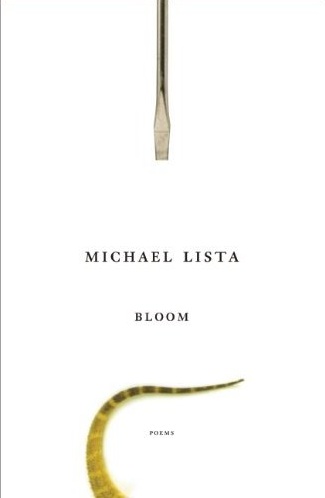 “Something that has bothered me enormously as a reader of poetry is the failure of poets—especially the so-called avant-garde—to pick up on the formal complexity of the world as revealed by the various scientific disciplines. Biologists have shown us the double-helix, the root not only of physiology but also of behaviour, cognition; chemistry gives us Bach and personality; and physicists are proving we’re more math than matter. And yet so many poets give us a world that looks profoundly out-dated; disordered, solipsistic, self-made, random, positively 20th century. I think a more honest book is one in which the spontaneity of personality is set within the strict—and ancient— clockwork of the world.” –Michael Lista, from “Not Every Gesture Is a Manifesto: An Interview…” by Jacob McArthur Mooney
Say I’m making it
for making’s sake, as humans must
when put before an erector set
whose pieces spell out
Please for the love of Jesus
do not dare assemble us
–from “Do. But Do.”
how when an atom’s centre smashes and cracks
new light explodes from the matter’s collapse
–from “Lotus Eaters”
Michael Lista’s collection Bloom comes with a guide map as an appendix, which might suggest its a book that takes us into unventured territory. And while I’m not sure that Lista’s book is necessarily more “honest” than those of the “so many poets” he mentioned in his interview, this is a fascinating collection nonetheless, in its premise and its execution.
Los Alamos, New Mexico is the guide map, and Bloom tells the story of Louis Slotin, a Canadian physicist working on the Manhattan Project. Exactly nine months after Slotin’s predecessor, Harry Diaghlian, was killed in an accident while “bring[ing] a core of nuclear fissile material as close to criticality as possible”, Slotin himself has an accident, and though he manages to shield the other scientists in the lab from radiation, he dies nine days later. An essential twist in the story is that Slotin died training his replacement, Alvin Graves, who was having an affair with Slotin’s wife.
I don’t know what “close to criticality” means, and neither have I read Ulysses, but even still, I was able to be captivated by Bloom. Each poem in the collection takes another poem as its source material (by poets as various as Ted Hughes, the Pearl Poet, and the Velvet Underground, by poets as cotemporary as Karen Solie, Robyn Sarah and Nick Laird, and plenty of [undoubtedly famous] other poets to whom a reference might bely that I’ve actually heard of them), and Lista refers to his work with the original poems as “English to English translations”. By which he means that his source materials are building blocks, modified to suit Lista’s poetic purposes and the purposes of the story.
Not a thing is original here– just as Slotin’s experience is a copy of Diaghlian’s, and Graves’ was the stand-in in Slotin’s marriage, each poem is a variation on something that has been written before, each of these poems refers to allusions and other texts (as well as a pivotal part of a 1989 movie projected onto John Cusack’s shoulder). And while the product of such an experiment is a little confusing and overwhelming, it’s also navigable and pretty fabulous to contemplate as a whole– the cacophony, so many voices, and such variation is entirely readable.
I am not this book’s intended audience, presuming it was only ever meant to have just one. But I am pleased to now understand how literary remixing could be an art onto itself and not simply plagiarism ala Opal Mehta. The incredibly illuminating Torontoist interview I refer to above (and yes, I was unafraid of cutting and pasting for this review) notes that Bloom is controversial, that readers could resent Lista’s rearrangement of beloved or iconic works (and I wonder too, if his variations might look paltry in comparison?). Interestingly, however, because my knowlege of the source material was so incredibly minimal (indeed, the only poem I’d read was Sir Gawain and the Green Knight back in Major British Writers, and I’m not sure whether to blame the University of Toronto or myself for this) none of these problems existed.
Lista’s poems refer me not to something that’s old, but something that’s entirely new, which was the opposite of his intentions, but it’s a distinctly original result.

April 5, 2010
There were sorcerers for such things
“But when Zach typed an a, it was magic. His iPod was magic. His digital TV was magic. The Internet was magic. Even his father’s car, the machine through which boys once achieved their first dominion over the physical world , was now controlled by a computer. Diagnosis of malfunction didn’t involve tinkering with an engine and getting covered in oil. The car plugged into another impenetrable computer at the dealership. Were anything to go wrong with the technical furniture of Zach’s life– and these days, machines didn’t sputter on you, develop a funny hissing sound, or start to squeak; they either worked, or they stopped dead– the notion of fixing it himself would never enter his head. There were sorcerers for such things, although the concept of repair had itself grown arcane; one was far more likely to go out and buy another machine that magically worked, then magically didn’t. Collectively, the human race was growing ever more authoritative about the mechanics of the universe. Individually, the experience of most people was of accelerating impotence and incomprehension. They lived in a world of superstition. They relied on voodoo– charms, fetishes, and crystal balls whose caprices they were helpless to govern, yet without which the conduct of daily life came to a standstill. Faith that the computer would switch on one more time and do what it was asked had more a religious than a rational cast. When the screen went black, the gods were angry.” –from Lionel Shriver’s So Much For That







