January 25, 2011
It was striped
“‘Have you seen my umbrella?’ a hyper Jamaican woman demands.
‘No.”
‘I left it right here.’ She points where I’m sitting.
‘I didn’t see it,’ I say.
‘I left it right here. Did you see it?’ The cuffs of her jacket are frayed, buttons are missing. I look behind and under my chair, go back to Emily.
The earth reversed her Hemispheres–
I touched the Universe–
And back it slid– and I alone–
A Speck upon a Ball–
Went out upon Circumference–
‘Have you seen my umbrella?’ the Jamaican woman demands of another bottom-feeder. ‘I left it right here.’ She points at me again, and I know she thinks I’ve swiped it. ‘It was striped.’
‘I can’t see it anywhere,’ I say. ‘Sorry.’
‘I left it right here. Striped.’
— from Lemon by Cordelia Strube
January 24, 2011
On Literary Blogs: A Passion for Reading
 One of the most wonderful things that ever happened to me was being asked to speak about literary blogs on a panel for an “Arts Matters” forum, hosted by Their Excellencies, Governor General Michaëlle Jean and Jean-Daniel Lafond in December 2008. I traveled to Ottawa by train, arriving in an incredible snowstorm, and in spite of the weather, a good crowd turned out to the forum at the Ottawa Public Library. My adoration for my fell0w panelists was solidified on the trip back to Rideau Hall, and the group of us spent the next day and a half as the Governor General’s guests there, attending the Governor General’s Literary Awards the following evening. It was a magical experience, unreal to fathom now. Even more so now that we have a new Governor General and the old website has come down, my address on literary blogs along with it.
So I’ve reposted it on my own site, for posterity. You can read it here.
January 20, 2011
The kids books we've been enjoying lately
 “There’s no doubt that the young adult novel is Fitch’s true metier”, writes Deirdre Baker in her Toronto Star review of Sheree Fitch’s latest book Pluto’s Ghost, and I have no truck with that, because in our house Fitch is queen of the board book (we discovered her via Kisses Kisses Baby-O), but her picture books own our hearts as well. In particular Mabel Murple, which is the reason my daughter knows at least one colour. First published in 1995 and recently re-issued with vibrant new illustrations, Mabel Murple is the tongue-twisting story of a purple girl, all dreamed up. A skateboarding scallywag, skiing speed demon (on purple snow) with a purple teddy bear called Snickernickerbox (and he snores). A story of merry motorbiking through muddy purple puddles, and a delectable-sounded condiment called Mabel Murple’s purple maple syrple. A whimsical singsong, adored by everybody in our family.
I recently checked out Mem Fox’s website, and found out that she’d been to dinner at Judith  Viorst’s not too long ago, and the idea of such a dinner party makes me a bit in love with the whole wide world. I’ve been getting a similar feeling from Viorst’s book Sunday Morning for ages now, with its amazing silhouette drawings by Hilary Knight. The drawings are what Harriet likes best about the book, and how she can pick out the cat and owl, and see all the rooms in the house at once with the fourth wall removed. She doesn’t get the jokes and the mischief yet though, which are my favourite parts. The boy who wakes up his brother with the noise like a soft machine gun, and how he walks around the house saying, “God, I’m hungry. God, I’m hungry,” because there are no grown-ups around to tell him not to say god. The fights with his brother, which are settled with a karate chop, and how they use their mother’s dress from the hamper to sop up spilled milk.
 The Owl and the Pussycat with Stephane Jorisch’s illustrations is deeply weird, and weirdly imagined. Tough cat arrives from the wrong side of the tracks, and masses look on with stone faces, mostly because they’re all wearing masks. The owl and the pussy cat are oblivious to the spectacle they are, and decide to be married for too long they have tarried. Sailing away to the land where the bong trees grow, they finally find a place where a pairing such as theirs is accepted, and they end up dancing by the light of the moon, the moon, the moon. These illustrations are just subtly sinister enough that a child will never stop being fascinated by them, but they’ll also never be entirely sure why they are.
Finally, we love, love Elephant and Piggie. So does everybody, of course, but better late to the party  than never. The latest in the series We Are in a Book (which I discovered via Nathalie Foy) does not disappoint. Gerald is thrilled to discover that he and Piggie are actually in a book (“That is so cool!”) until he learns that the book will end. That all books end. So together, he and Piggie come up with a plan to prolong their metafictional existences. It’s wonderful, and Harriet finds the simple language and exaggerated gestured in the illustrations absolutely hilarious. Stuart and I have about as much fun reading this to her as she has listening to us.
January 19, 2011
Canada Reads Indies 2: Be Good by Stacey May Fowles
 I’ve developed an aversion for any book described as “gritty”, mainly because “gritty” has lately been synonymous with “badly written stories about troubled girls who exchange blow jobs for heroin”. As though addressing sex, drugs and self-harming is merit enough that the writing itself doesn’t have to be good, the book doesn’t have to be interesting. This whole approach also failing to address the reason why so many fictional girls are exchanging blow jobs for heroin, because, frankly, this is troubling, but I digress.
So I was relieved to find that Stacey May Fowles’ first novel Be Good had more going for it than sheer grittiness. The book is about two friends who struggle with their feelings for one another, and end up on opposite sides of the country in unsatisfying relationships. Hannah has just left Montreal to follow her boyfriend Finn to Vancouver, while Morgan has been traveling Europe on the dime of her older lover Mr. Templeton. The novel comprises a series of flashbacks and snapshots which culminate to the story from a variety of perspectives– Hannah’s, Morgan’s, her roommate Estella’s, Finn’s and Mr. Templeton’s, as well as that of disembodied narrative voice that seems to be curating the collection.
The propensity towards falsehood and self-delusion (the latter never as effective as the former) on the part of Hannah and Morgan, as well as the fragmented nature of the narrative, ensures that “what really happened” is never clear, nor does it need to be, and that it’s what characters think happened which is more important (and always fluid). Ambiguity, embellishment, storytelling and outright lies are narrative methods as valid as truth, and perhaps even more valid for their unwillingness to adhere to the limits that truth imposes.
Hannah and Morgan are trying on various to guises to discover what’s at their core, chasing after different fantasies of the kind of women they might actually be. They pose drinking on fire escapes, imagining the world throwing them admiring glances, enacting magazine shoots, an impression of unreality. They dress up in costumes, imagine that the self is composed of details like grape bubblicious, see themselves from the outside and work that image down to the smallest detail. They see their friends as accessories, every new scene a set-up, that the world can be so deftly manipulated, that the people are so plastic.
Be Good is a coming of age story, the turning point occurring with Hannah’s line, “Perhaps the issue is not what people see in me but rather what I see in them.” Which is a revelation from a woman of any age, really. To step out of gaze and take stock of where you are. Though of course the conclusion is not so simple– it’s never clear whether each of the separate perspectives are actually different narrators, as there is a sameness to the voices. And though Hannah is the wordsmith of the two, Morgan is a famous fabricator, and so it’s possible that the whole book was hatched in the head of either of them, imagining the self as seen through the eyes of others. This last point being what makes Fowles’ book more interesting than other grit-lit– with all that ambiguity, this story is solipsistic with a twist.
Which is in constrast with Thomas King’s Truth and Bright Water, whose narrator is entirely self-effacing, but the two books share much else in common. Both are coming of age stories in with the protagonist’s relationship to the story isn’t always clear, in which he or she knows more or less than he/she lets on. Both books play with ideas of superficial poses, the natives playing up their culture on Indian Days not so far removed from the girls on the fire escape. Both books also have an ambiguous relationship to truth and fact, and choose to overlook these items in favour of a good story. Truth and Bright Water is also quite gritty, also with lesbians, suicide, sex, drink, drugs and destruction, and both skim a facile narrative surface belying darker stories underneath.
It’s just that in King’s book, however, we know that the darker stories are certainly true, and no longer are these poses anymore. His story wedded to a long, long history, whereas Fowles’ book and their characters seem to exist outside of time. King’s subtext more substantial too, unsurprisingly as insubstantiality is Fowles’ preoccupation here, but if we’re comparing books (which we are), King’s comes out the richer. If we weren’t comparing books, however, these two would stand side-by-side, drawing fascinating connections from one another.
Canada Reads Independently Rankings:
1) Truth and Bright Water by Thomas King
2) Be Good by Stacey May Fowles
January 18, 2011
This is Harriet, who
 This is Harriet, who can say tutu. Today she said sun for the first time, as well as soap and snow. And while we were reading Madeline, she pooh-poohed to the tiger in the zoo on cue. When she reads Madeline, she goes and gets her Madeline doll, and then goes and puts the doll away when the story is finished. When she sings I’m a Little Teapot, she goes and gets her teapot. When we’re at toddler time at the library and sing Twinkle Twinkle, Harriet goes over and points to the star on the door. Similiar with the clock on the wall during Hickory Dickory. She says boom whenever anything falls on the floor, which is often, but she pronounces it bum. She demands that our radio be playing music at all times, and gets frustated when I won’t turn off CBC, so then I have to. She is totally into Skinnamarink, and alligators, and Dennis Lee’s poem Alligator Pie. Her interests include being flung through the air, and looking out the window. Last week, she learned to kiss properly (as opposed to slapping her mouth against my face and saying “mmmbah”) and I don’t know that I’ve ever loved anything as much as that tiny smack. She loves reading books as much as she loves throwing them on the floor, and she’ll sit reading stories for ages, so she’s the toddler of my dreams. She likes Olivia, and Shirley Hughes’ Alfie, and any book about babies, and Mo Willems’ Elephant and Piggie, which she laughs at as she leafs through it by herself. She loves If You’re Happy and You Know It because she likes any excuse to clap her hands. She puts her arms in the air and says, “Uppy” and there is no choice but to comply. Every day she has more hair, and her big brown beautiful eyes are unfathomably lovely. We really love her. Every night around 11:30, we mention her for the first time in three hours, and it’s obvious that we miss her. Conversations about what Harriet likes, and how Harriet is, because it’s Harriet, you know. But not that we miss her so much of course that we’d want to hear a peep out of her before morning, oh no. There’s what Harriet likes and how Harriet is, but we’re very content to meet her again with the sun.
January 18, 2011
The Torontonians by Phyllis Brett Young (and Betty Draper)
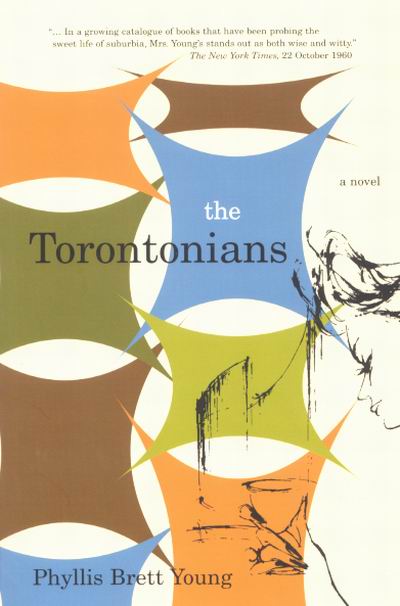 Phyllis Brett Young’s 1960book The Torontonians is not necessarily to be read as a stunning example of the novel form. The satire and irony have been rendered most unsubtle in the years since its first publication, so that The Torontonians reads more like Cyra McFadden’s The Serial than a remarkable work of literature. Remarkable, however, The Torontonians most certainly is when it is read for its feminist content and Toronto setting. It’s a fun read too, and in places very funny.
Published three years before Betty Friedan’s book, The Torontonians is The Feminine Mystique put to fiction, except that Young makes clear what most modern readers of The Feminine Mystique miss: the new woman problem is not so much with the domestic sphere itself, but rather with what consumerism has done to it. Women have never had it so good, except that their labour has been alienated from production via labour saving devices, which don’t actually save labour but just create more jobs to do. And then they’re expected to be fulfilled by the material goods that decorate their houses, and adorn their yards, and when they fail to be, nobody can imagine what could possibly have gone wrong. In its critique of consumer society, Young’s novel anticipates Atwood’s The Edible Woman.
The Torontonians also employs that setting so familiar from Atwood: the city of Toronto. London’s creeping here too, as Karen Whitney’s home on the city’s outskirts overnight becomes the centre of suburban Rowanwood (which was modelled on Leaside). One of the most enduring images of the novel is the Whitney’s buckweed lawn, which they’re forced to spend a summer painstakingly installing because they can’t afford to lay down sod but also realize their neighbours are running out of patience with their uncultivated grass. Rowanwood is the kind of neighbourhood in which a house with just one bathroom is frowned upon for dragging down the market value of the others.
In her novel, Young paints a picture of Toronto in the midst of transition, juxtaposing the suburbs against downtown where Karen had grown up in the Annex neighbourhood. She writes of a Toronto elite (“the Masseys and the masses”) who were all familiar through family connections, and attended the same private schools. But the city, howeer constant in its hum, is always changing. With some of her scenes set against pre-CN Tower aerial views, she shows that no one ever steps into the same city twice.
Young’s novel is a historical document, and deliberately so, as as the book’s introduction makes clear. She thought it was important that  writers document the way people lived then, and so we get a story in which doctor and patient both smoke during an examination at the Medical Arts Building at Bloor and St. George. We read about a city in which the subway was new, New Canadians were usually Hungarian, downtown high rise apartments were novel (and an exotic dream for the bored housewives of Rowanwood). There is the Peyton Place-ish suburban sex too, and a very funny line about who’d do what in Loblaws, but Young shows restraint here. By the end of the book it is quite clear that her people are not caricatures, and the narrative rises above plot cliches.
(The Torontonians is also very, very Betty Draper, and is the first Mad Men-ish book of a few I will be reading in the next while. The others are The Collected Works of John Cheever, and Rona Jaffe’s The Best of Everything. Any other suggestions?)
January 16, 2011
Upcoming Pivot
 It’s not easy to convince me to leave the house (because I love my house. It’s warm, it has my husband and my slanket), but the all-star line-up for the upcoming Pivot at the Press Club is calling my name. Not only does it feature Zoe Whittall, who was our interview subject not long ago, and Catherine Graham, who is a lovely person of my acquaintance whose new book will soon be mine, but the trio is topped off by Larissa Andrusyshyn whose Mammoth was one of my favourite books of 2010. Plus, there will be beer there. I absolutely cannot wait.

January 16, 2011
Canada Reads Independently 2011: Update 1
 So the reading has begun, and though the internet has been abuzz with readers planning to read along so I’d be reading a little less independently, I’ve only caught sight of a review or two so far. Last week, I finished Thomas King’s Truth and Bright Water, which I enjoyed very much, and would recommend to almost anybody as it’s a book to be appreciated on so many levels. I’m now reading Stacey May Fowles’ Be Good, which is a very different book, but not so different that I won’t be able to draw on connections between the two– the connections are there and they open each both books even wider, and one of my favourite parts of the Canada Reads model is comparing these books you might think have nothing to do with one another… We end up having conversations you never would have imagined.
Earlier this month, Sara from the blog Read and Bead read Stacey May Fowles’s Be Good in tandem with Carol Shields’ Unless, and she was surprised to find two strong connections between these books– both, in very different ways, focus on notions of “goodness”. Sara goes on, “The other interesting thing is that they are both similar in size and shape roughly 5×7 inches.” Be Good made her uncomfortable, though not disturbed, but she found it took her to a place she didn’t really wish to go. “It’s not always pretty, and lives are full of things left unsaid, hurt feelings, and longing.” Which, though not a ringing endorsement, is certainly a testament to the book’s impact.
Meanwhile, Rebecca Rosenblum reviewed Lynn Coady’s Play the Monster Blind. Rebecca writes, “[The collection is] very very funny, without being in any way “light.” It’s such a hard balance to walk, especially because a critical perception of “lightness” can sink a book like a lead balloon (abandon metaphor). There is humour in theses characters’ lives because there is humour in everyone’s life. We don’t (usually) laugh at the characters but with them–because we all know that life is funny and cruel and weird.”
She also can’t help sharing numerous excerpts, then becomes frustrated because their brilliance is not readily apparent out of context, and then just implores us to just go and read the book for ourselves. “The problem with Coady’s writing is that any random bit of it looks easy and delightful, and it’s only when you get to the end that realize how much you’ve experienced in the story.”
(Any reviews I missed? Any plans to get reading soon? Email me links to your reviews, or send the reviews themselves if you’re not posting them online, and I will feature them in the next Canada Reads Indies update).
January 13, 2011
Wild Libraries I have known: John W. Graham (Trinity College)
 The first day of my final year of undergraduate studies was Tuesday, September 11, 2001, and I remember sitting out on my rooftop patio the evening before, gazing at the city skyline, imagining that I really was smoking those cigarettes, and wishing something interesting would happen. The morning after notwithstanding, even, my wish was granted by the eight months that followed. I lived in a wonderful apartment with two beloved friends, and we had fun parties, elaborate suppers, hilarious adventures and misadventures, and sustained all night study sessions by runs to the 7-11 for Jolt Cola. We stayed up other nights editing school papers, writing newspaper back page columns, essays on Dryden’s All for Love, indulging in melodrama, kissing boys strange and otherwise, strumming guitars, and talking, talking, talking.
It was a wonderful year in which everything I touched turned to gold, and the sun was shining all the time, even when it wasn’t. And even when it wasn’t was sometimes because of my Cold War History seminar, which challenged me like none of my university courses ever had (and the way all of them should have). I loved the course, the discussion was great, the material was fascinating. Our professor was Margaret MacMillan, the year before she published Paris 1919 and won the Samuel Johnson Prize. She was formidable, brilliant, and her standards were high, but I was incapable of meeting them. That I managed to do so eventually made me prouder than almost anything else I’d done.
Our course readings were on reserve at the John W. Graham Library at UofT’s Trinity College, to be read in the library only. Now, it goes against everything I believe in to have any admiration for Trinity College (I went to the much preferable Victoria), but their new library had just opened that year, and it was lovely. Stately chairs in front of roaring fires, everything a beautiful dark wood, perfect lighting, brand new carrels where I’d take my readings too. In that library, I’d meet my other classmates, and we were always waiting for one another to be finished, and it was always late at night. I remember reading, reading about Kruschev’s Secret Speech, the Hungarian Revolution, Yalta, fellow-travellers, glasnost, the Prague Spring. I remember working harder than I’ve ever worked in my life, the discussions that we had and the work that I produced making me feel like something of an actual scholar for the first time (and the last). I remember leaving the library as they were closing up, jumping on my bike and riding off to somewhere in crisp, cold night air, and I remember how the stars looked, even though I might just be imagining them now. I remember an awareness that I was living through an extraordinary era in my own life, that things would never be so clear again, or so easy. Life then was delivered to us on a plate, but we knew it was ending come the springtime. It was impossible to imagine what would happen after that.
What I remember most is the smell of the John W. Graham Library, more palpably than I remember anything else about it. A new building redolence, of fresh paint and new wood that only looked ancient. It smelled like a hot stack of photocopies and not remotely like a book. I came to associate that smell with everything about that year, when were standing on the threshold of the rest of our lives, and if I could smell it now, I think I’d cry. I really would, because of how lovely it was and how young we all were, so ridiculously and unknowingly earnest.
But new smell only lasts so long. When I returned to Toronto in 2005, I went back to the library so see if I could find it again, and was disappointed to find it smelled like anywhere. And of course, I was standing in the very same place, but it wasn’t the same at all.






