March 29, 2011
Good Food For All: The Stop Cookbook
 Now that I can count down the weeks to asparagus season with the fingers on just two hands, I am thinking about eating springtime, and then summer and fall. It was around this time last year that I purchased Good Food For All: Seasonal Recipes from a Community Garden produced by The Stop Community Food Centre in Toronto, and it set us on a delicious course of seasonal eating in 2010. My only complaint about the book is that mine has fallen to pieces, but I suspect this is an indication of how good the book is rather than any of its deficiencies (save for binding).
Courtesy of Good Food For All, we have feasted on roast vegetable burritos, vegetarian shepherd’s pie, multi-grain supper salad, chicken burgers, beef stew, asparagus quinoa with peas and feta, stuffed swiss chard leaves, seared rainbow trout with greens, heirloom tomato salad, and strawberry bread. The strawberry bread in particular was the stuff of legend, and I am looking forward to strawberry season so I can make many of a loaf of that heavenly stuff. Once, I had to get rid of some beets and our dinner was an unappetizing sounding “beet bake” that turned out to be delicious. Another time, however, we had a tofu baked-bean casserole that was less so, but I feel like we should have known better. Otherwise, Good for For All has never led us wrong.
The book has beautiful photography, straightforward recipes and instructions, and follows the Stop’s educational mandate in such a useful fashion– a page devoted to different kinds of grains and how to cook them, for example, which was one of the first to fall out of my book. And I am happy because the cookbook is listed on The Stop’s website as “The Stop’s First Cookbook”, emphasis mine, because I’ll be first in line to pick up their second.
March 27, 2011
Spring Comes Suddenly: Raising awareness and money for Japanese relief efforts
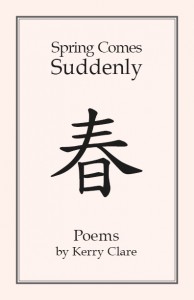 Spring Comes Suddenly is a collection of haiku poetry I wrote from 2004-2005 while we were living in Japan. Stuart and I published 20 copies of this book in late 2005, each one with hand stitched binding and Japanese paper along the spine with a cherry-blossom pattern. It was the first of two publications by Pickle Me This Press, and we sold our entire lot. The digital version of the book came about last year when Stuart expressed interest in learning more about e-publications, but settled for making a PDF version when he learned that e-pub wasn’t great for poetry.
We are now offering free downloads of Spring Comes Suddenly in order to raise money and awareness for Japanese earthquake relief. Because Japan was once our home, it has been particularly dismaying to learn about the devastation the country currently faces. Knowing Japan as we do, we also know that few other nations would be better equipped to deal with and recover from disaster, but we still can’t help wanting to do our part.
Please accept this book as a token of thanks for any donation you may have already made to the Canadian Red Cross Japan Relief Fund, or to the charities highlighted by the Toronto to Japan effort. If you have not yet made a contribution, please use Spring Comes Suddenly as an incentive to do so. I make no claims to be a poet, but the book is a journal of our Japanese year, and a love letter to a country that provided us with so much kindness and generosity.
(Click on the image to launch the PDF of Spring Comes Suddenly, or right click and select “Save Link As” to save a copy)
March 27, 2011
That annoying thing that women do
 This is not so important, but it occurs to me that I’ve been doing that annoying thing that women in my situation tend to do. Making comments about professional tea-guzzling and reading with my feet up, and though these things are practically absolutely true, they’re not the whole picture. I have a tendency toward self-deprecation anyway (it’s just easier that way), and I also don’t find the demands of stay-at-home motherhood particularly arduous, mostly because I have only one child who sleeps a lot, and a small house that requires little maintenance (plus we keep our standards very low). Life for me is very good, though to play the role of the idle hausfrau would be disingenuous (though this does not change the fact that tedious maneuvering really is the story of my life. Let that fact stand).
I thought of an excerpt from a review I read recently of Shirley Jackson’s work (“Dye the Steak Blue”  by Lidija Haas), and though I’m no Shirley Jackson, obviously, I can understand why Betty Friedan was annoyed by her, and I’m setting the matter straight here because I’m a little annoyed at myself. From the review: “Friedan called [Jackson] an Uncle Tom, one of those women who disingenuously portrayed themselves as ‘just housewives’, ‘revelling in a comic world of children’s pranks and eccentric washing machines’, affecting to find a challenge in the most routine chores and concealing the ‘vision, and the satisfying hard work’ which went into their proper vocation, as writers.”
So though my washing machine is terribly eccentric (in fact, it would be better termed a “kind-of washing machine” and it sometimes smells like it’s about to catch on fire), and though I do take pride in managing my household (which is no small task, as anyone who’s ever lived in a household realizes), I only do housework when my child is awake, and whenever she’s asleep, feet-up or otherwise, I am usually at work on something related to writing. I work very hard at this blog, on my freelance assignments, at reading thoughtfully and writing book reviews that communicate this, at writing fiction, at creating new projects and at being a part of a wider creative community. At managing to contribute to our household income through my creative work. And I absolutely love all of it. It is tremendously important to me.
So this is not to be the writer’s equivalent of those wretched Facebook statuses that made me hate mothers just as much as the rest of society does (“So you ask, do I work? Uh yes, I work 24 hours a day. Why? Because I am a Mom… I don’t get holidays, sick pay or days off. I work through the DAY & NIGHT. I am on call at ALL hours. re-post if you are a proud Mommy “). I just think I was selling myself short before, affecting a little too much, which isn’t surprising– there is unease that comes with being a stay-at-home mother. But I am also a feminist, and I’d never want to let Betty Friedan down.
Also, I much appreciate the friends who’ve been so supportive about last week’s news. Since the shock has worn off, we’re very positive about things, and even grateful that the right decision has made, in particular because it’s one we might not have been brave enough to make on our own.
March 26, 2011
Pigeon English by Stephen Kelman
 I’ve lately aimed to avoid the “this meets that” construction in my book reviews, but this one I really want to share: Stephen Kelman’s Pigeon English is Emma Donoghue’s Room meets Lord of the Flies. Told from the perspective of Harrison Opoku, an eleven-year-old Ghanian immigrant living in the wilds of London, Kelmen’s first novel is the story of six months in a community wracked by gang violence, knife crime, drug abuse, poverty and other urban blights. Through the eyes of Harrison, however, we also see its spots of beauty– the delight of riding the tube, how the wind gusts at the base of the tower blocks, the doggy personalities of local unsavoury characters’ canine companions, the peculiar quirks of local language (and now I’ve just realized that the book’s cover features dual imagery, and now it’s making me cross-eyed). In particular, Harrison is attracted to the pigeon he feeds covertly from his balcony, and seems to serve as the kind of protecting force that he is otherwise quite lacking.
This is a braver book than Room, which sanitized the experience of its young protagonist. Kelman doesn’t soften blows, though Harrison’s is a refreshing perspective upon stories which are so familiar from the news. He is wide-eyed, taking in his new home without context, though even he recognizes that there is nothing ordinary about the blood on the pavement from the dead boy who was stabbed. (“The dead boy’s mamma was guarding the blood. She wanted it to stay, you could tell. The rain wanted to come and wash the blood away, but she wouldn’t let it.” Um, and this is on the first page. Regardless of the upliftingness of Harrison’s perspective, the story doesn’t get easier than this. Consider yourself forewarned, but don’t necessarily be deterred.)
The most ordinary facts of childhood take place in extraordinary places, just as Donoghue made quite clear in her novel. Harrison and his friends play games, run fast, he holds hands with his girlfriend, and get into innocent mischief. He fights with his older sister, wants to please his mother, and longs for his father and baby sister who are still back in Ghana. However the CSI-styled games he plays with his friend get him into trouble over his head– his clumsy efforts to solve the murder of the dead boy attract the wrong kind of attention, and soon childhood games and real-life thuggery are entangled in irrevocable ways. (Kelman also shifts perspective a little bit at the end of the novel, similar to what happens at the end of Lord of the Flies*, to show that real-life thuggery itself is an extension of childhood games).
Problems with the book are worth mentioning: yes, there are paragraphs narrated by the pigeon, which is kind of unfathomable (“don’t let the pigeon drive the bus!”), but it’s only about 1% of the whole book, so don’t let it throw you off. I was also slightly unnerved about Ghanian slang delivered via a white writer, no matter how much he knows about working class communities, but part of this my problem and that issues of cultural appropriation are constantly under negotiation. In my mind, Kelman’s perspective was altogether convincing and issues of authenticity should be debated by somebody who isn’t me.
Pigeon English is a book a lot like its cover. Not that it will necessarily make you cross-eyed, but that it turns into something different the longer you look at it. That perception is always a matter of perspective, and in Harrison Opoku, Stephen Kelman has delivered an especially “lovely” one.
(*I know a lot about Lord of the Flies, because I wrote an essay on it in 1996. )
March 25, 2011
You know, it's all fine and well
 You know, it’s all fine and well to be a stay-at-home mother, professional tea guzzler, book-reader with-her-feet-up, but factor a husband’s job loss into the mix, and the whole situation is a little bit perilous. So you can imagine that we’ve had a bit of a stressful day at our house, and there has been much back-and-forthing between triumphant, “Onward, new opportunities beckon!”, and me crying and asking, “Why can’t everything just be easy?” We’re sure counting our blessings though. That our vacation was last month rather than next month (and that it was as splendid as it was), that we both have quite a bit of freelance work in the pipeline, that he has two months to go before his contract ends, that we’d been too lucky anyway and were about due for a kick in the ass. And no fear: this does not mean that I’m going to be cancelling my Royal Wedding party, no way, no how. At least it’s springtime.
So this is my full disclosure post, my “man, this kind of sucks” post, but once we’ve undergone the necessary period of uncertainty and anxiety, I have no doubt that he (and we) will be in a better place than before. And sometimes it’s nice to know that your worst problems are the ones you can still be sure have happened for a reason. We’re so lucky to have friends and family who support us as avidly as they do, and we’re also so lucky to have one another.
March 24, 2011
The original chronicler of motherhood
 Lately I’ve been turning to Shirley Hughes’ Alfie books whenever I’m in need of parenting guidance. (I am also reading another book called Toddler Taming that recommends spanking and tying up children with rope, quite unabashedly, but then it was written in 1984 when that sort of thing was de rigueur. But actually, casual cruelty aside(!), it’s a great book. Just let me explain… Review to come.) I love Shirley Hughes, and I really love Alfie, and Harriet loves him too, so we’ve read his stories an awful lot.
And I don’t think the experience of parenthood has ever been better articulated in literature than with this one paragraph from Alfie Gets in First: “Mum put the brake on the push-chair and left Annie Rose at the bottom of the steps while she lifted the basket of shopping up to the top. Then she found the key and opened the front door. Alfie dashed in ahead of her. “I’ve won, I’ve won!” he shouted. Mum put the shopping down in the hall and went back down the steps to lift Annie Rose out of her push chair. But what do you think Alfie did then?”
This kind of tedious maneuvering is the story of my life, and if you’ve ever lived such a life, you understand that Mum has spent ages strategizing the perfect order in which to perform the tasks that will deliver her children and groceries into her house with maximum efficiency. I absolutely adore that recognition. Never mind Rachel Cusk as chronicler of motherhood, no, Shirley Hughes absolutely did it first.
I love her illustrations, and am fascinated by the interior of Alfie’s house. Harriet likes to comb the pictures for teapots, and I love to spot what else is cluttering the corners: discarded shoes, soccer balls, old ties, umbrellas, toy teacups, tennis rackets, folded strollers, and acorns.
Though Alfie’s mum, however rumpled, is a far better mum/mom than I am. Which I’m absolutely fine with, having chosen to take Alfie and Annie Rose’s dad as the parent upon which I model myself. He’s not around as much as Mum (and there I fall short. I never seem to go away), but when he is around, he’s usually behind a newspaper. I love that when in Alfie’s Feet, he takes Alfie to the park, he takes care to bring his book and his newspaper. A parent after my own heart, I think, and Alfie doesn’t seem any less content as he splashes through the puddles, his dad reading the paper on a park bench behind him.
More:
March 23, 2011
The Vicious Circle reads: Light Lifting by Alexander MacLeod
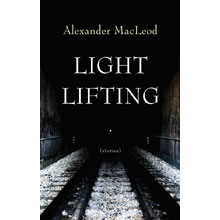 This will be the most boring Vicious Circle recap ever– we loved this book. General comments included, “This is the best book we’ve ever read” and “This is the only book we’ve ever read that managed to write about stable relationships.” We marvelled that Alexander MacLeod has not had to exploit the unhinged in order to create compelling short stories, that his stories are about ordinary lives and the points at which those lives shifted and changed, and thereby the stories manage to tell the story of those whole lives before and after based on one single moment in time.
Perhaps we were all blissed out by the onset of Spring (which turned out to be a lie, by the way). It was a sunny Saturday morning in the St. Lawrence neighbourhood, and the Toronto skyline was our dramatic backdrop. There was so much food, it was unfathomable (yet delicious) and the coffee was a-brewing. We had two babies in attendance. Just to set the scene.
Oh, there was some criticism, but we mostly forgot what it was. Really, this was the meeting at which The Vicious Circle totally forgot to be vicious.
“Miracle Mile”, it was noted by two of us, was the one story that didn’t seem to get better with rereading. (Three of us were re-reading the whole collection, and we liked it even more than the first time around). Its intensity was noted, which should have made the story’s ending much less surprising than it was. We loved “Wonder About the Parents”, in particular the part where the father is sent back into the truck stop men’s room to retrieve a baby outfit from the garbage can where it had been discarded covered with diarrhea. We did wonder about truck stop men’s rooms with change tables, but this one scenario was so absolutely irrational but made perfect sense– these are the things we do for the people we love. The helplessness of the parents, MacLeod’s depiction of the evolution of their love.
We also loved “Light Lifting”. Many of us noted that we’ve known people just like the characters in this story. We marvelled at how much a writer would have to know about the world in order to write a story like this, the details, like the effects of sunscreen on brick carrying hands. One of us was optimistic about the ending, and hoped terribly that things turned out one way rather than another. This story noted as a perfect example of MacLeod knowing when to step back and let the story happen, to be a voyeur. The steadiness of the voice that tells it– we note that the pivotal moment in this story is never the narrator taking that fateful first drink, which would have been a very easy plot twist.
“Adult Beginner 1” blew minds, and we talked a lot about endings. One of us is from Windsor, and noted how this story resonated as a result of that. Then we noted how it resonated as much for those of us who’ve never seen that Holiday Inn down by the waterfront. One of us who’d been stuck in an undertow once couldn’t quite believe how the story (the whole book?) had got right into her mind. We like how MacLeod writes male and female voices so perfectly. How the whole novel seems to be a mix of gender, a balance (which is rare). That some of us were nervous about reading it because it was perceived as a “male” book and were then surprised by the balance. That this is a book with something for everyone (and the one of us who’d given the book to everyone she knew for Christmas but had only just read it expressed relief that she’d ended up liking the book, and now knew she’d selected the right present.)
“The Loop” was also a very Windsor story. Also, like “Good Kids” after it, a story about nostalgia. How “The Loop” managed to be so very unsentimental, when it would have been so easy. How MacLeod wrote the creepy guy so convincingly. We remarked upon the line in “Good Kids” about the house that was a Bermuda Triangle for hopeful people. About how he writes about families of boys, how they beat the crap out of each other. How he’d nailed it so perfectly, those bands of brothers. Reggie was a bit Owen Meany, we thought.
And then “The Number Three”, which took the car accident and made it far more than a stock plot device. How terribly bad this story could have been, but it wasn’t. Some of us found the auto industry details a bit boring, others thought it was illuminating, the story behind every day objects that we never think about. The story was so sad, but the sadness was something true and more than itself. How this story (like all of them) exists on so many levels. How it’s about one thing, but so many other things at the same time.
We loved this book. We felt a bit sorry for every other book we’ve read lately, which seemed unfairly compared to this one. To ask another book to be Light Lifting was sort of a tall order, but still. One of us reflected that maybe she wasn’t sick of short stories after all. That instead she was “I’m tired of reading uneven collections where the stories are too dependent on quirks for them to be plausible and/or plot-worthy.” (Read her full review here.) There was so much more to MacLeod’s stories, so much more that even though we didn’t hate these stories, we still had a whole lot to talk about regarding them. Which is a rare thing. When consensus still makes for good conversation, but then, with the Vicious Circle conversation makes a point of being good.
March 22, 2011
Feature Ads at Pickle Me This
After ten years of blogging, I’ve decided to take a chance and try to sell an ad or two here at Pickle Me This. Though not ads nauseum, no; you’re not going to see much more sidebar clutter around here than the usual. Instead what I have in mind are Feature Ads, just one or two, providing my household with a bit of extra income, and providing authors, publishers and literary events with the chance to promote their products boldly. You can learn more about Feature Ads and read my spiel over here.
I am excited for this– I think it has something good to offer to everybody involved. I also look forward to using my new third column to support some of my favourite causes. And many thanks to Create Me This for reworking my site in such a speedy fashion.

March 21, 2011
My Adventures in the Land of Books
Our last vacation was in the land that books forgot, so I was excited to get away to England, the storybook centre of the universe.  Whenever we go to England, we always come back with enough books to fill another suitcase (especially that one time), and this trip was no exception. Though I had less luck in the charity shops than I was hoping for– they used to be rife with 1960s Penguin Paperbacks but they’re all gone now, and now all that’s left are copies of Jenny Colgan novels that came free with a copy of Cosmopolitan. And the children’s books picks were rubbish in the charity shops, but I suppose I can imagine why the second-hand children’s book market might have its challenges.
 The only books I ended up getting in charity shops were I Am Not Tired and I Will Not Go to Bed by Lauren Childs at the Oxfam in Ilkley, and Tyler’s Row by Miss Read at The Panopticon Shop in Glasgow (which is a charity shop to rebuild a theatre that burned down in 1938, and we sort of got turned off their cause when they made Stuart wait out in the rain with the pram). I also got a Brambley Hedge treasury at the Oxfam in Fleetwood.
And though I didn’t end up buying anything, the Oxfam Bookshop in Glasgow was beautiful–  much more boutique than charity shop. It was in the same square as the massive old building (now vacant) that used to house Borders, and I was informed that the loss of that store had been a tragedy– it had been a wonderful place. We also had a good time in the Waterstones in Glasgow, which looked like not much from the outside, but as I rode the escalator down to the lower level, revealed itself to have this hidden middle section between the two floors, sort of like the half-floor in Being John Malkovich, and also a coffee shop, with made my reluctant partner in bookshopping a very happy man. We found the children’s section, and Harriet hurled picture books, and then ate part of a sandwich that she found on the floor.
 I was thrilled to discover The Grove Bookshop in Ilkley, because independent bookshops are few and far between even in England, and also because this one was bustling. The store has gorgeous window displays, a great selection, and seemed like a thriving community hub. There was a line-up at the till, and another woman there to pick up her special order. I delighted in the selection of Penguin merch, and bought a tote bag, and also Old Filth by Jane Gardam (and now I have to read The Man in the Wooden Hat). I also like The Grove Bookshop in Ilkley because their website boasts a “fast and efficient ordering system [which] means the vast majority of customer orders arrive the following day.”
We spent our second-last day in London, and had scheduled bookshops a-plenty. I was so happy  to have a chance to visit Persephone Books, and actually, I’m grateful that budget constraints forced a limit of one book only, or else I would have bought the place out. Their books are so lovely, the shop so homey (but
  crowded! With Persephone books! Can you imagine anything more wonderful?), and I wanted to paw everything. To keep my fellow-travellers happy, I’d pre-selected my purchases so there was less browsing than you might imagine, but if I’d started, I never would have left and would no longer have a family.
I also enjoyed visiting the London Review Bookshop, which was not too far away.  The Cake Shop proved disappointing, sadly, as it was too small to accommodate Harriet’s stroller or Harriet, and was crowded with people discussing existential things who probably didn’t want to listen to Harriet talk about her bum. I bought The Tortoise and the Hare here, though I’d been debating another Rachel Cusk instead, being that day in the thralls of her book The Lucky Ones. And I am a little bit sorry now that I didn’t get the Rachel Cusk books, because she’s so great, and I never found another of her novels in a bookshop the rest of the time we were in England.
 Under Waterloo Bridge, I was happy to see the booksellers again, as well as a bit of sunshine. I didn’t buy anything because nothing immediately struck my eye, and because Stuart and Harriet were being very patient but I didn’t want to push them too far. I am sure if I’d browsed just a little while longer, I would have come up with one treasure or another. (I also wonder if the fact that I found less treasures amongst the used books this trip is because it’s now been a few years since I bought everything Margaret Drabble ever wrote.)
We spent the rest of our London day at The Tate Modern, and I enjoyed exploring  both its bookshops with their wonderful selections of children’s books. It was especially exciting to see Sara O’Leary‘s beautiful Where You Came From on display, amidst some fine company.
We spent our last day in Windsor, where I tried and failed to find a bookish treasure in the charity shops (including a wonderfully stocked Oxfam Bookshop, but everything good they had, I had already). We stopped in at the Windsor Waterstones and bought Harriet The Gruffalo and Alfie’s Feet, and I tried and failed to find a Rachel Cusk novel to buy, just as I would do the next day at the airport. Regrets, I’ve had a few.
But not too many. Our trip was full of bookish wonder. I arrived home with a most respectable stack, and what’s more, I’ve since read each and every one of them.