June 27, 2011
Wild Libraries I Have Known: Brewster Ladies Library
 Hamilton writer (and fellow member of the Barbara Pym Society!) Judy Pollard Smith writes about the Brewster Ladies Library in Brewster, Massachusetts:
I have a Golden Rule about Libraries. They have to carry Barbara Pym, May Sarton and Edith Wharton. If they carry all three I know they’ll have everything else that good libraries should have. And last week at the Brewster Ladies Libary, I counted several of each writer’s novels, neatly shelved and waiting for patrons to tuck them into their wicker baskets.
In 1852, when Brewster was a flourishing Cape village, Misses Sarah Augusta Mayo and Mary Louise Cobb, along with friends, raised enough money to place a shelf of lending books in the home of Captain Mayo on Main Street. Over the years the library has added a garden dripping with rich vegetation, and a fabulous addition. The original house still serves as a hushed reading room with stained glass windows and the original fireplace. If you listen you can hear the rustle of the Misses skirts as they pass by.
There is a cheerful children’s room with aquarium, story times, toys and books. There are author chats, book discussions, holiday family programs (works out well if it rains on your vacation!) and local artist’s displays.
There are 200 Senior Volunteers, four of whom were sitting gluing the pages back into books when I was there. There are cosy wing chairs, free internet and a general feeling of amicability. Denise at the Reference Desk redefines the words “pleasant, helpful, lovely.” And summer visitors can get a card for no charge.
I say, “Up with those two Misses who started their lending shelf in 1852!” They had no idea what shining threads they were weaving into the posterity of this tiny village.
June 26, 2011
On reading and riots
 Last week, a young woman who’d been photographed taking part in the Stanley Cup riots posted an online apology in which she first claimed to take responsibility for her actions, and then indignantly outlined the reasons why blame cast her way was disproportionate: mob mentality, that she’d only committed theft and not arson, the theft was for souvenir purposes, she’d been drunk–nice try, works for rapists– and besides, the whole thing was completely out of character. (I think she may have since had some PR consulting, however. The indignant bits of the post have been removed, and she now reads as genuinely sorry.)
As I read the post last week though, I thought about how much this young woman still had to learn about atonement. That perhaps she was victim of a culture that fools us into thinking public apology trumps being good in the first place. I thought of her remarkable sense of entitlement, how her fierce impression of who she was did not seem at all changed by what she had done. And if she was right, I thought, that her actions that night had indeed been completely out of character, then that was only because she didn’t have any character.
Character, according to Joan Didion (in “On Self-Respect”): “the willingness to accept responsibility for one’s own life.”
I thought about the mob mentality which the girl claimed had swept her right up, and I sort of understood it. Though you’ve got to wonder about the kind of person who gets swept up in a mob in the first place. These are the kinds of people who think being alive is a spectator sport.
And I thought about how much I dislike the part of church services where a minister speaks, and the congregation responds in unison. How even fans at a baseball game singing the national anthem makes me cringe a bit, because in circumstances like this, we’re speaking automatically, not thinking about anything we are saying. It’s a different kind of mob mentality, and one that is benign, but then I start thinking about the Nuremburg Rally, like it’s all a slippery slope. On the rare occasions when I happen to be in a church, I don’t respond when called on. I listen instead. And the droning sound of everyone’s voices is always a little bit terrifying.
Naturally, I am being melodramatic, but I was also thinking about reading. About how reading can be a communal experience, how it’s an exchange between writer and reader, but mostly how the latter retains his individuality. The power of the reader to regard the text with a discerning eye, and to re-read so the text changes as he does. I’m thinking about how reading is the opposite of mob mentality, and that armed with critical skills to apply to the world, a reader is unlikely to be swept away by any such thing.
There are arguments against this, of course. Someone will always mention Mao’s Little Red Book. But I’m still thinking that to read well is to learn to reside inside one’s own head, and I think there’s such tremendous value in that.
June 26, 2011
Words can't bring me down
“YOU, FEMALE LIVING PERSON, ARE RESPONSIBLE… for your self-esteem, and this means not listening to self-esteem pop or anyone who says you’re perfect. Do you hear Jay-fucking-Z rapping to dudes about how they’re perfect just the way they be? Ever heard a Stroke talk about how he’s a beautiful burst of true-coloured fireworks that makes stars pale in comparison and the sky feel blessed by God? No, right? That’s ’cause guys (super-loosely speaking, straight guys) are sanguine enough in their guyness to not require number-one anthems of hyperbolic over-consolation. Nor do they read self-help books about how to “celebrate” their “flaws.” Nor, in my not-limited experience, do wannabe-men talk about “just being themselves,” because, duh. You were born this way. Now strive to be (and I’m saying be, not look) better. Ain’t but one thing that’s gonna hold you down, and that’s the airbrushed, slicked-on attitude that you’re a precious gem of beinghood that doesn’t ever need to change. Changing is, quite obviously, the only way you get to be a better person. Anyone who tells you not to change is someone who doesn’t care if you lose at life. Girl, it’s just human sense. Just like you’re not inferior, you’re also nowhere close to being “perfect,” you’re not even consistently amazing, you definitely need to fix like six things about yourself, and you can stop singing total bullshit into your hairbrush, like, now.” –Sarah Nicole Prickett, “Women’s Responsibilties” (emphasis mine, because I love that final sentence madly)
June 24, 2011
I have had a happy birthday
 3+2 candles. Have finally finished reading Great Expectations. Ice cream is the easiest cake in the world to make. We had five kids under three (and their moms) over to eat the ice cream cake this morning, and the kids were delightful. Their moms are some of the best company I know. And now I’m going out for dinner with my little family, tomorrow we’ll celebrate birthdays, Father’s Day and my mom’s retirement with our extended family, and then piece de resistance is Sunday, when we have afternoon tea at the Windsor Arms Hotel. When, I guess, we will finally have to declare my birthday over. But until then…
Happy Weekend!
June 23, 2011
Penguins in the Post
Oh, there are words to describe yesterday, but they’re not very polite ones. They’re the words I was thinking as I hauled my hysterically tantrumming toddler home from a drop-in we visited in the morning, one that was so nice that apparently Harriet never wanted to go home. She was able to contort her body to become completely rigid (this kid would rock at planking) or to become a wet noodle, therefore rendering stroller get-her-inning completely impossible. She wanted me to carry her, and it was raining, and I couldn’t push a stroller, hold Harriet and an umbrella, so we got soaked. And then I could no longer carry Harriet at all, and that was all she wrote. It was horrid. And we won’t even get started on the whole “leaving the farmer’s market” meltdown in the afternoon, which was even worse, totally embarrassing and annoying. By the time Stuart came home from work, I was totally broken, and once again, considering putting Harriet up for adoption. “But tomorrow will be better,” I told myself, believing this to be somewhat naive, but it is June, mind you, and life is good in June, and indeed, better today has definitely been.
 And it still would have been better had I not received this incredible surprise from my pal at Penguin Canada. A Penguin tote bag (which would be enough in itself) packed with 24 Mini Moderns. But it would not be possible to receive a package like this, and for a day not to be made. And yes, partly because we’re in our third week of a mail strike and I’ve been missing surprises at my door, and partly because these books are so brilliantly Penguinesque in their design and because I can’t wait to find a place where I can line them all up in a row, and because there are authors I love here, and others still yet to be discovered. But mostly because now I am totally assured that there is such brilliant possibility in never knowing what a new day might deliver.

June 22, 2011
Best Canadian Essays 2011
 As one who reveres books as much as the next person who really, really loves them, you can imagine that I’m overjoyed to announce that very soon I will be published in one. I am so honoured that my essay “Love is a Let-Down”, which is the little essay that still hasn’t stopped, will be included in Best Canadian Essays 2011, part of an amazing series published by Tightrope Books. Quite grateful to editors Ibi Kaslik and Christopher Doda, and to the wonderful people at The New Quarterly who gave my piece its first home. And the staff at Peterborough Chapters better order in a whole bunch, because my mom is totally going to buy *all* of them. Looking forward also to my piece appearing, along with other fine writers’, amongst Caroline Adderson’s— speaking of honoured. And so pleased that I’m finally going to know what these guys are talking about.
June 22, 2011
Our Best Book from this week's library haul: Goldie and the Three Bears
 Diane Stanley’s Goldie and the Three Bears gets this week’s nod mostly because while I think it’s a pretty good picture book, Harriet is absolutely obsessed with it. (This also makes 2/3 weeks where our best book has been one Harriet has randomly pulled off the shelf with no regard for anything except chaos.) I love the detailed illustrations, and that this twist on an old story stands up perfectly fine all on its own. Goldie is a very picky little girl (the swing is “too high”, the movie is “too scary”, her peanut butter sandwich is only “just right” when it’s on white bread, no jelly, with the crusts cut off), which makes it hard for her to make friends (because Penny is too boring, and Jenny is too rough). When one day she gets off the bus at the wrong stop, however, she stumbles into an empty house, and tries a few sandwiches, sits in a few chairs, falls asleep in somebody’s bed, and in the process, makes a friend–one she can love with all her heart. Which sounds cheesy, but it isn’t, and we like the pictures of the friends climbing trees, building block towers, and have an elaborate tea party. If there has to be a story I read 10 times a day for a week, I am awfully glad it is this one.
June 21, 2011
Where I'm at
 Where have I been? For the past week, I’ve been (finally) reading Great Expectations by Charles Dickens, which is very good because this was one of my new years resolutions. Even better, that I’m enjoying it absolutely, delighting in bits, finding others amusing. Pip has just discovered the identity of his benefactor, and I’m as disgusted as he is at the whole thing in regards to his treatment of Joe Gargery (who I’ve sort of fancied from the start). I have also discovered that I’ve unknowingly modelled my parenting style on Mrs. Pocket, who ignores her children while she lounges and reads, which is pretty much my lifestyle. I’m on page 360 of 536, and still enjoying the ride (and I’m not sure that Dickens creates suspense as much as just making things so incredibly weird, there’s no knowing what happens next [which is kind of something different, no?]).
It’s nice to be reading a long book, and finding the length incidental to the book’s goodness. Though it certainly does cramp my style bit as a person who gets by on reading a lot and writing about it here– I do get impatient as I watch my to-be-read shelf get dusty…
Anyway, the book I’m reading is a battered old paperback whose origins I have no idea of. It was published in 1964, and the spine is bent into a U shape. It has an introduction by someone called Kellogg W. Hunt (and why aren’t more people named Kellogg anymore? Or ever.) The internet seems to be devoid of images of my book’s cover, but in searching for it, I’ve remembered that there exists a modern film adaptation of Great Expectations, and that I’ve even seen it. And that I remember absolutely nothing about the movie, except a scene with explicit oral sex. I don’t think I’ve arrived at that part in the book yet.
June 20, 2011
We love Postal Workers (in principle).
 This morning, Harriet and I took a batch of cookies to the locked-out postal workers picketing at the Post Office at Bloor and Spadina. Not because we’re supporters of labour per se (because really, our political leanings tend towards the middle of whatever fence we’re sitting on), but because these are the people who bring us the mail. And admittedly, they don’t always bring the mail so brilliantly– sometimes it takes two weeks to deliver a letter across town, I’ve had packages fail to arrive more times than should ever occur, and my letter-carrier is not the friendliest of women. Which is why it’s hard to wholeheartedly put my support behind Canada Post, particularly as the price of stamps go ever up-up-up, but they’ve got my support anyway because I believe in the spirit of the thing. And because I’m wary of angry people who believe that it’s too much for anyone to ask for a decent job with a living wage, just because they’ve given up hope for such a thing themselves.
I understand these things: that Canada Post continues to be a profitable enterprise, that postal workers’ salaries do not come from taxpayers, but that pension programs are unsustainable. I understand that (from the UK example) that there is argument as to whether mail circulation has in fact fallen, and that the state of privatized mail service (from the Netherlands example) is abysmal to customers and employees. What I don’t understand is this angry reflex of contracting out services being a viable option, which fails to acknowledge the economic drawbacks of a society in which full-time, decent-paying work is impossible to come by. I think workers have to stand up for their rights, and the rest of us ought to stand up alongside them (even those of us who, like the woman who called into Ontario Today last week bemoaning the sea cruises she will never get to take because she doesn’t have a pension at all). Hence the cookies. Solidarity.
I miss the mail. I miss my magazines, and thank-you notes, and wedding invitations, and birthday cards, and paycheques, surprises, presents, books, and even Bell Canada’s emphatic pleas for return of my patronage (though I’m never fooled by that font on the envelope that’s supposed to look like handwriting). I miss going to check for the mail’s arrival, and usually finding something great. I miss the Canada Post vans, which look so lonely in park at the end of my street, and I’d like to see them on the road again. I’ve been getting through these last mail-less week or so by imagining the massive postal backlog bundle that’s going to await me at the end of it all. And I determinedly hope that the woman breaking her back to deliver that bundle to my door managed to succeed in getting what she wanted.
June 19, 2011
Our work in progress


 I do have a feeling that happiness is as much about being content with what you’ve got as ensuring that what you’ve got is of extraordinary quality, workmanship, durability– even if it’s not all that much to look at it. Or at least that’s how it’s worked out for us over the last six years, since our beautiful wedding beside the sea and later that night when we danced to Flowers in the Window (which was always about possibility, and it still is, and the song’s still true).
 For me, another key to our happiness has been this: we spent April and May ready to spend the summer living on absolutely nothing, and so we instituted severe austerity measures, squirreled our money away, and made the best of things. And then things worked out better than we hoped, and now our usual meagre income feels like extraordinary wealth– we can buy books, and ice cream cones, and I can get my hair cut. This kind of relative thinking does wonders for the perspective. The year we
  moved back to Canada, I was in grad. school, Stuart was in immigration limbo, and we budgeted for $50 a week for groceries from No Frills, and after that year, I promise you, I have never, ever complained about money (or lack of it). Because from these experiences, we learned what enough is, and we’ve been able to tailor our lives accordingly. Mostly because I would hate to think of a life in which books and ice cream were no longer extravagances.
 Yesterday, we had the most wonderful day. We had lunch at Dessert Trends, which was amazing because Harriet decided to behave like an adorable toddler instead of a feral creature (or rather she behaved as a creature who eats her lunch instead of one who spits it all over the floor). It was also a good day because I bought the game Bananagrams, a toy accordion, and Olive Kitteridge at a yard sale for $5. After nap time, we walked off our decadent desserts with a walk in the heat to Dufferin Grove Park, which wasn’t hot at all, and Harriet played in the fountains for over an hour, and we sat on a park bench and watched her go. Harriet, the child who wakes up in the morning screaming, “More fun!” and goes
  to bed at night screaming, “More Day!”, and who intermittently screeches, “More water!” in more contexts than you’d ever imagine possible– it was her ideal way to spend an afternoon, and for once she got tired of an activity before having to be dragged away from it screaming, and we managed to talk her out of the swings by bribing her with ice cream. Which we picked up in Little Italy at the street festival, admidst throngs of happy people (only some of whom were drenched in cologne), and then we walked the rest of the way home in the sunshine, Harriet shoeless and sticky, and all of us happy with the way we’d spent our afternoon. Evening involved Mad Men (we’re rewatching Season 1. I still understand why I doubted the show’s goodness then, but I was wrong, wrong, wrong to ever do so). Sunny Saturdays in June are pretty much all a person requires in this life…
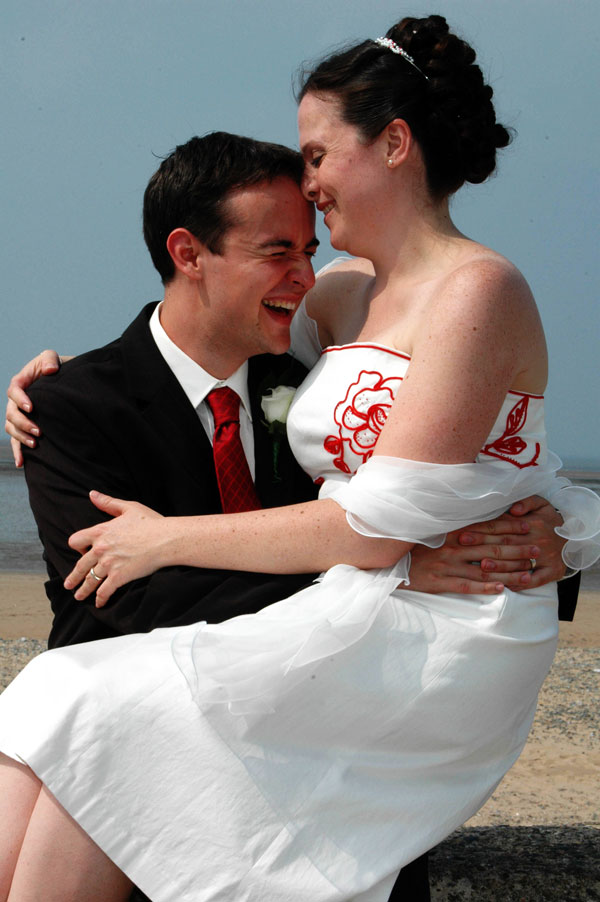 I do look forward to June 18 every year, mostly because it’s an excuse to post pictures from my wedding, which was the most wonderful day and everything I ever dreamed of it being (and thank you once again to whoever was responsible for that gorgeous sunshine). It was just 6 years ago, but
 we’ve come a long way since then, learning so much and changing our minds about a lot of things, but everything really important I believed in then, I still believe in now (except that James Blunt’s “You’re Beautiful” was a good song. I do not know what I was thinking). That there is love without compromise (to one’s self, I mean, not between one another), that marriage is a project that you mutually envisage and build up together, and that it’s forever a work-in-progress is wherein lies the beauty and possibility.






