July 14, 2011
Barbara Pym for afters
 We’ve invented a new dessert! Or rather, we’ve re-christened a very familiar one. This all came about because Harriet had taken to walking around the house screaming, “Barbara Pym!” Which is a bit weird, because Harriet and I don’t talk about Barbara Pym a lot, but I must talk about her to other people enough that the name is known (and I shouldn’t be surprised– Harriet has had her photo in the Barbara Pym Society newsletter after all).
One night a few weeks back, when Barbara Pym mania was at its height, Harriet was coerced into her chair at the table with the promise that we were going to be eating Barbara Pym for dessert. Dessert turned out to be berries with ice cream, which has since become the Barbara Pym that we eat almost daily. Splendid local raspberries tonight with maple ice cream made this particular dish of Barbara Pym delightful.
Here is a photo of the world’s dirtiest child devouring hers, having just completed her first course, which was mostly ketchup.
July 13, 2011
The world was upside down
“‘I don’t know why you’re laughing,’ said Aunt Irene. ‘I don’t see anything to laugh about. Everything strikes me as rather worrying.’
‘I’ll make a cuppa tea,’ said Mrs. O’Connor. She made terrible tea, very slimy, strong and tooth-stripping, but there was no denying its restorative powers.
‘If it does this to one’s cups,’ said Aunt Irene when Mrs. O’Connor had gone home to make tea for her boys, ‘what must it be doing to the lining of one’s stomach?’ She rubbed at the stained inside of the porcelain teacup. ‘I can’t be too rough,’ she said. ‘All its little gilt flowers will come off. They were designed for China tea. No one ever imagined Mrs. O’Connor would cross their path.’
The world was upside down. On the whole, this pleased Aunt Irene as much as it angered Mrs. Mason. It was more interesting that way, but it was hard on the porcelain.”– from The 27th Kingdom by Alice Thomas Ellis
July 12, 2011
Bring on the Books for Everybody: How Literary Culture Became Popular Culture
 The masses began their appropriation of literary culture during the 1990s with hit films like Emma, The English Patient and Shakespeare in Love, with the popular Jane Austen-riff Bridget Jones Diary, and by the time Michael Cunningham’s The Hours became a film in 2002 (an adaptation of a book that was an adaptation of Mrs. Dalloway, in which a 1950s suburban housewife achieves emotional oneness with Virginia Woolf), the dynamic shift was complete. Why and how this shift came about is documented in Jim Collins’ fascinating, absorbing book Bring on the Books for Everybody: How Literary Culture Became Popular Culture.
“Bring on the books for everybody!” was the call from Oprah as copies of Pearl S. Buck’s The Good Earth were distributed to her studio audience, and was the rallying cry in general as digitization began to make reading more accessible. It’s perplexing though, because this popularization is taking place as the decline of reading is lamented, as the book is declared dead over and over again. Clearly, according to Collins, digital culture has not killed the book, but rather the two co-exist and affect each other in unexpected ways.
What was once “the common reader” is now the “avid” or “passionate” reader, an empowered readership with its own sense of authority, their own understanding of just what reading is for, and their own parameters for book discussion. These are readers who read for self-cultivation, the very middlebrow sensibility that arose with widespread literacy over a hundred years ago and sent the Modernists scrambling for literary obscurity (and the Modernists could afford to do so, as most of them were backed by patrons with inherited wealth). Concurrent to this was the rise of English Literature as an area of academic study, an area that was strangely both elitist and populist– though literature was becoming more difficult to understand, it would be through study at university that readers would received the tools to access to it. And with this professionalization of English came about what Collins describes as an anti-snobbery: “The crucial distinction, which an entire institutionalized practice of reading endlessly reiterated, was between those who knew how to read closely and those who merely read, passionately or otherwise.”
How did the latter become so popularized, and so intrinsically linked to consumer culture? Collins puts forth “superstore bookstores” such as Barnes & Noble and Borders as the first explanation, which in their very architecture created a space that is what the library imagines itself as–instead of an “information hub”, a place where people actually sit down and read. Further, these bookstores delivered literary culture to places that hadn’t had any before, which is an effect as significant if not more so than the negative impact these stores have had on smaller independent ones.The second explanation is Amazon.com, which can now deliver books instantaneously (at least the electronic variety), and went from providing top-down content via an editorial staff in its early days to making its pages personalized for users, thus investing them with their own authority immediately, and underlining that authority by making its users books reviews and curators of reading lists.
Concomitantly came about the rise of “bibliophilia”, the idea that loving books brought authority enough to understand how they work, and that reading is for pleasure rather than rigorous study. This fits in well with the ethos of Oprah’s book club, and Collins uses the example of her Anna Karenina episode to explore the culture of Oprah reading. The segment began with her guest Barry Manilow singing the book’s title to the tune of Copa Cabana, her audience wearing their Tolstoy t-shirts, and a discussion with Karen from Will & Grace about how the book creates “a full sense of human nature that is universal.” (And here, Collins cautions us not to poke fun, using Harold Bloom’s point that to read is to “share in that one nature that writes and reads,” so Karen’s not far wrong.)
Collins addresses Oprah’s fine balance as “a literary tastemaker who is both an authority and one of us,” and compares her to Martha Stewart, another figure who has used mass media to enlighten us with taste in finer things. He also unpacks the case of Jonathan Franzen, the self-styled loner who’d given away his TV because of his vision of an apocalyptic world based on images, and had protested being an Oprah’s book club pick. Collins dismisses an opposition between the two with the reaction of his own graduate English students to the Anna Karenina episode and the Franzen debacle– they’d dismissed the book club as light-weight because the book never even factored into the discussion, and yet they didn’t ally themselves with Franzen either, with his old-school elitism (which doesn’t quite concur with his “middlebrow novel”, one of them suggests). Clearly the divide between popular culture and literary culture is more nuanced, less divided than the usual debate might have us understand.
Collins goes on to address long history of film adaptations of books, in particular the British tradition beginning in the 1980s with Merchant and Ivory, whose formula for success would be expanded upon and sealed by Miramax in the 1990s. The former was a niche genre, but became blockbuster formula, and he uses shows how the latter films were marketed in such a way as to appeal to communities of imagined cine-lit lovers. The route to adaptation was not a simple Franzen-esque divide between books good/images bad– Collins cites The Hours as a film that was as good as the book that preceded it, and also actually more complex, and notes that several Woolf scholars appeared in the DVD, that it led Mrs. Dalloway to became a bestseller in America in 2003.
In his discussion of popular literary fiction, Collins notes two trends, the first for the non-literary novel of manners based upon the literary 19th century tradition, and that the underlying use of this kind of fiction is meant to be self-help (not too dissimilar from the self-cultivators of last century). Just what fiction is for remains in question– to be read closely in the professional manner, are we to learn from it (broadening the idea of self-cultivation), or do we read for pleasure? We use the fiction we like to define how we’re seen by the world. And there are countless other points of view, each of them starting from a point no more or less authentic than the other.
The second trend he notes is “the devoutly literary bestseller”, the unabashedly bookish book. Books where characters are members of book clubs, where they write books, where they scorn the idea of fiction as useful until a wildly transporting moment as in Ian McEwan’s Saturday. Books concerned with art and beauty, books with Henry James as a character, bookish books like The Emperor’s Children and Special Topics in Calamity Physics (you know, the type of stuff that people like me suck up through a giant straw). But these more literary books with their “neo-aestheticism” come with their own utility linked with consumerism as a way to show us how to live well, and as evidence as we’re reading them that we’re doing so.
The book begins and ends with Collins in his local Barnes & Noble considering a mural of Great Authors sitting at cafe tables (“Henry James, Virginia Woolf, Jane Austen, Edith Wharton, and company”), the curious juxtaposition of these artists against the strange marketplace of the book superstore. But it gets less curious– near the end of the book, he provides an anecdote about a young Henry James longing for bestsellerdom. But it only gets more complicated too. A truly accurate mural, he imagines in his conclusion, would have Helena Bonham Carter, Oprah, Gwyneth Paltrow, Sylvia Plath, Harvey Weinstein, Jane Austen, Helen Fielding, Michael Ondaatje, several Amazon reviewers…
Collins ends on an optimistic note: our popular culture is richer for having the literary take its place within it. The 19th and 20th centuries are decidedly over, but we’re standing on the cusp of a new literary age.
July 10, 2011
Tin Book
 Because I’ve never stopped regretting not buying the book-shaped teapot I saw in England four years ago, there was not a moment of hesitation before I bought this book-shaped baking tin today. (I will admit, there have been moments of hesitation since. I have a feeling that collecting decorative baking tins is the beginning of a slippery slope to somewhere horrible, but alas, now it’s mine.) It’s a wide open recipe book, and the sides of the tin are the pages. I kind of absolutely love it, and it also means I can retire the baking tin upon which is printed a picture of Santa Claus looking like Satan.
I bought the tin at Madeleines, where we’d stopped in for our favourite watermelon sherbet en-route to the wading pool this afternoon. And after our successful wading pool sojourn, lovely Harriet (as usual) screamed the entire way home…

July 8, 2011
Mini Reviews: Granta 115 and The 27th Kingdom by Alice Thomas Ellis
 I bought Granta 115 for the Rachel Cusk essay “Aftermath” on her divorce, but as I read through the issue I quickly learned that one needs no excuse to buy Granta except that it’s Granta at all. What a discovery– yes, it’s a $20 magazine, but the price is more than worth it. being about 10 books in one. The Rachel Cusk essay was as complex, troubling and fascinating as I expected– I will have to read it about five more times to really understand it. Her prose is not readily accessible, the reader has to make her own way, and yet this path-blazing is so utterly engaging, and is why Cusk’s prose stays inside my head for ages after.
There was not one piece in this issue that was not a pleasure to read. I realize that 115 is a bit of a departure, comprising only female contributors, but this commitment to quality probably isn’t a one-off. For me, most notable were Julie Otsuka’s “The Children”, Francine Prose’s “Other Women”, Jeanette Winterson’s “All I Know About Gertrude Stein,” and Caroline Moorehead’s “A Train in Winter.” The last is a story of a group of female members of the French resistance who were taken to Birkenau, an absolutely brutal, stunning tale of devastation, depravity and survival, and this appears alongside Otsuka’s story of second-generation Japanese in America, Francine Prose’s thoughts on ’70s consciousness raising, Rachel Cusk and her divorce, and Janice Galloway’s “We’re Not In This Together” about the difficulty of obtaining contraception in the ’70s. Then stories of Haiti, Africa, India, and A.S. Byatt in the north of England. The contents of the issue are troubling, amusing, contradictory, complementary, as various as feminism itself, but so terribly good. What a fantastic introduction.
**
And then, why has Alice Thomas Ellis’ The 27th Kingdom been sitting on my shelf for years? Perhaps my new favourite book lately, sort of a mash-up of Hilary Mantel’s best social satire (Everyday is Mother’s Day) with her Beyond Black supernatural bent, a bit Graham Green’s Travels with My Aunt thrown in for good measure, also Muriel Spark’s The Comforters. I’d read Alice Thomas Ellis’ Birds of the Air some years ago, but it had not prepared me for the wit of this novel (shortlisted for the Booker Prize in 1983). It’s the story of a chaotic household in 1954 Chelsea, presided over by Aunt Irene, who fawns over her precious nephew Kyril, and who is well-serviced by local thieves to keep her in style. Her sister is a nun in Wales who sends to Aunt Irene a mysterious girl called Valentine whose presence causes strange events throughout the neighbourhood. Ellis had a mind for humanity at its most ridiculous, for the English at their most ridiculenglishness. What an extraordinarily wonderful book . (And do note, I’m reading though Es now– this is very exciting).
July 8, 2011
She could see that you might consume babies
“‘Why did the nuns expel you?” Kyril asked, venturing a little further, his head bent in an attitude so suggestive that Aunt Irene felt that, if he had been a stranger and addressing her, she would have emptied the orange pekoe over him. Sometimes she was so afraid for him with his reckless offensiveness that she felt sympathy for Focus’ [the cat] mother who, finding that the world had intruded and that strange human adults had fondled her kittens, had eaten the better part of the litter and was starting on Focus when he was rescued by Aunt Irene’s friend and thereafter raised on tinned milk dealt out by an old fountain-pen tube. She could see that you might consume babies when they were sweet enough to eat. At least you would know where they were. She worried about Kyril all the time, going about as he did in a world of fire and water, sudden concussions, cold steel and heights and depths, and taking so little care.” —The 27th Kingdom, Alice Thomas Ellis
July 7, 2011
It Must Be As Tall As A Lighthouse by Tabatha Southey
 If you accused me of being a Tabatha Southey fangirl, I could hardly deny it, because I have made a religion out of reading her columns aloud over croissant crumbs on Saturday mornings. And I kind of intended on liking her new book It Must Be As Tall as a Lighthouse (published by few-of-a-kind outlet The Book Bakery) because we’d read her previous picture book The Deep Cold River Story and really enjoyed it.
But no amount of Southey-admiration could have predicted the response I got to …Tall as a Lighthouse when I read it for the first time, out loud, and it left my husband and I both with tears in our eyes (and note that he is English, and only cries once annually). I think this is a book that will appeal more to parents than to children, although Harriet likes to pick out familiar images from the pictures– her favourite parts are the penguin, the fish, and the shovel. She also likes the rhyme scheme, and I do too, as it puts me in mind of one of my favourite picture books, A House is a House for Me.
And perhaps it’s because this is also a book about a house, about a house a mother will build her son, and she indulges all his impossible dreams–surrounded by ocean on all sides, in deepest outer space, near a good tobogganing hill, his window with a revolving view of jungle and desert (and with stairs made of eclairs). I particularly like “the window at which it is raining/when you just want to finish your book”.
But the house keeps changing as the boy keep changing, and he wants different things all the time. And then the end, oh my, the end– “For you’ve taught me that anything Perfect/ is only a moment of time…” That love so solid (red brick) for something so ephemeral is as impossible as the house itself, and yet that love exists, the most straightforward thing ever. Perhaps the loveliest articulation of parental love that I’ve ever encountered, the entire book is something to cherish.
July 7, 2011
Our Best Book from this week's library haul: The Terrible Plop by Ursula Dubosarsky/Andrew Joyner
 The Terrible Plop is The Gruffalo meets Chicken Little, the story of a strange sound that sends a whole forest running until one tiny bunny is brave enough face a scary reality, and find it not so scary at all. With its bouncy verse and tiny outsmarting creature, the story is a bit too Gruffalo derivative, but in the end manages its own particular charm. It’s got bunnies, rhymes, and chocolate cake, so what more could we ask for? And we’re still having fun reading it over and over again.
July 6, 2011
Literary Women: The Womanly Art of Blogging
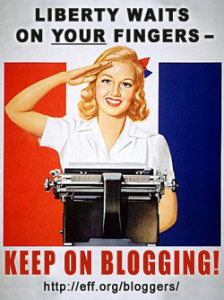 I’ve written a short essay on women and blogging for the wonderful blog Women Doing Literary Things, in which I write, “I’m not saying there aren’t any male bloggers—I just don’t read many of them. Though I also don’t read a lot of blogs written by women too: craft blogs, parenting blogs, home renovation blogs, fashion blogs, pregnancy blogs, infertility blogs, food blogs, and blogs about vintage rocking chairs. But the blogs that interest me, the literary ones— from the perspectives of common readers, academics, novelists, poets, mothers, book fetishists, illustrators, librarians, literary gossips, and critics alike—almost all of them are written by women.”
You can read the whole thing here, and I’d love it if you did.