


June 13, 2013
Hobbling Out in the World
 We made it to the Farmers Market yesterday, my first outing since coming home from the hospital. I had to hobble there while clutching my incision, and for the first time ever, we had to implore our slowpoke daughter not to walk so fast, but we made it and it was lovely to be in the world, even if the soundtrack was a bagpiper dueting with steel drummer on a version of Jamaica Farewell. We also came home with strawberries and raspberries, so it was definitely worth the trek. I’ve elected to spend today in bed though, partly because I don’t want to overdo it, and also because Iris was up most of the night, scarcely sleeping for more than an hour at a time.
It still remains true how much easier this experience of having a newborn baby has been. Part of this is because we skipped the stage where Baby loses 11% of her body weight and breastfeeding is as difficult as it is constant. Iris had surpassed her birth weight as of Monday and she’s doing very well, bouts of misery aside (which can be attributed to diagnosis:Baby). Partly because we knew what to expect in terms of the all-night fussiness and the problems which have no solutions. (This time I have not once paged the midwife because the baby refuses to go to sleep.) I am not resisting having Iris in bed with us when required, which was a huge hurdle before–everyone had warned that it was the slippery slope to the end of life as we know it, but now I know that it isn’t. I have not googled anything newborn-related to seek advice from uninformed, hysterical women who are as desperate as I am, and as I result, I do not feel so desperate. The holy trinity of a queen-sized bed, my smart-phone in the wee hours and the placenta pills continue to bolster us. My husband who is not going back to work anytime soon. All these things are making these days quite different than the last time we went through them. Also the knowledge that these are probably the last time we’ll go through them. It seems to me that having a second baby is like getting a tattoo after all.
When we went out into the world yesterday, I was not surprised to discover it was still there. It doesn’t seem surprising that life has gone on normally while our family has been changed forever. Iris’s arrival has not so shaken the foundation of our existence as Harriet’s did, mostly because we were parents already and have not had to weather the explosion of becoming so, and also because Harriet herself ties us to the world, to the pattern of ordinary days. Stuart gets up in the morning and takes her to school, and she comes home with dispatches from the world beyond the four walls of my room. She demands meals and bedtime, stories read, games played. “Pay the most attention to me,” she demands, ever comfortable with voicing her needs. And so we have not been able to be sucked into that funnel cloud of newborn mania, crazed internet searches, middle of the night despair, logs of inputs and outputs. Downstairs we have the Hospital for Sick Children Baby Care book, and if you open it you will find the marginalia of a madwoman. There is a chapter on sleep habits, and I went through it with a pen underlining every single bit of text. Obviously, the notes were unhelpful, and I’ve not opened that book in quite some time.
Which is not to say that I didn’t cry this morning after being up all night when the bad baby still wouldn’t settle. But I had a nap and then I felt better, and I’m looking forward to walking a little bit farther tomorrow.
June 12, 2013
The benefits of being bedridden
“Charles can no longer pay attention to one source of information at a time. He is Modern Man, programmed to take in several story lines, several plots at once. He cannot quite unravel them, but he cannot do without the conflicting impulses, the desperate stimuli. Perhaps he hopes the alcohol will simplify them, will stick them together and fuse them all into one consecutive narrative. The narrative of his own life, of his place in the history and geography of the world.” –Margaret Drabble, A Natural Curiosity
“‘No,’ I answered. “I don’t agree with that. I think you should learn, of course, and some days you must learn a great deal. But you should also have days when you allow what is already in you to swell up inside of you until it touches everything. And you can feel it inside you. If you never take time out to let that happen, then you just accumulate facts, and they begin to rattle around inside of you. You can make noise with them, but never really feel anything with them. It’s hollow.” –e.l. konigsburg, From the Mixed Up Files of Mrs. Basil E. Frankweiler
Isn’t Margaret Drabble’s 1989 novel eerily prescient of the internet? I enjoyed the konigsburg book as well, though it was a curious one. I’m now finishing reading Lisa Moore’s novel Caught, and will be rereading Slouching Towards Bethlehem afterwards. And I think I’m going to miss being bedridden… Other books in the horizon are The Eliot Girls and The Flamethrowers. And truly, this is the reason that breast is best.
June 10, 2013
Where’d You Go, Bernadette? by Maria Semple
 Apparently Maria Semple’s novel Where’d You Go, Bernadette? was one of the biggest books of last year, but perhaps I wasn’t paying attention. Someone who was paying attention, however, was Stuart, who took note when I picked this book up in the store and casually remarked, “I’m kind of interested in this one,” and proceeded to buy me the book for Mother’s Day. I saved it for postpartum, because I had a feeling, and oh, what a good feeling it was. Two nights ago, Iris’s all night eating/fussy fits began, and I was so glad to have this book on hand. My mind is fuzzy and there is no way I could write a coherent review, but it’s an endorsement, I think, that on Saturday night when I was up from 12am until 5am feeding the baby, all I could really think of was, “Yes! I get to read more Bernadette!”.
The book comprises a mishmash of forms–letters, emails, newspaper articles, memos and more. It reminded me a bit of A Visit from the Goon Squad combined with a bit of Special Topics in Calamity Physics. It’s heart-felt, satirical, rich with the stuff of the world. Lines in parentheses, like, “This is why you must love life: one day you’re offering up your social security number to the Russian Mafia; two weeks later you’re using the word calve as a verb.” Told from the vantage point of Bee Branch, a wise-beyond-her-years Seattle teen who lives in a decrepit former home for wayward girls atop a hill of blackberries with her father, a Microsoft developer, and her eccentric mother, Bernadette. We learn about Bernadette mainly from the point of view of other parents at Bee’s elite private school, other women bothered by Bernadette’s refusal to conform to their expectations of her. Bernadette is brilliant, agoraphobic, and her daughter adores her. We learn that in a past life, she found fame as an architect of buildings constructed from found-objects, but she stopped creating after a series of tragedies. And now suddenly, on the cusp of a family trip to Antarctica, Bernadette has disappeared. It’s up to Bee to put the pieces of the puzzle together, and find out where her mother has gone.
The perfect book to read in the middle of the night a few days post-partum is not to say the book isn’t really smart and satisfying. How wonderful to get the best of everything.
June 9, 2013
Sleeping Bunny
You can’t even tell that she is going to wake up at midnight and eat for five hours…

June 8, 2013
How Iris arrived
 It really was a very gentle time, the weeks we spent waiting for Iris to come. I spent last Friday evening bouncing on a ball to induce labour, made absolutely miserable, and then my husband discovered that if you bounced on a birthing ball to terrible hiphop ballads, the whole experience was made more fun. Though looking back, I realize it was probably for the best that my labour was not brought on by bouncing to Usher singing Love in this Club. And I absolutely adore the photo of me in my bathing suit from last week, the gloriousness of it all, though it’s all sort of bittersweet when I compare that image to my poor ravaged body today.
Here it is: I am so so happy. I know I am only four days postpartum, and probably hormones have something to do with the happiness as well, but they’re supposed to. “I never imagined it could be like this,” but this means something very different now. And I know the experience of my birth, although it was far from ideal, really has something to do with this. Oh, how much it matters how the baby arrives. I know this for sure now, but in a more nuanced way than when I was ranting a few weeks back.
My labour began on Sunday night after we’d eaten much of Barbara Pym’s Victoria Sponge, although it was not apparent to me that it was labour until Monday around noon. I spent Monday night awake every ten minutes with contractions, but then by morning they were gone. A visit to the midwives on Tuesday showed that things had been progressing, even without the contractions. They started again Tuesday night with a great deal of trouble on my behalf, and we were up all night again, sure that this was it. The midwives arrived with birthing supplies and found me dilated to 6 cm. But the contractions never got stronger and once again were gone in the morning. The midwives came later that morning with the intention of breaking my water, but then the baby’s heart-rate was troubling–she was not responsive enough. And while she was stable, it was scary, and there was no longer very much natural about my “natural” birth. I just wanted the baby out.
We took a cab to the hospital, both of us crying–partly because we knew our birth plans were out the window, because we were scared for the baby, and also because we knew we were leaving Harriet without having prepared her for this. (She was at school at the time, would be cared for by our wonderful friend Erin until my mom arrived to stay with her here.) It was cold and grey outside, and as we drove past a high school, a group of boys threw rocks at our car. The world seemed quite horrible and we kept crying–I have never seen a taxi driver more concerned about his fares (and so maybe the world was not so horrible after all).
En-route to the hospital, I started having contractions again, which continued as we waited in triage. The OB on-call found it odd that someone dilated 6cm was not progressing, and give me the option of induction, which I had no intention of taking. (“It’s going to need a lot of drugs to work,” she said, again, a far cry from natural.) But still, that she give me a choice made the decision to do a repeat c-section one that I could own, and I am grateful for that. Which is not to say that I wasn’t weeping in the OR, so much so that the staff was confused–never had a sadder woman been about to give birth. Situation compounded by an anaesthesiologist who I think forgot I was a human being as she handled my body pre-surgery. The student midwife came over to comfort me with casual conversation though–I think she said, “So what’s the first thing you’re going to eat when you can eat again?” And obviously, the answer was chocolate croissants, and seriously, that woman changed my world around. By the time Stuart was brought in in his scrubs, I was comforted and ready, and knew we had made the best and only choice.
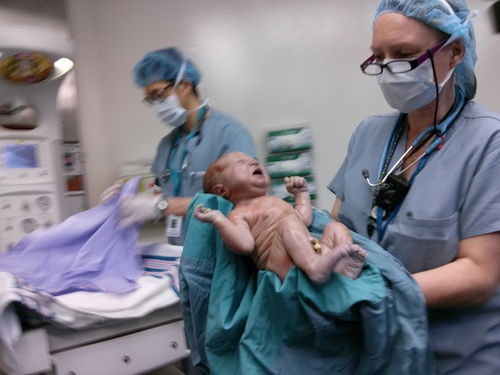 Iris means rainbow, and Malala is a hero. The midwives knew how troubled I’d been having never seen Harriet until she was wrapped and hatted when she was born, and so when they pulled her out and brought her to the warming bed, I knew just where to look and Stuart snapped a photo. She was amazing, purple, and she was mine, ours. I knew it instantly. Because of Harriet, there is a part of my heart that is mother-love now, and Iris resided there immediately. I cried and cried, like I’ve cried just one time before, at the birth of Iris’s sister. Our girl was finally here. Our family was complete. It meant something that we’d been waiting so hard for her, that I had been supported so much in my intentions for VBAC, and that Iris herself had been trying as hard to come to us–they discovered the cord was wrapped around her neck four times and there was no way she would have made it out on her own, and an induction would have been a disaster.
They didn’t lie, all those people who told me it would be different the second time around. That first night as Iris fed all night long, Stuart having to deliver her from one side to another as I was unable to move, I didn’t sit there wishing we could leave her and run away. I knew already that the objective to such a night wasn’t getting the baby to sleep, that the baby was doing nothing but simply being a baby. The goal of the night, I knew, was to get through it as best we could, which we did, aided by the fact that Iris has breastfed like a champion since being 40 minutes old.
 We left the hospital yesterday–turns out they can boot you out after 2 days now, which is kind of unbelievable, but we were good to go, and eager to get home to Harriet. The surgery has left me brutalized–I think my surgeon 4 years ago was a master of the art, because I was out for walks last time and today I can barely move. Midwives have assured me that my previous experience was the exception to the rule. And I hate that, feeling so badly, but it’s also not so bad being confined to my bed. I’m reading Where’d You Go, Bernadette, which I love. Stuart is bringing me snacks and meals. We prepared for all of this by buying a queen-sized bed last winter, which is so comfortable, and I also got a smart phone a few weeks ago, knowing it would make this kind of thing easier, still being connected to the world. The postpartum crazies also have yet to arrive–they were knocking at the door last night, but then were followed by the woman I’ve paid to make capsules of my placenta, which are meant to help balance hormones. She dropped off the pills, I started taking them, and I’ve been feeling cool ever since. No weeping even! Maybe it will all kick in tomorrow, but in the meantime, I’m happy to take good days where I find them.
Iris, as we know her so far, is marvellous. She arrived and looked like an elderly frog, the next day like a dinosaur, but now she just looks like Harriet did, but with fairer colouring. She practices smiling in her sleep, and midwives reported today that she’s doing great. Her mood could be assisted by the fact that her mother is not a lunatic. She’s just three ounces down from birth weight and we no longer need to wake to feed! Because of my previous experience, when Harriet lost so much weight, I’ve been breastfeeding with great persistence (which is not so heroic–Iris is content to let me read while doing this) and it seems to have paid off. It’s so good to be home and Stuart is taking such good care of me. Harriet is the big sister beyond my wildest dreams, her bond with Iris already making us swoon, and she is displaying such annoying and atrocious behaviour in addition to this that we know she is in fact fully processing the change in our family and we won’t have to wait for another shoe to drop.
 So there it is. Everything is wonderful. Just four days in, and I know you have to take good times one day at a time just like the trying ones, but it really means something. Four days postpartum with Harriet I was in pieces already. I was so scared to go through all this over again, and I am so relieved and grateful that this is different. That the gentle times continue. Knock wood, of course, and there will be challenges ahead, but I’m pleased that there really is a chance that I’ll be strong enough to meet them.
And thank you to so many friends for support and best wishes. We are a very lucky family.
June 6, 2013
Baby Iris has landed
Welcome to the world, Iris Malala. My heart was yours from minute one. And pleased to say labour came with Barbara Pym’s Victoria Sponge. Harriet is thrilled and we are zonked but happy out girl is finally here.
June 2, 2013
Victoria Sponge for Barbara Pym
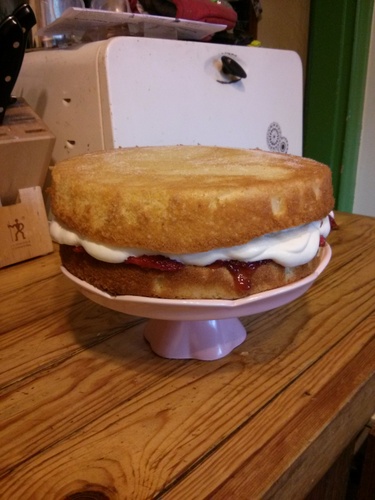 I successfully baked a Victoria Sponge cake in honour of the Barbara Pym centenary (and because I feel like eating one). Recipe from Nigella’s How to Be a Domestic Goddess, with fresh Ontario strawberries inside. Here’s hoping it tastes as good as it looks. And happy birthday, Miss Pym!
June 2, 2013
Reading Barbara Pym on her Centenary
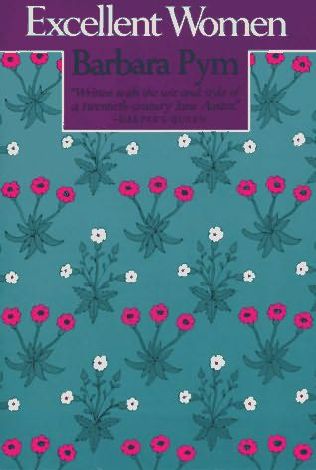 I have nearly all of Barbara Pym’s novels on my shelf, the bulk of which I obtained when a contents sale was held at a house around the corner and I pretty much cleaned out the library. And this is how it is with Barbara Pym novels–it usually takes death for a reader to finally part with them. Though they also turn up at used book sales from time to time (probably after a death as well), which is how I first encountered Excellent Women, perhaps Pym’s best-known novel. I’d heard of Pym from Susan Hill’s Howards End is on the Landing, Maureen Corrigan’s Leave Me Alone, I’m Reading and also from this wonderful piece on the CBC on the Barbara Pym Society, which I joined shortly after becoming a Pym convert. It was Excellent Women that fast turned me into one too, and no wonder, I discovered, over the past few days as I read the book again.
It’s wonderful. I could see how encountering Pym first through some of her other novels might be a less delightful experience, one not truly appreciated until one understands the nature of the Pymmian universe. But Excellent Women, as subtle and small as her other books, is so absolutely funny, its goodness immediately graspable. As ever, the delicious gap because what is written on the page and the reader’s apprehension of the true situation. It’s the story of Mildred Lathbury, spinster daughter of a clergyman whose life changes with the arrival of new neighbours Rocky and Helena Napier, plus a clergyman’s widow who steals the heart of the vicar whom everyone had assumed that Mildred was in love with.
And the lines: “A little grey woman… brewing coffee in the ruins.” The austerity of 1950s’ England is not at the novel’s forefront, but instead a shadow in the background with references to bombed-out buildings, ration books, and bad food. But ordinary life goes on anyway, church services conducted in the half of the church that was not destroyed in the war, which gives the congregation a heightened intimacy.
And the vicar with his plaintive call: “May I come up? I can hear the attractive rattle of tea things. I hope I’m not too late.” Oh, so much tea. “Perhaps there can be too much making cups of tea, I thought, as I watched Miss Statham filling the heavy teapot. We had all had our supper, or were supposed to have had it, and were met together to discuss the arrangements for the Christmas bazaar. Did we really need a cup of tea? I even said as much to Miss Statham and she looked at me with a hurt, almost angry look. ‘Do we need tea?’ she echoed. ‘But Miss Lathbury…’ She sounded puzzled and distressed and I began to realize that my question had struck at something deep and fundamental. It was the kind of question that starts a landslide in the mind.”
There are so many landslides in this tidy book, whose whole world is turned inside out by its final page. Most aren’t the landslides you’d notice and it doesn’t end with a wedding (though a further glimpse of these characters in another Pym novel reveals that one will come about eventually!!!), but more with a change in consciousness, the main character’s heightened awareness of her place in the world. And it’s a funny little world too, quintessentially English, rattling tea things and all. How I adore it, absolutely.
This past week, I also reread A Glass of Blessings, which is more subtle and infused with a touch of melancholy in spite of its delights. So many musings on a furniture storage facility–such a curious book. A bored and idle married woman fancies herself the object of another man’s affections, though he turns out to be gay (which is as expressly stated as you’d imagine for a book published in 1958). Pym is truly the master of the unrequited love narrative.
I do look forward to much Pym rereading this summer. I’ve read most of her books in a pleasurable blur, and welcome the opportunity to think deeper about them. I also look forward to baking a victoria sponge cake this afternoon in celebration of her centenary. It’s either bake a cake or have a baby, and the latter doesn’t appear to be happening yet.







