May 1, 2014
Hideout Hotel by Janine Alyson Young
 There is a lot to appreciate about Hideout Hotel, the debut short story collection by Janine Alyson Young. The first story, “Bushfire”, is full of violence, drink, and danger, and begins with its main character throwing up out a window. The book’s cover is appropriate–these are domestic tales, but the couch is hideous, threadbare, and sitting on the porch. There’s nothing cozy about these homes, which in the case of “Bushfire” is a trailer in an isolated Australian mining community. It’s where Gina lives with her pregnant sister, their parents finally leaving town, a town with nothing much except the hotel to drink, where Gina drowns her sorrows and is taken to bed by one man after another. She doesn’t imagine she’s happy, but supposes she could be, and looks forward to creating a cozy home with her sister, raising the baby together. But the eponymous fire in the distance suggests that Gina’s dream won’t come true, plus we begin to see that Gina’s handle on her fate is even more tenuous that she knows. This was a strong story, a story that surprised me, whose violence was not gratuitous, and is indicative of Young’s talent.
The story sets a tone which is echoed in the others. These are stories of young women who are trapped on the edge of nowhere, without agency or ambition. In “Greyhound Special”, a lead singer ditches her band and flees to Whitehorse where she pitches a crappy tent and looks to the universe of a sign of what next. In “Once It Breaks”, a young mother considers her loveless marriage. And then “Sung Spit Part One” and “Sung Spit Part Two”, which constitute half the book and together are two fragments of a novella, in which a young woman watches her teenage cousin carouse toward self-destruction, mesmerized by the girl’s charisma, her untouchability, how she refuses to be held. Meanwhile, the girl herself is pregnant, not going anyway, unsure of how to properly rebel against her hippie mother. We meet her a few years later in part two, a little older but still not over her cousin and the events that transpired the summer her cousin went away.
Of her older boyfriend, she explains, “I annoy him, I think, because I’m young and wasting my youth. I’m not excelling in anything, but more than that, I’m not fucking up either. I never get atrociously drunk or high, but I also haven’t applied for law school. It seems there’s no middle ground with youth. You’re supposed to be making the most of it by either getting somewhere or else destroying yourself one hilarious night at a time and I can’t seem to do either with much gusto.”
My problem though is that she doesn’t do much of anything at all, and neither do any of the women at the centre of these stories. The settings are interesting, the situations are interesting, and some really wonderful dynamics transpire–the relationship between the cousins in Sung Spit, or how when the girl visits her mother and sees her mother’s effort in relating to her, the idea of this is terrifying—but I wanted these girls to stop drifting. I was more interested in secondary characters, the mothers and mother-figures who seemed more fully formed by their experiences, but whose perspectives never come into play. Maybe the point is that I am old…
Hideout Hotel is a book with promise, and it holds the seeds of a great book to come.
April 30, 2014
Things About Iris at Nearly 11 Months
 1) Very interested in dogs and squirrels. Points to them as we walk down the street, and says, “eeggh”.
2) When you ask her where something is, she answers by pointing to a photo on the wall. Doesn’t seem to understand that reality is out in the room in all three dimensions.
3) Perhaps related to above, but obsessed with baby photos of her and her sister which hang in the hall.
4) Obsessed with traffic signal buttons at intersection. Must press the button every time we cross the street. Also wants to push the button on the other side, and sometimes cries when I don’t let her.
5) Likes to throw my Mitford books (conveniently situated at Iris height) onto the floor. Debo seems to be her favourite.
6) She eats pom-poms, toilet paper, and things we bring into the house on our shoes.
7) She has just started fake-laughing when she heard others laughing. It is terribly funny.
8) Probably should have been taught baby sign language because she just screams to get what she wants, and it’s so so terrible.
9) Is very soon going to have to be bought her own ice cream cone, as she is very crap at sharing.
10) Thinks she is 4.
April 28, 2014
My Co-Workers in the Mother Trade

“Just when I most needed important conversation, a sniff of the man-wide world, that is, at least one brainy companion who could translate my friendly language into his tongue of undying carnal love, I was forced to lounge in our neighbourhood park, surrounded by children.
All the children were there. Among the trees, in the arms of statues, toes in the grass, they hopped in and our of dog shit and dug tunnels into mole holes. Wherever the children, their mothers stopped to talk.” –Grace Paley, “Faith in a Tree”
I live a long way from Grace Paley’s Washington Square Park, Ms. Faith Darwin up in a tree. Paley’s fictional Faith and her scrappy friends talking politics and gossip as their children misbehave in the playground. These other women whom Paley (as Faith) calls, “My co-workers in the mother trade.” And I love that idea, the necessary solidarity even while personal alliances can be complicated. I think some of us could go a long way toward sorting out these Mommy wars (which are mostly fictional anyway) if we looked upon our fellow mothers like this. If our approach could be this un-adversarial, acknowledging the trade element of it, that motherhood is work and struggle, and yet in comradeship, our solidarity, the burden of it all is less. In our comradeship, there is even pleasure. The whole idea makes me long for a tree to perch in, for my very own corner in Washington Square Park.
But I kind of have that corner, I really do.
You know, Mom-friends get a terrible rap. I know this partly because I’ve done the rapping, acknowledging the disappointment and loneliness of my early days of motherhood, how I used to wander playgrounds desperate for someone to talk to as I spent my days caring for a nonverbal baby-person. I used to go to Mother/Baby yoga and not talk to anybody, and instead, measure myself agains all the women whose hair was styled, whose abdomens didn’t resemble deflated tires, the women who seemed to know exactly what they were doing, where I’d never been so inept in my life.
But that was a long time ago. (And what I’d give for an deflated tire abdomen these days, living as I do with its pneumatic cousin…)
Harriet began (pre)schooling about 18 months ago at a cooperative play school (speaking of comrades). I was nervous. “Other moms,” I thought, wrinkling my nose and thinking about yoga. But immediately, things were different. Part of it was the school itself, I think, which is part of a really excellent community. There is an atmosphere of friendliness fostered among the children, and that atmosphere makes its way up to their parents too. I remember during Harriet’s first few weeks at the school, I’d arrive to pick her up in the playground, and I soon found myself invited into the other mothers’ conversation. It got to the point where on sunny days, we’d linger in the park for hours, burying our feet in the warm warm sand, the children happily playing while I chatted with their moms.
Last year when I was pregnant, the other mothers celebrated my pregnancy alongside me and commiserated about its trials. When I was having health concerns (the kind that left me bursting into tears when other moms asked how I was doing), the support I received from these women buoyed my spirits. When Iris was born, other moms picked Harriet up from school, kept her for afternoons, and were incredibly generous with gifts that made her feel special. Because of the playschool moms, our family is part of a community that ties us to our neighbourhood and to this city. With the playschool moms, I’ve had the most important conversations.
(Sometimes, the playschool moms are dads, though not often. They’re sometime nannies too. And the playschool moms work part-time, full-time, work from home, work at home. There are a million ways to do it.)
It’s not just playschool though, because Harriet started kindergarten this year and it’s been just the same. I drop her off in the mornings and meet up with moms and dads starting out on their own days, and they’re always friendly and kind. In the first few weeks of school when Harriet cried every morning and then when I eventually left her, I’d be crying too, they were all so nice to me, so supportive of the tearful woman with the new baby whose big kid was a basket-case. Those who’d been through it already told me everything would be fine, and they weren’t lying. I meet them these days, on the other side of winter, and can’t quite believe how far we’ve come. Our conversations tend towards small talk, but these connections are vital. I know these people, I like these people. I know their kids, I’d trust them with my own kid, and I know that if I needed help, I wouldn’t be alone.
These are not friendships exactly. Maybe some of them will grow to be, but the collegiality in Grace Paley’s phrase is precisely right. These are my co-workers in the mother trade, we’ve all come so far since baby yoga, since we were desperate and tired and had something to prove. At kindergarten drop off at 8:57 Monday morning, never is there anything ever to prove, except that we made it before the bell rang, and that is huge and that is awesome. A victory we all share in. It’s a lovely way to start a day.
April 27, 2014
7 Ways to Sunday by Lee Kvern
 “Wild verus farmed,” begins Lee Kvern in the acknowledgements which precede her short story collection, 7 Ways to Sunday. “….I am of the latter variety. Wild. Largely unschooled… I learned the liar’s craft by hell and bent wheels, trials and multiple errors in good story judgement.” Her collection too is wild instead of farmed, 20-some years of stories gathered together for the first time instead of a carefully curated collection that was always going to be a book. And the collection works first because of its wildness, of the characters themselves, of the stories which place the reader in all kinds of situations, stories steeped so in their language and atmosphere so that the reader has to find her bearings every time, finds herself somewhere altogether new, the characters’ situations and fortunes shifting in a way that makes the book’s Snakes and Ladders cover so absolutely perfect. The collection works too just (just !) because Lee Kvern is a fantastic writer. When you’re this good, your 20-some years of stories were probably born to be bound.
I loved this book, hooked by the first story, “White,” in which a woman arrives with her husband and two young sons at an ice-fishing party in the middle of nowhere. It’s a dodgy scene: “We pass a running Plymouth, the windows dressed in rime. Inside: two steamy, half-dressed teenagers ravaging one another. My husband raises a brow at me. Avert, avert, I want to say my boys… Avert your eyes, turn away, this knowledge is not for you.” It’s an idea that runs through the book, parents failing to protect their children from the world, children seeing things they shouldn’t have seen, characters failing to avert their own lines of vision from painful revelations as to the realities of their lives.
In “High Ground,” a mother trails her son from party to party, sitting outside abandoned warehouses behind the wheel of her Camry, as he falls into drug abuse after an injury ends his career as a student athlete. “I miss his bare arms poking out of his Varsity jersey… rather than the tainted ticker tape of his blue tattoos telling the world–here is who he is now.” In “This is a Love Crime”, a woman married to a controlling husband whose behaviour borders on abuse drifts farther and farther from his sphere of influence as she grapples with a problem at her supermarket HR job with a checker who insists on violating the dress code with her hijab. “Detachment” is one of a few stories in the collection that take place on rural RCMP detachments; in this one, a complicated mother-daughter relationship plays out against a dangerous backdrop.
Similar is “In Search of Lucinda”, a 1970s set-piece whose garish colours are strikingly evoked as is scent and atmosphere. In this story, the father’s associates bring home two women whose appearance on the domestic scene is quite incongruous, and the situation (and the woman) is delivered redemption through the guilelessness of a little girl. In “Pioneer”, a mother struggles against love and fear for her son whose gender difference is becoming apparent. In “The Night Doors 1987”, a family arrives at the hospital to be with their ailing father as he dies, the story a devastating, haunting and beautiful portrayal of the last moments of a life, of the parts of life that nobody ever talks about, or at least not this vividly. And I loved the title story, in which redemption is once against delivered almost just past just in time, but leading up to that is the most gut-punching (and cringe-making!) spiral of a life heading out of control. It starts off kind of a funny, a guy so reprehensible that all he has for company are the Jehovah’s Witnesses who show up at his door every week, but instead, Kvern makes us care about him, and the oft-mocked door-knockers are offered literary redemption as well, to be people rather than punchlines. By the end of this fantastic story, I wanted to champion every single character.
April 23, 2014
The M Word in pictures
I’m so happy to share some beautiful photos from last week’s events for The M Word in Toronto and Kingston. Thank you to my excellent friend, Erin Smith, for the Toronto shots, and to the wonderful Andrea Cordonier (who I got to meet in real life!) for the Kingston ones.


April 22, 2014
Challenging the Mommy Wars
 When I was in Kingston last week, I sat down with Hollie Pratt Campbell, editor of the Kingston Heritage and Frontenac Gazette, and we had a terrific conversation over a couple cups of coffee. She turned that conversation into a really great article about The M Word that totally gets the book and the power of all its stories together.
When Kerry Clare’s first daughter, Harriet, was born in 2009, she found herself with a new life obsession.
“It was my occupation, but it was also my preoccupation, because it was all I could talk about,” the Toronto-based writer and editor says of her new role as a mother, recalling the many books she read and conversations she had with friends on the topic.
“But I also began to see that my preoccupation was alienating for some people. I had friends who couldn’t relate to these experiences. I had one friend who was having fertility problems. She was having a miserable time and felt so apart from women and mothers and where she wanted to be in her life. I started to think about how [the experiences of women who are not mothers] fit into the motherhood narrative even if it wasn’t in the conventional way.”
You can read the whole thing here. I’m so pleased with it!
April 22, 2014
#MakeSomething: The Most Magnificent Book
It is always a good day when we get a package in the mail from Kids Can Press. In particular, when that package has to do with a book that we’ve loved as much as we continue to love Ashley Spires The Most Magnificent Thing.

Remember that book? The book of which I wrote, “ It’s got everything. It’s got a dog, a girl who builds things, appealing illustrations that stand out against simple line drawings of an urban street-scape. It will appeal to both sexes. It’s got words, so many words, terrific verbs employed in the act of construction. It’s about coming up short, making mistakes and getting angry–the acknowledgement of such experiences is incredibly profound and has echoes of Sendak.”

So it was so cool to get this kit in the mail full of stuff for making, including a modified version of the book for us to “hack” and include in our creation. Harriet quickly set to work making blueprints, and was determined that her magnificent thing would be a monster.

The project came together fast. Harriet’s dad worked alongside her.

She cut, she stuck, she modified, she erred and tried again, and came up with something even better than her blueprints.
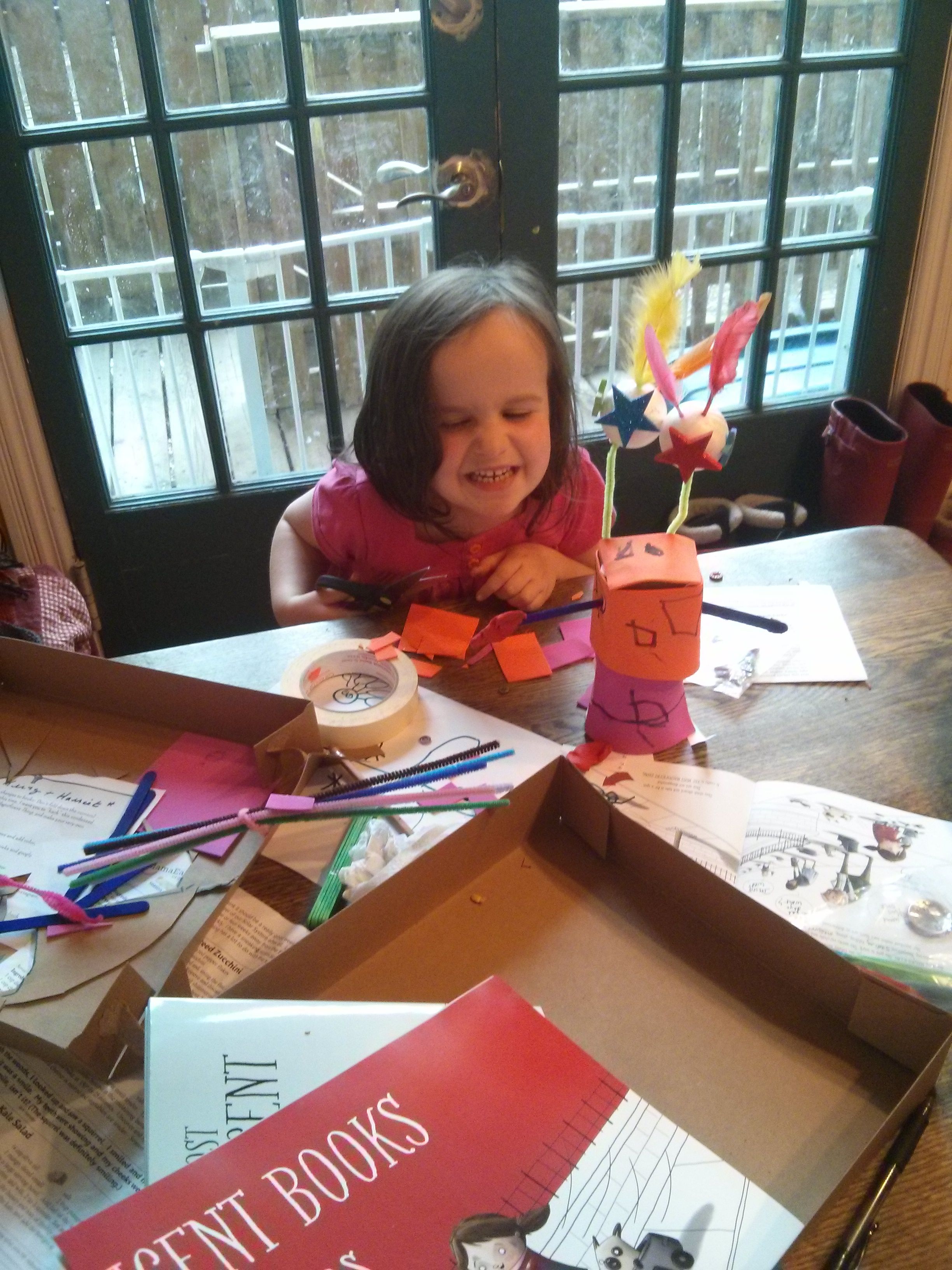
Like her mother, Harriet is blessed with not being a perfectionist, and so her final vision seemed more than satisfying. We hooked our guy up with the book, because monsters like reading just as much as anybody does.
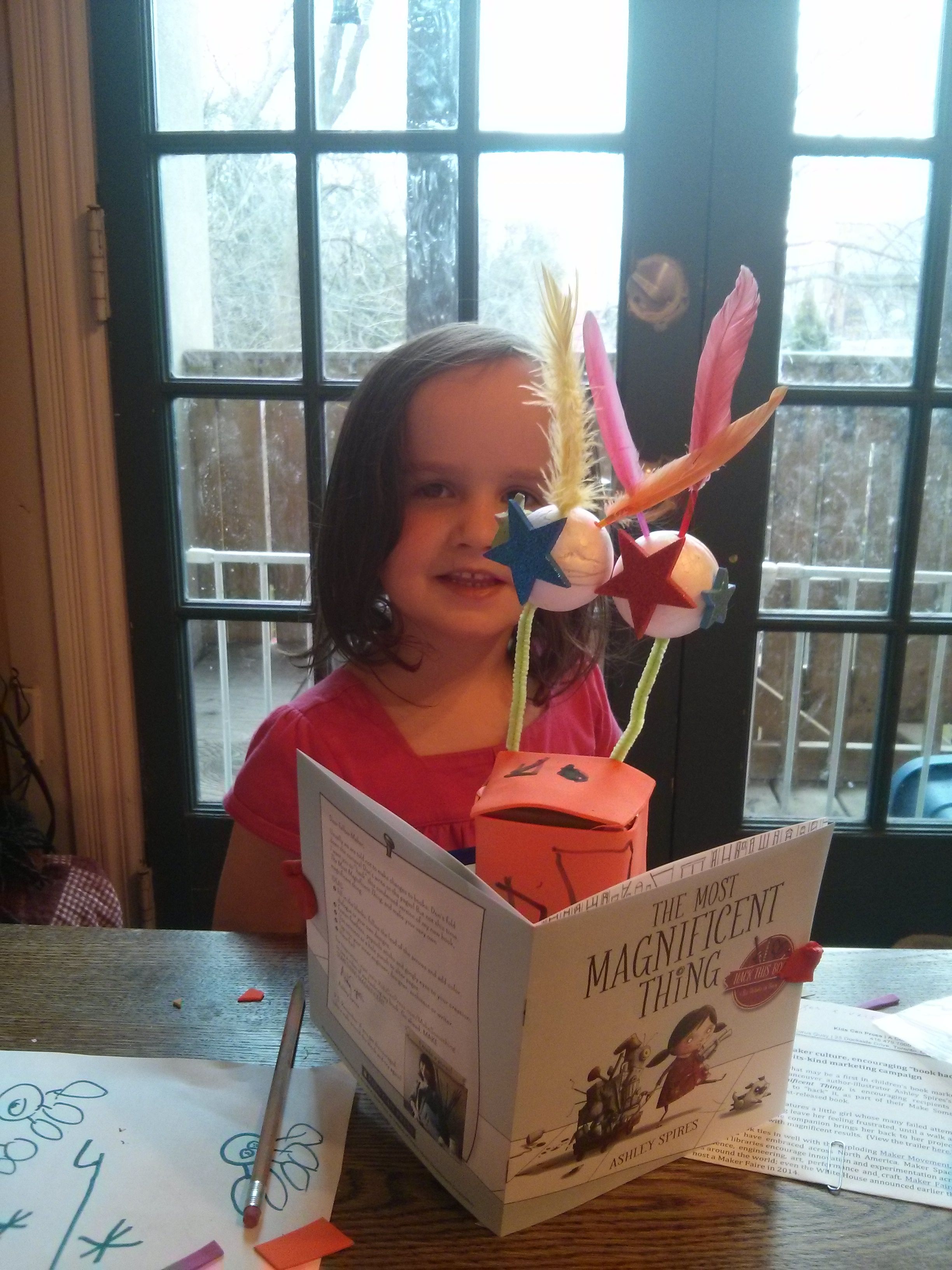
What fun fun fun, and just an example of the creativity this fantastic book will inspire. Thanks, Kids Can Press! So happy to spread the word about a book we love as much as this one.
April 21, 2014
A Tale for the Time Being
 It was during the summer of 2001 that I started flexing the muscles that would soon come to constitute the foundation of my self, by which I mean that I started book buying in earnest, books that weren’t secondhand paperbacks on my course lists. It was a pretty fantastic time to be buying books. I wasn’t worldly enough to be aware of Toronto’s independent bookshop scene, but I lived at Bay and Charles and was pretty thrilled by this huge and marvellous Indigo shop that had opened up around the corner, and around the corner from there was Chapters, another mega-bookshop, and this was back when mega-bookshops actually sold books. You know, I have nostalgia for those days, when I thought Chapters and Indigo were wonderlands. Like the World’s Biggest Bookstore, but with comfy chairs, and no dingy lighting. Plus, that summer I was working on King Street East, and at lunch time, we’d stop in at Nicholas Hoare and Little York Books, and suddenly my paycheques weren’t going so far, but there I was with The Portable Dorothy Parker and Zadie Smith’s White Teeth, and I was this close to being a grown-up person who could buy books whenever she damn well wanted to. It was delicious.
Though I think I got it on sale, Ruth Ozeki’s My Year of Meats. A hardcover on the remainder shelf, and I bought it at the Bloor Street Chapters. (I loved that store. I still resent the clothing store that later took over the space.) It may well have been the first hardcover I’d ever bought in my life, remaindered or otherwise. It was a monumental acquisition, fun, smart and quirky. As with White Teeth, it brought me an awareness that literature was being written right now, which had never occurred to me as I was plugging away at my English BA. That there was literature beyond my course lists, Joseph Conrad, orange paperbacks, and the New Canadian Library. Ruth Ozeki was a revelation.
And so I’ve been happy to be revelling in her wonderful new novel, A Tale for the Time Being. Everybody on earth already read this book last year and it was listed for all kinds of awards, but I only just got to it now, and it’s so wonderful. So full of everything, and there was the part that reminded me of Back to the Future, and the other that reminded me of A Swiftly Tilting Planet. It was heartbreaking, strange and really beautiful. Definitely worthy of all the acclaim.
This week, I also read Hetty Dorval by Ethel Wilson, who I’d never read before, and that was great too. I was inspired to finally pick it up by Theresa Kishkan’s blog post, and it was partly so great to read because I was reading the Persephone edition.
April 20, 2014
This cake was for the party
 The best thing is that I am no longer terrified, and it turned out I didn’t have to be after all. It turns out that I am quite good at talking about The M Word, because it’s a book that I know through and through, and that other people are interested enough to be listening. Our launch party on Tuesday went without a hitch, with a huge turnout and a wonderful presentation by our contributors. It was a huge whirlwind, kind of like getting married, in that I’ve spent the days since dazzled by the goodness but also concerned about all the people I saw who I didn’t manage to say good-bye to. Many books were sold, and the whole cake got eaten. Ben McNally Books is the most wonderful place, and it was an honour to have our event there.
Thanks to Nathalie, who snapped this picture, which I adore. I’ll be sharing more pictures from the Kingston and Toronto events later in the week.
The next morning, I did an interview with CBC Ontario Morning, which was really exciting and which plenty of people heard! I took the train to Kingston that afternoon with Iris and my mom, and took part in a reading that night at A Novel Idea Bookstore. Once again, the contributors were fantastic. It was amazing and fascinating to hear these essays read, these essays that I know so well, and to access them on a level that’s entirely new. Very cool too that this was a whole other list of contributors but their readings were every bit as excellent as they’d been the night before. What a line-up we’ve got going on for us in this anthology!
So now we’ve got a bit of quiet before things start getting busy again around Mother’s Day. (The idea is that The M Word makes a really great Mother’s Day gift. We think that this is a very good idea.) Events are coming up in Burlington, Calgary, Winnipeg, Hamilton, Victoria and Toronto, and I do hope you can make it to one.
And if you’re still not sure whether The M Word is for you, allow me to share our glowing endorsement by the kind and generous Angie Abdou, who writes:
“Stop everything. Withhold judgement for a minute. I promise you The M Word is not like any book you’ve read about motherhood. It is unexpected at every turn. Imagine your smartest and most articulate friend. Now fill the room with women as amazing as her, then spend as long as you like having honest conversations about your darkest, most secret thoughts around becoming (or not becoming) a parent. Say things you’re not really allowed to say. Say them well. Say them without judgement. That’s how immersion inThe M Word feels. As soon as I began reading the first essay, I realized how badly I needed this book.”
Thank you, Angie!
April 20, 2014
Blood Always Tells by Hilary Davidson
 I came to crime fiction via Kate Atkinson, so Hilary Davidson is something of a departure. She’s less blurry about genre, more bare-bones, hardboiled. Though not so much that there isn’t a character here who isn’t always spouting literary allusions, this time Marcus Aurelius. And the spouter is Desmond Edgars, a fascinating character, a helicopter pilot who hauled his own good self out of a troubled youth by way of a good education and military service. Though there is a hollowness to him, something broken in his core, and what makes Blood Always Tells different from the other crime novels I’ve read lately is that Desmond’s emotional truth and complexity stays peripheral to a question that refuses to digress, despite Davidson’s plot with its many twists and turns. And the question, of course, is, Who done it?
But who done what? It’s not straightforward. The book opens with Desmond’s half-sister, Dominique, who’s putting a plan in motion to take revenge on her cheating boyfriend, but then the two of them get kidnapped and holed up in a creepy house in the middle of nowhere. It seems like Dominique’s boyfriend has set them both up to get money out of his heartless wife (yes, he’s married. Yes, it’s complicated) or else the wife is out to get them both, and luckily Dominique has better luck getting a cellphone signal than she does getting her bearings. She manages to get through to her brother Desmond who drops everything to come and find her, to come to rescue just like he always did.
Blood Always Tells is a novel steeped in atmosphere, and it took me a while to find my own bearings, partly because Dominique is not well defined, and the story of her boyfriend and his wife is vaguely preposterous. But once Desmond took over the story, I was hooked, his perspective adding a steadying force, which is essential as the story gets wilder and wilder. Suddenly, we’re dealing with stupid cops and hostile cops, drug dealers, glamour models, three different tragic family legacies, and the extraordinary lengths that one sibling will go to protect another.
The final time I sat down with this book, I had just a few pages left, but absolutely no idea how the story would be resolved. The only thing I was expecting was that I would probably be surprised, and I was, even shocked. Hilary Davidson has nerve, in addition to skill, and in this, her first stand-alone novel, she’s made her mark and it’s truly first-rate.