June 13, 2014
Friday the 13th
Friday the 13th is a lucky day for me, for it was a Friday exactly eleven and a half years ago that I happened upon the person who, of all the billions of humans on the earth, would become my most beloved. Truly, no one has ever been luckier than I was that day.

And since then, two has become four. We’re still a bit blown away by this. It is possible that we always will be.
June 12, 2014
Viviane by Julia Deck and Linda Coverdale, trans
 Viviane by Julia Deck, translated by Linda Coverdale, is a spectacularly deceptive novel in a variety of ways. A small book, at just 149 pages, I figured it would be a quick read, but it wasn’t because I read it twice, and then skimmed it again. Deceptive too because I thought I knew what I was getting into, but I didn’t. I’d recently read The Dinner by Herman Koch, and Viviane was comparable—a narrative voice whose grasp of reality is hard to gauge, is she the problem or is it the world? But while Koch’s unhinged narrative comes at his story with a terrifyingly cold sense of control, Deck’s Viviane has lost control and scarcely even realizes.
She knows something is amiss though–“You are not entirely sure, but it seems to you that four or five hours ago, you did something that you shouldn’t have.” (The narrative moves between first, second and third person, employing also the informal second-person that would be clear in the novel’s original French, and the first person collective–this movement signifies Viviane’s tenuous hold on her own self and her story.) She seems to think that she’s just killed her therapist, cold blooded murder, but then she’s torn between hiding her crime and going back to the scene to find out exactly what had happened. Throughout all this, she’s caring for her 12 week old infant daughter on her own, having just left her husband and a disastrous marriage. She’s been on maternity leave from her job as a communications executive at a cement company, and she’s terrified that she’s being edged out of her job just as she was forced from the marriage.
It’s a disorienting novel. Viviane dashes around Paris, stashing her infant wherever she can manage. She tracks the other figures in the murdered therapist’s life, scours the papers for details, haunts her ex-husband and maintains a complicated relationship with her mother who may or may not be dead. It is never clear whether her reports are accurate–she starts one day twice, seemingly with no memory of the other. Her grasp of time and place is clinging and desperate. The baby herself is not a convincing presence, though nor is she for Viviane herself, or any mother of a newborn:
“There’s this child in our hands and we wonder how it happened. The babysitter handed her over without a fuss, pretending to believe she was our legitimate property. We sneak off with her… Once safely in the sixth-floor apartment, we settle into the rocking chair and observe the child for a very long time, waiting for a response, a revelation.”
Viviane is deceptive also because it’s rife with mysteries that are never solved. What went wrong in the marriage? Is she experiencing postpartum psychosis? Is the child in danger? How much can we believe of what she tells us, particularly since she doesn’t really believe any of it herself. And yet even without answers, Deck weaves an intriguing web of possibilities.
Viviane made a huge impact on the French literary scene when it was published in 2012, winning the French Voices Award, and Nominated for the Prix Femina, the Prix France Inter, and the Prix du Premier Roman for a first novel.
June 11, 2014
Well-known blogger is an oxymoron
“The Andrew Sullivan era of journalism is over. Blogs — defined as “an eclectic, scattered” reverse-chronological journal, “covering everything from foreign policy to TV to religion,” often in the first-person — are all but dead.” (This was actually posted on a blog. Alas).
It’s on a regular cycle that I come across articles about news outlets shutting down their blogs, this offered as proof that the blog is dead. All the while, I sit here typing at my blog, which I’ve been writing for fourteen years, with every intention to keep on writing my blog, first because I can’t stop and also because it’s done me a world of good professionally and in terms of general well-being. As I sit here typing at my blog, momentarily distracted by the blogs of others (who am I reading lately? I love how Sarah from edge of evening and I have such serendipitous reading habits; I’m a new reader of Alice Zorn’s blog; longtime fan of Matilda Magtree; I’ve been reading Making It Lovely since we both had daughters around the same time 5 years ago; I’ve been checking in with DoveGreyReader forever; I’m devoted to Girls Gone Child; I’ve learned so much from Rohan Maitzen’s Novel Readings; Shawna Lemary’s Calm Things; and I am so so overjoyed that Nathalie Foy is blogging books again. Oh, and you. I read your blog too. Likely, this is really so.)
So while the Andrew Sullivan era of journalism may be over, let this not be a statement about the state of the blog. First, because blogging is not journalism, and it was never meant to be. Blogging was always going to be on the fringes, so Sullivan’s new venture’s failure (in that only five pages on his site have received 100,000 page visits) is actually a statement that the blog is, um, bloggier than ever. Let it also not be a statement on the state of the blog because for many of us, the Andrew Sullivan era never registered. All the while that bloggers were making forays into mainstream media (and supposedly changing its face… until blogging died), most of us were sitting at home with our typepads, blogspots and wordpress sites. Content to be independent operators, doing our own thing, learning and growing, and pointing our modest traffic, our readers, in the direction of the world and saying, “Hey, look at this.”
It is amazing to me the way that women’s blogs have been ignored by those seeking to chronicle the history of the form. (I wrote about this three years ago in a post called, “The Womanly Art of Blogging”) Crucially, it is always the habits of male bloggers that are heralding blogging’s demise, and these are almost always political bloggers (as though political blogs are somehow blogs entire, as though politics were somehow the world—can you imagine?) but once it was a book blogger, and that too was ridiculous and wrong. It seems that everyone thinks that blogging is dead just around the same time he stops doing it. But.
All the while, the rest of us keep blogging, toiling away in semi-obscurity, and this is unfailingly true. Even well-known bloggers are semi-obscure–even those with enough ad revenue to pay the bills. Well-known blogger is an oxymoron. If it gets to be otherwise, well, maybe you’ve made it, but you’re also not really a blogger anymore.
June 10, 2014
In which we encounter The Book Bike

The neatest thing I’ve come across lately is the Meatlocker Editions Book Bike, which was at the Bloor Street Festival on Sunday. It’s true that if you put up a red sign that says “Books”, I will be on of the many curious people who come flocking, and my curiosity was more than satiated by what I found. The Book Bike is a community library on wheels, a very mobile way celebrate books and reading. The Book Bike turns up at community events and flocking readers are invited to take a book or leave one (and they are interested in larger book donations too–just drop them a line).

In addition to pedalling books around the city, Meatlocker Editions are also in the business of inspiring readers and writers through various projects, including workshops and publications. Their focus is supporting young women writers, a most inspiring response to the under-represenation of women’s voices in literary spheres.

There were some very cool small press gems on display on the Book Bike. I was quite thrilled to get a copy of Desert of the Heart by Jane Rule, which Karen Hofmann recently included on her “Barefoot Girls and Wild Women” list.
All in all, a most spectacular encounter. Go MLE!
June 8, 2014
They Left Us Everything by Plum Johnson
 When Plum Johnson’s mother died, as eldest daughter, she was charged with the task of packing up the contents of the family home. This would be no easy task for anyone, but particularly not for Johnson whose parents’ lakefront house on Oakville Ontario was both enormous and stuffed with the materials of decades and decades of family life (including ancient receipts, her father’s impeccable financial records, antique cans of soup, books and more books, and a wasp’s nest). Johnson left her own home in Toronto and moved into her parents’ house, figuring the task before her would take six weeks or so, but she ended up staying for over a year, an experience she recounts in her memoir, They Left Us Everything.
In some ways, Johnson’s is the kind of story that many readers will relate to–a tale of years of demanding elder care, about the peculiar grief of losing one’s parents and the complicated and surprising emotions which accompany this, about coming to terms with who our parents were and the people we wished them to be. But in others, her family’s story is more, well, storied (so much so that her mother has an entire shelf in their home related to books published by or about members of their family). Her family’s interesting background remains peripheral in this memoir, but informs the fascinating lives of the characters who populate it. We learn about her mother’s privileged upbringing in the American South, her father’s war exploits, the early years of her parents’ marriage in Asia, and their eventual settlement in Canada (which was a compromise between their respective heritages). Not everyone has a huge house on the shores of Lake Ontario to come home to for years and years, and there is a hint of exotic to Johnson’s family’s everyday life that makes for a compelling read. Also compelling is the terrific bond between Johnson and her siblings.
Johnson does a specular job of weaving the personal with the universal here, of making her parents so present in a story about their loss, of untangling the difficult legacy of inheritance—all this stuff, but then it’s everything that’s left of her parents in the world. And so Johnson delves into it all and discovers that she never really knew her parents after all. Her approach is similar to two other books that I enjoyed so much—Baking as Biography by Diane Tye and Outside the Box by Maria Meindl, in which women’s lives are discovered through unlikely archives.
In the end, They Left Us Everything is a literary mishmash just as much as the cupboards in Johnson’s parents house were repositories for every kind of thing. It’s a tale of grief, but also a record of fantastic stories, memorable characters, of family life in the mid-20th century, a scrapbook of fascinating objects, a portrait of family ties, and what it means to be a daughter and a mother. It’s an artfully crafted memoir, and a really wonderful read.
June 8, 2014
Summer Reads
 I wrote a fun blog post for 49th Shelf last week about books with fun summer covers, including my favourite summer cover of all time which is All the Voices Cry by Alice Petersen.
And speaking of summer reads, Chatelaine has a bumper-crop of great books lined up in their Summer Reading Special. I am happy to have reviewed the memoir Glitter and Glue by Kelly Corrigan, about a young American woman whose eyes are opened to motherhood and the experiences of her own mother during a gig working as an au-pair for a widower and his children in Australia. I found the book touching and remarkable for its M Word associations. You can read my take on it here.
Some summer reads I’m looking forward to getting to soon are Mating For Life by Marissa Stapley, The Vacationers by Emma Straub, Thunderstruck by Elizabeth McCracken and Based on a True Story by Elizabeth Renzetti.
June 6, 2014
Market Wine
 I’ve had no blogging mojo this week—sometimes this happens. I have also been incredibly tired, a condition that will not be ameliorated by my attendance on Harriet’s school trip to the High Park Nature Centre this afternoon. With the baby in tow. In my experience, shepherding 20 kids on the subway is one of the more crazy-making circumstances of one’s life. But the weather is beautiful, and I think we’re going to have a great afternoon. Tonight’s plan is wine on the porch, followed by Top of the Lake. The wine is from the Farmers’ Market, which means that the Farmer’s Market (and summer) have returned to us, and also that wine is now permitted to be sold at local markets, and both of these points are incredibly pleasing. So I am looking forward to tonight, though not so much, because I find that evenings that are too anticipated usually result in my cleaning up one of my children’s vomit. Somehow, they just know.
Also pleasing, I wrote a review of the memoir, Birding With Yeats, by Lynn Thomson in the National Post. It’s a curious book which only became weirder the more I thought about it, which I mean as an endorsement, actually. The fact that I thought about it so much, mostly. I was also reading it at the same time I was reading A Siege of Bitterns and Pluck. So many birds. It inspired me to create a list of these books and more–as ever, putting a bird on it is popular.
And I was thrilled by this review of The M Word in The Winnipeg Review this weekend by Angeline Schellenberg. She got the book exactly, and wrote about it so well. I loved, “Some moms decorate Barbie cakes in their sleep. The M Word is a kind of What to Expect When You’re the Rest of Us” and “A book about motherhood that includes those who never gave birth? Those who’ve been pregnant but never held a child? Halleluiah! Finally: a conversation with no “us versus them.” Here is only “us,” those who desire to “be connected by this understanding of what it is to love and celebrate your children.” The M Word offers what mothers (new and old) need most: to know we’re not alone.” So proud of this, and pleased that this book continues to find its way into the world.
June 5, 2014
A Year of Iris
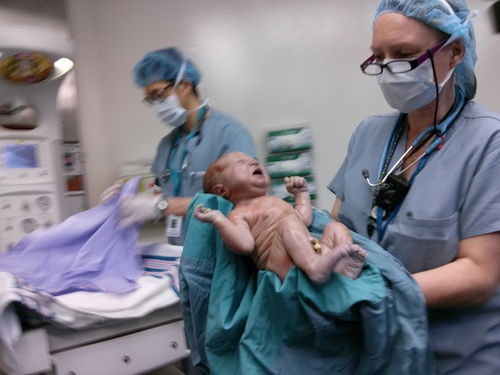
This whole week has been rife with “one year ago” nostalgia, the disbelief that so much time has passed, that it’s all gone so fast, and that there ever was a time when we didn’t have an Iris. And it is astounding to have a record of my first glimpse of her, a baby who looked nothing like anyone I’d ever seen, certainly not like her sister, who I’d sort of assumed was a baby template. But no, because here was someone else, someone entirely different, utterly herself. I was able to love her immediately, even as I understood that I didn’t know her at all.
While I feel as though I’ve always had an understanding of Harriet, that if I could have dreamed up a daughter she would have been just the one, Iris has been a mystery to me. She’s kept us guessing–she was born with a tooth, and then another by 3 months, and has yet to have any more. She’s had weird ailments that made us regular visitors at the Emergency Room this winter, and none of them have been either serious or straightforward. She’s very small, her weight in the low percentiles since 3 months of age, and while her weight went up at her 9 month visit, her height was down and she was in the third percentile. “Third?” I asked for clarification, thinking this put her in the bottom 30%, but no, it was the bottom 3. We track our girls’ heights on a doorframe in our house, and Iris is so much smaller than Harriet was at this age. And it’s all so different from my first baby, who was big and bruising and never got sick. And yet…
Iris can walk! Only single steps for now, but she has pretty much mastered pulling herself up to standing without support. She has been crawling for months, speeding across the floor, up flights of stairs, and across the sandbox, and the playground, and Harriet’s classroom, and pretty much anywhere. Iris is at home in the world. She can be jolly and happy, and she laughs and laughs, but has a scream that’s the definition of bloodcurdling. She will rarely consent to have anyone hold her, except her parents, but if you give her time and space, she’ll warm to you. She likes to play with balls and flips through books and if you put on music, she will do the shaky bum bum dance. She has learned to safely get down from furniture and the step in our hallway, and has never fallen. Somewhat recklessly, she has the ability to turn anything into a potential noose. Her favourite joke is blowing raspberries on people’s bare skin. She is an expert at blowing kissing too, and waving, and clapping, and in the last day or so, we’ve begun to suspect that Iris can talk. She can say, “Bye bye”, and “dog” and “Daddy” and sing, “Happy Birthday” (which sounds a bit like, “Apa buh”). She is absolutely in love with her sister, and the two of them now get up to all kinds of tricks, and they make one and other laugh and laugh, and their relationship makes me happy. I am also fascinated by the fact that it has nothing to do with me.
Iris has been up to all kinds of adventures this year. She’s taken two journeys on a plane, another on a train, and plenty of road trips. She has loved our co-op shifts at playschool and has been so welcomed there that she thinks it’s her school too. She’s had afternoon tea at the Windsor Arms, and been out for all kinds of brunches, lunches and dinners. Last Friday, she tried sushi for the first time, and discovered an affinity for edamame. On Sunday, we had our first experience of going out for ice cream and ordering four cones. She likes to hang out at the park and eat sand, and if you try to take her out of the swing, she will scream at you. She likes the slide. She likes looking out the window. She likes to open cupboard doors, get her fingers stuck in drawers, and often won’t eat her dinner until you take her out of her high chair and then she’ll eat what she’s just thrown on the floor. She’s big into eating paper and I once found a googly eye in her diaper. She is still really enthusiastic about pushing the button to change the traffic signals before we cross the street. And once we’ve crossed the street too. And if we just happen to be walking by one. And she loves climbing, her latest trick involving standing up on her rocking chair and then rocking it perilously. Her favourite book is Little You by Richard Van Camp and her Wonder Woman Board Book. She likes turning pages more than she likes listening to stories. She likes it when I play guitar, but mostly because she wants to put things in the hole. She is always game for a round of “Row Row Row Your Boat.”
She’s terrible at sleeping, and only naps on people, which has its benefits and drawbacks. Ever since I met her, I’ve been ridiculously tired, but I’ve also been ridiculously happy, so pleased and grateful to have the family I want to have. (To be finished having babies too.) I am grateful too for the gift of having learned to appreciate babies, an ability that was lost on me when Harriet was small. I am grateful that this really has been something of a do-over and that I had a chance to appreciate what they mean when they all tell us to enjoy every minute. I would never have believed it, but for the most part, enjoy it I really really did.
Happy Birthday to our beautiful girl! How wonderful life is now you’re in the world.

June 3, 2014
A Conversation About Mothers in Children’s Books

I’m really excited about the event we have scheduled for 7pm on Thursday June 19 at Parentbooks in Toronto (121 Harbord Street, just west of Spadina). I will be there, alone with Heather Birrell, Heidi Reimer, Amy Lavender Harris and Patricia Storms, and we’ll be talking about representations of motherhood in children’s books. Having chosen some of our favourite examples, we’ll be doing readings from the books and discussing why these stories are important to us, and also tying their themes to the broader themes from The M Word anthology. It’s going to be an intimate gathering, and I do hope that audience members will arrive with their own ideas for discussion.
Space is limited, so you are asked to RSVP at Parentbooks (416-537-8334).
The M Word will be for sale, along with some of the other books under discussion
I hope you can make it!






