January 27, 2015
Loving the Difficult
 “In a time of cutbacks to services for women and children, for the arts, the difficulties faced by young mothers today who also want to write are enormous. But they do have, as generations before them didn’t, literary mothers who have been mothers themselves and given us a literature richer for that experience. They have transcended or changed the meaning of “women’s literature.” Canada’s voice in world literature is, as often as not, a women’s voice, a mother’s voice, now being joined by the voices of women around the world.” –Jane Rule, “Our Mothers,” from Loving the Difficult, which I finished reading last night while overlooking the swimming pool observing my daughter’s bizarre inability to float.
I liked this book a lot, although overlap between essays was a bit repetitive, and some were far more insightful than others. I was intrigued by details of Rule’s childhood in California, details that reminded me of Joan Didion’s biography and autobiographical essays—they are near contemporaries. Their writing styles are not the same, but they seem to have a similar eye on the world. I’d be interested to read Rule’s posthumous autobiography, Taking My Life, to see how it might connect with Didion’s Where I Was From. I also liked the book as a piece of swim-lit—Rule was a lifeguard throughout her life, and one of her final essays on her pool (yes!) is one of the very best in the book. Other good pieces were on grief, losing her partner of many decades, on gay marriage (“You be normal, or else…”), on writing, on writing and money, a piece on parallels between being a lesbian and being left-handed, and so many passages that begged to be underlined.
January 26, 2015
Not Baklava
 This is not a post apologizing for a lack of updates. If you’ve ever learned anything about blogging from me, it’s probably that such posts are a waste of everybody’s time. What this post is, however, is an apology for my inability to blog while knitting. I can read while knitting; I can do this like a champion. I hold the book open with my feet, or employ my bookstand, and I basically knit this entire balaclava this way, while reading The Inconvenient Indian (and probably looked a bit curious and occupied as I did this during the hour I was waiting for Harriet to finish her dance class on Saturday). I have my limits though: I cannot read while knitting AND drink my tea, which is terrible. And I have yet to figure out how to knit and blog, which is why I have a completed balaclava to show for my Sunday evening instead of a freshly minted blog post. Alas, I think I made the right call, as it’s freezing this morning, and full facial covering goes a long long way.
It all went a bit wrong, however, once the balaclava was finished. It was 11:30 and everybody was asleep, but I was too excited to keep my success to myself. So I put the balaclava on myself and ran upstairs to wake up Stuart and show him. And I didn’t realize until I’d shaken him awake that it might be unnerving to be pulled from sleep in a darkened room by someone wearing a balaclava… The look of terror in his eyes was like nothing I’ve ever seen before. This morning I tried to reason with him: You knew your spouse was downstairs nearly finished knitting a balaclava. Surely it would be a crazy coincidence if the balaclava-wearer before you was somebody different?
But he insisted such rationales were beyond his mental capacity at that time. He is still a wee bit traumatized.
January 23, 2015
On rereading Ellen in Pieces, and other things
 My book club met last night to discuss Ellen in Pieces, which I’d been looking forward to because I’ve got feelings about this book. I reread it last weekend, and was delighted to find I enjoyed it just as much and came away with a deeper appreciation of the novel’s structure. It’s a novel that’s slightly disorienting to encounter the first time, but to read it again, you get to look around a bit more. It was fascinating to see signs of Ellen’s eventual fate embedded in the text from the very beginning. I read the chapters from other characters’ perspectives differently too—the first time, I’d been consumed by trying to figure out how these other stories related to Ellen’s, whereas this time, the connections seemed stronger and more straightforward. The most devastating moment in the whole book continues to be the ending to “Ellen-Celine, Celine-Ellen”, which I’ve read for the third time now and the effect hasn’t lessened at all. Anyway, this time the novel seemed a bit easier to get lost inside and wander around a bit it. It is definitely the kind of book that is made for rereading.
Plus, the book club liked it too, and it made for interesting discussion. And we got to eat blintzes, which I made because they’re in the book, even though I didn’t know what they were. It turned out they were delicious. Good to know.
 What else have I been reading lately? I read Anne Enright’s 2000 novel What Are You Like?, which had been sitting on my shelf for awhile. I started off in love with the stunning sentences, and then grew frustrated with the novel’s fragmentation (and I think I get bored with most novels at the point at while the mentally ill protagonist starts carving symbols into her legs). But then it unfolded in the most marvellous conclusion, and I saw that I should have had faith in Enright all along. The story of one woman’s unravelling via her pregnancy reminded me of Emily Perkins’ A Novel About My Life, which I feel as though I need to read again.
 Speaking of reading again, I pulled Bronwen Wallace’s People You’d Trust Your Life To off the shelf, which is a book that everyone should return to again and again. I’d read part of it while I was waiting for Iris to be born, so now the book is all tied up in that kind of nostalgia. I think that the book was a strong relationship to Adderson’s Ellen in terms of its masterful depiction of actual life (which happens to belong to a woman) and flawed, larger-than-life characters. But it also occurred to me how somebody ought to write an essay on Bronwen Wallace and Grace Paley as literary companions. Their works speak to each other, and are also unflinching in their politics. Good at titles too—I think that Wallace’s title sounds like a Paley one. And that Faith Darwin would have had a lot to talk about had she encountered any of Bronwen Wallace’s characters in the playground.
What else? I am knitting balaclavas for my children, and enjoying knitting and purling so very much. We are watching season 2 of Broadchurch. I loved Andrew Pyper’s new novel, The Damned, coming next month. And I’m now reading Thomas King’s A Short History of Indians, and finding it curious, fascinating and horrifying. It’s a really peculiar book. So glad to be reading it finally.
January 20, 2015
Delighted to be excited about Canada Reads
 Canada Reads hasn’t been so high on my radar, and my reaction to this morning’s announcement took me by surprise. I am really delighted to be excited about this year’s line-up, and to finally interrupt my incredible streak of being a Canada Reads killjoy. (I think it’s been about five years now.) I still don’t know why a book has to break a barrier, or what that even means, but I was pleased to see that the public voting component of the campaign was not so prominent this year (and it seems like authors didn’t feel the pressure to push themselves as much, which was refreshing). I wasn’t crazy about the old host even before it all fell out, so I am pleased by the fresh start of a new one who’s already demonstrated his Canada Reads chops. So I’m back in the game, and mostly, I am thrilled that the list is a selection of books that I’m really excited to read—this is the whole point. There are two books in translation, two books by great small presses, the Thomas King book that’s sitting our shelves (it’s my husband’s) but I haven’t read yet. In fact, I haven’t read any of them yet, but I ordered the other four from the Bob Miller Book Room this morning. I am excited for them to arrive, and to start to read The Inconvenient Indian tonight. I’ll be blogging about the books over the next month, and I am excited about this also. When I first participated in Canada Reads in 2009, I met readers online who’ve been my friends ever since then. I hope some of them will be reading along too. And you too? Looking forward to it.
January 19, 2015
Born Out of This by Christine Lowther
 Christine Lowther’s essay collection, Born Out of This, is a wild book about life on the margins, in terms of geography, culture, and environmental activism. It also reads like notes in a margin, rich with references to literary texts, song lyrics, poetry (in particular, works by Lowther’s mother, the poet Pat Lowther), and musings on life and nature, the view from her window. Which is not just any window. Christine Lowther makes her home on a house float off the Clayoquot Sound, on the west coast of Vancouver Island, anchored just off shore. A greenhouse sits on an accompanying float, where bees buzz and somehow slugs appear. After the pleasure of reading Sarah Henshaw’s The Bookshop That Floated Away last month, I was pleased to encounter another woman who makes her life on the water. And what a life it is, Lowther partaking in the labours required to keep her house maintained and sound, commuting to work via kayak (and later, motorboat), watching wolves from her deck, swimming with a seal, and (yes) shitting in a bucket. She writes wonderfully about her views of nature, of being immersed in it and still apart from it at once, about the complex and difficult relationships between humans and wild things, between people and place. She writes about the freedom and claustrophobia of rural life, and also about how her idyllic surroundings are not so at odds with her punk roots: “if anyone thinks it’s not punk to live out in nature they should visit during a storm.” Nature is teeming too with death as much as it’s full of life, the opening piece in the collection presenting a stream choked with the bodies of dead salmon, though it’s not strictly a system of binaries: “This landscape of gore nourishes and fertilizes the trees and berry bushes.” And so too is death a shadow in Lowther’s own life; in “Gifts from Lands So Far Apart,” she explores the ways in which the loss of mother was connected to landscape, and this loss subtly haunts the rest of the collection. (The following essay begins: “An infant harbour seal cries for its mother…”) Lowther also explores the roots of her own environmental and political activism, her essay, “We Tremble in Response: Famished for Grief,” an excellent complement to Nancy Lee’s recent novel The Age, both works exploring Vancouver in the early 1980s and a sense of inevitable catastrophe in the nuclear age, the sitting perched on the edge of the world in more ways than just one. Other essays, about community gardening in Vancouver and wildlife in the city, underline Lowther’s connections between here and there, her principle that the rural and urban are not so much at odds, and that indeed their sensibilities mingle.
January 14, 2015
Her by Harriet Lane
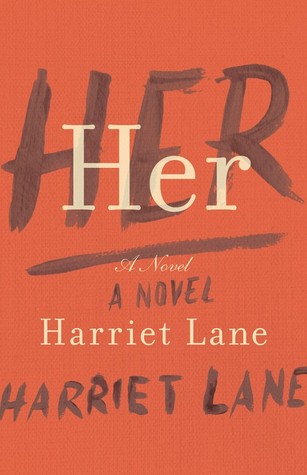
UPDATE: I can’t believe I forgot to note the extraordinary ends to which Lane uses the sinister implications of classic children’s literature, including Goodnight Moon and “James James Morrison Morrison Weatherby George Dupree”. So very good.
There is such a descriptor as sippy-cup sinister.
“I’m reading a terrifying book about a woman with a newborn,” I told my husband, who went pale then, because a woman with a newborn is the most terrifying thing he’s ever known.
“I’m tired of female pain and also tired of people who are tired of it,” write Leslie Jamison in “Grand Unified: Theory of Female Pain,” from The Empathy Exams, and I sometimes feel similarly about the reading of the burdens of motherhood.
It’s a burden documented in vivid detail in Her, the second novel by journalist Harriet Lane. The novel is a mash-up, one scene after another presented from two points of view. One from Emma, recently a mother of two, in her late thirties, struggling to get the stroller up the steps as her three-year-old clamours for her attention, and the baby cries, and she contemplates her life, wondering where her once-self—a successful journalist, happy and carefree—has got to. And then the other, from Nina, who spies Emma from a distance, knows her from long ago, and becomes determined to work her way into the other woman’s life to enact some form of revenge.
To Emma, hoever, Nina—a successful painter, her own daughter nearly grown—is a saviour, always turning up at the right time, offering Emma exactly what she needs, providing a glimpse of the world outside, of the life she’d like to have. Nina is a respite from the drudgery of a schedule Emma describes as full of tasks all both so urgent and tedious, breaking the day into useless pieces, rendering the whole thing as just scraps. But why is Nina so interested in her? It’s a nagging question, but one that Emma pushes to the back of her mind, which is already overwhelmed by lack of sleep, stress, financial worries, marital strife, and general ennui. She’s so vulnerable, which Nina recognizes instantly, and realizes she can prey on.
Which makes Her so compelling, so beyond those other narratives which tire me whose only virtue is their honesty, is that the truths revealed about new motherhood are just the starting point. From here, Lane has created a psychological thriller so convincing in its reality, so ominous in its mundanity, so sippy-cup sinister in a manner I last recall reading in Emily Perkins’ excellent 2008 book, A Novel About My Wife.
Nina gets closer and closer to Emma, welcomed into her home, caring for her children, and while we know along she has nefarious intentions—presented in the alternating chapters which, like Emma’s, are written in first-person—we don’t know why she’s out to exact revenge from Emma, who doesn’t remember her at all. We don’t know either which form her revenge will take, though as the novel progresses, indicators emerge, signs and signals that are so terrifying, all hurtling towards the novel’s very end, which is completely and utterly devastating. Not to mention amazing. But don’t say I didn’t warn you.
It’s a page-turner, but the reader will be slowed by Lane’s prose, the pitch-perfect imagery and descriptions, which are to be savoured. By the nuance too, suggesting the motherhood (and everything) is a many-sided reality after all. And the reader will be chilled by Lane’s suggestion that danger lurks even in the safest of places, that the most heightened maternal vigilance might never be enough.
January 13, 2015
Reading Green Knowe
 Throughout November we were reading Tom’s Midnight Garden at bedtime, which is one of a handful of favourite books from my childhood that hold up just as well. We all enjoyed it, though perhaps Stuart the most because it was his first encounter with the book. I was pleased because I think Harriet mostly grasped the time travel storyline, or some of it. I had read her Margaret Laurence’s The Olden Days Coat two Christmases ago, and she didn’t understand it at all. “There’s this thing called the present,” I was trying to explain, and she was baffled. Interesting too because while she now understands the concept of time, she actually remembers none of that time—anything that happened when she was three and back is kind of lost to us. We reread My Father’s Dragon last week, which I read her when she was three, and she had no recollection. I wonder if you have to have your own history before you understand that there is such a thing as history, and if a prerequisite to having a history is having begun to lose it.
Anyway, Tom’s Midnight Garden was lovely, and meaningful not only because I loved it as a child, but because it was the second book I read after Harriet’s birth, so to bring back memories of that time with a girl who seems so big now was remarkable. That she’s getting the time travel thing also means that we will be able to read Charlotte Sometimes by Penelope Farmer, which I am so looking forward to—I want to get the New York Review Edition. And at the back of Tom’s… was (in addition to an ad to join the Puffin Club, which I kept trying to join as a child, but I was sending in offers from the back of decades-old books so it never worked) listings of other Puffin books we might like. Including Lucy M. Boston’s The Children of Green Knowe.
I never read The Children of Green Knowe as a child, but received it as a gift about ten years ago, and read it then. I didn’t really get it. But I kept my copy of the book because it had been a gift, and because so many people are crazy about it—I decided there had to be more to it. It seemed in keeping with some of the themes of Tom’s Midnight Garden, the Puffin people thought we’d like it after all, and it’s a Christmas book and this was at the beginning of December. So I proposed we read it en-famille, post-Tom and we did, and it was a remarkable success. For me, in particular. For it seems a book that was meant to be read aloud, and in pieces, rather than plowed through like something with a plot. Reading it this way, I was able to appreciate its magic, its weirdness, and we were all quite struck by its atmosphere.
And it reminded me of the thing that children’s books have taught me about literature and books in general—that there is no such thing as “the text”. The text is ever changing, and its effects depend on myriad factors—the weather out the window, the plushness of a chair, whether or not the reader is awaiting test results. Children’s books, which we read over and over again like no other kind of book, have taught me to ever-undermine my (and any) literary authority. The number of times I’ve flipped through a picture book dismissively, and then sat down to read it with Harriet or Iris, and their appreciation has to directed me to what the book is all about, to what I may have missed the first time. There are bad books for sure, but so often there are great books but I’m just reading them wrong. So what a pleasure is rereading then, for the chance to finally get it right.
January 11, 2015
The Devil You Know by Elisabeth de Mariaffi
 The stakes were high for Elisabeth de Mariaffi’s The Devil You Know. On Wednesday morning, I walked 2km at -25 degrees to get a copy, because I’d been hearing such good things about it and it seemed like exactly the kind of book you want to hang out with curled up warm while the blizzard howls. A mystery, a thriller, a book set in Southern Ontario during the 1980s and early ’90s, during which a series of young girls were kidnapped and sometimes found murdered, otherwise their faces depicted on posters for years afterwards under the heading, “Missing.” Years later, “aged-enhanced” images of these children would be updated, but we’d still recognize them. I’ve noticed that reviewers have been responding to the book personally, viscerally. There’s a whole generation of us haunted by these missing girls—I could plot my own history by theirs, from Nicole Morin to Alicia Ross. (I was too young to know about the disappearance and murder of Sharin’ Morningstar Keenan in 1983, though she was taken the very playground where my children play.)
Evie Jones, rookie reporter and protagonist of The Devil You Know is similarly haunted, not least because she’s currently covering the Paul Bernardo case as he and his wife are arrested for the murders of Kristen French and Leslie Mahaffy in 1993. But also, in particular, because her own childhood best friend was one of the dead girls, Lianne Gagnon, whose story is a fiction conflating the cases of Keenan and Allison Parrott, who was last seen getting into a car with a strange man near Varsity Stadium eleven years before. Leanne’s killer was never found. And when a strange man begins appearing on Evie’s fire escape and elsewhere, a dark figure skirting on the periphery of her life, she begins to wonder if it’s Lianne’s killer returned and if there’s something that he wants from her. Her fears are dismissed by those around her, but she can’t shake the feeling that she’s under threat, and no wonder—her own history, and the stories of women in the world that she covers in her job, do absolutely nothing to suggest otherwise.
It is suggested—perhaps too strongly, my one criticism of this book, for the signs are there and the reader surely can read them—that Evie’s job as a crime reporter is part of her need to control the forces in her life, that she seeks out stories like Bernardo’s and the stories in missing and dead girls, in order to be in command of the narrative for once. And by those concerned for Evie’s wellbeing, it is suggested too that her need for control is a bad thing, that it’s detrimental to her mental health, and that it’s this desperation making her imagine the footsteps at the door… I mean, never mind the actual footsteps at the door.
But with Evie, de Mariaffi dares to posit instead that female agency is a salve instead of a symptom. Evie Jones is far from perfect, but she’s smart, unflinching, shameless, and brave. The hero of her own story, certainly.
In her research, employing a brand new tool called the internet, Evie starts looking back at the records of what happened to her friend, and learns that there is more to the story than she ever knew. The big picture that emerges as she puts pieces together begins to suggest that the story of Lianne’s disappearance is less random than Evie ever supposed, and that she can trace the case back to a place that’s closer to home than she can bare to imagine. And that all the trouble (and the footsteps) might not be in her head after all.
The Devil You Know is a gripping, fast-paced book that I had to be torn away from, an excellent crime book with strong female protagonists, in scintillating company with those by Laura Lippman and Gillian Flynn. But there is more to it than that. More than just nostalgia too, though it’s a part of it. de Mariaffi was long-listed for the Giller prize a couple of years ago for her short story collection, How to Get Along With Women, which included her acclaimed short story, “Kiss Me Like I’m the Last Man on Earth,” which I first read in The New Quarterly. And while it seemed like a leap for a writer to go from literary short stories to a thriller, once I began reading The Devil…, the connection seemed quite straightforward to me. Partly because of the nostalgia that infuses both the novel and the story, 1980s Toronto in startling specificity. But also because of how much short story writing sets one up to write a plot driven novel—this has never occurred to me before.
Short stories are all about atmosphere and their scenes, one moment standing in for many, representative of a broader picture. Nothing is extraneous, and so too is it with a crime novel, plot-driven, which just really means one scene after another. Though perhaps with some writers and books, the reader doesn’t notice the scene, so preoccupied is she by plot, but the scenes stand out in The Devil You Know. A gripping, fast-paced book that I had to be torn away from, and I kept noticing the scenes, which were like tiny short stories contained within. The plot is the book’s foundation, but the story rises far and large above it.
It was terrific, and definitely worth a walk in the cold.
January 8, 2015
Vacation Reads Part 2: All the Best/All the Rest
I don’t actually care about the weather, or the accommodations, or the buffet. If the books are no good, then the vacation is ruined. And this is never more important than when one is vacationing at home, as I was over the holidays. I finished reading Marilynne Robinson’s Lila on Christmas Eve, confident that the flat rectangular packages under our Christmas tree would yield great reading, and was I ever right.
 The first book I set to reading was An Exact Replica of a Figment of My Imagination, by Elizabeth McCracken, which I read in a day, and this meant that I spent all day Christmas being discovered hiding with my paperback, weeping, and exclaiming, “This book is just so good.” Stuart felt bad at first: “I got you a book that makes you sad.” But I shushed him. The sadness was important, but not the point. That I was weeping was a testament to this book, whose resistance of sentimentality is most remarkable. And it was also funny. Plus, brilliant. A memoir by the author of Thunderstruck and Other Stories, which was one of my top books of 2014. It’s the story that bridges the stillbirth of her first child with the birth of her second, a healthy boy, a year later, and it probes the edges of motherhood and humanity in a way that’s so important because few storytellers go to these places, where so many people go all the time. I’d recommend this book to anyone who is literate—no experience or interest in the subject matter required. It is a truly extraordinary memoir. I can’t wait to read McCracken’s other books.
 The other book I got for Christmas was the essay collection The Unspeakable, by Meghan Daum, which tied into the McCracken memoir in its probing of edges. (Daum is also editor of the essay anthology Selfish, Shallow & Self-Absorbed: Sixteen Writers on the Decision Not to Have Kids, out in March.) These essays are also about the things nobody talks about—what really happens when your mother dies, particularly if your relationship has always been fraught; what we’re looking for in dating and relationships, and in marriage; about nostalgia (though, truthfully, everybody talks about that) and about how the soundtrack to your twenties becomes “unbearable to listen to in twenty years…not because they…sound dated and trite but because they…sound like the lining of your soul”); about filling the supposed space in one’s life by not having children; on being “an honorary dyke”; playing charades with Nicole Kidman and Nora Ephron; being in a coma (last two examples in which “unspeakableness” becomes literal). Truthfully, some parts of these pieces flirted around the edges of the mundane, and really the guiding principle of these essays is their singular point of view, by the contrarian misfit, Daum, an excellent writer who examines everything critically, including her own insatiable thirst for discovering an authentic way to be in the world. There is a point to everything.
 Next, I reread The Witch of Exmoor by Margaret Drabble because, while she is one of my favourite authors, most of her output has in fact faded into a blur in my mind and I need to revisit many of them to remember what was what. It is possible that the books that had faded aren’t her best—that the fading is a mark of the books rather than my reading. Exmoor didn’t blow my mind. It received some poor reviews when it was published in 1996, James Wood contending that her Dickensian project lacked the depth of the original, that her characters were never allowed to be fully developed human beings and rather were pieces their author moved around on a game board. Though this is actually what I love best about Drabble’s work, her command of her fictional universe, the metafictional elements. I wonder if the novel was a victim of timing though: a year later was Labour’s election victory on the UK, the advent of the internet would also bring about rapid change. Her portrayal of “the way we live now” was almost so much on the cusp of something that the cusp itself seems less relevant in retrospect.
 And then I read Man at the Helm by Nina Stibbe, the first novel by author of the epistolary memoir Love, Nina. It’s possible that my aversion to the Drabble was too much heavy for holiday, and Man at the Helm was a perfect counter. Nancy Mitford meets Sue Townsend, the story of Lizzie Vogel, a young girl whose wealthy parents divorce in the 1970s, the children and their mother relocating to a Leicestershire village whose inhabitants are hostile to newcomers, in particular households without “a man at the helm.” And so Lizzie and her sister hatch a plot to find their mother a new man, a plan that has the unintended consequence of their mother sleeping with half the husbands in the village, doing her reputation not much good. Oh, it was so funny, and I loved it.
 And then my final holiday read was The Housekeeper and the Professor by Yoko Ogawa, which I plucked off the shelf at Book City because I liked the cover, and I loved the book for that reason very much before I read it, and then I read it, and there were other reasons. That it was a translation, first, which meant I was succeeding at my New Year’s Resolution before the New Year had even started. I also like that it was another book I read in a day, which is one of my great pleasures. It’s the story of a housekeeper who works for a former professor of mathematics with a brain injury that means he has a short-term memory of only 80 minutes, but the professor is taken with her young son, he teaches them both about the poetry of numbers, and the three of them together form a tenuous family unit for a while, a remarkable equation, the opposite of their previously lonely lives.
January 6, 2015
Further Adventures in Accidental Cakery
 “To me, the grounds for hope are simply that we don’t know what will happen next, and that the unlikely and the unimaginable transpire quite regularly.” —Rebecca Solnit, “Woolf’s Darkness”
Today was a day so firmly determined to shrug off its plan that all one can really do is shrug one’s shoulders…and eat dessert.
I have a babysitter on Tuesday mornings, who called last night to cancel because she was ill. Which I thought meant I’d lose some productivity today, but I didn’t know the half of it. When we woke up this morning, the furnace was broken and the temperature down to 15 degrees. With the wind-chill, today felt like -17 outside, so this was troubling news. Luckily, our landlords were on it, and I was grateful that the babysitter would not have arrived at our freezing house after all. Iris and I took Harriet to school, and then we came home to await the serviceperson’s arrival. For about 10 minutes after we came out of the -17, the house actually felt warm, but then it got cold again even though I was wearing multiple layers of clothing, tights under my pants. The only option left then was to put something in the oven.
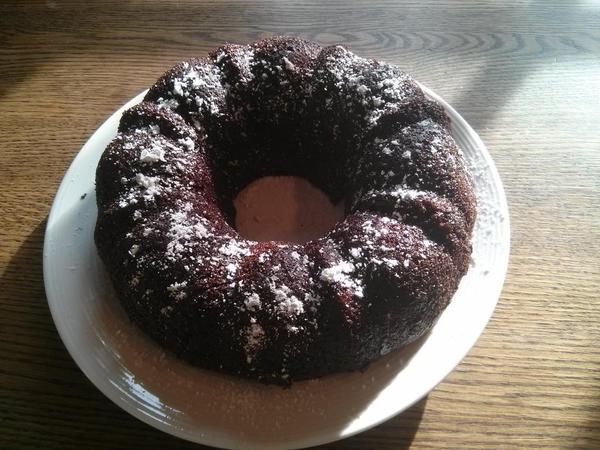
So I decided to make a cake. But it couldn’t be just any cake. We’ve had far too much in the way of baked goods over the past month and I’d sort of vowed to take a cake break, but then what else does one put in oven’s oven? I had absolutely nothing in the way of things to stew. So cake it was, but quinoa cake, I decided, because quinoa has been sitting in my cupboard for ages. (Although it was actually in the fridge, where we store all our grains to stymy inevitable infestations of mice and moths. Harriet thinks it’s weird that some families keep cereal in the cupboard. She’s never had a krispie that wasn’t chilled. Anyway…)
Quinoa sounded healthier than ordinary chocolate cake, at least. Except that it called for 4 eggs and we have no eggs. So I made it with flax meal sub’d for the four eggs. And coconut oil for the butter (and the coconut oil had frozen!). A quinoa cake didn’t sound all that promising in the first place, and all my sorry doctoring would do it no favours. I put it in my bundt pan (and how I love my bundt pan) where it baked for nearly two hours, and refused to be cooked all the way through. Mission accomplished though: I’d heated the kitchen most of the morning. Still no furnace serviceperson yet.
We’d lost another degree when I contacted our landlord to let her know that they’d not yet arrived. She heard back from them: they HAD come in the morning but knocked at my neighbour’s door and not ours, and didn’t call when they got no answer. She spent 40 minutes on the phone with the company, who told her that the serviceperson could return to our house tonight between 8 and 11pm. Unrelentingly, she stayed on the phone, where they finally agreed to return sooner but only at 3pm, when I leave to go pick up Harriet from school. And so I was charged with finding someone else to fetch Harriet from school, which I knew was going to be trouble—Harriet lives in perpetual fear that I’m not going to pick her up because I was late once in September 2013. Finally, both my landlord AND I found (different) kind neighbours willing to fetch Harriet, which led to more back and forthing as we sorted out the surfeit of human kindness.
The serviceperson finally arrived soon after Iris had awoken from the nap she was taking upstairs with a space heater. We had to chase him down before he left again, which wasn’t aided by the fact that Iris refused to be clothed in outerwear of any kind, and so I had to carry her out wrapped in Stuart’s hoodie. And then Iris and I had to spend 30 minutes in the basement bachelor apartment (where the furnace is) which had no place to sit down except the legendary sex bed (which I know well from sound through the air vents) and I didn’t feel exactly comfortable having Iris sit on that bed, but we had no choice. It was made, at least. She watched Elmo videos on my phone and ate goldfish crackers while I stared at at the serviceperson’s sizeable bum (and thankfully, it was not a plumber’s).
I asked him if all the furnaces broke on the coldest day of the year, and he said that tomorrow was actually the coldest day of the year, so we were getting our trouble out of the way early.
And then he was finally done, and I rushed out to find Harriet (not before putting Iris in snow pants and a jacket), who was being brought home by a classmate’s mother, but I went up the wrong street and missed them and was informed by the saintly crossing guard at Bloor and Spadina that Harriet had passed by her corner about five minutes before. So I had to run back home in the -17, and finally found Harriet in front of our house. Where we had heat again and Harriet was home, and so order was all restored, but I had accomplished absolutely nothing in the entire day, except for a really weird quinoa cake, so we sat down to eat it.
It wasn’t bad. Mushy in the middle, and really really rich. “If the furnace hadn’t broken, this cake wouldn’t exist,” I thought, as Iris found a knife and actually cut herself a second piece. I gave another to Harriet too, and then they wanted thirds, but I drew the line—quinoa, yes, but it had a cup of cocoa and even more sugar— and so they both crawled under the table and proceeded to eat the crumbs. They were down there for ages, and the licked the floor completely clean. I’ve never seen them so ravenous for anything.
Stuart came home and the house was in disarray, but we were reading stories, and everything seemed to be settling down. We were having a pasta dinner that involved boiling water and squeezing a lemon, so that was good, and then I remembered that tomorrow is pizza day, which is even better—no lunch to make. And once the pasta was eaten, we finished the cake, the whole thing (save for the quarter I gave to Harriet’s classmate’s mom for bringing her home, wrapped in tinfoil).
I am beginning to think there may be an order to the universe after all, and that accidental cake is part of it, most certainly.






