February 25, 2015
The M Word reviewed in Literary Mama
 The M Word was reviewed by Monica Frantz in the latest issue of Literary Mama:
“The M Word was an encouragement to me as I celebrated the first anniversary of becoming a mother. I was catching my breath after falling in love and falling pregnant in the span of six months, moving to the suburbs of Washington, D.C., from Manhattan, and surviving one year as a stay-at-home mom with an Ivy League master’s degree. My baby girl was one year old, and my world had shrunk and expanded many times over since that Sunday morning 20 months prior when I saw two lines on the pregnancy test and my boyfriend went out for bagels and decaf coffee to celebrate.
I was beaming at her first birthday party—proud of my girl and myself and thankful for everything our family had—but I also knew that I had lost a lot when I became a mother and that I had gained a new set of fears and anxieties. Reading The M Word gave me—sleep-deprived and desperate for adult conversation—the prompting and inspiration to do some reflecting on what motherhood meant to me. The text was engaging and, in some ways, challenging to my own tendency to seek safety among like-minded mothers.
As I finished reading it, a close friend found out that she was pregnant for the first time. As we celebrated her pregnancy, I hesitated to pass the collection along to her. Superstitious and hoping to protect her, I worried about giving her essays on loss and trauma and regret. But women deserve to hear a conversation about motherhood that is as beautiful and scary and messy and complex as motherhood itself. When her experience of motherhood strays from the accepted stereotype, if it hasn’t already, she’ll know that she is not alone.”
February 24, 2015
Islands of Decolonial Love by Leanne Simpson
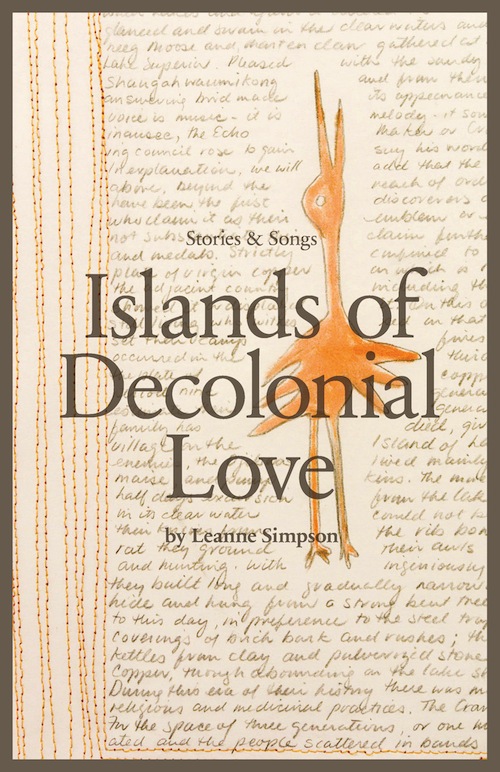 “for every one of your questions, there is a story hidden in the skin of the forest. use them as flint, fodder, love songs, medicine. you are from a place of unflinching power, the holder of our stories, the one who speaks up.”
I can’t hold Leanne Simpson’s Islands of Decolonial Love in my hand and tell you what it is. I don’t want to, actually. To say I’m finished with it, that I get it, that it’s just one thing. When these are “Stories and Songs,” and tricky and various. Full of voices—I don’t know that I’ve ever read a collection packed with such a motley crew, every one with a story to tell and power behind it (even when lack of power is the story), blending European and Indigenous literary traditions. I read it last week, and then tonight sat down and listened to the spoken word recordings of some of the pieces, set to music. They’re beautiful, vivid, and you can listen to them here.
Last week, we had a virtual round table on The State of the Canadian Short Story at 49thShelf, in which Doretta Lau had mentioned Simpson’s collection as one that had blown her away. I’d already ordered the book, because Marita Dachsel had mentioned she’d heard Simpson read from it, and it was already included on this list of books by First Nations women (as suggested by Sarah Hunt, who inspired the list). If it hadn’t been on my radar already, Thomas King named Simpson as recipient of the RBC Taylor Prize for Emerging Writers last year.
These stories aren’t easy, although they start off more cozy and familiar, stories from childhood, but these stories have edges meant to jar readers out of complacency. From “Buffalo On,” “right off the bat, let’s just admit we’re both from places that have been fucked up through no fault of our own in a thousand different ways for seven different generations and that takes a toll on how we treat each other. it just does.” “ishpadinaa” begins, “if i write in small characters no one will notice my grandma’s lying on a picnic table in dufferin grove park.” (This story put me in mind of Grace Paley.) I wanted to underline, “there are a couple of problems with being twenty-two but you don’t know about them yet because you can only find out about the problems sometime after you are no longer twenty-two…” from “Treaties.”
The stories about Peterborough—Nogojiwanong in Mississauga—were particularly interesting to me, as I grew up there. “yeah, it was me. i blew the fucking lift lock up in downtown peterborough…I don’t know where you’re going to fucking skate in the winter and i don’t care. oh wait. skate on the lake. oh wait, it doesn’t freeze anymore because you wrecked the weather.” And “jiibay or aandizooke”, which you can listen to here (and you should), about settlers who build their homes on burial mounds on the shores of Rice Like, and call 911 when they discover skulls in the ground while excavating for a new back deck. “Please pass the salsa.”
I don’t pretend to understand everything going on in these works. In most of them, there is a moment when the whole thing flies out my grasp, and then I have to chase it. I appreciate the music and spoken word accompanying these pieces though because the format suggests these are stories to return to, as you would a CD or song. Not like a book, that we tend to put on the shelf once we’re done. Like I said, I don’t want to be finished with these works, and they adhere to the oral tradition in this respect (which is implicit in the address of a lot of these pieces, all the voices I referred to), that these are stories meant to be returned to, shapeshifting, as the reader’s perspective does, the details slightly different every time.
February 22, 2015
And the Birds Rained Down by Jocelyn Saucier
 I approached And the Birds Rained Down, by Jocelyn Saucier, translated by Rhonda Mullins, the opposite of how I found Raziel Reid’s novel, When Everything Feels Like the Movies. The latter with so much hype, all my expectations, but I knew nothing about Saucier’s novel except that it had won several awards when published in its original French. And this is typical. Here is where the Canada Reads theme of “breaking barriers” first becomes relevant to And the Birds Rained Down. As critic J.C. Sutcliffe writes in her article, “On Not Reading Books from Quebec“, French Canadian Literature is barely on the radar of most English Canadians, French Canadian Literature barely accessible outside of Quebec. Except for the publishers—small publishers in particular, like Goose Lane, Anansi, and Coach House (who published this one)—who translate these books into English. Not so much breaking barriers as building bridges from one place to another.
And the Birds Rained Down is a quiet book, a tidy book, a comforting book. The most comforting book you’ve ever read about mass destruction, trauma, mental illness, suicide, marijuana, and love. It begins with a photographer arriving deep in the forest in Northern Ontario at a clearing where a stream cascades into volcanic rock. She’s come to interview a survivor of devastating fires that had taken place nearly a century before, but she’s come too late. He’s died, of natural causes, she’s assured by that two old men with whom the man she’d come to see, Boychuck, had created a community away from the world, their only connection to it two pot farmers. She’s been travelling the province photographing survivors of the fire, documenting their experiences. And while the other two men can’t contribute to her project, she’s intrigued by their company and drawn to return. And the photographer is not the only disrupter to this bucolic idyll. Not long after her departure, one of the pot farmers shows up with his Great Aunt who has been her whole life in mental institutions and refuses to return. Her arrival in the community changes the dynamic forever.
It’s not so much what the story is about, but how it’s told. And the Birds Rained Down is the kind of book you’d expect from a setting deep in the woods at the end of a road by a waterfall. It’s otherworldly with many elements of fairytales. An all-seeing narrator guides us through the book’s various sections from different characters’ points of view, though we are not so guided that there is not mystery here, or surprise The novel’s first paragraph is, “In which people go missing, a death-pact adds spice to life, and the lure of the forest and of love makes life worth living. The story seems far-fetched, but there are witnesses, so its truth cannot be doubted. To doubt it would be to deprive us of an improbable other world that offers refuge to special beings.”
This is the most different of the other Canada Reads books I’ve read this year, quieter in its intentions, subtler in its message, more playful and nuanced (though this makes me think of “Like life is always fucking subtle,” and how sometimes books have to be huge and devastating to get their points across). A mysterious book that’s lyrical, lovely, and rich with story and stories. It doesn’t really do anything except be a book (and it does that so well), which is a political statement in itself I think.
February 19, 2015
The magic of First Nations picture books
 “That is where change is occurring, when we can appreciate each others’ languages, stories and art.” –Julie Flett, Cree-Métis and Award-Winning Illustrator
I’ve been thinking a lot about First Nations issues these last few months, and have determined that the one useful thing I can do, in addition to the thinking, is reading. Not just reading either, but actually buying books by First Nations writers, supporting the publishers who support them. Buying and reading books by First Nations women’s writers in particular, and helping to amplify these writers’ voices. I’ve been thinking a lot since reading Thomas King’s The Inconvenient Indian, about “the dead Indian” and how it was public policy to exterminate First Nations culture (and people) for centuries. And perhaps, less indirectly than you’d think, it still is.
So how does one counter this? Well, by (as I’ve said) buying and reading the work of living, breathing First Nations authors, making these a part of my canon. And then by doing the same with my children, so that it never occurs to them that there is such thing as a Dead Indian. So that they only ever know First Nations cultures as being rich with art and story, with a proud but difficult history. And with the calibre of children’s books being produced these days by First Nations authors, conveying all this is no challenge at all.
 What’s the Most Beautiful Thing You Know About Horses?, by Richard Van Camp and George Littlechild
This book—Richard Van Camp’s second children’s book—was recommended to me when I was raving about Little You. It’s out of print, but I bought a used copy. It begins with Richard asking a simple question one day from his hometown of Fort Smith in the Northwest Territories, where the temperature today is forty below: “What’s the most beautiful thing you know about horses?” It’s a strange, meandering text, perfectly complimented by Littlechild’s illustrations. I like the book because it underlines the fact that First Nations people are undeniably present in the world—we see photos of Richard’s family members, the people to whom he’s asking his question. He’s asking because horses are foreign to his people so far in the north—in his language, Dogrib, the word for horse is “tlee-cho”, which means “big dog.” (‘When did dogs grow into horses? When did horses shrink into dogs? Do horses call dogs “little cousins”?’) He asks the question to his friend, George Littlechild, who is Cree. ‘The Cree word for horses is “mista’tim”. It means “big dog”—just like tlee-cho in the Dogrib language. Isn’t it neat how both our languages call horses “big dogs”?’ Emphasizing that First Nations are NationS indeed—separate but connected, each with its own language and culture. Which is a complicated thing to convey in a story, but Van Camp does it effortlessly. What’s the Most Beautiful Thing You Know About Horses? is a book that takes a single question, and instead of beginning to answer instead opens the world up wide.
 Sweetest Kulu, by Celina Kalluk and Alexandria Neonakis
Published by the award-winning Inhabit Media, an Inuit-owned publishing company located in Iqaluit, Nunavut, the only publisher in the Canadian Arctic, Sweetest Kulu is a sweet lullaby to a beloved baby whose existence is tied to the world all around. “Kulu” is an Inuktitut term of endearment, and indeed, this baby is adored—by the sun with its “blankets and ribbons of warm light,” by Snow Buntings that bring flowers, and by Caribou who “chose patience for you, cutest Kulu. He gave you the ability to look to the stars, so that you will always know where you are and may gently lead the way.” The message of the book, to the baby, is You Belong Here, which is powerful and important for political reasons, but is also an absolutely perfect way to welcome a new baby to the world.
 Not My Girl by Christy Jordon-Fenton and Margaret Pokiak-Fenton, and Gabrille Gimard
Not My Girl is a sequel to the When I Was Eight, both picture books based on the books for older readers, Fatty Legs and A Stranger at Home, memoirs of Margaret Pokiak-Fenton’s experiences at a residential school. In Not My Girl, she returns home to the Arctic after two years at school, and finds she is a stranger to her family, that she has lost her language and taste for her own culture. In a story that’s wholly compelling to young readers, Margaret must rediscover her place in her community and reconnect with her family. Not My Girl makes clear the trauma of children being removed from their families, suggests the painful legacy of residential schools, but ends on an empowering note as she learns to drive her own dogsled as her mother cheers her on.
 We All Count: A Book of Cree Numbers, by Julie Flett
Has there ever been a more subtly subversive title for a First Nations book than We All Count? In this book, which teaches the numbers 1-10 in Cree, Flett celebrates bonds between family and to the land, the illustrations gorgeous and compelling in a style that has become Flett’s signature. Iris, my youngest daughter, is as crazy about this book as she is about Little You. Her favourite image is for “Three aunties laughing.” She likes to point to the picture and tell me, “Happy.”

February 17, 2015
The M Word in Understorey Magazine
 I was so pleased to have the chance to talk about The M Word in Understorey Magazine, the wonderful magazine from Nova Scotia about mothering. Editor-in-Chief Katherine J. Barrett asked me so great questions about the book and how it came to be and the impact it’s had, as well as the tricky balance of being a mother and an artist. I’m really glad to have the chance to further spread the work about the book, which Barrett calls “unique and riveting.” You can read the interview here.
And I also recommend you reading Barrett’s editorial from the Fall 2014 issue, “Time to Grow Up, Mommy Lit.” An excellent call to arms.
February 17, 2015
It’s probably fair that I tell you about Monday

Because you’ve had to suffer through many a post in which I tell you about my glorious weekends and fantastic holidays, it is probably fair that I tell you about Monday. We had been away for the weekend visiting my parents, and it was so cold outside that all our plans for winter adventures were abandoned and we never got more adventurous than ordering in a pizza. We arrived home on Sunday night to discover our cold water pipes were frozen. We had hot water—impossibly scalding hot—but no cold, which meant no showers, flushing toilets or drinking water. We went to bed far too late and woke up in the morning (a holiday Monday!) to the pipe problem not being miraculously fixed, which was the solution we’d been hoping for. Our next solution was to turn the thermostat up high and hope that the heated house would thaw the pipes. We should have gone out at this point, but it still seemed so impossibly cold out and we were so tired we couldn’t bother, but this only meant that the indoors became as unbearable as out. By noon, we were taking turns running outside in short sleeves and bare feet to cool off. I made a soup for lunch that nobody ate, and since it was a vegan recipe by Mayim Bialik, I should have seen that coming (although trying to be Blossom has never steered me so wrong before… only into unflattering hats. But I digress). Iris went down for her nap, and we were all miserable. Stuart and I were taking turns being horrible to each other, Harriet had cabin fever. We still had no running water, and nobody had showered. We finally went outside for a walk around the block, but it was boring, and we were all cranky. The one thing going for us is that the sauna in our house had allowed a frozen chicken to defrost in record time, if not the pipes, so we had that for dinner, and then it occurred to us as we were setting the table that beer would make everything better, and we should have started drinking hours ago—the grown-ups at least. So we made up for lost time, all said we were sorry, and sat down to a delicious roast chicken as the sun went down—the only good thing that had happened all day. This morning our landlord knocked a hole in the drywall in the basement to unfreeze the pipes behind it, we had water again—celebrations were had. And we decided not to rue February for all the trouble it had caused us so far—colds, stomach bugs, computer malfunction, froze pipes etc.—because all the trouble had come our way just two weeks into this wretched month, and there’s still another two weeks left. Fingers crossed.
February 16, 2015
When Everything Feels Like the Movies by Raziel Reid
 Back in high school when everybody was watching My So-Called Life, I used to tune in and wonder why Angela Chase had ditched her normal friends to galavant with Rickie and Rayanne. I mean, I liked Angela’s hair, and dyed mine the exact same colour (although it didn’t take because my hair was too dark—probably safer that way), but the misfit friends didn’t gel with me. I’d turn the channel back to Party of Five. Similarly in real life, I would encounter characters with as much regard for the status-quo as Rickie and Rayanne (and I encountered them often—I went to an arts-focussed high school, a social environment far more welcoming than most), and I found these people baffling, even threatening. Because there was this thing called normal whose rules I was desperate to follow, and it was unnerving to come across someone who didn’t even play the game.
The one legacy of those years is that while I’m more broad-minded, I still don’t like “edgy”, and when something is described as such, I don’t think it’s for me. I am still annoyed at having had to read about people taking a shit in books as disparate as Franzen’s Freedom (ugh) and Heti’s How Should a Person Be? In most “edgy” books, there comes a point at which a character pulls out a blade and starts carving things into her arms and legs, and I’ve read that book already. It’s possible that edgy is boring. Or that I am boring, and more partial to reading books about spinsters and brewing proper cups of tea. I would like there to be a Bechdel test, but for women over the age of 65 who are crocheting tea cosies, and basically if your book doesn’t pass it, I’m just not interested.
So I was nervous about Raziel Reid’s When Everything Feels Like The Movies, even though it had been awarded a Governor General’s Award, had been run through the mud by a deplorable right-wing columnist (for being “a waste of taxpayer dollars” no less), and there had been censor-like calls to have the GG Award removed—circumstances all of which, obviously, made me want to run out and buy a copy of the novel right away). When the book was selected for Canada Reads 2015, I went right out and did so, intrigued by the opportunity to discover what the fuss was all about. And I am so glad I did.
It was devastating, like a trip back in time. Although Raziel Reid’s references are uber-contemporary, the atmosphere he creates of high school—its geography, social structures, how students pass their time, the rate at which time passes—was completely as I remembered it from back in the days before we had cameras on our phones, or phones at all, or twitter or Facebook or anything like that. It’s a culture onto itself, and while Reid’s character Jude is a misfit—he wears make-up, women’s clothing, has a troubled home-life, few friends or allies—misfit is the wrong word because he’s irrevocably a part of that culture. Because he’s too young to get away to someplace better, because he has so little agency over his existence. It’s not the right word either because a misfit describes an anomaly and there are a lot of kids out there like Jude—including one whose murder inspired Reid’s text.
When Everything Feels Like the Movies is convincing from the very start, Jude’s point of view perfectly executed and consistent. In order to create a sense of agency over his life, Jude imagines high school as a movie set, the complex social structures comprising players with their parts. And his part is unabashedly himself, for there is no one else he can be (and the alternative would be being no one at all), moreover his self-definition is limited by others’ expectations of his behaviour, and he plays right into that role. Jude and his friend Angela are crude, stupid, vindictive, reckless, and cruel in the manner that all people are when they are learning about words and responsibility and the power to hurt and shock (and be noticed). In this way, they’re not so different from their more conventional classmates. Every single one of them is scared, insecure, terrified of being found-out, and trying to be bullet-proof. And this is what I don’t think I knew back when I was in high school, wondering why my gay classmate couldn’t just act a bit less flamboyant. He scared me because we was me. We are each of us not so far apart after all.
But such platitudes mean nothing at the time, mean nothing in Reid’s book which is perfectly plotted towards a devastating conclusion alluded to in its first sentence. When Everything Feels Like the Movies is exactly the kind of young-adult fiction I appreciate, in which there is a gap between the protagonist’s sense of his experience and how I perceive reading as an adult. Though that gap is further complicated by the movies conceit, by which Jude’s experienced is reflected in a million mirrors and cameras—his sense of self at one multiplied and broken into pieces. He is so thoroughly in control of the narrative, never breaking character and rarely displaying any vulnerability, that there is something almost triumphant about the story, as much as it is heartbreaking—how he owns it. Except that he doesn’t own it at all, or rather his ownership is an act of desperation. Or is it? (and here is where the mirrors are important, reality staring back at you a thousand times, so it’s impossible to know where life ends and its reflections begin, or if the distinctions even matter).
Like Ru, while the text is straightforward and easy to read, it’s deceptively complicated, riddled with clues and traps. Similarly to Thomas King’s The Inconvenient Indian, it’s tone attempts a certain casualness which nearly belies the care with which the book is constructed. I’m not really sure how this novel fits in with the other two, though I’d be loathe to rank them at all because they’re all pretty extraordinary. These are not books that need to be pitted against one another, but indeed they’re books that need to be read.
February 11, 2015
My Julie Morstad story in Quill and Quire
 I hope you’ll pick up the latest issue of Quill and Quire, which is on newsstands now. It has a feature on Canadian horror (including a bit with Andrew Pyper, whom I interviewed this week at 49thShelf for his new novel, The Damned, which I really liked) and a huge spotlight on Canadian children’s literature. And right in the centre of the issue is my piece on Julie Morstad, of whose work I am quite beloved—Julia, Child, the Henry books with Sara O’Leary, the award-winning How-To, Singing Through the Dark, and more. The feature includes images from her forthcoming book with O’Leary, This is Sadie, which is going to blow your mind with its goodness. The piece was such a pleasure to write.
February 11, 2015
The Lion’s Own Story
 A year and a half ago, I fell head over heels in love with the book Ellen’s Lion by Crockett Johnson (who is best known for Harold and the Purple Crayon), a strange and funny book that surely inspired Hooray for Amanda and her Alligator by Mo Willems. It was unusual book, published in 1959 a collection of short stories a bit like the Frog and Toad books by Arnold Lobel or George and Martha by James Marshall, but with more text and fewer illustrations—some pages had no illustrations at all. And I found these stories mesmerizing, so beautiful, hilarious and weird. As Lion is a stuffed toy, all the action takes place in Ellen’s imagination, but as Ellen’s imagination is a thoroughly remarkable place, this doesn’t lessen the stories’ appeal, and they all walk this strange line where it’s never clear where the reality ends and fantasy begins, each one a trick each character is playing on the other. I loved it.
And I was intrigued to discover that Johnson had published a sequel four years later: The Lion’s Own Story. But I couldn’t find it anywhere. Not a copy to be found in the Toronto Public Library system, nor a used copy to be found online (except for one that was for sale for $300). Which made me wonder if the book was any good—it must not have been in print so long for copies to be so rare, and it’s really unusual for a book to not be anywhere in our city’s huge public library system (which has a special collection for rare children’s books).
But one day in January, I happened to take a look for it online, as I did from time to time, and discovered a copy on sale for $19.00. It wasn’t listed in great condition, which made my husband wary, but I put it to him this way: Would you rather have a crappy copy of The Lion’s Own Story, or never ever get to read it in your life? He saw my point.
Two days ago the book arrived, and the condition isn’t so bad at all. It’s been discarded from the Pacific Grove Public Library in California, which makes it seem like a very exotic arrival in our eyes, even if it smells a bit like a basement. And the stories are really terrific. Perhaps not quite as excellent as those in Ellen’s Lion, but that’s a tall order. It was marvellous to encounter Ellen and her lion again, and I’m going to get to thinking about these books, and write something more about them. Because they’re amazing examples of how smart and fantastic children’s literature can be. And literature too in general.
February 10, 2015
Ru by Kim Thúy
 My favourite thing about Canada Reads has been the reading, the strange context that arises from particular and unlikely groupings of different books, how books become oddly illuminated by these connections. For example, it would never have occurred to me to read Ru by Kim Thúy in light of The Inconvenient Indian by Thomas King. It hadn’t really occurred to me to read Ru at all, actually. I figured everyone had already read it for me. And I had been expecting something familiar—an immigrant’s tale like I’d encountered before, a literary tradition beginning with Frances Brooke in the 18th century, right on to Susannah Moodie, and Jane Urquhart with Away, and so on and so on.
But Kim Thúy’s novel turned out to have a lot more in common with Thomas King’s book than a two hundred year old settler tale. First, Thúy similarly jettisons chronology, her narrative weaving in and out of time, the past forever present. And as King uses his own experience and story-telling voice (lyricism) to inform his factual non-fiction, Thúy uses the same tools for her autobiographical novel. The boundaries of genre are blurred, as boundaries continue to be blurred through the entirety of Ru, the uselessness of borders being one of the book’s central themes.
A slim and quiet book, Ru is powerful as a disturber of binaries. Between North and South Vietnam, French and English Canada, between then and now, here and there, day and night. An Tinh, the narrator, immigrates to Quebec in the 1970s, escaping Vietnam via a Malaysian refugee camp. But she returns to her home country years later, lives and works there. The narrative moves between her time in Hanoi as an adult, her childhood in Saigon, her years growing up in Quebec, her present existence working and living in Montreal, a mother two to sons (one of whom is autistic, which becomes an interesting branch of this novel which is so much about motherhood and daughterhood, not to mention mother tongues and mother countries).
The trajectory of An Tinh’s tale is a hopeful one: from peril to safety, from poverty to prosperity, from war to peace, from dream to reality. Though it’s more complicated than that: there is trauma and loss, and An Tinh addresses a fellow immigrant from Vietnam, “our own ambivalence, our hybrid state: half this, half that, nothing at all and everything at once.” But still, it’s the everything that the reader takes away from the novel. It is a story of fullness.
And yet. To read about the uselessness and blurring of borders in the context of The Inconvenient Indian is a peculiar exercise. I can’t help but think about the forced assimilation, a national policy for centuries. That perhaps the template of Ru, while analogous to First Nations experiences in some ways (trauma, an ever-present past), is far too simplistic to apply to King’s history. We’ve done enough breaking barriers and blurring borders over the years, and perhaps a far better approach now might be to begin to respect them.






