February 13, 2016
Happy Valentines Day
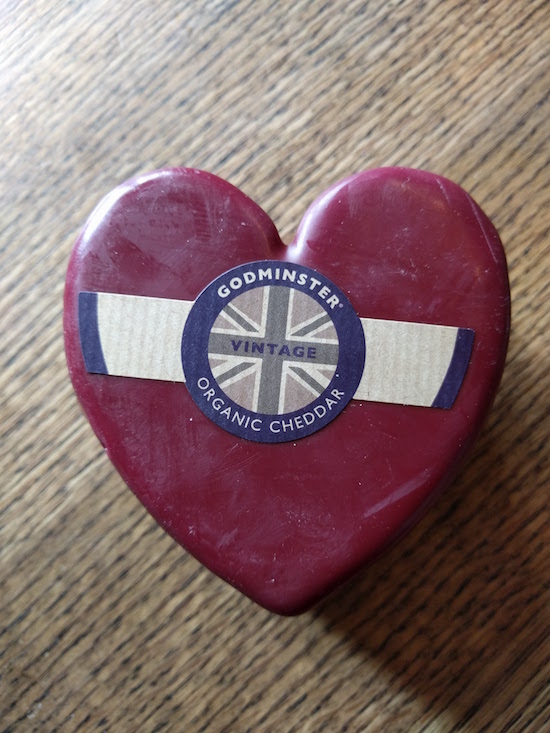
Everything’s been a special occasion around here lately, what with Pancake Tuesday and the fact that we had afternoon tea for dinner the day after that. And now it’s a long weekend, four days of it if you count Harriet’s PA Day, and we’re stretching out our Valentines Day celebrating and marking it with cheese. (Long weekend adventures have been extensively instagrammed.) It’s freezing cold outside but everything around here is wonderful and cozy, which feels nice after our terrible boring Christmas vacation rife with sickness. I just finished reading my second novel by Tana French (you MUST read Tana French) and now for sentimental reasons, am about to embark upon a reread of The Republic of Love.
February 12, 2016
My Heart Fills With Happiness, by Monique Gray Smith and Julie Flett
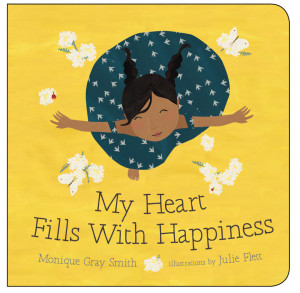
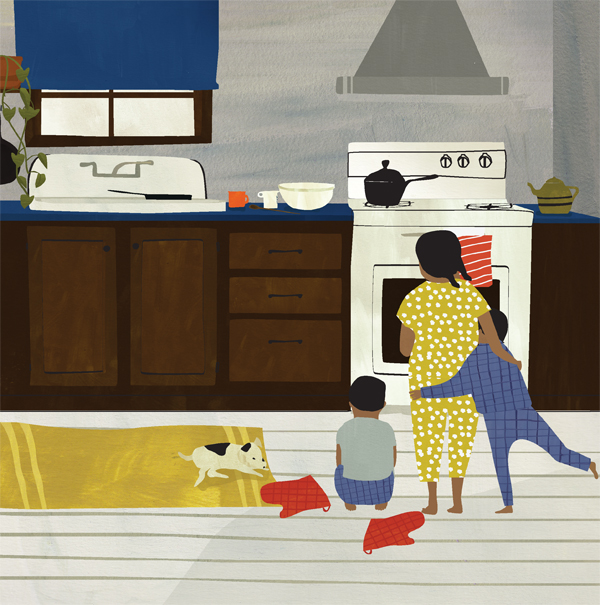
As the world’s biggest fan of Little You, the board book by Richard Van Camp and Julie Flett, I’m particularly excited about Flett’s latest work, My Heart Fills With Happiness, a board book written by Monique Gray Smith (whose novel, Tilly, was winner of the 2014 Burt Prize for First Nations, Métis and Inuit Literature). “This book is dedicated to the former Indian Residential School students and their families—may you find what you seek,” reads Smith’s dedication, and her text is a celebration of First Nations culture as well as those perfect moments of exuberant joy that might be noted as ordinary if they weren’t so extraordinary (and perhaps the key to happiness lies in knowing that distinction): when you see the face of someone you love, smell bannock baking in the oven (with a teapot in the illustration; and oh, do I ever want to bake bannock now), when you’re dancing, singing, or holding the hand of someone you love. “What fills YOUR heart with happiness?” the book asks as it ends.
I received an advanced copy of My Heart Fills With Happiness back in December when I’d been ill in bed for weeks, and I recall reading it with Iris one afternoon while we were home alone together. It was late afternoon and the west-facing window in my room was poured through with sunlight, as yellow as this book’s beautiful cover. We were lying in my bed, face to face, and prompted by the book’s final question, we started talking about the things that fill our hearts: cake, and sunlight, and hugs, and books. The first proper conversation we’d ever had, it occurred to me, as her brain had undergone some transformation rather suddenly (she’d just turned two and a half) and now was (kind of) a creature capable of communicating complex ideas: she looked at me and said, “The sun makes my window so open.” And I knew exactly what she meant.
 UPDATE: Bannock happened! We baked it this morning and the smell is indeed one that would fill your heart with happiness. Delicious. We happen to have leftover Devonshire cream in the fridge as well as strawberry jam, so my heart is basically exploding (and not just with cholesterol). I got the recipe from here.
February 10, 2016
Frankie Styne and the Silver Man, by Kathy Page
 My first proper job after graduating from university was temping as admin staff for a social services agency in the English Midlands, and it was a job that blew my mind in terms of what it taught me about the possibilities of narrative. My job required me type out reams of notes scrawled on yellow notepads and other paper scraps, and render these into a coherent story, and it was fascinating. I worked in Fostering and Adoption and wrote up family trees and histories for families pursuing these avenues, and then moved into Children and Families and supported social workers with overflowing caseloads working to protect vulnerable children and/from their parents (who were often unfathomably idiotic—or fathomably so; indeed, there was an entire basement room with paper files stacked to the ceiling of cases that stretched back generations).
I had this job concurrent to the Victoria Climbié murder inquiry, which delved into the systematic failure to protect a small girl who had been tortured and murdered by her guardians. The details of this failure are shocking, and yet they weren’t altogether: I’d seen how resources were scarce, how social workers were often impossibly tasked, and wondered too how far the social safety net would have to stretch in order to account for every possibility of unthinkable human evil. “The ends and edges of what [people] could have done or could do,” which is a line from Frankie Styne and the Silver Man, by Kathy Page.
Frankie Styne is a new edition of Page’s novel, first published in 1993, and it put me in mind of my favourite Hilary Mantel novels, her first two, Every Day is Mothers Day and Vacant Possession, dark comedies about the dark edges of humanity and their successful attempts to outmaneuver meddling social workers. Page’s social worker is Annie Purvis, who we know first from the point of view of her client, Liz Meredith, who’s just been moved into a terrace house with her baby. Liz has spent her time most recently living on a railcar after becoming estranged from her family, but since her baby’s birth (compounded by the fact that he has developmental abnormalities) she’s become tangled up in “the system”. Although she diverts all attempts to get her installed with a phone (living as she does by her grandmother’s advice to “Always avoid ties that bind”), she could do with a television, but in the meantime, she contents herself by listening to conversations between the troubled couple next door and imagining a different kind of reality existing on a planet far away, that life itself is merely the plot of a cheap pulp novel she’s somehow been stuck in.
A novel kind of like those penned by Frank Styne who lives next door to her, though they’ve barely met, and she’s never heard of his novels. Styne is a recluse, done in by a facial deformity and a lifelong struggle with sexual dysfunction, but now his latest book has been nominated for a major award and he’s going to have the press on his doorstep. Which drives him to become embroiled in a revenge plot of his own, sadistic fantasies that outdo any possibilities that have turned up so far in his books.
What impact do Frank Styne’s horror novels have upon the world? Is the impact more or less than the effect of Annie Purvis’s attempts to care for clients such as Liz Meredith and her son? Does Liz really require Annie Purvis’s meddling? And Page does such a terrific job of creating sympathy for each of her characters that we’re gunning for Liz, that we understand why she doesn’t take her son to a clinic after his foot is injured—because it’s true that they’d only take him away from her. And we know too that “they” is a group of people around a table, Annie Purvis and her associates, and they’re making their own gambles about the ends and edges of narrative possibility. That Annie Purvis has struggles of her own, a husband who resents the demands of her job. That all these people in close proximity affect each other in ways that no one can predict and that could never be plotted on a graph. That, contrary to Mrs. Thatcher’s assertion, there is such a thing as society after all, but what it is isn’t always pretty.
Frankie Styne and the Silver Man is dark and funny, painful and uplifting, marvellously satirical but never cynical, and thoroughly invested with good faith. Kathy Page is a marvel. This is the very best book that I’ve read in ages, and if I read another half as good in the next few months, that will constitute an extraordinary literary year.
February 8, 2016
The Disappearing Woman Writer
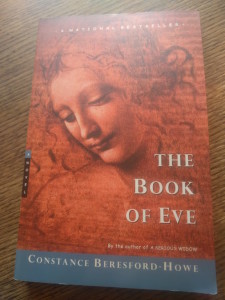 I’ve never read anything by Constance Beresford-Howe. Why not? Because her books were old, their covers not very enticing. That her focus was on older women also would not have meant anything to me for a very long time, would have been a drawback, actually (I’d had been through enough with The Stone Angel; I still don’t really love that book) though I recall that my mom had a copy of The Book of Eve. I never read her because her books were never assigned to me for a class, which the reason that I read many things. I suspect I didn’t read her books for the same reason that women proclaimed our universe “post-feminist” in the late 1990s. But her name was familiar when I encountered it in The Globe obits a couple of weeks ago. (You see, I am now at the point in my life at which older women have become interesting; I pore over the death notices every Saturday.) A name with which I am that familiar should perhaps have the death of its bearer meet with more press than just an obit: “Educator, Author, Lover of Literature.” The Globe’s Marsha Lederman had tweeted about her death, as well as had a few others who’d had her as a teacher at Ryerson. And I was glad when I learned that a longer obituary for Beresford-Howe was in the works. Because, see, I’d recently read the essay, “The Amazing Disappearing Women Writer”, and realized that lack of attention to Constance Beresford-Howe, in later life and in death, was not a literary anomaly.
In her essay, Jeannine Hall Gailey asks the question: “So, how can the mid-life woman writer attempt not to disappear right before the eyes of prominent male writers, king-makers, editors, judges and juries of prizes and grants? How do we stay seen and heard when perhaps our youthful charms may be diminishing but our art may be improving?”
It was a question I came at as a reader, though I am a writer too with greying hair and a body that is slowly turning into a splendid pudding. But it was as a reader I considered it, how much we are missing. And it affirmed why I do what I do here and elsewhere, championing books from the platform I’ve made, making noise and shouting my darnedest to ensure that women writers don’t just disappear. And that I have to backtrack too, take note of all those books and readers who weren’t bright and shiny enough when I first encountered them, give them another chance.
I was so happy to read Judy Stoffman’s profile of Constance Beresford-Howe in the Globe this weekend, and to have it affirmed that she’s probably a writer I will deeply appreciate, with Barbara Pym comparisons as the cherry on the sundae. I went out on Saturday afternoon and picked up a second-hand copy of The Book of Eve, and look forward to tracking down her other books in time, and to doing a lot of shouting about them.
February 7, 2016
Patrin, by Theresa Kishkan
 And so #TodaysTeacup continues, the Instagramming of my daily cup of tea, the end of the week marked with #CupAndSaucerFriday. I used to think I had too many sets of cups and saucers, but now it seems as though I don’t have enough. On Friday I took down the last of my cup and saucer sets to use, and was surprised to find that this one set is not from England—not Regency China, or Paragone Fine Bone China, or Coalport. No, this set was from a Czechoslovakian company called Altrohlau. Which was strange because I have Czechoslovakia on the brain, one of the settings for Theresa Kishkan’s beautiful, mysterious novella, Patrin—a novella in which the characters drink Earl Grey.
 I first read Theresa Kishkan in her essay that won the Edna Staebler Personal Essay Contest, and which was included in her essay collection, Mnemonic: A Book of Trees. Unsurprisingly, trees factor prominently in Patrin as well, in patterns of leaves on a quilt inherited by the title character from her grandmother, a Roma from Czechoslovakia who’d immigrated to Canada and become estranged from the rest of her family. When her grandmother dies, Patrin tries to discern the quilt’s pattern, hoping they might provide clues to her family history, which is otherwise lost to her now, the answer to the questions: from where and what did I come?
The novella weaves together several timelines from throughout the 1970s—Patrin embarking to Europe on her own and having her heart broken by a Gypsy musician; spending time with her grandmother in Edmonton after her father’s death, them sleeping together under the quilt; Patrin working in a bookstore in Victoria later in the decade, isolated from the world, trying to decode the mysteries of her own self; and Patrin journeying to Czechoslovakia to do exactly that in 1979, supposing the pattern of trees and leaves on her grandmother’s quilt might be a map of the area in Moravia in which her foremothers had lived and travelled almost a century before.
The world Patrin finds in Czechoslovakia is shadowy and mysterious, the elusiveness of Patrin’s own story underlined by Soviet-era suspicion and paranoia. A friend of a friend takes her on a journey to Moravia to find if her quilt-map line up with actual places after all, and if any history of her family remains. And here the story takes on dimensions of a fairy tale, rich and verdant with a touch of magic, with an ending that in retrospect was inevitable, and is also perfect.
 There’s another teacup too—Patrin takes stock of her “batterie de cuisine” as she moves into her own apartment on Oak Bay Avenue in Victoria in 1974, including a mug “from a potter on West Saanich Road” with a ceramic frog at the bottom. We have a mug just like that, a #TodaysTeacup feature from a few weeks back, Patrin wending its own way into my world, surprising patterns emerging, real life as art’s echo.
February 5, 2016
Last Stop on Market Street, by Matt de la Peña and Christian Robinson
I’ve been spending a lot of time lately thinking about the nature of an imperfect world, about the gifts inherent in that kind of reality. (The only kind of reality.) That accepting the imperfections and imperfectability of the world is not about giving up hope of making things better, but instead the reason why we mustn’t stop trying—where would we be if we did? And how other people keep us in check—even the assholes. Well-being lies not about improving the assholes, obliterating assholedom, but instead learning to live among them. Accepting too that everybody is someone else’s asshole sometime. It’s all a negotiation, this business of daily life in the world. Even negotiating with those people who will never understand that.
I read an article last weekend about a teacher remarking on her high-needs students: “There are a lot of kids here who keep life interesting.” I’m aspiring to maintain such a perspective on my fellow humans, the challenging ones.
A gift of living in the city and especially raising my children here is that the world’s imperfections are always close at hand. Garbage in the gutters, mentally ill people shouting obscenities in the streets, mentally sound people shouting obscenities in the streets, someone threw up on the sidewalk, drivers nearly bowling us over turning right on red lights, ugly graffiti sprayed on beautiful murals, and people who vape. Here is the world…and yet we love it anyway. Perhaps even more so. Because there’s also bees alighting on flowers, little kids holding their parents’ hands, squirrels eating sandwiches, cherry blossom springtimes, the wonder of an airplane soaring overhead, and music, and finger paint, and dancing to “Trouble” by Taylor Swift. It’s the same reasons we take to read Grimms’ fairy tales at their gruesomest: because here is the world…and yet.
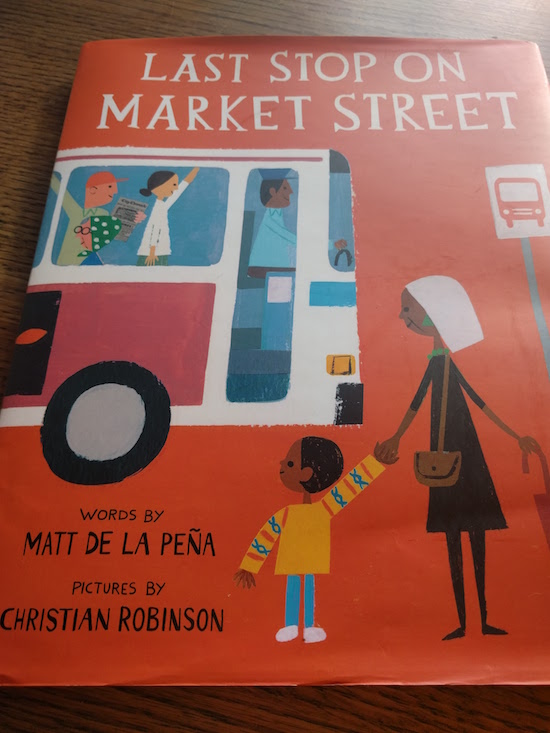
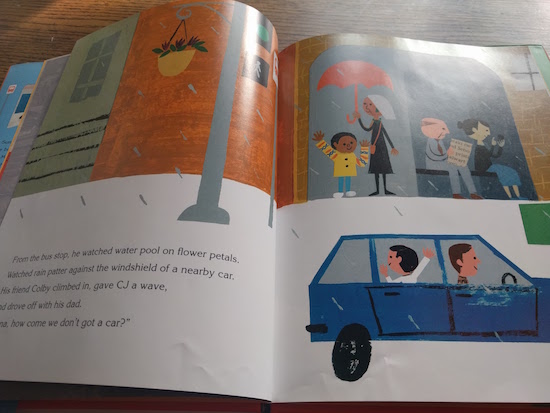
The city in Matt de la Peña and Christian Robinson’s Newbery Award-winning Last Stop on Market Street is San Francisco which, by virtue of its density, is a city of contrasts. We see this as CJ and his Nana board the bus on Sunday after church and make their way across town for a weekly appointment. CJ wonders why they have to go. He wonders why they can’t travel by car, like their friends who passed while they were waiting at the bus stop. But his Nana reminds him of the advantages of riding “a bus that breathes fire” (there is a dragon on the advertisement on the bus’s side), and of the people they’ll meet, the stories CJ will encounter on his way.
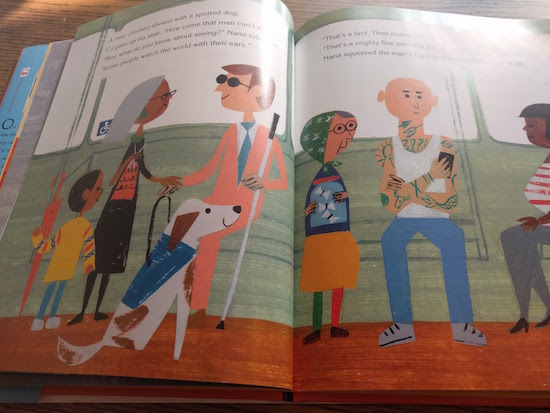
She’s proven right too, CJ’s Nana, knitting as they go, making friends with the man with the seeing-eye dog, convincing the man with guitar to break out in song—to which CJ closes his eyes and launches into a reverie, all butterflies and rhythm and moonlight. When the song ends, CJ tosses a coin into the man’s hat and suddenly they’re at their destination: “Last stop on Market Street!”
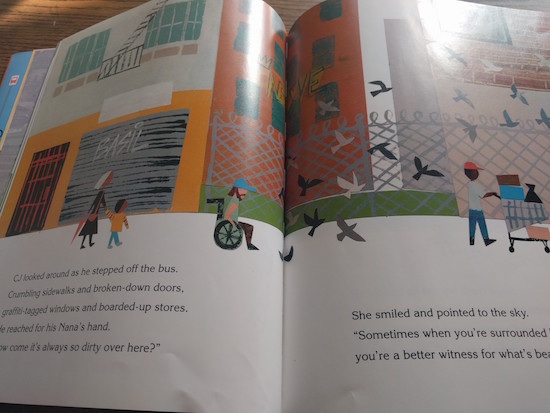
CJ is still not sure as he steps off the bus, taking his Nana’s hand. It’s a rough neighbourhood with boarded up shops and graffiti. The only birds are pigeons. His Nana points to the sky though: “Sometimes when you’re surrounded by dirt, CJ, you’re a better witness for what’s beautiful.” And in the following spread we see a bigger picture, a rainbow overhead. “He looked all around them again,/ at the bus rounding the corner out of sight/ and the broken streetlamps still lit up bright/ and the stray-cat shadows moving across the wall.”
The subtle rhyme of de la Peña’s prose gives the story a kind of music, rhythm and cadence. The journey culminates with CJ and his nana’s arrival at the soup kitchen where they work every week serving lunch to the people of the neighbourhood. People who are people in their own right: Esther with her new hat, and the Sunglass Man. And CJ tells his grandmother that he’s glad they came.
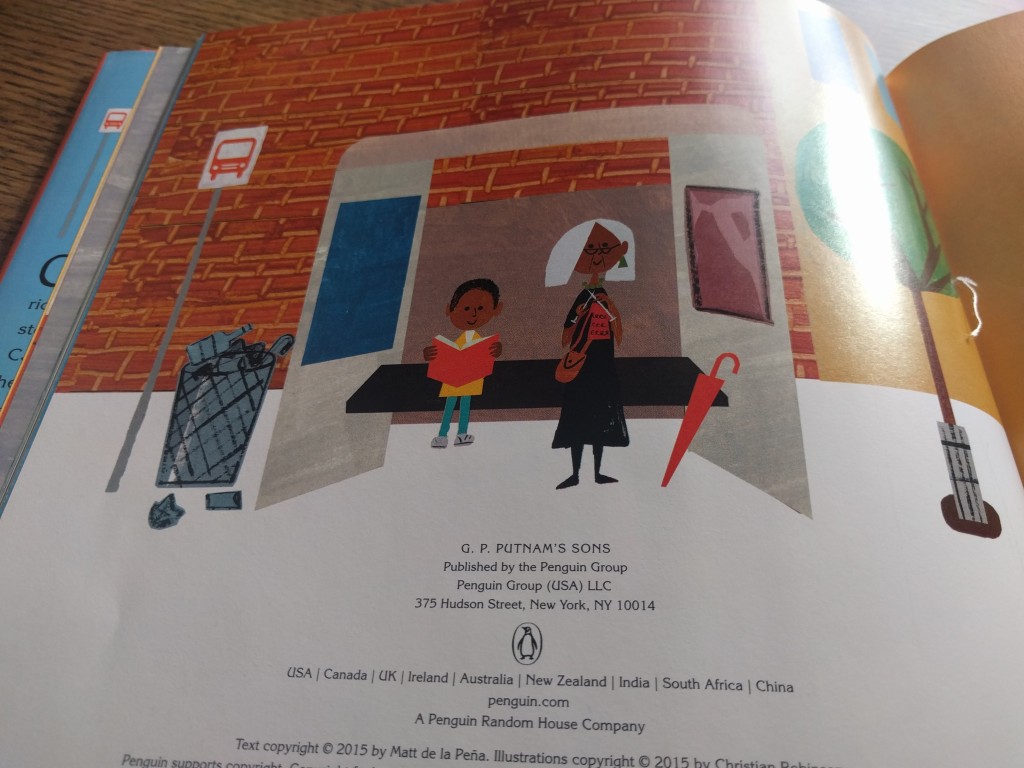
The story concludes with CJ and his nana back waiting for the bus, with caged spindly trees and overflowing litter bins, but the beauty’s there: we see it now. Perhaps it’s been there all along.
February 1, 2016
Gifts to Myself
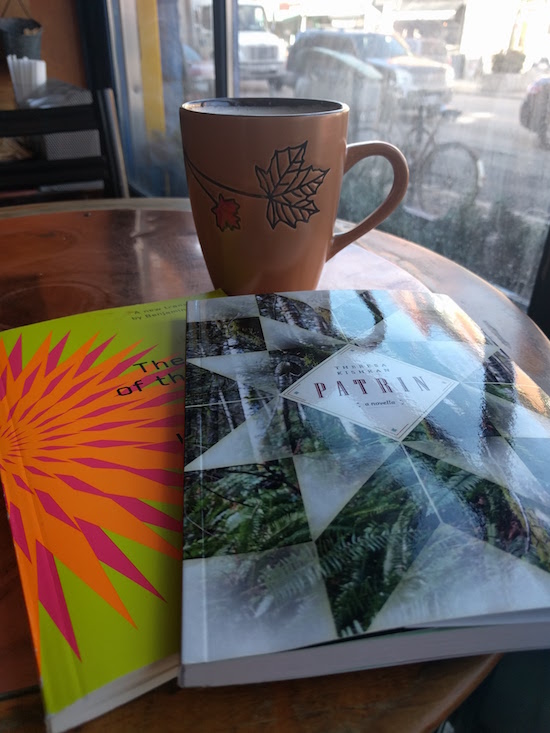
This morning was a gift to myself, a handing-in-your novel gift, though it didn’t occur to me that this was the occasion until I was looking for an excuse to spend my free time sitting reading a book while drinking a chai latte in a cafe. By this point I’d had my hair cut and my eyebrows waxed, and finally dropped off my new bathing suit to have the straps shortened—all the errands that I’ve been putting off for ages. I ordered a new green bin to replace our battered one, and bought clear garbage bags at the hardware store to use for green waste until the new bin arrives. Bought some stamps and finally mailed the thank-you notes that I’d had Harriet painstakingly write after Christmas, and which have waiting ever since to be enveloped and addressed. And yes, still had time to kill before it was time to fetch Iris from school, and so I sat in Future Bakery finishing The Hour of the Star, by Clarice Lispector. Thinking about the time I’d been there about two years ago reading Last Friends, by Jane Gardam, also having just had my hair cut and brows waxed—grooming, for me, is pretty much an annual affair; I’m low maintenance, or perhaps “slovenly” is more apt—and how Iris had just been a baby then and getting out for time to myself had been a major accomplishment. This time it’s an accomplishment of a different kind—I’ve been working hard this last two weeks on edits of my book, and also contributing to the wondrousness that is 49th Shelf at the moment (and I’m particularly proud of what we’re continuing to do there). It was such a pleasure to sit and read, and also to get those errands done. I’m mostly very reluctant to waste my child-free time on such things, but then I don’t really want to waste our Saturday/Sunday family time on them either, so then thank-you notes, for example, end up sitting unsent for weeks and weeks. Once in a while it’s nice to clear the decks. A gift indeed.
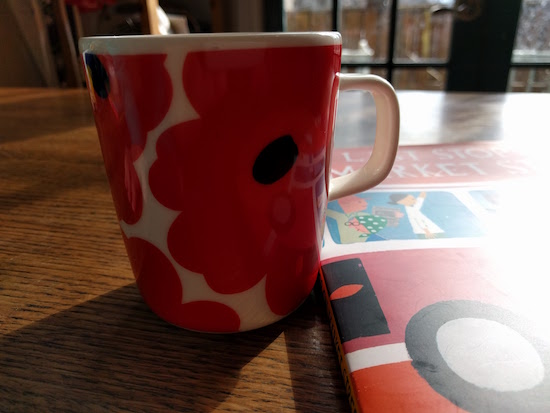
Though of course gifts to myself are hardly few and far between. I am nothing if not generous in that respect. Yesterday I had another excellent morning, following Harriet’s swimming lesson as we all headed to Kensington Market to buy chicken for last night’s dinner and also to try churros for the first time, and get wood-fired bagels for lunch, and I got to browse at Good Egg. Where I bought a beautiful Marimekko mug, my favourite print, the first such mug I’ve bought since #TodaysTeacup started, and yes, let’s not go overboard, but how wonderful to just want a thing…and simply have it. It’s almost more precious just for that, and I’m very pleased about this impulse buy. Also that it included the Newbery Medal-winning Last Stop on Market Street, which is so wonderful and I look forward to writing about this week for Picture Book Friday. So you see, not all my indulgences have to do with mugs and teacups—only most of them.
January 31, 2016
Bearskin Diary, by Carol Daniels
 Carol Daniels’ first novel, Bearskin Diary, is driven by a remarkable protagonist, powered by compelling narrative voice and an extraordinary point of view. Sandy Pelly was part of the “Sixties Scoop”, a First Nations child taken from her parents and set adrift in the fostering and adoption system. Her story, unlike so many others, turned out mostly well—she was adopted by white parents who were loving and supportive, who did their best to fight against the racism omnipresent in the society in which they lived, and she was well loved by her grandmother, her Ukrainian “Baba“, who instilled in Sandy a sense of her own self-worth and an instinct for story-telling. But the loss of her heritage and culture is deeply traumatic, a loss whose effects Sandy can’t even articulate properly—she doesn’t know what she’s missing. But she knows she’s missing something, not least of all a place where she belongs. There is a disturbing remembrance of Sandy at five-years-old trying to scrub away the brown from her skin.
Things are going well for Sandy. Against the odds, she’s making it as a TV reporter, a rare position for a First Nations woman in the 1980s (and not so common these days either)—and we’re shown the racism she has to contend with from co-workers. She and her best friend Ellen enjoy regular Girls Nights, and it’s at one of these that she meets Blue for the first time. A Metis police trainee, she is instantly attracted to him, for obvious reasons, but also because she sees a glimpse in him of what she’s missing in herself. Blue is similarly alienated from his culture, however, and their relationship proves complicated—she throws caution to the wind and decides to follow him to Saskatoon, where he lives and works, but after a period of domestic bliss, she realizes he’s still distracted by a previous relationship that might not be as far back in the past as she’d been lead to believe. While this revelation is devastating, however, Sandy has other preoccupations—she’s managed to find a great job in her new city, and has just received a troubling tip about Saskatoon police officers taking First Nations women into isolated areas and raping them, getting away with it over and over again. And as she’s grappling with just how to tell that particular story, Sandy is also connecting with local First Nations Elders and discovering the richness of a culture that’s been denied to her for her entire life.
I read the book in a couple of days, and found it fast-paced and really absorbing. Although I was compelled by the story itself and its main character, more so than the novel’s structure, the container that held it. While Sandy was a rich and textured character, secondary characters were more one-dimensional. There were also strange shifts in point-of-view throughout the text. But it also occurs to me that critiquing the book by English literature standards is also beside the point—Bearskin Diary is part of a different tradition and has a more mythological structure, with expansiveness instead of depth, with depth in the places that I didn’t look for it at first. It’s chronology too is remarkable, the present moment dissolving into the past—each one containing all those that came before. It’s a novel with the feel of the oral tradition—and indeed it’s the voice that draws the reader in.
Which makes reading Bearskin Diary really a pleasure. In a time in which it’s never been more important that First Nations’ women voices are heard (and read), Daniels’ novel is definitely one not to miss.
January 29, 2016
Picture Books We’ve Loved to Pieces
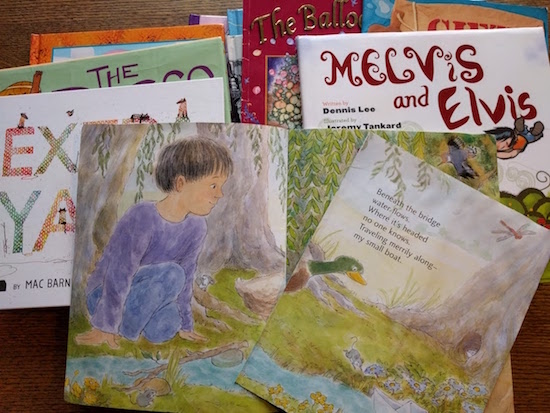
Wednesday was Family Literacy Day, and on 49thShelf, I wrote about the picture books our family has read to pieces. Reading with my children was been one of the most incredible parts of my life since they were born, and we’ve all come a long way since the first time I observed Family Literacy Day (which was six years ago, and I turned it into a week-long blogging extravaganza. Scroll down a bit here to se what we got up to). These days Harriet reads by herself more often than we read together, but we still read picture books every night, plus some of a chapter book—at the moment we’re doing The Borrowers Afield and it’s so perfect. Hanging out with books is my favourite way to be a family—or to be anything, for that matter…
January 28, 2016
Mitzi Bytes: An Outtake

The good news is that I handed in my edits today for Mitzi Bytes 4.0. The even better news is that it’s a much stronger manuscript than it was two weeks ago. The most substantial changes involved removing three blog posts (her blog posts, which are from her archives, come after each chapter of the main narrative, which is set in the present day). I liked these blog posts, but agreed that they didn’t serve to enhance the main story enough, so I wrote new ones that really do. Which left me with these outtakes, and thank goodness for the internet, which means they won’t have to go to waste. This particular post I read at the Draft Reading Series in November, and it went over pretty well, I think. It’s situated in the years before my protagonist meets her husband and settles down, during a time in which her tumultuous love life served as excellent blog fodder.
**
So it’s over. Good news for those of you who’ve been leaving comments haranguing me for being nauseatingly in love for the past seven weeks, for even counting the weeks. But come on, post-divorce, conducting a relationship for this length of time feels like an achievement. It’s an actual relationship. Seven weeks, at most times of the year, is a period long enough to include a statutory holiday and/or religious celebration. I met his mom. We had a pregnancy scare. This is the closest I’d come to forever since my marriage went down in sad and pitiful flames. And I see now how the whole thing was really just an experiment in intimacy, but in the midst of it, I thought I was writing the conclusion to the “Troubled” chapter of my life. That all my problems were solved.
But here we are right back where we started. And once again, the problem was me, and my compulsion to overlook other problems that are glaringly obvious. Once again, I really thought we’d find a way to make it work if I were just flexible and accommodating enough. Surely every relationship brings challenges and a couple is stronger for working through these. I really can’t believe there is a single bride who hasn’t lain awake on her wedding night beside a sleeping body and pondered whether she has possibly made a mistake.
Getting involved with D was never going to be a straightforward process—he was upfront about that from the start. He had strong ties to his mother and his sisters, and there was the matter of the son, G. G had been the result of a teenage fling, and he and his ex had worked hard to raise their son together, co-parenting and freeing him of any baggage that might come about from being someone who was conceived in the back of a pickup truck after a few too many drinks.
It helped too that the boy’s mother’s parents were loaded, ensuring that G. was well-looked after while his parents pursued their career goals, and from age six had been enrolled at one of the city’s most prestigious private schools. There would be no pick-up trucks for this upstanding young fellow whose achievements and admirable qualities his father was fond of reciting: the honour roll, valedictorian, vegetarian, peace activist, feminist, cycling advocate, chemistry whiz, philosophy buff, champion swimmer, hockey superstar and he packed boxes at the food bank at Christmas.
Obviously, he sounded insufferable, which was the first time since we’d met that I had a thought I couldn’t share with D, and that was awful. But in a way, I also feel sorry for the kid, because it must be hard to be talked-up like you’re a demi-god when you’re actually a thirteen-year-old boy, which is an awkward kind of person to have to be.
I finally met him last week. To be honest, I could have waited. I was completely okay with pretending this messianic child didn’t actually exist, even in spite of evidence to the contrary: his immaculate bedroom, some photos, a poster on the fridge from the march he’d organized in protest of the Iraq invasion. But none of these things made him real, which was fine with me, because a 13-year-old boy just didn’t seem like a thing my life was particularly missing.
But then one evening, there he was. He’d come down to D’s place after school, so he was wearing his school blazer whose crest was a mess of lions and swords. And even though he was as tall as I am, he was so clearly a child dressed up as a man that I was reminded of those old cereal commercials, the small boy dressed up in a big jacket at a big desk. But the boy took himself very seriously, firmly shaking my hand, sizing me up. “I’ve been hearing a lot about you,” he told me, as though he were the adult and I were the child. “Pleased to finally make your acquaintance.”
He had a moustache. I couldn’t stop looking at it. The most ridiculous thing on his pimply face. Dark and wispy, the moustache was no accident, it was cultivated, and I was reminded of lamb’s wool, of softness and down. Of a boy who’s trying to look like he’s not trying. The effort of being natural. Perhaps I should have identified.
But no, because I was actually trying to avoid natural at all costs. That night, natural would have betrayed me. So I kept a neutral expression as we had our dinner and he explained the ethics of veganism, of how it connected to the pro-life movement, and how he could be both pro-life and feminist at once. He was reading us the world as though it were something that existed in a sacred book we’d never heard of, and you got the sense that he was accustomed to other people being in awe of him, hanging on every word he said. His father was no exception.
“Isn’t he terrific?” D kept asking me after we’d seen G down the elevator on his way back to his mother’s. “I told you, didn’t I? That’s no ordinary kid.”
I managed to keep my mouth shut until we were at his sister’s the following weekend. D’s sister M, I imagined, was a woman after my own heart, completely lacking in pretention. It had been her pick-up truck that G had been conceived in. She still had the truck, and drove it up and down dirt roads in a cloud of dust. She wasn’t afraid to call things as she saw them. She’d already told me she was wary of a fresh divorcee in her baby brother’s life, but I appreciated her honesty. I would have been wary too.
So my guard was down as we sat out together on her veranda at the end of a busy day. The whole extended family was up there celebrating the long weekend, and they’d roasted a pig on a spit. Her own children were now running around the lawn with sparklers. We were each at either end of the hanging swing, legs curled up beneath us, cold bottles of beer in our hands. I thought I was looking in a mirror.
“So I hear you met the kid,” she said. He hadn’t come up with us, electing instead to stay in the city for a hockey tournament. D’s sister took a sip of her beer. “The little shit,” she said.
I waited a minute before I responded. “He’s certainly accomplished,” I offered.
“So he told you, I’m sure,” she said.
“His dad’s pretty proud.”
“He’s hoping the pride will override the guilt about everything else. It’s a mess,” she said. “And there’s no discipline. It’s better now, but you should have seen him when he was little. He got away with everything. They think the sun shines out of that kid’s ass.”
She started telling me stories, and we were still talking when the sparklers were burnt out, the sun set, and our bottles were empty. And up until this point, I’d handled myself with the utmost decorum—an especially impressive performance from the likes of me.
But then it all went wrong. We were sharing our impressions of wispy-lipped, pimple-face G, with his pro-life justice and the burgeoning build of a hockey enforcer.
I leaned in close, my voice low. I was really more than a bit drunk, though it’s still no excuse because I was speaking the truth. “The kind of kid,” I said, “who you just know is going to grow up to be a rapist. It’s practically written right there on his greasy forehead.”
D’s sister was staring at me now with a strange expression. I said, “Right?”
“I mean, maybe it was the blazer, or his teeth—that kind of orthodontia is a huge investment.” I was feeling vicious. I hated that kid. He was awful. “Shiny hair, and he’s just so convinced of himself. He was talking about his school, and he said, ‘They’re teaching us to be the leaders of tomorrow.’ He thinks he’s entitled to the whole fucking world.” But this hadn’t clarified things. “A little rapist,” I delivered finally, futilely. This was going over like a tumbleweed, and any rapport between us on the swing had disintegrated. She stood up and went inside without another word, leaving me swinging there alone.
I should have just found my car and driven back to the city, but I really was drunk, far too drunk to have found my car, let alone drive it. So I stayed in the swing until D found me there, coming in from where collecting fireflies with his nieces. They came up to the porch carrying jam jars full of dying light, and he left his on the rail so he could gather me up into his arms, and carry me upstairs to the bed in his sister’s spare room where we made love beneath a patchwork quilt that had been stitched by his great grandmother.
His sister didn’t get up in the morning. “Too much party,” everybody was saying, and my own aching head was pounding in agreement. D and I left after breakfast in order to the beat the traffic, which we didn’t beat, and I was quite sure that it was over then, as we sat there on the highway. He still had his eyes on the horizon, but I knew that everything between us was about to rapidly run out of gas.
She must have called him that night. I was at home still nursing my hangover with a pan frozen home fries, a fried egg cracked on top of them.
He texted me. “Did you call G ‘a little rapist’?”
I texted him back. “I can explain.”
One more time: “I’m not sure you can,” he wrote me.
And that’s the last I ever heard from him.






