February 19, 2019
Gleanings

- I’ve had my fill of faux community consultations.
- I want to constantly renew my creativity in attempts, and tries, and blunders, and anonymity.
- …how often it’s the entire atmosphere of reading — current circumstances, personal life stage, other voices bumping alongside — that makes a particular book memorable.
- That’s really the richness and beauty of anthologies. There are debates going on, and some readers take sides.
- How much more robust would my education have been had I read more women, especially ones who were still alive?
- Little girls with mothers who are teachers-of-life grow up to be women who observe, taste, admire, explore, and appreciate.
- …and once I’m in the water, I wonder who that person was who had hesitated, so happy am I to be swimming back and forth and back again.
- There is something so satisfying in perusing other people’s bookshelves.
- They say one shouldn’t do a thing if one’s heart isn’t in it–but one probably also shouldn’t do it if the heart is too much in it.
- I realize that by using the term “chit-chat”, I’ve possibly belittled what this group has come to mean to me.
- How certain gestures, features, remain over time, in the intricate mathematics of inheritance.
- I do still adore The Stone Diaries and recently pressed it upon a student, and I can certainly see its imprint on this book.
Do you like reading good things online and want to make sure you don’t miss a “Gleanings” post? Then sign up to receive “Gleanings” delivered to your inbox each week(ish). And if you’ve read something excellent that you think we ought to check out, share the link in a comment below.
February 19, 2019
The Young Unicorns, by Madeleine L’Engle
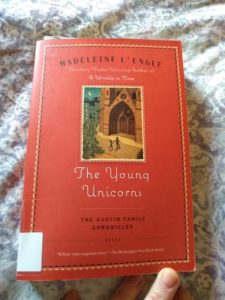
My Madeleine L’Engle/Austins project continued this weekend when I read The Young Unicorns, the third book in the Austins series. A series that is all-over-the-place in the most interesting way, in terms of genre in particular. Because this book (whose narrative does not, in fact, include a single unicorn, in case you were curious) is a dark and plot-driven mystery, very different from the previous two novels which were episodic. It’s also narrated in the third-person and comprises points of view from the entire Austin family. And I don’t remember if I ever picked this book up when I was a child, but I can understand why the Austin series as a whole confused me. Each book is a very different creature, this one set in a gritty and crime-ridden New York City where gang violence and corruption are endemic, where the Austin family has recently relocated to while Dr. Austin, a country doctor, takes up the opportunity to study surgical lasers at a prestigious research lab.
A surprising detail I learned while reading posts and other articles on this book (this one in particular!) was that not only did L’Engle write her books in set two different systems of time (chronos and kairos), but some of the series themselves were written out of sequence. So that The Arm of the Starfish (which I’ve never read) about Meg Murry’s daughter Polly was published in 1965, before either of the two books that immediately followed A Wrinkle In Time sequentially—which surely posed narrative challenges for their author. As I’ve been reading the Austin books I’ve also found it really illuminating to consider each novel in its own historical context—The Moon By Night (1963) informed by the Cuban Missile Crisis and fears of a nuclear holocaust, and now The Young Unicorns, which was published in 1968 and certainly informed by race riots and social unrest of the late-1960s, which is directly referenced in the text—although in her author’s note, L’Engle explains that her story takes place “not in the present but in that time in the future when many changes only projected today may have become actualities.”
Which is significant, because of how timely so many of historical concerns of The Young Unicorns seem for a reader in 2019, just as the previous book’s did. (When I was young, I thought it would be cool to live through the 1960s. Having now lived through the 1960s redux, I’ve changed my mind.) This novel is asking questions about responding to social unrest, about who to trust, whether we can trust anyone, or if trust itself is a fool’s game. It’s also an exploration of the nature of freedom, in particular to how it pertains to religion. Is obedience freedom? Is disobeying freedom, and when isn’t it? What does it mean to have peace if freedom is undermined to achieve it? (And this is where the title comes in, in reference to a quotation about unicorns that cannot be caught by the hunter but instead “can only be tamed of his own free will.”)
One could say the following of all of L’Engle’s books, but it’s especially relevant here: It’s so weird. Country Doctor Austin has been transformed into a scientist (basically Meg Murry’s dad), and Rob Austin is Charles-Wallace reborn, innocent and purely good, and they even have a reliable hound with uncanny awareness of the presence of evil. The Austins have rented the upper floors of an old mansion on Riverside Drive whose lower levels belong to a scholar and his musical prodigy daughter, Emily, who has been blind since a mysterious attack a few years before. Emily takes piano lessons from the eccentric Dr. Theo, and is helped in her studies and all around by Josiah “Dave” Davidson, a former gang member who was even more formerly than that a chorister at the Cathedral Church of St. John the Divine, which looms large in this novel, its catacombs leading through tunnels to abandoned subway stations and there is even a genie who mysteriously appears when the Austin children rub a lamp in an antique shop.
Dave is Black, and we meet him in the novel’s first sentence, and it’s significant, I think, that nowhere in the novel is his race explicitly stated, but we’re meant to infer it because he’s an “ex-hood” who lives in a Harlem tenement. (Race is stated a few times elsewhere in the book—the Cathedral’s Dean is Puerto Rican, and also an “ex-hood;” also, the two scientists who performed Dr. Austin’s job before him are Chinese and Indian, and a character makes a racist statement about their Asian-ness, at one point, but this character is also literally an arch-villain, so this might be the point.)
That race is otherwise absent from the novel is significant though, especially based on its 1968 publication year and its references to riots, mobs run amok. But this was also the heart of the Civil Rights Movement, and to remove race from the story of rioting and social unrest in northern American cities in 1968 is disingenuous. There is a suggestion too that the rioting and violence is thoughtless and rootless, violence for the sake of violence. But maybe this is what happens when you’re the type of person who doesn’t see colour or write colour, and the definition of progressivism in 1968 for many is that the Austin family regularly had a Black boy sit with them at their table, never mind that his Blackness is never delineated.
While a compelling and gripping read, I also found the novel a bit difficult and disorienting. Part of that is the nature of a book that is all about puzzles, tricks, and mystery, but I’m not sure that was it entirely. There is a dinner party scene where Dr. Austin is discussing his work with the Micro-Ray laser with the visiting Canon Tallis, and then the children leave the table, conversation shifts, and then two pages later, Canon Tallis asks, “Just what is your work, Doctor?” And Dr. Austin replies, “I design and make a small surgical instrument known as the Micro-Ray.” “This is on the principle of the laser?” Canon Tallis asks, and I want to yell at him, “Weren’t you even listening when you were talking about this two pages ago????”
So was it a mistake? But then strange to find a mistake in a brand new edition of the book first published fifty years ago, no? Elsewhere, there is also a reference to the revolutionary work of Dr. Calvin O’Keefe on starfish regeneration, which wonderfully blurs the lines between L’Engle’s series, but then in the previous Austin book, set just six months before, Vicky Austin had referenced A Wrinkle in Time as a literary work as she wishes her family could “tesser” across America just like Meg and Charles Wallace Murry. An inconsistency too or something more interesting than that, and I do love the idea that the Austin’s realism is not quite what it seems.
Calvin O’Keefe’s starfish work is from 1965’s The Arm of the Starfish (ostensibly the sixth book after Wrinkle…), which this reviewer found similar to The Young Unicorns but more problematic and less compelling. And in her review she also lays out the problem of Meg Murry, fierce and brave heroine of A Wrinkle In Time, but one who is forever playing second fiddle to a brilliant male character, whether it be her husband or her brother. I have always loved A Swiftly Tilting Planet, the third book in the series, and I’d always hoped that the reason Meg Murry O’Keefe is sitting in her parents’ kitchen while her husband is out saving the world from nuclear annihilation is because she’s nine-months-pregnant with their first child. But if Starfish is any indication, Meg Murry retired from being a feminist icon as soon as she comes of age: “Always called Mrs. O’Keefe, she is calm, reassuring, intent, focused on mothering her children, a near clone of Mrs. Austin in the Austin books, serene and capable. And all wrong for Meg Murry.”
As with the line, “Daddy doesn’t like women who wear pants,” in The Moon By Night, Mrs. Austin in The Young Unicorns is happy enough to uphold the patriarchal status quo. As her daughter Suzy explains of how Mrs. Austin gave up a fledging music career to become a doctor’s wife, “Well, she’s just Mother. She decided she didn’t want to be something, didn’t she?” And it’s interesting that we see L’Engle seemingly unable to write a woman character who balances her creative passions (whether they be art or science) with marriage and family life, especially since she herself managed to do so. Although one could speculate how successful L’Engle actually felt she was in this balancing seeing as she wrote these idealized self-denying maternal figures over and over again.
“I think the closest we ever come in this naughty world to realizing unity in diversity is around a family table,” Canon Tallis comments after spending time with the Austin family, and questions of family, connection ,and disconnection recur throughout the text. For the first time, the Austin family themselves feel estranged from each other, and there are also questions of how they can possibly imagine themselves as an island of peace and calm in a world so dangerous and broken. In their own small town, it was easier to suppose it, but living in the city it becomes undeniable that all things are connected. “And it’s all about what Grandfather’s always saying, how we can’t love each other if we separate ourselves from anybody, anybody at all, and how anything that happens to anybody in the world really happens to everybody.”
February 18, 2019
Lemon, it’s Wednesday

“Lemon, it’s Wednesday,” so goes the 30 Rock meme after Liz Lemon comment on the week that’s been, which is the way I was feeling last week about the month of February, when we weren’t even two weeks into it yet. We’ve had stomach bugs, and kid emotional turmoil, disturbed sleep, terrible weather, and so much snow shovelling. We have a provincial government whose sheer incompetence is the only thing between it and the destruction of our public institutions, and so last week I was out at two community meetings with galvanizing plans and discussion for how we can stand up for public education. I am not exaggerating when I tell you that most of my neighbourhood is covered in a thick and impermeable sheet of ice, which means that any walk down the street is a hobble, and I’ve got leaks in my boots. I’m feeling discouraged and sad about how my writing career is panning out, with a novel rejected in November and the one I did publish prominently featured in the chain bookstore clearance bin. And I’ve reached that inevitable point in my own plans for exciting things this year where I wonder if I’m fooling myself and everybody thinks I’m a total idiot. I was so tired last Thursday after running around taking everyone to their swimming lessons, and also having dinner ready early so that everyone could eat around their swimming lessons. “I’m sorry I was cranky,” was the text I sent home while Iris was practicing her flutter kick in the pool before me. “I think what I need is to just come home tonight and take a bath.” But of course there would be no bath, because before the night was out it would become clear that I have head-lice. Head-lice was the one thing my February had been missing.
My brain is still teeming. The itch. It doesn’t require proof or evidence. Thought is enough. You do it yourself. Lice. Imagine them crawling on your head. Claws touching skin. They pass over us, across this family. —Alexander MacLeod, “Wonder About Parents”
In the last few days, we’ve spent over a hundred dollars on expensive shampoo and a lice comb, and my husband has spent hours picking over my scalp with attention to detail. And it makes me wonder what the women who end up with lice who don’t have partners do? Let alone the women who have lice who don’t have a spare $80 lying around to buy the shampoo necessary to treat the whole family (and for best results, repeat the process in seven days). I feel outclassed by the people who are able to call in the lice-trepreneurs (this is a thing!), but at least I can afford Nixx. And it makes me think about the “Bug Economics” essay in Carissa Halton’s wonderful book, Little Yellow House, which I read in January. She writes about how many families are unable to afford the “kill-these-damn-bugs shampoo,” which might not even work anyway. She goes on to write about another inner-city scourge, bed-bugs, but the principle applies to lice as well: “While everyone can get [them], the poor are most likely to have to deal with the creatures longer than most.” I am lucky: I am not poor. Also, I don’t have bed-bugs. (Yet? February has a lot of steam left in it still.)
Lice. The third week. Head checks in the morning and head checks at night after the baths. You need to go slowly. A separate bath for every person. New water. Fresh pillow cases every night. New sheets. New blankets. The washing machine is going to die. Hats and T-shirts and hooded sweatshirts. Brushes and combs and hair elastics. Water boiling in the kettle. Everything that touches us needs to be scalded. —”Wonder About Parents”
Lice is a metaphor. Lice is also not a metaphor, which is the unfortunate part of this story, or at least one unfortunate part. (It is February. There is very little fortune.) But still, lice is a metaphor for the secret shame that creeps around your head, and makes you unfit for others’ company. It marks you and makes you less than, and everybody tells you that they’re attracted to people with clean hair, but nobody believes that anyway. You start contemplating pixie cuts, crew cuts, buzz cuts. The chance to be somebody different. Because what if I’m completely hopeless, and I’m just the last person to realize it? It’s taken me almost forty years to contact lice, and I’d always kind of thought that I was immune to it all, just like how I thought I was immune to failure. Or dared to hope my story would end up different than most people’s, is what I mean, that it could even be a story of triumph. Everyone gets lice sometimes (although usually it’s when they’re six and not thirty-nine), and everyone’s book ends up in the clearance bin, but still, who wants to be everyone? Necessary humility, certainty, but insufficient consolation.
The only way out is through.
Which is true for head-lice, and Februaries, and any period of unhappiness. It’s never easy, because you get to March and you’re still carrying February inside you, and maybe you’ve still got nits (although I’m really hoping I don’t). And to be honest, I don’t any advice that is better than that, to just keep going, in addition to washing one’s hair with vinegar, which might not even help, but I like that there is something else I can do—in addition to the chemical shampoo.
February 13, 2019
Mini Reviews: Three Books on Family

The Last Romantics, by Tara Conklin: The summary on the jacket flap of Tara Conklin’s new novel The Last Romantics tells you that this is a story that begins in a yellow house, with a funeral, an iron poker…”a free and feral summer in a middle-class Connecticut town.” And while all this is true, it doesn’t begin to tell the reader what this book is about, a book that takes place over a century and actually begins in an auditorium in a dystopian future, a world wracked by climate chaos, where 102-year-old Fiona Skinner is asked to explain the story behind her most famous poem. And I’m amused by the challenge this novel must have created for marketers, who prefer novels to ones that can summed up in a sentence, and this one definitely isn’t one of those. A clue to what’s actually going on here lies in a blurb on the back by Meg Wolitzer, whose two most recent books have been similarly ambitious in their reach, not explicitly about anything either except the story itself, about the characters within and how time changes and complicates their connections. The story is the sweep, and so it is here, although it’s not always completely convincing as it is in Wolitzer’s more masterful work (though I will admit this is a high bar).
There are narrative strands in this novel that don’t go anywhere, and while one could argue that life itself is a bit like that, the reader gets the impression that this novel was once a more larger and more unruly manuscript and much got cut in the taming, and now there are several parts of the novel that don’t know what to do with themselves. There are also a few plot points that hinge on characters doing unfathomable things, which was annoying. But, most fundamentally: this novel was never not interesting, and I found it thoroughly engaging. The shifts between point of view (no small feat with a first-person narrator) was beautiful crafted, and provide moments of real illumination. The Last Romantics is a curious beast, and I can think of worse things for a novel to be.
*

Reproduction, by Ian Williams: This debut novel by award-winning poet Williams is another curious beast, but more deliberately so than with Conklin’s book. Williams brings a poet’s attention to form, always pushing at the novel’s limits, making it hold more, do more, be more—and it mostly absolutely works. Beyond form, this is always a family story like none I’ve ever read before—two people meet in a Toronto hospital room in the late 1970s and their mothers are dying. One is Felicia, a teenage girl from an unnamed Caribbean island, and the other is Edgar, adult son of a wealthy German immigrant family. One thing leads to another, and after a time they end up having a child together, though Edgar leaves the scene, and Felicia ends up raising her son, Armistice, in the basement apartment of a suburban Brampton side-split where Oliver lives, and we find them all next in the 1990s and Oliver’s two children have arrived for the summer from their home with his ex-wife, and one thing leads to another, and another child is born. Which all sounds more straightforward than it really is, because there are tricks with language, details, timelines and lineage. I loved the specificity of the story, it’s strangeness, but its utter plausibility, how it’s not a sensible story, but it makes perfect sense. This is another book that is never not interesting, but it’s also a demanding read—so when I finished Reproduction, I made a point of picking up a novel that was in a different gear. And this is my favourite thing about books, that there’s not just a single kind…
*

Her One Mistake, by Heidi Perks: The opposite of a book that’s unlike any I’ve ever read before is Her One Mistake. a psychological thriller with an unreliable narrator Gone Girlish vibeWhich certainly has been overdone in recent years, and has its pale imitators, but I thought Heidi Perks’ novel was really terrific—and reminiscent of the TV series Broadchurch, and not just because of the setting in Dorset, UK. This one starts when Charlotte agrees to take her friend Harriet’s young daughter, Alice, to a school fair, but then Alice goes missing, and Charlotte’s negligence is seemingly to blame. But as always, the real story is more complicated, and there are twists and turns to find out what really happened to Alice. My only criticism would be that Harriet’s husband is way too absolutely evil to be a realistic human character, but then a) if I’ve learned anything in recent years it’s that some men’s capacity for abusiveness is beyond my wildest imaginings and b) none of the novel’s twists hang on the possibility of his character being anything than what he is, so there’s nothing cheap happening here. I really loved this book, and its ending was gripping and explosive and had me shouting at the page.
February 12, 2019
Gleanings

- By-gone letters pull us intimately into the moment of their writing and thus seem truer than memories.
- I like to believe that leaning is love.
- Literature strengthens our imagination. If we all have the tools to try to imagine a better world, we’re already halfway there.
- I like the smell of coffee percolating, the way tulips nod their heads when brought inside, handwritten notes and letters, walking barefoot in the sand…
- As a writer, what I’ve done is not as important as what I’m going to be doing.
- And I noticed it because I was looking.
- This morning I went out to see if the small dark animal that jumped into the bush beyond my study window left tracks in the snow.
- Who needs a canvas when you’ve got walls!
- Undoing crochet still leaves you with all the yarn, after all: you just have to make something else out of it.
- It’s a stance, bewilderment. It’s a way of entering the day, and of thinking differently, even in times that seem to call for its opposite.
- I recognize that this sadness is the cost of loving my daughter and I wouldn’t change that for anything.
- But it is not true that identity politics are necessarily divisive. Difference is a fact of life, to which divisiveness is only one response. Inclusiveness is another: not just tolerating but celebrating difference, fighting for the rights of all, not just the few.
- My Year of Slow.
Do you like reading good things online and want to make sure you don’t miss a “Gleanings” post? Then sign up to receive “Gleanings” delivered to your inbox each week(ish). And if you’ve read something excellent that you think we ought to check out, share the link in a comment below.
February 11, 2019
On Asking for Things

I think I’ve been audacious precisely twice in my life, and I’ve written about one of those times before: the time I encountered hydro workers on a country road and pulled over to ask if I could have a ride in their bucket. “I can’t think of a reason why not,” was the worker’s incredible reply, and so we had an adventure, just because we’d had the nerve to ask for it. But such nerve, for me, was uncharacteristic, and while I will forever wish I was the kind of person who was ever asking for bucket rides, that day was an anomaly. Instead, I’m pretty religious about following the rules, keeping to the speed limit, staying in my lane, and watching spacing.
(“If we give one out to you, we’ll have to start giving them out to everybody,” I once told a patron when I worked in a library, and he’d asked to borrow a pencil. Libraries, with their decimals and rules, are my natural habitat, and the habits I acquired there have proven awfully hard to break. At my local branch, I still get rankled when I see children eating crackers by the board books, scattering crumbs across the floor.)
The other time I was audacious was completely by accident, or ignorance. When I was seventeen, I spent a week in Edinburgh, where my aunt, uncle and cousins were living for a year, by which I meant that my youthful naivety (and stupidity) was unleashed on the international community. I was a ridiculous human being, and insisted on wearing pyjamas on the plane, WHICH WAS NOT GLAMOUROUS. I also thought the whole point of travel was to try out the McDonalds menu in other cities. In Edinburgh, the commercial streets were lined with signs that said, “To Let,” and every time I saw one, I pointed and shouted, “Toilet!” I had to purchase a second suitcase in a charity shop in order to bring home the supply of chocolate bars I’d bought on my trip. And even with all this, my cousin consented to spend time with me. She is a very understanding person, and to this day (mysteriously, on her end) one of my dearest friends.
We spent a week together, aimless and kind of dumb, eating McDonalds, and visiting castles, and TopShop, and then one day we walked past a hair salon and there was a sign in the window: OAP Haircuts, £3. Which I thought seemed like a very reasonably price for a haircut, so I went in and asked for it. “I would like an OAP haircut, please.” I recall how the staff responded kind of strangely, but I just wrote that off as being because they didn’t much chance at this salon to cut the hair of a nubile young lass with long chestnut hair—everyone else in the place was kind of old, see? And afterwards, all this was just a funny story I told, about the time I went to Scotland and got my hair cut (which is far more characteristic than the bucket ride, if I’m being honest). We even took a photo to remember it by.

It was not until years later that I figured it all out, what an OAP haircut actually was, why everyone else in the salon had come in for a set. That an OAP is an “old age pensioner” (surely this had come up in Adrian Mole. How had I missed it) and what must the woman at the desk had thought when I walked into the place asking for a senior’s discount? (On the other hand, I was foreign. Being foreign helps you get away with so many things. Which makes me realize that “I think I’ve been audacious precisely twice in my life” is not exactly accurate, because doing the year we lived in Japan, we did audacious things all the time. As gaijin, no less was expected of us.)
My biggest takeaway from all of this is that sometimes, if you want a thing, all you’ve got to do is ask for it. Sometimes, due to sheer audacity—accidental or otherwise—the person you’re asking will have no choice, but to just give it to you. (Unless it is a pencil, and I am working at the library circulation desk. Because if I gave one to you, I’d have to give one to everybody.) That being naive and ignorant enough ask for a thing can sometimes actually be the key to getting it. And that’s not the whole story, of course, and anyone who tells you that your consciousness is the key to unlocking the universe IS LYING. But still, there is power in asking. Sometimes it’s as simple as that.
February 8, 2019
Pencil: A Story With a Point
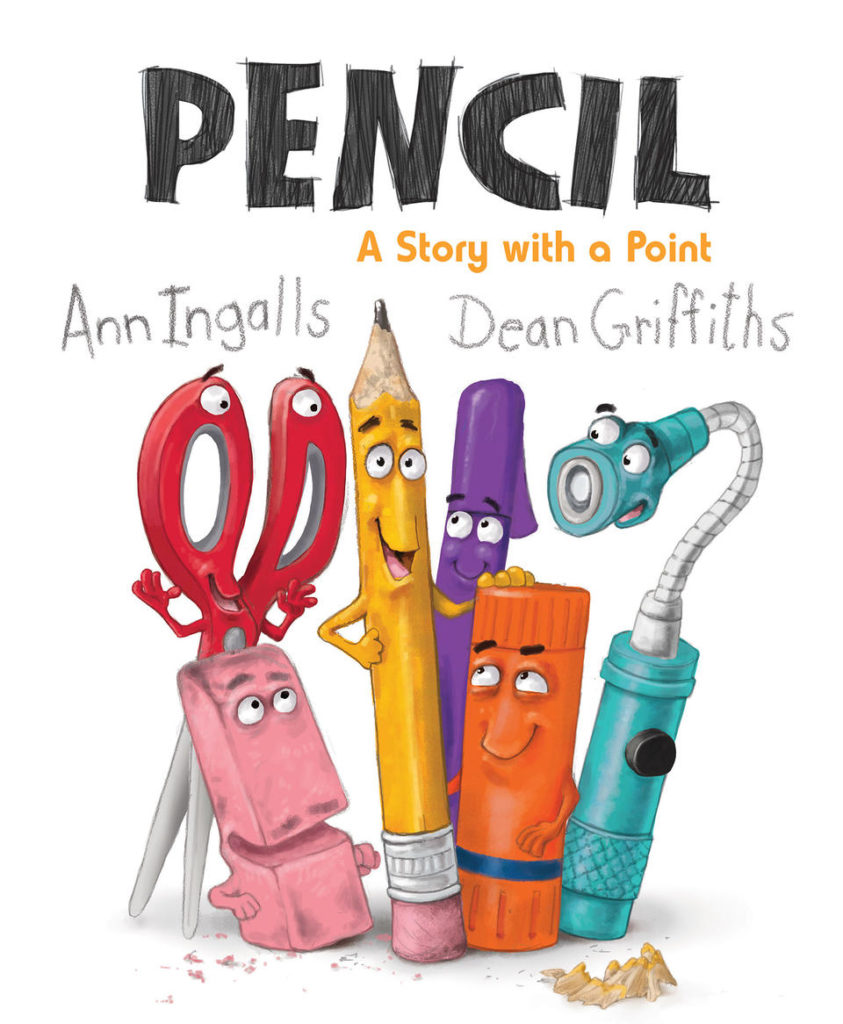
I will admit to being a bit wary of Pencil: A Story With a Point, by Ann Ingalls and Canadian illustrator Dean Griffiths. I am not convinced that the world necessarily needs more stories about anthropomorphized writing or colouring implements, plus I’d flipped through and saw it was also a story about the perils of too much screen time, and I’m wary of morals and screen fear-mongering. But the illustrations are very appealing (including very cool endpapers) so I sat down to read this with my daughter, and told her, “If we’re going to like this book, it’s going to have to be really good.”
And it was. Primarily, because (as might be discerned from the book’s subtitle) Pencil is playful with language and we never got tired of the puns–”You don’t measure up,” says the ruler in the junk drawer, alongside the spare battery who says, “He’ll get a real charge out of that/ ‘”Happy to hold things together,” said Paper Clip and Tape.’ It goes on, ‘”You’re a cut above the rest,’ said Scissors/ “Our friendship is permanent,” said Marker.’
And while this indeed a pencil versus tablet story for our screen saturated age, it’s also more interesting than just that, about a boy who loved his pencil until he abandoned it for tablet pursuits, and then Pencil was rescued from the junk drawer by the boy’s sister, and was there to see it happen: the tablet crashing to the floor and breaking, the boy distraught. Is there anything that Pencil can do?
The part where Pencil fails to make the boy feel better by showing him all the awesome things pencils can do (“He could be a tent pole for a really small tent.”) was very funny, and then, with the help of his junk drawer friends, Pencil arrives at an ingenious solution. Pencil and the boy are reunited. A happy ending to this warm and humorous book which demonstrates that a story with a point is not necessarily a bad thing. It’s all in the delivery, and this one is done right.
February 7, 2019
When Old Books Are New Again

In December, I posted a photo of the book I was reading, Busman’s Honeymoon, by Dorothy L. Sayers (which I purchased at Sleuth of Baker Street), and my friend Leah (a Sayers fan) commented in disbelief that there existed a copy of a Dorothy L Sayers book that was brand new. “I bet the pages don’t even fall out of that one,” Sara added to our conversation, and they really didn’t. And as the only other Sayers novels that I’ve read before have been cheap and battered paperbacks (one that was withdrawn from the North York Public Library), I understood their amazement at my pristine, brand new, spine un-cracked, and with an attractive cover. What does it even mean to read a Dorothy Sayers novel whose pages aren’t held together with an elastic band and which doesn’t smell like mildew? Surely the experience is a little inauthentic?
But it really wasn’t. Great binding and legible text would only add to the experience of a novel that’s pretty enjoyable in its own right. A fresh book will be approached with a spirit of freshness as well, which was only further demonstrated to me when I received a copy of Edith Wharton’s The Age of Innocence for Christmas later that month.

Of course, it wasn’t just any copy of Edith Wharton’s The Age of Innocence. I’d asked for the edition published by Toronto Gladstone Press (owned and operated by celebrated Canadian book designer Ingrid Paulson), a book I’d decided I had to have when I saw the image of the New York City map circa 1879 inside it. I am a sucker for maps in books, plus there were the opera glasses on the cover, and the beautiful, beautiful spine. Is it possible to fall in love with a book for its spine? Reader, I assure you that it is.
On her website, Paulson describes her mission with Gladstone Press as follows: “Old books aren’t always boring. They aren’t necessarily hard to read. They aren’t the ‘bran’ of literature (good for you, but not much flavour). They just end up looking that way. So I am trying to change that.”

I’ve never read The Age of Innocence before. Honestly, take an objective look at the covers of previous editions and ask yourself why I’d even want to. Because I felt like I probably should, mainly. (Winner of the Pulitzer Prize in 1921!) But I’ve got a personal aversion to languid ladies lounging in chairs, and the 1993 movie tie-in edition makes me uncomfortable—what IS that man doing to poor Michelle Pfeiffer’s neck? But those opera glasses: that’s the book I want to read.

And I loved The Age of Innocence, reading it with a pleasure over a single day during the holidays, nothing bran about it. It was an absorbing story of a once-upon-a-time New York that was also timeless, and daring, grappling with problems of women’s liberation that we’ve still not got our head around a century later. Which is to say that there is nothing stale about this novel, and it was a pleasure to discover it in this beautiful edition whose design provides the freshness that such a book deserves.
- Learn more about Gladstone Press, whose other titles are Wuthering Heights and The Hounds of the Baskervilles. And more books are coming this spring.
February 6, 2019
Winter Reads on the Radio
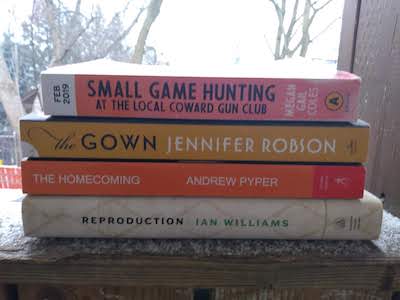
I was on the radio talking winter reads this morning as ice pellets were falling from the sky. Two of them are books I’ve loved, and the other two are books I’m looking forward to loving. Listen again to my selections here: I come on at 42.10.
February 5, 2019
Small Game Hunting at the Local Coward Gun Club, by Megan Gail Coles
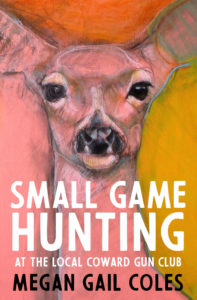
If you hang a pistol in your novel’s title, law dictates that it’s going to go off before the book is over, even if your gun is a metaphoric one. And if the title of Small Game Hunting at the Local Coward Gun Club is not indication enough that this book is not going to be completely painless, its author, Megan Gail Coles even includes a warning: “This might hurt a little. Be brave.” But yes, be brave. Venture forth into this book, where the weather is extreme and feet are freezing, and nobody is holding your hand. Where the atoms fall like snowflakes in a blizzard, instead of orderly, in a straight line, one thing after another, as you’d expect from a more linear text. There are moments when you’ll find yourself lost in the storm, zero-visibility. But just keep going. Be brave.
There are sentences in Coles’ first book, Eating Habits of the Chronically Lonesome, that I have never forgotten, more than four years after I read them first. “The reason Garry did these things was ’cause he couldn’t afford any better. Half of what he earned over at Pretty Paws was carted off to Newfoundland. Child support for an autistic kid he had with Slutty Marie down Gilbert Street, this the result of a one night stand./ Have you ever heard a sadder story, Dame? I mean, really? I barely poked her.” Not a comfort read, you know what I am saying? Unforgettable, dark, slyly humorous, meticulously crafted sentences. I have been looking forward to Megan Gail Coles’ debut novel for a long time, and while it hurt a little, it also did not disappoint.
Ostensibly, Small Game Hunting... is the story of a trendy restaurant in St. John’s over the course of a single day in February while outside a snowstorm is raging. The chef has been sleeping with the hostess who is serving his wife’s father (whose money funds the establishment) as he has lunch with the city’s mayor. The bartender is in love with the hostess. The server is hungover. And the woman who’s been waiting in the doorway, without her boots on and cold and wet and aching feet, has ties to the hostess, as they grew up together in rural Newfoundland, and to one of the restaurant’s customers, who not long ago caused her irreparable harm in an act of violence. And all of these characters have parents and sisters and ex-best friends who now hate them for justifiable reasons. “Sometimes John looks around the restaurant and wonders who is in the most trouble.”
It’s not an easy book. There is violence and there is trauma and there is an attention to language that requires the reader’s full investment, and while that investment pays off big time, the demand might also try some readers’ patience. Because Megan Gail Coles is asking a lot of her readers here, but she more than pays it back—not least of all letting plot be a huge incentive to keep on turning the pages. The tension is enormous in this web of emotions, ties and betrayals, and that proverbial gun is due to go off at any moment. The chef is fucking the hostess in the kitchen as his wife is coming down the street—you get the idea. The novel moving between each character’s point of view to add layer upon layer of meaning, and each character’s section has also its own voice, specific diction, preoccupations. It is a dizzying experience indeed to reside in so many minds at once.
But it’s also so rich, and we gain sympathy for even the most hapless characters, because nearly everyone in this book has done despicable things. And we see too the way that certain characters are imminently more forgivable than others, how they get away with everything, and by “certain characters,” I mean white men. “The defences of their choices would be vicious.”
In a recent profile, Coles described her novel as “a declaration of war on misogyny,” which is such a perfect articulation. Small Game Hunting at the Local Coward Gun Club is about the nonchalance with which men do harm to women, which is also a microcosm for an economic and political system that renders certain kinds of people disposable. Characters in the novel are robbed of opportunity, are played by institutions they trusted, are wracked by debt and addiction and systemic oppression. There’s a Gatsbyesque arc to the inevitability of their fates. And the men who cheat? Those reckless, careless characters? The bullet was never going to hit them. One way or another, they’re always going to be fine.






