November 4, 2026
“To love this world is not a simple thing.”
“It is like democracy is a bottle someone can threaten to smash and do a bit of damage with.” —Ali Smith, Autumn, 2017
Last night many remarkable things happened, but chief among them—from my perspective—is that I went to bed entirely relaxed and not even that engaged with the results of the election in a country that I don’t live in. Not because the election wasn’t consequential, but instead because I had a pretty good feeling (based on facts) that the results of the election were going to be fine, that democracy would do the thing it was supposed to do; I didn’t have to manage it. And I can’t remember the last time I felt like that about a US election, about any election really. To think that there might have been a time that I did, but then I would have been young then, and really didn’t know anything.
It’s been an incredible season for democracy lately—not just the US, but Brazil, and Serbia. My own city decidedly reelected our progressive mayor last week in a victory that defied pollsters’ predictions. Voters in Alberta stood up for Canada the week before that. I’m still thinking about Hungary, the tremendous odds of Magyar’s victory, how hard and persistently Hungarians fought to make it happen. And what is most heartening about all of this is that it’s not about winning, us versus them, but instead an understanding that these are electoral results that are ultimately going to serve everybody—even the people who might not be celebrating them yet.
At a different time in my life, I would have wondered if these victories were indicative of a broader shift, a realignment. And in some ways, they are—we have seen what authoritarianism looks like and we do not like it. But I have also grown wary of reading too much into such patterns, of supposing a few data points can tell us anything definitive about how the future might go. Which I say not to put a damper on the joy of all this, but instead to suggest that the recent election of a far right party in a German state (for example) also might not be indicative of something sweeping to come, and the reality is more likely that there will always be this and that to contend with, that the future is gong to go all of the ways, that the tension is inherent, and while it means we cannot be complacent, it also means there might be something that all of us could stand to learn from each other. That the world might be more complex and interesting than left versus right, or just that we might require a different kind of framework by which to properly understand who we really are.
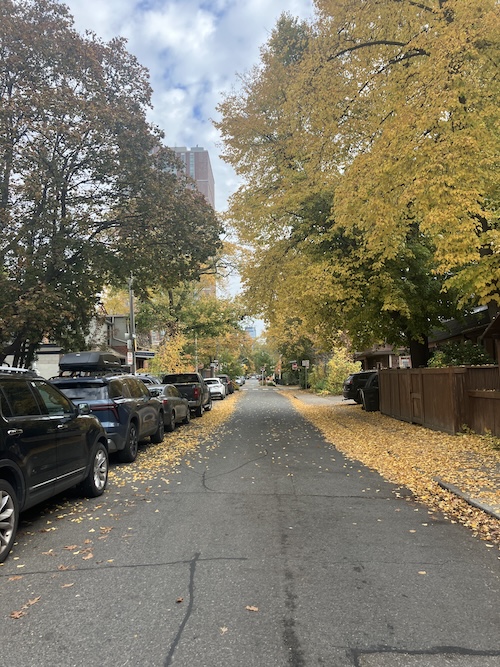
There are some days when it feels especially easy to love the world for what it is, which was what I was thinking about yesterday before I even knew how the election would turn out. The light was so incredibly golden, and it was shining through whatever autumn leaves had not yet fallen into a carpet across the street and sidewalks, and the sky was so blue, and the beauty of it all was just absolutely breathtaking. And I was thinking of how it’s easy to love the world, even when it breaks my heart, the fragility of life itself only underlining how precious and miraculous it is to be here at all, to be able to hold what we hold. And to hold it all so close, while we can, as the seasons and cycles swirl around us, nothing ever finished, nothing ever still.
“To love this world is not a simple thing. But no matter what you do, life happens. That’s the funny, forgivable thing about the earth, It is not only loss that is imminent: it’s creation.” —Alessandra Naccarato, Imminent Domains, 2023