October 23, 2026
Gaining Ground, by Joan Barfoot
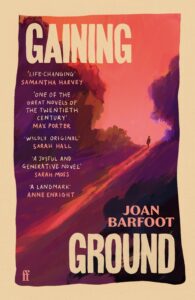
We’ll never know if I would have appreciated Joan Barfoot’s Gaining Ground quite as much had I picked it up in its original edition, a 1978 hardback, called Abra, published in Canada by McGraw-Hill-Ryerson Press. The novel won the Books in Canada First Novel Award, but it’s what happened to it decades later that has brought it onto my radar today, because sometimes the long afterlife of a book can bring surprises. For Barfoot—who went on to publish ten other books, was longlisted for the Man Booker Prize in 2002, shortlisted for the 2005 Scotiabank Giller Prize, and won the Marian Engel Award—that surprise was a message from an editor at Faber & Faber in the UK not so long ago that led to the book being reissued earlier this year with its UK title, garnering all kinds of rave reviews, and translation rights sold in 13 territories.
So that was that story that initially sold me on this novel, one that’s older than I am, now resurrected, but the new edition itself—with such an eerily gorgeous cover and painted illustrations of onions, radishes, eggplants, and other vegetables on the cover’s insides—was what clinched the appeal. Which was important, because I still wasn’t sure this wasn’t a novel I hadn’t already encountered in CanLit, along the lines of Surfacing, The Diviners, The Book of Eve, very much of its time. But with its fresh face, I was willing to give Gaining Ground a chance in its own right (definitely swayed by blurbs from Sarahs Moss and Hall, Margaret Drabble, Katherine May, and others).
And I’m so glad I did, because I found it enthralling, even though stories about people running away to the wilderness are never my favourite—social connection, for me, tends to be where story lives. But Abra’s voice in Gaining Ground is so rich and embodied in Barfoot’s first person narration that I never wished for her to have anybody to talk to (and even when she does, she is taciturn).
The story begins in the present, Abra disconnected from the world—from clocks and mirrors, and everything except the seasons and growing the food that sustains her in her rural cabin—when the world rolls up her driveway in the form of her 18 year old daughter Kate, last seen nine years before when Abra fled her tidy life in the city, leaving behind her husband and two children. At first, Abra doesn’t recognize the girl; Abra literally can’t even remember her own name after so many seasons of solitude. She is gruff, and antisocial, but vaguely aware that her daughter wants something from her that she’s not prepared to give.
What kind of woman abandons her family without a second thought? Barfoot’s novel is the answer to that, taking her reader back into the story of her former life, not even entertaining a justification of her actions, because Abra knows, like a kind of spell to which her curious name is the beginning. Whereas everything else about her except her name was always unremarkable before, especially the way she sleepwalks young into marriage, and a life of domestic convention. Eventually, she and her husband are well off. The husband is kind. Which means it’s impossible to explain how the key to her dissatisfaction is absolutely everything, and Abra doesn’t view her drastic escape plan as a kind of breakdown, even, regarding what happens to her instead as a story of finally becoming, of assembling a self and a life.
There is nothing romantic about Abra’s journey back to the land, nothing of Morag Gunn’s idyll by the river. Instead, her life is basic, rugged, and hard. Ever spring, she’s stricken with a fever. She lives on stored blanched vegetables from her freezer. Her work in the garden is backbreaking, and her body becomes hard and strong, and everything she does is imbued with a kind of essential purpose. None of it makes sense from the outside, she knows that others find her appearance disturbing, but the perceptions of others don’t concern her anymore, not in the slightest.
There is indeed something bewitching about Abra’s stream of consciousness, about the plainness of her telling, and what’s most interesting is its outright refusal of questions of right or wrong, what is natural and what is deviant, about good mothers or bad ones. This is a story that rises above such considerations and which, like its protagonist, is so solidly, marvellously, about itself.