May 6, 2026
Welcome to Sunny Town, by Théodora Armstrong
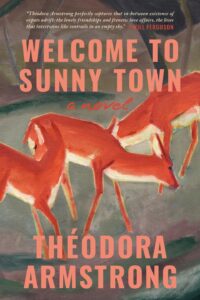
Welcome to Sunny Town, by Théodora Armstrong, is the story of Maggie, a young artist stuck in her relationship and creative process who decides to broaden her horizons by moving to Japan to teach ESL in 2001. She joins an artist friend in Okayama and becomes part of the ESL expat community there, but eventually finds that the connections she’s making are somehow making her feel more lost than ever. After the Twin Towers fall in New York City that September, the world feels even more strange, Maggie’s Japanese life an unreality, and she must take stock of her present and her past in order to begin contemplating such a thing as the future.
I loved this book, partly for reasons that are personal. I too “taught” English in Japan not longer after the turn of the century and so the culture and dynamics Armstrong writes about were familiar to me and brought back so many memories—the obnoxious cultural superiority manifesting from all sides in conversation classes, Japanese housewives who befriend young gaijin as a hobby (I got “picked up” in the grocery store a few times), weirdo expats who’ve been in Japan for way too long, and (even worse) the ones who manage to escape and then find their way back again.
Armstrong also so perfectly captures the longing and pain of being in one’s 20s anywhere, realizing how little foundation any of us really have beneath our feet, recognizing our parents as flawed and human, putting too much effort into relationships unworthy of our energy, pushing everything (especially our limits) just a little too far simply to find out what happens if we do.
Welcome to Sunny Town is a Künstlerroman, a beautiful and tender portrait of womanhood and becoming. And while Maggie is a messy character, the narrative does not get bogged down in her boredom and ennui, as I’ve encountered (and been put off by) in other “messy girl lit,” too cool for school. Nope, Maggie dares to feel, to hope, to want, to create.
And to connect, most important of all, both with the world around her, and to the reader who’s lucky enough to pick this novel up.