September 29, 2025
Starry Starry Night, by Shani Mootoo
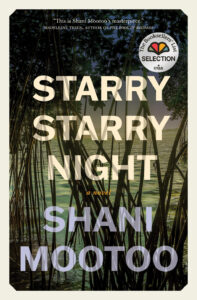
There is nothing precious or cloying about the child’s perspective at the centre of Shani Mootoo’s latest novel, Starry Starry Night, the story of a young girl emerging into consciousness in 1960s’ Trinidad. No, instead Anju’s point of view is considered as seriously as Anju herself considers the world around her, the narrative following her attempts to understand it between the ages of four and 12, which are pivotal years in her own life, but also for her country as it breaks away from the United Kingdom, becoming independent in 1962.
When we first meet Anju, she’s comfortable and indulged in the care of her Ma and Pa, her world carefully ordered, though she’s not always safe—there are male neighbours and relatives who are dangerous, though she can’t exactly articulate why. Early on, there are gaps between Anju’s grasp of her reality and what’s really going on, things that Anju can’t see or that she doesn’t want to see, for example that woman called “Mummy” whom she speaks to on the phone, who later appears with someone who is apparently Anju’s father, both of them just back from Ireland, with a little brother and sister in tow.
Starry Starry Night is a stunning example of what “show don’t tell” can do, the narrative so steeped in Anju’s perspective that the reader feels her experiences viscerally, in particular the first great trauma of her life when she’s taken from the grandmother who raised her and forced to resume her life in a household to which she never feels she belongs, and that feeling of being a misfit only intensifies as Anju grows older and finds herself resisting the gender norms inflicted on her. We also feel her confusion as she struggles to make sense of things that don’t actually make sense, such as Trindad’s racial hierarchy, the tensions in her parents’ marriage, and her mother’s feelings for her, which move between hot and cold.
I’ve never understood the point of autofiction (which I’ve always suspected is merely a device for blame-dodging) as much as I understand it with this book, which includes photographs from Mootoo’s own childhood, as well as items from her biography. One of the novel’s epigraphs is taken from Annie Ernaux’s A Girl’s Story: “…The girl in the picture is not me, but neither is she a fictional creation. There is no one else in the world I know in such vast and inexhaustible detail.” Here, such vast and inexhaustible detail serve to bring a long-gone world back to life.
PS If you liked this book, you should check out another story of 1960s’ Caribbean childhood, The Pages of the Sea, by Anne Hawk, who I interviewed for BOOKSPO last fall.






