March 19, 2026
The Republic of Love
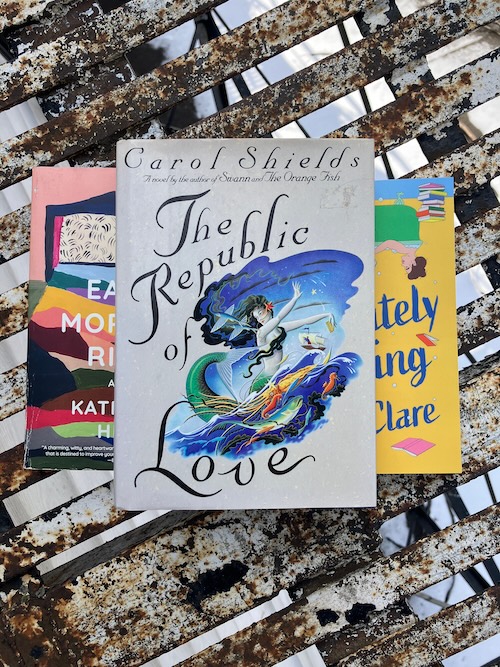
“Work is important. Living arrangements are important. Wars and good sex and race relations and the environment are important, and so are health and illness. Even minor shifts of faith or political intention are given a weight that is not accorded to love. We turn our heads and pretend it’s not there, the thunderous passions that enter that enter a life and alter its course. Love belongs in an amateur operetta, on the inside of a jokey greeting card, or in the annals of an old-fashioned poetry society. Moon and June and spoon and soon. September and remember. Lord Byron, Edna St. Vincent Millay. It’s womanish, it’s embarrassing, something to jeer at, something for jerks. Just a love story, people say about a book they happen to be reading, or caught reading. They smirk or roll their eyes at the mention of love.” —Carol Shields, The Republic of Love
The question of what to read while launching a book, for me, is a vital one with the highest stakes, and the answer is never straightforward. I don’t want anything too challenging, or too flawed, or too difficult to consider while my mood is all over the place. The book can’t be unputdownable, because I’ll be busy and distracted, putting it down over and over again—more important that it be pick-up-able again. There needs to be some comfort inherent. The tone has to be pitch-perfect, hitting just right, or I’ll be unable to tolerate it. I remember reading Lianne Moriarty’s Big Little Lies when my first novel came out, and it was the perfect companion, especially since it was a mass market paperback (I bought it at the drug store) and it fit so easily into my purse.
The last two books I read before I finally picked up this one were abandoned within their first hundred pages. Possibly the problem was me, and I just wasn’t in the proper head space to appreciate them, but it was a problem regardless, and I required a sure thing. And so I picked up Carol Shields’ novel The Republic of Love, a novel I’ve read several times, but an edition that I’ve never read before, a first edition hardcover I bought at Bay Used Books in Sudbury when I was in town years ago for the Wordstock Literary Festival, the very same edition that my main character Clemence picks up on her first visit to Crampton’s Used Bookshop in one of the early chapters of Definitely Thriving.
When I was a teenager, Carol Shields blew my mind wide open to what a novel could hold and what a novel could do with her celebrated The Stone Diaries. And in some ways I regret the way that book’s massive acclaim would overshadow her earlier work, which to be always seemed like an afterthought. Because rereading her novels over the last year and a bit has underlined just how intricate and fascinating her fiction had always been, and that all her books were part of a wider project of trying to get to the bottom of the unfathomableness of other people and the (im)possibilty of ever really understanding one another.
Shields was so curious and open-hearted about the world that her fiction today reads as fresh and clever as the day her books were published. It certainly helps that most of us are as baffled by the mysteries of other people as we ever were—so the questions she was grappling with are as urgent as they ever were. It was interesting to be reading this novel about love and the nature of romance (and about how unseriously love and romance are taken in our society) as I’ve been releasing my own book that is categorized as romance (a most fraught endeavour! People are so rude about romance, as the passage I’ve quoted above makes clear, but also people who love romance have very specific ideas about what romance is and isn’t). I adore that Carol Shields knew that a novel about romance was important, in case anyone needed reminding.
I was amazed to be reading The Republic of Love, and realizing just how much it reminder me of Katherine Heiny’s 2022 novel Early Morning Riser, both books about modern love, about love in a small city, about what it means when there’s a high chance of you running into your spouse’s ex’s husband when you’re out purchasing groceries. Both books are about the infinite ways that we’re bound to each other, and the unbearable beauty of so much humanity, how sometimes it’s too much, impossible to hold. Both books rendered with incredible specificity—how both portray the minutiae of work and home decor, family ties, friendship, celebration, tragedy, mundanity, and all the rest.
The Republic of Love is such a good book, such a strange and wonderful book. It’s about the romance between a couple who don’t even meet until halfway through the narrative. It’s about these two people but also about an entire city, gorgeously and hilariously polyphonic. It’s about a man who begins his life with twenty-seven mothers, domesticity on steroids. Oh, it’s over the top, in the very best way (and also a love letter to Winnipeg!).
“Love, love, love, how can we possibly speak of love in the last decade of the twentieth century, a century that is, in any case, in tatters?”






