October 7, 2025
Run Like a Girl, by Catherine McKenna
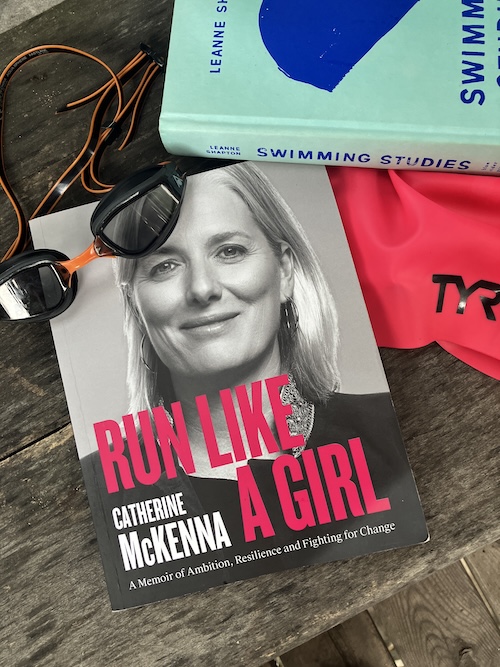
RUN LIKE A GIRL, the memoir by former MP and Environment Minister Catherine McKenna, was an impulse buy. I picked it up at the bookstore because I was curious about who’d published it (it was Sutherland House Publishing) and discovered that it was more of a scrapbook than a typical memoir, like those SOUVENIR OF CANADA books that Douglas Coupland published about 20 years ago, replete with snapshots, clippings, photos of objects (the shoes she wore canvassing, her collection of swim caps, an array of campaign buttons, the cover of U2’s WAR, the first album McKenna ever bought), Nike ads she cut out of magazines and taped on her bedroom wall during the ’90s (which is both cringe AND very relatable), along with short passages of text. I was drawn by the book’s format and also interested in McKenna’s story as a female politician who’d received outsized hate and abuse during her tenure (there are people thought they were being clever by calling her “Climate Barbie”), so I took the book home…where I read her acknowledgements and discovered that the book’s unique format was dreamed up in the company of McKenna’s “swim friend,” Leanne Shapton, whose own books which are collections of objects and images are some of my favourites, her memoir SWIMMING STUDIES in particular. So of course I wanted to read RUN LIKE A GIRL. (If McKenna had called her book SWIM LIKE A GIRL, I would have purchased with more alacrity, but possibly I am a niche audience for that.)
“Run like a girl” was a phrase that McKenna adopted during her campaign for office before the 2015 federal election (after a gruelling nomination process during which others were waiting for a more traditional [male] candidate to drop into her Ottawa Centre riding), which basically meant staying true to herself and her values, and honouring her own particular style in getting things done, a style honed from the outset during her upbringing in gritty Hamilton, ON, and her experience as a competitive swimmer. The swimming remains a through-line for McKenna, even after she becomes a parent, and then an MP—as Environment Minister, she had responsibility for Canada’s national parks, and there are photos and anecdotes from her swimming in pristine places all over the country; she also writes about being part of the parliamentary swim team and having to dive under water to get away from Elizabeth May’s very persistent lobbying.
McKenna’s is an inspiring story of determination and finding her own way—at law school, as a lawyer, as a mother, as a politician. She writes candidly about her frustrations as a part of Justin Trudeau’s government where promises of sunny ways dissolved into a dearth of support and real leadership from above for MPs, where she feels as though she was too optimistic as Environment Minister in envisioning the oil and gas industry collaborating with policy makers to enact meaningful change to meet Canada’s emissions targets. She writes about her decision to leave politics at a moment that was right for her, and also about her current role where she continues to work for climate action through the company she founded, Climate and Nature Solutions.
Inspiring, engaging, hopeful and human, RUN LIKE A GIRL was a fun, colourful, and most compelling read. To anyone who finds traditional political memoir a little dry or who wants to be reminded of the what’s possible for the future of climate, politics, and more, this book will be a winner.






