September 15, 2025
Ripeness, by Sarah Moss
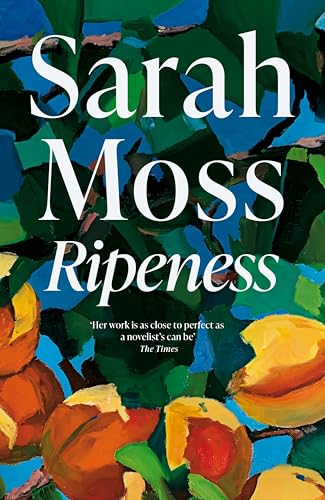
This is not a review. I’m still piecing together my experience of reading RIPENESS, the latest novel by Sarah Moss (out now in Canada), whose work I fell in love with through her three short novels, GHOST WALL, SUMMERWATER, and THE FELL. Her most release is the memoir MY GOOD BRIGHT WOLF, about her childhood and more recent experiences with anorexia. And now RIPENESS, a novel-sized novel, but which rips apart convention regarding structure. The very first sentence is, “Yes, Edith says.” Quotation marks done away with, long long paragraphs, dialogue within those paragraphs, the novel comprising two sections whose relationship is hard to discern, except that they are both about Edith, one (in third person) set in the present where Edith is around 70, divorced, living a comfortable life in Ireland, and the other (first person) about Edith’s experience in the 1960s on the cusp of adulthood travelling to a villa in Italy to spend time with her older sister, a ballerina, who is waiting out the final weeks of an unwanted pregnancy.
How do these two sections knit together? The answers to that question are not straightforward, but they’re interesting, even if I’m not sure what they are yet. How does the story of her sister’s child connect to Edith’s friend’s discovery in the present that her mother had once given up a child long ago, a son who was raised in America and who is returning to Ireland, a place to which he feels he belongs? A place to which Edith, who is Edith, will never belong. Edith an exile who is the child of an exile, her mother a Jew who was the sole member of her family to survive the Holocaust when she was sent to the British midlands just in time. How does all this connect to the Ukrainian refugees who’ve made their homes in Ireland, and the less familiar-seeming refugees from other places whom Edith’s neighbours resent and wave placards against?
There is all this and so much more, so much ripeness—the fruits on the trees in Italy, the very pregnant Lydia, Edith at the beginning of her experience just before she goes to study at Oxford. There is no sex for young Edith, but plenty for Edith in the present day (she utters the first line in the midst of it). A study of maternal ambivalence, of bodies, of citizenship, of youth, and age, and fathoming unfathomable things. RIPENESS is a novel about saying YES, and also saying no, sometimes. About life, and consequences, and I need to read it again in order to fully understand it, but the point is that I want to.






