January 15, 2024
Gleanings

Special edition of “Gleanings” with pieces from The New Quarterly’s stunning “Dispatches: Writing In/During Crisis.” I’m so grateful to TNQ and all the writers who contributed.
- You don’t need to know the answers. Writing is driven by questions. Readers want to see you stumble toward truth. I give them permission to be uncertain, to search, to fail. Be patient toward all that is unsolved in your heart, I tell them, quoting Rilke. Live the questions now.
- End this war. As the great soul Vivian Silver, murdered so brutally by Hamas, told her beloved Palestinian and Israeli friends: There is no road to peace. Peace is the road.
- With the intensity of the ruination it has created and continues to create in Gaza, Israel seems to have ambitions to destroy our ability to imagine at all. As a writer, I felt particularly attuned to it.
- This language—the power it carries—cleaves me. I think to myself, naively, that if the world understood the beauty of this moment without the blunting, the thinning translation into English for it to be understood, this earth-shattering moment in Arabic, they might care about this girl, and this man who saves her from the death she thinks she’s experiencing. I think about how journalistic language describing Palestinian men and girls like them is rarely this beautiful, this tender, this poetic. Western audiences never see this beauty because not only do we reduce and censor the language we use about Palestinians, we can barely even speak about them at all.
- Was it possible to be blameless and innocent? What would it mean to create a house with “no more padding between the word and the world”?
- I believe that it is my particular obligation as a Jewish writer and one who has written about persecution and genocide to speak out about this. I know that many in my (Jewish and other) community will be angry and upset with me. That they will be horrified that I don’t centre the hostages and the loss experienced on October 7th. It’s not that I don’t understand the pain or want those humans returned to safety. Or that I support Hamas or don’t wish for a different political leadership and solution in Gaza. It’s that I believe the horrifying events happening there meet the definition of genocide. We’re in the middle of a genocide. Never again.
- To choose to embrace suffering, whether in experiencing or witnessing it, though our fears may tell us we’re unequipped to handle that. To choose not to stay trapped within the suffocating boundaries of comfort, though our fears may tell us they’re the only thing keeping us safe. Perhaps most of all, to embrace our inherent wildness, the endless contradictions and complexities of ourselves and others, though our fears may tell us that will leave us unmoored without the ballast of simpler, easier moralities./ Only then, perhaps, can we say we’re truly alive. The words come unbidden after that.
January 15, 2024
One-On-One
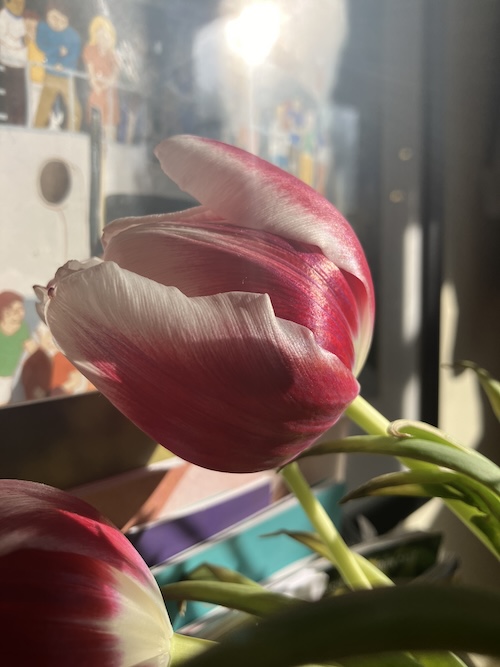
Yesterday I sat on my couch beside a friend who scrolled and scrolled through the vacation photos on her phone, two weeks in Japan, and it occurred to me that I can’t remember the last time I partook in such an activity, and also how much it fulfilled me. How different it felt to see her trip and hear her stories, rather than just aimlessly scrolling through them on my own social media feeds, how such a thing stands for everything I’m yearning for right now, one-on-one contact, live and in person. I have found existing so much on a virtual realm overwhelming and confusing as I try to make sense of my connections to others, what’s required of me, and what I should expect in return. I am having the unsurprising revelation that maybe human beings are not meant to have 3700 friends—who knew? So going back to basics, and grateful for the ability to share meals together, visit in our homes, have conversations over tea and coffee, all those things that until 2020, it never would have occurred to me to take for granted. And how completely they can fill my soul.
January 11, 2024
Penelope Mortimer: About Time (Too)
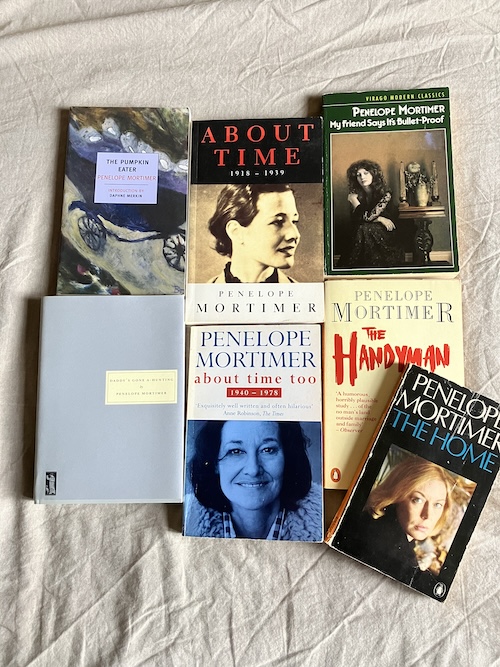
“Of all the Penelopes, Mortimer is my favourite,” I wrote in 2018, though I don’t think I’ve read her since then, and need to refresh my memory, especially now that I’ve just read her two memoirs, ABOUT TIME and ABOUT TIME, TOO. Penelope Mortimer is a standout in my library for being the only author whose books I own in editions from Virago Modern Classics, Persephone AND NYRB (plus two regular old orange-spined Penguins, even though THE HANDYMAN has fallen to pieces). I first learned about her from Carol Shields’ and Blanche Howard’s collected letters, in which they raved about THE HOME, which I loved so much. I actually have no recollection of reading DADDY’S GONE A_HUNTING, a 1958 novel about a mother procuring an abortion for her daughter. I took THE PUMPKIN-EATER, perhaps her best-known book, on a beach side holiday about ten years ago and found it wholly unsatisfying for the occasion, but I think I will appreciate it better now having read its author’s memoirs, for this novel—like all of her novels—was borne of her experience, and that context might just be essential.
In ABOUT TIME, TOO, she writes about looking back on her childhood as a kind of Eden, though it doesn’t read like that me in her first memoir, instead a middle-class English experience of sexual abuse and emotional deprivation, but she recounts it all so jollily that one might just be convinced. The second paragraph of ABOUT TIME begins, “Fortunately I know nothing about my ancestors, and see no particular reason to find out,” and I actually LOVE that, but it’s also emblematic of Mortimer’s refusal to engage with the heart of things, even if such refusal is why the memoir is a pleasure to encounter. The pain in ABOUT TIME, TOO is much more visceral, immediate (a lot of the book is taken from Mortimer’s journals), mostly surrounding the breakdown of her marriage to playwright John Mortimer, her second husband. In between the two husbands, she had two children with two more different fathers, having six children in total, and between the lines one might read some regret about how her children might have suffered by their parents’ unconventional choices, but not too much, and I admire the way Mortimer never apologizes for her sexual appetites, or for her creative impulses, her need to be writing and creating. “The only way to love it all is to cling to it too fiercely. I don’t want to let anything else, anyone else, in. My comfort is the idea of writing this novel. My aim is to keep alive.”
January 9, 2024
Gleanings
- A good dinner knocks the rough edges off a day, and Melissa’s chicken was better than good, especially with the Vouvray Paul chose for the occasion. Who knew what sherry and sesame oil could do for a No Frills date? Paul poured the last of the wine. “You always were a cheap date,” he said. “A coffee and a Danish at the Alps Riviera.”
- But I only recommend starting a newsletter if you are interested in the newsletter as a project in and of itself. If you are going in expecting your newsletter to translate into major book sales (and you’re not already a household name), it will likely be disappointing.
- I know those things that get me in the flow (painting, reading, writing, walking). But what I want to do is go deeper into it, that flow. And once I’m there, to take it slow. I’m not one for making resolutions, but I do try to set some intentions and make plans, although I don’t hold myself steadfastly to them.
- Law is not the only way to be reborn
- Finally, the thing that really captured me was that The Shamshine Blind tells a story about the ways that grief and hopelessness intersect. As I continue to ache from my own losses in 2023, as I keep watching the news and feeling despair about life and the world, reading Agent Curtida’s emotional processing struck something tender in me.
- I have been writing since I was seven years old. I had a teacher who made empty book templates and she told the class to write a story. I wrote a book called The King which was about a lion who was the king of the jungle and a tiger who tried to take over the kingdom. Coincidentally, I wrote this book before the Disney movie The Lion King came out. My teacher told me that I had a great imagination and I should keep writing, and that’s exactly what I did.
- The company of readers – the people we love and the people with whom we share this love – is a rare, rich and utterly special fellowship.
- In each the role of religion, the way in which images of the enemy are embedded in the holy narratives of each people, cannot be ignored.
- I’ve told my kids for a long time that I think staying soft in a hard world is by far the strongest thing I’ve ever done.
January 8, 2024
One Hand in My Pocket
I’ve been thinking a lot about Shawna Lemay’s New Year’s post, “Learning to Be Of Two Minds,” mostly because my own personal 2024 quest (which is to be more human) involves precisely that, I think—even if I also struggle with this sense that I possibly might not know my own mind, the voice in my head consistently taking down any coherent narrative I’m offering it, which is exhausting, flip-floppy, though maybe the problem is that I’ve not learned to be of two minds, but rather my two minds are forever in conflict, which is something I need to resolve, to learn to let those two minds be.
Shawna’s post (which quotes Alanis Morissette and Marilynne Robinson) spoke to me in two (of course!) central ways, both creatively stimulating. First, it made me realize that the title of the novel which I’m working to have a new completed draft of by the end of the month needs to be titled ONE HAND IN MY POCKET. Why? Because it’s about a character whose life is a work in progress, a woman for whom it all comes down to that she “hasn’t got it all figured out just yet.”
And second, because of how the idea of having one hand in my pocket (as well as not having it all figured out just yet) really speaks to me in terms of where I’m at personally, and creatively. I feel like I’ve spend the last 10+ years showing all my cards, sharing my process, all the time, and that kind of openness has become unsatisfying.
In a piece in The Toronto Star this week (promoting her new book Let It Go), author Chelene Knight writes: “When I share something painful or heavy, I ask myself what I need in return and ensure I share my pain in spaces where I can receive what I need. I’m grateful for my intentional community. This is why social media is more of a highlight reel for me — the online world doesn’t get to have both my joy and my pain; they receive only the pieces I’m willing to give away because it’s unlikely I’ll get back what I need. But sadly, we don’t always consider social media as an intentional exchange.”
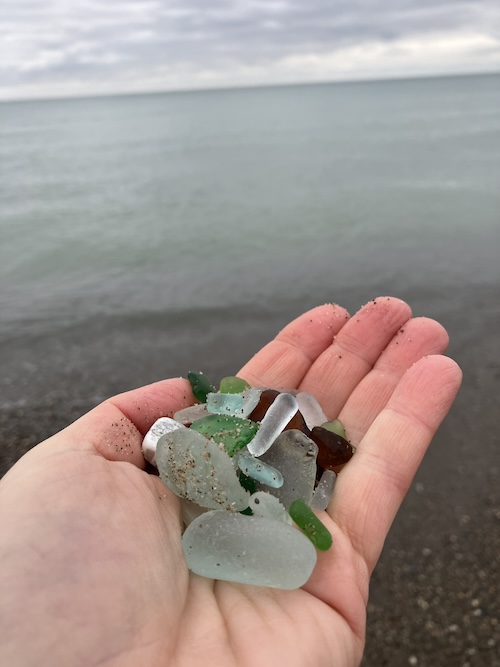
In 2024, I want to be more thoughtful about such transactions, and keep more things—more the joy and the pain—just for me, and the people in my life. Which is to say, I want to keep one hand in my pocket (and the other one is giving a high five. Or gathering sea glass. Probably not flicking a cigarette).
January 5, 2024
Creative Goals for 2024
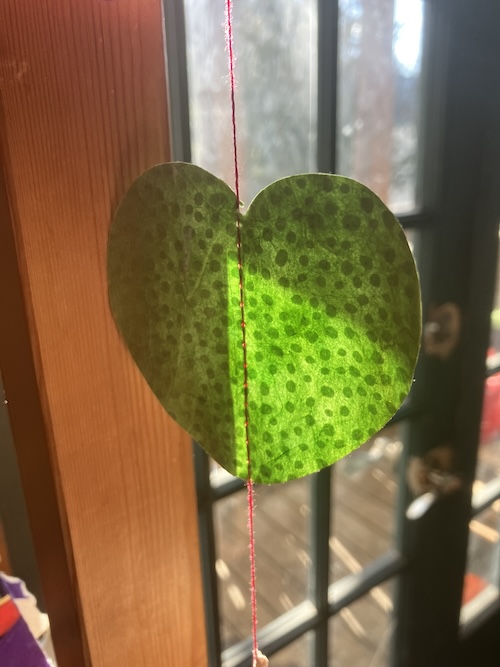
We woke up to 2024 with a thin layer of snow on the ground, surprise, surprise, particularly in this winter that isn’t—not that I’m complaining about that. But the snow delighted me, a fresh coat, a blank canvas, the perfect note on which to begin again. And for (at least?) the fifth year in a row, we returned to the lake to greet the year, to the edge of the land, where the waves come in again and again, where the beach is forever changing, never the same place twice.
A fresh coat, a blank canvas—these things invigorate me. I’ve spent the last three weeks laying low, staying quiet, coming back to myself after an autumn that left me quite exhausted and feeling creatively paralyzed, most uninspired. The space and quiet making me feel ready to create again, to get excited and make things. To switch up my routines as well and try some new things, to recalibrate. And to decide that the following are where my creative focus will be directed.
- Finish my novel! This is my Emily Henry-meets-Katherine Heiny-with Barbara Pym as a maiden aunt-book, which I’ve been writing since 2021, and which just might be the freshest, funniest, smartest thing I’ve ever written. It currently needs its final third radically altered, and my goal is to have the draft ready to go by the end of January.
- Focus on long-form writing (ie sign up for my Substack!): I spent all fall yearning to write an essay about why a museum takes up so much real estate in my novel, but lacked the time/focus to get it done, until I was called on to write an author talk for an event in November, and finally getting that piece on paper just felt so good. I want more of that! And I want less of the fragmentation of thinking that results from so much time spent on Instagram. AND SO…I am trading that time for a commitment to writing one fun, rich and engaging essay every month throughout 2024, and after the first three months, those essays are going to be for paid subscribers only on my Substack. (If you already subscribe to my newsletter, which is a digest of blog posts and book reviews, you’re automatically signed up for the Substack—watch your inbox for my first essay [on Danielle Steel’s Jewels, naturally!] at the end of the month!)
- Create a podcast! Coming in March. WATCH THIS SPACE!! I am excited to learn more about audio recording and editing and to have some fun conversations about books and reading.
- Begin a new book: There is a story in my head, or rather a sweeping family tree, and I think that all this might be a book I want to write (a book that inspired me to pick up Danielle Steel’s Jewels again, actually!). I want to write a saga! A saga necessitating the fact of historical fiction. Am I up to it? Can I pull it off? The only way to find out is to try….
January 4, 2024
Apples on the Windowsill, by Shawna Lemay
If you’ve been following, you’ll know that I’ve been rethinking a lot of my social media habits with the advent of the new year, habits that I think were defined by the pandemic when Instagram was of one of the few means of connection in a time of stark isolation, and also gave me a real sense of what everyone was going through (which is to say, a lot). And one of the great joys of my online life in more recent years has been the vicarious excitement of seeing people returning to the world, doing those things that they were baking bread instead of doing in 2020, all of the adventures and connections the loss of which they’d been profoundly grieving. I knew what it meant when Shawna Lemay finally returned to Rome, is what I’m trying to tell you—I’d become that invested in the story she was telling. And now I’m thinking of all of our pandemic Instagrams as still lifes, these windows into each other’s worlds which seemed especially essentially when the life had gone completely still.
Shawna Lemay’s new essay collection is the first book I’ve read in 2024, and while it’s called Apples on the Windowsill, it’s as much about lemons, not only about how the light falls on their unwinding rinds, but also what we do when life gives them to us. Which is to say, put them in a bowl and take their picture, and notice them, how they absorb the light, and how they change, the same way that Lemay documented a series of still life images throughout 2020-22, images that included such various items as pop tarts, Kraft dinner, a crystal bowl filled with strawberries, and various arrangements of grocery store flowers that Lemay’s husband, a painter, would use in his own work. As will come to no surprise to anyone who has been following Lemay’s blog for the past few years, Bruce Springsteen is referenced again and again throughout this collection, and this quotation from an interview comes close to summing up Lemay’s focus in her book: “What do you do when your dreams come true? What do you do if they don’t?”
Apples on a Windowsill is a meditation on being human, and on staying human (soft and porous) in a world that makes this difficult. These are essays about marriage, and being an artist, and being the wife of an artist, working at a library, and about finding inspiration in the ordinary. As I begin a new year, I also find these essays are a helpful guide for how to be, and how to see, and I underlined all kinds of passages: “The magic trick of art, and perhaps particularly still life, is to remind us above all that there is beauty at the same time as evil. Evil is a given, but beauty persists. The magic trick of still life is that it reminds us that we’re not alone. The magic trick of still life is that it’s really not a trick at all.”
January 3, 2024
New Year’s Gleanings!
- May we delete social media from our phones and become part of real communities that are sometimes underwhelming, because they are not full of the dopamine hits of Silicon Valley’s design, but also surprisingly beautiful. May we keep showing up, week after week, rain or shine, sparkly or dull. That’s it, just keep showing up.
- But it is OK — and good for us all — to acknowledge and celebrate the many moments of banal public cohesion that don’t make it to social media in which Torontonians display their differences, and the sky doesn’t fall.
- I think I feel that way about making a simple moral response to Gaza right now. It would be at worst, near-fetched.
- I feel like for myself, I have to get back to my absolute basics, and to rebuild my compassion and empathy all over again, not to mention so many of the other good things that have been slowly dismantled from just living the last few years.
- Part of travel is also to discover who you are when you’re not in your familiar territory. Who are you out there “in the wild”?
- I decanted onto a plate from the cupboard. It was my parents’ wedding china and for 60 years, turkey was all it held, coming out as it did just on special occasions. Now they’re my everyday plates.
- Emily’s unshakeable conviction that she is a writer is the main highlight for me, every time I reread this novel. She will write even if she doesn’t have paper, even if she is forbidden to write because her aunt believes novels are wicked, even if teachers or classmates or relatives—or friends and mentors—mock her.
- What I was missing more than anything, what I needed, was my creative spark. I didn’t consciously know this till the spark reappeared.
- Warning: I am going to type some things that will read as being critical of this yoga class, and many readers will think Where The Fuck Does She Get Off. I get off (not literally) (sometimes literally) to my own words in my own head, obviously. I have had a diary-blog for 24 years. I am leaving a review on the Yelp of my mind.
- So this year: no snow, a waxing gibbous moon, seen last night with Jupiter, apparently their final encounter of the year, and one pan of buttercrunch remaining to be made and glazed with dark Belgian chocolate. With any luck, the tin in the box waiting in Ottawa will be fresh enough to eat when it’s delivered on January 5th. I don’t miss the snow. I miss the children, who’ve grown up, and I miss my parents, who are long gone to spirit, and I miss the friends who’ve either died or ghosted themselves into other lives. But when I walk up the stairs on Christmas Eve, when I look out the window into a darkness unpunctuated by any light but our own, the memory of them will be the company I imagine as I wait for the morning.
- I cherish each of those sweet memories because I’ve learned that the Halcyon Days are fleeting and must be savoured.
- I do still really enjoy settling in to write about a book that really got me thinking (or feeling!), and blogging in general is still the writing I find most intellectually liberating and stimulating, so we’ll see what happens in 2024. People seem to be predicting a blogging renaissance, as social media communities are fragmenting and “the discourse” (which, when it’s genuinely bookish, is to be cherished) is suffering. I’m here for it if you are!
- I’m going to be fifty in June. Not really a big thing, in reality, and i’m happy to be alive and aging. But my mom is 78 and just recovering from a surgery and not feeling well and the combination is bringing mortality and life choices to a much larger screen near you.
- But then we held hands and listened to Fireside Al Maitland reading Frederick Forsyth’s The Shepherd, and for just a moment my eyes were dry and my heart was full.
- I also felt the impact of that sentence. I have wasted so many years being ashamed of my body, avoiding activities and social events because of my body, dieting, and talking about being overweight.
- I miss walking into the field and seeing your horse raise his head from the grass to look at you. I miss being recognized and the nicker. I miss that warmth in my chest.
- Somehow, in the moment when I start to slip, I must simply… let go. To understand, that contrary to my control-freak nature, the thing to do here is—nothing?!?
- And I thought to myself, of all of the houses, of all the streets, we landed here, next to you.
- “You there, so restless, where are you trying to get to? This is winter,” she said with a sparkle as the sun reflected off her back./ All is well.”
January 2, 2024
Returning to Myself
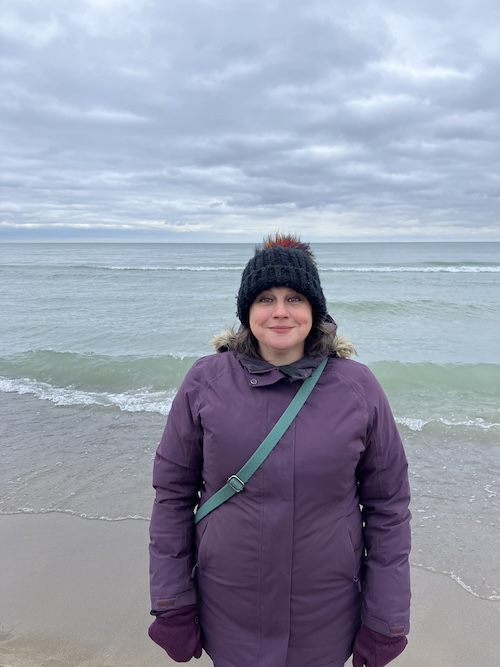
Something I’m grateful for is the way that selfies and Instagram have taught me to make friends with my face, with my appearance, which is no small thing when you’re a woman in your mid-40s (and I kind of wished I’d been able to do as much when I was youthful and 600% gorgeous but had no idea of the latter). For a very long time, I’d see pictures of my self and feel bad about not looking the way I thought I looked in my head. But once selfies became a thing, the face in the photo became familiar, somebody I recognized, even if she looked a little bit odd or the light was unflattering, but who doesn’t look odd, sometimes? How tedious to be the woman who freaks out about appearing in photos with the same face she walks around in the world with all the time.
There was also so much that was gratifying about Instagram’s algorithm’s favouring of faces, and bodies. The whole matter feeling particularly subversive since my face and body defy conventional beauty standards in some ways, and so I’d get to celebrate myself, to feel empowered and good inside my own skin, as though I was the one making the rules instead of catering to somebody else’s standard, and I was, I think, for a while.
Or maybe I never was, I don’t know. What I do know, however, is that at some point it started to feel not good. That whenever I needed the dopamine hit of engagement with my posts, I’d post a photo of my face, and the LIKES would start coming. And is that any way to treat my friend? Something that started off feeling empowering and meaningful becoming a cheap kind of gesture, and I became conscious of that. I became conscious of everything, this performance of my self, my life, my tea cups, even. I did not like it anymore.
Instagram wasn’t a performance, in the beginning. Or if it was, I didn’t notice, because it was serving me, and the LIKES came easily, so I didn’t have to think of them. (There were never so many, but numbers aren’t the kind of data my mind clings to.) I’ve spent the last 23 years putting elements of my life on the internet, and so social media feels natural to me, and I’ve always been able to use it in my own way, creating my own template instead of contorting myself in order to fit into somebody else’s, which is part of the reason why I’ll always be obscure, but it’s also entirely the reason I’m still here.
But last fall, it stopped feeling good to me. Partly it was became I was working so hard to try to sell my book (which is to say, to try to sell myself) and the book wasn’t selling. And—not unrelated—I was stuck in a rut in general, doing all these things both in my actual life and on the internet simply because these were things I always did, and while it’s true that rituals add meaning to existence, it’s possible to ritual so much that the life gets sucked out of them. The small ceremony of #TodaysTeacup began to feel rote. Posting my face began to feel rote. And then, even worse, I was doing all these things by rote and getting less engagement than I’d ever seen before, and it made me feel really bad about myself and about everything, and what even is the point of that?
Last year I struggled a lot to feel present in the moment. I think a lot of it was anticipation about my book release, so much set upon that event that every moment before it just felt like counting down the days. In the summer I swam to the middle of the lake in my favourite place in the whole world, and it just didn’t feel like my head was there, which was terrible since immersion in that lake, in that moment, in any moment, really, is so essential to my mental health. Similar to Instagram, it felt I was performing my experience, doing the things I do because these are the things I do, rather than consciously deliberately doing them.
By mid-December, I was pretty miserable. I actually diagnosed myself with a low grade depression, but I think I was just getting my period. Or maybe I was actually depressed after all, but getting off Instagram did the trick of fixing what was ailing me. Instantaneously. I think I’d been exhausted from the effort of trying to promote my book inside my little sphere of influence, like a crazy maniacal tap-dance that absolutely no one on the planet cared about, and once I got to stop dancing, it felt like such a relief. No longer scrolling past everybody else’s literary end-of-year triumphs, all the while my novel hadn’t garnered a single review. (And yes, I know that there are many writers who’d be grateful for the opportunity/exposure/sales I’ve been lucky to have, which is part of the reason talking about this at all is hard, but…that’s not the point?). Being able to just take a mug down from the cupboard without thinking about it. Heading out with friends and family and not taking a single photo, or if I did, not showing it to anybody. Noticing something beautiful, and not needing to share that beauty in order for it to true. Merely living a day, instead of feeling like I had to document it—and there was nothing mere about it. It was so restorative, and meaningful, and felt like I’d got a part of my life back that was only just for me.
And this is what I’m hoping of more of in this new year, to return to myself, to connect with the moment, to live more offline, and live differently on it. To spend less of my time striving for external validation (so much of which is superficial) and more time doing things that are meaningful to me.






